


 |
市場調查報告書
商品編碼
2062239
波紋管:市場佔有率分析、產業趨勢與統計、成長預測(2026-2031)Corrugated Pipe - Market Share Analysis, Industry Trends & Statistics, Growth Forecasts (2026 - 2031) |
||||||

※ 本網頁內容可能與最新版本有所差異。詳細情況請與我們聯繫。
根據 Mordor Intelligence 預測,波紋管市場規模預計將在 2025 年達到 155.7 億美元,2026 年達到 163.3 億美元,到 2031 年達到 207.1 億美元,2026 年至 2031 年的複合年成長率為 4.87%。
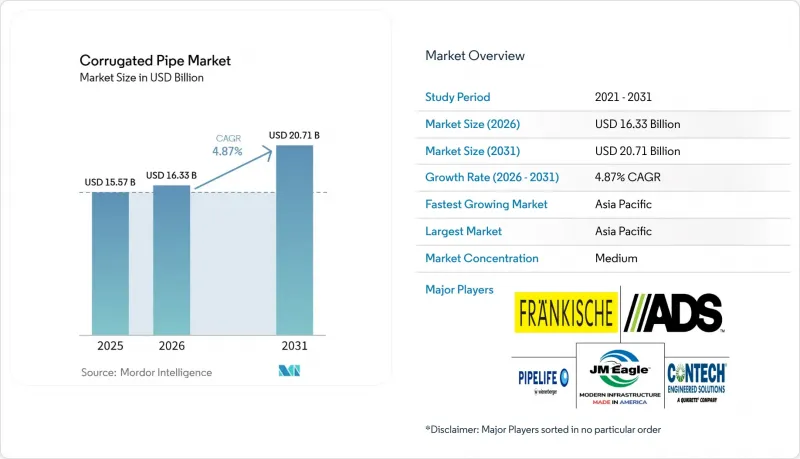
本報告按材料(高密度聚苯乙烯、其他)、壁體結構(雙層波紋管、其他)、直徑(300毫米及以下、其他)、應用領域(排水和污水處理、涵洞和道路、其他)、終端用戶行業(市政基礎設施、農業、其他)以及地區(亞太地區、北美地區、其他)進行細分。市場預測以美元計價。
全球波紋管市場趨勢及洞察
排水和道路網路基礎設施投資
公共工程預算越來越側重於現有設施的維護,而非新建高速公路。美國兩黨共同通過的《基礎建設法案》撥款1,100億美元用於道路和橋樑建設,涵洞更換是其中一項具體項目。來自麻薩諸塞州康科德的報告顯示,緊急涵洞維修的優先順序高於其他維修工作,這一趨勢在全國普遍存在。印度的國家基礎設施計畫優先投資於地方道路和城市排水系統,導致二、三線城市對小口徑管道的需求強勁。各機構擴大將涵洞工程與路面加舖工程結合,縮短競標週期,並優先選擇擁有本地倉庫、能夠實現準時交貨的供應商。這種方法最大限度地減少了交通中斷,並提高了對能夠維持本地庫存的製造商的採購偏好。
對輕便、耐用且經濟實惠的管道的需求
波紋管比鋼筋混凝土管輕60%至70%,顯著降低了起重機租賃和人事費用,尤其是在偏遠地區。 2025年,明尼蘇達州交通部確認,再生高密度聚乙烯(HDPE)管在環剛度和長期撓度方面與原生樹脂管性能相當。非開挖施工方法允許沿著現有道路鋪設管道,避免了都市區昂貴的道路維修工作,進一步提高了成本效益。 2025年的一項生命週期研究表明,考慮到運輸和安裝所需的能源,HDPE排水系統的隱含碳含量比混凝土低40%。雖然每米成本較高,但總安裝成本仍然較低,因此承包商越來越傾向於選擇塑膠管。隨著廢舊樹脂供應趨於穩定和價格溢價下降,預計這一趨勢將進一步擴大。
HDPE、PVC和金屬原物料價格波動
在管道合約中,價格通常提前6至12個月確定。乙烯和鋁價格的飆升可能迫使製造商重新談判合約或承擔損失。例如,2025年初鋁價上漲15%時,一些製造商退出了固定價格競標。雖然目前美國市政競標中已開始加入與指數掛鉤的價格條款,但採購經驗有限的小規模市政當局通常會推遲項目,直到價格穩定下來。此類價格波動會擾亂生產計劃,增加加班成本,並降低工廠運轉率。
細分市場分析
2025年,高密度聚苯乙烯(HDPE)佔波紋管市場收入的52.82%,這反映了其在強度、柔軟性和成本方面的最佳平衡。預計到2031年,鋁材將以4.93%的複合年成長率(CAGR)實現最高成長,主要得益於沿海城市和化工廠對耐腐蝕系統的需求。聚氯乙烯(PVC)在必須符合防火標準的重力式污水管道系統中繼續保持其地位,而聚丙烯則用於需要耐熱性的製程水管道。不銹鋼和纖維增強複合材料則滿足一些特殊應用的需求,在這些應用中,高成本從衛生和電磁滲透性角度來看是合理的。
2025年,明尼蘇達州交通部 (MnDOT) 證明,使用50%再生高密度聚乙烯 (HDPE) 製造的管道符合AASHTO M294環剛度標準,為大規模公共合約強制使用再生材料鋪平了道路。在金屬領域,ASTM B745標準的修訂規範了波紋型材和接頭形態,降低了製造成本,使鋁的價格更接近複合鋼。目前,材料的選擇正在分化。注重成本的市政採購者傾向於使用再生HDPE,而處於鹽鹼或酸性環境中的項目則願意為再生HDPE支付比鋁或不銹鋼高出30%的溢價。
到2025年,雙壁波紋管將佔據46.00%的市場。這主要歸功於其輕巧的設計和光滑的內徑,從而最大限度地減少了水的流失。鋼筋增強聚乙烯(PE)旋轉工法預計到2031年將以5.20%的複合年成長率成長。這是由於公路管理機構對埋設在地下深處的涵洞需要更高的承載能力。單壁管仍然廣泛應用於農業排水領域,在這些領域,經濟性比結構要求更為重要。穿孔管則常用於都市雨水徑流法規要求的滲濾池和屋頂綠化工程。
康泰克(Contech)的Spirolite內襯系統將鋼材融入PE螺旋型材中,實現了老舊混凝土污水管的非開挖式維修,並將工程成本降低高達60%。標準化的檢測方法,例如ISO 9969環剛度標準,使承包商能夠跨國採購相容材料。市場競爭格局呈現兩極化:鋼筋旋轉工法在高規格基礎設施項目中佔據主導地位,而雙層壁HDPE管道則在價格敏感的住宅和小規模商業市場中佔據主導地位。
區域分析
預計到2025年,亞太地區將佔全球銷售額的46.03%,並在2031年之前以5.62%的複合年成長率成長。中國的「海綿城市」計畫要求在30個試點城市建設透水基礎設施,加快採購多孔高密度聚乙烯(HDPE)儲存,以減輕污水處理設施的負荷並補充地下水。印度的「國家基礎設施管道計畫」正在資助農村道路和都市區排水系統建設,從而對中小口徑管道產生了穩定的需求。日本和韓國正在沿海地區用HDPE管道替換腐蝕的鋼涵,而東協正在擴大排水系統以減輕洪水風險,這些項目通常由推廣標準化熱塑性樹脂系統的多邊銀行提供資金。
北美緊隨其後,佔據了相當大的市場佔有率。美國兩黨共同通過的《基礎設施法案》撥款1,100億美元用於道路和橋樑建設,其中大部分用於涵洞更換。加拿大各省則專注於資產維護,以高密度聚乙烯(HDPE)管道替換劣化的鍍鋅鋼管。墨西哥近岸外包的蓬勃發展推動了新建工業園區的建設,這些園區需要大口徑排水系統。市場需求正從單純追求數量轉向工程服務,例如非維修和數位化檢測,這為現有企業創造了基於服務的競爭優勢。
儘管歐洲的銷售成長放緩,但在嚴格的監管方面仍處於領先地位。 PPWR 2025/40 強制要求使用再生材料,並對簽訂閉合迴路合約的供應商給予獎勵。德國和荷蘭正在實施回收廢棄管道的試點項目,而東歐國家則利用歐盟的團結基金,用高密度聚乙烯(HDPE)維修農村排水系統。南美洲的擴張主要集中在巴西和阿根廷,但外匯波動和關稅抑制了進口需求。在中東和非洲,由於沙烏地阿拉伯「2030願景」和南非的訂單計畫推動了基礎設施建設,耐腐蝕鋁管和不銹鋼管的訂單量雖然不大,但正在成長。
其他好處
- Excel格式的市場預測(ME)表
- 3個月的分析師支持
目錄
第1章:引言
- 研究假設和市場定義
- 調查範圍
第2章:調查方法
第3章執行摘要
第4章 市場狀況
- 市場概覽
- 市場促進因素
- 排水和道路網路基礎設施投資
- 對輕便、耐用且經濟實惠的管道的需求
- 加強雨水徑流管理條例
- 在脫碳專案中採用再生高密度聚乙烯
- 基於邊緣運算的物聯網漏水偵測系統
- 電動車超級工廠的化學廢棄物處理線需要耐腐蝕管路。
- 市場限制因素
- HDPE、PVC和金屬原物料價格波動
- 對塑膠廢棄物和廢棄產品的回收問題感到擔憂
- 消防安全標準限制在高層建築中使用塑膠導線管。
- 加氣混凝土管道的引入削弱了其成本優勢。
- 價值鏈分析
- 波特五力模型
第5章 市場規模與成長預測
- 材料
- 高密度聚苯乙烯(HDPE)
- 聚氯乙烯(PVC)
- 聚丙烯(PP)
- 防鏽的
- 鋁
- 其他
- 透過牆體結構
- 雙層瓦楞紙板
- 單層波形
- 鋼筋增強聚乙烯螺旋
- 穿孔和分切型
- 依直徑
- 300毫米或更小(小型)
- 300-600毫米(中等尺寸)
- 超過 600 毫米(大)
- 透過使用
- 排水/污水
- 雨水管理
- 電纜和光纖保護
- 涵洞和道路
- 工業和農業用途
- 按最終用戶行業分類
- 地方政府基礎設施
- 住宅/商業建築
- 農業
- 工業加工
- 其他
- 按地區
- 亞太地區
- 中國
- 日本
- 印度
- 韓國
- ASEAN
- 其他亞太國家
- 北美洲
- 美國
- 加拿大
- 墨西哥
- 歐洲
- 德國
- 英國
- 法國
- 義大利
- 西班牙
- 俄羅斯
- 其他歐洲國家
- 南美洲
- 巴西
- 阿根廷
- 其他南美國家
- 中東和非洲
- 沙烏地阿拉伯
- 南非
- 其他中東和非洲國家
- 亞太地區
第6章 競爭情勢
- 市場集中度
- 策略趨勢
- 市佔率和排名分析
- 公司簡介
- Advanced Drainage Systems
- Armtec
- Contech Engineered Solutions LLC
- DAYU Equipment Development Group
- FRANKISCHE Rohrwerke Gebr. Kirchner GmbH & Co. KG
- Jain Irrigation Systems Ltd.
- JM EAGLE, INC.
- Lane Enterprises, LLC.
- Pars Ethylene Kish Co.
- PIPELIFE INTERNATIONAL GmbH
- Prinsco, Inc.
- TDR Pipe
- Uponor North America
- Wavin NV
第7章 市場機會與未來展望
According to Mordor Intelligence, the corrugated pipe market size is projected to be USD 15.57 billion in 2025, USD 16.33 billion in 2026, and reach USD 20.71 billion by 2031, growing at a CAGR of 4.87% from 2026 to 2031.
This report is Segmented by Material (High-Density Polyethylene, and More), Wall Structure (Double-Wall Corrugated, and More), Diameter (Less Than 300 Mm, and More), Application (Drainage and Sewage, Culverts and Roads, and More), End-User Industry (Municipal Infrastructure, Agriculture, and More), and Geography (Asia-Pacific, North America, and More). The Market Forecasts are Provided in Terms of Value (USD).
Global Corrugated Pipe Market Trends and Insights
Infrastructure Investments in Drainage and Road Networks
Public-works budgets are increasingly focused on asset preservation rather than new highway construction. The U.S. Bipartisan Infrastructure Law allocates USD 110 billion to roads and bridges, with culvert replacement specifically included as a line item. Concord, Massachusetts, has reported that emergency culvert repairs are displacing other maintenance tasks, a trend observed nationwide. India's National Infrastructure Pipeline prioritizes investments in rural roads and urban drainage, resulting in steady demand for small-diameter pipes in tier-2 and tier-3 cities. Agencies are increasingly aligning culvert work with pavement overlays, reducing bid windows and favoring suppliers with regional warehouses for just-in-time delivery. This approach minimizes traffic disruptions and shifts procurement preferences toward manufacturers with local stock availability.
Demand for Lightweight, Durable and Cost-Effective Pipes
Corrugated pipes, which are 60% to 70% lighter than reinforced-concrete alternatives, significantly reduce crane rental and labor costs, particularly in remote areas. In 2025, the Minnesota Department of Transportation confirmed that recycled-HDPE pipes perform comparably to virgin-resin pipes in terms of ring stiffness and long-term deflection. Trenchless installation methods further enhance cost efficiency by allowing pipes to be installed through existing alignments, avoiding expensive street restoration in urban areas. A 2025 life-cycle study revealed that HDPE drainage systems have 40% lower embodied carbon compared to concrete when transportation and installation energy are considered. Contractors increasingly prefer plastic pipes despite higher per-meter costs, as total installed costs remain lower. This trend is expected to grow as post-consumer resin supply stabilizes and price premiums decrease.
Volatile HDPE, PVC and Metal Feedstock Prices
Pipe contracts often lock prices six to twelve months in advance. Price spikes in ethylene or aluminum can force fabricators to either renegotiate contracts or absorb losses. For instance, a 15% increase in aluminum prices in early 2025 led several producers to withdraw from fixed-price bids. Index-linked pricing clauses are now appearing in U.S. municipal tenders, but smaller towns with limited procurement expertise often delay projects until prices stabilize. This volatility disrupts production schedules, increases overtime costs, and reduces plant utilization rates.
Other drivers and restraints analyzed in the detailed report include:
- Stricter Storm-Water Runoff Compliance Mandates
- Recycled-HDPE Adoption in Decarbonization Programs
- Plastic-Waste and End-of-Life Recycling Concerns
For complete list of drivers and restraints, kindly check the Table Of Contents.
Segment Analysis
In 2025, high-density polyethylene (HDPE) captured 52.82% of the corrugated pipe market revenue, reflecting its optimal balance of strength, flexibility, and cost. Aluminum is anticipated to grow at the fastest rate, with a 4.93% CAGR through 2031, driven by the demand for corrosion-resistant systems in coastal cities and chemical plants. Polyvinyl chloride (PVC) continues to hold its position in gravity sewers that must adhere to flame-spread codes, while polypropylene is utilized in process-water lines requiring heat resistance. Stainless steel and fiber-reinforced composites cater to niche applications where hygiene or electromagnetic transparency justify higher costs.
MnDOT demonstrated in 2025 that pipes manufactured with 50% post-consumer HDPE met AASHTO M294 ring-stiffness criteria, opening up large public contracts requiring recycled content. On the metals side, updates to ASTM B745 standardized corrugation profiles and joint geometries, reducing fabrication costs and enabling aluminum to be priced closer to coated steel. Material selection now diverges: cost-sensitive municipal buyers prefer recycled-content HDPE, while projects in saline or acidic environments are willing to pay a 30% premium for aluminum or stainless steel.
Double-wall corrugated pipes accounted for 46.00% of the market share in 2025, attributed to their lightweight design and smooth inner bore, which minimizes hydraulic losses. Steel-reinforced polyethylene (PE) spiral pipes are projected to grow at a 5.20% CAGR through 2031, driven by the need for higher load ratings in culverts under deep fills by highway agencies. Single-wall pipes remain widely used in farm drainage applications, where affordability outweighs structural requirements. Perforated variants are commonly employed in infiltration basins and green roofs mandated by urban runoff regulations.
Contech's Spirolite liner system incorporates steel into a PE spiral profile, enabling trenchless rehabilitation of deteriorating concrete sewers and reducing project costs by up to 60%. International standards such as ISO 9969 for ring stiffness harmonize testing, allowing contractors to source materials interchangeably across borders. The competitive landscape is divided: steel-reinforced spirals secure high-profile infrastructure projects, while double-wall HDPE dominates price-sensitive residential and light-commercial markets.
Geography Analysis
Asia-Pacific held 46.03% of global revenue in 2025 and is forecast to grow at a 5.62% CAGR through 2031. China's sponge-city directive makes permeable infrastructure mandatory in 30 pilot metros and stimulates procurement of perforated HDPE basins that recharge aquifers rather than overload treatment plants. India's National Infrastructure Pipeline funds rural roads and urban drainage, channeling steady demand for small- and medium-diameter pipes. Japan and South Korea replace corroded steel culverts with HDPE in coastal prefectures, while ASEAN nations expand drainage to reduce flood risk, often financed by multilateral banks that favor standardized thermoplastic systems.
North America follows with a substantial value share. The U.S. Bipartisan Infrastructure Law provides USD 110 billion for roads and bridges, much allocated to culvert replacement. Canadian provinces focus on asset preservation, substituting HDPE for deteriorated galvanized steel. Mexico's near-shoring boom drives new industrial parks that need large-diameter drainage. Demand is evolving from pure volume toward engineered services such as trenchless rehab and digital inspection, giving incumbents a service-based moat.
Europe shows slower top-line growth yet leads in regulatory stringency. The PPWR 2025/40 compels recycled content, rewarding suppliers with closed-loop agreements. Germany and the Netherlands pilot take-back programs for end-of-life pipes, while Eastern European nations leverage EU cohesion funds to upgrade rural drainage with HDPE. South America's expansion centers on Brazil and Argentina, though currency swings and tariffs moderate import appetite. In the Middle-East and Africa, Saudi Arabia's Vision 2030 infrastructure push and South Africa's water-loss programs lift orders for corrosion-resistant aluminum and stainless-steel pipes despite smaller overall volumes.
- Advanced Drainage Systems
- Armtec
- Contech Engineered Solutions LLC
- DAYU Equipment Development Group
- FRANKISCHE Rohrwerke Gebr. Kirchner GmbH & Co. KG
- Jain Irrigation Systems Ltd.
- JM EAGLE, INC.
- Lane Enterprises, LLC.
- Pars Ethylene Kish Co.
- PIPELIFE INTERNATIONAL GmbH
- Prinsco, Inc.
- TDR Pipe
- Uponor North America
- Wavin N.V.
Additional Benefits:
- The market estimate (ME) sheet in Excel format
- 3 months of analyst support
TABLE OF CONTENTS
1 Introduction
- 1.1 Study Assumptions and Market Definition
- 1.2 Scope of the Study
2 Research Methodology
3 Executive Summary
4 Market Landscape
- 4.1 Market Overview
- 4.2 Market Drivers
- 4.2.1 Infrastructure investments in drainage and road networks
- 4.2.2 Demand for lightweight, durable and cost-effective pipes
- 4.2.3 Stricter storm-water runoff compliance mandates
- 4.2.4 Recycled-HDPE adoption in decarbonization programs
- 4.2.5 Edge-powered IoT leak-detection corridors
- 4.2.6 EV gigafactory chemical-waste channels need corrosion-resistant conduits
- 4.3 Market Restraints
- 4.3.1 Volatile HDPE, PVC and metal feedstock prices
- 4.3.2 Plastic-waste and end-of-life recycling concerns
- 4.3.3 Fire-safety codes limiting plastic conduit in high-rise builds
- 4.3.4 Emergence of cellular-concrete pipes eroding cost advantage
- 4.4 Value Chain Analysis
- 4.5 Porter's Five Forces
- 4.5.1 Bargaining Power of Suppliers
- 4.5.2 Bargaining Power of Buyers
- 4.5.3 Threat of New Entrants
- 4.5.4 Threat of Substitutes
- 4.5.5 Competitive Rivalry
5 Market Size and Growth Forecasts (Value)
- 5.1 By Material
- 5.1.1 High-Density Polyethylene (HDPE)
- 5.1.2 Polyvinyl Chloride (PVC)
- 5.1.3 Polypropylene (PP)
- 5.1.4 Stainless Steel
- 5.1.5 Aluminum
- 5.1.6 Other Materials
- 5.2 By Wall Structure
- 5.2.1 Double-Wall Corrugated
- 5.2.2 Single-Wall Corrugated
- 5.2.3 Steel-Reinforced PE Spiral
- 5.2.4 Perforated and Slotted Variants
- 5.3 By Diameter
- 5.3.1 Less than 300 mm (Small)
- 5.3.2 300-600 mm (Medium)
- 5.3.3 Greater than 600 mm (Large)
- 5.4 By Application
- 5.4.1 Drainage and Sewage
- 5.4.2 Storm-Water Management
- 5.4.3 Cable and Fiber-Optic Protection
- 5.4.4 Culverts and Roads
- 5.4.5 Industrial and Agricultural Uses
- 5.5 By End-user Industry
- 5.5.1 Municipal Infrastructure
- 5.5.2 Residential and Commercial Construction
- 5.5.3 Agriculture
- 5.5.4 Industrial Processing
- 5.5.5 Other End-user Industries
- 5.6 By Geography
- 5.6.1 Asia-Pacific
- 5.6.1.1 China
- 5.6.1.2 Japan
- 5.6.1.3 India
- 5.6.1.4 South Korea
- 5.6.1.5 ASEAN Countries
- 5.6.1.6 Rest of Asia-Pacific
- 5.6.2 North America
- 5.6.2.1 United States
- 5.6.2.2 Canada
- 5.6.2.3 Mexico
- 5.6.3 Europe
- 5.6.3.1 Germany
- 5.6.3.2 United Kingdom
- 5.6.3.3 France
- 5.6.3.4 Italy
- 5.6.3.5 Spain
- 5.6.3.6 Russia
- 5.6.3.7 Rest of Europe
- 5.6.4 South America
- 5.6.4.1 Brazil
- 5.6.4.2 Argentina
- 5.6.4.3 Rest of South America
- 5.6.5 Middle-East and Africa
- 5.6.5.1 Saudi Arabia
- 5.6.5.2 South Africa
- 5.6.5.3 Rest of Middle-East and Africa
- 5.6.1 Asia-Pacific
6 Competitive Landscape
- 6.1 Market Concentration
- 6.2 Strategic Moves
- 6.3 Market Share (%)/Ranking Analysis
- 6.4 Company Profiles (includes Global level Overview, Market level overview, Core Segments, Financials as available, Strategic Information, Products and Services, and Recent Developments)
- 6.4.1 Advanced Drainage Systems
- 6.4.2 Armtec
- 6.4.3 Contech Engineered Solutions LLC
- 6.4.4 DAYU Equipment Development Group
- 6.4.5 FRANKISCHE Rohrwerke Gebr. Kirchner GmbH & Co. KG
- 6.4.6 Jain Irrigation Systems Ltd.
- 6.4.7 JM EAGLE, INC.
- 6.4.8 Lane Enterprises, LLC.
- 6.4.9 Pars Ethylene Kish Co.
- 6.4.10 PIPELIFE INTERNATIONAL GmbH
- 6.4.11 Prinsco, Inc.
- 6.4.12 TDR Pipe
- 6.4.13 Uponor North America
- 6.4.14 Wavin N.V.
7 Market Opportunities and Future Outlook
- 7.1 White-space and Unmet-Need Assessment

 印度不鏽鋼管及管件:市場佔有率分析、產業趨勢與統計及成長預測(2026-2031)
 非金屬管道市場:依產品類型、應用、設備類型、最終用戶、國家及地區分類-全球產業分析、市場規模、市場佔有率及2026年至2033年預測。混凝土管材市場報告:趨勢、預測和競爭分析(至2035年)
 現場固化工法市場:依樹脂種類、纖維種類、固化方法、編織方式、塗層方法及地區分類。
 聚烯管道市場:全球市場預測(2026-2032)
 2026年全球鋁管市場報告2026年全球現場固化工法(CIPP)襯裡市場報告
 管架和管支撐器具市場規模、佔有率和成長分析:按結構類型、材質、承載能力、應用和地區分類-2026年至2033年產業預測
 2026-2030年全球PPR管材市場PPR管材生產線市場:依管徑範圍、壁厚等級、製造流程、連接類型、自動化程度、應用、最終用戶分類,全球預測,2026-2032年