


 |
市場調查報告書
商品編碼
2062215
車輛掃描器:市場佔有率分析、行業趨勢和統計數據、成長預測(2026-2031 年)Vehicle Scanner - Market Share Analysis, Industry Trends & Statistics, Growth Forecasts (2026 - 2031) |
||||||

※ 本網頁內容可能與最新版本有所差異。詳細情況請與我們聯繫。
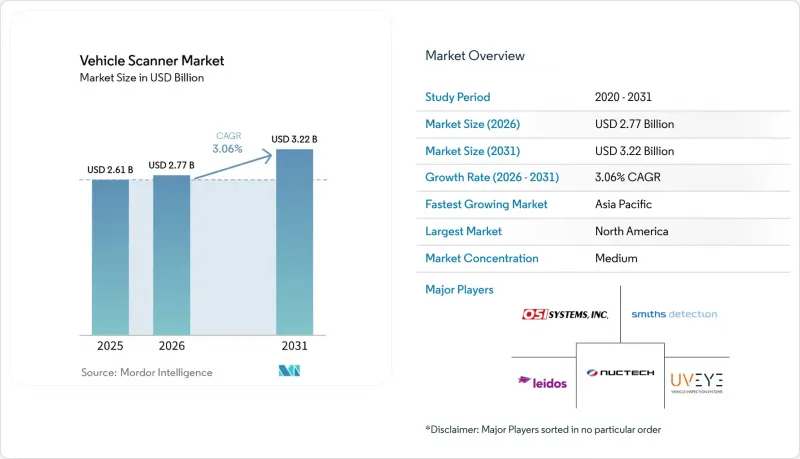
據 Mordor Intelligence 稱,2025 年車輛掃描儀市值為 26.1 億美元,預計到 2031 年將達到 32.2 億美元,而 2026 年為 27.7 億美元,預測期(2026-2031 年)的複合年成長率為 3.06%。
本報告按掃描器類型(固定式和攜帶式)、結構類型(例如免下車掃描器)、技術(例如X光反散射技術)、組件(例如攝影機)、應用領域(例如政府和關鍵基礎設施保護、商業和工業設施等)以及地區進行細分。市場預測以美元計價。
全球車輛掃描器市場趨勢與洞察
跨境貿易量增加及強制性貨物安全措施
貨櫃貨物的快速成長已超過人工檢查能力,迫使海關當局部署高通量、非侵入式系統。美國國會已設定目標,力爭在五年內實現進口貨櫃100%掃描;歐盟也於2025年運作了針對陸上貨物的第二代進口控制系統(ICS2)。智利投資300億智利披索(約3,100萬美元)購置移動式X光安檢車,並在2025年1月至9月期間查獲了680萬仿冒品。印度2026-2027財政年度的聯邦預算中累計了在所有主要港口安裝人工智慧安檢閘門的資金。這些指南正從一次性資本採購轉向多年更新,並傾向於採用模組化平台,以便在不更換硬體的情況下進行軟體升級。
美國和歐盟的指令要求港口進行100%掃描。
監理期限的縮短加快了採購步伐。美國海關與邊防安全(CBP) 目前已投入使用 405 套非侵入式檢查設備,據報道,為滿足 2027 年前的強制性要求,CBP 還訂購了 38 套免下車檢查系統。美國國土安全部正在聖伊西德羅進行低能耗門戶的示範測試,該門戶可將輻射暴露量降低一半。在歐洲,ICS2 正在敦促各港口將車牌識別和 X光成像技術整合到其海關風險評估系統中,而阿根廷已在高海拔邊境檢查站部署了拖車掃描儀,用於對運往歐盟市場的貨物進行預清關。
累積輻射暴露相關的健康與隱私問題
民間團體呼籲監管機構收緊輻射計量限制。美國法規將車輛掃描的輻射劑量限制在每次掃描0.1毫倫琴以內,俄亥俄州法律也遵循此限制。英國國防部的一項研究發現,單次反向散射掃描的輻射劑量為0.05微西弗,但人們開始擔憂工作人員在單一輪班中掃描數百輛車所造成的累積輻射劑量。美國國土安全部對超低劑量掃描門戶的試點運作表明,政策正在轉向非電離輻射技術,並加速了毫米波技術的應用。
細分市場分析
到2025年,固定式龍門架系統將佔據車輛掃描器市場65.71%的佔有率,這反映了其在高流量港口和邊境檢查站數十年的部署經驗。這些系統整合了頂部X光設備、輻射門和自動化輸送機,每小時處理能力為40至60台。可攜式設備的每小時處理能力較低,但其優勢在於海關當局可以在尖峰時段或情報驅動的高優先級監控區域靈活重新部署設備。智利已將一台Nuctech MT1213 DE設備部署到卡德納爾·薩莫雷邊境檢查站,由於惡劣的天氣條件和波動的交通流量,在該檢查站安裝永久性基礎設施並不現實。
移動式車輛掃描儀市場正以3.78%的複合年成長率快速成長,這主要得益於可安裝在鐵路車輛、卡車或拖車上的移動式設計。美國海關近期訂購了100套移動式安檢系統,旨在應對不斷變化的安全威脅,而無需進行新的土木工程。雖然固定式掃描儀在主要港口仍然必不可少,但預算有限的機構目前正透過在主要樞紐使用龍門式掃描儀,在次要邊境檢查站使用拖車式掃描儀,在不增加相應資本支出的情況下最大限度地擴大覆蓋範圍。
2025年,能夠一次掃描車輛前後全貌的免下車通道將佔總銷售額的52.54%。這些通道仍然是檢測武器、毒品和未申報貨物的監管基礎。由關鍵基礎設施使用者驅動的底盤監控系統,與門禁控制柱結合使用,預計將以3.55%的複合年成長率成長。越南的智慧閘門結合了底盤監控系統(UVSS)、車牌辨識和生物識別技術,可在不到一分鐘的時間內完成卡車通行檢查。
混合架構正在模糊不同類別之間的界線。供應商正在將UVSS陣列整合到X光偵測通道中,使操作員能夠在一次掃描中查看駕駛室、貨艙和底盤的複合影像。在目前的車輛掃描儀市場中,能夠將所有影像層整合到統一分析儀表板中的供應商備受青睞,這有助於減輕操作員的工作量並增強審計追蹤。這種整合在企業園區中尤其重要,因為在這些園區中,記錄走私貨和意外損壞至關重要。
區域分析
北美地區在2025年貢獻了39.26%的收入,這主要得益於其成熟的部署基礎和大規模契約,其中包括一份價值2億美元的移動式乘用車掃描儀訂單。美國國土安全部(DHS)資助的聖伊西德羅低能耗試點計畫展示了該地區向低劑量門戶的轉型。加拿大和墨西哥正在協調相關協議,以支援統一的美墨加協定(USMCA)走廊,重點是建立一個可互通的軟體層,用於即時交換貨物資料。
亞太地區預計將以3.63%的複合年成長率成長,是所有地區中成長最快的。印度2026-2027財政年度預算要求所有主要港口採用人工智慧掃描技術。越南已引入配備自動通道和無人值守掃描系統(UVSS)的智慧閘門,以促進與中國的跨境交通。中國、日本和韓國正在升級雙能閘門,以整合車牌辨識和駕駛臉部辨識。同時,澳洲正在更新其系統,以符合生物安全標準。
歐洲的市佔率得益於進口管制系統2(ICS2),該系統將於2025年4月起應用於公路貨運。倫敦希斯洛機場已安裝史密斯探測公司的CT掃描系統,作為其耗資10億英鎊的現代化計畫的一部分。東歐候選國正在加快掃描儀的採購,以推進入盟談判。在南美洲,智利和阿根廷主導,使用移動卡車來守護那些土木工程成本高的山口。中東和非洲的情況則是喜憂參半。沙烏地阿拉伯和阿拉伯聯合大公國正在投資大規模升級改造,而其他一些地區則由於預算限制,難以進入農村地區。
其他好處:
- Excel格式的市場預測(ME)表
- 3個月的分析師支持
目錄
第1章:引言
- 研究假設和市場定義
- 調查範圍
第2章:調查方法
第3章執行摘要
第4章 市場狀況
- 市場概覽
- 市場促進因素
- 跨境貿易量增加以及有關貨物安全的法規
- 美國和歐盟的指令要求港口進行100%掃描。
- 人工智慧驅動的異常檢測可以減少誤報和人事費用。
- 中東和非洲以及亞太地區關鍵基礎設施安全支出激增。
- 保險公司和貨運租賃公司正在引入免下車掃描儀,以實現產物保險索賠處理的自動化。
- 歐盟進口控制系統 2 (ICS2) 的分階段實施正在刺激對綜合無損檢測的投資。
- 市場限制因素
- 累積輻射暴露相關的健康與隱私問題
- 免下車通道的高昂成本阻礙了小規模機構採用這種通道。
- 各地區影像診斷及檢查標準缺乏統一性
- 合格現場技術人員的短缺限制了我們向區域市場擴張的能力以及我們的售後服務體系。
- 產業價值鏈分析
- 監理情勢
- 技術展望
- 波特五力分析
- 宏觀經濟因素對市場的影響
第5章 市場規模與成長預測
- 按掃描器類型
- 固定式/文具式
- 可攜式/移動式
- 依結構類型
- 免下車掃描儀
- 底盤監控系統(UVSS)
- 透過技術
- X光反向散射
- 雙能量透射X光
- 毫米波成像
- 兆赫成像
- 紅外線和光學線掃描
- 聲學型/超音波型
- 按組件
- 相機
- 照明單元
- 障礙
- 軟體
- 服務
- 其他規則
- 透過使用
- 保護政府和關鍵基礎設施
- 商業和工業設施
- 交通物流樞紐
- 汽車經銷店和車隊維護
- 執法和邊境管制
- 按地區
- 北美洲
- 美國
- 加拿大
- 墨西哥
- 南美洲
- 巴西
- 阿根廷
- 其他南美國家
- 歐洲
- 德國
- 英國
- 法國
- 義大利
- 西班牙
- 其他歐洲國家
- 亞太地區
- 中國
- 日本
- 印度
- 韓國
- ASEAN
- 其他亞太國家
- 中東和非洲
- 中東
- 沙烏地阿拉伯
- 阿拉伯聯合大公國
- 土耳其
- 其他中東國家
- 非洲
- 南非
- 奈及利亞
- 其他非洲國家
- 中東
- 北美洲
第6章 競爭情勢
- 市場集中度
- 策略趨勢
- 市佔率分析
- 公司簡介
- OSI Systems Inc.(Rapiscan Systems)
- Smiths Detection Inc.
- Leidos Holdings Inc.(VACIS)
- Nuctech Company Limited
- UVeye Ltd.
- SecureOne International BV
- Astrophysics Inc.
- Advanced Detection Technology LLC
- Liberty Defense Holdings Ltd.
- VOTI Detection Inc.
- Linev Systems LLC
- Unival Group GmbH
- SecureTech LLC
- Tescon Sicherheitssysteme AG
- Omnitec Security Systems LLC
- International Road Dynamics Inc.
- Vehant Technologies Pvt Ltd.
- SCANLAB GmbH
- Honeywell International Inc.(Intelligrated Scanner Division)
第7章 市場機會與未來展望
According to Mordor Intelligence, the vehicle scanner market size was valued at USD 2.61 billion in 2025 and is estimated to grow from USD 2.77 billion in 2026 to reach USD 3.22 billion by 2031, at a CAGR of 3.06% during the forecast period (2026-2031).
This report is Segmented by Scanner Type (Fixed or Static, and Portable or Mobile), Structure Type (Drive-Through Scanners, and More), Technology (X-Ray Backscatter, and More), Component (Camera, and More), Application Vertical (Government and Critical Infrastructure Protection, Commercial and Industrial Facilities, and More), and Geography. The Market Forecasts are Provided in Terms of Value (USD).
Global Vehicle Scanner Market Trends and Insights
Rising Cross-Border Trade Volumes And Cargo Security Mandates
Rapid growth in containerized freight has outpaced the capacity of manual inspection, prompting customs agencies to deploy high-throughput, non-intrusive systems. The U.S. Congress set a five-year window for 100% scanning of inbound containers, while the European Union activated the Import Control System 2 for road freight in 2025. Chile invested CLP 30 billion (USD 31 million) in mobile X-ray trucks, seizing 6.8 million counterfeit goods during January-September 2025. India's 2026-27 Union Budget allocates funding for AI-powered portals at every major port. Such directives are converting episodic capital purchases into multi-year refresh programs that favor modular platforms capable of software upgrades without hardware replacement.
Mandatory 100% Scanning Directives At U.S. And EU Ports
Compressed regulatory timelines are accelerating procurement. U.S. Customs and Border Protection already operates 405 non-intrusive inspection units and has ordered 38 additional drive-through systems to meet the mandate by 2027, according to. The Department of Homeland Security is piloting low-energy portals that cut radiation dose in half at San Ysidro. In Europe, ICS2 is pushing ports to integrate license-plate recognition and X-ray images with customs risk engines, while Argentina deployed trailer-type scanners at high-altitude crossings to pre-clear cargo destined for EU markets.
Health And Privacy Concerns Over Cumulative Radiation Exposure
Advocacy groups are pressuring regulators to tighten dose limits. U.S. rules cap vehicle-scan exposure at 0.1 milliroentgen per pass, and Ohio's state code mirrors that ceiling. A U.K. defense study shows a single backscatter scan delivers 0.05 microsieverts, yet staff scanning hundreds of vehicles per shift raises collective-dose objections. DHS pilots of ultra-low-dose portals signal a policy shift toward non-ionizing options, boosting millimeter-wave adoption.
Other drivers and restraints analyzed in the detailed report include:
- AI-Enabled Anomaly Detection Reduces False Positives And Staffing Costs
- Surge In Security Spending For Critical Infrastructure In Middle East And Africa And Asia-Pacific
- High Capex For Drive-Through Portals Deters Small Facilities
For complete list of drivers and restraints, kindly check the Table Of Contents.
Segment Analysis
Fixed gantries commanded 65.71% of the 2025 vehicle scanner market share, reflecting decades of deployment at high-volume ports and border crossings. These installations integrate overhead X-ray, radiation portals, and automated conveyors, supporting throughputs of 40-60 vehicles per hour. Portable units, although lower in hourly capacity, give customs agencies the freedom to reposition assets at seasonal trade peaks or intelligence-led hotspots. Chile moved a Nuctech MT1213 DE unit to the Cardenal Samore crossing, where extreme weather and fluctuating traffic volumes make permanent infrastructure impractical.
The vehicle scanner market for mobile systems is advancing at a 3.78% CAGR, driven by relocatable designs that can ride on railcars, trucks, or trailers. U.S. Customs recently ordered 100 relocatable portals to satisfy evolving threat profiles without new civil works. While fixed scanners remain indispensable for anchor ports, budget-constrained agencies now blend both categories, using gantries at main hubs and trailers at secondary crossings to maximize coverage without proportional capital outlay.
Drive-through portals accounted for 52.54% of 2025 revenue due to their one-pass, head-to-tail imaging capability. They remain a regulatory cornerstone for the detection of weapons, narcotics, and undeclared cargo. Under-vehicle surveillance systems are projected to grow at a 3.55% CAGR, driven by critical infrastructure users who pair them with access-control bollards. Vietnam's smart gates combine UVSS, license plate recognition, and biometric checks to clear trucks in less than 1 minute.
Hybrid architectures are blurring category lines as vendors embed UVSS arrays inside X-ray lanes, giving operators a composite view of cabin, cargo hold, and chassis in a single transit. The vehicle scanner market now rewards suppliers that can feed all image layers into unified analytic dashboards, easing operator workload and tightening audit trails. This convergence is particularly valuable at corporate campuses concerned with both contraband and accidental damage documentation.
Geography Analysis
North America retained 39.26% of 2025 revenue thanks to a mature installed base and sizable follow-on contracts, including a USD 200 million order for relocatable passenger-vehicle scanners. A DHS-funded low-energy pilot at San Ysidro underlines the region's pivot toward lower-dose portals. Canada and Mexico are harmonizing protocols to support unified USMCA corridors, favoring interoperable software layers that exchange manifest data in real time.
Asia-Pacific is projected to grow at a 3.63% CAGR, the quickest among all regions. India's 2026-27 budget mandates AI-based scanning at every major port. Vietnam opened smart gates with autonomous lanes and UVSS to streamline cross-border traffic with China. China, Japan, and South Korea are upgrading dual-energy portals to integrate license-plate and driver-face recognition, while Australia refreshes systems to meet biosecurity benchmarks.
Europe's share is anchored by the Import Control System 2, effective for road freight since April 2025. London Heathrow installed Smiths Detection CT systems as part of a GBP 1 billion modernization.Eastern European candidate states are front-loading scanner procurements to expedite accession talks. South America is led by Chile and Argentina, which rely on mobile trucks to secure mountain passes where civil works are cost-prohibitive. The Middle East and Africa remain mixed: Saudi Arabia and the United Arab Emirates fund large-scale upgrades, while budget gaps limit rural penetration elsewhere.
- OSI Systems Inc. (Rapiscan Systems)
- Smiths Detection Inc.
- Leidos Holdings Inc. (VACIS)
- Nuctech Company Limited
- UVeye Ltd.
- SecureOne International BV
- Astrophysics Inc.
- Advanced Detection Technology LLC
- Liberty Defense Holdings Ltd.
- VOTI Detection Inc.
- Linev Systems LLC
- Unival Group GmbH
- SecureTech LLC
- Tescon Sicherheitssysteme AG
- Omnitec Security Systems LLC
- International Road Dynamics Inc.
- Vehant Technologies Pvt Ltd.
- SCANLAB GmbH
- Honeywell International Inc. (Intelligrated Scanner Division)
Additional Benefits:
- The market estimate (ME) sheet in Excel format
- 3 months of analyst support
TABLE OF CONTENTS
1 INTRODUCTION
- 1.1 Study Assumptions and Market Definition
- 1.2 Scope of the Study
2 RESEARCH METHODOLOGY
3 EXECUTIVE SUMMARY
4 MARKET LANDSCAPE
- 4.1 Market Overview
- 4.2 Market Drivers
- 4.2.1 Rising Cross-Border Trade Volumes and Cargo Security Mandates
- 4.2.2 Mandatory 100% Scanning Directives at U.S. and EU Ports
- 4.2.3 AI-Enabled Anomaly Detection Reduces False Positives and Staffing Costs
- 4.2.4 Surge in Security Spending for Critical Infrastructure in MEA and Asia-Pacific
- 4.2.5 Insurance and Fleet Leasing Firms Adopting Drive-Through Scanners for Automated Damage Claims Processing
- 4.2.6 EU Import Control System 2 (ICS2) Phase-In Driving Integrated Non-Intrusive Inspection Investments
- 4.3 Market Restraints
- 4.3.1 Health and Privacy Concerns Over Cumulative Radiation Exposure
- 4.3.2 High Capex for Drive-Through Portals Deters Small Facilities
- 4.3.3 Absence of Unified Imaging and Test Standards Across Regions
- 4.3.4 Scarcity of Certified Field Technicians Limits Rural Deployment and After-Sales Support
- 4.4 Industry Value-Chain Analysis
- 4.5 Regulatory Landscape
- 4.6 Technological Outlook
- 4.7 Porter's Five Forces Analysis
- 4.7.1 Bargaining Power of Suppliers
- 4.7.2 Bargaining Power of Buyers
- 4.7.3 Threat of New Entrants
- 4.7.4 Threat of Substitutes
- 4.7.5 Intensity of Competitive Rivalry
- 4.8 Impact of Macroeconomic Factors on the Market
5 MARKET SIZE AND GROWTH FORECASTS (VALUE)
- 5.1 By Scanner Type
- 5.1.1 Fixed / Static
- 5.1.2 Portable / Mobile
- 5.2 By Structure Type
- 5.2.1 Drive-Through Scanners
- 5.2.2 Under-Vehicle Surveillance Systems (UVSS)
- 5.3 By Technology
- 5.3.1 X-Ray Backscatter
- 5.3.2 Dual-Energy Transmission X-Ray
- 5.3.3 Millimeter-Wave Imaging
- 5.3.4 Terahertz Imaging
- 5.3.5 Infrared and Optical Line-Scan
- 5.3.6 Acoustic / Ultrasonic
- 5.4 By Component
- 5.4.1 Camera
- 5.4.2 Lighting Unit
- 5.4.3 Barriers
- 5.4.4 Software
- 5.4.5 Services
- 5.4.6 Other Components
- 5.5 By Application Vertical
- 5.5.1 Government and Critical Infrastructure Protection
- 5.5.2 Commercial and Industrial Facilities
- 5.5.3 Transportation and Logistics Hubs
- 5.5.4 Automotive Dealership and Fleet Maintenance
- 5.5.5 Law Enforcement and Border Control
- 5.6 By Geography
- 5.6.1 North America
- 5.6.1.1 United States
- 5.6.1.2 Canada
- 5.6.1.3 Mexico
- 5.6.2 South America
- 5.6.2.1 Brazil
- 5.6.2.2 Argentina
- 5.6.2.3 Rest of South America
- 5.6.3 Europe
- 5.6.3.1 Germany
- 5.6.3.2 United Kingdom
- 5.6.3.3 France
- 5.6.3.4 Italy
- 5.6.3.5 Spain
- 5.6.3.6 Rest of Europe
- 5.6.4 Asia-Pacific
- 5.6.4.1 China
- 5.6.4.2 Japan
- 5.6.4.3 India
- 5.6.4.4 South Korea
- 5.6.4.5 ASEAN
- 5.6.4.6 Rest of Asia-Pacific
- 5.6.5 Middle East and Africa
- 5.6.5.1 Middle East
- 5.6.5.1.1 Saudi Arabia
- 5.6.5.1.2 United Arab Emirates
- 5.6.5.1.3 Turkey
- 5.6.5.1.4 Rest of Middle East
- 5.6.5.2 Africa
- 5.6.5.2.1 South Africa
- 5.6.5.2.2 Nigeria
- 5.6.5.2.3 Rest of Africa
- 5.6.5.1 Middle East
- 5.6.1 North America
6 COMPETITIVE LANDSCAPE
- 6.1 Market Concentration
- 6.2 Strategic Moves
- 6.3 Market Share Analysis
- 6.4 Company Profiles (includes Global Level Overview, Market Level Overview, Core Segments, Financials as available, Strategic Information, Market Rank/Share, Products and Services, Recent Developments)
- 6.4.1 OSI Systems Inc. (Rapiscan Systems)
- 6.4.2 Smiths Detection Inc.
- 6.4.3 Leidos Holdings Inc. (VACIS)
- 6.4.4 Nuctech Company Limited
- 6.4.5 UVeye Ltd.
- 6.4.6 SecureOne International BV
- 6.4.7 Astrophysics Inc.
- 6.4.8 Advanced Detection Technology LLC
- 6.4.9 Liberty Defense Holdings Ltd.
- 6.4.10 VOTI Detection Inc.
- 6.4.11 Linev Systems LLC
- 6.4.12 Unival Group GmbH
- 6.4.13 SecureTech LLC
- 6.4.14 Tescon Sicherheitssysteme AG
- 6.4.15 Omnitec Security Systems LLC
- 6.4.16 International Road Dynamics Inc.
- 6.4.17 Vehant Technologies Pvt Ltd.
- 6.4.18 SCANLAB GmbH
- 6.4.19 Honeywell International Inc. (Intelligrated Scanner Division)
7 MARKET OPPORTUNITIES AND FUTURE OUTLOOK
- 7.1 White-Space and Unmet-Need Assessment

 車輛掃描器市場-2026-2032年全球市場預測
 2026-2034年全球車輛X光掃描儀市場規模、佔有率、趨勢和成長分析報告
 美國汽車X光掃描儀市場規模、佔有率和趨勢分析報告:按組件、類型、應用和細分市場分類(2026-2033年)X光車載掃描器市場規模、佔有率和趨勢分析報告:按組件、類型、應用、地區和細分市場分類(2026-2033年)
 2026年全球車輛掃描器市場報告
 車輛掃描器市場機會、成長要素、產業趨勢分析及2026-2035年預測。
 車輛掃描器市場-全球產業規模、佔有率、趨勢、機會和預測,按掃描器、結構、應用、技術、地區和競爭細分,2020-2030 年全球車輛掃描器市場:市場規模(依掃描器類型、依結構類型、按應用、按組件、按地區)、未來預測
 車輛掃描器市場規模、佔有率及成長分析(按掃描器類型、結構類型、組件、應用、技術和地區)- 2025-2032 年產業預測