


 |
市場調查報告書
商品編碼
2062171
語音使用者介面:市場佔有率分析、產業趨勢與統計、成長預測(2026-2031)Voice User Interface - Market Share Analysis, Industry Trends & Statistics, Growth Forecasts (2026 - 2031) |
||||||

※ 本網頁內容可能與最新版本有所差異。詳細情況請與我們聯繫。
據 Mordor Intelligence 稱,2025 年語音使用者介面 (VUI) 市場價值為 154.8 億美元,預計到 2031 年將達到 520.8 億美元,而 2026 年為 189.5 億美元,預測期(2026-2031 年)的複合年成長率為 22.41%。
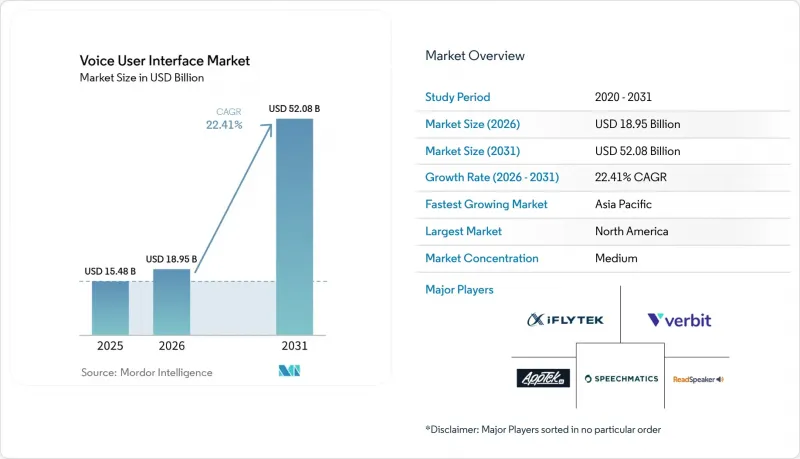
本報告按元件(軟體、硬體、服務)、部署模式(本地部署、雲端部署)、應用領域(消費性電子、汽車、醫療保健、銀行、金融服務和保險、零售和電子商務、教育及其他)、技術堆疊(邊緣人工智慧處理、雲端處理、混合處理)和地區進行細分。市場預測以美元計價。
全球語音使用者介面市場趨勢與洞察
透過深度學習提高語音辨識準確率
預計2025年, 變壓器架構可將生產環境中的字詞錯誤率降低至5.42%,與2023年的循環神經網路相比,提升40%。情境偏置技術使語音介面無需特殊培訓即可分析法律、醫療和金融術語,從而擴展了其在交易大廳和手術室等高風險環境中的應用。學術界對REB-former的研究減少了冗餘注意力頭,將邊緣設備延遲降低至180毫秒,並實現了穿戴式裝置上的即時互動。克服這些障礙使得企業能夠將語音輸入從輔助控制方式提升為主要控制方式,加速了其在以往依賴鍵盤和觸控螢幕的各個行業的應用。
支援離線語音處理的設備端邊緣AI晶片
這款專用神經處理單元的運算速度高達 10 TOPS,功耗卻低於 500 毫瓦,足以在智慧型手機和車載主機中部署十億參數模型。 [3] 例如,梅賽德斯-奔馳在 2026 年 E-Class 轎車中,透過將本地喚醒詞檢測與性能適中的轉錄模型相結合,實現了低於 200 毫秒的執行時間。離線推理將性能與網路品質解耦,這在通訊條件不穩定的汽車和工業環境中至關重要。此外,大規模生產還能帶來經濟效益。 ChipIntelli 計劃在 2025 年交付 1500 萬枚單價 2.80 美元的晶片,從而為電池供電的感測器、門鎖和恆溫器等設備添加可靠的語音控制功能。
對隱私和資料安全的持續擔憂
生物辨識語音指紋受《生物識別一般資料保護規則》(GDPR)敏感資料條款的約束。此外,68%的受訪消費者仍不確定他們的語音助理如何儲存和共用錄製的資料。美國聯邦貿易委員會(FTC)與亞馬遜就兒童數據問題達成的和解加劇了這種疑慮,導致家長購買意願下降了12個百分點。目前,各公司正在採用設備內處理和資料不保留策略。 Nuance公司的「Dragon Medical One」僅保留匿名文本,為此,其項目預算增加了約120萬美元,以確保符合《健康保險互通性與課責法案》(HIPAA)的要求。在建立透明的管治框架之前,隱私問題可能會阻礙醫療保健、銀行和教育產業的普及應用。
細分市場分析
隨著企業將部署範圍擴展到承包解決方案之外,服務已從輔助角色轉變為成長的驅動力。雖然預計到 2025 年軟體市佔率將保持在 57.16%,但服務預計將以 23.18% 的年均成長率成長至 2031 年,超過軟體和硬體的成長速度。例如,2025 年 Nuance DAX Copilot 醫院部署項目,需要 180大規模的整合工作,針對 40 位醫生的詞彙量進行語音口音調整,並編制合規文檔,每個站點可產生 34 萬美元的專業服務收入。因此,在自然語言不斷發展、持續需要再培訓的推動下,服務領域的語音使用者介面市場規模的成長速度超過了核心授權市場。
硬體在價值鏈中仍然至關重要,它將波束成形麥克風、數位訊號處理器和神經處理單元整合到經濟高效的晶片上。 Anker 的 Thus 晶片結合了六麥克風陣列和 1 TOPS 的推理能力,可提高遠距離語音採集質量,出貨量達數百萬顆,售價 4.20 美元。持續學習合約有助於提高用戶留存率。除非每季更新資料集,否則準確率每年會下降 4-7 個百分點,這使其成為專注於語音領域的顧問公司的持續收入來源。程式碼、晶片和服務之間的這種相互依存關係,即使在客製化加速發展的情況下,也能維持組件配置的平衡。
預計到2025年,雲端部署將佔總營收的63.22%,這主要得益於GPU池化技術的推動。 GPU池化技術已將推理成本降低至每分鐘語音0.005美元至0.02美元,顯著降低了本地部署解決方案的經濟可行性。 OpenAI的GPT-4o語音模式在每百萬輸入令牌5美元的成本下,延遲僅為232至320毫秒。這些指標表明,對於複雜的推理和多模態任務,語音使用者介面市場仍然以雲端為主導。然而,混合路由處理(在本地觸發詞觸發器,僅發送上下文相關的查詢)正逐漸成為標準,可在設備端處理70%至80%的標準語音,從而降低頻寬需求。
儘管本地部署的規模從絕對值來看仍然較小,但由於中國和印度的數據主權法律禁止生物識別數據的出口,其複合年成長率 (CAGR) 高達 18.90%。科大訊飛的醫院部署完全保留在本地資料中心內,以滿足個人資料保護法律的要求,這使得每個使用者的許可數量增加了 40%,同時確保了合規性。跨國供應商現在需要維護兩條產品線——公共雲端和主權本地部署——這增加了工程的複雜性,但也擴大了他們在語音使用者介面市場的佔有率,因為語音使用者介面部署不會受到法律障礙的影響。
區域分析
預計北美將引領市場,到2025年將佔全球銷售額的38.23%。北美擁有成熟的智慧音箱市場,銷售量已達3億台,加上美國聯邦貿易委員會(FTC)的早期監管舉措,為企業提供了清晰的法律框架,促進了醫療保健領域的積極應用。由於目前消費者滲透率穩定在62%,北美的預期複合年成長率(CAGR)為20.80%,低於全球平均。美國佔該地區收入的78%,其生態系統轉換成本高昂,用戶難以放棄Alexa或Siri,從而鞏固了其市場地位。加拿大和墨西哥分別佔14%和8%,兩國正利用近期在語碼轉換準確性方面的提升,加速雙語部署。
亞太地區以24.17%的複合年成長率領先。中國在該地區佔據了大部分收入,這主要得益於百度旗下DuerOS的強勁表現,該平台每月在電動車和智慧家居領域處理83億查詢。印度的市佔率小規模,但其成長主要得益於區域城市的滲透率以及吸引新用戶的在地化語音模式。日本和韓國正致力於設備內處理,以符合2025年隱私權法修正案的要求。同時,東協市場因方言多樣性而面臨挑戰,雖然對小規模參與企業構成障礙,但也為區域領導者創造了成長空間。
歐洲佔全球整體收入的21.40%。其預計22.60%的複合年成長率主要得益於汽車行業法規強制要求加入語音功能以減少駕駛過程中的拖車事故。然而,歐盟人工智慧法規定的二級資訊揭露要求使合規成本增加了8%至12%,迫使規模較小的供應商退出市場或尋求合作夥伴。南美洲雖然僅佔全球整體收入的6.20%,但其複合年成長率高達23.40%,主要得益於巴西葡萄牙語語音銀行業務的發展。在中東和非洲(5.80%),阿拉伯語語音服務的早期應用正在推進,但顯著的方言差異和公共語料庫的缺乏導致準確率存在較大差距,阻礙了除政府和通訊業者之外的更廣泛應用。
其他好處
- Excel格式的市場預測(ME)表
- 3個月的分析師支持
目錄
第1章:引言
- 研究假設和市場定義
- 調查範圍
第2章:調查方法
第3章執行摘要
第4章 市場狀況
- 市場概覽
- 市場促進因素
- 透過深度學習提高語音辨識準確率
- 支援離線語音處理的設備端邊緣AI晶片
- 智慧音箱和語音優先消費性設備的普及
- 汽車資訊娛樂系統中VUI整合的進展
- 支援上下文豐富的語音對話的多模態平台模型。
- 開放原始碼語音語料庫降低了小眾語言市場的進入門檻。
- 市場限制因素
- 對隱私和資料安全的持續擔憂
- 由於聲音和口音差異,識別準確率降低。
- OEM設備中專有喚醒詞IP的專利費不斷上漲。
- 歐盟人工智慧法第二階段的透明度要求正在增加合規成本。
- 產業價值與價值鏈分析
- 監理情勢
- 技術展望
- 波特五力分析
- 宏觀經濟因素對市場的影響
第5章 市場規模與成長預測
- 按組件
- 軟體
- 硬體
- 服務
- 按實現類型
- 現場
- 雲
- 透過使用
- 家用電器
- 車
- 衛生保健
- BFSI
- 零售與電子商務
- 教育
- 其他
- 依技術堆疊
- 邊緣人工智慧處理
- 基於雲端的處理
- 混合處理
- 按地區
- 北美洲
- 美國
- 加拿大
- 墨西哥
- 南美洲
- 巴西
- 阿根廷
- 其他南美國家
- 歐洲
- 德國
- 英國
- 法國
- 義大利
- 西班牙
- 其他歐洲國家
- 亞太地區
- 中國
- 日本
- 印度
- 韓國
- ASEAN
- 其他亞太國家
- 中東和非洲
- 中東
- 沙烏地阿拉伯
- 阿拉伯聯合大公國
- 土耳其
- 其他中東國家
- 非洲
- 南非
- 奈及利亞
- 其他非洲地區
- 中東
- 北美洲
第6章 競爭情勢
- 市場集中度
- 策略趨勢
- 市佔率分析
- 公司簡介
- Amazon.com, Inc.
- Google LLC
- Apple Inc.
- Microsoft Corporation
- Baidu Inc.
- iFlytek Co., Ltd.
- Nuance Communications, Inc.
- Sensory, Inc.
- Cerence Inc.
- SoundHound AI, Inc.
- Verbit, Inc.
- AppTek LLC
- Speechmatics Ltd.
- ReadSpeaker Holding BV
- Voiceitt Ltd.
- LumenVox LLC
- AISpeech Co., Ltd.
- Deepgram, Inc.
- Picovoice Inc.
- Voxygen SAS
- Uniphore Technologies Inc.
- Grit AI Inc.
- Kore.ai, Inc.
- AssemblyAI, Inc.
- Talkie.ai Sp. z oo
第7章 市場機會與未來展望
According to Mordor Intelligence, the voice user interface market size was valued at USD 15.48 billion in 2025 and estimated to grow from USD 18.95 billion in 2026 to reach USD 52.08 billion by 2031, at a CAGR of 22.41% during the forecast period (2026-2031).
This report is Segmented by Component (Software, Hardware, and Services), Deployment Mode (On-Premises, and Cloud), Application Vertical (Consumer Electronics, Automotive, Healthcare, BFSI, Retail and E-Commerce, Education, and More), Technology Stack (Edge AI Processing, Cloud-Based Processing, and Hybrid Processing), and Geography. The Market Forecasts are Provided in Terms of Value (USD).
Global Voice User Interface Market Trends and Insights
Advances in Deep-Learning Speech Recognition Accuracy
Transformer architectures cut production word-error rates to 5.42% in 2025, a 40% lift over 2023 recurrent networks. Contextual-biasing techniques allow voice interfaces to parse legal, medical, and financial jargon without bespoke retraining, expanding use in high-stakes environments such as trading floors and operating rooms. Academic REB-former research prunes redundant attention heads, reducing edge-device latency to 180 milliseconds and making real-time interaction feasible for wearables. With the threshold crossed, enterprises now elevate voice from secondary input to primary control, accelerating deployments across verticals that once relied on keyboards and touchscreens.
On-Device Edge AI Chips Enabling Offline Voice Processing
Specialized neural processing units reach 10 TOPS at sub-500 milliwatt power budgets, placing 1 billion-parameter models inside smartphones and car head units.[3] Mercedes-Benz, for instance, achieves sub-200 millisecond execution in the 2026 E-Class by pairing local wake-word detection with mid-tier transcription models. Offline inference decouples performance from network quality, a decisive benefit in automotive and industrial sites where coverage is spotty. Volume economics follow: ChipIntelli shipped 15 million USD 2.80 chips in 2025, enabling battery-powered sensors, locks, and thermostats to add reliable voice control.
Persistent Privacy and Data-Security Concerns
Biometric voiceprints fall under sensitive-data clauses in the General Data Protection Regulation, and 68% of surveyed consumers remain unsure how assistants store or share recordings. The United States Federal Trade Commission settlement with Amazon over child data amplified skepticism, knocking 12 percentage points off purchase intent among parents. Enterprises now adopt on-device processing and zero-retention policies. Nuance's Dragon Medical One keeps only de-identified text, adding roughly USD 1.2 million to project budgets but securing Health Insurance Portability and Accountability Act compliance. Until transparent governance frameworks solidify, privacy anxiety will mute uptake in healthcare, banking, and education.
Other drivers and restraints analyzed in the detailed report include:
- Proliferation of Smart Speakers and Voice-First Consumer Devices
- Growing Integration of VUI in Automotive Infotainment
- Acoustic and Accent Variability Reducing Recognition Accuracy
For complete list of drivers and restraints, kindly check the Table Of Contents.
Segment Analysis
Services advanced from a supporting role to a growth engine as enterprises widen deployments beyond turnkey packages. Software retained 57.16% share in 2025, but services are slated to compound at 23.18% annually through 2031, eclipsing both software and hardware expansion. Large rollouts, such as a 2025 hospital implementation of Nuance DAX Copilot, demanded 180 integration hours, accent tuning for 40 physician vocabularies, and compliance documentation, yielding USD 340,000 in professional-services revenue per site. The voice user interface market size for services is therefore scaling faster than the core licensing pool, driven by recurring retraining needs as natural language evolves.
Hardware remains essential in the value chain, bundling beamforming microphones, digital signal processors, and neural processing units on cost-efficient dies. Anker's Thus chip ships in multimillion-unit volumes at USD 4.20, bundling six-microphone arrays with 1 TOPS inference, elevating far-field capture quality. Continuous-learning contracts add another layer of stickiness: accuracy drifts 4-7 percentage points each year unless datasets are refreshed quarterly, creating annuity revenue for speech-specialist consultancies. This interdependence between code, silicon, and services sustains a balanced component mix even as customization accelerates.
Cloud deployments controlled 63.22% of 2025 revenue, propelled by GPU pooling that drops inference cost to USD 0.005-0.02 per audio minute, well below on-premises economics. OpenAI's GPT-4o voice mode hits 232-320 millisecond latency at USD 5 per million input tokens. Such metrics keep the voice user interface market leaning toward the cloud for complex reasoning and multimodal tasks. Nevertheless, hybrid routing processing wakes word triggers locally, then shipping only context-dependent queries has emerged as the operational norm, resolving 70-80% of standard utterances on-device and containing bandwidth demand.
On-premises installations, although smaller in absolute value, post an 18.90% CAGR due to data-sovereignty laws in China and India that forbid biometric prints from leaving national borders. iFlytek's hospital deployments remain entirely inside local data centers to satisfy Personal Information Protection Law rules, lifting per-seat licenses 40% yet securing regulatory clearance. Multinational vendors must now sustain dual product tracks, public cloud and sovereign on-premises, raising engineering complexity but widening the voice user interface market share they can address without legal hindrance.
Geography Analysis
North America led with 38.23% of 2025 revenue. A mature 300 million smart-speaker base and early Federal Trade Commission rule-setting gave enterprises legal clarity, prompting aggressive healthcare implementations. The region's 20.80% forecast CAGR trails the global average because consumer penetration now plateaus at 62% of households. The United States accounts for 78% of regional revenue, locked in by ecosystem switching costs that deter users from leaving Alexa or Siri setups. Canada and Mexico, at 14% and 8% respectively, accelerate bilingual rollouts, leveraging recent improvements in code-switched accuracy.
Asia-Pacific posts the fastest 24.17% CAGR. China owns the majority of regional revenue on the strength of Baidu's DuerOS, which fields 8.3 billion monthly queries across electric vehicles and smart homes. India holds a smaller slice, propelled by tier-2 city adoption and vernacular speech models that resonate with first-time internet users. Japan and South Korea emphasize on-device processing to align with 2025 privacy amendments, and the Association of Southeast Asian Nations markets struggle with dialect fragmentation, raising barriers to smaller entrants but opening room for regional champions.
Europe captures 21.40% of global revenue. Growth, forecast at 22.60% CAGR, is paced by automotive mandates requiring voice to mitigate driver distraction. However, EU Artificial Intelligence Act Tier-II disclosures add 8-12% compliance overhead, nudging smaller vendors to exit or partner. South America, though only 6.20% of worldwide revenue, expands at 23.40% CAGR behind Portuguese-language voice banking in Brazil. Middle East and Africa, at 5.80%, see early Arabic voice deployments, but dialect diversity and limited public corpora keep accuracy gaps wide, slowing uptake outside government and telecom pilots.
- Amazon.com, Inc.
- Google LLC
- Apple Inc.
- Microsoft Corporation
- Baidu Inc.
- iFlytek Co., Ltd.
- Nuance Communications, Inc.
- Sensory, Inc.
- Cerence Inc.
- SoundHound AI, Inc.
- Verbit, Inc.
- AppTek LLC
- Speechmatics Ltd.
- ReadSpeaker Holding B.V.
- Voiceitt Ltd.
- LumenVox LLC
- AISpeech Co., Ltd.
- Deepgram, Inc.
- Picovoice Inc.
- Voxygen S.A.S.
- Uniphore Technologies Inc.
- Grit AI Inc.
- Kore.ai, Inc.
- AssemblyAI, Inc.
- Talkie.ai Sp. z o.o.
Additional Benefits:
- The market estimate (ME) sheet in Excel format
- 3 months of analyst support
TABLE OF CONTENTS
1 INTRODUCTION
- 1.1 Study Assumptions and Market Definition
- 1.2 Scope of the Study
2 RESEARCH METHODOLOGY
3 EXECUTIVE SUMMARY
4 MARKET LANDSCAPE
- 4.1 Market Overview
- 4.2 Market Drivers
- 4.2.1 Advances in Deep-Learning Speech Recognition Accuracy
- 4.2.2 On-Device Edge AI Chips Enabling Offline Voice Processing
- 4.2.3 Proliferation of Smart Speakers and Voice-First Consumer Devices
- 4.2.4 Growing Integration of VUI in Automotive Infotainment
- 4.2.5 Multimodal Foundation Models Enabling Context-Rich Voice Interactions
- 4.2.6 Open-Source Speech Corpora Lowering Entry Barriers for Niche Language Markets
- 4.3 Market Restraints
- 4.3.1 Persistent Privacy and Data-Security Concerns
- 4.3.2 Acoustic and Accent Variability Reducing Recognition Accuracy
- 4.3.3 Escalating Royalties for Proprietary Wake-Word IP in OEM Devices
- 4.3.4 EU AI Act Tier-II Transparency Mandates Inflating Compliance Overheads
- 4.4 Industry Value and Supply-Chain Analysis
- 4.5 Regulatory Landscape
- 4.6 Technological Outlook
- 4.7 Porter's Five Forces Analysis
- 4.7.1 Bargaining Power of Suppliers
- 4.7.2 Bargaining Power of Buyers
- 4.7.3 Threat of New Entrants
- 4.7.4 Threat of Substitutes
- 4.7.5 Intensity of Competitive Rivalry
- 4.8 Impact of Macroeconomic Factors on the Market
5 MARKET SIZE AND GROWTH FORECASTS (VALUE)
- 5.1 By Component
- 5.1.1 Software
- 5.1.2 Hardware
- 5.1.3 Services
- 5.2 By Deployment Mode
- 5.2.1 On-Premises
- 5.2.2 Cloud
- 5.3 By Application Vertical
- 5.3.1 Consumer Electronics
- 5.3.2 Automotive
- 5.3.3 Healthcare
- 5.3.4 BFSI
- 5.3.5 Retail and E-commerce
- 5.3.6 Education
- 5.3.7 Other Application Verticals
- 5.4 By Technology Stack
- 5.4.1 Edge AI Processing
- 5.4.2 Cloud-Based Processing
- 5.4.3 Hybrid Processing
- 5.5 By Geography
- 5.5.1 North America
- 5.5.1.1 United States
- 5.5.1.2 Canada
- 5.5.1.3 Mexico
- 5.5.2 South America
- 5.5.2.1 Brazil
- 5.5.2.2 Argentina
- 5.5.2.3 Rest of South America
- 5.5.3 Europe
- 5.5.3.1 Germany
- 5.5.3.2 United Kingdom
- 5.5.3.3 France
- 5.5.3.4 Italy
- 5.5.3.5 Spain
- 5.5.3.6 Rest of Europe
- 5.5.4 Asia-Pacific
- 5.5.4.1 China
- 5.5.4.2 Japan
- 5.5.4.3 India
- 5.5.4.4 South Korea
- 5.5.4.5 ASEAN
- 5.5.4.6 Rest of Asia-Pacific
- 5.5.5 Middle East and Africa
- 5.5.5.1 Middle East
- 5.5.5.1.1 Saudi Arabia
- 5.5.5.1.2 United Arab Emirates
- 5.5.5.1.3 Turkey
- 5.5.5.1.4 Rest of Middle East
- 5.5.5.2 Africa
- 5.5.5.2.1 South Africa
- 5.5.5.2.2 Nigeria
- 5.5.5.2.3 Rest of Africa
- 5.5.5.1 Middle East
- 5.5.1 North America
6 COMPETITIVE LANDSCAPE
- 6.1 Market Concentration
- 6.2 Strategic Moves
- 6.3 Market Share Analysis
- 6.4 Company Profiles (includes Global Level Overview, Market Level Overview, Core Segments, Financials as available, Strategic Information, Market Rank/Share, Products and Services, Recent Developments)
- 6.4.1 Amazon.com, Inc.
- 6.4.2 Google LLC
- 6.4.3 Apple Inc.
- 6.4.4 Microsoft Corporation
- 6.4.5 Baidu Inc.
- 6.4.6 iFlytek Co., Ltd.
- 6.4.7 Nuance Communications, Inc.
- 6.4.8 Sensory, Inc.
- 6.4.9 Cerence Inc.
- 6.4.10 SoundHound AI, Inc.
- 6.4.11 Verbit, Inc.
- 6.4.12 AppTek LLC
- 6.4.13 Speechmatics Ltd.
- 6.4.14 ReadSpeaker Holding B.V.
- 6.4.15 Voiceitt Ltd.
- 6.4.16 LumenVox LLC
- 6.4.17 AISpeech Co., Ltd.
- 6.4.18 Deepgram, Inc.
- 6.4.19 Picovoice Inc.
- 6.4.20 Voxygen S.A.S.
- 6.4.21 Uniphore Technologies Inc.
- 6.4.22 Grit AI Inc.
- 6.4.23 Kore.ai, Inc.
- 6.4.24 AssemblyAI, Inc.
- 6.4.25 Talkie.ai Sp. z o.o.
7 MARKET OPPORTUNITIES AND FUTURE OUTLOOK
- 7.1 White-space and Unmet-Need Assessment

 語音使用者介面市場:商業機會、成長要素、產業趨勢分析及2026-2035年預測
 全球語音使用者介面市場規模、佔有率、趨勢和成長分析報告(2026-2034年)
 2026年全球零用戶介面(UI)技術市場報告2026年全球語音使用者介面市場報告
 語音使用者介面市場-全球產業規模、佔有率、趨勢、機會和預測,依產品、應用、產業垂直領域、地區和競爭格局分類,2021-2031年預測
 語音使用者介面市場規模、佔有率、成長分析(按產品、應用、垂直產業和地區)-2025 年至 2032 年產業預測
 語音使用者介面市場按產品、組件、應用和最終用戶分類 - 2025-2030 年全球預測
 語音使用者介面市場:2025-2029 年全球
 全球語音使用者介面 (VUI) 市場