


 |
市場調查報告書
商品編碼
2062119
再生建築骨材:市場佔有率分析、產業趨勢與統計及成長預測(2026-2031)Recycled Construction Aggregates - Market Share Analysis, Industry Trends & Statistics, Growth Forecasts (2026 - 2031) |
||||||

※ 本網頁內容可能與最新版本有所差異。詳細情況請與我們聯繫。
據 Mordor Intelligence 稱,2025 年再生建築骨材的市場規模為 203.7 億美元,預計到 2031 年將從 2026 年的 216.9 億美元成長至 296.9 億美元,預測期(2026-2031 年)的複合年成長率為 6.48%。
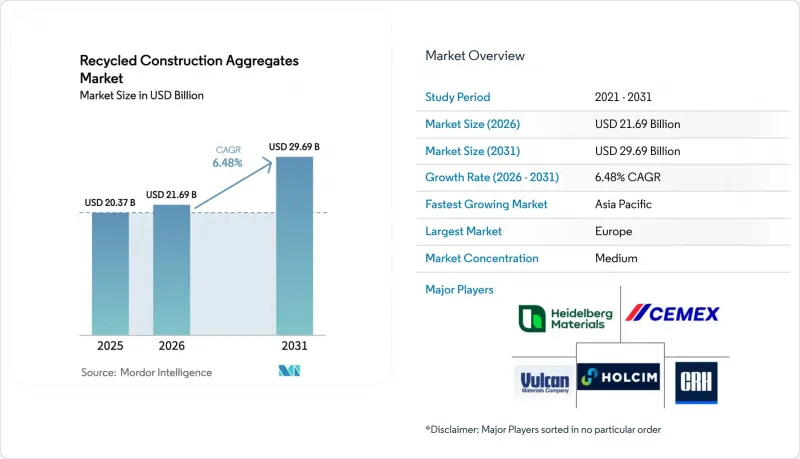
本報告按類型(碎石、礫石、沙子、混凝土骨材及其他)、應用領域(住宅、商業、基礎設施、工業)、原料(建築和拆除廢棄物、再生瀝青路面及其他)以及地區(亞太地區、北美地區、歐洲及其他地區)進行細分。市場預測以美元計價。
全球再生建築骨材市場趨勢及洞察
強制對建築和拆除廢棄物進行數位化追蹤
衛星追蹤和電子清單有效地遏制了非正規非法傾倒,並將廢棄物引導至有資格的回收商。歐盟的「數位廢棄物運輸系統」將於2026年5月投入運營,屆時海關官員將能夠攔截不合規的跨境運輸,並對每次違規行為處以罰款。中國於2026年1月啟動的「固態廢棄物行動計畫」強制要求運輸5噸以上建築廢棄物的卡車使用北斗系統進行追蹤。同時,印度於2026年4月發布的「建築和拆除廢棄物管理條例」提高了生產者延伸責任制(EPR)的目標,並推動在2029年之前全面落實。這些條例將提高原料的透明度,降低新建工廠的資金籌措風險,並加速再生建築骨材的市場推廣,尤其是先前依賴非正規供應鏈的地區。
政府正在加強循環經濟目標。
自2027年起,沙烏地阿拉伯將強制規定公共工程項目中一定比例的骨材必須來自再生材料。墨西哥的《循環經濟法》將於2026年生效,該法將建築材料的押金返還制度與生產者責任制掛鉤。蘇格蘭已實施一項規定,禁止在道路維修中使用廢棄石材,除非在50公里半徑範圍內有再生材料可用。這項規定確保了市政當局對瀝青的大部分需求得到滿足。這些強制性措施不僅擴大了再生建築骨材的市場,也刺激了對生產能力的投資,尤其是在以前被忽視的地區。
認知到結構級天然石材與其他材料的性能差異。
設計標準通常限制在承重混凝土混合料中使用再生骨材。在印度,再生粗骨材的使用僅限於M25混凝土。然而,在韓國,如果再生粗骨材超過一定閾值,則會對設計強度施加限制。由於缺乏長期性能數據,結構工程師對這些骨材的品質仍持懷疑態度。這種懷疑阻礙了再生建築骨材的廣泛應用,尤其是在高層建築和橋樑工程中。
細分市場分析
到2025年,混凝土骨材將佔據再生建築骨材市場40.22%的主導佔有率,預計在2026年至2031年的預測期內將以6.67%的複合年成長率穩步成長。二氧化碳養護線可提高28天抗壓強度,使再生材料能有效取代EN 206認證結構混合料中未使用的玄武岩。碎石用於公差較小的路基,而再生礫石則更適用於透水性路面,以確保符合歐洲雨水法規。由於氣孔率分級日益複雜,高細粒砂的供應面臨挑戰,這不僅推高了加工成本,也阻礙了其市場滲透。
分類、衝擊破碎和衝擊磨機是投資的重點。這些改進確保產品符合 UNI 11531-1:2024 標準,尤其是在片狀破碎和洛杉磯磨耗測試閾值方面,使其適用於結構混凝土。海德堡材料公司已在其波蘭工廠的生產線上引入了二氧化碳處理技術。同時,豪瑞集團正透過一項策略性收購擴大其產能,計劃於 2024 年完成,並明確專注於為低碳接合材料設計的混凝土骨材。預計這些設備的進步將在 2026 年至 2031 年的預測期內推動再生建築骨材市場的發展,尤其是在預製混凝土和預拌混凝土領域。
區域分析
到2025年,歐洲將佔全球整體銷售額的36.69%。在蘇格蘭,對骨材課稅正在擴大再生骨材和未使用石材之間的價格差距。歐盟的「數位化廢棄物運輸系統」強制要求即時報告跨境廢棄物,有效堵住了先前不利於本地回收商的漏洞。在德國,建築規範強制要求在非結構性構件中使用再生材料。在法國,如果本地有再生材料,則在地方政府道路建設合約中優先使用。在英國,再生瀝青路面(RAP)現在已被允許用於相當大比例的路面工程。這些措施共同促進了高價值土木工程項目中再生建築骨材的市場發展。
預計亞太地區在2026年至2031年的預測期內將實現7.12%的複合年成長率。印度的生產者延伸責任制(EPR)目標預計將在2026年至2029年間顯著提高。在中國,各省被要求在2027年前實現資源利用目標,北斗系統將對此進行監測。在印尼、越南和馬來西亞,資源轉移條款已納入年度基礎設施支出。然而,內陸市場仍缺乏足夠的破碎能力,這為尋求將再生建築骨材市場佔有率拓展到主要都會區以外的新進入者提供了良好的機會。
北美正受惠於《基礎設施投資與就業法案》以及碳定價機制,這些機制提升了再生材料的競爭力。在加拿大,碳排放稅的提高預計將推高採石場的柴油價格。 2023年,美國透過使用再生瀝青路面材料(RAP)而非新材料,實現了顯著的成本降低。墨西哥的《2026年循環經濟法案》將押金返還機制與圖拉的廢棄物評估園區結合,使墨西哥成為再生建築骨材市場快速成長的中心。南美、中東和非洲仍處於發展初期,但巴西和沙烏地阿拉伯展現出強勁的政策動能。這表明,如果能夠克服資金籌措挑戰並解決廢棄石材價格低廉的問題,中期內該領域具有成長潛力。
其他好處:
- Excel格式的市場預測(ME)表
- 3個月的分析師支持
目錄
第1章:引言
- 研究假設和市場定義
- 調查範圍
第2章:調查方法
第3章執行摘要
第4章 市場狀況
- 市場概覽
- 市場促進因素
- 強制對建築和拆除廢棄物進行數位化追蹤
- 政府的循環經濟目標變得更加嚴格。
- 採石場的柴油燃料稅提高了,縮小了與天然骨材的成本差距。
- 碳封存骨材可獲得負排放額度。
- 人工智慧最佳化的移動式破碎機使每噸物料的處理成本降低了 18% 以上。
- 市場限制因素
- 結構級材料與天然石材在性能上的認知差距。
- 亞太地區主要城市以外地區缺乏回收基礎設施
- 由於微量金屬污染,RAP混合物的處置成本正在飆升。
- 價值鏈分析
- 波特五力模型
第5章 市場規模與成長預測
- 按類型
- 碎石
- 碎石
- 沙
- 混凝土骨材
- 其他
- 透過使用
- 住宅
- 商業的
- 基礎建設(道路、橋樑、鐵路)
- 產業
- 來源
- 建築和拆除廢棄物
- 再生瀝青路面
- 其他(爐渣、鑄造砂等)
- 按地區
- 亞太地區
- 中國
- 印度
- 日本
- 韓國
- 東南亞國協
- 其他亞太國家
- 北美洲
- 美國
- 加拿大
- 墨西哥
- 歐洲
- 德國
- 英國
- 法國
- 義大利
- 西班牙
- 俄羅斯
- 北歐國家
- 其他歐洲國家
- 南美洲
- 巴西
- 阿根廷
- 其他南美國家
- 中東和非洲
- 沙烏地阿拉伯
- 南非
- 其他中東和非洲國家
- 亞太地區
第6章 競爭情勢
- 市場集中度
- 策略趨勢
- 市佔率和排名分析
- 公司簡介
- Boral Limited
- Breedon Group plc
- CEMEX SAB de CV
- Cherry Companies
- Colas Group
- CRH
- Delta Sand & Gravel
- Eurovia
- GreenRock Recycling
- Heidelberg Materials
- HOLCIM
- Holroyd Company, Inc
- K&B Crushers
- Martin Marietta Materials
- Sibelco
- Veidekke
- Vulcan Materials Company
第7章 市場機會與未來展望
According to Mordor Intelligence, the recycled construction aggregates market size was valued at USD 20.37 billion in 2025 and is estimated to grow from USD 21.69 billion in 2026 to reach USD 29.69 billion by 2031, at a CAGR of 6.48% during the forecast period (2026-2031).
This report is Segmented by Type (Crushed Stone, Gravel, Sand, Concrete Aggregates, and Others), Application (Residential, Commercial, Infrastructure, and Industrial), Source (Construction and Demolition Waste, Reclaimed Asphalt Pavement, and Others), and Geography (Asia-Pacific, North America, Europe, and More). The Market Forecasts are Provided in Terms of Value (USD).
Global Recycled Construction Aggregates Market Trends and Insights
Digital Construction and Demolition-Waste Tracking Mandates
Satellite tracking and electronic manifests are effectively curbing informal dumping, steering debris towards licensed recyclers. The European Union's Digital Waste Shipment System, operational since May 2026, empowers customs officers to intercept non-compliant cross-border shipments, levying fines for each infraction. China's Solid Waste Action Plan, initiated in January 2026, mandates Beidou tracking for trucks hauling over 5 tonnes of construction debris. Simultaneously, India's Construction and Demolition Waste Management Rules, unveiled in April 2026, elevate extended-producer-responsibility targets, pushing for full compliance by 2029. These regulations bolster feedstock transparency, reduce financing risks for new plants, and accelerate the market's adoption of recycled construction aggregates, especially in regions previously reliant on informal supply chains.
Government Circular-Economy Targets Tighten
Starting in 2027, Saudi Arabia will require public projects to source a portion of their aggregates from recycled materials. In Mexico, the Circular Economy Law, effective in 2026, links producer responsibilities to deposit-return schemes for construction materials. Scotland has implemented a rule stating that if recycled materials are available within a 50-kilometer radius, the use of virgin stone for road repairs is prohibited. This regulation has led to a significant reservation of municipal asphalt demand. These mandates not only broaden the market for recycled construction aggregates but also encourage investments in capacity, particularly in previously overlooked regions.
Perceived Structural-Grade Performance Gap vs. Natural Stone
Design codes often restrict the use of recycled aggregates in load-bearing mixes. In India, the use of recycled coarse aggregates is limited to the M25 concrete. South Korea, on the other hand, imposes a design strength limit when the coarse recycled aggregate surpasses a specific threshold. Due to a lack of long-term performance data, structural engineers remain skeptical about the quality of these aggregates. This skepticism has hindered the widespread adoption of recycled construction aggregates, especially in high-rise buildings and bridge projects.
Other drivers and restraints analyzed in the detailed report include:
- Cost Gap Narrows vs. Virgin Aggregates as Diesel Levies Rise
- Carbon-Mineralised Aggregates Earn Negative-Emission Credits
- Sparse Recycling Infrastructure Outside Tier-1 Asia-Pacific Metros
For complete list of drivers and restraints, kindly check the Table Of Contents.
Segment Analysis
In 2025, concrete aggregates held a dominant 40.22% share of the recycled construction aggregates market, with projections indicating a robust 6.67% CAGR through the forecast period of 2026-2031. Carbonation-curing lines enhance the 28-day compressive strength, enabling recycled materials to effectively replace virgin basalt in EN 206-certified structural mixes. While crushed stone finds its application in road bases with lenient tolerances, recycled gravel is the preferred choice for permeable pavements, ensuring compliance with Europe's stormwater regulations. High-fines sand encounters supply challenges due to air-classification upgrades, which not only inflate processing costs but also hinder its market penetration.
Selective demolition, impact crushers, and air separators have become focal points for investments. These enhancements guarantee adherence to UNI 11531-1:2024 standards, particularly for flakiness and Los-Angeles abrasion thresholds, rendering them suitable for structural-grade concrete. Heidelberg Materials has integrated carbonation into its production line at a Polish facility. On the other hand, Holcim's strategic acquisitions in 2024 have amplified its capacity, with a clear focus on concrete aggregates designed for low-carbon binders. Such advancements in equipment are set to bolster the recycled construction aggregates market, especially within the precast and ready-mix domains, over the forecast period of 2026-2031.
Geography Analysis
In 2025, Europe accounted for 36.69% of global revenue. In Scotland, a levy on aggregates has widened the recycled discount compared to virgin stone. The European Union's Digital Waste Shipment System mandates the real-time reporting of cross-border waste, effectively closing loopholes that have historically disadvantaged local recyclers. Germany mandates the use of recycled content in the non-structural elements of its building code. France prioritizes recycled materials for municipal road orders when they are locally available. The United Kingdom now allows a significant percentage of Reclaimed Asphalt Pavement (RAP) in surface layers. These measures collectively strengthen the market for recycled construction aggregates in high-value civil works.
The Asia-Pacific region is set to achieve a 7.12% compound annual growth rate (CAGR) during the forecast period of 2026-2031. India's extended producer responsibility targets are expected to increase significantly between 2026 and 2029. In China, prefectures are mandated to achieve resource utilization goals by 2027, a directive supported by Beidou monitoring. Indonesia, Vietnam, and Malaysia have integrated diversion clauses into their annual infrastructure spending. However, inland markets still lack sufficient crushing capacity, presenting greenfield opportunities for investors aiming to expand the footprint of the recycled construction aggregates market beyond tier-1 hubs.
North America is benefiting from the Infrastructure Investment and Jobs Act, along with carbon pricing that enhances the competitiveness of recycled materials. Canada's rising carbon tax is projected to increase quarry diesel prices. In 2023, the United States achieved significant savings by utilizing Reclaimed Asphalt Pavement (RAP) instead of virgin materials. Mexico's 2026 Circular Economy Law, which combines deposit-return schemes with a waste-valorization park in Tula, positions the nation as a burgeoning hub for the recycled construction aggregates market. While South America, the Middle-East, and Africa are still in their infancy, Brazil and Saudi Arabia showcase robust policy momentum. This indicates potential growth in the medium term, provided they overcome financing challenges and address the low prices of virgin stone.
- Boral Limited
- Breedon Group plc
- CEMEX S.A.B. de C.V.
- Cherry Companies
- Colas Group
- CRH
- Delta Sand & Gravel
- Eurovia
- GreenRock Recycling
- Heidelberg Materials
- HOLCIM
- Holroyd Company, Inc
- K&B Crushers
- Martin Marietta Materials
- Sibelco
- Veidekke
- Vulcan Materials Company
Additional Benefits:
- The market estimate (ME) sheet in Excel format
- 3 months of analyst support
TABLE OF CONTENTS
1 Introduction
- 1.1 Study Assumptions and Market Definition
- 1.2 Scope of the Study
2 Research Methodology
3 Executive Summary
4 Market Landscape
- 4.1 Market Overview
- 4.2 Market Drivers
- 4.2.1 Digital construction and demolition waste tracking mandates
- 4.2.2 Government circular-economy targets tighten
- 4.2.3 Cost gap narrows vs. virgin aggregates as quarry diesel levies rise
- 4.2.4 Carbon-mineralised aggregates earn negative-emission credits
- 4.2.5 AI-optimised mobile crushers cut processing cost/ton >=18%
- 4.3 Market Restraints
- 4.3.1 Perceived structural-grade performance gap vs. natural stone
- 4.3.2 Sparse recycling infrastructure outside Tier-1 Asia-Pacific metros
- 4.3.3 Trace-metal contamination spikes disposal cost for RAP blends
- 4.4 Value Chain Analysis
- 4.5 Porter's Five Forces
- 4.5.1 Bargaining Power of Suppliers
- 4.5.2 Bargaining Power of Buyers
- 4.5.3 Threat of New Entrants
- 4.5.4 Threat of Substitutes
- 4.5.5 Competitive Rivalry
5 Market Size and Growth Forecasts (Value)
- 5.1 By Type
- 5.1.1 Crushed Stone
- 5.1.2 Gravel
- 5.1.3 Sand
- 5.1.4 Concrete Aggregates
- 5.1.5 Others
- 5.2 By Application
- 5.2.1 Residential
- 5.2.2 Commercial
- 5.2.3 Infrastructure (roads, bridges, rail)
- 5.2.4 Industrial
- 5.3 By Source
- 5.3.1 Construction and Demolition Waste
- 5.3.2 Reclaimed Asphalt Pavement
- 5.3.3 Others (slag, foundry sand, etc.)
- 5.4 By Geography
- 5.4.1 Asia-Pacific
- 5.4.1.1 China
- 5.4.1.2 India
- 5.4.1.3 Japan
- 5.4.1.4 South Korea
- 5.4.1.5 ASEAN Countries
- 5.4.1.6 Rest of Asia-Pacific
- 5.4.2 North America
- 5.4.2.1 United States
- 5.4.2.2 Canada
- 5.4.2.3 Mexico
- 5.4.3 Europe
- 5.4.3.1 Germany
- 5.4.3.2 United Kingdom
- 5.4.3.3 France
- 5.4.3.4 Italy
- 5.4.3.5 Spain
- 5.4.3.6 Russia
- 5.4.3.7 NORDIC Countries
- 5.4.3.8 Rest of Europe
- 5.4.4 South America
- 5.4.4.1 Brazil
- 5.4.4.2 Argentina
- 5.4.4.3 Rest of South America
- 5.4.5 Middle-East and Africa
- 5.4.5.1 Saudi Arabia
- 5.4.5.2 South Africa
- 5.4.5.3 Rest of Middle-East and Africa
- 5.4.1 Asia-Pacific
6 Competitive Landscape
- 6.1 Market Concentration
- 6.2 Strategic Moves
- 6.3 Market Share (%)/Ranking Analysis
- 6.4 Company Profiles (includes Global Overview, Market Overview, Core Segments, Financials, Strategic Information, Products and Services, and Recent Developments)
- 6.4.1 Boral Limited
- 6.4.2 Breedon Group plc
- 6.4.3 CEMEX S.A.B. de C.V.
- 6.4.4 Cherry Companies
- 6.4.5 Colas Group
- 6.4.6 CRH
- 6.4.7 Delta Sand & Gravel
- 6.4.8 Eurovia
- 6.4.9 GreenRock Recycling
- 6.4.10 Heidelberg Materials
- 6.4.11 HOLCIM
- 6.4.12 Holroyd Company, Inc
- 6.4.13 K&B Crushers
- 6.4.14 Martin Marietta Materials
- 6.4.15 Sibelco
- 6.4.16 Veidekke
- 6.4.17 Vulcan Materials Company
7 Market Opportunities and Future Outlook
- 7.1 White-space and unmet-need assessment

 廢棄物衍生建築骨材市場分析及預測(至2035年):類型、產品、技術、應用、材料類型、製程、最終用戶、安裝配置、解決方案
 循環經濟建築和拆除材料市場預測至2034年:按材料類型、廢棄物來源、應用、最終用戶和地區分類的全球分析
 骨材市場規模、佔有率和成長分析:按建築骨材、工業骨材、人造骨材和骨材以及地區分類-2026-2033年產業預測
 高鋁骨材市場:依等級、產品、應用和地區分類。再生建築骨材市場:依產品類型、應用和地區分類2034年廢棄物衍生建築骨材市場預測:按材料類型、加工技術、應用、最終用戶和地區分類的全球分析建築骨材市場:依產品類型、應用和地區分類
 2026年全球道路建設用骨材市場報告電子廢棄物回收材料市場預測至2034年-按材料類型、來源、回收流程、應用、最終用戶、收集管道和地區分類的全球分析
 2026-2034年全球骨材市場規模、佔有率、趨勢和成長分析報告