


 |
市場調查報告書
商品編碼
2062002
五水偏矽酸鈉:市場佔有率分析、產業趨勢與統計、成長預測(2026-2031)Sodium Metasilicate Pentahydrate - Market Share Analysis, Industry Trends & Statistics, Growth Forecasts (2026 - 2031) |
||||||

※ 本網頁內容可能與最新版本有所差異。詳細情況請與我們聯繫。
根據 Mordor Intelligence 預測,五水偏矽酸鈉的市場規模預計將從 2025 年的 8.6 億美元成長到 2026 年的 9 億美元,到 2031 年達到 11.4 億美元。
預計 2026 年至 2031 年的年複合成長率(CAGR)為 4.84%。
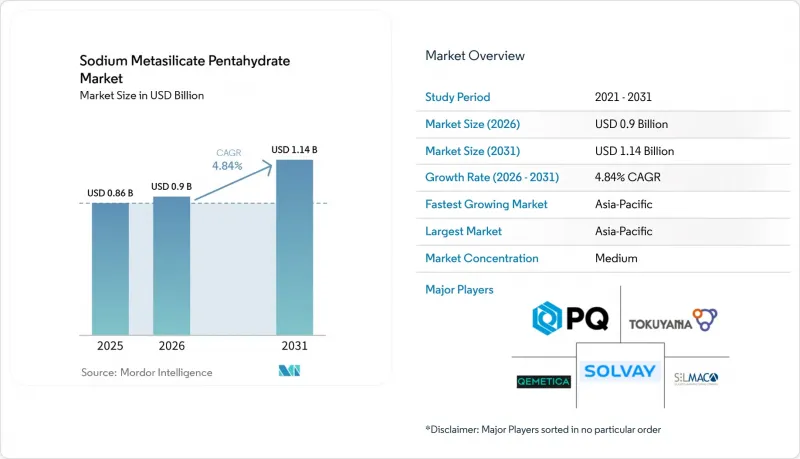
本報告按純度(工業級、技術級、低鹼特種混合物)、形態(粉末、顆粒、濃縮液液)、應用(清潔劑和肥皂、水處理、其他)以及地區(北美、南美、歐洲、亞太、中東和非洲)進行細分。市場預測以美元計價。
全球五水偏矽酸鈉市場趨勢及洞察
對清潔劑和清潔劑的需求增加
歐盟、美國和加拿大嚴格的磷酸鹽法規迫使配方開發商在自動洗碗機粉狀清潔劑和商用清潔劑中用五水偏矽酸鈉取代三聚磷酸鈉。這種化合物具有鹼性,能夠螯合硬水離子,並在玻璃和鋼材表面形成一層保護性的矽酸鹽薄膜——這些特性是大多數沸石無法複製的。典型的配方中五水偏矽酸鈉的添加量為1.5%至3.0%(重量比),既能調節pH值,又能滿足與過碳酸鈉類漂白劑共研磨所需的熱穩定性。歐洲化學品管理局(ECHA)的數位化成分護照要求製造商記錄純度資訊和重金屬限量,許多小規模配方公司透過委託製造夥伴關係來承擔這些合規成本。因此,尋求歐盟市場的亞洲出口商正在轉向使用符合REACH法規附件XVII閾值的高純度原料,這推動了五水偏矽酸鈉市場短期銷售的成長。
在建築和水泥添加劑領域不斷拓展應用。
五水偏矽酸鈉透過沉澱水合矽酸鈣相來促進混凝土緻密化,從而提高抗壓強度並降低透水性。這些特質在美國和歐盟的低碳採購法規下備受關注。美國的「清潔能源採購舉措」已撥款45億美元用於低碳材料,而德國對生物基建材的5億歐元津貼也推動了對防水矽酸鹽密封劑的需求。中國的「零碳建築標準」也產生了類似的連鎖反應,地方政府強制要求在公共工程中使用再生和替代接合材料,進一步提高了區域內的採用率。此外,偏矽酸鈉還能活化富含飛灰和礦渣的水泥混合物,減少水泥熟料用量,使生產商符合《巴黎協定》的脫碳藍圖。這些結構性獎勵拓展了五水偏矽酸鈉市場的成長潛力,使其應用範圍超越了傳統的清潔劑領域。
環境問題及處理法規
五水偏矽酸鈉溶液在1%濃度下pH值為12-13,根據全球化學品統一分類和標籤制度(GHS),它被歸類為皮膚和眼睛刺激物。這增加了遵守美國職業安全與健康管理局(OSHA)和歐盟化學品分類和標籤(CLP)標籤要求的成本。鹼性廢水必須排放和後才能排放,而沒有專用中和池的使用者場所則需要額外投入資金建造廢水處理設施。索爾維公司已為過去與合成堿灰生產相關的石灰石儲存和地下水監測累計了4.32億歐元的環境準備金,這顯示大規模營運中債務是如何累積的。歐盟排放交易體系(EU ETS)下不斷上漲的碳價正使瓦斯爐的成本以兩位數的速度成長,並降低了歐洲相對於美國天然純鹼(堿灰)來源的競爭力。不同司法管轄區監管力度的不均衡,增加了五水合矽酸鈉市場跨國供應鏈的複雜性。
細分市場分析
2025年,五水偏矽酸鈉市場中,工業級產品將佔據58.10%的佔有率,這反映了其在重型清潔劑、鍋爐水處理和耐火黏合劑等領域的廣泛應用。純度為95-98%的技術級產品在紡織品、陶瓷和建築密封劑領域仍是一種經濟高效的選擇。隨著酵素相容配方的日益普及,預計到2031年,與低鹼性特種混合物相關的五水偏矽酸鈉市場規模將以5.46%的複合年成長率成長。
純度低於95%的特級產品能夠抑制鹼性,並在玻璃表面形成矽酸鹽薄膜,從而保護鋁製和敏感肌膚。 PQ公司位於印尼的精細研磨工廠為亞洲客戶提供高品質的二氧化矽產品,這些客戶主要專注於綠色標籤清潔劑和低VOC塗料,這表明產品差異化正朝著顆粒工程和雜質控制的方向發展。隨著歐盟數位護照要求記錄重金屬含量,供應商被迫投資線上分析設備,以確保鉛、砷和鉻的含量低於REACH法規附件XVII的限值。這一系列法規進一步鞏固了對工業級產品的需求,同時也推動了五水偏矽酸鈉市場中特種混合物細分領域的快速成長。
區域分析
到2025年,亞太地區將佔全球銷售額的47.80%,預計到2031年將以5.67%的複合年成長率成長。這主要得益於中國「零碳建築標準」、印度「飲用水生命線計畫」(Jal Jeevan Mission)以及東協建築業蓬勃發展等因素的推動,這些因素腐蝕抑制劑、水泥緻密劑和酵素相容清潔劑混合物的採購量加快。當地供應商正利用接近性快速發展的紙漿、造紙和紡織產業集群的優勢,而跨國公司則透過提高產能和建立合資企業來加強其在該地區的業務基礎。
在北美,懷俄明州豐富的天然鹼蘊藏量(可製成低成本的天然堿灰)正推動著相關產業的擴張,例如位於喬治亞奧古斯塔的PQ公司高效爐,該爐已於2025年投入運作。美國的「清潔能源計畫」(By-Clean Initiative)正在投資45億美元用於低碳水泥添加劑,以滿足對矽酸鹽硬化劑的需求。儘管鑄造業酚醛和胺甲酸乙酯黏合劑的替代略微抑制了矽酸鹽硬化劑的產量,但中西部和陽光地帶市政供水事業採用水處理技術正在促進五水矽酸鈉市場的成長。
在歐洲,儘管合成堿灰的能源成本和碳排放稅令人擔憂,但歐盟第2026/405號條例中的數位通行證條款統一了市場進入,並支持高純度產品的溢價。德國5億歐元的綠建築補貼和法國的稅額扣抵提振了建築需求,部分抵銷了歐元走強導致清潔劑出口下滑的影響。南美、中東和非洲市場仍在持續成長,儘管規模較小,其中沙烏地阿拉伯的海水淡化廠和巴西的紙漿廠是主要的需求來源,所有這些都推動了全球五水偏矽酸鈉市場的擴張。
其他好處
- Excel格式的市場預測(ME)表
- 3個月的分析師支持
目錄
第1章:引言
- 研究假設和市場定義
- 調查範圍
第2章:調查方法
第3章執行摘要
第4章 市場狀況
- 市場概覽
- 市場促進因素
- 對清潔劑和清潔劑的需求增加
- 在建築和水泥添加劑領域不斷拓展應用
- 在水處理和工業清洗領域中得到更廣泛的應用
- 紙漿和造紙加工業的成長
- 過渡到使用不含磷酸鹽的商用洗碗劑
- 市場限制因素
- 環境問題及處理法規
- 與低鹼性酵素基洗滌劑的競爭
- 堿灰和矽砂原料價格波動
- 價值鏈分析
- 波特五力模型
第5章 市場規模與成長預測
- 純度
- 工業級(99%以上)
- 技術級(95-98%)
- 低鹼性特製混合物(95%或以下)
- 按形式
- 粉末
- 顆粒
- 濃縮液液
- 透過使用
- 清潔劑和肥皂
- 水處理
- 建築材料和水泥添加劑
- 紙漿和造紙加工
- 紡織品加工和染色
- 陶瓷和耐火材料
- 其他
- 按地區
- 亞太地區
- 中國
- 日本
- 印度
- 韓國
- ASEAN
- 其他亞太國家
- 北美洲
- 美國
- 加拿大
- 墨西哥
- 歐洲
- 德國
- 英國
- 法國
- 義大利
- 西班牙
- 俄羅斯
- 北歐國家
- 其他歐洲國家
- 南美洲
- 巴西
- 阿根廷
- 其他南美國家
- 中東和非洲
- 沙烏地阿拉伯
- 南非
- 其他中東和非洲國家
- 亞太地區
第6章 競爭情勢
- 市場集中度
- 策略趨勢
- 市佔率和排名分析
- 公司簡介
- American Elements
- Ankit Silicate
- Changyi Longgang Inorganic Silicon
- Gujarat Multi Gas Base Chemicals
- IQE Group
- JR Simplot Company
- Kiran Global Chem
- Nippon Chemical Industrial
- Occidental Petroleum(OxyChem)
- Penta Manufacturing Company
- PQ Corporation
- QEMETICA
- Shandong Laizhou Hongda Chemical
- Shandong Tiantai Silicate
- Shenzhen Feiming Sci-Tech
- Silmaco
- Solvay
- Tokuyama Corporation
- WR Grace & Co.
- Yogi Mag Chem
第7章 市場機會與未來展望
According to Mordor Intelligence, the sodium metasilicate pentahydrate market size is projected to grow from USD 0.86 billion in 2025 to USD 0.9 billion in 2026, and reach USD 1.14 billion by 2031, growing at a CAGR of 4.84% from 2026 to 2031.
This report is Segmented by Purity (Industrial-Grade, Technical-Grade, and Low-Alkali Specialty Blends), Form (Powder, Granules, and Liquid Concentrate), Application (Detergents and Soaps, Water Treatment, and More), and Geography (North America, South America, Europe, Asia-Pacific, and Middle East and Africa). The Market Forecasts are Provided in Terms of Value (USD).
Global Sodium Metasilicate Pentahydrate Market Trends and Insights
Rising Demand in Detergents and Cleaning Agents
Stringent phosphate caps in the EU, United States, and Canada are directing formulators to replace sodium tripolyphosphate with sodium metasilicate pentahydrate in automatic dishwasher powders and institutional cleaners. The compound supplies alkalinity, sequesters hard-water ions, and deposits a protective silicate film on glass and steel that most zeolites cannot replicate. Typical inclusion levels hover between 1.5% and 3.0 wt %, balancing pH with the thermal stability needed to co-grind with sodium percarbonate bleaches. Digital ingredient passports demanded by ECHA now force manufacturers to document purity profiles and heavy-metal limits, a compliance cost many small blenders absorb via tolling partnerships. Asian exporters chasing EU shelf space are therefore shifting to high-purity supplies that match REACH Annex XVII thresholds, buttressing near-term volume growth for the sodium metasilicate pentahydrate market.
Expanding Applications in Construction and Cement Additives
Sodium metasilicate pentahydrate densifies concrete by precipitating calcium silicate hydrate phases that lift compressive strength and lower permeability, making it attractive under low-carbon procurement rules in the United States and EU. The U.S. Buy Clean Initiative earmarks USD 4.5 billion for low-embodied-carbon materials, while Germany's EUR 500 million grant for bio-based building products elevates demand for water-resistant silicate sealants. China's Zero Carbon Building Standard has similar pull-through effects as local governments mandate recycled and alternative binders in public works, deepening regional uptake. Sodium metasilicate also activates fly-ash and slag-rich cement mixes, suppressing clinker content and aligning producers with Paris-aligned decarbonization roadmaps. These structural incentives extend the growth runway for the sodium metasilicate pentahydrate market beyond its historic detergent base.
Environmental Concerns and Handling Regulations
Sodium metasilicate pentahydrate solutions exhibit pH levels of 12-13 at 1% concentration, qualifying as skin and eye irritants under GHS, which raises the cost of compliance with OSHA and EU CLP labeling mandates. Alkaline effluents must be neutralized before discharge, adding CAPEX for wastewater treatment at user sites that lack dedicated neutralization tanks. Solvay booked EUR 432 million in environmental provisions for legacy limestone storage and groundwater monitoring linked to synthetic soda-ash production, showing how liabilities can stack up at scale. EU ETS carbon prices elevate the cost of gas-fired furnaces by double-digit percentages, lowering European competitiveness against U.S. trona-based supply. Uneven regulatory intensity across jurisdictions amplifies supply-chain complexity for multinationals in the sodium metasilicate pentahydrate market.
Other drivers and restraints analyzed in the detailed report include:
- Increasing Use in Water Treatment and Industrial Cleaning
- Growth in Pulp and Paper Processing Industry
- Competition from Low-Alkali Enzymatic Cleaning Chemistries
For complete list of drivers and restraints, kindly check the Table Of Contents.
Segment Analysis
Industrial-grade material controlled 58.10% of the 2025 sodium metasilicate pentahydrate market share, reflecting its role in heavy-duty detergents, boiler-water treatment, and refractory binders. Technical-grade products at 95-98% purity remain cost-efficient choices for textiles, ceramics, and construction sealants. The sodium metasilicate pentahydrate market size linked to low-alkali specialty blends is projected to climb at 5.46% CAGR through 2031 as enzyme-compatible formulations proliferate.
Specialty grades below 95% purity still deliver silicate film formation on glass yet temper alkalinity to protect aluminum ware and sensitive skin. PQ Corporation's Indonesia micronizer brings premium silica performance to Asian customers that target green-label cleaning and low-VOC coatings, an indicator that product differentiation is shifting to particle engineering and impurity control. EU digital passports now record heavy-metal levels, nudging suppliers to invest in online analyzers that keep lead, arsenic, and chromium below REACH Annex XVII limits. This regulatory loop further entrenches industrial-grade demand while supporting rapid growth in specialty-blend niches inside the sodium metasilicate pentahydrate market.
Geography Analysis
Asia-Pacific commanded 47.80% of 2025 revenue and is projected to grow at a 5.67% CAGR through 2031 as China's Zero Carbon Building Standard, India's Jal Jeevan Mission, and ASEAN construction booms accelerate procurement of corrosion inhibitors, cement densifiers, and enzyme-compatible detergent blends. Local suppliers leverage proximity to burgeoning pulp and paper and textile complexes, while multinationals deepen stakes through capacity additions and joint ventures.
North America capitalizes on abundant Wyoming trona reserves that underpin low-cost natural soda ash, fostering expansions like PQ Corporation's high-efficiency furnace in Augusta, Georgia, commissioned in 2025. The U.S. Buy Clean Initiative channels USD 4.5 billion toward low-carbon cement additives, sustaining demand for silicate hardeners. Foundry substitution toward phenolic-urethane binders constrains volume slightly, yet water-treatment implementations at municipal utilities in the Midwest and Sun Belt shore up growth for the sodium metasilicate pentahydrate market.
Europe wrestles with synthetic-soda-ash energy costs and carbon fees, yet the digital passport clause in Regulation (EU) 2026/405 harmonizes market access and underpins premium pricing for high-purity supply. Germany's EUR 500 million green-building grant and France's tax credits sustain construction uptake, partially offsetting lagging detergent exports linked to a strong euro. South America and the Middle East and Africa remain smaller but rising, with Saudi desalination plants and Brazilian pulp mills furnishing anchor offtake that collectively enlarge the global sodium metasilicate pentahydrate market footprint.
- American Elements
- Ankit Silicate
- Changyi Longgang Inorganic Silicon
- Gujarat Multi Gas Base Chemicals
- IQE Group
- J. R. Simplot Company
- Kiran Global Chem
- Nippon Chemical Industrial
- Occidental Petroleum (OxyChem)
- Penta Manufacturing Company
- PQ Corporation
- QEMETICA
- Shandong Laizhou Hongda Chemical
- Shandong Tiantai Silicate
- Shenzhen Feiming Sci-Tech
- Silmaco
- Solvay
- Tokuyama Corporation
- W. R. Grace & Co.
- Yogi Mag Chem
Additional Benefits:
- The market estimate (ME) sheet in Excel format
- 3 months of analyst support
TABLE OF CONTENTS
1 Introduction
- 1.1 Study Assumptions and Market Definition
- 1.2 Scope of the Study
2 Research Methodology
3 Executive Summary
4 Market Landscape
- 4.1 Market Overview
- 4.2 Market Drivers
- 4.2.1 Rising demand in detergents and cleaning agents
- 4.2.2 Expanding applications in construction and cement additives
- 4.2.3 Increasing use in water treatment and industrial cleaning
- 4.2.4 Growth in pulp and paper processing industry
- 4.2.5 Shift toward phosphate-free industrial dishwashing formulations
- 4.3 Market Restraints
- 4.3.1 Environmental concerns and handling regulations
- 4.3.2 Competition from low-alkali enzymatic cleaning chemistries
- 4.3.3 Price volatility of soda-ash and silica-sand feedstocks
- 4.4 Value Chain Analysis
- 4.5 Porter's Five Forces
- 4.5.1 Threat of New Entrants
- 4.5.2 Bargaining Power of Buyers
- 4.5.3 Bargaining Power of Suppliers
- 4.5.4 Threat of Substitutes
- 4.5.5 Competitive Rivalry
5 Market Size and Growth Forecasts (Value)
- 5.1 By Purity
- 5.1.1 Industrial-grade (>=99%)
- 5.1.2 Technical-grade (95-98%)
- 5.1.3 Low-alkali specialty blends (Less than 95%)
- 5.2 By Form
- 5.2.1 Powder
- 5.2.2 Granules
- 5.2.3 Liquid concentrate
- 5.3 By Application
- 5.3.1 Detergents and soaps
- 5.3.2 Water treatment
- 5.3.3 Construction materials and cement additives
- 5.3.4 Pulp and paper processing
- 5.3.5 Textile processing and dyeing
- 5.3.6 Ceramics and refractories
- 5.3.7 Other Applications
- 5.4 By Geography
- 5.4.1 Asia-Pacific
- 5.4.1.1 China
- 5.4.1.2 Japan
- 5.4.1.3 India
- 5.4.1.4 South Korea
- 5.4.1.5 ASEAN Countries
- 5.4.1.6 Rest of Asia-Pacific
- 5.4.2 North America
- 5.4.2.1 United States
- 5.4.2.2 Canada
- 5.4.2.3 Mexico
- 5.4.3 Europe
- 5.4.3.1 Germany
- 5.4.3.2 United Kingdom
- 5.4.3.3 France
- 5.4.3.4 Italy
- 5.4.3.5 Spain
- 5.4.3.6 Russia
- 5.4.3.7 NORDIC Countries
- 5.4.3.8 Rest of Europe
- 5.4.4 South America
- 5.4.4.1 Brazil
- 5.4.4.2 Argentina
- 5.4.4.3 Rest of South America
- 5.4.5 Middle-East and Africa
- 5.4.5.1 Saudi Arabia
- 5.4.5.2 South Africa
- 5.4.5.3 Rest of Middle-East and Africa
- 5.4.1 Asia-Pacific
6 Competitive Landscape
- 6.1 Market Concentration
- 6.2 Strategic Moves
- 6.3 Market Share/Ranking Analysis
- 6.4 Company Profiles (includes Global level Overview, Market level overview, Core Segments, Financials as available, Strategic Information, Products and Services, and Recent Developments)
- 6.4.1 American Elements
- 6.4.2 Ankit Silicate
- 6.4.3 Changyi Longgang Inorganic Silicon
- 6.4.4 Gujarat Multi Gas Base Chemicals
- 6.4.5 IQE Group
- 6.4.6 J. R. Simplot Company
- 6.4.7 Kiran Global Chem
- 6.4.8 Nippon Chemical Industrial
- 6.4.9 Occidental Petroleum (OxyChem)
- 6.4.10 Penta Manufacturing Company
- 6.4.11 PQ Corporation
- 6.4.12 QEMETICA
- 6.4.13 Shandong Laizhou Hongda Chemical
- 6.4.14 Shandong Tiantai Silicate
- 6.4.15 Shenzhen Feiming Sci-Tech
- 6.4.16 Silmaco
- 6.4.17 Solvay
- 6.4.18 Tokuyama Corporation
- 6.4.19 W. R. Grace & Co.
- 6.4.20 Yogi Mag Chem
7 Market Opportunities and Future Outlook
- 7.1 White-space and Unmet-Need Assessment

 矽酸鈉:市場佔有率分析、產業趨勢與統計、成長預測(2026-2031)
 矽酸鈉市場:2026-2032年全球市場預測(依實體形態、矽酸鹽種類、製造方法、功能、包裝、通路和應用分類)
 2026-2034年全球矽酸鈉市場規模、佔有率、趨勢和成長分析報告
 矽酸鈉市場報告:按類型、等級、形態、應用、最終用戶和地區分類(2026-2034 年)矽酸鈉市場規模、佔有率、成長及全球產業分析:按類型和應用分類,區域洞察及2026-2034年預測
 全球矽酸鈉市場:市場規模、佔有率和趨勢分析(按應用和地區分類),細分市場預測(2026-2033 年)
 矽酸鈉市場-全球產業規模、佔有率、趨勢、機會及按州、應用、地區和競爭格局分類的預測(2021-2031年)按形態、應用和最終用途產業結晶質層狀矽酸鈉市場-全球預測,2026-2032年
 矽酸鈉市場規模、佔有率及成長分析(依形態、類型、等級、應用、最終用途及地區分類)-2026-2033年產業預測
 矽酸鈉:全球市佔率及排名、總收入及需求預測(2025-2031年)