


 |
市場調查報告書
商品編碼
2061942
法律和監管技術領域的自主人工智慧:市場佔有率分析、行業趨勢和統計數據以及成長預測(2026-2031 年)Agentic AI In Legal And Regulatory Tech - Market Share Analysis, Industry Trends & Statistics, Growth Forecasts (2026 - 2031) |
||||||

※ 本網頁內容可能與最新版本有所差異。詳細情況請與我們聯繫。
預計法律監管技術領域的自主人工智慧市場將從 2025 年的 1.034 億美元成長到 2026 年的 1.3441 億美元,到 2031 年將達到 4.7839 億美元,2026 年至 2031 年的複合年成長率為 28.91%。
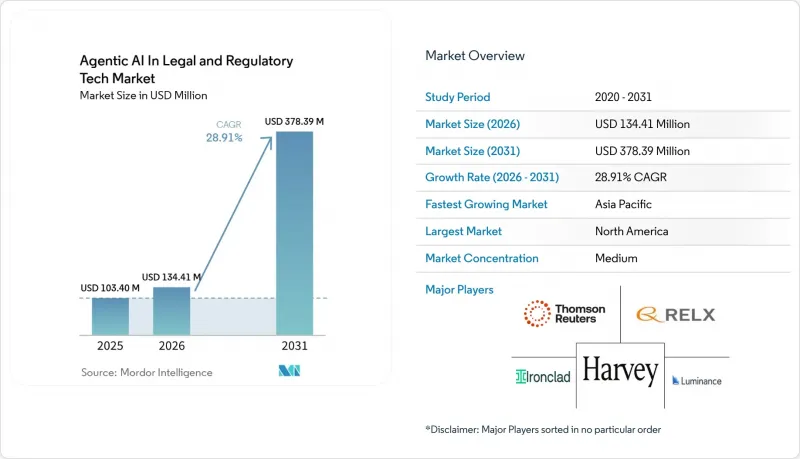
本報告按應用領域(例如,合約生命週期管理代理、電子取證和文件審查代理)、部署模式(例如,基於雲端)、最終用戶行業(例如,律師事務所、企業法務部門)、核心技術(例如,機器學習和預測模型)以及地區進行細分。市場預測以美元計價。
法律監理科技領域自主人工智慧市場的趨勢與洞察
生成式人工智慧工具在法律工作流程中的主流化進程正在加速。
根據企業法律營運聯盟(Corporate Legal Operations Consortium)的數據,到2025年,52%的企業法律團隊將部署生產級生成式人工智慧系統,這一比例是前一年的兩倍多。此外,85%的企業將設立內部人工智慧委員會來制定相關政策。這些委員會的廣泛設立表明,這並非一次性的先導計畫,而是長期預算投資。湯森路透指出,目前40%的法律專業人士正在使用生成式人工智慧,53%的人計劃在未來12個月內部署完全自主的智慧體。這種快速普及值得關注,因為大規模語言模型(LLM)所需的客製化編碼極少,使中型企業能夠立即獲得以往只有大型企業才能使用的功能。
由於外部法律費用飆升,需要降低成本。
湯森路透報告稱,預計2024年,外部律師的平均收費率將上漲8.3%。為此,企業法務部門正在擴充內部團隊,並部署人工智慧驅動的審查工具來取代複雜度較低的外部工作。一家擁有500名律師的律師事務所實施了一套人工智慧案件篩選系統,將案件處理時間從48小時縮短至5分鐘,從而減輕了合夥人的工作量並提高了回應速度。法務營運部門正日益將成本管理與人才策略結合,並更加重視技術技能的獲取,將其視為留住人才的關鍵因素。
關於雲端託管 LLM 推斷中律師與客戶之間的資料隱私和保密性的擔憂。
2026年2月,美國訴赫普納案的裁決宣布,在缺乏合約保障的情況下使用消費者聊天機器人構成對律師-客戶保密特權的放棄。該裁決加速了向企業級服務的轉變,這些服務承諾零資料保存、區域資料儲存管理以及SOC 2 II型認證。目前,美國47個州律師協會要求在將敏感資料傳遞給人工智慧工具之前,必須獲得客戶的書面同意。醫療保健和金融業中規避風險的法律負責人正在推遲採用人工智慧技術,直到供應商提供本地部署或混合部署方案。
細分市場分析
到2025年,電子取證和文件審查代理將佔據法律和監管技術領域自主人工智慧(AI)市場佔有率的34.89%。這一主導地位得益於其能夠降低取證預算,而取證預算通常每個案件超過100萬美元。 Relativity公司的「aiR for Review」在特權資訊分類方面達到了90%的準確率,並將人工審查時間縮短了一半。目前規模較小的訴訟結果預測代理預計將以30.11%的複合年成長率成長,並預計在2031年之前為法律和監管技術領域的代理人工智慧市場帶來顯著成長。
預測分析的快速普及主要源自於企業尋求以數據驅動的方式製定和解範圍和管轄權策略。 Lex Machina 的法官分析模組現已成為 AmLaw 200 強律師事務所中 60% 的標準做法。同時,合約生命週期管理代理也吸引了企業法務部門的關注,他們希望縮短談判週期,Ironclad 完成 1.5 億美元的 F 輪資金籌措便印證了這一點。合規情報和智慧財產權管理代理人也在推動市場需求,尤其是在監管嚴格的產業和擁有大規模專利組合的產業。
預計到2025年,雲端平台將佔總收入的61.89%,這證實了大多數買家更傾向於訂閱式經營模式和持續的模式升級。因此,法律和監管技術市場中基於代理的人工智慧仍然與超大規模資料中心業者GPU的可用性密切相關。然而,由於跨境併購交易等敏感資料必須保留在企業防火牆內,邊緣和嵌入式部署正以29.71%的複合年成長率快速成長。這種轉變正在推動法律和監管技術市場中基於代理的人工智慧(針對硬體最佳化推理設備)的市場規模擴大。
混合架構允許在本地處理敏感數據,同時將日常營運放在雲端,但這也會因 API 重複而產生成本。像 Amlaw(一家美國律師事務所)這樣擁有傳統文件管理系統的大型律師事務所通常會選擇本地叢集來與其現有記錄整合。同時,業務管理供應商正在引入輕量級 LLM(生命週期管理),這使得小規模的律師事務所無需在多個登入帳戶之間切換即可使用基於代理的功能。
區域分析
預計到2025年,北美將佔法律和監管技術領域自主人工智慧銷售額的41.89%。美國律師協會百強律師事務所(AmLaw 100)和財富500強企業的法務部門正透過在其營運中部署合約生命週期管理和合規代理來推動市場需求。隨著美國紐約南區地方法院於2026年2月澄清律師與客戶之間的保密義務,企業採用率預計將大幅提升。加拿大的成長更為穩定。多倫多的律師事務所傾向於使用電子取證代理來保持相對於美國同行的競爭優勢,而在墨西哥,採用率的驅動力主要來自遵守《美國-墨西哥-加拿大協定》(USMCA)的跨國公司子公司。
預計到2031年,亞太地區的複合年成長率將達到29.91%,成長速度位居全球之首。中國的「智慧法院」每年處理超過3000萬件案件,利用人工智慧進行案件分類和量刑輔助。在日本,法務省正在試行由人工智慧驅動的合約審查,以實現企業交易的現代化;而印度的數位化法院計畫則推動了對具成本效益調查人員的需求。新加坡的「智慧國家」策略以及韓國在半導體和金融領域的複雜監管也進一步促進了這一趨勢。
歐洲雖然略顯落後,但受益於GDPR的實施和活躍的跨境併購,歐盟法律和監管技術領域的基於代理的人工智慧市場正在擴張。總部位於倫敦的Magic Circle律師事務所正在實施編配平台,用於管理多司法管轄區的實質審查,而一家德國律師事務所則專注於歐盟人工智慧法律的合規性審計。在法國新創企業中,針對歐洲大陸法律體系量身訂做的合約談判代理正在開發中。在中東,主導阿拉伯聯合大公國和沙烏地阿拉伯為首的國家已經採納了一項由政府主導的人工智慧應用政策,以實施合規和爭議解決工具。在非洲,由於基礎設施與其他地區相比存在差距,人工智慧的應用主要集中在南非和埃及。
其他好處:
- Excel格式的市場預測(ME)表
- 3個月的分析師支持
目錄
第1章:引言
- 研究假設和市場定義
- 調查範圍
第2章:調查方法
第3章執行摘要
第4章 市場狀況
- 市場概覽
- 市場促進因素
- 加速在法律工作流程中採用生成式人工智慧工具
- 由於外部法律費用飆升,需要降低成本。
- 在整體法律運營中推行雲端優先的數位轉型計劃
- 監管機構日益嚴格的審查要求合規自動化系統必須能夠經受住審計。
- 跨境專案中對多智慧體編配的需求尚未滿足
- 創業投資支持的新興專業解決方案提供商,專注於小眾訴訟服務。
- 市場限制因素
- 關於雲端託管LLM推斷的資料隱私和敏感資訊問題
- 人工智慧故障的責任以及律師的道德和專業責任
- 碎片化的舊有系統阻礙了人工智慧的無縫整合。
- 法律領域缺乏微調人工智慧模型的優秀人才:這一現實並未充分報導。
- 宏觀經濟因素對市場的影響
- 產業價值鏈分析
- 監理情勢
- 技術展望
- 波特五力分析
第5章 市場規模與成長預測
- 透過使用
- 合約生命週期管理代理
- 電子發現和文件審查代理
- 法律調查分析代理
- 合規和監管資訊代理
- 訴訟結果預測代理
- IP管理代理
- 按部署模式
- 基於雲端的
- 現場
- 混合
- 邊緣/嵌入式
- 按最終用戶行業分類
- 律師事務所
- 公司法務部
- 金融服務合規部門
- 政府和監管機構
- 醫療保健和生命科學
- 保險
- 科技與通訊
- 核心技術
- 機器學習和預測模型
- 基於規則的專家系統
- 大規模語言模式(GenAI)代理
- 多智慧體編配平台
- 按地區
- 北美洲
- 美國
- 加拿大
- 墨西哥
- 南美洲
- 巴西
- 阿根廷
- 其他南美國家
- 歐洲
- 英國
- 德國
- 法國
- 義大利
- 西班牙
- 其他歐洲國家
- 亞太地區
- 中國
- 日本
- 印度
- 韓國
- 其他亞太國家
- 中東和非洲
- 中東
- 阿拉伯聯合大公國
- 沙烏地阿拉伯
- 其他中東國家
- 非洲
- 南非
- 埃及
- 其他非洲國家
- 中東
- 北美洲
第6章 競爭情勢
- 市場集中度
- 策略趨勢
- 市佔率分析
- 公司簡介
- Thomson Reuters Corporation
- RELX PLC
- LexisNexis Legal & Professional
- Harvey AI Inc.
- Ironclad Inc.
- Luminance Technologies Ltd.
- Casetext Inc.
- Everlaw Inc.
- DISCO Inc.
- Relativity ODA LLC
- Icertis Inc.
- ContractPod Technologies Ltd.
- Kira Systems Inc.
- Exterro Inc.
- Reveal-Brainspace Inc.
- Evisort Inc.
- SirionLabs Pte. Ltd.
- LinkSquares Inc.
- SpotDraft Inc.
- Onit Inc.
第7章 市場機會與未來展望
According to Mordor Intelligence, the agentic AI market in the legal and regulatory tech market is expected to grow from USD 103.4 million in 2025 to USD 134.41 million in 2026, and is forecast to reach USD 478.39 million by 2031 at a 28.91% CAGR over 2026-2031.
This report is Segmented by Application (Contract Lifecycle Management Agents, Ediscovery and Document Review Agents, and More), Deployment Model (Cloud-Based, and More), End-User Industry (Law Firms, Corporate Legal Departments, and More), Core Technology (Machine-Learning and Predictive Models, and More), and Geography. The Market Forecasts are Provided in Terms of Value (USD).
Global Agentic AI In Legal And Regulatory Tech Market Trends and Insights
Accelerating Mainstream Adoption of GenAI Tools Within Legal Workflows
Corporate Legal Operations Consortium data show that 52% of corporate legal teams had production-grade generative AI systems in 2025, more than double the prior year, and 85% had an internal AI committee guiding policy. Widespread committees signal permanent budget lines rather than one-off pilots. Thomson Reuters noted that 40% of legal professionals now use generative AI and 53% expect to add fully autonomous agents within 12 months. The steep curve is unique because LLMs require minimal custom coding, giving mid-market firms immediate access to capabilities once reserved for the exclusive domain of large firms.
Cost-Reduction Imperatives Amid Rising Outside-Counsel Fees
Thomson Reuters reported an 8.3% blended-rate increase for outside counsel in 2024, prompting corporate legal heads to expand in-house teams and adopt AI-driven review tools that replace low-complexity external work. A 500-attorney firm documented a drop in intake time from 48 hours to 5 minutes after deploying AI-supported triage, cutting partner hours and improving responsiveness. Legal operations groups increasingly rank technology proficiency as a talent-retention factor, linking cost control to workforce strategy.
Data-Privacy And Privilege Concerns Over Cloud-Hosted LLM Inference
A February 2026 ruling in US v. Heppner declared that using consumer chatbots without contractual protections waived attorney-client privilege. The decision accelerated migration to enterprise-grade tiers that promise zero-retain data handling, regional residency controls, and SOC 2 Type II attestations. Forty-seven state bars now require written client consent before confidential data passes through AI tools. Risk-averse general counsel in healthcare and finance are delaying deployments until vendors deliver on-premises or hybrid options.
Other drivers and restraints analyzed in the detailed report include:
- Cloud-First Digital-Transformation Initiatives Across Legal Operations
- Increasing Regulatory Scrutiny Demanding Audit-Ready Compliance Automation
- Hallucination Liability And Ethical-Competence Obligations For Attorneys
For complete list of drivers and restraints, kindly check the Table Of Contents.
Segment Analysis
In 2025, eDiscovery and document review agents secured 34.89% of the agentic AI (artificial intelligence) market share in the legal and regulatory tech market, a dominance driven by their ability to cut discovery budgets that often exceed USD 1 million per matter. Relativity's aiR for Review reached 90% accuracy in privilege classification, halving human review hours. Litigation outcome prediction agents, though smaller today, are forecast to expand at a 30.11% CAGR, adding significant volume to the agentic artificial intelligence market in legal and regulatory tech by 2031.
Rapid adoption of predictive analytics stems from firms seeking data-backed settlement ranges and venue strategies. Lex Machina's judge analytics module is now standard among 60% of AmLaw 200 practices. At the same time, contract-lifecycle agents attract corporate legal departments eager to shorten negotiation cycles, as evidenced by Ironclad's USD 150 million Series F funding. Compliance-intelligence and IP-management agents round out demand, especially in sectors with intensive regulatory duties or large patent estates.
Cloud platforms accounted for 61.89% of revenue in 2025, confirming that most buyers prefer subscription economics and continuous model upgrades. The agentic artificial intelligence in legal and regulatory tech market therefore remains closely tied to hyperscaler GPU availability. However, edge and embedded deployments are growing at a 29.71% CAGR because sensitive data, such as cross-border M&A, must remain within firm firewalls. This shift is expanding the agentic artificial intelligence in the legal and regulatory tech market size for hardware-optimized inference appliances.
Hybrid architectures allow routine work to stay in the cloud while confidential data is processed on-premises, but they also introduce API duplication costs. Large AmLaw firms with legacy document systems often choose on-premises clusters to integrate with existing records. Meanwhile, practice-management vendors embed lightweight LLMs so that small firms can gain agentic features without juggling multiple logins.
Geography Analysis
North America accounted for 41.89% of 2025 revenue for agentic AI in the legal and regulatory tech market. AmLaw 100 firms and Fortune 500 legal operations drive volume through cross-practice rollout of contract lifecycle and compliance agents. Enterprise adoption surged after the US District Court for the Southern District of New York clarified privilege obligations in February 2026. Canada's growth is steadier; Toronto firms favor eDiscovery agents to stay competitive with U.S. counterparts, while Mexico sees uptake mainly among multinational subsidiaries complying with the United States-Mexico-Canada Agreement.
Asia-Pacific is projected to record a 29.91% CAGR through 2031, the fastest worldwide. China's Smart Courts handle more than 30 million cases annually using AI case-routing and sentencing support. Japan's ministry pilots AI-enabled contract review to modernize corporate transactions, while India's digital court projects raise demand for budget-friendly research agents. Singapore's Smart Nation strategy and South Korea's regulatory complexity in semiconductors and finance add further momentum.
Europe trails slightly but benefits from GDPR enforcement and active cross-border M&A, expanding the agentic AI market within the bloc's legal and regulatory tech. Magic Circle firms in London buy orchestration platforms to manage multi-jurisdictional due diligence, while German practices focus on EU AI Act compliance audits. France's start-up scene cultivates contract negotiation agents tuned to civil-law systems. The Middle East, led by the United Arab Emirates and Saudi Arabia, is adopting sovereign-AI mandates to implement compliance and dispute-resolution tools. In Africa, adoption is concentrated in South Africa and Egypt due to infrastructure gaps elsewhere.
- Thomson Reuters Corporation
- RELX PLC
- LexisNexis Legal & Professional
- Harvey AI Inc.
- Ironclad Inc.
- Luminance Technologies Ltd.
- Casetext Inc.
- Everlaw Inc.
- DISCO Inc.
- Relativity ODA LLC
- Icertis Inc.
- ContractPod Technologies Ltd.
- Kira Systems Inc.
- Exterro Inc.
- Reveal-Brainspace Inc.
- Evisort Inc.
- SirionLabs Pte. Ltd.
- LinkSquares Inc.
- SpotDraft Inc.
- Onit Inc.
Additional Benefits:
- The market estimate (ME) sheet in Excel format
- 3 months of analyst support
TABLE OF CONTENTS
1 INTRODUCTION
- 1.1 Study Assumptions and Market Definition
- 1.2 Scope of the Study
2 RESEARCH METHODOLOGY
3 EXECUTIVE SUMMARY
4 MARKET LANDSCAPE
- 4.1 Market Overview
- 4.2 Market Drivers
- 4.2.1 Accelerating Mainstream Adoption of GenAI Tools Within Legal Workflows
- 4.2.2 Cost-Reduction Imperatives Amid Rising Outside-Counsel Fees
- 4.2.3 Cloud-First Digital-Transformation Initiatives Across Legal Operations
- 4.2.4 Increasing Regulatory Scrutiny Demanding Audit-Ready Compliance Automation
- 4.2.5 Under-Served Demand for Multi-Agent Orchestration in Cross-Border Matters
- 4.2.6 Emerging VC-Backed Point Solutions Targeting Niche Litigation Tasks
- 4.3 Market Restraints
- 4.3.1 Data-Privacy and Privilege Concerns Over Cloud-Hosted LLM Inference
- 4.3.2 Hallucination Liability and Ethical-Competence Obligations for Attorneys
- 4.3.3 Fragmented Legacy Systems Limiting Seamless AI Integration
- 4.3.4 Under-Reported Shortage of Legal-Domain AI Talent for Model Fine-Tuning
- 4.4 Impact of Macroeconomic Factors on the Market
- 4.5 Industry Value Chain Analysis
- 4.6 Regulatory Landscape
- 4.7 Technological Outlook
- 4.8 Porter's Five Forces Analysis
- 4.8.1 Bargaining Power of Suppliers
- 4.8.2 Bargaining Power of Buyers
- 4.8.3 Threat of New Entrants
- 4.8.4 Threat of Substitutes
- 4.8.5 Intensity of Competitive Rivalry
5 MARKET SIZE AND GROWTH FORECASTS (VALUE)
- 5.1 By Application
- 5.1.1 Contract Lifecycle Management Agents
- 5.1.2 eDiscovery and Document Review Agents
- 5.1.3 Legal Research and Analytics Agents
- 5.1.4 Compliance and Regulatory Intelligence Agents
- 5.1.5 Litigation Outcome Prediction Agents
- 5.1.6 IP-Management Agents
- 5.2 By Deployment Model
- 5.2.1 Cloud-based
- 5.2.2 On-premises
- 5.2.3 Hybrid
- 5.2.4 Edge / Embedded
- 5.3 By End-User Industry
- 5.3.1 Law Firms
- 5.3.2 Corporate Legal Departments
- 5.3.3 Financial-Services Compliance Units
- 5.3.4 Government and Regulatory Bodies
- 5.3.5 Healthcare and Life Sciences
- 5.3.6 Insurance
- 5.3.7 Technology and Telecom
- 5.4 By Core Technology
- 5.4.1 Machine-Learning and Predictive Models
- 5.4.2 Rule-based Expert Systems
- 5.4.3 Large-Language-Model (GenAI) Agents
- 5.4.4 Multi-agent Orchestration Platforms
- 5.5 By Geography
- 5.5.1 North America
- 5.5.1.1 United States
- 5.5.1.2 Canada
- 5.5.1.3 Mexico
- 5.5.2 South America
- 5.5.2.1 Brazil
- 5.5.2.2 Argentina
- 5.5.2.3 Rest of South America
- 5.5.3 Europe
- 5.5.3.1 United Kingdom
- 5.5.3.2 Germany
- 5.5.3.3 France
- 5.5.3.4 Italy
- 5.5.3.5 Spain
- 5.5.3.6 Rest of Europe
- 5.5.4 Asia-Pacific
- 5.5.4.1 China
- 5.5.4.2 Japan
- 5.5.4.3 India
- 5.5.4.4 South Korea
- 5.5.4.5 Rest of Asia-Pacific
- 5.5.5 Middle East and Africa
- 5.5.5.1 Middle East
- 5.5.5.1.1 United Arab Emirates
- 5.5.5.1.2 Saudi Arabia
- 5.5.5.1.3 Rest of Middle East
- 5.5.5.2 Africa
- 5.5.5.2.1 South Africa
- 5.5.5.2.2 Egypt
- 5.5.5.2.3 Rest of Africa
- 5.5.5.1 Middle East
- 5.5.1 North America
6 COMPETITIVE LANDSCAPE
- 6.1 Market Concentration
- 6.2 Strategic Moves
- 6.3 Market Share Analysis
- 6.4 Company Profiles (includes Global Level Overview, Market Level Overview, Core Segments, Financials as available, Strategic Information, Market Rank/Share, Products and Services, Recent Developments)
- 6.4.1 Thomson Reuters Corporation
- 6.4.2 RELX PLC
- 6.4.3 LexisNexis Legal & Professional
- 6.4.4 Harvey AI Inc.
- 6.4.5 Ironclad Inc.
- 6.4.6 Luminance Technologies Ltd.
- 6.4.7 Casetext Inc.
- 6.4.8 Everlaw Inc.
- 6.4.9 DISCO Inc.
- 6.4.10 Relativity ODA LLC
- 6.4.11 Icertis Inc.
- 6.4.12 ContractPod Technologies Ltd.
- 6.4.13 Kira Systems Inc.
- 6.4.14 Exterro Inc.
- 6.4.15 Reveal-Brainspace Inc.
- 6.4.16 Evisort Inc.
- 6.4.17 SirionLabs Pte. Ltd.
- 6.4.18 LinkSquares Inc.
- 6.4.19 SpotDraft Inc.
- 6.4.20 Onit Inc.
7 MARKET OPPORTUNITIES AND FUTURE OUTLOOK
- 7.1 White-Space and Unmet-Need Assessment

 監管科技全球市場規模、佔有率、趨勢和成長分析報告(2026-2034)
 監理科技市場:全球預測,2026-2032年
 2026-2030年全球監管科技市場
 2026年全球人工智慧(AI)監管技術市場報告
 監管技術市場預測至2034年—按監管職能、技術、部署模式、應用領域和最終用戶分類的全球分析
 2026-2030年全球人工智慧監管技術市場
 監管科技市場規模、佔有率和趨勢分析報告:按部署類型、組織、應用、地區和細分市場預測(2026-2033 年)
 監管科技市場分析及至2035年預測:類型、產品、服務、技術、組件、應用、部署、最終用戶、解決方案
 監管科技市場規模、佔有率、趨勢和預測(按組件、部署類型、公司規模、應用、最終用戶和地區分類),2026-2034 年監管科技市場規模、佔有率、成長及全球產業分析:依類型、應用和地區劃分的洞察與預測(2026-2034 年)