


 |
市場調查報告書
商品編碼
2061940
媒體、娛樂和內容製作領域智慧AI的市場佔有率分析、產業趨勢、統計數據和成長預測(2026-2031)。Agentic AI In Media, Entertainment, And Content Creation - Market Share Analysis, Industry Trends & Statistics, Growth Forecasts (2026 - 2031) |
||||||

※ 本網頁內容可能與最新版本有所差異。詳細情況請與我們聯繫。
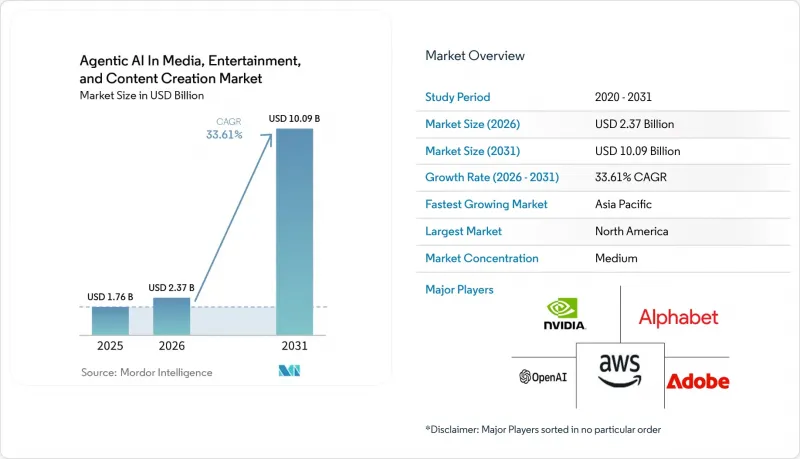
預計媒體、娛樂和內容製作領域代理人工智慧的市場規模將從 2025 年的 17.6 億美元成長到 2026 年的 23.7 億美元,然後從 2026 年到 2031 年以 33.61% 的複合年成長率成長,到 2031 年達到 100.9 億美元。
本報告按應用領域(製作/內容創作、後製/視覺特效、其他)、人工智慧自主等級(輔助人工智慧、其他)、部署模式(本地部署、雲端部署、混合部署)、最終用戶(影視工作室、其他)、元件(軟體平台、其他)和地區進行細分。市場預測以美元計價。
媒體、娛樂和內容製作領域代理人工智慧市場的趨勢和洞察。
生成式人工智慧成本的降低將使獨立創作者能夠進入市場。
2024年初至2025年末,推理成本下降了70%,降低了進入門檻,使得YouTube創作者能夠以低於50美元的價格製作一分鐘的影片。資金湧入了Sozee和Channel Farm等人工智慧原生公司,這些公司能夠自動完成劇本編寫、故事板繪製和素材生成。整合了OpenAI、Anthropic和Cohere模型的無程式碼編配工具,使得創作者無需工程人才。 OpenAI的GPT-4 Turbo的價格從2024年1月的每千枚代幣0.03美元跌至2025年12月的0.01美元。同時,Midjourney和Stability AI等平台上的圖像生成成本降至每幀0.01美元以下,使創作者能夠以低於每分鐘50美元的價格製作短影片影片。隨著成本的持續下降,獨立創作者有望開拓大型工作室忽略的長尾細分市場,從而重塑新內容的數量和多樣性。
串流媒體平台上對高度個人化內容的需求
目前,超過五分之四的觀看時長受到建議引擎的影響,而像Disney+和Spotify這樣的服務正在整合生成式人工智慧技術,以創建特定地區的預告片、縮圖、播客片頭,甚至是不同的故事情節。研究表明,個人化體驗可以將用戶留存率提高高達25%,這意味著數十億美元的額外經常性收入。這種經濟邏輯正推動平台採用半自動系統,在遵循文化差異和當地規則的同時,大規模地產生和標記內容。
合成演員與深度造假引發的倫理問題
美國演員工會(SAG)透過在合約中加入條款,要求在2025年之前使用數位肖像必須獲得同意並支付版稅,從而降低了製片廠的合規成本。一些備受矚目的訴訟,例如因未經授權使用人工智慧複製著名演員肖像而達成的500萬美元和解協議,凸顯了其中的法律風險。調查顯示,大多數消費者支持對合成媒體實施更嚴格的監管,歐盟的法規目前已要求浮水印。企業必須將同意管理和揭露流程納入其工作流程,否則將面臨聲譽受損和執法部門的懲罰。
細分市場分析
預計到2025年,媒體、娛樂和內容創作領域的智慧體人工智慧市場將佔製作和內容創作產業38.31%的佔有率。這反映了生成式影片編輯工具和人工智慧輔助資產建構器的廣泛應用。工作室已將剪輯週期從數週縮短至數天,並將概念藝術成本降低了高達40%。相較之下,在地化和翻譯市場預計到2031年將達到34.81%的複合年成長率。這主要得益於多語言語音克隆技術,該技術使得印地語、葡萄牙語和阿拉伯語受眾能夠以遠低於傳統重新配音的成本使用語音庫。
目前,在地化技術能夠以95%的準確率在32種語言中還原語調和節奏,使平台能夠更新過往內容並快速擴展目標市場。因此,與媒體、娛樂和內容創作領域在地化工作相關的基於代理的人工智慧市場規模預計將以遠超傳統任務(例如調色)的速度成長。此外,工作室也正在利用後製人工智慧進行遮罩去除、幀插值和4K升頻等操作,進一步減輕了以往由大規模視覺特效團隊所承擔的工作。
2025年,輔助人工智慧(AI)支出佔總支出的51.24%,創作者們依賴文字提示編輯器和圖像生成工具來補充其手動工作流程。半智慧體解決方案透過鍊式子任務增加了結構化的自主性,但仍需要在關鍵決策節點獲得使用者批准。預計到2031年,全自主系統將實現34.21%的複合年成長率,這主要得益於基於查詢調用的大規模語言模型,這些模型無需人工干預即可查詢資料庫、安排渲染和發布資源。
在內容審核和即時字幕製作領域,全自動系統的引入已將處理時間從數小時縮短至數分鐘。然而,在劇本創作和電影攝影等領域,人類的直覺仍然極為寶貴,人工智慧僅扮演輔助角色。能夠根據任務複雜程度調整自主程度的供應商,將達到最佳生產力,並在不疏遠創新團隊的前提下,進一步擴大全自動人工智慧在媒體、娛樂和內容創作領域的市場佔有率。
區域分析
北美地區在好萊塢早期對LED技術規模化投資以及矽谷基礎建模實驗室的集中推動下,預計到2025年將佔全球收入的37.72%。美國工作室受益於靈活的行業特定法規,但關於合成肖像的新工會條款正在縮小其允許使用的範圍。加拿大58%的視覺特效稅額扣抵吸引海外後製公司進駐溫哥華,而墨西哥的近岸設施則為電視劇製作提供了成本優勢。因此,該地區的智慧體人工智慧市場保持穩定,但已多元化發展,涵蓋媒體、娛樂和內容創作等領域。
預計到2031年,亞太地區的複合年成長率將達到34.59%,這主要得益於中國抖音面向大眾的影片頭像、日本利用人工智慧輔助動畫以彌補熟練勞動力短缺,以及印度擁有2億創作者群體,並利用本地語言文本生成影片。位元組跳動的人工智慧影片頭像於2025年在抖音上線,用戶無需拍攝即可創建個人化內容,並在短短六個月內用戶量突破1億。這充分展現了中國平台部署基於代理系統的規模。韓國行動遊戲巨頭正在整合人工智慧資源,以縮短關卡設計時間約40%,進一步鞏固了該地區的成長勢頭,並縮小了與北美地區的收入差距。
在歐洲,先進科技的應用依然活躍,這主要得益於英國創新虛擬舞台和德國高度專業化的視覺特效工作室。然而,該地區也面臨可能影響其成長軌跡的挑戰,尤其是歐盟人工智慧法規和強制性水印要求帶來的合規成本。與北美和亞太地區等更具活力的市場相比,這些監管措施可能會減緩歐洲的成長速度。同時,南美、中東和非洲雖然目前市場小規模,但展現出巨大的發展潛力。巴西對遊戲產業的5億美元投資預計將帶來顯著進展。阿拉伯聯合大公國(阿拉伯聯合大公國)正積極透過政府主導的人工智慧獎勵來促進成長。這些獎勵旨在阿布達比和杜拜等關鍵地區建立後製中心,預示著新的中心將會出現,並有望在2031年前提升該地區的市場佔有率。
其他好處:
- Excel格式的市場預測(ME)表
- 3個月的分析師支持
目錄
第1章:引言
- 研究假設和市場定義
- 調查範圍
第2章:調查方法
第3章執行摘要
第4章 市場狀況
- 市場概覽
- 市場促進因素
- 生成式人工智慧成本的降低將使獨立創作者能夠蓬勃發展。
- 串流媒體平台上對高度個人化內容的需求
- 電影製作中虛擬製作舞台的興起
- 超超大規模資料中心業者雲端GPU價格競爭
- 使用語音合成和配音工具對過往曲目進行在地化
- 基礎模型微調市場
- 市場限制因素
- 關於合成演員和深度造假的倫理問題
- 模型學習中高昂的知識產權授權成本
- 人工智慧生成內容監管方面的不確定性
- 基於代理的編配中的計算供應瓶頸
- 宏觀經濟因素對市場的影響
- 產業價值鏈分析
- 監理情勢
- 技術展望
- 波特五力分析
第5章 市場規模與成長預測
- 透過使用
- 製作和內容創作
- 後製和視覺特效
- 行銷和廣告
- 遊戲與互動媒體
- 廣播和串流媒體業務
- 在地化和翻譯
- 人工智慧按自主程度分類
- 支援人工智慧
- 半智慧體人工智慧
- 完全自主人工智慧
- 按部署模式
- 現場
- 雲
- 混合
- 最終用戶
- 電影和電視製作公司
- 出版公司和媒體公司
- 廣告和創新機構
- 遊戲工作室
- 個人創作者和小型企業
- 按組件
- 軟體平台
- 服務
- 硬體加速器
- 按地區
- 北美洲
- 美國
- 加拿大
- 墨西哥
- 南美洲
- 巴西
- 阿根廷
- 其他南美國家
- 歐洲
- 英國
- 德國
- 法國
- 義大利
- 西班牙
- 其他歐洲國家
- 亞太地區
- 中國
- 日本
- 印度
- 韓國
- 其他亞太國家
- 中東和非洲
- 中東
- 阿拉伯聯合大公國
- 沙烏地阿拉伯
- 其他中東國家
- 非洲
- 南非
- 埃及
- 其他非洲國家
- 中東
- 北美洲
第6章 競爭情勢
- 市場集中度
- 策略趨勢
- 市佔率分析
- 公司簡介
- Adobe Inc.
- OpenAI, LLC
- NVIDIA Corporation
- Amazon Web Services, Inc.
- Alphabet Inc.
- Meta Platforms, Inc.
- Microsoft Corporation
- Stability AI Ltd.
- Runway AI, Inc.
- Synthesia Ltd.
- Epic Games, Inc.
- Unity Software Inc.
- IBM Corporation
- SoundHound AI, Inc.
- Descript, Inc.
- ElevenLabs, Inc.
- Shutterstock, Inc.
- DeepMind Technologies Limited
- WetaFX Ltd.
- Cinesite Group
第7章 市場機會與未來展望
According to Mordor Intelligence, the agentic aI market size in media, entertainment, and content creation is expected to grow from USD 1.76 billion in 2025 to USD 2.37 billion in 2026, and is forecast to reach USD 10.09 billion by 2031 at a 33.61% CAGR over 2026-2031.
This report is Segmented by Application (Production and Content Creation, Post-Production and VFX, and More), AI Autonomy Level (Assistive AI, and More), Deployment Model (On-Premises, Cloud, and Hybrid), End-User (Film and TV Studios, and More), Component (Software Platforms, and More), and Geography. The Market Forecasts are Provided in Terms of Value (USD).
Global Agentic AI In Media, Entertainment, And Content Creation Market Trends and Insights
Generative AI Cost Declines Enabling Indie Creators
A 70% drop in inference pricing between early 2024 and late 2025 lowered entry barriers and allowed YouTube producers to complete minute-long videos for under USD 50. Funding flowed to AI-native outfits such as Sozee and Channel Farm, which automate scripting, storyboard creation, and asset generation. No-code orchestration tools that chain OpenAI, Anthropic, and Cohere models removed the need for engineering talent. OpenAI's pricing for GPT-4 Turbo dropped from USD 0.03 per 1,000 tokens in January 2024 to USD 0.01 by December 2025, while image-generation costs on platforms like Midjourney and Stability AI fell below USD 0.01 per frame, enabling creators to produce short-form video content for under USD 50 per minute of finished output. As costs fall further, independent creators seize long-tail niches that large studios overlook, reshaping the volume and diversity of new releases.
Streaming Platforms' Demand for Hyper-Personalized Content
Recommendation engines now influence more than four out of five viewing hours, and services like Disney+ and Spotify embed generative AI to craft localized trailers, thumbnails, podcast intros, and even alternate story arcs. Research indicates that tailored experiences can increase retention by up to 25%, translating into billions in additional recurring revenue. This economic logic drives platforms to adopt semi-agentic systems that generate and tag content at scale while adhering to cultural nuance and regional rules.
Ethical Concerns Over Synthetic Actors and Deepfakes
The Screen Actors Guild secured contract clauses in 2025 that require consent and residuals for the use of digital likeness, reducing compliance costs for studios. High-profile lawsuits, including a USD 5 million settlement involving an unauthorized AI replica of a major actor, highlighted legal exposure. Surveys show most consumers favor stricter rules on synthetic media, and EU regulations now mandate watermarking. Companies must embed consent management and disclosure into workflows or risk reputational damage and enforcement penalties.
Other drivers and restraints analyzed in the detailed report include:
- Rise of Virtual Production Stages in Film-Making
- Cloud-GPU Price Wars Among Hyperscalers
- High IP Licensing Costs for Model Training
For complete list of drivers and restraints, kindly check the Table Of Contents.
Segment Analysis
The Agentic AI market in media, entertainment, and content creation recorded a 38.31% share in production and content creation in 2025, reflecting widespread adoption of generative video editors and AI-assisted asset builders. Studios shortened editing cycles from weeks to days and cut concept-art costs by up to 40%. In contrast, localization and translations are projected to post a 34.81% CAGR through 2031, fueled by multilingual voice cloning that unlocks archival libraries for Hindi, Portuguese, and Arabic audiences at a fraction of prior re-dubbing costs.
Localization technology now replicates tone and cadence across 32 languages with 95% fidelity, enabling platforms to refresh back catalogs and expand addressable markets quickly. As a result, the Agentic AI market size in media, entertainment, and content creation, tied to localization roles, is poised to expand far faster than legacy tasks such as color grading. Studios also harness post-production AI for mask removal, frame interpolation, and 4K upscaling, further compressing workloads previously handled by large VFX teams.
Assistive AI maintained 51.24% of 2025 spending as creators relied on text-prompt editors and image generators to augment manual workflows. Semi-agentic solutions added structured autonomy, chaining subtasks while still requiring user approval at decision nodes. Looking ahead, fully agentic systems should log a 34.21% CAGR to 2031, driven by function-calling large language models that query databases, schedule renders, and publish assets without human mediation.
In content moderation and real-time subtitle creation, fully agentic deployments already shrink turnaround from hours to minutes. Yet scriptwriting and cinematography remain assistive domains where human taste carries premium value. Providers that map autonomy levels to task complexity will achieve optimal productivity, pushing the Agentic AI market share of full agents in media, entertainment, and content creation higher without alienating creative teams.
Geography Analysis
North America delivered 37.72% of 2025 revenue thanks to Hollywood's early investment in LED volumes and Silicon Valley's concentration of foundation-model labs. U.S. studios benefit from flexible, sector-specific regulation, although new union clauses on synthetic likenesses tighten permissible use. Canada's 58% VFX tax credit has attracted overseas post-production work to Vancouver, while Mexico's nearshore facilities offer cost advantages for episodic shoots, keeping the regional Agentic AI market stable yet distributed across media, entertainment, and content creation.
Asia-Pacific is projected to register a 34.59% CAGR through 2031, fueled by China's mass-market Douyin video avatars, Japan's AI-assisted anime in-betweening that offsets skilled-labor shortages, and India's 200 million-strong creator base leveraging local-language text-to-video generation. ByteDance's 2025 rollout of AI-generated video avatars on Douyin, which allows users to create personalized content without filming, reached over 100 million users within six months, demonstrating the scale at which Chinese platforms can deploy agentic systems. South Korea's mobile game leaders are integrating AI assets to reduce level design time by roughly 40%, reinforcing the region's upward trajectory and closing the revenue gap with North America.
Europe continues to demonstrate strong adoption of advanced technologies, driven by the United Kingdom's innovative virtual stages and Germany's highly specialized VFX studios. However, the region faces challenges that could impact its growth trajectory, particularly due to the compliance costs associated with the EU AI Act and the mandatory watermarking requirements. These regulatory measures may slow down growth when compared to the more dynamic markets of North America and Asia-Pacific. On the other hand, South America, the Middle East, and Africa, while currently smaller markets, are showing promising potential. Brazil's USD 500 million investment in the gaming sector is expected to drive significant advancements, while the United Arab Emirates is actively fostering growth through sovereign AI incentives. These incentives aim to establish post-production hubs in key locations such as Abu Dhabi and Dubai, signaling the emergence of budding hotspots that could help increase regional market share by 2031.
- Adobe Inc.
- OpenAI, L.L.C.
- NVIDIA Corporation
- Amazon Web Services, Inc.
- Alphabet Inc.
- Meta Platforms, Inc.
- Microsoft Corporation
- Stability AI Ltd.
- Runway AI, Inc.
- Synthesia Ltd.
- Epic Games, Inc.
- Unity Software Inc.
- IBM Corporation
- SoundHound AI, Inc.
- Descript, Inc.
- ElevenLabs, Inc.
- Shutterstock, Inc.
- DeepMind Technologies Limited
- WetaFX Ltd.
- Cinesite Group
Additional Benefits:
- The market estimate (ME) sheet in Excel format
- 3 months of analyst support
TABLE OF CONTENTS
1 INTRODUCTION
- 1.1 Study Assumptions and Market Definition
- 1.2 Scope of the Study
2 RESEARCH METHODOLOGY
3 EXECUTIVE SUMMARY
4 MARKET LANDSCAPE
- 4.1 Market Overview
- 4.2 Market Drivers
- 4.2.1 Generative AI Cost Declines Enabling Indie Creators
- 4.2.2 Streaming Platforms' Demand for Hyper-Personalised Content
- 4.2.3 Rise of Virtual Production Stages in Film-Making
- 4.2.4 Cloud-GPU Price Wars Among Hyperscalers
- 4.2.5 Generative Voice and Dubbing Tools Localising Back-Catalogs
- 4.2.6 Foundation Model Fine-Tuning Marketplaces
- 4.3 Market Restraints
- 4.3.1 Ethical Concerns Over Synthetic Actors and Deepfakes
- 4.3.2 High IP Licensing Costs for Model Training
- 4.3.3 Regulatory Uncertainty Around AI-Generated Content
- 4.3.4 Compute Supply Bottlenecks for Agentic Orchestration
- 4.4 Impact of Macroeconomic Factors on the Market
- 4.5 Industry Value Chain Analysis
- 4.6 Regulatory Landscape
- 4.7 Technological Outlook
- 4.8 Porter's Five Forces Analysis
- 4.8.1 Bargaining Power of Suppliers
- 4.8.2 Bargaining Power of Buyers
- 4.8.3 Threat of New Entrants
- 4.8.4 Threat of Substitutes
- 4.8.5 Intensity of Competitive Rivalry
5 MARKET SIZE AND GROWTH FORECASTS (VALUE)
- 5.1 By Application
- 5.1.1 Production and Content Creation
- 5.1.2 Post-Production and VFX
- 5.1.3 Marketing and Advertising
- 5.1.4 Gaming and Interactive Media
- 5.1.5 Broadcast and Streaming Operations
- 5.1.6 Localisation and Translations
- 5.2 By AI Autonomy Level
- 5.2.1 Assistive AI
- 5.2.2 Semi-Agentic AI
- 5.2.3 Fully Agentic AI
- 5.3 By Deployment Model
- 5.3.1 On-Premises
- 5.3.2 Cloud
- 5.3.3 Hybrid
- 5.4 By End-User
- 5.4.1 Film and TV Studios
- 5.4.2 Publishers and Media Houses
- 5.4.3 Advertising and Creative Agencies
- 5.4.4 Game Studios
- 5.4.5 Independent Creators and SMEs
- 5.5 By Component
- 5.5.1 Software Platforms
- 5.5.2 Services
- 5.5.3 Hardware Accelerators
- 5.6 By Geography
- 5.6.1 North America
- 5.6.1.1 United States
- 5.6.1.2 Canada
- 5.6.1.3 Mexico
- 5.6.2 South America
- 5.6.2.1 Brazil
- 5.6.2.2 Argentina
- 5.6.2.3 Rest of South America
- 5.6.3 Europe
- 5.6.3.1 United Kingdom
- 5.6.3.2 Germany
- 5.6.3.3 France
- 5.6.3.4 Italy
- 5.6.3.5 Spain
- 5.6.3.6 Rest of Europe
- 5.6.4 Asia-Pacific
- 5.6.4.1 China
- 5.6.4.2 Japan
- 5.6.4.3 India
- 5.6.4.4 South Korea
- 5.6.4.5 Rest of Asia-Pacific
- 5.6.5 Middle East and Africa
- 5.6.5.1 Middle East
- 5.6.5.1.1 United Arab Emirates
- 5.6.5.1.2 Saudi Arabia
- 5.6.5.1.3 Rest of Middle East
- 5.6.5.2 Africa
- 5.6.5.2.1 South Africa
- 5.6.5.2.2 Egypt
- 5.6.5.2.3 Rest of Africa
- 5.6.5.1 Middle East
- 5.6.1 North America
6 COMPETITIVE LANDSCAPE
- 6.1 Market Concentration
- 6.2 Strategic Moves
- 6.3 Market Share Analysis
- 6.4 Company Profiles (includes Global Level Overview, Market Level Overview, Core Segments, Financials as available, Strategic Information, Market Rank/Share, Products and Services, Recent Developments)
- 6.4.1 Adobe Inc.
- 6.4.2 OpenAI, L.L.C.
- 6.4.3 NVIDIA Corporation
- 6.4.4 Amazon Web Services, Inc.
- 6.4.5 Alphabet Inc.
- 6.4.6 Meta Platforms, Inc.
- 6.4.7 Microsoft Corporation
- 6.4.8 Stability AI Ltd.
- 6.4.9 Runway AI, Inc.
- 6.4.10 Synthesia Ltd.
- 6.4.11 Epic Games, Inc.
- 6.4.12 Unity Software Inc.
- 6.4.13 IBM Corporation
- 6.4.14 SoundHound AI, Inc.
- 6.4.15 Descript, Inc.
- 6.4.16 ElevenLabs, Inc.
- 6.4.17 Shutterstock, Inc.
- 6.4.18 DeepMind Technologies Limited
- 6.4.19 WetaFX Ltd.
- 6.4.20 Cinesite Group
7 MARKET OPPORTUNITIES AND FUTURE OUTLOOK
- 7.1 White-Space and Unmet-Need Assessment

 2026-2034年全球人工智慧市場規模、佔有率、趨勢和成長分析報告(媒體和娛樂產業)
 媒體和娛樂產業人工智慧市場規模、佔有率和成長分析:按組件、部署類型、企業規模、媒體類型、應用、最終用戶和地區分類——2026-2033年產業預測
 2034年媒體和娛樂產業人工智慧市場預測:按解決方案類型、組件、部署模式、技術、應用和地區分類的全球分析
 2026年全球媒體與娛樂產業人工智慧市場報告2026年全球人工智慧媒體娛樂生成器市場報告媒體與娛樂市場的人工智慧(AI):策略性洞察與預測(2026-2031)
 人工智慧在媒體和娛樂領域的市場分析及預測(至2035年):按類型、產品類型、服務、技術、組件、應用、設備、最終用戶、解決方案和部署類型分類
 媒體和娛樂領域人工智慧市場規模、佔有率和趨勢分析報告:按解決方案、按應用、按地區、細分市場預測,2025-2030 年媒體和娛樂領域人工智慧的全球市場、機會和 2033 年策略