


 |
市場調查報告書
商品編碼
2061913
研磨:市場佔有率分析、產業趨勢與統計、成長預測(2026-2031)Grinding Machines - Market Share Analysis, Industry Trends & Statistics, Growth Forecasts (2026 - 2031) |
||||||

※ 本網頁內容可能與最新版本有所差異。詳細情況請與我們聯繫。
根據 Mordor Intelligence 預測,研磨機市場規模將從 2025 年的 64.7 億美元成長到 2026 年的 67.6 億美元,到 2031 年將達到 85.9 億美元,2026 年至 2031 年的複合年成長率預計為 4.89%。
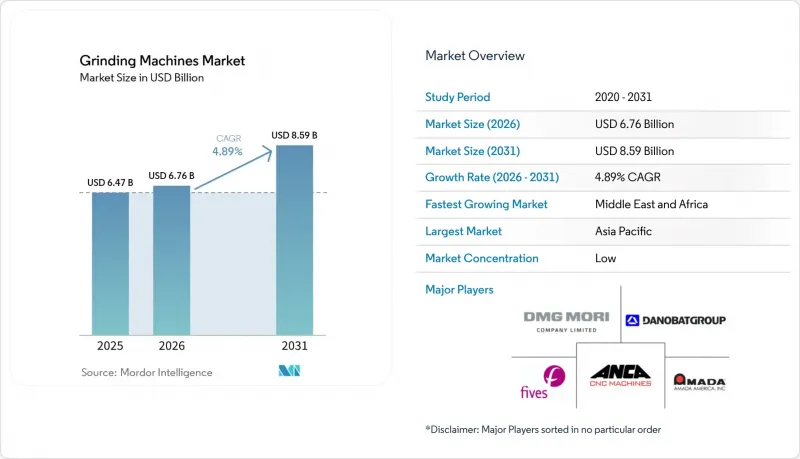
本報告按產品類型(平面研磨、圓柱研磨、無心研磨、齒輪研磨、研磨磨床及其他)、控制方式(數控、手動)、終端用戶行業(汽車、航太、通用機械、電子、能源、醫療及其他)和地區(北美、歐洲、亞太、中東、南美)進行細分。市場預測以貨幣單位(十億美元)表示。
全球研磨市場趨勢及洞察
整個產業對高精度零件的需求日益成長。
為了滿足航太的AS9100和汽車領域的IATF 16949等全球品質標準,製造商正在不斷提高尺寸和幾何精度,從而推動了對高性能圓柱研磨的需求。圓柱研磨平台通常可實現直徑公差在±1微米左右,圓度在個位數微米範圍內,從而減少了二次表面處理工程,提高了大量生產的製程能力。在半導體製造設備中,精確研磨可確保主軸精度和穩定的跳動,而永續性項目則旨在減少隱含排放。例如,台積電的冷卻液回收系統在保持關鍵主軸圓度精度小於3微米的同時,降低了二氧化碳排放。美國製造業在2025年的生產率提升反映了機械設備的持續現代化,包括可減少廢品並穩定加工週期的研磨單元。工具機製造商正在引入進程內測量和自適應控制技術,以在無需頻繁人工干預的情況下保持公差,這與工廠在更嚴格的客戶審核下降低變異性的努力一致。
汽車引擎和變速箱製造的擴張
到2026年初,美國的汽車組裝依然強勁,支撐了對曲軸、凸輪軸和精密齒輪的需求。這些零件需要研磨,以控制內燃機和電動平台的噪音、振動和聲振粗糙度(NVH)閾值。在德國,2026年2月乘用車產量年增1%,電池式電動車註冊量達46,300輛。這進一步增加了對更嚴格的齒形和高速齒輪精加工的需求,以滿足傳動系統耐久性目標。電動車架構提高了轉速和堆疊公差,推動了齒輪精加工製程向使用CBN砂輪的研磨研磨和精密修整的轉變。能源效率目標和更嚴格的生命週期成本管理正在推動高效主軸和現代控制系統的應用,這些系統可以監控每個零件的能耗,以滿足工廠層面的目標。將感測和分析融入研磨過程的基於 CNC 的工作流程在重新設計生產線以創建更靈活的生產系統的供應商中越來越受歡迎。
極高的設備和基礎設施投資
工業數控研磨的資本投資通常在每台8萬至50萬美元之間,但配備自動化、測量功能和五軸加工功能的配置價格可能更高。擁有成本不僅限於機器本身,還可能包括CAD/CAM許可、安裝、精密基礎、三相電源和空氣系統,這些對於小規模工廠來說可能構成障礙。公共部門採購人員正在採用生命週期成本分析,優先考慮具有可衡量的長期成本節約的高效設備,這導致對可記錄的能源性能和預測性維護的需求增加。新興市場的融資環境可能會延遲中小型製造商的現代化計畫,因為他們難以籌集資金來資金籌措機器、軟體和輔助系統。分階段實施自動化和測量設備的採購人員往往能夠更好地進行風險管理,但必須做好投資回收期稍長的準備。在研磨市場,這些現實體現在:在需求低迷時期,採購決策會被推遲;而在訂單積壓和運轉率上升時,採購決策則會加快。
細分市場分析
到2025年,圓柱研磨將佔據研磨市場佔有率的28.21%,這反映了它們在軸心、軸承滾道和精密銷的外徑和內徑精加工中發揮的廣泛作用。像STUDER S31這樣的平台具有熱穩定性和模組化配置,可適應各種加工長度,即使在長時間連續加工操作中也能確保高度可重複的精度。隨著電動車(EV)動力傳動系統的擴展,齒輪研磨正在推動這一領域的成長。這是因為對更高精度形狀和更安靜運行的要求更高,這就需要適用於研磨和成形研磨的高品質齒面光潔度。研磨市場受益於玻璃態CBN砂輪的採用和智慧修整程序的引入,這些程序可在保持形狀的同時縮短加工週期。使用者還要求進行進程內測量以檢查齒距和輪廓,從而減少工位之間的人工操作並降低缺陷風險。為了最大限度地減少繁忙單元中長時間加工週期內的熱漂移,輕型工具機底座和線性馬達驅動裝置正在引入。工廠若想實現更順暢的程序變更,就需要簡化的使用者介面,以減少非切削時間,並支援研磨市場中產品配置的靈活變更。
預計到2031年,研磨研磨系統市場將以6.23%的複合年成長率成長,這反映了電動車和混合動力驅動系統的持續擴張以及對低噪音電驅動橋的需求。平面研磨仍然是模具表面、模具鑲件和平板加工的主力軍,其平面度和表面光潔度精度為下游組裝工藝提供了支援。無心研磨可為燃油、醫療和運動系統等圓柱形零件提供高吞吐量,但需要特定的設定專業知識。刀具磨床和刀具研磨支援切削刀具的製造和再磨削,透過整合測量功能減少返工並保持刀具形狀。特種研磨和帶研磨解決方案透過涵蓋複雜形狀的去毛邊和保形精加工,豐富了產品線。在整個產品系列中,研磨產業正朝著滿足能源和數據需求的方向發展,強調高效主軸、更佳的冷卻液管理以及每個批次的數位化可追溯性。
區域分析
預計到2025年,亞太地區將佔研磨市場規模的45.87%。這得益於該地區在汽車、電子和資本財的強大產業生態系統,以及主要工具機OEM廠商宣布的產能擴張計劃。近期的一些投資計劃,例如捷太格特在古吉拉突邦新建的工廠(計劃於2027年投產),顯示精密加工平台正在持續本地化,以滿足國內和出口需求。區域買家優先考慮配備計量和能源監控功能的軟性數控單元,以應對操作人員短缺問題並降低單件運作。此外,亞太地區研磨市場也受惠於供應商為汽車和軸承生產場所提供的無人值守單元自動化解決方案,這些場所對產量和一致性要求極高。
預計中東和非洲地區將經歷最快的成長,這主要得益於產業多元化計劃,這些計劃將為能源、公共產業和流程工業項目提供資金,而這些項目需要大型旋轉機械和精密零件。從2024年起,海灣國家不斷擴大的公共工程項目儲備將改善研磨、測量儀器以及渦輪機、泵浦和閥門配套服務供應商的業務前景。在地採購政策正在幫助原始設備製造商 (OEM) 建立服務中心和零件庫存,從而減少關鍵資產的停機時間並加強運作市場聯繫。隨著新產能的投產,採用高效主軸、改進冷卻液管理和數位化維護的工廠將更有利於實現能源和成本目標。
在北美,大規模應用依然盛行,數控自動化技術正日益普及,以應對不斷上漲的工資壓力和熟練工人短缺的問題。預計到2025年底,製造業的平均時薪將繼續上漲,這將進一步凸顯流程整合以及在研磨單元中採用機器人作業的重要性。回流計劃優先考慮預測性維護、數位雙胞胎和彈性自動化,推動了從手動機器向聯網數控研磨的轉變。歐洲的趨勢反映了監管因素和不斷變化的汽車需求,能源效率法規推動了主軸和軸的升級,以降低單位面積的能耗,從而達到各工廠的目標。綜合這些趨勢,精度、能源效率和數位化可追溯性已成為各地區研磨市場的通用選擇標準。
其他好處:
- Excel格式的市場預測(ME)表
- 3個月的分析師支持
目錄
第1章:引言
- 研究假設和市場定義
- 調查範圍
第2章:調查方法
第3章執行摘要
第4章 市場狀況
- 市場概覽
- 市場促進因素
- 各行各業對高精度零件的需求都在不斷成長。
- 汽車引擎和變速箱製造的擴張
- 軸承製造業的成長
- 擴大難加工材料的應用
- 模具製造的要求
- 擴大航太渦輪機零件的生產規模
- 市場限制因素
- 對設備和基礎設施的投資極為高
- 熟練的研磨操作員嚴重短缺
- 研磨和耗材高成本
- 透過先進的硬車削技術展開競爭
- 價值供應鏈分析
- 監理情勢
- 技術展望
- 產業吸引力—五力分析
- 新進入者的威脅
- 供應商的議價能力
- 買方的議價能力
- 替代品的威脅
- 競爭公司之間的競爭
- 專業研磨方法與特定應用
- 按原產國分類的品質分類
第5章 市場規模與成長預測
- 依產品類型
- 平面研磨
- 圓柱研磨
- 無心研磨
- 齒輪研磨
- 工具和刀具研磨
- 其他(附式研磨機、專用研磨機等)
- 控制方法
- CNC研磨
- 傳統/手動研磨機
- 按最終用戶行業分類
- 車
- 航太/國防
- 通用機械/金屬加工
- 電氣和電子設備
- 能源(石油和天然氣、發電)
- 醫療器材
- 其他(鐵路、施工機械)
- 按地區
- 北美洲
- 美國
- 加拿大
- 墨西哥
- 南美洲
- 巴西
- 阿根廷
- 秘魯
- 其他南美國家
- 歐洲
- 英國
- 德國
- 法國
- 義大利
- 西班牙
- 比荷盧經濟聯盟(比利時、荷蘭、盧森堡)
- 北歐國家(丹麥、芬蘭、冰島、挪威、瑞典)
- 其他歐洲國家
- 亞太地區
- 中國
- 印度
- 日本
- 澳洲
- 韓國
- 東協(印尼、泰國、菲律賓、馬來西亞、越南)
- 其他亞太國家
- 中東和非洲
- 沙烏地阿拉伯
- 阿拉伯聯合大公國
- 卡達
- 科威特
- 土耳其
- 埃及
- 南非
- 奈及利亞
- 其他中東和非洲國家
- 北美洲
第6章 競爭情勢
- 市場集中度
- 策略趨勢
- 市佔率分析
- 公司簡介
- Amada Machine Tools
- ANCA Pty Ltd
- DANOBATGROUP
- DMG MORI Co., Ltd.
- Fives Group
- JTEKT Corporation(Toyoda)
- Okuma Corporation
- UNITED GRINDING Group
- Makino Milling Machine Co., Ltd.
- Haas Automation
- Gleason Corporation
- Schutte(Alfred H.)
- Studer(Fritz Studer AG)
- KELLENBERGER
- EMAG GmbH & Co. KG
- Junker Group
- Komatsu NTC Ltd.
- Chevalier Machinery
- Hyundai WIA
- Hardinge Inc.
- 3M(Super-abrasive systems)
第7章 市場機會與未來展望
According to Mordor Intelligence, the grinding machines market size is expected to increase from USD 6.47 billion in 2025 to USD 6.76 billion in 2026 and reach USD 8.59 billion by 2031, growing at a CAGR of 4.89% over 2026-2031.
This report is Segmented by Product Type (Surface, Cylindrical, Centerless, Gear, Tool & Cutter Machines, and Others), by Control Type (CNC, and Manual), by End-User Industry (Automotive, Aerospace, General Machinery, Electronics, Energy, Medical, and Others), and by Geography (North America, Europe, Asia-Pacific, and Middle East, South America). Market Forecasts are Provided in Value (USD Billion).
Global Grinding Machines Market Trends and Insights
Increasing Demand for High-Precision Components Across Industries
Manufacturers are raising dimensional and geometric precision to meet global quality frameworks such as AS9100 for aerospace and IATF 16949 for automotive, which has strengthened the case for high-performance cylindrical grinding. Cylindrical platforms routinely deliver diameter tolerances near +-1 micrometer with roundness within low single-digit micrometers, which reduces secondary finishing and improves process capability at volume. In semiconductor equipment, precision grinding supports spindle accuracy and stable runout while sustainability programs seek to cut embedded emissions, as seen in TSMC's deployment of coolant recycling that lowered CO2 output while preserving sub-3-micrometer circular accuracy on critical spindles. U.S. manufacturing productivity gains reported for 2025 reflect sustained modernization of machine assets, which includes CNC grinding cells that lower scrap and stabilize cycle times. Machine builders are embedding in-process gauging and adaptive control to maintain tolerance bands without frequent operator intervention, which aligns with factory efforts to reduce variability under tighter customer audits.
Automotive Engine and Transmission Manufacturing Expansion
Motor vehicle assemblies in the United States remained resilient into early 2026, which supported consistent demand for crankshafts, camshafts, and precision gears that require grinding to manage NVH thresholds in both ICE and electrified platforms. Germany recorded a 1% year-over-year rise in passenger-car output in February 2026, while battery-electric registrations advanced to 46,300 units, which reinforced the need for tighter tooth-flank topographies and high-speed gear finishes to meet drivetrain durability goals. VDA. EV architecture elevates rotational speeds and stack tolerances, which shift more gear-finishing work to generating and form grinding with CBN wheels and accurate dressing. Energy efficiency objectives and lifecycle cost discipline are encouraging the use of high-efficiency spindles and modern controls that monitor energy per part to meet site-level targets. CNC-based workflows that bring sensing and analytics to grinding processes are gaining traction with tier suppliers that are rebalancing line designs for flexible production runs.
Extremely High Equipment and Infrastructure Investment
The capital outlay for industrial CNC grinders typically ranges from USD 80,000 to USD 500,000 per unit, and configurations with automation, gauging, and five-axis capability can push higher. Ownership costs extend beyond the machine and can include CAD or CAM licenses, rigging and installation, precision foundations, three-phase power, and air systems, which can be a hurdle for smaller shops. Public-sector buyers apply life-cycle cost tests that favor efficient equipment with measurable savings over time, which has increased demand for documented energy performance and predictive maintenance. Financial conditions in emerging markets can slow modernization plans for small and mid-sized manufacturers who struggle to fund the full stack of machines, software, and auxiliary systems. Buyers who phase automation and metrology additions often see better risk control, yet they must carry slightly longer payback windows. The grinding machines market reflects these realities in delayed purchase decisions during lulls and faster commitments when backlogs and utilization rise.
Other drivers and restraints analyzed in the detailed report include:
- Growth in the Bearing Manufacturing Industry
- Rising Adoption of Hard-to-Machine Materials
- Severe Shortage of Skilled Grinding Machine Operators
For complete list of drivers and restraints, kindly check the Table Of Contents.
Segment Analysis
Cylindrical machines held 28.21% of the grinding machines market share in 2025, which reflects their broad role in OD and ID finishing across shafts, bearing races, and precision pins. Platforms like STUDER S31 illustrate thermal stability and modular setups for a wide range of work lengths, and these capabilities support repeatable precision over long runs. Gear grinders are pacing the category as EV powertrains expand, since tighter topographies and quiet running require higher-quality tooth finishing that favors generating and form grinding. The grinding machines market benefits from the adoption of vitrified CBN wheels and smarter dressing routines that compress cycle time while holding form. Users also seek in-process gauging for pitch and profile checks to reduce manual handling and defect risk between stations. Lightweight machine bases and linear motor drives are being deployed to contain thermal drift during long cycles in busy cells. Shops aiming for smoother program changes are pushing for simplified user interfaces that cut non-cut time and support flexible shifts in product mix in the grinding machines market.
Gear grinding systems are expanding at a 6.23% CAGR to 2031 for the grinding machines market size, which reflects the continuous buildout of EV and hybrid drivetrains and demand for low-noise e-axles. Surface grinders remain workhorses for die faces, mold inserts, and plate work, where flatness and finish values support downstream assembly. Centerless grinders enable high-rate throughput for cylindrical parts in fuel, medical, and motion systems, though setup requires specific expertise. Tool and cutter grinders address cutting-tool production and regrind, and integrated metrology reduces rework while maintaining geometry. Specialty and belt solutions round out the portfolio by covering deburring and conformal finishing on complex shapes. Across product groups, the grinding machines industry is aligning with energy and data requirements that reward efficient spindles, better coolant management, and digital traceability for every batch.
Geography Analysis
Asia-Pacific accounted for a 45.87% share of the grinding machines market size in 2025, supported by strong automotive, electronics, and capital equipment ecosystems, and by announced capacity additions from leading machine-tool OEMs. Recent investment plans, such as JTEKT's new plant in Gujarat, with production slated for FY2027, signal sustained localization of precision platforms to serve domestic and export programs. Regional buyers prioritize flexible CNC cells with embedded measurement and energy monitoring to mitigate operator gaps and reduce kilowatt-hours per part. The grinding machines market in Asia-Pacific also benefits from suppliers that integrate automation for lights-out cells in automotive and bearing hubs where throughput and consistency matter.
The Middle East and Africa are projected to post the fastest growth as industrial diversification programs fund energy, utilities, and process-sector projects that draw on heavy rotating equipment and precision components. Public program pipelines in the Gulf have expanded since 2024, which improves visibility for suppliers of grinders, metrology, and services that support turbines, pumps, and valves. Local-content policies are encouraging OEMs to establish service hubs and parts inventory, which reduces downtime on critical assets and strengthens aftermarket ties. Plants that adopt efficient spindles, better coolant management, and digitized maintenance will be well-positioned to meet energy and cost metrics as new capacity comes online.
North America maintains a large installed base and continues to adopt CNC automation to offset wage pressure and skill shortages. Manufacturing average hourly earnings rose through late 2025, which intensifies the case for process consolidation and robotic loading in grinding cells. Reshoring programs emphasize predictive maintenance, digital twins, and flexible automation, which support the shift to networked CNC grinders over manual machines. Europe's course reflects regulatory drivers and automotive demand changes, with energy efficiency mandates pushing spindle and axis upgrades to reduce energy per unit in line with site targets. Together, these dynamics create a grinding machines market where precision, energy performance, and digital traceability are common selection filters across regions.
- Amada Machine Tools
- ANCA Pty Ltd
- DANOBATGROUP
- DMG MORI Co., Ltd.
- Fives Group
- JTEKT Corporation (Toyoda)
- Okuma Corporation
- UNITED GRINDING Group
- Makino Milling Machine Co., Ltd.
- Haas Automation
- Gleason Corporation
- Schutte (Alfred H.)
- Studer (Fritz Studer AG)
- KELLENBERGER
- EMAG GmbH & Co. KG
- Junker Group
- Komatsu NTC Ltd.
- Chevalier Machinery
- Hyundai WIA
- Hardinge Inc.
- 3M (Super-abrasive systems)
Additional Benefits:
- The market estimate (ME) sheet in Excel format
- 3 months of analyst support
TABLE OF CONTENTS
1 Introduction
- 1.1 Study Assumptions & Market Definition
- 1.2 Scope of the Study
2 Research Methodology
3 Executive Summary
4 Market Landscape
- 4.1 Market Overview
- 4.2 Market Drivers
- 4.2.1 Increasing Demand for High-Precision Components Across Industries
- 4.2.2 Automotive Engine and Transmission Manufacturing Expansion
- 4.2.3 Growth in Bearing Manufacturing Industry
- 4.2.4 Rising Adoption of Hard-to-Machine Materials
- 4.2.5 Tool and Die Manufacturing Requirements
- 4.2.6 Aerospace Turbine Component Manufacturing Intensification
- 4.3 Market Restraints
- 4.3.1 Extremely High Equipment and Infrastructure Investment
- 4.3.2 Severe Shortage of Skilled Grinding Machine Operators
- 4.3.3 High Grinding Wheel and Consumable Costs
- 4.3.4 Competition from Advanced Hard Turning Technologies
- 4.4 Value / Supply-Chain Analysis
- 4.5 Regulatory Landscape
- 4.6 Technological Outlook
- 4.7 Industry Attractiveness - Porter's Five Forces
- 4.7.1 Threat of New Entrants
- 4.7.2 Bargaining Power of Suppliers
- 4.7.3 Bargaining Power of Buyers
- 4.7.4 Threat of Substitutes
- 4.7.5 Competitive Rivalry
- 4.8 Grinding Type Specialization and Application Niches
- 4.9 Quality Tier Stratification by Manufacturing Origin
5 Market Size & Growth Forecasts (Value, In USD Billion)
- 5.1 By Product Type
- 5.1.1 Surface Grinding Machines
- 5.1.2 Cylindrical Grinding Machines
- 5.1.3 Centerless Grinding Machines
- 5.1.4 Gear Grinding Machines
- 5.1.5 Tool & Cutter Grinding Machines
- 5.1.6 Others (Belt Grinders, Special Purpose Grinding Machines, etc.)
- 5.2 By Control Type
- 5.2.1 CNC Grinding Machines
- 5.2.2 Conventional/Manual Grinding Machines
- 5.3 By End-user Industry
- 5.3.1 Automotive
- 5.3.2 Aerospace & Defense
- 5.3.3 General Machinery & Metal Fabrication
- 5.3.4 Electrical & Electronics
- 5.3.5 Energy (Oil & Gas, Power Generation)
- 5.3.6 Medical Devices
- 5.3.7 Others (Railway, Construction Equipment)
- 5.4 By Geography
- 5.4.1 North America
- 5.4.1.1 United States
- 5.4.1.2 Canada
- 5.4.1.3 Mexico
- 5.4.2 South America
- 5.4.2.1 Brazil
- 5.4.2.2 Argentina
- 5.4.2.3 Peru
- 5.4.2.4 Rest of South America
- 5.4.3 Europe
- 5.4.3.1 United Kingdom
- 5.4.3.2 Germany
- 5.4.3.3 France
- 5.4.3.4 Italy
- 5.4.3.5 Spain
- 5.4.3.6 BENELUX (Belgium, Netherlands, and Luxembourg)
- 5.4.3.7 NORDICS (Denmark, Finland, Iceland, Norway, and Sweden)
- 5.4.3.8 Rest of Europe
- 5.4.4 Asia-Pacific
- 5.4.4.1 China
- 5.4.4.2 India
- 5.4.4.3 Japan
- 5.4.4.4 Australia
- 5.4.4.5 South Korea
- 5.4.4.6 ASEAN (Indonesia, Thailand, Philippines, Malaysia, Vietnam)
- 5.4.4.7 Rest of Asia-Pacific
- 5.4.5 Middle East and Africa
- 5.4.5.1 Saudi Arabia
- 5.4.5.2 United Arab Emirates
- 5.4.5.3 Qatar
- 5.4.5.4 Kuwait
- 5.4.5.5 Turkey
- 5.4.5.6 Egypt
- 5.4.5.7 South Africa
- 5.4.5.8 Nigeria
- 5.4.5.9 Rest of Middle East and Africa
- 5.4.1 North America
6 Competitive Landscape
- 6.1 Market Concentration
- 6.2 Strategic Moves
- 6.3 Market Share Analysis
- 6.4 Company Profiles (includes Global level Overview, Market level overview, Core Segments, Financials as available, Strategic Information, Products & Services, and Recent Developments)
- 6.4.1 Amada Machine Tools
- 6.4.2 ANCA Pty Ltd
- 6.4.3 DANOBATGROUP
- 6.4.4 DMG MORI Co., Ltd.
- 6.4.5 Fives Group
- 6.4.6 JTEKT Corporation (Toyoda)
- 6.4.7 Okuma Corporation
- 6.4.8 UNITED GRINDING Group
- 6.4.9 Makino Milling Machine Co., Ltd.
- 6.4.10 Haas Automation
- 6.4.11 Gleason Corporation
- 6.4.12 Schutte (Alfred H.)
- 6.4.13 Studer (Fritz Studer AG)
- 6.4.14 KELLENBERGER
- 6.4.15 EMAG GmbH & Co. KG
- 6.4.16 Junker Group
- 6.4.17 Komatsu NTC Ltd.
- 6.4.18 Chevalier Machinery
- 6.4.19 Hyundai WIA
- 6.4.20 Hardinge Inc.
- 6.4.21 3M (Super-abrasive systems)
7 Market Opportunities & Future Outlook
- 7.1 White-space & Unmet-Need Assessment

 2026-2030年全球研磨市場
 研磨機械市場-2026-2032年全球市場預測
 研磨市場機會、成長要素、產業趨勢分析及2026-2035年預測。
 研磨機械市場規模、佔有率和趨勢分析報告:按類型、應用、地區和細分市場分類(2026-2033 年)數控圓柱研磨市場:按類型、軸數、應用、最終用戶和銷售管道分類-2026-2032年全球市場預測無心研磨市場:2026-2032年全球市場預測(依工具機類型、控制方式、自動化程度、磨料、軸配置、工具機轉速、額定功率、終端用戶產業及銷售管道)
 磨床市場:按組件、型號、加工能力、產品類型、最終用途行業和地區分類數控雙立柱平面研磨市場:依軸配置、磨料類型、自動化程度、操作類型、終端用戶產業、通路分類,全球預測,2026-2032年立式主軸旋轉平面研磨市場:按工具機類型、應用、最終用戶、驅動系統、自動化程度、砂輪材料、工作台尺寸分類,全球預測,2026-2032年離心式研磨和精加工機市場:按類型、材料、最終用途行業和應用分類 - 全球預測,2026-2032 年