


 |
市場調查報告書
商品編碼
2083290
研磨市場機會、成長要素、產業趨勢分析及2026-2035年預測。Grinding Machine Market Opportunity, Growth Drivers, Industry Trend Analysis, and Forecast 2026 - 2035 |
||||||

全球研磨市場預計到 2025 年將價值 63 億美元,年複合成長率為 5.1%,到 2035 年將達到 103 億美元。
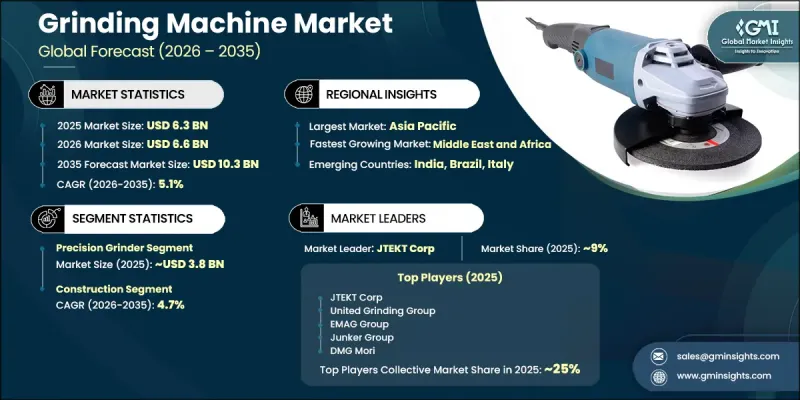
研磨在現代製造業中繼續發揮至關重要的作用,能夠實現高精度表面精加工、成形和材料微加工。各行各業對尺寸精度要求極高的零件的需求不斷成長,推動了對先進研磨解決方案的需求。尤其是在各行業轉型為電氣化、自動化和智慧製造之際,製造商正擴大採用這些設備來滿足不斷變化的生產需求。物聯網連接、機器學習和邊緣運算的整合,正在將研磨設備從傳統機器轉變為能夠進行即時監控和最佳化的智慧生產系統。先進的數控研磨平台現在可以透過互連數據系統支援自動調整、刀具性能增強、熱控制和預測性維護。具備進程內測量、熱補償和雲端監控等功能的AI賦能研磨解決方案,其成本通常比傳統系統高出25%至40%,但它們能夠提高生產率、減少停機時間並提升營運效率,因此正在製造業得到廣泛應用。
| 市場範圍 | |
|---|---|
| 開始年份 | 2025 |
| 預測期 | 2026-2035 |
| 上市時的市場規模 | 63億美元 |
| 預測金額 | 103億美元 |
| 複合年成長率 | 5.1% |
預計到2025年,精密研磨市場規模將達到38億美元,並在2026年至2035年間以5.6%的複合年成長率成長。該市場的成長主要得益於各行業對高精度和表面品質要求日益成長的需求。先進零件產量的不斷提高也推動了對精密研磨技術的需求。此外,立方氮化硼(CBN)和鑽石基超磨粒砂輪等高性能研磨的應用,進一步提高了加工效率,並促進了該市場的擴張。
預計到2025年,建築業將佔據24.8%的市場佔有率,並在2026年至2035年間以4.7%的複合年成長率成長。研磨機廣泛應用於建築相關領域,例如工業設備、金屬結構和專用機械零件的製造、維修和維護。基礎設施建設活動的活性化和工業項目的擴張為研磨設備供應商創造了更多商機。新興經濟體投資的增加預計將支撐該領域需求的持續成長。
美國研磨市場預計到2025年將達到11億美元,並在2026年至2035年間以5.7%的複合年成長率成長。這一成長主要得益於美國對先進製造業和半導體生產能力的投資增加。大型企業不斷擴大的製造舉措催生了對用於精密製造流程的專用研磨解決方案的需求。此外,美國市場正經歷從傳統數控研磨設備向先進智慧研磨系統的轉變,這些系統旨在滿足半導體、航太和電動汽車行業不斷變化的需求。
目錄
第1章:調查方法
第2章執行摘要
第3章 行業洞察
- 產業生態系分析
- 供應商情況
- 製造商
- 中斷
- 零售商
- 利潤率分析
- 每個階段增加的價值
- 影響價值鏈的因素
- 影響產業的因素
- 促進因素
- 向電動車轉型和汽車電氣化
- 製造業回歸國內市場及透過產業政策獎勵策略
- 航太和國防領域的擴張
- 產業潛在風險與挑戰
- 中國工業成長放緩及國內產能過剩
- 積層製造和非磨損工藝的替代方案
- 機會
- 促進因素
- 成長潛力分析
- 技術與創新展望
- 最新科技趨勢
- 新興技術
- 價格分析
- 按產品類型分析歷史價格趨勢
- 依球員類型分類的定價策略(高級球員、超值球員、成本加成球員)
- 貿易數據分析
- 進出口量及進口額趨勢
- 主要貿易路線及關稅的影響
- 監理情勢
- 標準和合規要求
- 區域監理框架
- 認證標準
- 波特的分析
- PESTLE分析
- 人工智慧和生成式人工智慧對市場的影響
- 利用人工智慧改造現有經營模式
- 按細分市場分類的生成式人工智慧用例和部署藍圖
- 風險、限制和監管考量
第4章 競爭情勢
- 介紹
- 企業市佔率分析
- 按地區
- 企業矩陣分析
- 主要市場公司的競爭分析
- 競爭定位矩陣
- 主要進展
- 併購
- 夥伴關係和聯盟
- 新產品發布
- 業務拓展計劃
第5章 市場估算與預測:依產品類型分類,2022-2035年
- 非精密研磨機
- 桌上型砂輪研磨機
- 可攜式研磨機
- 立式研磨機
- 研磨帶研磨機
- 精密研磨機
- 圓柱研磨
- 平面研磨
- 無心研磨
- 工具和刀具研磨
- 其他
- 特殊研磨系統
第6章 市場估算與預測:依自動化類別分類,2022-2035年
- 手動的
- 半自動
- 自動的
- 機器人技術
第7章 市場估計與預測:依材料分類,2022-2035年
- 鐵和金屬
- 非鐵金屬
- 陶瓷和先進材料
- 複合材料及其他
第8章 市場估計與預測:依應用領域分類,2022-2035年
- 車
- 航太
- 醫學領域
- 建造
- 工業製造
- 電氣和電子設備
- 海上
- 其他
第9章 市場估價與預測:依通路分類,2022-2035年
- 直銷
- 間接銷售
第10章 市場估價與預測:依地區分類,2022-2035年
- 北美洲
- 美國
- 加拿大
- 歐洲
- 德國
- 英國
- 法國
- 義大利
- 西班牙
- 瑞典
- 荷蘭
- 亞太地區
- 中國
- 印度
- 日本
- 韓國
- 澳洲
- 印尼
- 拉丁美洲
- 巴西
- 墨西哥
- 阿根廷
- 中東和非洲
- 沙烏地阿拉伯
- UAE
- 南非
第11章:公司簡介
- 世界公司
- United Grinding Group
- JUNKER Group
- DMG MORI
- JTEKT Corporation
- Gleason Corporation
- AMADA Co Ltd
- EMAG Group
- Makino
- 本地公司
- ROSA Ermando
- Danobat Group
- Schaudt(UGG)
- TOS Hostivar
- ELB-Schliff
- Okuma Corporation
- Geibel & Hotz
-
- ACE Micromatic
- BFW
- Hanjiang Machine Tool
- Lapmaster Wolters
- Weldon Solutions
- Nagel Precision
- Woohwa
The Global Grinding Machine Market was valued at USD 6.3 billion in 2025 and is estimated to grow at a CAGR of 5.1% to reach USD 10.3 billion by 2035.
Grinding machines continue to play a crucial role in modern manufacturing by delivering accurate surface finishing, shaping, and material refinement with high precision. The rising requirement for components with strict dimensional accuracy across multiple industries is strengthening demand for advanced grinding solutions. Manufacturers are increasingly adopting these machines to support evolving production requirements, especially as industries move toward electrification, automation, and smart manufacturing. The integration of IoT connectivity, machine learning, and edge computing is transforming grinding equipment from conventional machinery into intelligent production systems capable of real-time monitoring and optimization. Advanced CNC grinding platforms now support automated adjustments, improved tool performance, thermal control, and predictive maintenance capabilities through connected data systems. Although AI-enabled grinding solutions with features such as in-process measurement, thermal correction, and cloud-based monitoring typically carry a 25-40% higher cost than conventional systems, their ability to improve productivity, reduce downtime, and increase operational efficiency is encouraging wider adoption across manufacturing sectors.
| Market Scope | |
|---|---|
| Start Year | 2025 |
| Forecast Year | 2026-2035 |
| Start Value | $6.3 Billion |
| Forecast Value | $10.3 Billion |
| CAGR | 5.1% |
The precision grinder segment generated USD 3.8 billion in 2025 and is expected to grow at a CAGR of 5.6% from 2026 to 2035. Growth in this segment is supported by rising demand from industries where superior accuracy and surface quality are essential manufacturing requirements. Increasing production of advanced components is creating greater demand for precision grinding technologies. The adoption of high-performance grinding materials, including cubic boron nitride (CBN) and diamond-based superabrasive wheels, is further enhancing machining efficiency and supporting segment expansion.
The construction segment represented 24.8% share in 2025 and is projected to grow at a CAGR of 4.7% between 2026 and 2035. Grinding machines are widely used in construction-related applications for manufacturing, repairing, and maintaining industrial equipment, metal structures, and specialized machinery components. Growing infrastructure development activities and expanding industrial projects are creating additional opportunities for grinding equipment suppliers. Increasing investments in developing economies are expected to support continued demand growth within this segment.
U.S. Grinding Machine Market reached USD 1.1 billion in 2025 and is forecast to grow at a CAGR of 5.7% from 2026 to 2035. Growth in the country is supported by increasing investment in advanced manufacturing and semiconductor production capabilities. Expanding fabrication initiatives by leading technology companies are generating demand for specialized grinding solutions used in precision manufacturing processes. The U.S. market is also experiencing a transition from traditional CNC grinding equipment toward advanced smart grinding systems designed to support the changing requirements of semiconductor, aerospace, and electric vehicle industries.
Major players operating in the grinding machine industry include DMG MORI; United Grinding Group; AMADA Co Ltd; JTEKT Corporation; Gleason Corporation; JUNKER Group; EMAG Group; Makino; Danobat Group; ROSA Ermando; Okuma Corporation; Schaudt (UGG); ELB-Schliff; TOS Hostivar; Geibel & Hotz; ACE Micromatic; Hanjiang Machine Tool; BFW; Lapmaster Wolters; Weldon Solutions; Nagel Precision; and Woohwa. Key strategies adopted by companies in the grinding machine market include continuous investment in automation, digital technologies, and advanced machining solutions to improve operational efficiency and product performance. Market participants are focusing on developing smart grinding systems with enhanced connectivity, predictive maintenance capabilities, and improved precision to meet changing customer requirements. Companies are also expanding their product portfolios, strengthening global distribution networks, and forming strategic collaborations to increase market reach. Innovation in grinding technologies, customized solutions, and investment in research and development remain important approaches for companies seeking to improve competitiveness and secure long-term market growth.
Table of Contents
Chapter 1 Research methodology
- 1.1 Research approach
- 1.2 Quality Commitments
- 1.2.1 GMI AI policy & data integrity commitment
- 1.2.1.1 Source consistency protocol
- 1.2.1 GMI AI policy & data integrity commitment
- 1.3 Research trail & confidence scoring
- 1.3.1 Research trail components
- 1.3.2 Scoring components
- 1.4 Data Collection
- 1.4.1 Partial list of primary sources
- 1.5 Data mining sources
- 1.5.1 Paid sources
- 1.5.1.1 Sources, by region
- 1.5.1 Paid sources
- 1.6 Base estimates and calculations
- 1.6.1 Base year calculation
- 1.7 Forecast model
- 1.7.1 Quantified market impact analysis
- 1.7.1.1 Mathematical impact of growth parameters on forecast
- 1.7.1 Quantified market impact analysis
- 1.8 Research transparency addendum
- 1.8.1 Source attribution framework
- 1.8.2 Quality assurance metrics
- 1.8.3 Our commitment to trust
Chapter 2 Executive Summary
- 2.1 Industry 360° synopsis
- 2.2 Business trends
- 2.3 Regional
- 2.4 Type
- 2.5 Automation
- 2.6 Material
- 2.7 Application
- 2.8 Distribution channel
Chapter 3 Industry Insights
- 3.1 Industry ecosystem analysis
- 3.1.1 Supplier landscape
- 3.1.2 Manufacturers
- 3.1.3 Distributors
- 3.1.4 Retailers
- 3.1.5 Profit margin analysis
- 3.1.6 Value addition at each stage
- 3.1.7 Factor affecting the value chain
- 3.2 Industry impact forces
- 3.2.1 Growth drivers
- 3.2.1.1 EV and automotive electrification transition
- 3.2.1.2 Manufacturing reshoring and industrial policy stimulus
- 3.2.1.3 Aerospace and defense sector expansion
- 3.2.2 Industry pitfalls & challenges
- 3.2.2.1 China industrial slowdown and domestic overcapacity
- 3.2.2.2 Additive manufacturing and non-abrasive process substitution
- 3.2.3 Opportunities
- 3.2.1 Growth drivers
- 3.3 Growth potential analysis
- 3.4 Technology and innovation landscape
- 3.4.1 Current technological trends
- 3.4.2 Emerging technologies
- 3.5 Pricing analysis (driven by primary research)
- 3.5.1 Historical price trend analysis by product category
- 3.5.2 Pricing strategy by player type (premium / value / cost-plus)
- 3.6 Trade data analysis (based on paid database)
- 3.6.1 Import/export volume & value trends
- 3.6.2 Key trade corridors & tariff impact
- 3.7 Regulatory landscape
- 3.7.1 Standards and compliance requirements
- 3.7.2 Regional regulatory frameworks
- 3.7.3 Certification standards
- 3.8 Porter's analysis
- 3.9 PESTEL analysis
- 3.10 Impact of AI & generative AI on the market
- 3.10.1 AI-driven disruption of existing business models
- 3.10.2 GenAI use cases & adoption roadmap by segment
- 3.10.3 Risks, limitations & regulatory considerations
Chapter 4 Competitive Landscape, 2025
- 4.1 Introduction
- 4.2 Company market share analysis
- 4.2.1 By Region
- 4.2.1.1 North America
- 4.2.1.2 Europe
- 4.2.1.3 Asia Pacific
- 4.2.1.4 Latin America
- 4.2.1.5 Middle East & Africa
- 4.2.1 By Region
- 4.3 Company matrix analysis
- 4.4 Competitive analysis of major market players
- 4.5 Competitive positioning matrix
- 4.6 Key developments
- 4.6.1 Mergers & acquisitions
- 4.6.2 Partnerships & collaborations
- 4.6.3 New product launches
- 4.6.4 Expansion plans
Chapter 5 Market Estimates & Forecast, By Product Type, 2022 - 2035, (USD Billion) (Units)
- 5.1 Key trends
- 5.2 Non-precision grinder
- 5.2.1 Bench grinder
- 5.2.2 Portable grinder
- 5.2.3 Pedestal grinder
- 5.2.4 Abrasive belt grinder
- 5.3 Precision grinder
- 5.3.1 Cylindrical grinding machines
- 5.3.2 Surface grinding machines
- 5.3.3 Centre-less grinding machines
- 5.3.4 Tool and cutter grinding machines
- 5.3.5 Others
- 5.4 Specialized grinding systems
Chapter 6 Market Estimates & Forecast, By Automation, 2022 - 2035, (USD Billion) (Units)
- 6.1 Key trends
- 6.2 Manual
- 6.3 Semi-automatic
- 6.4 Automatic
- 6.5 Robotic
Chapter 7 Market Estimates & Forecast, By Material, 2022 - 2035, (USD Billion) (Units)
- 7.1 Key trends
- 7.2 Ferrous metals
- 7.3 Non-ferrous metals
- 7.4 Ceramics and advanced materials
- 7.5 Composites and others
Chapter 8 Market Estimates & Forecast, By Application, 2022 - 2035, (USD Billion) (Units)
- 8.1 Key trends
- 8.2 Automotive
- 8.3 Aerospace
- 8.4 Medical
- 8.5 Construction
- 8.6 Industrial manufacturing
- 8.7 Electrical and electronics
- 8.8 Marine
- 8.9 Others
Chapter 9 Market Estimates & Forecast, By Distribution Channel, 2022 - 2035, (USD Billion) (Units)
- 9.1 Key trends
- 9.2 Direct sales
- 9.3 Indirect sales
Chapter 10 Market Estimates & Forecast, By Region, 2022 - 2035, (USD Billion) (Units)
- 10.1 Key trends
- 10.2 North America
- 10.2.1 U.S
- 10.2.2 Canada
- 10.3 Europe
- 10.3.1 Germany
- 10.3.2 UK
- 10.3.3 France
- 10.3.4 Italy
- 10.3.5 Spain
- 10.3.6 Sweden
- 10.3.7 Netherlands
- 10.4 Asia Pacific
- 10.4.1 China
- 10.4.2 India
- 10.4.3 Japan
- 10.4.4 South Korea
- 10.4.5 Australia
- 10.4.6 Indonesia
- 10.5 Latin America
- 10.5.1 Brazil
- 10.5.2 Mexico
- 10.5.3 Argentina
- 10.6 Middle East and Africa
- 10.6.1 Saudi Arabia
- 10.6.2 UAE
- 10.6.3 South Africa
Chapter 11 Company Profiles
- 11.1 Global Players
- 11.1.1 United Grinding Group
- 11.1.2 JUNKER Group
- 11.1.3 DMG MORI
- 11.1.4 JTEKT Corporation
- 11.1.5 Gleason Corporation
- 11.1.6 AMADA Co Ltd
- 11.1.7 EMAG Group
- 11.1.8 Makino
- 11.2 Regional Players
- 11.2.1 ROSA Ermando
- 11.2.2 Danobat Group
- 11.2.3 Schaudt (UGG)
- 11.2.4 TOS Hostivar
- 11.2.5 ELB-Schliff
- 11.2.6 Okuma Corporation
- 11.2.7 Geibel & Hotz
- 11.3 Emerging Players & Innovators
- 11.3.1 ACE Micromatic
- 11.3.2 BFW
- 11.3.3 Hanjiang Machine Tool
- 11.3.4 Lapmaster Wolters
- 11.3.5 Weldon Solutions
- 11.3.6 Nagel Precision
- 11.3.7 Woohwa

 2026-2030年全球研磨市場
 研磨機械市場-2026-2032年全球市場預測
 研磨:市場佔有率分析、產業趨勢與統計、成長預測(2026-2031)
 研磨機械市場規模、佔有率和趨勢分析報告:按類型、應用、地區和細分市場分類(2026-2033 年)數控圓柱研磨市場:按類型、軸數、應用、最終用戶和銷售管道分類-2026-2032年全球市場預測無心研磨市場:2026-2032年全球市場預測(依工具機類型、控制方式、自動化程度、磨料、軸配置、工具機轉速、額定功率、終端用戶產業及銷售管道)
 磨床市場:按組件、型號、加工能力、產品類型、最終用途行業和地區分類數控雙立柱平面研磨市場:依軸配置、磨料類型、自動化程度、操作類型、終端用戶產業、通路分類,全球預測,2026-2032年立式主軸旋轉平面研磨市場:按工具機類型、應用、最終用戶、驅動系統、自動化程度、砂輪材料、工作台尺寸分類,全球預測,2026-2032年離心式研磨和精加工機市場:按類型、材料、最終用途行業和應用分類 - 全球預測,2026-2032 年