


 |
市場調查報告書
商品編碼
2061897
草銨膦:市場佔有率分析、產業趨勢與統計、成長預測(2026-2031)Glufosinate - Market Share Analysis, Industry Trends & Statistics, Growth Forecasts (2026 - 2031) |
||||||

※ 本網頁內容可能與最新版本有所差異。詳細情況請與我們聯繫。
根據 Mordor Intelligence 預測,草銨膦市場規模將從 2025 年的 21 億美元成長到 2026 年的 23 億美元,到 2031 年達到 34 億美元,預計 2026 年至 2031 年的複合年成長率為 7.2%。
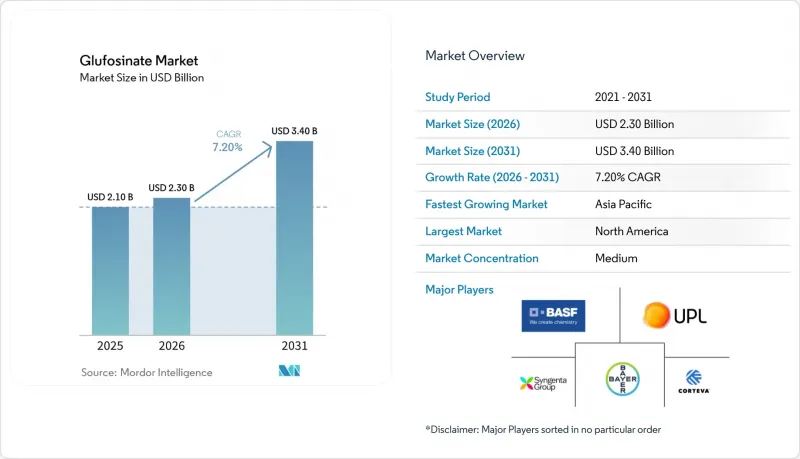
本報告按作物類型(例如穀物)、製劑形式(例如水性懸浮液濃縮液)、處理階段(例如發芽前)、分銷管道(例如線上平台)和地區(北美、歐洲、亞太、南美、非洲和中東)進行細分。市場規模和預測均以美元計價。
全球草銨膦市場趨勢及洞察
Glyphosate抗性雜草蔓延對市場的影響
目前,長芒莧在美國31個州廣泛分佈,水麻在25個州廣泛分佈,這兩種雜草都已被證實對Glyphosate具有抗性。如果不加以控制,它們可使大豆減產高達90%。抗Glyphosate雜草的增加是草銨膦市場的主要驅動力。面對抗性雜草的困擾,農民正轉向草銨膦,將其作為有效的替代除草劑。草銨膦可以控制多種對Glyphosate不再敏感的雜草。在Glyphosate使用量高的地區,這種趨勢尤其明顯,在這些地區,抗性管理策略對於維持作物產量和品質至關重要。
擴大耐草銨膦生物技術作物的種植
耐草銨膦基因改造作物的廣泛應用正在推動市場需求。這些生物技術改良的作物,例如大豆、玉米和棉花,使農民能夠在不損害作物的情況下施用草銨膦。這些耐草銨膦品種的推廣應用正在全球擴大,尤其是在北美和南美,因為它們能夠有效控制雜草、提高產量並增強作物管理技術的柔軟性。此外,對生物技術研發投入的增加正在推動新型耐草銨膦作物品種的推出,預計將進一步促進市場成長。另外,草銨膦非常適合永續農業實踐,因此對於尋求兼顧產量和環境保護的農民來說,它是一個理想的選擇。
新一代羥苯丙酮酸雙加氧酶(HPPD)抑制劑和生物除草劑的出現
新一代羥苯丙酮酸雙加氧酶 (HPPD) 抑制劑和生物除草劑的引入加劇了草銨膦市場的競爭。雖然 HPPD 抑制劑能有效控制闊葉雜草,但源自微生物和植物萃取物等天然生物除草劑正日益受到重視環境永續雜草控制方法的農民的青睞。隨著這些先進替代方案的普及,尤其是在有機、精密農業和永續農業實踐中,它們可能會在某些作物上部分取代草銨膦。為此,生產商正致力於改進配方、提高桶混相容性並實施有針對性的行銷策略,以維持其市場佔有率。
細分市場分析
穀物和穀類領域佔據最大佔有率,預計到2025年將佔草銨膦市場佔有率的44%。這一主導地位源自於小麥、水稻和玉米等主糧作物的廣泛種植,這些作物需要有效的除草劑來控制雜草並提高產量。草銨膦具有廣譜除草效果和低殘留活性,使其特別適用於穀物種植。此外,該領域受益於成熟的施用方法和大型穀物生產商的廣泛採用,鞏固了其作為最大作物類型細分市場的地位。
油籽和豆類作物是成長最快的作物,2026年至2031年的複合年成長率將達到9.8%。這一成長主要得益於全球對富含植物來源和蛋白質的豆類作物的需求不斷成長,以及亞太和南美等地區種植面積的擴大。農民正在增加草銨膦的使用,以提高除草效率並減少作物損失,尤其是在包含油籽和豆類作物的輪作系統中。此外,向永續農業和犁地農業的轉變也促進了草銨膦在這些作物中的應用,因為它有助於土壤保持,同時確保有效的雜草控制。
由於水懸浮液能夠無縫整合到現有的罐混劑和噴灑設備中,預計到2025年,它將成為最大的細分市場,佔據草銨膦市場佔有率的52%。這項優勢源自於其易於操作、在水中分散均勻以及可靠的除草效果。水懸浮液懸浮劑因其穩定的藥效和與標準噴灑設備的兼容性,被農民廣泛應用於穀物、穀類和油籽作物的種植。
乾粉製劑(水分散性顆粒劑)是成長最快的產品,預計2026年至2031年複合年成長率將達到11.2%。這與大型農場青睞的電商配送模式相符。其成長主要得益於更長的保存期限、便捷的運輸以及與精準和機械化噴灑系統的兼容性。由於與液體製劑相比,水分散性顆粒劑徑流較少、耐雨性較強,因此在降雨量大、灌溉條件不穩定的地區,乾粉製劑的應用日益廣泛。此外,乾粉製劑技術的進步提高了其溶解性和功效,使其成為大規模、資源高效型農業實踐的首選。
區域分析
到2025年,北美將繼續保持其最大區域市場的地位,佔據草銨膦市場32.5%的佔有率。這一主導地位歸功於抗除草劑作物的廣泛種植、先進的農業基礎設施以及完善的農藥供應鏈。美國和加拿大的農民之所以使用草銨膦,是因為它具有廣譜除草功效,能夠有效對抗抗Glyphosate雜草,並且與生物技術作物系統相容。此外,強大的分銷網路和健全的法規結構確保了草銨膦產品在全部區域的供應和持續使用。
亞太地區是成長最快的地區,預計2026年至2031年複合年成長率將達到11.2%。這一成長主要得益於中國、印度和東南亞等國家糧食、穀類、油籽和豆類種植面積的擴大,以及耐草銨膦作物品種的引進和現代農業技術的快速應用。此外,農業零售基礎設施的擴建、數位化農業解決方案的引入以及精準噴灑技術的進步也進一步推動了草銨膦的應用。
南美洲的草銨膦市場正在成長,主要得益於巴西甘蔗、咖啡和大豆種植業填補了百草枯留下的市場空白,以及阿根廷針對多重抗藥性雜草的雙重打擊計畫。由於外匯波動和中國供應過剩,投入成本波動較大,但技術轉換和聯合施藥計畫正在抵銷價格波動的影響。德國和法國等歐洲國家仍然是玉米和穀物行業的主要用戶,但對內分泌干擾物的更嚴格監管可能會促使高價值水果種植者改變其策略。
其他好處:
- Excel格式的市場預測(ME)表
- 3個月的分析師支持
目錄
第1章:引言
- 研究假設和市場定義
- 調查範圍
第2章:調查方法
第3章執行摘要
第4章 市場狀況
- 市場概覽
- 市場促進因素
- Glyphosate抗性雜草蔓延對市場的影響
- 擴大耐草銨膦生物技術作物的種植
- 解除管制對Paraquat和麥草畏市場的影響
- 精準噴灑技術的引入提高了對發芽後除草劑的需求。
- 奈米和微膠囊化草銨膦製劑的快速普及
- 可疊加性狀種子混合物可實現雙模式除草劑方案。
- 市場限制因素
- 中國供應過剩導致的價格波動正在影響市場。
- 歐盟嚴格的毒性評估
- 羥苯丙酮酸雙加氧酶(HPPD)對市場的影響
- 降雨模式日益不穩定,人們對雨水抵抗能力表示擔憂。
- 監理情勢
- 技術展望
- 波特五力分析
第5章 市場規模與成長預測
- 按作物類型
- 穀類和穀類食品
- 油籽/豆類
- 水果和蔬菜
- 其他作物類型
- 製劑形式
- 濃縮水懸浮液
- 液態(可溶性)濃縮液
- 乾粉製劑(水分散性顆粒)
- 通過加工階段
- 發芽前
- 發芽後
- 透過分銷管道
- 農業零售商和合作社
- 線上平台
- 其他分銷管道
- 按地區
- 北美洲
- 美國
- 加拿大
- 墨西哥
- 其他北美國家
- 南美洲
- 巴西
- 阿根廷
- 其他南美國家
- 歐洲
- 德國
- 法國
- 英國
- 俄羅斯
- 義大利
- 西班牙
- 其他歐洲國家
- 亞太地區
- 中國
- 印度
- 澳洲
- 日本
- 泰國
- 越南
- 菲律賓
- 其他亞太國家
- 中東
- 土耳其
- 沙烏地阿拉伯
- 其他中東國家
- 非洲
- 南非
- 埃及
- 其他非洲國家
- 北美洲
第6章 競爭情勢
- 市場集中度
- 策略趨勢
- 市佔率分析
- 公司簡介
- BASF SE
- Bayer AG
- UPL Limited
- Syngenta AG
- Nufarm Limited
- Jiangsu Seven-continent Green Chemical Co., Ltd.
- Zhejiang Yongnong Chemical Co., Ltd.
- Fuhua Tongda Chemical Co., Ltd.
- Sumitomo Chemical Co., Ltd.
- Albaugh, LLC
- Limin Chemical Co., Ltd.(Limin Group Co., Ltd.)
- FMC Corporation
- Corteva, Inc.
- Shandong Weifang Rainbow Chemical Co., Ltd.
第7章 市場機會與未來展望
According to Mordor Intelligence, the glufosinate market size is projected to increase from USD 2.1 billion in 2025 to USD 2.3 billion in 2026 and reach USD 3.4 billion by 2031, growing at a CAGR of 7.2% over 2026-2031.
This report is Segmented by Crop Type (Cereals and Grains, and More), by Formulation (Aqueous Suspension Concentrate, and More), by Treatment Stage (Pre-Emergence, and More), by Distribution Channel (Online Platforms and More), and by Geography (North America, Europe, Asia-Pacific, South America, Africa, and Middle East). The Market and Forecasts are Provided in Terms of Value (USD).
Global Glufosinate Market Trends and Insights
Impact of Glyphosate-Resistant Weed Proliferation on the Market
Palmer amaranth nowadays infests 31 United States states and waterhemp 25 states, both showing confirmed glyphosate resistance that slashes soybean yields by up to 90% when unmanaged. The increasing prevalence of glyphosate-resistant weeds is a significant driver for the glufosinate market. Farmers dealing with resistant weed populations are turning to glufosinate as an effective alternative herbicide. It offers control over a broad spectrum of weeds that no longer respond to glyphosate. This trend is particularly prominent in regions with high glyphosate usage, where resistance management strategies are essential to maintaining crop yield and quality.
Expansion of Glufosinate-Tolerant Biotech Crops
The growth of glufosinate-tolerant genetically modified crops is driving market demand. These biotech crops, such as soybeans, maize, and cotton, enable farmers to apply glufosinate without harming the crop. The adoption of these tolerant varieties is expanding globally, particularly in North and South America, as they facilitate effective weed control while supporting higher productivity and flexibility in crop management practices. Furthermore, the increasing investments in biotechnology research and development are leading to the introduction of new glufosinate-tolerant crop varieties, which is projected to further boost market growth. The compatibility of glufosinate with sustainable farming practices also makes it a preferred choice for farmers aiming to balance productivity with environmental stewardship.
Emergence of Next-gen Hydroxyphenylpyruvate Dioxygenase (HPPD) and Bio-Herbicides
The introduction of next-generation Hydroxyphenylpyruvate Dioxygenase (HPPD) inhibitors and bio-herbicides is intensifying competition in the glufosinate market. Hydroxyphenylpyruvate Dioxygenase (HPPD) inhibitors are effective at controlling broadleaf weeds, while bioherbicides derived from natural sources, such as microbes or plant extracts, appeal to farmers prioritizing environmentally sustainable weed control methods. As these advanced alternatives gain popularity, particularly in organic, precision, or sustainable agricultural practices, they may partially replace glufosinate in certain crop applications. In response, manufacturers are focusing on improving formulations, enhancing tank-mix compatibility, and implementing targeted marketing strategies to retain market share.
Other drivers and restraints analyzed in the detailed report include:
- Impact of Paraquat and Dicamba Regulatory Exit on the Market
- Precision-Spraying Adoption Boosting Post-Emergence Demand
- Rainfastness Concerns Under Increasingly Erratic Rainfall Patterns
For complete list of drivers and restraints, kindly check the Table Of Contents.
Segment Analysis
Cereals and grains led the largest segment, with 44% of the glufosinate market share in 2025, this leadership is attributed to the extensive cultivation of staple crops such as wheat, rice, and maize, which require effective herbicidal solutions to manage weeds and enhance yield. Glufosinate's broad-spectrum weed control and low residual activity make it particularly suitable for cereal and grain farming. Furthermore, the segment benefits from established application practices and widespread adoption among large-scale cereal producers, solidifying its position as the largest crop-type segment.
Oilseeds and pulses are the fastest growing, advancing at a 9.8% CAGR through 2026-2031. This growth is driven by increasing global demand for plant-based oils and protein-rich pulses, coupled with expanded cultivation in regions such as Asia-Pacific and South America. Farmers are increasingly adopting glufosinate to enhance weed management efficiency and minimize crop losses, particularly in rotation systems involving oilseeds and legumes. Additionally, the transition toward sustainable and no-till farming practices is boosting glufosinate usage in these crops, as it supports soil conservation while ensuring effective weed control.
Aqueous suspension concentrate led largest segment, with 52% of glufosinate market share in 2025, because they integrate smoothly into existing tank mixes and distribution infrastructure. This dominance is attributed to their ease of handling, uniform dispersion in water, and reliable weed control performance. Suspension concentrates are widely utilized by farmers for cereal, grain, and oilseed crops due to their consistent efficacy and compatibility with standard spraying equipment.
Dry formulation (water-dispersible granules) is fastest growing, projected to grow at an 11.2% CAGR to 2026-2031, aligning with e-commerce shipping models favored by large farms. This growth is driven by their extended shelf life, ease of transport, and compatibility with precision and mechanized spraying systems. WDGs are increasingly adopted in regions with high rainfall or irrigation variability, as they minimize runoff and enhance rainfastness compared to liquid formulations. Additionally, advancements in dry formulation technology are improving solubility and efficacy, making them a preferred choice for large-scale and resource-efficient farming practices.
Geography Analysis
North America remains the largest regional contributor in 2025, with a 32.5% share of the glufosinate market. This dominance is attributed to the widespread adoption of herbicide-tolerant crops, advanced agricultural infrastructure, and a well-established agrochemical supply chain. Farmers in the United States and Canada utilize glufosinate for its broad-spectrum weed control, effectiveness against glyphosate-resistant weeds, and compatibility with biotech crop systems. Additionally, robust distribution networks and strong regulatory frameworks ensure the availability and consistent use of glufosinate products across the region.
Asia-Pacific is the fastest-growing region, with a 11.2% CAGR through 2026-2031. This growth is driven by the increasing cultivation of cereals, grains, oilseeds, and pulses, alongside the adoption of glufosinate-tolerant crop varieties and the rapid implementation of modern farming techniques in countries such as China, India, and Southeast Asia. The expansion of agri-retail infrastructure, adoption of digital farming solutions, and advancements in precision spraying technologies further support the uptake of glufosinate.
South America glufosinate market growing propelled by Brazilian sugarcane, coffee and soybean segments that filled the paraquat void and by Argentine double-hit programs for multi-resistant weeds. Currency swings and Chinese oversupply create input-cost rollercoasters, but trait adoption and stacked programs counterbalance price-induced hesitancy. Europe countries like Germany and France remain core users in corn and cereals, yet high-value fruit growers may pivot if endocrine-disruptor rules tighten.
- BASF SE
- Bayer AG
- UPL Limited
- Syngenta AG
- Nufarm Limited
- Jiangsu Seven-continent Green Chemical Co., Ltd.
- Zhejiang Yongnong Chemical Co., Ltd.
- Fuhua Tongda Chemical Co., Ltd.
- Sumitomo Chemical Co., Ltd.
- Albaugh, LLC
- Limin Chemical Co., Ltd. (Limin Group Co., Ltd.)
- FMC Corporation
- Corteva, Inc.
- Shandong Weifang Rainbow Chemical Co., Ltd.
Additional Benefits:
- The market estimate (ME) sheet in Excel format
- 3 months of analyst support
TABLE OF CONTENTS
1 Introduction
- 1.1 Study Assumptions and Market Definition
- 1.2 Scope of the Study
2 Research Methodology
3 Executive Summary
4 Market Landscape
- 4.1 Market Overview
- 4.2 Market Drivers
- 4.2.1 Impact of glyphosate-resistant weed proliferation on the market
- 4.2.2 Expansion of glufosinate-tolerant biotech crops
- 4.2.3 Impact of paraquat and dicamba regulatory exit on the market
- 4.2.4 Precision-spraying adoption boosting post-emergence demand
- 4.2.5 Rapid uptake of nano-microencapsulated glufosinate formulations
- 4.2.6 Stacked-trait seed mixes enabling dual-mode herbicide programs
- 4.3 Market Restraints
- 4.3.1 Price volatility driven by Chinese oversupply affects the market
- 4.3.2 Stringent toxicology reviews in the European Union
- 4.3.3 Hydroxyphenylpyruvate Dioxygenase (HPPD) impact on the market
- 4.3.4 Rainfastness concerns under increasingly erratic rainfall patterns
- 4.4 Regulatory Landscape
- 4.5 Technological Outlook
- 4.6 Porter's Five Forces Analysis
- 4.6.1 Threat of New Entrants
- 4.6.2 Bargaining Power of Suppliers
- 4.6.3 Bargaining Power of Buyers
- 4.6.4 Threat of Substitutes
- 4.6.5 Intensity of Competitive Rivalry
5 Market Size and Growth Forecasts (Value)
- 5.1 By Crop Type
- 5.1.1 Cereals and Grains
- 5.1.2 Oilseeds and Pulses
- 5.1.3 Fruits and Vegetables
- 5.1.4 Other Crop Types
- 5.2 By Formulation
- 5.2.1 Aqueous Suspension Concentrate
- 5.2.2 Liquid (Soluble) Concentrate
- 5.2.3 Dry Formulation (Water-Dispersible Granules)
- 5.3 By Treatment Stage
- 5.3.1 Pre-Emergence
- 5.3.2 Post-Emergence
- 5.4 By Distribution Channel
- 5.4.1 Agri-Retailers and Cooperatives
- 5.4.2 Online Platforms
- 5.4.3 Other Distribution Channels
- 5.5 By Geography
- 5.5.1 North America
- 5.5.1.1 United States
- 5.5.1.2 Canada
- 5.5.1.3 Mexico
- 5.5.1.4 Rest of North America
- 5.5.2 South America
- 5.5.2.1 Brazil
- 5.5.2.2 Argentina
- 5.5.2.3 Rest of South America
- 5.5.3 Europe
- 5.5.3.1 Germany
- 5.5.3.2 France
- 5.5.3.3 United Kingdom
- 5.5.3.4 Russia
- 5.5.3.5 Italy
- 5.5.3.6 Spain
- 5.5.3.7 Rest of Europe
- 5.5.4 Asia-Pacific
- 5.5.4.1 China
- 5.5.4.2 India
- 5.5.4.3 Australia
- 5.5.4.4 Japan
- 5.5.4.5 Thailand
- 5.5.4.6 Vietnam
- 5.5.4.7 Philippines
- 5.5.4.8 Rest of Asia-Pacific
- 5.5.5 Middle East
- 5.5.5.1 Turkey
- 5.5.5.2 Saudi Arabia
- 5.5.5.3 Rest of Middle East
- 5.5.6 Africa
- 5.5.6.1 South Africa
- 5.5.6.2 Egypt
- 5.5.6.3 Rest of Africa
- 5.5.1 North America
6 Competitive Landscape
- 6.1 Market Concentration
- 6.2 Strategic Moves
- 6.3 Market Share Analysis
- 6.4 Company Profiles (Includes Global Level Overview, Market Level Overview, Core Segments, Financials as Available, Strategic Information, Market Rank/Share, Products And Services, And Recent Developments)
- 6.4.1 BASF SE
- 6.4.2 Bayer AG
- 6.4.3 UPL Limited
- 6.4.4 Syngenta AG
- 6.4.5 Nufarm Limited
- 6.4.6 Jiangsu Seven-continent Green Chemical Co., Ltd.
- 6.4.7 Zhejiang Yongnong Chemical Co., Ltd.
- 6.4.8 Fuhua Tongda Chemical Co., Ltd.
- 6.4.9 Sumitomo Chemical Co., Ltd.
- 6.4.10 Albaugh, LLC
- 6.4.11 Limin Chemical Co., Ltd. (Limin Group Co., Ltd.)
- 6.4.12 FMC Corporation
- 6.4.13 Corteva, Inc.
- 6.4.14 Shandong Weifang Rainbow Chemical Co., Ltd.
7 Market Opportunities and Future Outlook

 Fipronil吡唑市場:全球市場預測,2026-2032年
 Fipronil:市場佔有率分析、行業趨勢和統計數據、成長預測(2026-2031)
 壬二酸市場:依產品等級、應用、最終用戶及地區分類
 全球草銨膦市場:機會與策略展望(至2035年)草銨膦市場:2026-2032 年全球市場預測
 壬酸市場規模、佔有率和成長分析:按產品等級、純度、應用、終端用戶產業和地區分類-2026-2033年產業預測
 草銨膦市場規模、佔有率和成長分析:按製劑、作物類型、應用、加工階段、分銷通路和地區分類-2026-2033年產業預測
 草銨膦市場報告:按作物類型、製劑類型、應用和地區分類(2026-2034 年)Fipronil市場:2026-2032年全球市場預測(依作物類型、製劑類型、劑型、最終用途、應用方法及通路分類)
 Fipronil市場 - 全球產業規模、佔有率、趨勢、機會、預測:按形態、應用、區域和競爭格局分類,2021-2031年