


 |
市場調查報告書
商品編碼
2061759
智慧空氣清淨機:市場佔有率分析、產業趨勢與統計及成長預測(2026-2031)Smart Air Purifier - Market Share Analysis, Industry Trends & Statistics, Growth Forecasts (2026 - 2031) |
||||||

※ 本網頁內容可能與最新版本有所差異。詳細情況請與我們聯繫。
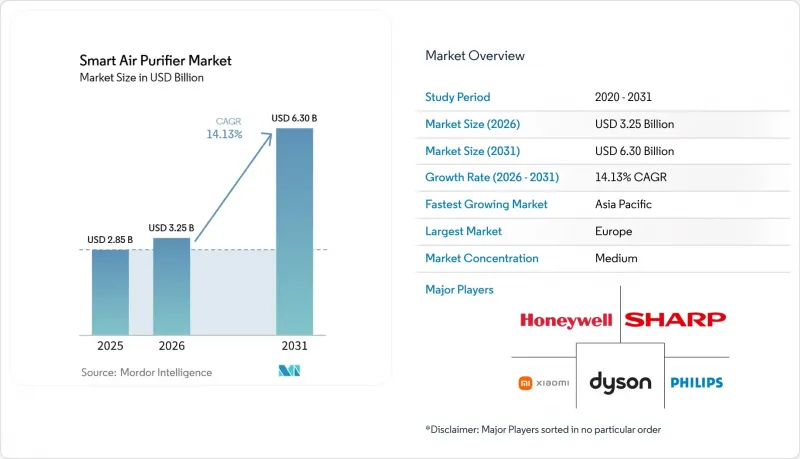
根據 Mordor Intelligence 預測,智慧空氣清淨機市場規模預計在 2025 年達到 28.5 億美元,在 2026 年達到 32.5 億美元,在 2031 年達到 63 億美元。
預計從 2026 年到 2031 年,其複合年成長率將達到 14.13%。
本報告涵蓋產品類型(集塵機、煙氣和廢氣集塵機、其他)、技術(高效能空氣微粒過濾器、離子過濾器、其他)、安裝類型(固定式/可攜式、管道式/中央空調)、應用領域(住宅、商業、工業)、配銷通路(B2C、B2B)以及地區(北美、南美、其他)。市場預測以美元計價。
全球智慧空氣清淨機市場趨勢及洞察
都市區對PM2.5和VOCs的認知不斷提高
主要大都會圈的空氣品質已達到危急水平,預計到2025年,胡志明市和印度德里的嚴重霧霾現象將成為內陸空氣污染的重大新聞。智慧空氣清淨機內建的即時顆粒物感測器,能夠透過易於理解的控制面板顯示這些看不見的危害,從而提高居住者的購買意願。使用者還將污染物濃度的激增與特定的烹飪和清潔活動聯繫起來,促使他們改變行為,進一步凸顯了此類設備的價值。製造商現在不再僅僅將0.3微米顆粒的檢測能力及其與揮發性有機化合物(VOCs)的關聯性作為可選功能進行推廣,而是將其作為證明產品價值的關鍵因素。因此,智慧空氣清淨機市場正受益於消費者日益成長的健康意識,而這種意識與以往的電子產品購買週期相比,對價格的敏感度有所降低。
與智慧家庭生態系統和語音助理整合
暖通空調控制系統與空氣清淨機的整合,使得在室外污染高峰時段能夠自動增加氣流,無需用戶干預即可提升舒適度。語音助理可啟動「潔淨空氣」程序,在居住者回家前提高風扇轉速並啟動UV-C紫外線殺菌模組,從而將空氣清淨機融入他們的日常生活。雲端控制面板整合了空氣品質、入住率和能耗數據,為建築管理人員提供可操作的洞察。這種互通性降低了獨立型號的吸引力,迫使品牌轉向開放API和支援Matter的韌體。這一趨勢促進了重複銷售,因為韌體升級和配件感測器能夠維持產品的效用。
高昂的設備和濾芯更換成本
高效能空氣微粒過濾器(HEPA)濾芯每年每台售價50至150美元,這使得低收入家庭即使在霧霾嚴重的都市區也難以負擔。製造商正在推出靜電過濾器和可清洗過濾器,但要讓消費者相信它們同樣有效,還需要第三方檢驗和行銷成本。在可支配所得成長速度跟不上污染嚴重程度的地區,補貼和「按需付費」模式或許能刺激潛在需求。在成本壁壘降低之前,價格彈性將持續抑制HEPA濾芯的普及,尤其是在需要部署多台設備的場所,例如大型公寓或教室。
細分市場分析
預計到2025年,集塵機將佔空氣清淨機銷量的44.35%,凸顯了家庭和小規模辦公室對PM2.5和過敏原捕集的廣泛需求。其市場主導地位得益於成熟的HEPA過濾器和具有競爭力的價格,尤其吸引了首次購買者。同時,受餐廳、商用廚房和輕工業設施對VOC和油煙控制需求的推動,煙氣和廢氣集塵機的市場正以14.92%的複合年成長率快速成長。目前,多層設計整合了顆粒物收集層、活性碳層和催化劑層,無需單獨的設備。這種整合表明,未來的型號將整合除塵和煙氣控制功能,並簡化維護。 「其他」類別(例如,針對特定病原體的檢測艙和生物過濾塔)雖然規模較小,但對推動感測器技術創新以及這些技術隨後滲透到主流產品線方面發揮著重要作用。這些趨勢共同推動智慧空氣清淨機市場不斷發展,產品類型不斷湧現,以應對新型污染物的特性。
第二代集塵機結合了0.3微米感測器和智慧型手機警報功能,可主動提高風扇轉速。煙塵控制單元整合了耐熱機殼和油脂收集盤,以適應烹飪環境。早期用戶透過減少異味申訴和獲得合規證書證明了投資回報率,推動了該技術在行業的廣泛應用。隨著PM2.5和VOCs標準的日益嚴格,多功能智慧空氣清淨機的整體潛在市場將進一步擴大,從而帶動跨領域研發投資。
在智慧空氣清淨機市場,HEPA系統預計到2025年將佔59.35%的銷售額,這得益於其經證實高達99.97%的去除效率以及與監管測試方法的高度一致性。製造商目前將HEPA過濾器安裝在完全密封的機殼中,以防止旁路,並將這種升級作為「真正的」或「醫用級」產品進行銷售。離子過濾器預計到2031年將以16.32%的複合年成長率成長,以滿足消費者對低功耗和無濾網運作的需求。這種成長趨勢在電費高的市場尤其顯著。 UV-C、活性碳和等離子模組完善了這些技術配置,並經常組合成混合系統,以解決病原體和異味問題。
基於離子的解決方案必須將臭氧排放控制在區域基準值以下。各公司正在推廣合規認證,以增強消費者的信心。疫情後,人們對殺菌功能的需求日益成長,UV-C紫外線淨化器也因此受益,但燈管的頻繁更換導致成本增加。新創公司正在研究光催化氧化和冷等離子體陣列技術,這些技術有望在最大限度減少耗材的同時,分解多種污染物。這些努力凸顯了智慧空氣清淨機市場正在向模組化平台轉型,使用者可以根據污染物環境的變化更換和疊加不同的技術。
區域分析
預計到2025年,歐洲將佔全球銷售額的31.75%。這主要得益於節能空氣清淨機在生態設計指令和消費者生態標章的推動下,已獲得早期普及。該地區的零售商將室內空氣品質與健康產品結合,從而更容易實現提升銷售。隨著商業房地產所有者投資改善空氣品質以滿足綠色租賃要求,市場成長仍在持續。擁有多語言韌體和符合GDPR數據政策的製造商正在贏得消費者信任,並促成重複購買。
亞太地區是智慧空氣清淨機市場成長最快的地區,預計在都市化加速和空氣污染日益嚴重的背景下,將以14.18%的複合年成長率成長。在中國,隨著全國室內空氣監測的普及,公眾意識不斷提高;而在印度,消費者將空氣清淨機視為身分的象徵。可支配收入的增加推動了高級產品的銷售,本土品牌也憑藉本地化的用戶界面和售後服務網路競爭。韓國和日本政府對物聯網空氣品質感測器的補貼也進一步促進了其普及。
在北美,受監管法規的主導,智慧空氣清淨機的需求依然強勁。 PM2.5基準值的提高加速了老舊型號的更換,因為這些老舊型號已不再符合新標準。智慧家庭的普及也促進了對可與現有智慧家庭中心同步的連網空氣清淨機的需求。
在中東和非洲,智慧空氣清淨機市場仍在發展中,但蘊藏著巨大的發展潛力。杜拜斥資5億美元製定的「空氣品質策略」將空氣清淨機納入國家氣候技術組合。沙烏地阿拉伯針對7000家工廠開展的監測活動表明,未來市場需求將受到監管合規性的推動。南美洲的智慧空氣清淨機市場仍處於起步階段,但聖保羅和波哥大日益嚴重的都市區霧霾表明,如果收入水平提高,該市場將具有長期發展潛力。總體而言,監管的進步和經濟發展正在塑造該地區智慧空氣清淨機市場的發展。
其他好處:
- Excel格式的市場預測(ME)表
- 3個月的分析師支持
目錄
第1章:引言
- 研究假設和市場定義
- 調查範圍
第2章:調查方法
第3章執行摘要
第4章 市場狀況
- 市場概覽
- 市場促進因素
- 都市區對PM2.5和VOCs的認知不斷提高
- 與智慧家庭生態系統和語音助理整合
- 加強主要經濟區室內空氣品質法規
- 疫情後消費者在住宅健康領域的支出
- 感測器成本降低,使得嵌入式室內空氣品質 (IAQ) 模組的開發成為可能。
- 根據室內空氣品質 (IAQ) 數據提供的保險費折扣
- 市場限制因素
- 更換設備和過濾器的成本很高。
- 消費者對性能聲明的懷疑態度
- 連網裝置中的資料隱私與網路安全風險
- 對臭氧發生器實施更嚴格的監管
- 產業價值鏈分析
- 波特五力分析
- 洞察最新市場趨勢與創新
- 洞察近期市場趨勢(新產品發布、策略性舉措、投資、合作、合資、業務擴張、併購等)
第5章 市場規模與成長預測
- 依產品類型
- 集塵機
- 煙塵收集器
- 其他
- 透過技術
- HEPA
- 活性碳過濾
- 離子過濾器
- 紫外線技術
- 其他
- 按安裝類型
- 固定式/可攜式
- 管道式中央空調
- 透過使用
- 住宅
- 商業
- 產業
- 透過分銷管道
- B2C/零售
- 多品牌商店
- 品牌自營店
- 線上
- 其他分銷管道
- B2B/廠商直銷
- B2C/零售
- 按地區
- 北美洲
- 加拿大
- 美國
- 墨西哥
- 南美洲
- 巴西
- 秘魯
- 智利
- 阿根廷
- 其他南美國家
- 歐洲
- 英國
- 德國
- 法國
- 西班牙
- 義大利
- 比荷盧經濟聯盟(比利時、荷蘭、盧森堡)
- 北歐國家(丹麥、芬蘭、冰島、挪威、瑞典)
- 其他歐洲國家
- 亞太地區
- 印度
- 中國
- 日本
- 澳洲
- 韓國
- 東南亞(新加坡、馬來西亞、泰國、印尼、越南、菲律賓)
- 其他亞太國家
- 中東和非洲
- 阿拉伯聯合大公國
- 沙烏地阿拉伯
- 南非
- 奈及利亞
- 其他中東和非洲國家
- 北美洲
第6章 競爭情勢
- 市場集中度
- 策略趨勢
- 市佔率分析
- 公司簡介
- Dyson Ltd.
- Sharp Corporation
- Xiaomi Corporation
- Honeywell International Inc.
- Koninklijke Philips NV
- LG Electronics Inc.
- Coway Co., Ltd.
- Levoit(Vesync Co., Ltd.)
- Winix Inc.
- Havells India Ltd.
- Unilever PLC(Blueair AB)
- Smart Air Filters Pvt Ltd.
- Daikin Industries Ltd.
- Samsung Electronics Co., Ltd.
- IQAir AG
- Panasonic Corporation
- Molekule Inc.
- Rabbit Air
- Airversa
- GermGuardian(Guardian Technologies)
- SharkNinja
- Alen Corporation
第7章 市場機會與未來展望
According to Mordor Intelligence, the smart air purifier market size is projected to be USD 2.85 billion in 2025, USD 3.25 billion in 2026, and reach USD 6.30 billion by 2031, growing at a CAGR of 14.13% from 2026 to 2031.
This report is Segmented by Product Type (Dust Collectors, Fume & Smoke Collectors, and Others), Technology (HEPA, Ionic Filter, and More), Installation Type (Stand-Alone / Portable and In-Duct / Central HVAC), Application (Residential, Commercial, and Industrial), Distribution Channel (B2C and B2B), and Geography (North America, South America, and More). The Market Forecasts are Provided in Terms of Value (USD).
Global Smart Air Purifier Market Trends and Insights
Rising Urban PM2.5 & VOC Awareness
Urban air quality deterioration has reached crisis levels in major metropolitan areas, and severe smog episodes in Ho Chi Minh City and Delhi, India, turned inland air pollution into front-page news in 2025. Real-time particulate sensors inside connected purifiers translate invisible hazards into easy-to-read dashboards, raising purchase urgency among city dwellers. Users also link pollutant spikes to specific cooking or cleaning activities, creating behaviour change that further underscores device value. Manufacturers now promote 0.3-micron detection and VOC correlation as proof points rather than optional add-ons. As a result, the smart air purifier market benefits from health-driven demand that is less price-sensitive than previous discretionary gadget cycles.
Integration With Smart-Home Ecosystems & Voice Assistants
Partnerships between HVAC controllers and air purifiers allow automated airflow boosts during peak outdoor pollution periods, improving comfort without user intervention. Voice assistants trigger "clean air" routines that raise fan speeds and switch on UV-C modules before occupants arrive home, embedding purifiers into daily habits. Cloud dashboards consolidate air-quality, occupancy, and energy data, giving building managers actionable insights. This interoperability makes standalone models less attractive, pushing brands toward open APIs and Matter-ready firmware. The dynamic lifts repeat sales because firmware upgrades and accessory sensors extend product relevance.
High Device & Filter-Replacement Costs
Annual HEPA cartridge spend of USD 50-150 per unit deters lower-income households even in cities with hazardous smog . Manufacturers respond with electrostatic or washable filters, but convincing buyers of comparable efficacy requires third-party validation and marketing outlays. In regions where disposable income lags pollution intensity, subsidies or pay-as-you-clean models could unlock latent demand. Until cost barriers ease, price elasticity will curb penetration, especially in multi-device scenarios such as large apartments or classrooms.
Other drivers and restraints analyzed in the detailed report include:
- Stricter Indoor-Air-Quality Regulations in Key Economies
- Falling Sensor Costs Enabling Embedded IAQ Modules
- Consumer Scepticism Over Performance Claims
For complete list of drivers and restraints, kindly check the Table Of Contents.
Segment Analysis
Dust collectors generated 44.35% of the market air purifier revenue in 2025, highlighting their broad appeal for PM2.5 and allergen capture in homes and small offices. Their dominance rests on mature HEPA media and competitive pricing that suits first-time buyers. Fume and smoke collectors, however, are climbing at a 14.92% CAGR as restaurants, commercial kitchens, and light-manufacturing sites target VOCs and grease vapors. Multi-stage designs now blend particulate, activated-carbon, and catalytic layers, reducing the need for separate units. This convergence signals that future models will unify dust and fume control to streamline maintenance. The "Others" niche-pathogen detection pods and biofiltration towers-remains small but influential by pushing sensor innovation that later filters into mainstream lines. Combined, these trends keep the smart air purifier market in a state of product-type evolution responsive to emerging pollutant profiles.
Second-generation dust collectors pair 0.3-micron sensors with smartphone alerts that prompt pre-emptive fan speed increases. Fume and smoke units integrate temperature-resistant housings and grease-collection trays to suit cooking environments. Early adopters validate ROI through lower odor complaints and regulatory compliance certificates, encouraging wider industry uptake. As PM2.5 and VOC standards tighten, the total addressable smart air purifier market size for mixed-use devices will broaden further, stimulating cross-category R&D investment.
In the smart air purifier market, HEPA systems captured 59.35% of 2025 revenue thanks to proven 99.97% removal efficiency and strong alignment with regulatory test methods. Manufacturers now encase HEPA filters within fully sealed housings to prevent bypass and market the upgrade as "true" or "medical-grade." Ionic filters, recording a 16.32% CAGR through 2031, address consumer desire for lower energy draw and filter-free operation. Their trajectory is strongest in markets where electricity tariffs are high. UV-C, activated-carbon, and plasma modules round out the technology mix, often combined in hybrid stacks to attack pathogens and odors.
Ionic solutions must manage ozone output below regional limits; firms advertise compliance certificates to reassure buyers. UV-C add-ons ride post-pandemic interest in germicidal capabilities, yet lamp-replacement cycles add cost. Start-ups explore photocatalytic oxidation and cold-plasma arrays that promise broad-spectrum pollutant breakdown with minimal consumables. This experimentation underscores a wider shift in the smart air purifier market toward modular platforms, letting users swap or layer technologies as pollutant profiles change.
Geography Analysis
Europe generated 31.75% of 2025 revenue as ecodesign directives and consumer eco-labels spurred early adoption of energy-efficient purifiers. The region's retailers position indoor-air quality alongside wellness categories, making upselling easier. Growth continues as commercial landlords invest in air-quality upgrades to meet green-lease clauses. Manufacturers with multilingual firmware and GDPR-compliant data policies gain trust and repeat sales.
Asia-Pacific is the fastest-growing region in the smart air purifier market, with a forecast 14.18% CAGR, underpinned by urbanization and high ambient smog. China's national indoor-air monitoring expansion widens public awareness, while Indian consumers view clean-air devices as status symbols. Rising disposable income supports premium purchases, and local brands compete on localized UI and after-sales networks. Government subsidies for IoT air-quality nodes in South Korea and Japan further boost uptake.
North America shows steady, regulation-driven demand in the smart air purifier market. The tightened PM2.5 limit accelerates the replacement of legacy units unable to meet new benchmarks. Smart-home penetration also favors connected purifiers that sync with existing hubs.
The Middle East and Africa present nascent yet promising opportunities in the smart air purifier market. Dubai's USD 500 million Air Quality Strategy positions clean-air appliances as part of national climate-tech portfolios. Saudi Arabia's monitoring push across 7,000 plants indicates future compliance-led demand. South America remains early stage, but worsening urban smog in Sao Paulo and Bogota hints at long-term potential once income levels rise. Overall, regulatory progress and economic development together shape the smart air purifier market's geographic rollout path.
- Dyson Ltd.
- Sharp Corporation
- Xiaomi Corporation
- Honeywell International Inc.
- Koninklijke Philips N.V.
- LG Electronics Inc.
- Coway Co., Ltd.
- Levoit (Vesync Co., Ltd.)
- Winix Inc.
- Havells India Ltd.
- Unilever PLC (Blueair AB)
- Smart Air Filters Pvt Ltd.
- Daikin Industries Ltd.
- Samsung Electronics Co., Ltd.
- IQAir AG
- Panasonic Corporation
- Molekule Inc.
- Rabbit Air
- Airversa
- GermGuardian (Guardian Technologies)
- SharkNinja
- Alen Corporation
Additional Benefits:
- The market estimate (ME) sheet in Excel format
- 3 months of analyst support
TABLE OF CONTENTS
1 Introduction
- 1.1 Study Assumptions & Market Definition
- 1.2 Scope of the Study
2 Research Methodology
3 Executive Summary
4 Market Landscape
- 4.1 Market Overview
- 4.2 Market Drivers
- 4.2.1 Rising Urban PM2.5 & VOC Awareness
- 4.2.2 Integration With Smart-Home Ecosystems & Voice Assistants
- 4.2.3 Stricter Indoor-Air-Quality Regulations in Key Economies
- 4.2.4 Post-Pandemic Consumer Spend on Residential Wellness
- 4.2.5 Falling Sensor Costs Enabling Embedded IAQ Modules
- 4.2.6 Insurance Premium Discounts Tied to IAQ Data
- 4.3 Market Restraints
- 4.3.1 High Device & Filter-Replacement Costs
- 4.3.2 Consumer Skepticism Over Performance Claims
- 4.3.3 Data-Privacy & Cyber-Security Risks in Connected Units
- 4.3.4 Regulatory Crack-Downs on Ozone-Emitting Devices
- 4.4 Industry Value Chain Analysis
- 4.5 Porter's Five Forces Analysis
- 4.5.1 Threat of New Entrants
- 4.5.2 Bargaining Power of Suppliers
- 4.5.3 Bargaining Power of Buyers
- 4.5.4 Threat of Substitutes
- 4.5.5 Competitive Rivalry
- 4.6 Insights into the Latest Trends and Innovations in the Market
- 4.7 Insights on Recent Developments (New Product Launches, Strategic Initiatives, Investments, Partnerships, JVs, Expansion, M&As, etc.) in the Market
5 Market Size & Growth Forecasts (Value)
- 5.1 By Product Type
- 5.1.1 Dust Collectors
- 5.1.2 Fume & Smoke Collectors
- 5.1.3 Others
- 5.2 By Technology
- 5.2.1 HEPA
- 5.2.2 Activated Carbon Filtration
- 5.2.3 Ionic Filter
- 5.2.4 Ultra-Violet Technology
- 5.2.5 Others
- 5.3 By Installation Type
- 5.3.1 Stand-alone / Portable
- 5.3.2 In-duct / Central HVAC
- 5.4 By Application
- 5.4.1 Residential
- 5.4.2 Commercial
- 5.4.3 Industrial
- 5.5 By Distribution Channel
- 5.5.1 B2C/Retail
- 5.5.1.1 Multi-brand Stores
- 5.5.1.2 Exclusive Brand Outlets
- 5.5.1.3 Online
- 5.5.1.4 Other Distribution Channels
- 5.5.2 B2B/Directly from the Manufacturers
- 5.5.1 B2C/Retail
- 5.6 By Geography
- 5.6.1 North America
- 5.6.1.1 Canada
- 5.6.1.2 United States
- 5.6.1.3 Mexico
- 5.6.2 South America
- 5.6.2.1 Brazil
- 5.6.2.2 Peru
- 5.6.2.3 Chile
- 5.6.2.4 Argentina
- 5.6.2.5 Rest of South America
- 5.6.3 Europe
- 5.6.3.1 United Kingdom
- 5.6.3.2 Germany
- 5.6.3.3 France
- 5.6.3.4 Spain
- 5.6.3.5 Italy
- 5.6.3.6 BENELUX (Belgium, Netherlands, and Luxembourg)
- 5.6.3.7 NORDICS (Denmark, Finland, Iceland, Norway, and Sweden)
- 5.6.3.8 Rest of Europe
- 5.6.4 Asia-Pacific
- 5.6.4.1 India
- 5.6.4.2 China
- 5.6.4.3 Japan
- 5.6.4.4 Australia
- 5.6.4.5 South Korea
- 5.6.4.6 South East Asia (Singapore, Malaysia, Thailand, Indonesia, Vietnam, and Philippines)
- 5.6.4.7 Rest of Asia-Pacific
- 5.6.5 Middle East And Africa
- 5.6.5.1 United Arab of Emirates
- 5.6.5.2 Saudi Arabia
- 5.6.5.3 South Africa
- 5.6.5.4 Nigeria
- 5.6.5.5 Rest of Middle East And Africa
- 5.6.1 North America
6 Competitive Landscape
- 6.1 Market Concentration
- 6.2 Strategic Moves
- 6.3 Market Share Analysis
- 6.4 Company Profiles (includes Global level Overview, Market level overview, Core Segments, Financials as available, Strategic Information, Market Rank/Share for key companies, Products & Services, and Recent Developments)
- 6.4.1 Dyson Ltd.
- 6.4.2 Sharp Corporation
- 6.4.3 Xiaomi Corporation
- 6.4.4 Honeywell International Inc.
- 6.4.5 Koninklijke Philips N.V.
- 6.4.6 LG Electronics Inc.
- 6.4.7 Coway Co., Ltd.
- 6.4.8 Levoit (Vesync Co., Ltd.)
- 6.4.9 Winix Inc.
- 6.4.10 Havells India Ltd.
- 6.4.11 Unilever PLC (Blueair AB)
- 6.4.12 Smart Air Filters Pvt Ltd.
- 6.4.13 Daikin Industries Ltd.
- 6.4.14 Samsung Electronics Co., Ltd.
- 6.4.15 IQAir AG
- 6.4.16 Panasonic Corporation
- 6.4.17 Molekule Inc.
- 6.4.18 Rabbit Air
- 6.4.19 Airversa
- 6.4.20 GermGuardian (Guardian Technologies)
- 6.4.21 SharkNinja
- 6.4.22 Alen Corporation
7 Market Opportunities & Future Outlook
- 7.1 Integration with Smart Home Ecosystems & Data Monetization


