


 |
市場調查報告書
商品編碼
2061592
交通感測器:市場佔有率分析、產業趨勢與統計、成長預測(2026-2031)Traffic Sensors - Market Share Analysis, Industry Trends & Statistics, Growth Forecasts (2026 - 2031) |
||||||

※ 本網頁內容可能與最新版本有所差異。詳細情況請與我們聯繫。
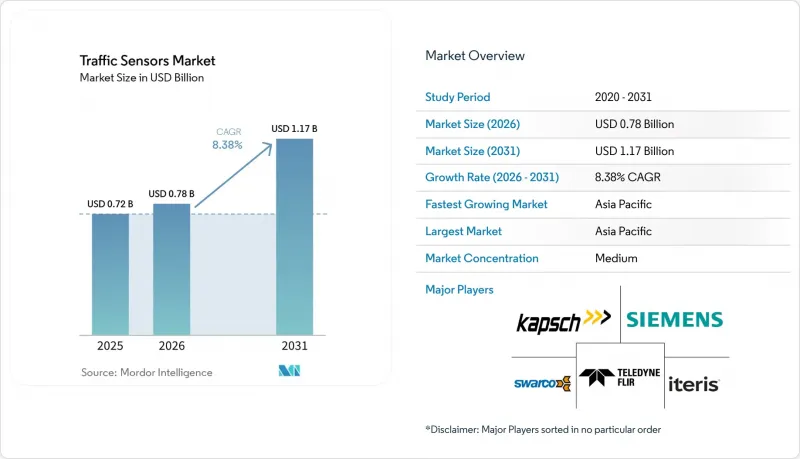
根據 Mordor Intelligence 預測,交通感測器市場規模將從 2025 年的 7.2 億美元成長到 2026 年的 7.8 億美元,然後在 2031 年達到 11.7 億美元,2026 年至 2031 年的複合年成長率為 8.38%。
本報告按感測器類型(例如,導向迴路)、應用(例如,動態重量測量)、安裝方式(例如,侵入式(道路))、安裝位置(例如,都市區十字路口)、最終用戶行業(例如,政府和道路管理機構)、連接技術(例如,有線)和地區進行細分。市場預測以美元計價。
全球交通感測器市場趨勢及洞察
都市化與壅塞壓力
紐約市每年因大都會圈堵塞損失高達200億美元,促使大規模部署感測器,預計將出行時間縮短25%,二氧化碳排放減少20%(交通出行審查委員會)。一項34億美元的聯邦公路安全改善基金正在將交通檢測技術融入道路改造,以減少致命交通事故。中國約800個智慧城市試點計畫正在進一步加速交通感測器的部署,這些計畫涵蓋車輛、行人和微型出行用戶,將交通感測器市場擴展到道路車輛以外的領域。
對智慧城市和智慧交通系統的投資正在激增。
美國SMART津貼在2024年撥款5,000萬美元用於34個項目,為部署配備豐富感測器的路口和邊緣伺服器樹立了先例。歐洲地平線計畫撥款2.54億歐元(約2.76億美元)用於數位化交通基礎建設,並強制要求採用可互通的感測技術。像亞歷山大市耗資500萬美元的智慧運輸計畫這樣的城市級措施表明,資金正迅速流入市政採購領域。
初期實施需要大量資金投入
根據美國智慧交通協會(ITS America)估計,在美國25萬個路口部署V2X技術需要65億美元,而鋪路、人事費用和維護成本進一步加重了這項負擔。雖然低成本無線節點(例如奧克拉荷馬州州40美元的原型機)降低了進入門檻,但開發中國家面臨資金籌措缺口,減緩了科技的普及。羅德島州價值275.9萬美元的橋樑監測協議等合約凸顯了即使是單一資產也需要巨額資本投資。
細分市場分析
預計到2025年,導引線圈仍將佔據交通感測器37.35%的市場佔有率,但雷射雷達(LiDAR)12.02%的複合年成長率表明,市場正朝著非侵入式、高解析度測繪方向發展。隨著營運商對車輛分類和行人安全整合解決方案的需求不斷成長,預計與LiDAR配套的交通感測器市場規模將超過導引線圈。 Seyond的系統實現了99%的車輛辨識準確率和92%的行人辨識率,輕鬆超越了基於導引線圈的替代方案。雷達和熱成像技術可在惡劣天氣條件下與LiDAR形成互補,而壓電陣列仍是動態重量測量(WIM)的關鍵。結合多種測量方法的邊緣感測器能夠收集更豐富的數據,同時降低生命週期成本,並且是聯邦政府SMART指南中的優先考慮因素。
LiDAR的成長趨勢主要得益於組件價格下降、小型化以及車規級可靠性的提升。傳統的環形感測器在適應多模態交通網路方面有局限性,因為它們無法應對路面磨損或車道增加的情況,也無法偵測自行車。當成本和安裝受到限制時,紅外線和磁力計解決方案的作用也較為有限。儘管供應商生態系統正在不斷壯大,但整合能力仍然是關鍵的競爭優勢,因為各機構更傾向於承包分析方案而非原始資料交付。
預計到2025年,固定式感測器將佔總銷售額的53.40%,因為傳統的環形感測器仍將在號誌燈路口佔據主導地位,而可攜式感測器的複合年成長率預計將達到11.84%。交通感測器市場對可快速部署、太陽能供電的設備需求日益成長,這類設備可以避免車道封閉和瀝青路面切割。在奧克拉荷馬州,一款售價40美元的無線節點即使在資金有限的地區也展現出成本競爭力。目前,可攜式LiDAR套件正在幫助建築工地提升現場態勢感知能力,使承包商更容易遵守安全法規。
交通管理人員重視感測器位置的柔軟性,以便根據施工階段、活動或臨時公車專用道進行調整。路側安裝的設備不會影響路面,可在不損害路面完整性的前提下提供多車道覆蓋和診斷功能。從長遠來看,環路維修正朝著雷達-攝影機組合的方向發展,這種組合可提供更高的資料精度和更低的生命週期成本。
區域分析
預計到2025年,亞太地區將佔全球銷售額的34.70%,並將在2031年之前維持11.93%的複合年成長率。中國基於「中國製造2025」計畫的智慧城市示範項目,正推動城市基礎設施預算持續投入人工智慧驅動的偵測技術。日本先進交通系統產業的目標是到2033年實現72.39億美元的市場規模,並將交通流量預測和視覺化技術整合到政府批准的項目中。印度1.4兆美元的國家基礎設施計畫凸顯了對多模態物流監控日益成長的需求。
北美擁有成熟的部署基礎,但仍持續投資於維修和升級。紐約市每年1億美元的SMART預算撥款和壅塞收費系統正在推動邊緣運算設備的轉型。非侵入式感測器適用於維修,在最大限度地減少車道封閉至關重要的地區,此類感測器正逐漸成為採購的主流選擇。加拿大正透過聯邦和省級成本分擔機制實現走廊管理的現代化,而墨西哥則專注於與美墨加協定(USMCA)貿易流量融合的貨運走廊。
在歐洲,感測器專案正與脫碳目標緊密相連。 「地平線歐洲」計畫和10億歐元的「互聯、協作和自動化出行」(CCAM)計畫正在支援多模態感測技術的互通性。德國和英國正在投資鐵路和公路基礎設施,這些基礎設施將整合適用於未來自動駕駛部署的新一代感測器。在中東和非洲,一些感測器部署與大型智慧城市計畫密切相關,而石油出口國則正在資助收費系統和動態稱重網路,以保護重型貨物運輸通道的安全。
其他好處:
- Excel格式的市場預測(ME)表
- 3個月的分析師支持
目錄
第1章:引言
- 研究假設和市場定義
- 調查範圍
第2章:調查方法
第3章執行摘要
第4章 市場狀況
- 市場概覽
- 市場促進因素
- 都市化與交通壅塞壓力
- 智慧城市和智慧交通系統資金激增
- 收費和擁塞收費系統必須使用即時數據
- 考慮電網與電氣化結合的交通管理。
- 邊緣人工智慧、低功耗、非侵入式感測器
- 多模態微移動性偵測標準
- 市場限制因素
- 初期實施需要大量資金投入
- 資料隱私和網路安全合規成本
- 氣候(高溫和鹽分)導致的感測器劣化。
- 協議碎片化阻礙了互通性
- 價值供應鏈分析
- 監理情勢
- 技術展望
- 波特五力模型
第5章 市場規模與成長預測
- 依感測器類型
- 感應線圈
- 壓電
- 彎板
- 磁力計
- 圖片/影片
- 雷達類型
- 紅外線的
- LiDAR
- 透過安裝方法
- 地下式(安裝在道路內)
- 非侵入式(道路/路邊)
- 可攜式/臨時安裝
- 透過使用
- 交通監控與交通流量最佳化
- 駕駛過程中的重量測量
- 車輛分類與分析
- 自動動態收費
- 事件偵測與安全分析
- 按安裝位置
- 都市區交叉路口
- 普通公路和高速公路
- 橋樑和隧道
- 停車處
- 按最終用途類別
- 政府和道路管理機構
- 收費公路經營/公私合營特許特許經營
- 智慧城市解決方案整合商
- 物流和車輛管理公司
- 透過連接技術
- 有線(CAN、乙太網路)
- 無線(DSRC/C-V2X)
- 蜂巢式物聯網(NB-IoT/LTE-M/5G)
- LPWAN(LoRa/Sigfox)
- 按地區
- 北美洲
- 美國
- 加拿大
- 墨西哥
- 南美洲
- 巴西
- 阿根廷
- 其他南美國家
- 歐洲
- 德國
- 英國
- 法國
- 西班牙
- 義大利
- 其他歐洲國家
- 亞太地區
- 中國
- 日本
- 印度
- 澳洲
- 其他亞太國家
- 中東和非洲
- GCC
- 南非
- 其他中東和非洲國家
- 北美洲
第6章 競爭情勢
- 策略趨勢
- 市佔率分析
- 公司簡介
- Kapsch TrafficCom AG
- Siemens AG
- FLIR(Teledyne)
- Iteris Inc.
- Q-Free ASA
- SWARCO AG
- International Road Dynamics
- Sensys Networks Inc.
- Kistler Group
- Bosch Security & Safety Systems
- Axis Communications
- Smartmicro GmbH
- SICK AG
- EFKON GmbH
- Citilog(Swarco)
- Raytheon Technologies
- Sensata Technologies
- LeddarTech Inc.
- IHI Corporation
- Acyclica(FLIR)
第7章 市場機會與未來展望
According to Mordor Intelligence, the traffic sensors market size is expected to grow from USD 0.72 billion in 2025 to USD 0.78 billion in 2026 and is forecast to reach USD 1.17 billion by 2031 at 8.38% CAGR over 2026-2031.
This report is Segmented by Sensor Type (Inductive Loop, and More), Application ( Weigh in Motion and More), Installation Method (Intrusive (In-Road) and More), Deployment Location (Urban Intersections and More), End-Use Sector (Government and Road Agencies and More), Connectivity Technology (Wired and More) and by Geography. The Market Forecasts are Provided in Terms of Value (USD).
Global Traffic Sensors Market Trends and Insights
Urbanisation & Congestion Pressure
Metropolitan congestion costs New York USD 20 billion each year, prompting large-scale sensor roll-outs that shorten travel times by as much as 25% and trim CO2 output up to 20% trafficmobilityreviewboard. Federal Highway Safety Improvement funds of USD 3.4 billion embed detection into roadway upgrades to cut fatalities. China's nearly 800 smart-city pilots further accelerate deployments that span vehicles, pedestrians and micromobility users, broadening the traffic sensors market beyond road vehicles alone
Smart-City & ITS Funding Surge
The USD SMART Grants program disbursed USD 50 million across 34 projects in 2024, setting precedents for sensor-rich intersections and edge servers .Horizon Europe earmarked EUR 254 million (USD 276 million) to digital transport infrastructure that mandates interoperable detection. City-level initiatives, such as Alexandria's USD 5 million smart-mobility plan, confirm that funding is cascading rapidly to municipal procurement
High Up-Front Deployment CAPEX
ITS America estimates USD 6.5 billion is needed to equip 250,000 U.S. intersections with V2X technology, a burden intensified by paving, labor and maintenance costs . Developing economies face financing gaps that delay roll-outs, although low-cost wireless nodes such as Oklahoma's USD 40 prototype ease entry barriers Contracts like Rhode Island's USD 2.759 million bridge monitoring deal highlight the sizable capital commitment even for individual assets
Other drivers and restraints analyzed in the detailed report include:
- Mandated Real-Time Data for Tolling & Congestion Pricing
- Edge-AI Low-Power Non-Intrusive Sensors
- Data-Privacy & Cyber-Security Compliance Costs
For complete list of drivers and restraints, kindly check the Table Of Contents.
Segment Analysis
Inductive loops retained 37.35% traffic sensors market share in 2025, yet LiDAR's 12.02% CAGR signals a pivot to non-intrusive, high-resolution mapping. The traffic sensors market size attached to LiDAR solutions is projected to outpace loops as operators seek vehicle classification and pedestrian safety in one package. Seyond's system posts 99% vehicle accuracy and 92% pedestrian recognition, outperforming loop-based alternatives simpl.. Radar and thermal imaging complement LiDAR in adverse weather, while piezoelectric arrays remain vital for weigh-in-motion. Edge-ready sensors that combine modalities collect richer data with lower lifecycle cost, a priority under federal SMART guidance
LiDAR's upward curve is reinforced by falling component prices, smaller form factors and automotive-grade reliability. Traditional loops struggle with pavement wear and lane additions, and their inability to detect cyclists limits suitability for multimodal grids. Infrared and magnetometer solutions hold niche roles where cost or site constraints dictate. A diverse supplier ecosystem is emerging, yet integration skill remains a differentiator as agencies favor turnkey analytics over raw feed delivery.
Intrusive installs made up 53.40% revenue in 2025 as legacy loops dominate signalized junctions, but portable sensors are forecast for 11.84% CAGR. The traffic sensors market increasingly rewards quick-deploy, solar-powered units that avoid lane closures and asphalt cutting. Oklahoma's USD 40 wireless node underscores cost competitiveness even for cash-constrained districts. Portable LiDAR kits now underpin work-zone situational awareness, easing contractor compliance with safety mandates.
Traffic managers prioritize flexibility to realign sensors with construction phases, events or pop-up bus lanes. Non-intrusive over-road gear delivers multi-lane coverage and diagnostics without disturbing pavement integrity. Long-term, loop retrofits shift toward radar-camera combos delivering higher data fidelity and lower lifetime spend.
Geography Analysis
Asia-Pacific generated 34.70% 2025 revenue and posts a 11.93% CAGR through 2031. China's smart-city pilots, anchored in the Made in China 2025 program, keep urban infrastructure budgets flowing toward AI-enabled detection. Japan's advanced traffic systems sector targets USD 7.239 billion by 2033 as Ministry-approved projects integrate flow prediction and visualization. India's USD 1.4 trillion National Infrastructure Pipeline underlines rising demand for multimodal logistics monitoring .
North America commands mature install bases yet continues to invest in retrofit upgrades. USD 100 million annual SMART allocations and congestion pricing in New York spur edge-ready replacements. Retrofit-friendly, non-intrusive sensors dominate procurements that must minimize lane closures. Canada modernizes corridor management through federal-provincial cost sharing, whereas Mexico focuses on freight corridors linked to USMCA trade flows.
Europe links sensor projects to decarbonization targets. Horizon Europe and the EUR 1 billion Connected, Cooperative and Automated Mobility program fund multi-modal detection interoperability. Germany and the UK channel funds into rail and high-speed roadways that embed next-gen sensors suitable for future autonomous deployment. Middle East and Africa exhibit selective adoption tied to flagship smart-city schemes, though oil-exporting states fund toll and weigh-in-motion networks to safeguard heavy-load corridors.
- Kapsch TrafficCom AG
- Siemens AG
- FLIR (Teledyne)
- Iteris Inc.
- Q-Free ASA
- SWARCO AG
- International Road Dynamics
- Sensys Networks Inc.
- Kistler Group
- Bosch Security & Safety Systems
- Axis Communications
- Smartmicro GmbH
- SICK AG
- EFKON GmbH
- Citilog (Swarco)
- Raytheon Technologies
- Sensata Technologies
- LeddarTech Inc.
- IHI Corporation
- Acyclica (FLIR)
Additional Benefits:
- The market estimate (ME) sheet in Excel format
- 3 months of analyst support
TABLE OF CONTENTS
1 INTRODUCTION
- 1.1 Study Assumptions and Market Definition
- 1.2 Scope of the Study
2 RESEARCH METHODOLOGY
3 EXECUTIVE SUMMARY
4 MARKET LANDSCAPE
- 4.1 Market Overview
- 4.2 Market Drivers
- 4.2.1 Urbanisation and Congestion Pressure
- 4.2.2 Smart-City and ITS Funding Surge
- 4.2.3 Mandated Real-Time Data for Tolling and Congestion Pricing
- 4.2.4 Electrification-Linked Grid-Aware Traffic Management
- 4.2.5 Edge-AI Low-Power Non-Intrusive Sensors
- 4.2.6 Multimodal Micromobility Detection Standards
- 4.3 Market Restraints
- 4.3.1 High Up-Front Deployment CAPEX
- 4.3.2 Data-Privacy & Cyber-Security Compliance Costs
- 4.3.3 Climate-Driven Sensor Degradation (Heat and Salinity)
- 4.3.4 Fragmented Protocols Hindering Interoperability
- 4.4 Value / Supply-Chain Analysis
- 4.5 Regulatory Landscape
- 4.6 Technological Outlook
- 4.7 Porters Five Forces
- 4.7.1 Threat of New Entrants
- 4.7.2 Bargaining Power of Buyers
- 4.7.3 Bargaining Power of Suppliers
- 4.7.4 Threat of Substitutes
- 4.7.5 Competitive Rivalry
5 MARKET SIZE & GROWTH FORECASTS (VALUE)
- 5.1 By Sensor Type
- 5.1.1 Inductive Loop
- 5.1.2 Piezoelectric
- 5.1.3 Bending Plate
- 5.1.4 Magnetometer
- 5.1.5 Image / Video
- 5.1.6 Radar-Based
- 5.1.7 Infrared
- 5.1.8 LiDAR
- 5.2 By Installation Method
- 5.2.1 Intrusive (In-Road)
- 5.2.2 Non-Intrusive (Over-Road / Roadside)
- 5.2.3 Portable / Temporary
- 5.3 By Application
- 5.3.1 Traffic Monitoring and Flow Optimisation
- 5.3.2 Weigh-In-Motion
- 5.3.3 Vehicle Classification and Profiling
- 5.3.4 Automated and Dynamic Tolling
- 5.3.5 Incident Detection and Safety Analytics
- 5.4 By Deployment Location
- 5.4.1 Urban Intersections
- 5.4.2 Highways and Expressways
- 5.4.3 Bridges and Tunnels
- 5.4.4 Parking Facilities
- 5.5 By End-Use Sector
- 5.5.1 Government and Road Agencies
- 5.5.2 Toll Operators / PPP Concessions
- 5.5.3 Smart-City Solution Integrators
- 5.5.4 Logistics and Fleet Operators
- 5.6 By Connectivity Technology
- 5.6.1 Wired (CAN, Ethernet)
- 5.6.2 Wireless (DSRC / C-V2X)
- 5.6.3 Cellular-IoT (NB-IoT / LTE-M / 5G)
- 5.6.4 LPWAN (LoRa / Sigfox)
- 5.7 By Geography
- 5.7.1 North America
- 5.7.1.1 United States
- 5.7.1.2 Canada
- 5.7.1.3 Mexico
- 5.7.2 South America
- 5.7.2.1 Brazil
- 5.7.2.2 Argentina
- 5.7.2.3 Rest of South America
- 5.7.3 Europe
- 5.7.3.1 Germany
- 5.7.3.2 United Kingdom
- 5.7.3.3 France
- 5.7.3.4 Spain
- 5.7.3.5 Italy
- 5.7.3.6 Rest of Europe
- 5.7.4 APAC
- 5.7.4.1 China
- 5.7.4.2 Japan
- 5.7.4.3 India
- 5.7.4.4 Australia
- 5.7.4.5 Rest of APAC
- 5.7.5 Middle East and Africa
- 5.7.5.1 GCC
- 5.7.5.2 South Africa
- 5.7.5.3 Rest of Middle East and Africa
- 5.7.1 North America
6 COMPETITIVE LANDSCAPE
- 6.1 Strategic Moves
- 6.2 Market Share Analysis
- 6.3 Company Profiles (includes Global level Overview, Market level overview, Core Segments, Financials as available, Strategic Information, Market Rank/Share for key companies, Products & Services, and Recent Developments)
- 6.3.1 Kapsch TrafficCom AG
- 6.3.2 Siemens AG
- 6.3.3 FLIR (Teledyne)
- 6.3.4 Iteris Inc.
- 6.3.5 Q-Free ASA
- 6.3.6 SWARCO AG
- 6.3.7 International Road Dynamics
- 6.3.8 Sensys Networks Inc.
- 6.3.9 Kistler Group
- 6.3.10 Bosch Security & Safety Systems
- 6.3.11 Axis Communications
- 6.3.12 Smartmicro GmbH
- 6.3.13 SICK AG
- 6.3.14 EFKON GmbH
- 6.3.15 Citilog (Swarco)
- 6.3.16 Raytheon Technologies
- 6.3.17 Sensata Technologies
- 6.3.18 LeddarTech Inc.
- 6.3.19 IHI Corporation
- 6.3.20 Acyclica (FLIR)
7 MARKET OPPORTUNITIES AND FUTURE OUTLOOK
- 7.1 White-Space and Unmet-Need Assessment


