


 |
市場調查報告書
商品編碼
2044163
感測器融合:市場佔有率分析、產業趨勢與統計、成長預測(2026-2031)Sensor Fusion - Market Share Analysis, Industry Trends & Statistics, Growth Forecasts (2026 - 2031) |
||||||

※ 本網頁內容可能與最新版本有所差異。詳細情況請與我們聯繫。
2025 年感測器融合市場價值為 87.4 億美元,預計到 2031 年將達到 182.1 億美元,而 2026 年為 100.4 億美元,預測期(2026-2031 年)複合年成長率為 12.65%。
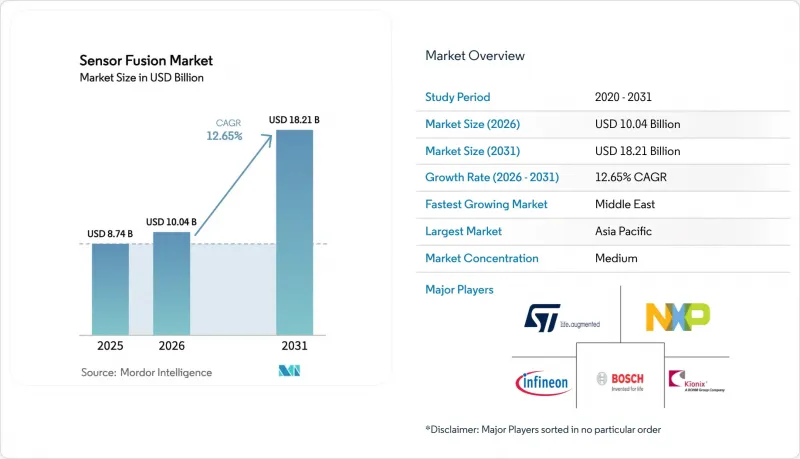
固態LiDAR成本的持續下降、歐洲新車安全評鑑協會(Euro NCAP)日益嚴格的安全標準以及邊緣人工智慧矽技術的進步,正促使原始設備製造商(OEM)的預算轉向多感測器套件,將攝影機、雷達、雷射雷達和慣性測量單元整合到單一堆堆疊中。汽車製造商正在跨平台實現感測器融合硬體的標準化,以避免重新設計成本;而消費性電子產品製造商則採用設備端推理技術,以降低雲端延遲並遵守隱私法規。一級供應商和半導體巨頭之間日益激烈的競爭給硬體利潤率帶來了壓力,但訂閱式融合軟體和空中下載功能更新的成長正在抵消這一趨勢的影響。流入成像雷達和軟體定義雷射雷達新創公司的資金正在加速創新週期,縮短新技術的上市時間,並加強冗餘策略。
全球感測器融合市場趨勢與洞察
Euro NCAP 五星評級體系強制使用感測器融合技術,正在加速歐洲汽車製造商對該技術的採用。
歐洲新車安全評鑑協會 (Euro NCAP) 2026 年版協議強制要求車輛必須整合雷達或LiDAR攝影機才能獲得五星評級,這促使歐洲汽車製造商即時對其量產車型進行重新設計。大眾汽車已確認,從 2026 年起,所有基於 MEB 平台的車型都將配備雷達-攝影機融合系統,從而淘汰單感測器架構。由於汽車製造商必須以承包的方式滿足法規要求,因此擁有認證中間件的一級供應商正在贏得設計訂單。這項法規的全球影響在出口到亞太和南美地區的車型中尤其顯著,這些地區的工程師透過重複使用歐洲規格的平台來最大限度地減少差異。這項政策轉變使得多感測器冗餘成為標準配置,而非高級選配。
固態LiDAR成本的降低使得在中檔車輛上安裝多感測器套件成為可能。
和賽科技的目標是利用矽光電和大規模生產的規模經濟,在2026年底前推出售價低於500美元的固態雷射雷達。比亞迪已在其售價低於2.5萬美元的轎車上配備了雷射雷達、攝影機和雷達陣列,將其業務範圍擴展到豪華車以外的領域。吉利的「銀河」計畫也採用了類似的策略,而歐洲和北美的競爭對手也在加速推進其固態雷射雷達的藍圖。預計到2027年,中國國內的LiDAR年產量將超過200萬台,這將建立起供應鏈優勢,並鞏固其在區域內普及經濟型高級駕駛輔助系統(ADAS)領域的領先地位。
缺乏統一的融合架構標準阻礙了互通性。
SAE關於ADAS感測器介面的指南仍屬自願性質。同時,AUTOSAR、ROS 2和各種專有協定堆疊正在爭奪主導。汽車製造商在更換感測器供應商時面臨高昂的工程成本,而且空中下載(OTA)更新需要花費大量時間對不同協議進行重新檢驗。儘管產業聯盟致力於建立開放模式,但預計在2028年之前無法就資料時序和故障模式處理達成一致,這將阻礙平台的可擴展性。
細分市場分析
預計到2025年,硬體將佔感測器融合市場銷售額的61.73%,這反映了構成物理感測層的雷達、LiDAR、攝影機和慣性測量單元(IMU)模組的資本密集特性。雷達模組的價格在50美元到150美元之間,憑藉其在各種天氣條件下的出色性能,在高級駕駛輔助系統(ADAS)市場佔據主導地位。固態LiDAR的單價仍超過500美元,目前僅限於需要冗餘的3-5級自動駕駛項目。影像感測器受益於智慧型手機的經濟效益,使得多相機陣列的單價低於10美元。雖然硬體驅動的感測器融合市場規模預計將穩定成長,但其成長速度可能慢於軟體市場。
隨著原始設備製造商 (OEM) 轉向無線功能解鎖和訂閱模式,預計到 2031 年,軟體市場將以 12.68% 的複合年成長率 (CAGR) 超越硬體市場。 Mobileye SuperVision 等平台透過按車輛收取授權費,正在將一次性硬體銷售轉變為持續的收入來源。 ISO 26262檢驗工具進一步提高了利潤率,汽車製造商平均每個平台花費 500 萬至 1000 萬美元用於認證其融合堆疊。這些趨勢鞏固了軟體作為感測器融合產業中最具價值創造層的地位。
雷達與攝影機的融合技術,結合了雷達的速度和精度以及攝影機的物體分類能力,預計到2025年將佔據感測器融合市場43.56%的佔有率。大陸集團的ARS540 4D雷達擴展了高空解析度,並提高了在複雜城市環境中的性能(CONTINENTAL.COM)。在售價低於500美元的固態單元的支援下,LiDAR和攝影機融合技術預計將以12.72%的最高複合年成長率成長。賓士和Stellantis已採用法雷奧的SCALA 3雷射雷達實現L3級自動駕駛能力,這表明該技術正從原型階段走向量產階段。
整合式雷達、LiDAR和攝影機的三感測器配置仍屬於小眾市場,主要應用於高階自動駕駛計程車項目,因為在這些項目中,冗餘設計比成本更為重要。同時,由於IMU-GPS融合技術對組件成本的影響極小,因此在無人機和智慧型手機領域正日益普及。隨著固態LiDAR的價格接近成像雷達,預計混合技術也將應用於中階車型,感測器融合市場有望拓展到豪華車以外的領域。
感測器融合市場按交付方式(硬體、軟體)、融合方式(雷達+攝影機融合、雷射雷達+攝影機融合、其他)、演算法類型(卡爾曼濾波器(EKF、UKF)、貝氏網路、其他)、應用、車輛類型和地區進行細分。市場預測以美元計價。
區域分析
到2025年,亞太地區將佔全球市場佔有率的40.81%,並成為收入最高的地區。這主要得益於中國積極推廣高階駕駛輔助系統(ADAS)、日本的機器人生態系統以及韓國的半導體供應鏈。光是中國就將佔該地區銷售額的58%,這主要得益於比亞迪、吉利和蔚來汽車在電動車(EV)中對多感測器套件的標準化應用。政府針對L2級自動駕駛功能的補貼獎勵進一步推動了該技術的普及,而國內LiDAR產能的提升也加劇了本土汽車製造商之間的價格競爭。
2025年,歐洲在全球銷售中佔據了相當大的佔有率,這得益於嚴格的歐洲新車安全評鑑協會(Euro NCAP)規則和通用安全法規對多模態感測技術的強制要求。德國是區域需求的主要驅動力,大眾、寶馬和梅賽德斯-奔馳等汽車製造商已在平台層面整合感測融合技術和堆疊,將研發投入分散到多個品牌。隨著監管範圍在2028年擴展至商用車和摩托車,預計歐洲感測器融合市場將保持穩定成長。
預計到2025年,北美將佔據相當大的市場佔有率,這主要得益於美國汽車製造商在高級駕駛輔助系統(ADAS)領域的自願投入以及5.9 GHz頻段車聯網(V2X)頻率的分配。中東地區雖然目前規模較小,但預計到2031年將實現12.75%的複合年成長率,成為成長最快的地區,這主要得益於阿拉伯聯合大公國和沙烏地阿拉伯將國防預算用於需要強大融合技術的自主資產。南美和非洲由於汽車保有量低以及雷射雷達供應鏈的限制,目前整體收入佔有率較小,但採礦和農業的自動化正在創造新的機會。
其他好處
- Excel格式的市場預測(ME)表
- 3個月的分析師支持
目錄
第1章:引言
- 研究假設和市場定義
- 調查範圍
第2章:調查方法
第3章執行摘要
第4章 市場狀況
- 市場概覽
- 市場促進因素
- Euro NCAP 五星評級體系強制使用感測器融合技術,這正在加速歐洲汽車製造商對該技術的採用。
- 降低固態雷射雷達的成本,使得在中國的中檔車輛上部署多感測器套件成為可能。
- 邊緣人工智慧晶片的進步使得行動裝置和XR設備能夠實現即時多模態融合。
- 在智慧工廠中引入AMR機器人需要高精度感測器融合。
- 為中東地區的多感測器目標獲取和導航系統國防現代化專案提供資金。
- 整合 V2X 資料流融合和協定堆疊,用於在美國實現 L4 級自動駕駛。
- 市場限制因素
- 缺乏統一的融合架構標準阻礙了互通性。
- 非汽車物聯網設備的高運算負荷推高了組件成本。
- 新興市場對雷射雷達的接受度較低,限制了多模態融合技術的應用。
- 關於基於雲端的感測器融合管道的數據隱私和網路安全問題
- 價值鏈分析
- 監管和技術展望
- 多感測器融合平台的技術演進藍圖
- 邊緣人工智慧整合和SoC技術進步
- 宏觀經濟因素對市場的影響
- 波特五力分析
- 供應商的議價能力
- 買方的議價能力
- 新進入者的威脅
- 替代品的威脅
- 競爭公司之間的競爭
- 主要市場趨勢
- 主要專利和研究活動
- 主要和新興應用
- 主動車距控制巡航系統(ACC)
- 自動緊急煞車(AEB)
- 電子穩定控制系統(ESC)
- 前向碰撞警報(FCW)
- 其他新興應用
第5章 市場規模與成長預測
- 以規定形式
- 硬體
- 軟體
- 透過熔融法
- 雷達+攝影機融合
- LiDAR+相機融合
- 雷達+LiDAR融合
- IMU+GPS融合
- 三感測器融合(攝影機+雷達+LiDAR)
- 按演算法類型
- 卡爾曼濾波(EKF、UKF)
- 貝氏網路
- 神經網路,深度學習
- 全球導航衛星系統(GNSS)與慣性導航系統(INS)的融合
- 透過使用
- 高級駕駛輔助系統(ADAS)
- ACC
- AEB
- ESC
- FCW
- 車道維持輔助系統(LKA)
- 自動駕駛(3-5級)
- 家用電器(AR、VR、智慧型手機、穿戴式裝置)
- 機器人和無人機
- 工業自動化和智慧製造
- 國防/航太
- 高級駕駛輔助系統(ADAS)
- 按車輛類型
- 搭乘用車
- 輕型商用車
- 大型商用車輛
- 其他自動駕駛汽車
- 按地區
- 北美洲
- 美國
- 加拿大
- 墨西哥
- 歐洲
- 德國
- 英國
- 法國
- 義大利
- 西班牙
- 其他歐洲國家
- 亞太地區
- 中國
- 日本
- 韓國
- 印度
- 亞太其他地區
- 南美洲
- 巴西
- 阿根廷
- 南美洲其他地區
- 中東
- 沙烏地阿拉伯
- 阿拉伯聯合大公國
- 土耳其
- 其他中東國家
- 非洲
- 南非
- 奈及利亞
- 埃及
- 其他非洲地區
- 北美洲
第6章 競爭情勢
- 市場集中度
- 策略趨勢
- 市佔率分析
- 公司簡介
- Robert Bosch GmbH
- Continental AG
- NXP Semiconductors NV
- STMicroelectronics NV
- Infineon Technologies AG
- Texas Instruments Inc.
- Nvidia Corporation
- Qualcomm Incorporated
- Analog Devices Inc.
- Mobileye Global Inc.
- Aptiv PLC
- Renesas Electronics Corporation
- Valeo SA
- ZF Friedrichshafen AG
- Arbe Robotics Ltd.
- BASELABS GmbH
- LeddarTech Inc.
- TDK Corporation
- Kionix Inc.(ROHM)
- Memsic Inc.
- CEVA Inc.
- AMD Xilinx
第7章 市場機會與未來展望
The sensor fusion market size was valued at USD 8.74 billion in 2025 and estimated to grow from USD 10.04 billion in 2026 to reach USD 18.21 billion by 2031, at a CAGR of 12.65% during the forecast period (2026-2031).
Sustained cost reductions in solid-state LiDAR, rising Euro NCAP safety mandates, and breakthroughs in edge-AI silicon are shifting original-equipment budgets toward integrated multi-sensor suites that combine cameras, radar, LiDAR, and inertial units in a single stack. Vehicle manufacturers are standardizing sensor-fusion hardware across entire platforms to avoid redesign costs, while consumer-electronics brands adopt on-device inference to cut cloud latency and comply with privacy regulations. Intensifying competition among tier-one suppliers and semiconductor leaders is compressing hardware margins, a trend offset by growth in subscription-based fusion software and over-the-air feature unlocks. Capital inflows into imaging-radar and software-defined LiDAR start-ups are accelerating innovation cycles, reducing time-to-market for new modalities and enhancing redundancy strategies.
Global Sensor Fusion Market Trends and Insights
Mandate Of Sensor Fusion For Euro NCAP 5-Star Ratings Accelerating European OEM Adoption
Euro NCAP's 2026 protocols require radar-camera or LiDAR-camera integration to secure a 5-star score, driving immediate redesigns of volume models by European brands. Volkswagen confirmed that all post-2026 MEB launches will carry radar-camera fusion, eliminating single-sensor architectures. Tier-one suppliers with certified middleware are capturing design wins as automakers seek turnkey compliance. The regulation's global ripple effect is evident in exports to Asia Pacific and South America, where reuse of Euro-spec platforms minimizes engineering divergence. This policy shift entrenches multi-sensor redundancy as a baseline rather than a premium option.
Solid-State LiDAR Cost Decline Enabling Multi-Sensor Suites in Mid-Segment Cars
Hesai is committed to sub-USD 500 solid-state LiDAR by late 2026, leveraging silicon-photonics and volume scaling. BYD already deploys LiDAR-camera-radar arrays in sedans below USD 25,000, widening adoption beyond luxury tiers. Geely's Galaxy program mirrors this strategy, prompting European and North American peers to accelerate solid-state roadmaps. China's domestic output is projected to top 2 million LiDAR units annually by 2027, establishing supply-chain leverage that reinforces the region's leadership in affordable ADAS penetration.
Lack of Uniform Fusion Architecture Standards Hindering Interoperability
SAE guidelines for ADAS sensor interfaces remain voluntary, while AUTOSAR, ROS 2, and proprietary stacks compete for dominance. Automakers incur higher engineering costs when swapping sensor suppliers, and over-the-air updates demand time-consuming revalidation across divergent protocols. Industry consortia are pursuing open formats, yet consensus on data timing and failure-mode handling is not expected before 2028, slowing cross-platform scalability.
Other drivers and restraints analyzed in the detailed report include:
- Edge-AI Chip Advancements Allowing Real-Time Multi-Modal Fusion in Mobile and XR Devices
- Deployment of AMR Robots in Smart Factories Demanding High-Accuracy Sensor Fusion
- High Computational Overhead Raising Bill-Of-Materials For Non-Automotive IoT
For complete list of drivers and restraints, kindly check the Table Of Contents.
Segment Analysis
Hardware captured 61.73% of 2025 revenue across the sensor fusion market, reflecting the capital intensity of radar, LiDAR, camera, and IMU modules that constitute the physical sensing layer. Radar modules priced between USD 50 and USD 150 dominate ADAS because of robust all-weather capabilities, whereas solid-state LiDAR, still above USD 500 per unit, is reserved for Level 3-5 programs requiring redundancy. Imaging sensors benefit from smartphone-scale economies, enabling multi-camera arrays at sub-USD 10 each. The sensor fusion market size attributed to hardware is set to increase steadily but at a slower pace than software.
Software is projected to outpace hardware with a 12.68% CAGR through 2031 as OEMs shift to over-the-air feature unlocks and subscription models. Platforms such as Mobileye SuperVision charge licensing fees per vehicle, converting one-off hardware sales into recurring revenue. ISO 26262 validation tools further enhance margins, with automakers spending USD 5-10 million per platform to certify fusion stacks. This dynamic positions software as the prime value-capture layer inside the sensor fusion industry.
Radar-camera pairing represented 43.56% of sensor fusion market share in 2025 by combining radar's velocity accuracy with camera-based object classification. Continental's ARS540 4D radar extends elevation resolution, enhancing performance in cluttered urban settings CONTINENTAL.COM. LiDAR-camera fusion, supported by sub-USD 500 solid-state units, is forecast to record the fastest 12.72% CAGR. Mercedes-Benz and Stellantis deploy Valeo's SCALA 3 LiDAR to unlock Level 3 functions, underscoring the technology's migration from prototypes to series production.
Three-sensor frameworks that integrate radar, LiDAR, and cameras remain niche, limited to premium robotaxi programs where redundancy trumps cost. Conversely, IMU-GPS fusion is entrenched in drones and smartphones due to minimal bill-of-materials impact. As solid-state LiDAR pricing converges with imaging-radar, mid-segment vehicles are expected to embrace hybrid approaches, expanding the sensor fusion market footprint beyond luxury tiers.
Sensor Fusion Market Sensor Fusion Market Segmented by Offering (Hardware, Software), Fusion Method (Radar + Camera Fusion, Lidar + Camera Fusion and More), Algorithm Type (Kalman Filter (EKF, UKF), Bayesian Networks and More), Application, Vehicle Type and Geography. The Market Forecasts are Provided in Terms of Value (USD).
Geography Analysis
Asia Pacific generated the largest regional revenue in 2025 at 40.81%, anchored by China's aggressive ADAS penetration, Japan's robotics ecosystem, and South Korea's semiconductor supply chain. China alone accounted for 58% of regional turnover, driven by BYD, Geely, and NIO standardizing multi-sensor suites across their electric vehicles. Government incentives that tie subsidies to Level 2 functionality further expand uptake, while domestic LiDAR capacity strengthens price competitiveness for local automakers.
Europe accounted for a fair share of global revenue in 2025, benefiting from stringent Euro NCAP and General Safety Regulation mandates that require multi-modal sensing. Germany led regional demand, with Volkswagen, BMW, and Mercedes-Benz integrating fusion stacks at the platform level to amortize R&D across multiple brands. The sensor fusion market in Europe is projected to maintain steady growth as regulatory scope broadens to include commercial vehicles and motorcycles by 2028.
North America held a considerable share in 2025, driven by U.S. automakers' voluntary ADAS commitments and allocations of 5.9 GHz V2X spectrum. The Middle East, though smaller today, is forecast for the fastest 12.75% CAGR through 2031 as the United Arab Emirates and Saudi Arabia channel defense budgets into autonomous assets requiring robust fusion. South America and Africa collectively captured a small share of revenue, constrained by lower vehicle ownership and limited LiDAR supply chains, yet mining and agriculture automation is opening targeted opportunities.
- Robert Bosch GmbH
- Continental AG
- NXP Semiconductors N.V.
- STMicroelectronics N.V.
- Infineon Technologies AG
- Texas Instruments Inc.
- Nvidia Corporation
- Qualcomm Incorporated
- Analog Devices Inc.
- Mobileye Global Inc.
- Aptiv PLC
- Renesas Electronics Corporation
- Valeo S.A.
- ZF Friedrichshafen AG
- Arbe Robotics Ltd.
- BASELABS GmbH
- LeddarTech Inc.
- TDK Corporation
- Kionix Inc. (ROHM)
- Memsic Inc.
- CEVA Inc.
- AMD Xilinx
Additional Benefits:
- The market estimate (ME) sheet in Excel format
- 3 months of analyst support
TABLE OF CONTENTS
1 INTRODUCTION
- 1.1 Study Assumptions and Market Definition
- 1.2 Scope of the Study
2 RESEARCH METHODOLOGY
3 EXECUTIVE SUMMARY
4 MARKET LANDSCAPE
- 4.1 Market Overview
- 4.2 Market Drivers
- 4.2.1 Mandate of Sensor Fusion for Euro NCAP 5-Star Ratings Accelerating European OEM Adoption
- 4.2.2 Solid-State LiDAR Cost Decline Enabling Multi-Sensor Suites in Mid-Segment Cars across China
- 4.2.3 Edge-AI Chip Advancements Allowing Real-Time Multi-Modal Fusion in Mobile and XR Devices
- 4.2.4 Deployment of AMR Robots in Smart Factories Demanding High-Accuracy Sensor Fusion
- 4.2.5 Defense Modernization Programs Funding Multi-Sensor Targeting and Navigation Systems in Middle East
- 4.2.6 Integration of V2X Data Streams into Fusion Stacks to Unlock L4 Autonomous Driving in the United States
- 4.3 Market Restraints
- 4.3.1 Lack of Uniform Fusion Architecture Standards Hindering Interoperability
- 4.3.2 High Computational Overhead Raising BoM for Non-Automotive IoT Devices
- 4.3.3 Limited LiDAR Penetration in Emerging Markets Restricts Multi-Modal Fusion Adoption
- 4.3.4 Data-Privacy and Cyber-Security Concerns Around Cloud-Aided Sensor Fusion Pipelines
- 4.4 Value Chain Analysis
- 4.5 Regulatory or Technological Outlook
- 4.5.1 Technology Evolution Roadmap for Multi-Sensor Fusion Platforms
- 4.5.2 Edge-AI Integration and SoC Advancements
- 4.6 Impact of Macroeconomic Factors on the Market
- 4.7 Porter's Five Forces Analysis
- 4.7.1 Bargaining Power of Suppliers
- 4.7.2 Bargaining Power of Buyers, Consumers
- 4.7.3 Threat of New Entrants
- 4.7.4 Threat of Substitute Products
- 4.7.5 Intensity of Competitive Rivalry
- 4.8 Key Market Trends
- 4.8.1 Key Patents and Research Activities
- 4.8.2 Major and Emerging Applications
- 4.8.2.1 Adaptive Cruise Control (ACC)
- 4.8.2.2 Autonomous Emergency Braking (AEB)
- 4.8.2.3 Electronic Stability Control (ESC)
- 4.8.2.4 Forward Collision Warning (FCW)
- 4.8.2.5 Other Emerging Applications
5 MARKET SIZE AND GROWTH FORECASTS (VALUE)
- 5.1 By Offering
- 5.1.1 Hardware
- 5.1.2 Software
- 5.2 By Fusion Method
- 5.2.1 Radar + Camera Fusion
- 5.2.2 LiDAR + Camera Fusion
- 5.2.3 Radar + LiDAR Fusion
- 5.2.4 IMU + GPS Fusion
- 5.2.5 3-Sensor Fusion (Camera + Radar + LiDAR)
- 5.3 By Algorithm Type
- 5.3.1 Kalman Filter (EKF, UKF)
- 5.3.2 Bayesian Networks
- 5.3.3 Neural Network, Deep Learning
- 5.3.4 GNSS, INS Integration
- 5.4 By Application
- 5.4.1 Advanced Driver Assistance Systems (ADAS)
- 5.4.1.1 ACC
- 5.4.1.2 AEB
- 5.4.1.3 ESC
- 5.4.1.4 FCW
- 5.4.1.5 Lane-Keep Assist (LKA)
- 5.4.2 Autonomous Driving (Level 3-5)
- 5.4.3 Consumer Electronics (AR, VR, Smartphones, Wearables)
- 5.4.4 Robotics and Drones
- 5.4.5 Industrial Automation and Smart Manufacturing
- 5.4.6 Defense and Aerospace
- 5.4.1 Advanced Driver Assistance Systems (ADAS)
- 5.5 By Vehicle Type
- 5.5.1 Passenger Cars
- 5.5.2 Light Commercial Vehicles
- 5.5.3 Heavy Commercial Vehicles
- 5.5.4 Other Autonomous Vehicles
- 5.6 By Geography
- 5.6.1 North America
- 5.6.1.1 United States
- 5.6.1.2 Canada
- 5.6.1.3 Mexico
- 5.6.2 Europe
- 5.6.2.1 Germany
- 5.6.2.2 United Kingdom
- 5.6.2.3 France
- 5.6.2.4 Italy
- 5.6.2.5 Spain
- 5.6.2.6 Rest of Europe
- 5.6.3 Asia-Pacific
- 5.6.3.1 China
- 5.6.3.2 Japan
- 5.6.3.3 South Korea
- 5.6.3.4 India
- 5.6.3.5 Rest of Asia-Pacific
- 5.6.4 South America
- 5.6.4.1 Brazil
- 5.6.4.2 Argentina
- 5.6.4.3 Rest of South America
- 5.6.5 Middle East
- 5.6.5.1 Saudi Arabia
- 5.6.5.2 United Arab Emirates
- 5.6.5.3 Turkey
- 5.6.5.4 Rest of Middle East
- 5.6.6 Africa
- 5.6.6.1 South Africa
- 5.6.6.2 Nigeria
- 5.6.6.3 Egypt
- 5.6.6.4 Rest of Africa
- 5.6.1 North America
6 COMPETITIVE LANDSCAPE
- 6.1 Market Concentration
- 6.2 Strategic Moves
- 6.3 Market Share Analysis
- 6.4 Company Profiles (includes Global Level Overview, Market Level Overview, Core Segments, Financials as available, Strategic Information, Market Rank, Share, Products and Services, Recent Developments)
- 6.4.1 Robert Bosch GmbH
- 6.4.2 Continental AG
- 6.4.3 NXP Semiconductors N.V.
- 6.4.4 STMicroelectronics N.V.
- 6.4.5 Infineon Technologies AG
- 6.4.6 Texas Instruments Inc.
- 6.4.7 Nvidia Corporation
- 6.4.8 Qualcomm Incorporated
- 6.4.9 Analog Devices Inc.
- 6.4.10 Mobileye Global Inc.
- 6.4.11 Aptiv PLC
- 6.4.12 Renesas Electronics Corporation
- 6.4.13 Valeo S.A.
- 6.4.14 ZF Friedrichshafen AG
- 6.4.15 Arbe Robotics Ltd.
- 6.4.16 BASELABS GmbH
- 6.4.17 LeddarTech Inc.
- 6.4.18 TDK Corporation
- 6.4.19 Kionix Inc. (ROHM)
- 6.4.20 Memsic Inc.
- 6.4.21 CEVA Inc.
- 6.4.22 AMD Xilinx
7 MARKET OPPORTUNITIES AND FUTURE OUTLOOK
- 7.1 White-Space and Unmet-Need Assessment

 感測器融合市場-2026-2032年全球市場預測
 汽車感測器融合市場預測至2034年:全球融合方法、感測器類型、自動化程度、技術、應用、銷售管道和區域分析
 感測器融合市場報告:按類型、技術、產業和地區分類(2026-2034 年)
 2026年全球感測器融合市場報告
 汽車感測器融合市場-策略洞察與預測(2026-2031年)
 感測器融合市場分析及預測(至2035年):依類型、產品類型、服務、技術、組件、應用、功能、部署類型及最終用戶分類感測器融合市場規模、佔有率、成長率及全球產業分析:按類型、應用和地區分類的洞察,2026-2034 年預測全球感測器融合市場規模、佔有率、趨勢和成長分析報告(2026-2034年)
 感測器融合市場-全球產業規模、佔有率、趨勢、機會和預測,按類型(雷達感測器、慣性測量單元感測器、影像感測器及其他)、技術、最終用戶、地區和競爭格局分類,2021-2031年預測感測器融合積體電路市場預測至2032年:按感測器類型、技術、應用、最終用戶和地區分類的全球分析