


 |
市場調查報告書
商品編碼
2044160
卡車隊列行駛:市場佔有率分析、行業趨勢和統計數據、成長預測(2026-2031)Truck Platooning - Market Share Analysis, Industry Trends & Statistics, Growth Forecasts (2026 - 2031) |
||||||

※ 本網頁內容可能與最新版本有所差異。詳細情況請與我們聯繫。
2025 年卡車編隊行駛市場價值 8.1 億美元,預計到 2031 年將達到 26.9 億美元,而 2026 年為 9.9 億美元,預測期(2026-2031 年)複合年成長率為 22.12%。
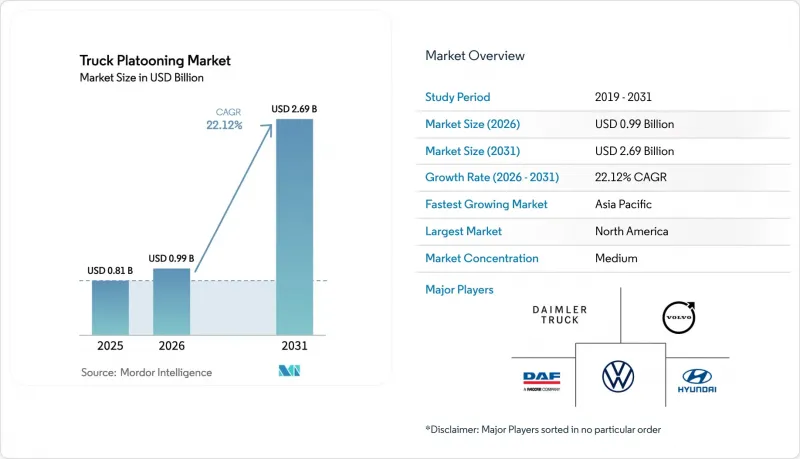
隨著溫室氣體排放監管處罰日益嚴格,車隊營運商正加速採用編隊行駛技術,其排放成長速度超過了編隊行駛空氣動力學效應帶來的燃油節省成本回收期。隨著第五代車聯網(C-V2X)技術在美國州際公路、歐洲泛歐交通運輸網路(TEN-T)走廊以及中國京滬高速公路的部署,延誤限制已被消除。這項技術進步使得車輛間通訊能夠在更短的距離和更短的時間內完成,從而顯著提高燃油效率。同時,原始設備製造商(OEM)正在轉向基於訂閱的定價模式。這種轉變將資本投資轉化為營運成本,使他們能夠吸引通常營運中型牽引車的中型運輸公司作為潛在客戶群。托運人透過在長期貨運合約中加入編隊行駛條款,進一步推動了編隊行駛技術的普及。該策略不僅保證了檢驗的範圍 3排放,而且還將編隊行駛從單純的成本削減工具重新定義為保護盈利能力的關鍵措施。
全球卡車電鍍市場趨勢與洞察
更嚴格的全球溫室氣體排放法規和燃油效率標準
重型車輛排放氣體法規的收緊速度遠遠超過車輛的正常更換週期,迫使運輸企業尋求短期合規措施。歐盟規定,到2030年,卡車二氧化碳排放必須比2019年的基準值減少45%,如果未能達到標準,每行駛一定里程都將面臨罰款。加州的「先進清潔車隊」(ACF)法規要求優先運輸企業確保從2027年起,其新購買的8級卡車中有相當一部分是零排放或近零排放車輛。中國將於2024年7月實施的第六階段排放氣體標準進一步收緊了氮氧化物排放限制,從而提升了車隊行駛帶來的燃油節省的經濟效益。這些處罰措施使得車隊行駛不僅成為提高效率的手段,也成為規避法規的避險方式。
商用 5G-C-V2X 服務正式上線,延遲低於 50 毫秒。
獨立組網的5G核心網現已覆蓋美國大部分州際公路網,將端到端網路延遲控制在30毫秒以下,從而確保在高速公路上行駛時保持10-15米的安全跟車距離。中國移動在京滬走廊部署的5G-Advanced網路支援五輛卡車編隊同步煞車。 3GPP Release 17標準引入了直接側鏈(Direct Sidelink)技術,使卡車即使在網路覆蓋範圍之外的農村地區也能保持車隊行進。大規模的半導體出貨量支撐著這個規模。恩智浦半導體(NXP)預計2025年C-V2X晶片組的出貨量將大幅成長,實現顯著的年成長。
貨運週期放緩正在抑制運輸公司的資本投資。
2025年,貨運價格和貨運量大幅下降,導致收費公路運輸公司用於技術升級的資金減少。美國卡車現貨貨運價格跌破了許多運輸公司的損益平衡點,迫使它們將有限的資金用於償還債務,而不是投資於編隊行駛維修。在歐洲,2025年第三季公路貨運量較去年同期下降,是連續第四季度下滑。這一趨勢進一步降低了收入,並導致設備訂單延遲。 2025年,由於高昂的資金籌措成本難以收回新技術投資,收費公路運輸公司減少了資本投資。供應過剩的問題加劇了這種情況,導致美國卡車與貨物的比例失衡。這種失衡不僅降低了資產運轉率,也延長了編隊行駛硬體投資的回收期。
細分市場分析
預計到2025年,駕駛輔助配置將佔據卡車編隊行駛市場62.15%的顯著佔有率,這表明監管機構傾向於選擇L2級系統,以確保人工監控對車輛運作至關重要。這種主導地位反映了監管機構對能夠保持駕駛員積極參與、兼顧技術進步與安全性的系統的信心。同時,隨著立法者致力於制定全面的L4級公路法規,以及保險框架日趨完善,預計自動駕駛卡車編隊行駛將以23.54%的複合年成長率高速成長。如果目前的普及趨勢持續下去,並在技術進步和不斷完善的配套法規的推動下,到2031年,自動駕駛卡車編隊行駛市場有望實現顯著成長。
目前,車隊營運商主要選擇駕駛員輔助編隊行駛,因為這些系統能夠確保駕駛員對車輛操作負責。這種方式與現有的商業駕駛執照法規高度相容,也便於保險公司為此類系統承保。然而,隨著跨境責任分擔協議的最終敲定和日益規範化,自動駕駛技術的應用預計將會加速。自動駕駛系統具有顯著優勢,例如大幅降低燃油成本和提高勞動效率,預計這些優勢將推動其在預測期內卡車編隊行駛市場佔有率的穩定成長。
主動車距控制巡航系統(ACC)預計到2025年將佔總銷售量的33.25%,它已成為所有商業化車隊行駛的基礎技術。保險公司越來越建議車隊部署冗餘煞車系統,推動了主動煞車輔助系統實現強勁的複合年成長率(CAGR),預計年成長率將達到26.11%。歐盟將於2024年11月生效的法規將進一步強化這一趨勢,該法規將強制要求所有新卡車安裝自動緊急煞車系統,預計全部區域廣泛應用。
為了提升車輛的安全性和性能,汽車製造商正逐步將感測器融合架構應用於量產車型。這些架構融合了雷達的遠距離偵測能力、LiDAR的高精度以及攝影機的先進目標分類能力。雖然這些系統會增加製造成本,但它們能顯著降低事故發生的機率,也反映了汽車產業日益重視利用規模經濟來提升安全性和營運效率的趨勢。
預計到2025年,車對車(V2V)通訊將佔總收入的50.13%。這主要歸功於其無需依賴固定路側基礎設施即可運作的特性。這種特性帶來了顯著的柔軟性和成本效益,因為它允許在相容卡車可用時組建專案車隊。由於不依賴基礎設施,這種連接模式對尋求在動態環境中最佳化營運的車隊營運商來說尤其具有吸引力。同時,在聯邦政府的大力投資推動下,車對基礎設施(V2I)連接預計將以22.87%的複合年成長率穩步成長,這些投資用於在美國和歐盟的主要貨運走廊部署路側設備。這一成長表明,人們越來越重視基礎設施建設,以支持高度互聯的解決方案。
高速公路管理機構正積極採用車路通訊(V2I)技術,將其作為提高車道利用率、緩解交通堵塞以及收集詳細貨物數據以輔助決策的戰略工具。此外,融合了車對車(V2V)和車對基礎設施(V2I)協定的晶片組,例如恩智浦半導體(NXP)的RoadLINK,最大限度地減少了硬體差異。這些晶片組也支援軟體更新,從而可以引入新的服務和功能,進一步提升聯網汽車技術的提案。
區域分析
北美地區擁有完善的州際公路網路、廣泛的5G覆蓋範圍以及聯邦政府的大力津貼,預計到2025年將佔全球收入的43.15%。然而,各州不同的監管規定仍然迫使營運商調整車隊配置,導致在加州、亞利桑那州和德克薩斯州等州際間傳輸時效率降低。 《基礎設施投資與就業法案》有望加快5G網路的年度普及率,因為它將為更多聯網汽車計畫提供資金。
在嚴格的二氧化碳排放上限和泛歐交通網路(TEN-T)現代化計劃的支持下,歐洲位居第二,但短期擴張受到跨境責任分歧和德國經濟停滯的限制。目前正在討論中的聯合國歐洲經濟委員會(UNECE)監管協調方案有望實現跨多個國家的車隊行進,並消除當前碎片化帶來的弊端。
亞太地區正以25.56%的複合年成長率展現出最快的成長勢頭,這主要得益於中國貨運數位化藍圖的推動。路線圖要求2026年後銷售的新卡車中,相當一部分必須達到L2級自動駕駛標準。日本的「社會5.0」計畫為認證車隊提供大幅通行費折扣,而印度的「黃金四邊形」道路改善計畫則為車聯網(V2I)試點計畫投入了大量資金。儘管由於基礎建設不足和監管差異,各國採用該技術的速度會有所不同,但其成長潛力巨大。
其他好處
- Excel格式的市場預測(ME)表
- 3個月的分析師支持
目錄
第1章:引言
- 研究假設和市場定義
- 調查範圍
第2章:調查方法
第3章執行摘要
第4章 市場狀況
- 市場概覽
- 市場促進因素
- 更嚴格的全球溫室氣體排放法規和燃油效率標準
- 商用 5G-C-V2X 服務正式上線,延遲低於 50 毫秒。
- 政府資助的多國/跨歐盟試點走廊
- 柴油價格飆升,導致其與傳統運輸車輛的投資報酬率差距不斷擴大。
- 基於OEM的平台即服務(PaaS)訂閱模式
- 托運人申請的範圍 3 脫碳權額
- 市場限制因素
- 貨運市場的低迷抑制了付費運輸公司的資本投資。
- 每台設備的維修和感測器套件成本相對較高。
- 跨境責任問題和資料所有權的不確定性
- 網路攻擊風險推高了保險費。
- 價值/供應鏈分析
- 技術藍圖
- 波特五力模型
- 新進入者的威脅
- 買方的議價能力
- 供應商的議價能力
- 替代品的威脅
- 競爭公司之間的競爭
第5章 市場規模及成長預測(價值(美元))
- 鉑金型
- 駕駛員輔助卡車編隊行駛(DATP)
- 自動駕駛卡車編隊行駛
- 依技術類型
- 主動車距控制巡航系統
- 前方碰撞警報
- 自動緊急制動
- 主動式煞車輔助
- 車道維持輔助
- 其他ADAS功能(盲點警告等)
- 透過基礎設施連接
- 車對車通訊(V2V)
- 車路協同(V2I)
- 全球定位系統(GPS)
- 按卡車級別
- 8級(大型車輛)
- 6-7 級(中等規模)
- 按車輛類型
- 本公司自有車輛
- 付費運輸公司
- 透過使用
- 長途
- 按地區/樞紐之間
- 港口和多式聯運短途運輸
- 按所有權類型/經營模式
- OEM整合訂閱
- 第三方技術提供商
- 按地區
- 北美洲
- 美國
- 加拿大
- 北美其他地區
- 南美洲
- 巴西
- 阿根廷
- 南美洲其他地區
- 歐洲
- 德國
- 英國
- 法國
- 西班牙
- 義大利
- 俄羅斯
- 其他歐洲國家
- 亞太地區
- 中國
- 日本
- 印度
- 韓國
- 亞太其他地區
- 中東和非洲
- 阿拉伯聯合大公國
- 沙烏地阿拉伯
- 埃及
- 土耳其
- 南非
- 其他中東和非洲國家
- 北美洲
第6章 競爭情勢
- 市場集中度
- 策略趨勢
- 市佔率分析
- 公司簡介
- Daimler Truck AG
- AB Volvo
- Paccar Inc(DAF Trucks)
- Volkswagen Group
- Hyundai Motor Company
- Iveco Group
- ZF Friedrichshafen AG
- Continental AG
- Robert Bosch GmbH
- Knorr-Bremse AG
- NXP Semiconductors NV
- Einride AB
第7章 市場機會與未來展望
The truck platooning market size was valued at USD 0.81 billion in 2025 and estimated to grow from USD 0.99 billion in 2026 to reach USD 2.69 billion by 2031, at a CAGR of 22.12% during the forecast period (2026-2031).
Fleet operators are accelerating deployment because regulatory penalties on greenhouse-gas (GHG) emissions now exceed the payback period for the aerodynamic fuel savings that platooning delivers. With the roll-out of fifth-generation C-V2X along United States interstates, Europe's TEN-T corridors, and China's Beijing-Shanghai expressway, latency constraints have been eliminated. This advancement facilitates vehicle-to-vehicle signaling in minimal time and with tighter following gaps, significantly boosting fuel economy. Concurrently, original-equipment manufacturers (OEMs) are transitioning to subscription pricing. This shift transforms capital expenditures into operating costs, thereby attracting mid-sized carriers - typically operating a moderate number of tractors - into the potential customer fold. Shippers are further bolstering adoption by incorporating platooning clauses in long-term freight contracts. This strategy not only ensures verifiable Scope-3 emission reductions but also redefines platooning from a mere cost-saving tool to a crucial revenue-protection measure.
Global Truck Platooning Market Trends and Insights
Stringent Global GHG Mandates and Fuel-Economy Standards
Heavy-duty emission rules are toughening faster than typical replacement cycles, forcing carriers to search for near-term compliance tools. The European Union requires a 45% reduction in truck CO2 by 2030 relative to 2019 baselines, with non-compliance fines per required kilometer . California's Advanced Clean Fleets rule obliges high-priority carriers to make a significant share of new Class 8 purchases zero- or near-zero-emission from 2027. China's Stage VI standards, effective since July 2024, impose stricter nitrogen-oxide limits, magnifying the economic benefit of the fuel savings typical of tight-gap convoys. Penalty frameworks now make platooning not merely an efficiency upgrade but a regulatory hedge.
Commercial Launch of 5G-C-V2X Enabling Sub-50 ms Latency
Standalone 5G cores now blanket the bulk of United States interstates, achieving end-to-end network latencies below 30 milliseconds and enabling safe inter-vehicle gaps of 10-15 meters at highway speeds. China Mobile's 5G-Advanced build-out on the Beijing-Shanghai corridor supports synchronized braking across five-truck platoons. Release 17 of the 3GPP standard introduced direct sidelink, letting trucks maintain cohesion even in rural coverage gaps . Semiconductor volume shipments confirm scale: NXP delivered a significant volume of C-V2X chipsets in 2025, a notable jump year-on-year.
Freight-Cycle Downturn Curbing Cap-Ex by For-Hire Fleets
In 2025, freight rates and volumes significantly declined, reducing the discretionary cash that for-hire fleets typically allocate for technology upgrades. United States truckload spot rates dropped below the break-even point for numerous carriers, forcing many to divert limited funds towards servicing debts rather than investing in platooning retrofits. In Europe, road-freight tonnage experienced a year-over-year decline in Q3 2025, marking the fourth consecutive quarterly drop. This trend further diminished revenues and postponed equipment orders. Capital expenditures among for-hire carriers decreased in 2025, as high financing costs made the math for new-technology paybacks less appealing. An overcapacity issue exacerbated the situation, with the United States truck-to-load ratio becoming imbalanced. This imbalance not only depressed asset utilization but also extended payback periods for platooning hardware.
Other drivers and restraints analyzed in the detailed report include:
- Government-Funded Multi-State/Trans-EU Pilot Corridors
- Rising Diesel Prices Widening ROI Gap vs. Conventional Convoys
- High Retrofit and Sensor-Suite Cost per Truck
For complete list of drivers and restraints, kindly check the Table Of Contents.
Segment Analysis
In 2025, driver-assistive configurations are expected to dominate the truck platooning market with a significant 62.15% share, highlighting regulators' preference for Level 2 systems that ensure human oversight remains integral to operations. This dominance reflects the comfort of regulatory bodies with systems that keep drivers actively involved, maintaining a balance between technological advancement and safety. At the same time, autonomous platooning is anticipated to grow at a strong 23.54% CAGR as lawmakers work on drafting comprehensive Level 4 highway regulations and as insurance frameworks become more sophisticated. If the current adoption trends continue, the market size for autonomous truck platooning is likely to experience substantial growth by 2031, driven by advancements in technology and supportive regulatory developments.
At present, fleets predominantly opt for driver-assistive platoons, as these systems ensure that drivers remain responsible for vehicle operations. This approach aligns well with existing commercial-license regulations, making it easier for insurers to underwrite policies for such systems. However, as cross-border liability agreements are finalized and become more standardized, the adoption of autonomous operations is expected to accelerate. Autonomous systems offer significant advantages, including superior fuel savings and enhanced labor efficiencies, which are likely to drive their increasing market share in truck platooning steadily throughout the forecast period.
Adaptive cruise control, which accounts for 33.25% of 2025 revenues, has established itself as the foundational layer for every commercially deployed platoon. Insurance underwriters are increasingly advocating for redundant braking systems in fleets, which is driving active brake assist to achieve a robust forecast CAGR of 26.11%. This trend is further reinforced by the European Union's mandate requiring automated emergency braking systems in all new trucks, set to take effect in November 2024, ensuring widespread adoption across the region.
OEMs are progressively integrating sensor-fusion architectures into their factory builds to enhance vehicle safety and performance. These architectures combine radar's long-range detection capabilities, lidar's high precision, and the advanced object classification features of cameras. While these systems introduce incremental production costs, they significantly lower accident probabilities, emphasizing the industry's growing focus on leveraging scale advantages to improve safety and operational efficiency.
In 2025, vehicle-to-vehicle links generated 50.13% of total revenue, primarily due to their ability to operate without relying on fixed roadside assets. This capability allows fleets to form ad-hoc platoons whenever compatible trucks converge, offering significant flexibility and cost efficiency. The absence of infrastructure dependency makes this connectivity model particularly appealing for fleet operators aiming to optimize operations in dynamic environments. Meanwhile, vehicle-to-infrastructure connectivity is projected to grow at a strong 22.87% CAGR, driven by substantial federal investments in roadside-unit deployments across the United States and major freight corridors in the European Union. This growth underscores the increasing emphasis on infrastructure enhancements to support advanced connectivity solutions.
Highway agencies are actively adopting V2I technology as a strategic tool to improve lane utilization, reduce congestion, and collect detailed freight data for better decision-making. Additionally, converged chipsets like NXP's RoadLINK, which integrate both vehicle-to-vehicle and vehicle-to-infrastructure protocols, are minimizing hardware differentiation. These chipsets also enable software updates, allowing the introduction of new services and functionalities, further enhancing the value proposition of connected vehicle technologies.
The Truck Platooning Market Report is Segmented by Platooning Type (Driver-Assistive Truck Platooning and Autonomous Truck Platooning), Technology Type (Adaptive Cruise Control, and More), Infrastructure Connectivity (Vehicle-To-Vehicle (V2V), and More), Truck Class (Class 8 and More), Fleet Type (Private and More), Application, Ownership/Business Model, and Geography. Market Forecasts are Provided in Terms of Value (USD).
Geography Analysis
North America accounts for 43.15% of the 2025 revenue, driven by a well-connected interstate network, extensive 5G coverage, and supportive federal grants. Yet state-level rule divergence still forces carriers to alter platoon configurations, trimming efficiency when crossing borders between California, Arizona, and Texas. Annual adoption, nevertheless, is set to quicken as the Infrastructure Investment and Jobs Act funds more connected-vehicle projects.
Europe ranked second, underpinned by stringent CO2 caps and the TEN-T modernization program, but cross-border liability gaps and economic stagnation in Germany moderate near-term expansion. Harmonized UNECE regulations under discussion could unlock multi-country platoons, erasing current fragmentation penalties.
Asia-Pacific shows the fastest trajectory at 25.56% CAGR, propelled by China's freight-digitization roadmap that mandates Level 2 automation on a significant share of new trucks sold from 2026. Japan's Society 5.0 program offers a notable share of toll rebates for certified platoons, while India's Golden Quadrilateral upgrade earmarks high costs for V2I pilots. Remaining infrastructure gaps and regulatory inconsistencies mean ramp-up will vary by nation, but upside potential is significant.
- Daimler Truck AG
- AB Volvo
- Paccar Inc (DAF Trucks)
- Volkswagen Group
- Hyundai Motor Company
- Iveco Group
- ZF Friedrichshafen AG
- Continental AG
- Robert Bosch GmbH
- Knorr-Bremse AG
- NXP Semiconductors N.V.
- Einride AB
Additional Benefits:
- The market estimate (ME) sheet in Excel format
- 3 months of analyst support
TABLE OF CONTENTS
1 Introduction
- 1.1 Study Assumptions and Market Definition
- 1.2 Scope of the Study
2 Research Methodology
3 Executive Summary
4 Market Landscape
- 4.1 Market Overview
- 4.2 Market Drivers
- 4.2.1 Stringent Global GHG Mandates and Fuel-Economy Standards
- 4.2.2 Commercial Launch of 5G-C-V2X Enabling Sub-50 ms Latency
- 4.2.3 Government-Funded Multi-State/Trans-EU Pilot Corridors
- 4.2.4 Rising Diesel Prices Widening ROI Gap vs. Conventional Convoys
- 4.2.5 OEM Platooning-as-a-Service Subscription Models
- 4.2.6 Scope-3 Decarbonization Credits Demanded by Shippers
- 4.3 Market Restraints
- 4.3.1 Freight-Cycle Downturn Curbing Cap-Ex by For-Hire Fleets
- 4.3.2 High Retrofit and Sensor-Suite Cost per Truck
- 4.3.3 Cross-Border Liability and Data-Ownership Uncertainty
- 4.3.4 Cyber-Attack Exposure Driving Insurance Premium Spikes
- 4.4 Value/Supply-Chain Analysis
- 4.5 Technological Roadmap
- 4.6 Porter's Five Forces
- 4.6.1 Threat of New Entrants
- 4.6.2 Bargaining Power of Buyers
- 4.6.3 Bargaining Power of Suppliers
- 4.6.4 Threat of Substitutes
- 4.6.5 Intensity of Competitive Rivalry
5 Market Size & Growth Forecasts (Value (USD))
- 5.1 By Platooning Type
- 5.1.1 Driver-Assistive Truck Platooning (DATP)
- 5.1.2 Autonomous Truck Platooning
- 5.2 By Technology Type
- 5.2.1 Adaptive Cruise Control
- 5.2.2 Forward Collision Warning
- 5.2.3 Automated Emergency Braking
- 5.2.4 Active Brake Assist
- 5.2.5 Lane Keep Assist
- 5.2.6 Other ADAS (Blind-Spot Warning, etc.)
- 5.3 By Infrastructure Connectivity
- 5.3.1 Vehicle-to-Vehicle (V2V)
- 5.3.2 Vehicle-to-Infrastructure (V2I)
- 5.3.3 Global Positioning System (GPS)
- 5.4 By Truck Class
- 5.4.1 Class 8 (Heavy-Duty)
- 5.4.2 Class 6-7 (Medium-Duty)
- 5.5 By Fleet Type
- 5.5.1 Private/Dedicated Fleets
- 5.5.2 For-Hire Common Carriers
- 5.6 By Application
- 5.6.1 Long-Haul Line-haul
- 5.6.2 Regional / Hub-to-Hub
- 5.6.3 Port and Intermodal Drayage
- 5.7 By Ownership / Business Model
- 5.7.1 OEM-Integrated Subscription
- 5.7.2 Third-Party Technology Provider
- 5.8 By Geography
- 5.8.1 North America
- 5.8.1.1 United States
- 5.8.1.2 Canada
- 5.8.1.3 Rest of North America
- 5.8.2 South America
- 5.8.2.1 Brazil
- 5.8.2.2 Argentina
- 5.8.2.3 Rest of South America
- 5.8.3 Europe
- 5.8.3.1 Germany
- 5.8.3.2 United Kingdom
- 5.8.3.3 France
- 5.8.3.4 Spain
- 5.8.3.5 Italy
- 5.8.3.6 Russia
- 5.8.3.7 Rest of Europe
- 5.8.4 Asia-Pacific
- 5.8.4.1 China
- 5.8.4.2 Japan
- 5.8.4.3 India
- 5.8.4.4 South Korea
- 5.8.4.5 Rest of Asia-Pacific
- 5.8.5 Middle East and Africa
- 5.8.5.1 United Arab Emirates
- 5.8.5.2 Saudi Arabia
- 5.8.5.3 Egypt
- 5.8.5.4 Turkey
- 5.8.5.5 South Africa
- 5.8.5.6 Rest of the Middle East and Africa
- 5.8.1 North America
6 Competitive Landscape
- 6.1 Market Concentration
- 6.2 Strategic Moves
- 6.3 Market Share Analysis
- 6.4 Company Profiles (Includes Global Level Overview, Market Level Overview, Core Segments, Financials as Available, Strategic Information, Market Rank/Share for Key Companies, Products and Services, SWOT Analysis, and Recent Developments)
- 6.4.1 Daimler Truck AG
- 6.4.2 AB Volvo
- 6.4.3 Paccar Inc (DAF Trucks)
- 6.4.4 Volkswagen Group
- 6.4.5 Hyundai Motor Company
- 6.4.6 Iveco Group
- 6.4.7 ZF Friedrichshafen AG
- 6.4.8 Continental AG
- 6.4.9 Robert Bosch GmbH
- 6.4.10 Knorr-Bremse AG
- 6.4.11 NXP Semiconductors N.V.
- 6.4.12 Einride AB
7 Market Opportunities and Future Outlook

 卡車編隊行駛市場規模、佔有率和成長分析:按編隊行駛類型、通訊技術、編隊行駛佈局、推進系統、組件、最終用戶和地區分類-2026-2033年產業預測
 卡車排隊系統市場規模、佔有率和成長分析:按技術、連接方式、卡車類型、應用、最終用戶和地區分類-2026-2033年產業預測
 卡車編隊行駛市場分析及至2035年預測:類型、產品、服務、技術、組件、應用、部署模式、最終用戶、功能、安裝類型
 2026-2034年全球汽車自動跟車系統市場規模、佔有率、趨勢及成長分析報告
 卡車編隊行駛市場報告:按編隊行駛類型、通訊技術、技術、服務、感測器類型和地區分類(2026-2034 年)
 2026年全球卡車排隊市場報告
 卡車隊列市場:按技術、隊列類型、通訊技術和地區分類2026年全球軌道自動跟車系統市場報告2026年全球汽車自動跟車系統市場報告全球卡車編隊行駛市場規模、佔有率、趨勢和成長分析報告(2026-2034)