


 |
市場調查報告書
商品編碼
2044154
奈米纖維素:市場佔有率分析、產業趨勢與統計、成長預測(2026-2031)Nanocellulose - Market Share Analysis, Industry Trends & Statistics, Growth Forecasts (2026 - 2031) |
||||||

※ 本網頁內容可能與最新版本有所差異。詳細情況請與我們聯繫。
奈米纖維素市場預計到 2026 年價值 13.6 億美元,高於 2025 年的 11.2 億美元,預計到 2031 年將達到 35.3 億美元。
預計從 2026 年到 2031 年,其複合年成長率將達到 21.1%。
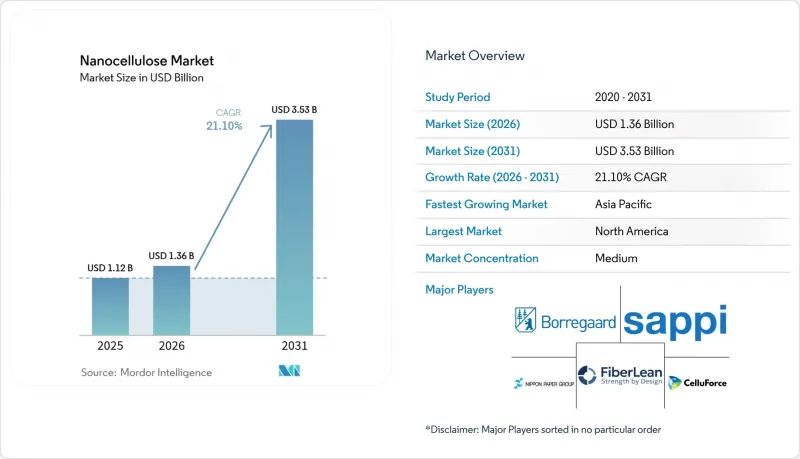
對永續性日益成長的需求、石化產品價格的波動以及材料科學的快速發展,共同推動兩位數成長的清晰路徑。輕量化汽車、回收阻隔薄膜和生物醫學支架將推動短期需求,而採用酵素的低能耗製程將在未來形成成本競爭。北美老牌企業正利用成熟的試驗生產線和與原始設備製造商 (OEM) 的牢固關係,而亞洲生產商則憑藉更低的加工成本和接近性電子包裝產業叢集的優勢,縮小與北美企業的差距。原料的柔軟性,例如從木漿轉向農業廢棄物,將進一步降低供應鏈風險,並鞏固循環經濟經營模式。老牌紙漿巨頭正處於競爭前沿,不斷擴大生產規模,而生物技術新創公司則在高價值治療領域開拓利基市場,由此產生的積極夥伴關係和授權趨勢將加速應用推廣。
全球奈米纖維素市場趨勢及洞察
優異的機械性質和阻隔性能
奈米纖維素的拉伸強度為4.9–7.5 GPa(吉帕),彈性模量為100–200 GPa,在對重量要求極高的零件中,其性能接近碳纖維。因此,奈米纖維素市場正因其在汽車車身面板和飛機內部裝潢建材等領域的應用而備受關注。橡樹嶺國家實驗室在2025年證實了這一潛力,他們證明碳奈米纖維增強奈米纖維素複合材料的拉伸強度比傳統玻璃纖維複合材料高50%,韌性幾乎是後者的兩倍。奈米纖維素的高長寬比和表面積促進了其與聚合物基體的牢固結合,最大限度地降低了分層風險,並提高了疲勞壽命。日本汽車製造商預測,如果用奈米纖維素取代某些金屬和塑膠零件,每輛車可減重20公斤,從而顯著節省燃油並減少生命週期排放。除了承重零件外,超薄奈米纖維素薄膜相比乙烯-乙烯醇共聚物(EVOH)和Polyvinylidene氯乙烯(PVDC)具有更優異的氧氣和水蒸氣阻隔性,同時還可回收和可堆肥。這些在機械性能和阻隔性的優勢,使得該材料擁有廣泛的市場應用,從家用電器機殼到藥品泡殼包裝均有涉及。
對永續包裝的需求正在飆升。
零售商、電商公司和食品品牌正競相尋找替代石油基薄膜的材料,這推動了對生物基阻隔材料的需求激增。在2024年R3PACK認證評估期間,比利時、法國和盧森堡的歐洲連鎖店透過試點項目,以纖維素包裝取代塑膠托盤,減少了數千噸一次性塑膠的使用。歐盟指令規定,到2030年,所有包裝材料都必須可重複使用或可回收,這促使加工商尋求奈米纖維素塗層的認證,以改善傳統紙板的性能。細菌纖維素薄膜具有優異的紫外線阻隔性能和拉伸強度,即使在低溫運輸物流條件下也能保持性能,同時防止光敏食品劣化。一家瑞典新創公司透過最佳化乾燥能耗和卷軸式塗佈速度,消除了最後的經濟障礙,使其成本與低密度聚乙烯(LDPE)薄膜持平。食品藥物管理局(FDA)核准原纖化纖維素作為食品接觸材料,並認定其“公認安全 (GRAS)”,這進一步降低了北美供應商的採用風險。隨著品牌所有者簽訂多年供應協議,奈米纖維素市場正在獲得可預測的收入基礎,從而支持其產能擴張。
生產成本高且規模化生產有風險
即使對水解製程進行最佳化,酸性製程的最低售價仍為每幹噸10,031美元,而目前酵素法製程的最低售價為每幹噸65,740美元,均遠高於通用聚合物的基準價格。雖然連續造紙試驗製程可以將每公斤產品的資本支出(Capex)減半,但其留存率上限為73%,使得永續的品管仍然困難。高昂的資本支出限制了大型工廠的建設,使其僅限於大型紙漿公司和國有企業,阻礙了創新企業進入新興市場,而這些企業往往缺乏長期資金籌措能力。生命週期評估表明,當工廠年產量超過2萬噸時,其環境效益將提高6.5倍,但如此規模的資金籌措需要可靠的後續契約,而目前很少有下游用戶能夠保證這一點。這種「先有雞還是先有蛋」的困境抑制了原本強勁的需求,並促使人們逐步解決瓶頸問題,而不是新建待開發區的造紙廠。
細分市場分析
預計到2025年,奈米纖維素(NFC)將在奈米纖維素市場佔據41.35%的市場佔有率,這反映了其成熟的生產基礎設施以及在造紙和複合材料應用領域的廣泛適用性。然而,成長最快的細分市場將是細菌纖維素,預計到2031年其複合年成長率將達到35.40%,這主要得益於其超高的純度以及在製藥和生物醫學應用領域的高階定位。這種生產方式的兩極化凸顯了戰略定位的差異:NFC利用機械加工的可擴展性,而細菌纖維素則瞄準高附加價值應用,並能有效利用發酵成本。
奈米晶纖維素 (NCC) 在增強材料應用領域持續穩定成長,尤其是在那些對其晶體結構優勢(例如尺寸穩定性和耐熱性)要求極高的領域。微纖化纖維素 (MFC) 是一種過渡性技術,與傳統纖維素相比,它在紙張和包裝應用中具有更優異的性能,同時在成本上與傳統添加劑保持競爭力。
木漿仍保持其主導地位,預計到2025年將佔據57.80%的市場佔有率,這得益於紙漿和造紙行業數十年來發展積累的成熟供應鏈和加工基礎設施。然而,農業廢棄物作為原料,正以22.95%的複合年成長率呈現強勁成長勢頭,憑藉其成本優勢和與循環經濟的兼容性,對木漿的長期主導地位構成了根本性挑戰。向農業廢棄物的轉變反映了人們對經濟最佳化和永續性的需求,優先考慮有效利用廢棄物而非消耗未開發的資源。
微藻類、海藻和細菌宿主為化妝品精華液和眼科溶液提供特殊原料,在這些產品中,絕對純度比成本更為重要。這些生物基原料能夠實現閉迴路培養,最大限度地減少農藥殘留,並有助於獲得非基因改造生物(GMO)認證。歐洲的聯合企業正在利用當地的纖維作物來彌補紙漿短缺,並研究大麻纖維和亞麻纖維作為原料。然而,殘留物的物流仍然十分複雜。為了應對季節性供應狀況,需要濕式儲存筒倉和高密度顆粒,這導致了隱性資本支出(CAPEX)。為此,木漿生產商正在利用監管鏈和全年穩定的供應來確保其在大規模生產包裝應用中的可靠性。這種競爭格局正在推動持續創新,並引領奈米纖維素市場邁向原料多元化的未來。
區域分析
預計到2025年,北美將以43.25%的市佔率引領奈米纖維素市場。這主要得益於美國農業部和能源部提供的初期津貼,這些撥款用於建造試點生產線,以及汽車和航太領域原始設備製造商(OEM)的強勁需求。該地區高度一體化的紙漿和造紙行業物流網路使造紙廠能夠快速將蒸煮器改造為纖維素奈米纖維生產線,而無需新的資本支出(CAPEX)。一級供應商正與州立大學合作,最佳化汽車片狀成型塑膠,以滿足美國公路安全保險協會(IIHS)的碰撞安全標準。雖然北美永續包裝的法規結構不如歐盟嚴格,但主要量販店的品牌承諾確保了穩定的採購。因此,北美奈米纖維素市場的整體規模繼續成為全球生產商定價的基準。
預計到2031年,亞太地區將以23.70%的複合年成長率成長,挑戰北美市場的主導。日本企業透過改造折舊免稅額造紙設備,比競爭對手提前數年成功實現了纖維素奈米纖維的商業化。同時,中國新創公司正在採用國產低成本高壓均質機,以避免進口關稅。深圳的電子組裝製造商指定使用奈米纖維素阻隔膜來保護有機發光二極體(OLED)模組免受氧氣侵蝕,這創造了獨特的市場需求,並縮短了供應商的認證週期。印度和泰國豐富的農業廢棄物資源使原料成本降低了40%,而酵素授權協議則加速了奈米纖維素的應用。因此,奈米纖維素市場正在東協港口周邊地區(出口物流匯聚地)掀起一股工廠建設熱潮。
在歐洲,儘管全球對一次性塑膠製品實施了最嚴格的禁令,奈米纖維素市場預計仍將維持約15%的成長。比利時和北歐國家的加工商正在尋求奈米纖維素塗層的認證,以達到95%的紙張回收標準。儘管能源價格上漲給利潤率帶來壓力,但歐盟的創新津貼正在降低試點投資的風險,這些投資旨在展現循環生物經濟領域的領先地位。南美洲擁有豐富的甘蔗渣資源,一旦CelOCE的酵素工廠實現商業化,預計將成為低成本的出口中心。中東和非洲目前仍處於小規模階段,正致力於開發奈米纖維素增強水泥複合材料,以減少沙漠地區建築施工產生的粉塵。跨國水泥巨頭正在資助沿岸地區大型企劃附近的試驗性應用。該地區的多元化發展反映了政策、資源和產業結構的差異,為奈米纖維素市場的全球成長奠定了平衡的基礎。
其他好處
- Excel格式的市場預測(ME)表
- 3個月的分析師支持
目錄
第1章:引言
- 研究假設和市場定義
- 調查範圍
第2章:調查方法
第3章執行摘要
第4章 市場狀況
- 市場概覽
- 市場促進因素
- 優異的機械性質和阻隔性能
- 對永續包裝的需求正在飆升。
- 推動制定關於使用一次性塑膠製品作為替代品的法規
- 活性化活動/試點設施和資金籌措
- 利用酵素進行低能耗生產的突破性進展
- 市場限制因素
- 生產成本高且規模化生產有風險
- 與其他生物奈米材料的競爭
- 食品接觸安全與吸入問題
- 價值鏈分析
- 波特五力模型
- 供應商的議價能力
- 買方的議價能力
- 新進入者的威脅
- 替代品的威脅
- 競爭程度
第5章 市場規模與成長預測
- 依產品類型
- 奈米纖維素(NFC)
- 奈米晶纖維素(NCC)
- 細菌纖維素
- 微纖化纖維素(MFC)
- 其他
- 按供應來源
- 木漿
- 農業殘餘物
- 微藻類和其他生物資源
- 其他
- 按形式
- 乾粉
- 凝膠
- 懸浮液
- 按最終用途行業分類
- 紙張加工
- 油漆和塗料
- 石油和天然氣
- 飲食
- 複合材料
- 藥品和化妝品
- 其他
- 按地區
- 亞太地區
- 中國
- 印度
- 日本
- 韓國
- 馬來西亞
- 泰國
- 印尼
- 越南
- 亞太其他地區
- 北美洲
- 美國
- 加拿大
- 墨西哥
- 歐洲
- 德國
- 英國
- 法國
- 義大利
- 西班牙
- 北歐國家
- 土耳其
- 俄羅斯
- 其他歐洲國家
- 南美洲
- 巴西
- 阿根廷
- 哥倫比亞
- 南美洲其他地區
- 中東和非洲
- 沙烏地阿拉伯
- 南非
- 奈及利亞
- 卡達
- 埃及
- 阿拉伯聯合大公國
- 其他中東和非洲國家
- 亞太地區
第6章 競爭情勢
- 市場集中度
- 策略趨勢
- 市佔率分析
- 公司簡介
- Axcelon Biopolymers Corporation
- Borregaard AS
- CelluComp
- CelluForce
- Chuetsu Pulp & Paper Co., Ltd.
- Daicel Corporation
- FiberLean
- GranBio Technologies
- Melodea
- NIPPON PAPER INDUSTRIES CO., LTD.
- Norske Skog ASA
- Oji Holdings Corporation
- Sappi Ltd
- Stora Enso
- UPM
第7章 市場機會與未來展望
Nanocellulose market size in 2026 is estimated at USD 1.36 billion, growing from 2025 value of USD 1.12 billion with 2031 projections showing USD 3.53 billion, growing at 21.1% CAGR over 2026-2031.
Escalating sustainability mandates, volatile petrochemical prices, and rapid material science breakthroughs converge to create a clear runway for double-digit expansion. Automotive lightweighting, recyclable barrier films, and biomedical scaffolds headline near-term demand, while enzymatic low-energy processes unlock future cost competitiveness. North American incumbents leverage mature pilot lines and close original equipment manufacturer (OEM) ties, yet Asian producers narrow the gap through lower conversion costs and proximity to electronics and packaging clusters. Raw-material flexibility shifting from wood pulp to agricultural residues further de-risks supply chains and anchors circular-economy business models. Established pulp majors expand tonnage on the competitive front, whereas biotech start-ups chase premium therapeutic niches, resulting in an active partnership and licensing landscape that accelerates application rollout.
Global Nanocellulose Market Trends and Insights
Superior Mechanical and Barrier Properties
Nanocellulose's tensile strength of 4.9-7.5 GPa (Gigapascals) and elastic modulus of 100-200 GPa position it close to carbon fiber in weight-sensitive components, making it attractive for automotive body panels and aircraft interiors within the nanocellulose market. Oak Ridge National Laboratory validated this potential in 2025 by showing 50% higher tensile strength and nearly double toughness in carbon-nanofiber-enhanced nanocellulose composites versus conventional glass-fiber alternatives. The high aspect ratio and surface area foster tight bonding with polymer matrices, minimizing delamination risk and boosting fatigue life. Japanese automakers project a 20 kg per-vehicle weight cut when nanocellulose substitutes selected metal and plastic parts, translating into meaningful fuel savings and lower lifecycle emissions. Beyond load-bearing parts, ultrathin nanocellulose films block oxygen and water vapor better than Ethylene Vinyl Alcohol (EVOH) or Polyvinylidene Chloride (PVDC), yet remain recyclable and compostable. These dual mechanical and barrier advantages underpin the material's broad addressable market, from consumer electronics casings to pharmaceutical blister packs.
Sustainable Packaging Demand Surge
Retail, e-commerce, and food brands rush to replace petroleum films, driving a steep demand curve for bio-based barriers. European chains in Belgium, France, and Luxembourg replaced pilot-scale plastic trays with cellulose packs in the 2024 R3PACK trial, eliminating thousands of tonnes of single-use plastics. European Union (EU) directives mandate that all packaging be reusable or recyclable by 2030, prompting converters to qualify nanocellulose coatings that upgrade ordinary paperboard. Bacterial cellulose films show superior ultraviolet (UV) shielding and tensile strength, reducing spoilage in light-sensitive foods while holding up under cold-chain logistics. Swedish start-up lines achieved cost parity with Low Density Polyethylene (LDPE) wrap by optimizing drying energy and roll-to-roll coating speeds, removing the final economic roadblock. Food and Drug Administration (FDA)'s Generally Recognized As Safe (GRAS) nod for fibrillated cellulose in food contact further derisks adoption for North American suppliers . As brand owners lock in multi-year supply contracts, the nanocellulose market secures a predictable revenue base for capacity expansions.
High Production Cost and Scale-up Risk
Even with hydrolysis optimization, minimum selling prices hover at USD 10,031 per dry tonne for acid routes, and USD 65,740 per dry tonne for current enzymatic yields, dwarfing commodity polymer benchmarks. Continuous papermaking pilots halve capex per output kilogram, yet sustained quality control remains elusive as retention tops out at 73%. Capex intensity restricts large-scale units to pulp majors and state-backed entities, marginalizing innovators in emerging markets that lack patient capital. Life-cycle assessments show a 6.5-fold environmental win once plants exceed 20,000 tpa, but financing such nameplates requires off-take certainty that few downstream users can underwrite today. This chicken-and-egg dynamic tempers otherwise strong demand signals and prompts phased debottlenecking rather than greenfield mega-mills.
Other drivers and restraints analyzed in the detailed report include:
- Regulatory Push to Replace Single-use Plastics
- Rising R&D Pilot Facilities and Funding
- Competition From Other Bio-nanomaterials
For complete list of drivers and restraints, kindly check the Table Of Contents.
Segment Analysis
Nanofibrillated Cellulose (NFC) commands 41.35% market share in 2025 within the nanocellulose market, reflecting its established production infrastructure and broad applicability across paper processing and composites applications. However, Bacterial Cellulose is the fastest-growing segment with 35.40% CAGR through 2031, driven by its ultra-pure properties and premium positioning in pharmaceuticals and biomedical applications. The production dichotomy reveals strategic positioning where NFC leverages mechanical processing scalability, while bacterial cellulose targets high-value applications, justifying fermentation costs.
Nanocrystalline Cellulose (NCC) maintains steady growth through its crystalline structure advantages in reinforcement applications, particularly where dimensional stability and thermal resistance prove critical. Microfibrillated Cellulose (MFC) is a bridge technology, offering enhanced properties over conventional cellulose while remaining cost-competitive with traditional additives in paper and packaging applications.
Wood Pulp maintains its dominant position with 57.80% market share in 2025, leveraging established supply chains and processing infrastructure developed over decades of pulp and paper industry evolution. Yet, Agricultural Residues as a source demonstrate the strongest growth trajectory at 22.95% CAGR, fundamentally challenging wood pulp's long-term dominance through cost advantages and circular economy alignment. The shift toward agricultural residues reflects economic optimization and sustainability mandates favoring waste valorization over virgin resource consumption.
Micro-algae, seaweed, and bacterial hosts supply specialty volumes for cosmetic serums and ophthalmic solutions where absolute purity trumps cost. These bio-sources allow closed-loop cultivation, minimizing pesticide carry-over and easing Genetically Modified Organism (GMO)-free certification. European consortiums study hemp hurd and flax shive feedstocks, leveraging regional fiber crops to offset pulpwood shortages. However, residue logistics remain complex: seasonal availability demands wet-storage silos or densification pellets, adding hidden capex. Wood pulp producers counter with chain-of-custody certification and guaranteed year-round supply, arguing reliability for mass-market packaging volumes. The competitive dance ensures continuous innovation and locks the nanocellulose market into a multi-feedstock future.
The Nanocellulose Market Report is Segmented by Product Type (Nanofibrillated Cellulose, Bacterial Cellulose, and More), Source (Wood Pulp, Agricultural Residues, and More), Form (Dry, Gel, and Suspension), End-Use Industry (Paper Processing, Oil and Gas, Composites, and More), and Geography (Asia-Pacific, North America, Europe, South America, and Middle East and Africa). The Market Forecasts are Provided in Terms of Value (USD)
Geography Analysis
North America leads the Nanocellulose market with a 43.25% revenue share in 2025, backed by early USDA and DOE grants that underwrote pilot lines and strong pull from automotive and aerospace original equipment manufacturers (OEMs). The region enjoys deeply integrated pulp-and-paper logistics, letting mills quickly pivot digesters toward cellulose nanofibrils without greenfield capital expenditure (CAPEX). Tier-1 suppliers collaborate with state universities to optimize automotive sheet-molding compounds that meet Insurance Institute for Highway Safety (IIHS) crash standards. Regulatory frameworks on sustainable packaging are less stringent than in the European Union (EU), yet brand commitments by big box retailers ensure stable offtake. As a result, the nanocellulose market size across North America remains the anchor against which global producers benchmark pricing.
Asia-Pacific records a 23.70% CAGR that challenges North America's leadership by 2031. Japanese corporations commercialized cellulose nanofiber years ahead of rivals by repurposing depreciated paper machines, while Chinese start-ups deploy low-cost, high-pressure homogenizers built domestically to evade import duties. Electronics assemblers in Shenzhen specify nanocellulose barrier films to protect Organic Light Emitting Diode (OLED) modules from oxygen ingress, creating captive demand and shortening supplier qualification cycles. Agricultural residue abundance in India and Thailand cuts feedstock bills by 40%, and enzyme licensing deals accelerate adoption. Consequently, the Nanocellulose market attracts continuous plant announcements around ASEAN ports where export logistics converge.
Europe secures mid-teen growth on the back of the world's strictest single-use-plastic bans. Converters in Belgium and the Nordics qualify Nanocellulose coatings to meet 95% paper recyclability thresholds. While higher energy prices squeeze margins, EU innovation grants de-risk pilot investments that showcase circular-bioeconomy leadership. South America, buoyed by sugarcane bagasse supplies, emerges as a low-cost export hub once CelOCE enzyme plants go commercial. Middle East and Africa start from a small base yet eye nanocellulose enhanced cement composites to curb desert construction dust, with multinational cement majors funding test pours near Gulf megaprojects. This geographic mosaic mirrors differing policy, resource, and industrial profiles, underpinning a balanced global growth picture for the nanocellulose market.
- Axcelon Biopolymers Corporation
- Borregaard AS
- CelluComp
- CelluForce
- Chuetsu Pulp & Paper Co., Ltd.
- Daicel Corporation
- FiberLean
- GranBio Technologies
- Melodea
- NIPPON PAPER INDUSTRIES CO., LTD.
- Norske Skog ASA
- Oji Holdings Corporation
- Sappi Ltd
- Stora Enso
- UPM
Additional Benefits:
- The market estimate (ME) sheet in Excel format
- 3 months of analyst support
TABLE OF CONTENTS
1 Introduction
- 1.1 Study Assumptions & Market Definition
- 1.2 Scope of the Study
2 Research Methodology
3 Executive Summary
4 Market Landscape
- 4.1 Market Overview
- 4.2 Market Drivers
- 4.2.1 Superior Mechanical and Barrier Properties
- 4.2.2 Sustainable Packaging Demand Surge
- 4.2.3 Regulatory Push to Replace Single-use Plastics
- 4.2.4 Rising R&D Pilot Facilities and Funding
- 4.2.5 Enzymatic Low-energy Production Breakthroughs
- 4.3 Market Restraints
- 4.3.1 High Production Cost and Scale-up Risk
- 4.3.2 Competition From Other Bio-nanomaterials
- 4.3.3 Food-contact Safety and Inhalation Concerns
- 4.4 Value Chain Analysis
- 4.5 Porter's Five Forces
- 4.5.1 Bargaining Power of Suppliers
- 4.5.2 Bargaining Power of Buyers
- 4.5.3 Threat of New Entrants
- 4.5.4 Threat of Substitutes
- 4.5.5 Degree of Competition
5 Market Size & Growth Forecasts (Value)
- 5.1 By Product Type
- 5.1.1 Nanofibrillated Cellulose (NFC)
- 5.1.2 Nanocrystalline Cellulose (NCC)
- 5.1.3 Bacterial Cellulose
- 5.1.4 Microfibrillated Cellulose (MFC)
- 5.1.5 Others
- 5.2 By Source
- 5.2.1 Wood Pulp
- 5.2.2 Agricultural Residues
- 5.2.3 Micro-algae & Other Bio-sources
- 5.2.4 Others
- 5.3 By Form
- 5.3.1 Dry (Powder)
- 5.3.2 Gel
- 5.3.3 Suspension
- 5.4 By End-use Industry
- 5.4.1 Paper Processing
- 5.4.2 Paints and Coatings
- 5.4.3 Oil and Gas
- 5.4.4 Food and Beverage
- 5.4.5 Composites
- 5.4.6 Pharmaceuticals and Cosmetics
- 5.4.7 Other End-user Industries
- 5.5 By Geography
- 5.5.1 Asia-Pacific
- 5.5.1.1 China
- 5.5.1.2 India
- 5.5.1.3 Japan
- 5.5.1.4 South Korea
- 5.5.1.5 Malaysia
- 5.5.1.6 Thailand
- 5.5.1.7 Indonesia
- 5.5.1.8 Vietnam
- 5.5.1.9 Rest of Asia-Pacific
- 5.5.2 North America
- 5.5.2.1 United States
- 5.5.2.2 Canada
- 5.5.2.3 Mexico
- 5.5.3 Europe
- 5.5.3.1 Germany
- 5.5.3.2 United Kingdom
- 5.5.3.3 France
- 5.5.3.4 Italy
- 5.5.3.5 Spain
- 5.5.3.6 NORDIC Countries
- 5.5.3.7 Turkey
- 5.5.3.8 Russia
- 5.5.3.9 Rest of Europe
- 5.5.4 South America
- 5.5.4.1 Brazil
- 5.5.4.2 Argentina
- 5.5.4.3 Colombia
- 5.5.4.4 Rest of South America
- 5.5.5 Middle East and Africa
- 5.5.5.1 Saudi Arabia
- 5.5.5.2 South Africa
- 5.5.5.3 Nigeria
- 5.5.5.4 Qatar
- 5.5.5.5 Egypt
- 5.5.5.6 United Arab Emirates
- 5.5.5.7 Rest of Middle East and Africa
- 5.5.1 Asia-Pacific
6 Competitive Landscape
- 6.1 Market Concentration
- 6.2 Strategic Moves
- 6.3 Market Share Analysis
- 6.4 Company Profiles (includes Global level Overview, Market level overview, Core Segments, Financials as available, Strategic Information, Market Rank/Share for key companies, Products & Services, and Recent Developments)
- 6.4.1 Axcelon Biopolymers Corporation
- 6.4.2 Borregaard AS
- 6.4.3 CelluComp
- 6.4.4 CelluForce
- 6.4.5 Chuetsu Pulp & Paper Co., Ltd.
- 6.4.6 Daicel Corporation
- 6.4.7 FiberLean
- 6.4.8 GranBio Technologies
- 6.4.9 Melodea
- 6.4.10 NIPPON PAPER INDUSTRIES CO., LTD.
- 6.4.11 Norske Skog ASA
- 6.4.12 Oji Holdings Corporation
- 6.4.13 Sappi Ltd
- 6.4.14 Stora Enso
- 6.4.15 UPM
7 Market Opportunities & Future Outlook
- 7.1 White-space & Unmet-need Assessment
- 7.2 Enzymatic and Biological Methods for Nanocellulose Production

 奈米纖維素市場-2026-2032年全球市場預測
 奈米纖維素和生物基奈米材料市場預測至2034年—全球產品類型、原料來源、製造技術、表面功能化、形態、應用、最終用戶和區域分析
 細菌纖維素複合材料市場:商業機會、成長要素、產業趨勢分析及2026-2035年預測奈米纖維素材料市場預測至2034年-全球產品類型、原料來源、製造方法、通路、應用、最終用戶和地區分析
 奈米纖維素全球市場規模、佔有率、趨勢和成長分析報告(2026-2034)全球奈米晶纖維素市場規模、佔有率、趨勢和成長分析報告(2026-2034)全球微/奈米纖維素市場(2026-2036 年)
 奈米纖維素市場規模、佔有率、趨勢和預測:按產品類型、應用和地區分類,2026-2034年3D列印奈米纖維素市場:策略性洞察與預測(2026-2031年)奈米纖維素市場:策略性洞察與預測(2026-2031年)