


 |
市場調查報告書
商品編碼
2083112
細菌纖維素複合材料市場:商業機會、成長要素、產業趨勢分析及2026-2035年預測Bacterial Cellulose Composites Market Opportunity, Growth Drivers, Industry Trend Analysis, and Forecast 2026 - 2035 |
||||||

全球細菌纖維素複合材料市場預計到 2025 年價值 2.305 億美元,並將以 13.4% 的複合年成長率成長,到 2035 年達到 8.187 億美元。
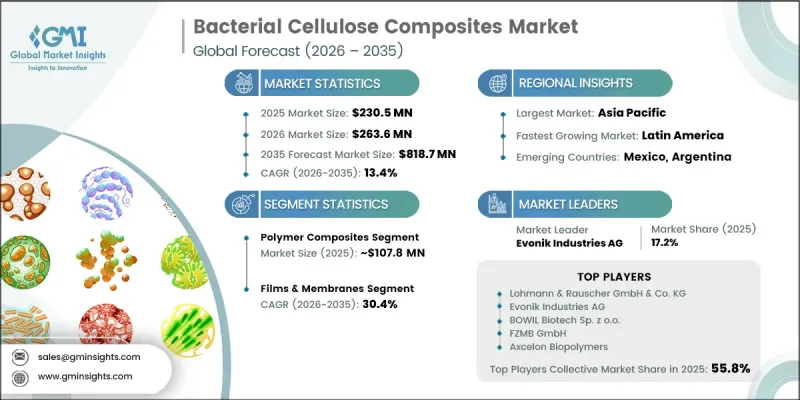
市場成長的驅動力來自日益嚴格的永續性要求、對石化材料更為嚴格的監管,以及北美、歐洲和亞太全部區域不斷推動循環經濟的措施。細菌纖維素複合材料作為一種新一代生物基材料,正日益受到關注,其符合不斷發展的採購標準,這些標準強調生物分解性和可再生原料含量。在包裝、個人護理和紡織業,替代傳統塑膠已成為一項策略重點,而細菌纖維素複合材料的應用也正在擴大。此外,這些材料還具有高拉伸強度、優異的保水性、生物相容性和奈米結構纖維等先進功能,使其適用於高性能應用。電子產業(例如感測器、軟性顯示器和導電介面)向軟性永續材料體系的轉變,進一步推動了對兼具柔軟性、熱穩定性和結構均勻性的材料的需求。歐盟的《包裝和包裝廢棄物指令》等法規結構以及更廣泛的永續性,正在推動向生物基替代材料的強制過渡,從而加速全球市場的滲透。
| 市場範圍 | |
|---|---|
| 開始年份 | 2025 |
| 預測期 | 2026-2035 |
| 上市時的市場規模 | 2.305億美元 |
| 預計金額 | 8.187億美元 |
| 複合年成長率 | 13.4% |
預計到2025年,聚合物複合材料市場規模將達到1.078億美元,佔市場佔有率的46.8%。其市場主導地位得益於成熟的整合技術,這些技術能夠將細菌纖維素與廣泛使用的聚合物結合,從而實現規模化生產和廣泛的商業性應用。基於聚合物的細菌纖維素體係正日益應用於需要結構柔軟性和阻隔性能的領域,尤其是在先進的生物醫學和包裝解決方案中。
預計到2025年,薄膜和膜材市佔率將達到30.4%,成為主要產品類別之一。此細分市場的成長主要得益於其在多個終端應用產業的廣泛適用性,包括醫療應用、軟性電子產品、過濾系統和包裝阻隔層等。其功能多樣性和高材料利用率已促使其在全球主要地區實現更廣泛的商業性部署。
預計到2025年,北美細菌纖維素複合材料市場佔有率將達到27.5%,主要受醫療、包裝和電子產業需求成長的推動。該地區生物基複合材料的技術研發和工業化應用均持續取得進展。美國憑藉其強大的創新生態系統引領區域消費,而加拿大則專注於環境永續的材料解決方案。不斷擴大的環保材料監管支援以及醫療領域應用的日益廣泛,正持續推動全部區域的市場穩步成長。
目錄
第1章:調查方法和範圍
第2章執行摘要
第3章 行業洞察
- 產業生態系分析
- 供應商情況
- 利潤率
- 每個階段增加的價值
- 影響價值鏈的因素
- 中斷
- 影響產業的因素
- 促進因素
- 產業潛在風險與挑戰
- 市場機遇
- 成長潛力分析
- 監理情勢
- 波特的分析
- PESTLE分析
- 價格趨勢
- 按地區
- 複合材料的類型
- 未來市場趨勢
- 技術與創新展望
- 最新科技趨勢
- 新興技術
- 專利趨勢
- 貿易統計
- 主要進口國
- 主要出口國
- 永續性和環境方面
- 永續計劃
- 減少廢棄物策略
- 生產中的能源效率
- 具有環保意識的舉措
- 考慮碳足跡
第4章 競爭情勢
- 介紹
- 企業市佔率分析
- 按地區
- 北美洲
- 歐洲
- 亞太地區
- LATAM
- 中東和非洲
- 按地區
- 主要市場公司的競爭分析
- 競爭定位矩陣
- 主要進展
- 併購
- 夥伴關係和聯盟
- 新產品發布
- 業務拓展計劃
第5章 市場估計與預測:依組合類型分類,2022-2035年
- 聚合物複合材料
- 無機複合材料
- 碳基複合材料
- 混合複合材料
第6章 市場估計與預測:依形式分類,2022-2035年
- 薄膜
- 水凝膠和濕泡沫
- 乾燥紙/片
- 粉末/顆粒
- 其他
第7章 市場估計與預測:依最終用途產業分類,2022-2035年
- 醫療和藥品
- 電子和半導體
- 軟性電子產品和顯示器
- 儲能
- 感測器和生物感測器
- 食品/飲料
- 汽車和航太
- 消費品和個人護理
- 其他
第8章 市場估計與預測:依地區分類,2022-2035年
- 北美洲
- 美國
- 加拿大
- 歐洲
- 德國
- 英國
- 法國
- 西班牙
- 義大利
- 其他歐洲國家
- 亞太地區
- 中國
- 印度
- 日本
- 澳洲
- 韓國
- 其他亞太國家
- 拉丁美洲
- 巴西
- 墨西哥
- 阿根廷
- 其他拉丁美洲國家
- 中東和非洲
- 沙烏地阿拉伯
- 南非
- UAE
- 其他中東和非洲國家
第9章:公司簡介
- Axcelon Biopolymers
- BOWIL Biotech Sp. z oo
- Evonik Industries AG
- FZMB GmbH
- Hainan Guangyu Bio-technology
- Hyundai Bioland Co., Ltd.
- Lohmann & Rauscher GmbH & Co. KG
- Malai Biomaterials Design
- Modern Synthesis Ltd.
- Polybion SA de CV
The Global Bacterial Cellulose Composites Market was valued at USD 230.5 million in 2025 and is estimated to grow at a CAGR of 13.4% to reach USD 818.7 million by 2035.
Market growth is driven by accelerating sustainability mandates, rising regulatory restrictions on petrochemical-based materials, and increasing organizational commitments to circular economy adoption across major industrial regions, including North America, Europe, and Asia Pacific. Bacterial cellulose composites are gaining traction as next-generation bio-based materials that align with evolving procurement standards emphasizing biodegradability and renewable content. Their adoption is expanding across the packaging, personal care, and textile industries, where the substitution of conventional plastics is becoming a strategic priority. In addition, these materials offer advanced functional properties such as high tensile strength, superior moisture retention, biocompatibility, and nanostructured fiber architecture, making them suitable for high-performance applications. The shift toward flexible and sustainable material systems in electronics, including sensors, flexible displays, and conductive interfaces, is further strengthening demand due to the need for materials that combine flexibility, thermal stability, and structural uniformity. Regulatory frameworks such as the EU's Packaging and Packaging Waste Directive and broader sustainability initiatives are reinforcing mandatory transitions toward bio-based alternatives, accelerating market penetration globally.
| Market Scope | |
|---|---|
| Start Year | 2025 |
| Forecast Year | 2026-2035 |
| Start Value | $230.5 Million |
| Forecast Value | $818.7 Million |
| CAGR | 13.4% |
The polymer composites segment reached USD 107.8 million, capturing a 46.8% share in 2025. Its dominance is supported by established integration technologies that facilitate the combination of bacterial cellulose with widely used polymers, enabling scalable production and broad commercial adoption. Polymer-based bacterial cellulose systems are increasingly utilized in applications requiring structural flexibility and barrier performance, particularly in advanced biomedical and packaging solutions.
The films and membranes segment accounted for 30.4% share in 2025, emerging as the leading form factor. This segment's growth is driven by its adaptability across multiple end-use industries, including medical applications, flexible electronics, filtration systems, and packaging barriers. Commercial deployment is already expanding across major global regions due to its functional versatility and material efficiency.
North America Bacterial Cellulose Composites Market held 27.5% share in 2025, supported by increasing demand across healthcare, packaging, and electronics sectors. The region continues to advance in both technological development and industrial-scale adoption of bio-based composites. The United States leads regional consumption due to strong innovation ecosystems, while Canada emphasizes environmentally sustainable material solutions. Growing regulatory support for eco-friendly materials and expansion in healthcare applications continue to reinforce steady market growth across the region.
Key companies operating in the Bacterial Cellulose Composites Market include Evonik Industries AG, Polybion S.A. de C.V., Hyundai Bioland Co., Ltd., Axcelon Biopolymers, BOWIL Biotech Sp. z o.o., FZMB GmbH, Hainan Guangyu Bio-technology, Lohmann & Rauscher GmbH & Co. KG, Malai Biomaterials Design, and Modern Synthesis Ltd. Companies operating in the Bacterial Cellulose Composites Market are focusing on material innovation, strategic collaborations, and scaling production capabilities to strengthen their competitive position. A key strategy involves advancing R&D in biofabrication processes to enhance material performance, durability, and cost efficiency. Firms are increasingly forming partnerships with biotechnology research institutes and end-use manufacturers to accelerate commercialization and application diversification. Expanding pilot-scale and industrial production facilities is another critical focus to support rising demand across packaging, healthcare, and electronics sectors.
Table of Contents
Chapter 1 Methodology & Scope
- 1.1 Research approach
- 1.2 Quality Commitments
- 1.2.1 GMI AI policy & data integrity commitment
- 1.2.1.1 Source consistency protocol
- 1.2.1 GMI AI policy & data integrity commitment
- 1.3 Research Trail & Confidence Scoring
- 1.3.1 Research Trail Components
- 1.3.2 Scoring Components
- 1.4 Data Collection
- 1.4.1 Partial list of primary sources
- 1.5 Data mining sources
- 1.5.1 Paid sources
- 1.5.1.1 Sources, by region
- 1.5.1 Paid sources
- 1.6 Base estimates and calculations
- 1.6.1 Base year calculation for any one approach
- 1.7 Forecast model
- 1.7.1 Quantified market impact analysis
- 1.7.1.1 Mathematical impact of growth parameters on forecast
- 1.7.1 Quantified market impact analysis
- 1.8 Research transparency addendum
- 1.8.1 Source attribution framework
- 1.8.2 Quality assurance metrics
- 1.8.3 Our commitment to trust
Chapter 2 Executive Summary
- 2.1 Industry 360° synopsis
- 2.2 Key market trends
- 2.2.1 Regional
- 2.2.2 Composite type
- 2.2.3 Form
- 2.2.4 End-user industry
Chapter 3 Industry Insights
- 3.1 Industry ecosystem analysis
- 3.1.1 Supplier landscape
- 3.1.2 Profit margin
- 3.1.3 Value addition at each stage
- 3.1.4 Factor affecting the value chain
- 3.1.5 Disruptions
- 3.2 Industry impact forces
- 3.2.1 Growth drivers
- 3.2.2 Industry pitfalls and challenges
- 3.2.3 Market opportunities
- 3.3 Growth potential analysis
- 3.4 Regulatory landscape
- 3.4.1 North America
- 3.4.2 Europe
- 3.4.3 Asia Pacific
- 3.4.4 Latin America
- 3.4.5 Middle East & Africa
- 3.5 Porter's analysis
- 3.6 PESTEL analysis
- 3.7 Price trends
- 3.7.1 By region
- 3.7.2 By composite type
- 3.8 Future market trends
- 3.9 Technology and innovation landscape
- 3.9.1 Current technological trends
- 3.9.2 Emerging technologies
- 3.10 Patent Landscape
- 3.11 Trade statistics (HS code)
- 3.11.1 Major importing countries
- 3.11.2 Major exporting countries
- 3.12 Sustainability and environmental aspects
- 3.12.1 Sustainable practices
- 3.12.2 Waste reduction strategies
- 3.12.3 Energy efficiency in production
- 3.12.4 Eco-friendly initiatives
- 3.13 Carbon footprint consideration
Chapter 4 Competitive Landscape, 2025
- 4.1 Introduction
- 4.2 Company market share analysis
- 4.2.1 By region
- 4.2.1.1 North America
- 4.2.1.2 Europe
- 4.2.1.3 Asia Pacific
- 4.2.1.4 LATAM
- 4.2.1.5 MEA
- 4.2.1 By region
- 4.3 Competitive analysis of major market players
- 4.4 Competitive positioning matrix
- 4.5 Key developments
- 4.5.1 Mergers & acquisitions
- 4.5.2 Partnerships & collaborations
- 4.5.3 New Product Launches
- 4.5.4 Expansion Plans
Chapter 5 Market Estimates and Forecast, By Composite Type, 2022-2035 (USD Million) (Kilo Tons)
- 5.1 Key trends
- 5.2 Polymer composites
- 5.3 Inorganic material composites
- 5.4 Carbon material composites
- 5.5 Hybrid composites
Chapter 6 Market Estimates and Forecast, By Form, 2022-2035 (USD Million) (Kilo Tons)
- 6.1 Key trends
- 6.2 Films & membranes
- 6.3 Hydrogels & wet forms
- 6.4 Dried sheets & papers
- 6.5 Powders & particles
- 6.6 Others
Chapter 7 Market Estimates and Forecast, By End Use Industry, 2022-2035 (USD Million) (Kilo Tons)
- 7.1 Key trends
- 7.2 Healthcare & pharmaceutical
- 7.3 Electronics & semiconductor
- 7.3.1 Flexible electronics & displays
- 7.3.2 Energy storage
- 7.3.3 Sensors & biosensors
- 7.4 Food & beverage
- 7.5 Automotive & aerospace
- 7.6 Consumer goods & personal care
- 7.7 Others
Chapter 8 Market Estimates and Forecast, By Region, 2022-2035 (USD Billion) (Kilo Tons)
- 8.1 Key trends
- 8.2 North America
- 8.2.1 U.S.
- 8.2.2 Canada
- 8.3 Europe
- 8.3.1 Germany
- 8.3.2 UK
- 8.3.3 France
- 8.3.4 Spain
- 8.3.5 Italy
- 8.3.6 Rest of Europe
- 8.4 Asia Pacific
- 8.4.1 China
- 8.4.2 India
- 8.4.3 Japan
- 8.4.4 Australia
- 8.4.5 South Korea
- 8.4.6 Rest of Asia Pacific
- 8.5 Latin America
- 8.5.1 Brazil
- 8.5.2 Mexico
- 8.5.3 Argentina
- 8.5.4 Rest of Latin America
- 8.6 Middle East and Africa
- 8.6.1 Saudi Arabia
- 8.6.2 South Africa
- 8.6.3 UAE
- 8.6.4 Rest of Middle East and Africa
Chapter 9 Company Profiles
- 9.1 Axcelon Biopolymers
- 9.2 BOWIL Biotech Sp. z o.o.
- 9.3 Evonik Industries AG
- 9.4 FZMB GmbH
- 9.5 Hainan Guangyu Bio-technology
- 9.6 Hyundai Bioland Co., Ltd.
- 9.7 Lohmann & Rauscher GmbH & Co. KG
- 9.8 Malai Biomaterials Design
- 9.9 Modern Synthesis Ltd.
- 9.10 Polybion S.A. de C.V.

 奈米纖維素市場-2026-2032年全球市場預測
 奈米纖維素和生物基奈米材料市場預測至2034年—全球產品類型、原料來源、製造技術、表面功能化、形態、應用、最終用戶和區域分析奈米纖維素材料市場預測至2034年-全球產品類型、原料來源、製造方法、通路、應用、最終用戶和地區分析
 奈米纖維素全球市場規模、佔有率、趨勢和成長分析報告(2026-2034)全球奈米晶纖維素市場規模、佔有率、趨勢和成長分析報告(2026-2034)全球微/奈米纖維素市場(2026-2036 年)
 奈米纖維素市場規模、佔有率、趨勢和預測:按產品類型、應用和地區分類,2026-2034年
 奈米纖維素:市場佔有率分析、產業趨勢與統計、成長預測(2026-2031)3D列印奈米纖維素市場:策略性洞察與預測(2026-2031年)奈米纖維素市場:策略性洞察與預測(2026-2031年)