


 |
市場調查報告書
商品編碼
2044114
終端安全:市場佔有率分析、產業趨勢與統計、成長預測(2026-2031)Endpoint Security - Market Share Analysis, Industry Trends & Statistics, Growth Forecasts (2026 - 2031) |
||||||

※ 本網頁內容可能與最新版本有所差異。詳細情況請與我們聯繫。
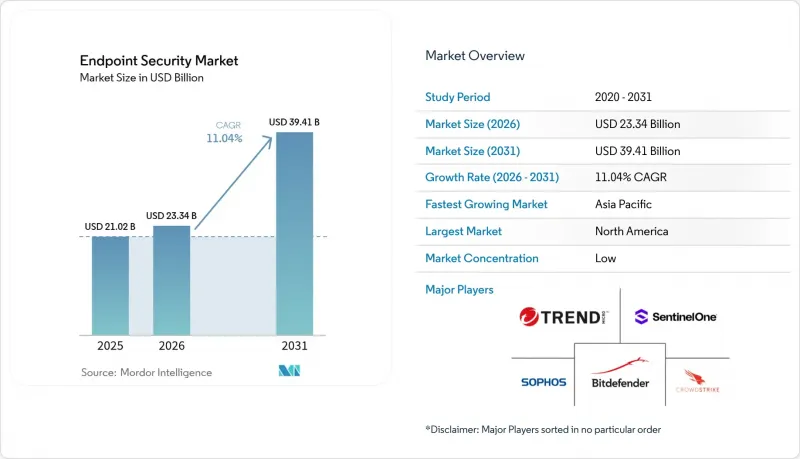
預計到 2026 年,終端安全市場規模將達到 233.4 億美元,高於 2025 年的 210.2 億美元,預計到 2031 年將達到 394.1 億美元。
預計 2026 年至 2031 年的複合年成長率為 11.04%。
終端安全市場的強勁需求源於遠端辦公和混合辦公模式的穩步發展、自帶設備辦公 (BYOD) 策略的擴展以及勒索軟體即服務 (RaaS) 工具包的進步。此外,企業還面臨著物聯網 (IoT) 的日益普及,這模糊了 IT 網路和營運技術 (OT) 網路之間的界限,使關鍵工業資產面臨與以往針對辦公室設備的相同威脅。因此,基於雲端的控制、零信任存取策略和人工智慧驅動的行為分析正成為現代終端保護策略的標準組成部分。平台供應商正透過整合晶片級安全功能,並將終端保護平台 (EPP) 和終端偵測與回應 (EDR) 功能整合到安全存取服務邊緣 (SASE) 解決方案中來應對這些挑戰,從而簡化分散式使用者的策略執行。
全球終端安全市場趨勢與洞察
自帶設備辦公室 (BYOD) 和行動工作人員的激增
由於自帶設備辦公室 (BYOD) 策略將約 47 億個行動終端暴露在傳統防火牆之外,終端安全市場正經歷強勁成長勢頭,這主要得益於行動裝置管理工具的快速普及,這些工具能夠將企業資料與個人應用分開。目前,70% 的攻擊都涉及身分洩露,迫使企業依賴零信任框架,在授予網路存取之前檢驗設備健康狀況。高階主管越來越將網路安全視為董事會層面的優先事項,91% 的高階主管認為網路安全是一項策略資產,而不僅僅是合規性問題。現代終端安全套件內建的人工智慧功能可提供即時行為分析,從而檢測各種設備環境中的風險行為。
勒索軟體即服務 (RaaS) 的發展
勒索軟體攻擊的門檻已經降低,預計2024年初感染率將激增50%。目前,醫療保健產業資料外洩的平均成本高達1,010萬美元,迫使醫院部署增強型檢測與回應(EDR)平台,以關聯終端和網路遙測資料。雙重和三重勒索策略也瞄準了備份數據,迫使企業重新設計資料復原計畫。分析師預測,到2031年,勒索軟體造成的損失將超過每年2,650億美元,預計將推動對主動式終端防禦的投資增加。
安全營運中心和事件回應團隊技能短缺
全球網路安全專業人員缺口高達300萬,約半數首席資訊安全安全長 (CISO) 擔憂自身應對能力存在不足。這加速了託管偵測與回應 (MDR) 的普及,預計到2025年,半數企業將把全天候監控營運外包。在人才供應狀況改善之前,利用自動化和人工智慧工具對警報進行優先排序並編寫遏制措施腳本,被視為切實可行的過渡方案。
細分市場分析
端點檢測與反應 (EDR) 產品正以 15.52% 的複合年成長率快速成長,輕鬆超越傳統防毒工具。儘管企業更傾向於使用行為分析來識別零日攻擊,但由於防火牆/統一威脅管理 (UTM) 設備與現有網路設備的深度整合,它們仍保持著 19.58% 的銷售佔有率。隨著企業擴大選擇從外部獲取專業知識,而不是建立自己的內部安全營運中心,託管偵測與回應 (MDR) 訂閱服務也正蓬勃發展。
法規要求推動加密和預防資料外泄(DLP) 模組的發展,因為 GDPR 和 NIS2 等法規要求採取切實可行的資料保護措施。由於安全更新部署時間平均仍需 97 天,導致攻擊面暴露,因此對修補程式管理工具的投資正在增加。能夠阻止惡意軟體的應用控制工具有助於降低企業網路中個人裝置上影子 IT 的風險。
預計到2025年,雲端平台將佔據終端安全市場57.88%的佔有率,並將以每年15.01%的速度持續成長至2031年。集中式策略引擎可加速在全球分散式設備上的部署,並將海量資料即時輸入人工智慧模型。對於面臨資料主權法規和專用營運技術(OT)限制的企業而言,混合架構仍備受歡迎。
在國防和關鍵基礎設施等強制要求本地處理的領域,本地部署仍然十分普遍。即使在這些領域,許多團隊也正在採用SASE疊加架構,將軟體定義網路與雲端交付的安全性結合,以簡化管理。雲端整合的EDR分析功能可以降低攻擊延遲並縮短平均回應時間。
終端安全市場按解決方案類型(防毒/反惡意軟體、防火牆/UTM 等)、部署模式(本地部署、雲端部署、混合部署)、組織規模(大型企業、中小企業)、最終用戶產業(銀行、金融服務和保險、政府/國防、醫療保健/生命科學等)以及地區進行細分。市場預測以美元計價。
區域分析
預計到2025年,北美將維持33.12%的銷售佔有率。充足的安全預算、日益複雜的威脅情勢以及人工智慧的早期應用正在推動持續升級。政府雲端安全計畫和緊密的供應商網路正在形成良性創新循環。
歐洲的這股動能源自於2024年10月即將全面實施的NIS2指令。該指令將要求超過16萬家機構實施經認證的終端安全控制措施,違規者將面臨最高1,000萬歐元的罰款。這項法規使得關鍵基礎設施、製造業和數位服務供應商等產業的需求持續高漲。
亞太地區是成長最快的地區,年複合成長率達12.22%。該地區各國正大力投資網路彈性框架,而針對通訊業者和金融機構的高調攻擊事件進一步提升了企業主管的關注。中國的安全團隊將API暴露視為首要關注點,其中27%的團隊將其優先順序置於惡意軟體之上。政府資金和本地供應商生態系統正在加速日本、韓國、澳洲和東南亞國協對網路彈性架構的採用。
在中東和非洲,不斷上漲的網路保險費和日益嚴格的隱私法正促使銀行和能源公司加強終端安全控制。在拉丁美洲,雲端運算的採用率正在不斷提高,尤其是在零售商和數位銀行公司中,他們往往繞過了傳統的本地部署環境。
其他好處:
- Excel格式的市場預測(ME)表
- 3個月的分析師支持
目錄
第1章:引言
- 研究假設和市場定義
- 調查範圍
第2章:調查方法
第3章執行摘要
第4章 市場狀況
- 市場概覽
- 市場促進因素
- 自帶設備辦公室 (BYOD) 和行動工作人員模式的激增
- 勒索軟體即服務 (RaaS) 的發展
- 物聯網終端在OT網路中的普及
- SASE 在邊緣端整合 EPP/EDR 得到廣泛應用。
- OEM整合的晶片級安全IP
- 經認證的EDR可享網路保險保費折扣
- 市場限制因素
- 安全營運中心和事件回應團隊技能短缺
- 中小企業的預算限制
- 人們對持續端點遙測的隱私擔憂日益加劇
- 第三方安保人員的供應鏈風險
- 產業價值鏈分析
- 監理情勢
- 技術展望
- 產業吸引力-波特五力分析
- 供應商的議價能力
- 買方的議價能力
- 新進入者的威脅
- 替代品的威脅
- 競爭公司之間的競爭
- 宏觀經濟因素對市場的影響
第5章 市場規模與成長預測
- 按解決方案類型
- 防毒/反惡意軟體
- 防火牆/UTM
- 端點檢測與響應 (EDR)
- 託管偵測與回應 (MDR)
- 加密和預防資料外泄
- 補丁和配置管理
- 應用和設備控制
- 其他
- 部署模式
- 現場
- 雲
- 混合
- 按組織規模
- 大公司
- 中小企業
- 按最終用戶行業分類
- BFSI
- 政府/國防
- 醫療保健和生命科學
- 製造業
- 能源與公共產業
- 零售與電子商務
- 資訊科技和通訊
- 教育
- 其他終端用戶產業
- 按地區
- 北美洲
- 美國
- 加拿大
- 墨西哥
- 南美洲
- 巴西
- 阿根廷
- 智利
- 南美洲其他地區
- 歐洲
- 德國
- 英國
- 法國
- 義大利
- 西班牙
- 俄羅斯
- 其他歐洲地區
- 亞太地區
- 中國
- 印度
- 日本
- 韓國
- 澳洲
- 新加坡
- 馬來西亞
- 亞太其他地區
- 中東和非洲
- 中東
- 阿拉伯聯合大公國
- 沙烏地阿拉伯
- 土耳其
- 其他中東國家
- 非洲
- 南非
- 奈及利亞
- 其他非洲地區
- 中東
- 北美洲
第6章 競爭情勢
- 市場集中度
- 策略趨勢
- 市佔率分析
- 公司簡介
- Trend Micro Inc.
- CrowdStrike Holdings Inc.
- SentinelOne Inc.
- Sophos Ltd.
- Bitdefender LLC
- ESET Spol. s ro
- Kaspersky Lab JSC
- Trellix(Musarubra US LLC)
- OpenText(Cybersecurity & Carbonite Unit)
- WatchGuard Technologies Inc.
- Fortinet Inc.
- Cisco Systems Inc.
- Palo Alto Networks Inc.
- Broadcom Inc.(Symantec Endpoint)
- Microsoft Corporation(Defender for Endpoint)
- Deep Instinct Ltd
- Cybereason Inc.
- BlackBerry Ltd(Cylance)
- Malwarebytes Inc.
- AhnLab Inc.
- F-Secure Corp.
- Elastic NV(Security)
- ReaQta BV(IBM)
- Comodo Security Solutions Inc.
- Seqrite(Quick Heal Technologies)
第7章 市場機會與未來趨勢
- 評估未開發的領域和未滿足的需求
Endpoint Security Market size in 2026 is estimated at USD 23.34 billion, growing from 2025 value of USD 21.02 billion with 2031 projections showing USD 39.41 billion, growing at 11.04% CAGR over 2026-2031.
Strong demand in the endpoint security market stems from the steady shift toward remote and hybrid work, the expansion of bring-your-own-device (BYOD) policies, and the growing sophistication of ransomware-as-a-service toolkits. Enterprises also face an expanding Internet-of-Things (IoT) footprint that blurs the line between information-technology and operational-technology networks, exposing critical industrial assets to the same threats historically aimed at office devices. Cloud-delivered controls, zero-trust access policies, and AI-driven behavioural analytics are therefore becoming default components of modern endpoint protection strategies. Platform providers are responding by embedding chip-level security features and bundling endpoint protection platform (EPP) and endpoint detection and response (EDR) capabilities into secure-access-service-edge (SASE) offerings to simplify policy enforcement across distributed users.
Global Endpoint Security Market Trends and Insights
Surge in BYOD and Mobile Workforce
The endpoint security market is witnessing strong momentum as BYOD policies have exposed roughly 4.7 billion mobile endpoints that sit outside traditional firewalls, prompting rapid deployment of mobile-device-management tools that partition corporate data from personal apps. Identity compromise now appears in 70% of attacks, so firms lean on zero-trust frameworks that verify device posture before allowing network access. Executives increasingly view cybersecurity as a board-level priority, with 91% describing it as a strategic asset rather than a compliance exercise. AI features embedded in modern endpoint suites perform real-time behavioural analysis to flag risky actions across a diverse device ecosystem.
Escalating Sophistication of Ransomware-as-a-Service
Service-based ransomware lowered the barrier to entry, triggering a 50% spike in infections during early 2024. Healthcare breaches now cost USD 10.1 million on average, forcing hospitals to adopt extended-detection-and-response platforms that correlate endpoint and network telemetry. Double- and triple-extortion tactics also target backups, compelling enterprises to redesign data-recovery plans. Analysts expect ransomware damage to surpass USD 265 billion annually by 2031, funnelling more spend into proactive endpoint defences.
Skill Shortage in SOC and Incident-Response Teams
The global deficit of 3 million cyber professionals leaves roughly half of chief information security officers anxious about coverage gaps. Managed-detection-and-response (MDR) uptake is therefore accelerating, with half of organizations expected to outsource 24/7 monitoring by 2025. Automation and AI tools that triage alerts and script containment actions are seen as practical stopgaps until the workforce pipeline improves.
Other drivers and restraints analyzed in the detailed report include:
- Proliferation of IoT Endpoints Across OT Networks
- Wider Adoption of SASE Bundling EPP/EDR at Edge
- Budget Constraints Among SMBs
For complete list of drivers and restraints, kindly check the Table Of Contents.
Segment Analysis
Endpoint detection and response products are expanding at 15.52% CAGR, easily eclipsing legacy antivirus tools. Organizations favour behaviour analytics that spotlight zero-day exploits, while firewall/UTM appliances retain 19.58% revenue share thanks to deep integration with existing network gear. Managed-detection-and-response subscriptions are also gaining ground as firms lease expertise rather than build internal security operations centres.
Regulatory scrutiny is breathing life into encryption and data-loss-prevention modules as rules such as GDPR and NIS2 demand demonstrable data-protection controls. Patch-management utilities attract spend because security updates still average a 97-day rollout window, leaving attack surfaces exposed. Application-control tools that block unauthorized software help limit shadow-IT risks for personal devices on corporate networks.
Cloud platforms already command 57.88% of the endpoint security market size in 2025 and will compound 15.01% annually to 2031. Centralized policy engines accelerate rollout across globally distributed devices and feed AI models with large data volumes in real time. Hybrid architectures remain popular for firms facing data-sovereignty rules or specialist operational-technology constraints.
On-premises deployments persist in defence and critical-infrastructure verticals where local processing is mandated. Even there, many teams adopt SASE overlays that couple software-defined networking with cloud-delivered security to simplify administration. Integrated EDR analytics in the cloud reduce dwell time and enhance mean-time-to-respond statistics.
Endpoint Security Market is Segmented by Solution Type (Antivirus/Anti-malware, Firewall/UTM, and More), Deployment Mode (On-Premises, Cloud, and Hybrid), Organization Size (Large Enterprises and Small and Medium-Sized Enterprises), End-User Industry (BFSI, Government and Defense, Healthcare and Life Sciences, and More), and Geography. The Market Forecasts are Provided in Terms of Value (USD).
Geography Analysis
North America maintained 33.12% revenue share in 2025. Deep security budgets, an advanced threat landscape, and early AI adoption fuel ongoing upgrades. Government cloud-security programs and a dense network of vendors create a virtuous innovation cycle.
Europe's momentum is tied to the full enforcement of the NIS2 directive in October 2024, which compels more than 160,000 organizations to deploy certified endpoint controls or face fines up to EUR 10 million. The regulation keeps demand high across critical infrastructure, manufacturing, and digital services providers.
Asia-Pacific is the fastest-growing territory at 12.22% CAGR. Nations across the region pour investment into cyber-resilience frameworks, and high-profile attacks on telecoms and financial institutions have sharpened executive focus. Chinese security teams rank API exposure as their top concern, with 27% putting it ahead of malware. Government funding and local vendor ecosystems accelerate adoption across Japan, South Korea, Australia, and the ASEAN bloc.
The Middle East and Africa notice rising cyber-insurance premiums and tougher privacy laws, nudging banks and energy operators to upgrade endpoint controls. Latin America expands cloud deployments that leapfrog legacy on-premises estates, particularly in retail and digital-banking firms.
- Trend Micro Inc.
- CrowdStrike Holdings Inc.
- SentinelOne Inc.
- Sophos Ltd.
- Bitdefender LLC
- ESET Spol. s r.o.
- Kaspersky Lab JSC
- Trellix (Musarubra US LLC)
- OpenText (Cybersecurity & Carbonite Unit)
- WatchGuard Technologies Inc.
- Fortinet Inc.
- Cisco Systems Inc.
- Palo Alto Networks Inc.
- Broadcom Inc. (Symantec Endpoint)
- Microsoft Corporation (Defender for Endpoint)
- Deep Instinct Ltd
- Cybereason Inc.
- BlackBerry Ltd (Cylance)
- Malwarebytes Inc.
- AhnLab Inc.
- F-Secure Corp.
- Elastic NV (Security)
- ReaQta BV (IBM)
- Comodo Security Solutions Inc.
- Seqrite (Quick Heal Technologies)
Additional Benefits:
- The market estimate (ME) sheet in Excel format
- 3 months of analyst support
TABLE OF CONTENTS
1 INTRODUCTION
- 1.1 Study Assumptions and Market Definition
- 1.2 Scope of the Study
2 RESEARCH METHODOLOGY
3 EXECUTIVE SUMMARY
4 MARKET LANDSCAPE
- 4.1 Market Overview
- 4.2 Market Drivers
- 4.2.1 Surge in BYOD and mobile workforce
- 4.2.2 Escalating sophistication of ransomware-as-a-service
- 4.2.3 Proliferation of IoT endpoints across OT networks
- 4.2.4 Wider adoption of SASE bundling EPP/EDR at edge
- 4.2.5 Chip-level security IP integrated by OEMs
- 4.2.6 Cyber-insurance premium discounts for certified EDR
- 4.3 Market Restraints
- 4.3.1 Skill shortage in SOC & incident-response teams
- 4.3.2 Budget constraints among SMBs
- 4.3.3 Rising privacy backlash against continuous endpoint telemetry
- 4.3.4 Supply-chain risk of third-party security agents
- 4.4 Industry Value Chain Analysis
- 4.5 Regulatory Landscape
- 4.6 Technological Outlook
- 4.7 Industry Attractiveness - Porter's Five Forces Analysis
- 4.7.1 Bargaining Power of Suppliers
- 4.7.2 Bargaining Power of Buyers
- 4.7.3 Threat of New Entrants
- 4.7.4 Threat of Substitutes
- 4.7.5 Intensity of Competitive Rivalry
- 4.8 Impact of Macroeconomic Factors on the Market
5 MARKET SIZE AND GROWTH FORECASTS (VALUES)
- 5.1 By Solution Type
- 5.1.1 Antivirus / Anti-malware
- 5.1.2 Firewall / UTM
- 5.1.3 Endpoint Detection and Response (EDR)
- 5.1.4 Managed Detection and Response (MDR)
- 5.1.5 Encryption and Data Loss Prevention
- 5.1.6 Patch and Configuration Management
- 5.1.7 Application and Device Control
- 5.1.8 Others
- 5.2 By Deployment Mode
- 5.2.1 On-premises
- 5.2.2 Cloud
- 5.2.3 Hybrid
- 5.3 By Organization Size
- 5.3.1 Large Enterprises
- 5.3.2 Small and Medium-sized Enterprises (SME)
- 5.4 By End-user Industry
- 5.4.1 BFSI
- 5.4.2 Government and Defense
- 5.4.3 Healthcare and Life Sciences
- 5.4.4 Manufacturing
- 5.4.5 Energy and Utilities
- 5.4.6 Retail and e-Commerce
- 5.4.7 IT and Telecom
- 5.4.8 Education
- 5.4.9 Other End-User Industries
- 5.5 By Geography
- 5.5.1 North America
- 5.5.1.1 United States
- 5.5.1.2 Canada
- 5.5.1.3 Mexico
- 5.5.2 South America
- 5.5.2.1 Brazil
- 5.5.2.2 Argentina
- 5.5.2.3 Chile
- 5.5.2.4 Rest of South America
- 5.5.3 Europe
- 5.5.3.1 Germany
- 5.5.3.2 United Kingdom
- 5.5.3.3 France
- 5.5.3.4 Italy
- 5.5.3.5 Spain
- 5.5.3.6 Russia
- 5.5.3.7 Rest of Europe
- 5.5.4 Asia-Pacific
- 5.5.4.1 China
- 5.5.4.2 India
- 5.5.4.3 Japan
- 5.5.4.4 South Korea
- 5.5.4.5 Australia
- 5.5.4.6 Singapore
- 5.5.4.7 Malaysia
- 5.5.4.8 Rest of Asia-Pacific
- 5.5.5 Middle East and Africa
- 5.5.5.1 Middle East
- 5.5.5.1.1 United Arab Emirates
- 5.5.5.1.2 Saudi Arabia
- 5.5.5.1.3 Turkey
- 5.5.5.1.4 Rest of Middle East
- 5.5.5.2 Africa
- 5.5.5.2.1 South Africa
- 5.5.5.2.2 Nigeria
- 5.5.5.2.3 Rest of Africa
- 5.5.5.1 Middle East
- 5.5.1 North America
6 COMPETITIVE LANDSCAPE
- 6.1 Market Concentration
- 6.2 Strategic Moves
- 6.3 Market Share Analysis
- 6.4 Company Profiles (includes Global level Overview, Market level overview, Core Segments, Financials as available, Strategic Information, Market Rank/Share, Products and Services, Recent Developments)
- 6.4.1 Trend Micro Inc.
- 6.4.2 CrowdStrike Holdings Inc.
- 6.4.3 SentinelOne Inc.
- 6.4.4 Sophos Ltd.
- 6.4.5 Bitdefender LLC
- 6.4.6 ESET Spol. s r.o.
- 6.4.7 Kaspersky Lab JSC
- 6.4.8 Trellix (Musarubra US LLC)
- 6.4.9 OpenText (Cybersecurity & Carbonite Unit)
- 6.4.10 WatchGuard Technologies Inc.
- 6.4.11 Fortinet Inc.
- 6.4.12 Cisco Systems Inc.
- 6.4.13 Palo Alto Networks Inc.
- 6.4.14 Broadcom Inc. (Symantec Endpoint)
- 6.4.15 Microsoft Corporation (Defender for Endpoint)
- 6.4.16 Deep Instinct Ltd
- 6.4.17 Cybereason Inc.
- 6.4.18 BlackBerry Ltd (Cylance)
- 6.4.19 Malwarebytes Inc.
- 6.4.20 AhnLab Inc.
- 6.4.21 F-Secure Corp.
- 6.4.22 Elastic NV (Security)
- 6.4.23 ReaQta BV (IBM)
- 6.4.24 Comodo Security Solutions Inc.
- 6.4.25 Seqrite (Quick Heal Technologies)
7 MARKET OPPORTUNITIES AND FUTURE TRENDS
- 7.1 White-Space and Unmet-Need Assessment

 2026-2030年全球終端安全市場
 終端安全市場:2026-2032年全球市場預測(依產品、作業系統、應用程式、最終用戶、部署類型及企業規模分類)
 終端安全市場報告:按組件、部署模式、組織規模、產業和地區分類(2026-2034 年)
 終端和雲端管理安全:市場佔有率分析、行業趨勢和統計數據以及成長預測(2025-2030 年)
 2026年全球終端安全市場報告
 終端安全市場規模、佔有率、成長率及全球產業分析:按類型、應用和地區的洞察,2026-2034年的預測
 終端安全市場:依組件、應用點(工作站、行動裝置、伺服器、POS終端)、部署類型、產業規模和最終用戶(航空航太與國防、政府、銀行與金融保險、醫療保健、製造業) - 至2036年的全球預測
 端點安全市場分析及預測(至 2035 年):按類型、產品類型、服務、技術、組件、應用、部署類型、最終用戶和解決方案分類全球終端安全市場規模、佔有率、趨勢和成長分析報告(2026-2034)
 終端安全市場 - 全球產業規模、佔有率、趨勢、機會和預測(按解決方案、部署模式、組織規模、最終用戶、地區和競爭格局分類,2021-2031 年)