


 |
市場調查報告書
商品編碼
2043956
商用車ADAS:市場佔有率分析、產業趨勢與統計、成長預測(2025-2030年)Commercial Vehicle ADAS - Market Share Analysis, Industry Trends & Statistics, Growth Forecasts (2025 - 2030) |
||||||

※ 本網頁內容可能與最新版本有所差異。詳細情況請與我們聯繫。
預計到 2025 年,商用車 ADAS 市場價值將達到 137.8 億美元,預計在預測期(2025-2030 年)內將以 16.13% 的複合年成長率成長,到 2030 年將達到 291 億美元。
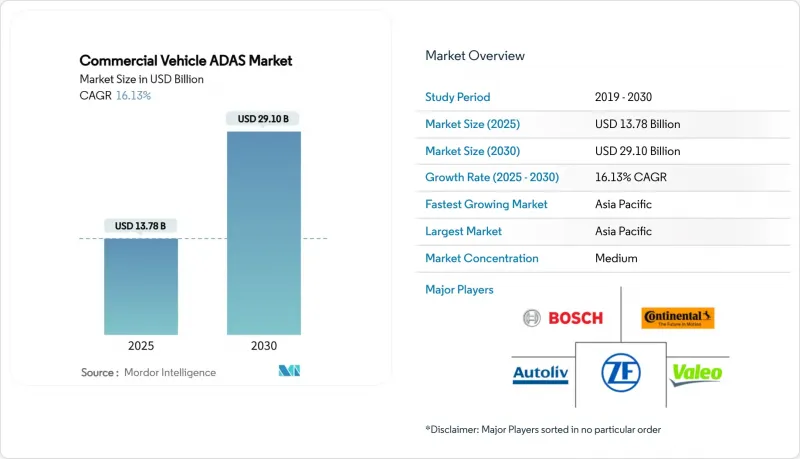
這一成長軌跡反映了監管要求的調整、感測器融合架構的成熟以及碰撞避免技術帶來的顯著經濟效益。根據美國聯邦機動車輛運輸安全管理局 (FMCSA) 估計,在高級駕駛輔助系統 (ADAS) 上每投資 1 美元,就能在碰撞相關成本節約、駕駛員留存率和保險收益方面獲得 5.09 美元的回報。雷達、攝影機和雷射雷達的成本在 2024 年以後將持續下降,這使得汽車製造商能夠將先進的 L2 級功能整合到小型、中型和大型平台中,而無需收取可能阻礙消費者的溢價。同時,北美和歐洲的保險公司目前為配備前向碰撞警報、盲點偵測和駕駛員監控功能的車輛提供平均 6% 至 12% 的保費折扣。這為利潤極為微薄的車隊營運商提供了進一步的獎勵。
全球商用車ADAS市場趨勢與洞察
加強道路安全法規
國家和超國家機構已就新型卡車和巴士的ADAS(高級駕駛輔助系統)最低標準達成協議。歐盟《通用安全條例》規定,2024年7月之後銷售的所有新型商用車輛必須配備高級緊急煞車系統、智慧速度輔助系統和駕駛疲勞預警系統。印度也計劃從2026年開始強制要求巴士和重型卡車配備類似功能,使這個世界第二大貨運市場達到全球最佳實踐標準。在美國,根據聯邦汽車運輸安全管理局(FMCSA)的調查結果,自動緊急煞車系統的要求已進入最後階段。法規的統一將消除區域技術差異,使一級供應商能夠開發全球通用的硬體和軟體堆疊,並享受規模經濟效益。這種監管壓力最終將促使原始設備製造商(OEM)淘汰不帶ADAS的車型,使商用車ADAS成為標準安全功能,而非可選升級。
自動駕駛/ADAS技術堆疊的技術進步
從二級預警輔助到預測性干預的過渡取決於感測器融合的精確度和人工智慧驅動的情境察覺。大陸集團的第六代雷達以高採樣率實現了360度全方位覆蓋,而博世和微軟則應用生成式人工智慧技術,以比基於規則的演算法更快的速度對危險進行分類。雷射雷達的成本已降至2019年的十分之一,單光子崩潰式二極體技術的進步使其即使在雨霧天氣下也能達到8毫米的距離解析度和更佳的識別能力。熱成像技術與77 GHz雷達相結合,有助於在夜間識別行人和路邊基礎設施。這些技術的融合正在加速三級貨運路線的開發週期,而戴姆勒卡車的目標是在2027年前在美國高速公路上部署SAE四級自動駕駛車輛。
ADAS組件初始成本高
儘管感測器價格正在下降,但LiDAR單元的價格仍高達四位數,這使得拉丁美洲和東協部分地區的個人承包商難以負擔。包含雷達、超音波和網域控制器的完整感測器套件會使新底盤的成本增加數千美元,從而延長小規模車輛擁有者的投資回收期。售後市場也面臨類似的挑戰。只有30%的維修店有足夠大的調整工位來進行攝影機校準。 Mobileye決定在2024年縮減其維修安裝部門的規模,凸顯了短期供應的限制。隨著半導體供應恢復正常和規模經濟的擴大,二級供應商預計到2026年,相機模組的平均售價將再下降20%,從而降低價格障礙。
細分市場分析
駕駛輔助系統的應用主要集中在車隊營運商認為能夠立即盈利的功能。主動車距控制巡航系統(ACC)預計到2024年將佔銷售額的24.71%,這反映了其在高速公路編隊行駛中顯著提升燃油效率的有效性。在商用車高級駕駛輔助系統(ADAS)市場,駕駛監控系統的市場規模正以16.72%的複合年成長率成長,因為監管機構已日益將疲勞偵測定義為一項關鍵功能。一級供應商正在整合眼瞼閉合指數、心率變異性和臉部特徵點追蹤等技術,以將車輛轉變為一個生物識別的安全區域。
同時,美國聯邦公路交通安全管理局 (FMCSA) 的法規草案規定,在時速 40 英里(約 64 公里/小時)時,自動緊急煞車 (AEB) 的最小減速必須達到 0.45G,此後 AEB 的推廣應用迅速成長。此外,歐洲標準 (Eurospec) 中引入了盲點偵測功能,其中包括右轉時對騎乘者的保護測試,這也促進了 AEB 的普及。前向碰撞警報仍然是一項基本功能,但它正擴大被整合到包含夜視疊加功能的多模態融合系統中。
雷達在2024年將佔據商用車ADAS市場48.17%的佔有率,仍是碰撞緩解的核心技術。其不可或缺的地位毋庸置疑,因為其短程模組的價格低於50美元,且即使在雨天也能保持良好的性能。然而,LiDAR(LiDAR)的單價低於350美元,解析度提升至每度200線,預計到2030年將達到16.57%的複合年成長率。韓國科學技術研究院(KIST)開發了一種抖動僅為56皮秒的單光子崩潰式二極體,將城市測繪的精度提升至10公分以內。
感測器融合策略正從冗餘轉向互補。麥格納的熱雷達混合系統將偵測範圍擴展至200米,與純雷達系統相比,誤報率降低了50%。域控制單元管理Gigabit的乙太網路資料流,確保了碰撞規避演算法的確定性延遲。
區域分析
預計到2024年,亞太地區將佔據全球商用車ADAS市場38.73%的收入佔有率,並以16.24%的複合年成長率保持領先地位直至2030年。中國快速的電氣化進程,以及乘用車L2級自動駕駛技術的引進,正在形成一條通用的供應鏈,從而降低了卡車ADAS的成本。在廣東省和浙江省等省份的保險補助推動下,商用車車隊正將前向碰撞警報作為標準配備。然而,區域道路標線的不一致性以及複雜的交通狀況,使得人工智慧模型需要基於多樣化的資料集進行訓練。
北美市場成熟且持續成長。美國國家公路交通安全管理局 (遠距離診斷) 目前正在審議自動緊急煞車 (AEB) 的相關法規,預計這些法規將正式確立大多數長途運輸車隊已採用的事實標準。保險公司的遠端診斷技術正在形成一個反饋循環,透過避免碰撞事故,將保險索賠成本降低 30%,並將這些收益回饋給營運商。加拿大遵循美國法規,跨境貨運走廊正在促進規範的標準化。在歐洲,2024 年 7 月的全面強制實施將鞏固高級駕駛輔助系統 (ADAS) 作為必備功能的地位。歐洲在駕駛員監控領域也處於領先地位,基於攝影機的疲勞偵測系統計劃於 2026 年強制實施。斯堪地那維亞國家正在冬季條件下進行卡車編隊行駛測試,檢驗感測器融合技術在冰雪和泥濘路面上的可靠性。在東歐,由於鐵路車輛老化,這些車輛的引進被推遲了,但歐盟的「連接歐洲設施」提供的維修補貼旨在彌合這一差距。
在南美洲和中東,這些技術仍處於早期應用階段。巴西國家道路安全計畫建議安裝車道偏離預警系統,但尚未設定具有法律約束力的實施期限。波灣合作理事會(GCC)成員國正在考慮引進氫燃料卡車,同時也評估攝影機後視鏡系統以應對沙漠眩光。在每個新興地區,商用車高級駕駛輔助系統(ADAS)產業都面臨高額進口關稅和有限的校準基礎設施的雙重障礙,但隨著感測器成本的降低,預計到2030年,ADAS將逐步滲透市場。
其他好處
- Excel格式的市場預測(ME)表
- 3個月的分析師支持
目錄
第1章:引言
- 研究假設和市場定義
- 調查範圍
第2章:調查方法
第3章執行摘要
第4章 市場狀況
- 市場概覽
- 市場促進因素
- 加強道路安全法規
- 自動駕駛/ADAS技術堆疊的技術進步
- 車隊總擁有成本最佳化的必要性
- 與保險和遠端資訊處理相關的ADAS獎勵
- 歐盟自2026年起強制實施駕駛員監控
- 適用於舊款車輛的標準化售後套件
- 市場限制因素
- ADAS組件初始成本高
- 對不支援 CAN 總線的車輛進行改裝的複雜性。
- 都市區雷達頻段擁擠
- 駕駛者對駕駛的興趣正在下降,技能差距也在擴大。
- 價值/供應鏈分析
- 供應商環境
- 監理情勢
- 技術展望
- 波特五力模型
- 新進入者的威脅
- 供應商的議價能力
- 買方的議價能力
- 替代品的威脅
- 競爭公司之間的競爭
第5章 市場規模及成長預測(價值(美元))
- 系統特定
- 主動車距控制巡航系統
- 盲點偵測
- 車道偏離預警系統
- 自動緊急制動
- 前方碰撞警報
- 夜視系統
- 駕駛員監控
- 輪胎壓力監測系統
- 抬頭顯示器
- 停車輔助系統
- 其他
- 透過感測器
- 雷達
- LiDAR
- 超音波
- 影像
- 其他
- 按車輛類型
- 輕型商用車(LCV)
- 中型和大型商用車輛
- 透過分銷管道
- 原廠正品零件
- 售後市場
- 按地區
- 北美洲
- 美國
- 加拿大
- 北美其他地區
- 南美洲
- 巴西
- 阿根廷
- 南美洲其他地區
- 歐洲
- 德國
- 英國
- 法國
- 義大利
- 西班牙
- 其他歐洲國家
- 亞太地區
- 中國
- 日本
- 印度
- 韓國
- 澳洲
- 亞太其他地區
- 中東和非洲
- 阿拉伯聯合大公國
- 沙烏地阿拉伯
- 南非
- 其他中東和非洲國家
- 北美洲
第6章 競爭情勢
- 市場集中度
- 策略趨勢
- 市佔率分析
- 公司簡介
- Bosch
- Continental
- ZF Friedrichshafen
- Autoliv
- Valeo
- Daimler Truck
- Volvo Group
- MAN Truck & Bus
- Scania AB
- HL Mando
- Harman International
- Applied Intuition
- Imagination Technologies
- Vignal Group
- Gauzy
第7章 市場機會與未來展望
The Commercial Vehicle ADAS Market size is estimated at USD 13.78 billion in 2025, and is expected to reach USD 29.10 billion by 2030, at a CAGR of 16.13% during the forecast period (2025-2030).
This trajectory reflects the alignment of regulatory mandates, maturing sensor fusion architectures, and the clear economic case for crash-avoidance technology. The Federal Motor Carrier Safety Administration (FMCSA) estimates that every USD 1 spent on advanced driver-assistance systems returns USD 5.09 in crash-related savings, driver retention, and insurance benefits. Radar, camera, and LiDAR costs have fallen steadily since 2024, allowing OEMs to embed sophisticated Level 2 functionality across light, medium, and heavy platforms without a price premium discouraging buyers. At the same time, insurers in North America and Europe now grant average premium discounts of 6-12% for vehicles equipped with forward-collision warning, blind-spot detection, and driver monitoring-a further incentive for fleets navigating razor-thin operating margins.
Global Commercial Vehicle ADAS Market Trends and Insights
Increasing Road-Safety Regulations
National and supranational bodies have converged on a minimum ADAS baseline for new trucks and buses. The European Union's General Safety Regulation obliges advanced emergency braking, intelligent speed assistance, and driver drowsiness warning for all new commercial vehicles sold after July 2024. India will mandate similar functionality for buses and heavy trucks from 2026, elevating the world's second-largest freight market to global best practice. The United States is finalising an automatic emergency-braking requirement that mirrors the FMCSA's own research findings. Harmonised rules are erasing regional engineering divergence, enabling Tier-1 suppliers to develop global hardware-software stacks and capture economies of scale. Over time this legislative pressure removes non-ADAS variants from OEM line-ups, anchoring the commercial vehicle ADAS market as a default safety attribute rather than a discretionary upgrade.
Technological Advances in Autonomous/ADAS Stacks
The transition from Level 2 warning aids to predictive intervention hinges on sensor fusion accuracy and AI-enabled scene interpretation. Sixth-generation radar from Continental brings 360-degree coverage at elevated sampling rates, while Bosch and Microsoft are applying generative AI to classify hazards faster than rule-based algorithms.LiDAR costs have dropped to one-tenth of 2019 levels, and single-photon avalanche diode breakthroughs now give 8 mm range resolution, extending identification capabilities under rain or fog. Thermal imaging paired with 77 GHz radar helps differentiate pedestrians from roadside infrastructure at night. These converging technologies shorten development cycles for Level 3 freight corridors, with Daimler Truck aiming to field SAE Level 4 rigs on US highways by 2027.
High Initial ADAS Component Cost
Despite falling sensor prices, LiDAR still commands four-figure unit costs that owner-operators in Latin America or parts of ASEAN deem prohibitive. Full sensor suites incorporating radar, ultrasonic, and domain controllers add several thousand dollars to a new chassis, eroding the payback horizon for small fleets. The aftermarket faces comparable hurdles: only 30% of repair shops possess alignment bays large enough for camera calibration. Mobileye's 2024 decision to wind down its retrofit division underscored short-term volume limitations. As silicon supply normalises and economies of scale ramp, Tier-2 vendors expect camera modules to decline another 20% in average selling price by 2026, narrowing the affordability gap.
Other drivers and restraints analyzed in the detailed report include:
- Fleet TCO Optimisation Mandates
- Insurance-Telematics-Linked ADAS Incentives
- Retrofit Complexity for Pre-CAN Vehicles
For complete list of drivers and restraints, kindly check the Table Of Contents.
Segment Analysis
Driver-assistance installations cluster around functions that fleets deem immediately profitable. Adaptive Cruise Control accounted for 24.71% of 2024 revenue, a reflection of proven fuel-efficiency gains during highway platooning. The commercial vehicle ADAS market size for Driver Monitoring Systems is expanding at a 16.72% CAGR because regulators now define fatigue detection as critical. Tier-1 suppliers integrate eye-closure metrics, heart-rate variability, and facial-landmark tracking, turning the cabin into a biometric safety zone.
In parallel, Automatic Emergency Braking adoption accelerated after draft FMCSA rules outlined a 0.45 g minimum deceleration requirement at 40 mph. Blind-spot detection gained momentum once the Eurospec code introduced right-turn cyclist-protection tests. Forward-collision warning remains foundational but is being subsumed into multi-modal fusion stacks that also host night-vision overlays.
With 48.17% revenue share of commercial vehicle ADAS market in 2024, radar remains the backbone of collision mitigation. Price points below USD 50 per short-range module and proven performance in rain keep it indispensable. However, LiDAR is registering a 16.57% CAGR through 2030 as per-unit costs dip below USD 350 and resolution climbs to 200 lines per degree. The Korea Institute of Science and Technology produced single-photon avalanche diodes with 56-picosecond jitter, raising urban mapping fidelity to sub-decimeter levels.
Sensor fusion strategy has moved from redundancy to complementarity. Magna's thermal-radar hybrid extends detection to 200 meters and cuts false positives by 50% compared with radar-only systems. Domain control units manage 10-gigabit per second Ethernet streams, ensuring deterministic latency for collision-avoidance algorithms.
The Commercial Vehicle ADAS Market Report is Segmented by System (Adaptive Cruise Control, Blind Spot Detection, and More), Sensor (Radar, Lidar, and More), Vehicle Type (Light Commercial Vehicles and Medium and Heavy Commercial Vehicles), Distribution Channel (OEM-Fitment and Aftermarket), and Geography. The Market Forecasts are Provided in Terms of Value (USD).
Geography Analysis
Asia-Pacific retained 38.73% of global commercial vehicle ADAS market revenue share in 2024 and will maintain pole position at a 16.24% CAGR through 2030. China's rapid electrification overlaps Level-2 penetration in new passenger cars, creating a shared supply chain that lowers ADAS costs for trucks. Commercial fleets in Guangdong and Zhejiang provinces deploy forward-collision warning as standard, encouraged by provincial insurance subsidies. Nonetheless, local road-marking inconsistencies and mixed traffic demand AI models trained on heterogeneous data sets.
North America represents a mature yet still expanding arena. Automatic emergency braking legislation under review at the National Highway Traffic Safety Administration will formalise a de facto standard already adopted by most long-haul fleets. Insurance telediagnostics create a feedback loop where crash-avoidable cases trim claim costs by 30%, internalising the benefit for operators. Canada mirrors US rules, and cross-border freight corridors encourage specification parity. Europe's July 2024 blanket requirement cements ADAS as a non-optional feature. The continent also leads on driver-monitoring, with mandatory camera-based fatigue detection scheduled for 2026. Scandinavia pilots truck platooning in winter conditions, stress-testing sensor fusion under snow and slush. Eastern European adoption lags due to an ageing fleet; retrofit subsidies under the EU's Connecting Europe Facility aim to close the gap.
South America and the Middle East remain nascent. Brazil's National Road Safety Plan endorses lane-departure alarms but lacks binding timelines. Gulf Cooperation Council fleets exploring hydrogen trucks also evaluate camera-mirror systems to tackle desert glare. In each emerging region the commercial vehicle ADAS industry faces twin obstacles of high import tariffs and limited calibration infrastructure, although falling sensor costs promise gradual inroads through 2030.
- Bosch
- Continental
- ZF Friedrichshafen
- Autoliv
- Valeo
- Daimler Truck
- Volvo Group
- MAN Truck & Bus
- Scania AB
- HL Mando
- Harman International
- Applied Intuition
- Imagination Technologies
- Vignal Group
- Gauzy
Additional Benefits:
- The market estimate (ME) sheet in Excel format
- 3 months of analyst support
TABLE OF CONTENTS
1 Introduction
- 1.1 Study Assumptions & Market Definition
- 1.2 Scope of the Study
2 Research Methodology
3 Executive Summary
4 Market Landscape
- 4.1 Market Overview
- 4.2 Market Drivers
- 4.2.1 Increasing road-safety regulations
- 4.2.2 Technological advances in autonomous/ADAS stacks
- 4.2.3 Fleet TCO optimisation mandates
- 4.2.4 Insurance-telematics-linked ADAS incentives
- 4.2.5 EU driver-monitoring mandate post-2026
- 4.2.6 Standardised retrofit kits for legacy fleets
- 4.3 Market Restraints
- 4.3.1 High initial ADAS component cost
- 4.3.2 Retrofit complexity for pre-CAN vehicles
- 4.3.3 Urban radar-spectrum congestion
- 4.3.4 Driver disengagement & skills gap
- 4.4 Value / Supply-Chain Analysis
- 4.5 Supplier Landscape
- 4.6 Regulatory Landscape
- 4.7 Technological Outlook
- 4.8 Porter's Five Forces
- 4.8.1 Threat of New Entrants
- 4.8.2 Bargaining Power of Suppliers
- 4.8.3 Bargaining Power of Buyers
- 4.8.4 Threat of Substitutes
- 4.8.5 Competitive Rivalry
5 Market Size & Growth Forecasts (Value (USD))
- 5.1 By System
- 5.1.1 Adaptive Cruise Control
- 5.1.2 Blind Spot Detection
- 5.1.3 Lane Departure Warning System
- 5.1.4 Automatic Emergency Braking
- 5.1.5 Forward Collision Warning
- 5.1.6 Night Vision System
- 5.1.7 Driver Monitoring
- 5.1.8 Tyre-Pressure Monitoring System
- 5.1.9 Head-Up Display
- 5.1.10 Park Assist System
- 5.1.11 Others
- 5.2 By Sensor
- 5.2.1 Radar
- 5.2.2 LiDAR
- 5.2.3 Ultrasonic
- 5.2.4 Image
- 5.2.5 Others
- 5.3 By Vehicle Type
- 5.3.1 Light Commercial Vehicles (LCV)
- 5.3.2 Medium and Heavy Commercial Vehicles
- 5.4 By Distribution Channel
- 5.4.1 OEM-Fitment
- 5.4.2 Aftermarket
- 5.5 By Geography
- 5.5.1 North America
- 5.5.1.1 United States
- 5.5.1.2 Canada
- 5.5.1.3 Rest of North America
- 5.5.2 South America
- 5.5.2.1 Brazil
- 5.5.2.2 Argentina
- 5.5.2.3 Rest of South America
- 5.5.3 Europe
- 5.5.3.1 Germany
- 5.5.3.2 United Kingdom
- 5.5.3.3 France
- 5.5.3.4 Italy
- 5.5.3.5 Spain
- 5.5.3.6 Rest of Europe
- 5.5.4 Asia-Pacific
- 5.5.4.1 China
- 5.5.4.2 Japan
- 5.5.4.3 India
- 5.5.4.4 South Korea
- 5.5.4.5 Australia
- 5.5.4.6 Rest of Asia-Pacific
- 5.5.5 Middle East and Africa
- 5.5.5.1 United Arab Emirates
- 5.5.5.2 Saudi Arabia
- 5.5.5.3 South Africa
- 5.5.5.4 Rest of Middle East and Africa
- 5.5.1 North America
6 Competitive Landscape
- 6.1 Market Concentration
- 6.2 Strategic Moves
- 6.3 Market Share Analysis
- 6.4 Company Profiles (Includes Global Level Overview, Market Level Overview, Core Segments, Financials as Available, Strategic Information, Market Rank/Share for Key Companies, Products and Services, SWOT Analysis, and Recent Developments)
- 6.4.1 Bosch
- 6.4.2 Continental
- 6.4.3 ZF Friedrichshafen
- 6.4.4 Autoliv
- 6.4.5 Valeo
- 6.4.6 Daimler Truck
- 6.4.7 Volvo Group
- 6.4.8 MAN Truck & Bus
- 6.4.9 Scania AB
- 6.4.10 HL Mando
- 6.4.11 Harman International
- 6.4.12 Applied Intuition
- 6.4.13 Imagination Technologies
- 6.4.14 Vignal Group
- 6.4.15 Gauzy
7 Market Opportunities & Future Outlook
- 7.1 White-Space & Unmet-Need Assessment

 商用車ADAS市場-2026-2032年全球市場預測
 2026年商用車高級駕駛輔助系統(ADAS)全球市場報告
 商用車ADAS市場機會、成長要素、產業趨勢分析及2026年至2035年預測
 全球商用車ADAS市場
 商用車 ADAS 市場,全球 2025-2029