


 |
市場調查報告書
商品編碼
2043855
5G晶片組:市場佔有率分析、產業趨勢與統計、成長預測(2026-2031年)5G Chipset - Market Share Analysis, Industry Trends & Statistics, Growth Forecasts (2026 - 2031) |
||||||

※ 本網頁內容可能與最新版本有所差異。詳細情況請與我們聯繫。
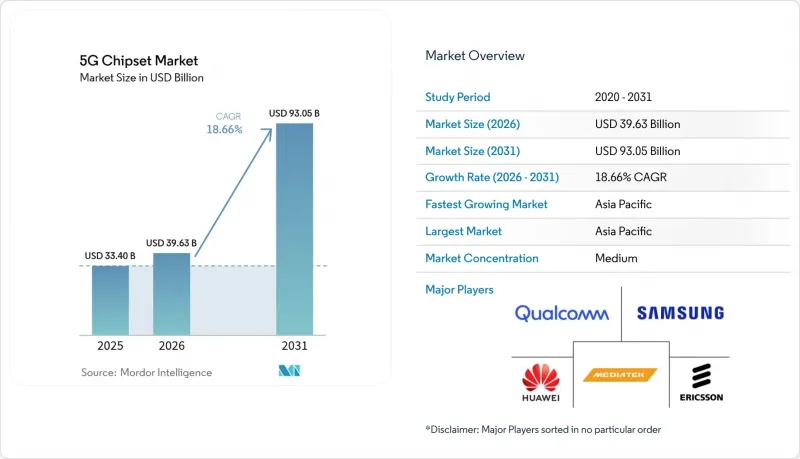
預計 5G 晶片組市場將從 2025 年的 334 億美元和 2026 年的 396.3 億美元成長到 2031 年的 930.5 億美元,2026 年至 2031 年的年複合成長率(CAGR)為 18.66%。
持續的基礎設施投資、不斷成長的邊緣人工智慧工作負載以及不斷擴大的專用網路部署,持續推動對專用晶片的需求。由於6GHz以下頻段的部署,晶片供應依然充足,而向毫米波和3奈米以下製程的過渡則透過溢價創造了附加價值。政府獎勵,特別是527億美元的《晶片法案》(CHIPS Act),正在擴大美國國內晶圓廠(半導體製造廠)的產能。鎵供應的出口限制和日益加劇的地緣政治風險凸顯了雙源戰略的必要性。在此背景下,設備製造商和網路供應商為確保差異化的智慧財產權和供應彈性而加強的垂直整合,正推動5G晶片組市場的發展。
全球5G晶片組市場趨勢與洞察
5G RAN 在全球範圍內的快速部署正在推動對基礎設施半導體的需求。
預計到2029年,商用5G人口覆蓋率將達到80%,高於2024年的40%,這將迫使通訊業者提高網路密度並投資於高容量回程傳輸。小型基地台架構需要針對中頻段和毫米波(mmWave)運行最佳化的高效能射頻前端模組,而大規模MIMO部署則需要先進的電源管理積體電路來降低能耗。亞太地區的需求激增最為顯著,光是中國在2024年就新增了超過80萬個5G基地台。這些因素為數位和類比5G晶片組市場的參與企業都提供了廣泛的收入基礎。
毫米波頻率競標為先進半導體技術創造了機會。
自2024年以來,美國、日本和韓國在24-47 GHz頻段進行的激烈頻譜競標已吸引了超過350億美元的競標。由於毫米波的傳播距離較短,先進的波束成形積體電路、高線性度功率放大器和自適應天線調諧晶片至關重要,這些晶片都能帶來較高的毛利率。固定無線存取的部署尤其注重散熱設計和良率的提升,因此能夠提供整合前端參考設計及強大校準軟體的供應商將從中受益。
地緣政治出口限制正在為半導體產業造成戰略瓶頸。
美國工業與安全局 (BIS) 擴大了實體清單,限制向部分中國無廠半導體公司出口先進的EDA工具、微影術系統和HBM。中國採取的報復性措施限制鎵和鍺的出口,可能導致鎵價上漲150%,並使美國GDP減少34億美元。這些措施將迫使設計公司重新認證製程節點、建立庫存緩衝並確保供應鏈多元化,從而降低整個5G晶片組市場的短期盈利。
細分市場分析
預計到2025年,ASIC晶片將佔據25.40%的銷售佔有率,成為最大的市場佔有率,這主要得益於OEM廠商追求針對特定應用最佳化、兼顧能效的晶片性能。這種主導地位在無線單元的基頻中尤其明顯,這些處理器能夠分擔第1層調度任務。相較之下,FPGA晶片預計將以19.94%的複合年成長率成長,超越所有其他競爭產品,這得益於Open RAN先導計畫,這些項目強調可重構性,以適應不斷演進的3GPP版本。預計到2031年,基於ASIC晶片的基頻單元在5G晶片組市場的規模將達到342億美元。整合式調變解調器的系統晶片(SoC)解決方案在智慧型手機、穿戴式裝置和C-V2X模組中持續普及,因為它們能夠減少PCB面積並降低組件成本。
FPGA 也是線上加速卡的基礎,這些加速卡可以減輕 x86 伺服器中的前向糾錯任務,從而提高虛擬化 RAN 部署中的頻譜效率。射頻積體電路 (RFIC) 保持穩定的出貨量,支援中頻寬和毫米波頻段的寬頻前端濾波和相控陣波束成形。毫米波技術晶片、天線調諧器、低雜訊放大器 (LNA)、功率放大器和電源管理 IC 構成了一個圍繞可自由組合的參考設計而建構的生態系統。這些類別共同推動了 5G 晶片組市場在通用和高利潤細分領域的蓬勃發展。
智慧型手機數據機和雲端加速器ASIC的強勁流片量推動5nm平台在2025年佔據31.10%的營收佔有率。然而,隨著邊緣AI工作負載對每瓦性能的要求越來越高,預計3nm以下晶圓將以20.12%的複合年成長率實現最高成長。隨著台積電在2025年下半年開始量產其N2工藝,以及三星推出其MBCFET環柵(GAA)架構,預計2nm晶片在5G晶片組中的市佔率將上升。 7nm仍將是中階階行動電話的主要製程節點,而16nm和28nm將繼續用於對成本要求較高的物聯網閘道器和射頻開關矩陣。
28nm 以上的成熟製程節點為電源管理和類比周邊設備,電壓接受度比整合密度更為重要。這種均衡的節點配置能夠緩解供需波動,並提供設計柔軟性,即使在最先進的產能因地緣政治因素或自然災害而中斷的情況下,也能確保產品的可用性。
區域分析
預計到2025年,亞太地區將佔全球銷售額的47.50%,並在2031年之前以19.22%的複合年成長率成長。儘管面臨出口管制壓力,中國仍確保了對射頻前端和基頻積體電路(ASIC)的國內需求,預計到2025年中期將部署超過180萬個5G基地台。韓國和日本正致力於提高毫米波(mmWave)密度,推動利潤率更高的晶片組組件配置。印度的生產連結獎勵計畫計畫(PLI)正在支持新興的晶圓廠項目,這些項目專注於28奈米電源管理和射頻開關節點,從而擴大區域供應多樣性。
北美受惠於《晶片和整合產品法案》(CHIPS Act)注入的資金以及毫米波技術的早期部署。美國佔全球毫米波設備出貨量的80%以上,並推動了對波束成形積體電路的需求。加拿大則專注於本地固定無線電舉措,該計劃傾向於採用6GHz以下的C頻段前端。歐洲在獨立組網(SA)核心的採用方面落後於其他地區,預計到2025年,只有2%的基地台具備完整的SA功能,低於美國的24%。然而,北歐通訊業者保持著近乎全覆蓋的網路,並推動了對本地生產的、適用於寒冷氣候的節能大型基地台台矽組件的需求。
在中東和非洲,波灣合作理事會(GCC)成員國正在建造大規模物聯網走廊,並呈現穩定成長態勢。在南美洲,巴西發展勢頭強勁,而阿根廷則面臨宏觀經濟制約,導致進展。整體而言,區域政策支援和頻譜分配速度仍是影響5G晶片組市場發展動能的主要因素。
其他好處:
- Excel格式的市場預測(ME)表
- 3個月的分析師支持
目錄
第1章:引言
- 研究假設和市場定義
- 調查範圍
第2章:調查方法
第3章執行摘要
第4章 市場狀況
- 市場概覽
- 市場促進因素
- 全球範圍內的5G無線接入網部署正在迅速擴大。
- 毫米波頻率競標正在刺激對新型半導體的需求。
- 邊緣人工智慧工作負載正在轉移到 5 奈米或更小的製程節點。
- 開放式無線存取網的解耦正在推動通用晶片的普及。
- 工業4.0設施中私有5G的部署現狀
- 政府對採用CHIPS方法的國內製造實驗室提供補貼
- 市場限制因素
- 對先進節點的地緣政治出口限制
- 化合物半導體供應鏈中的脆弱性
- 3奈米或以下製程製造需要高額的資本投資。
- 毫米波裝置的功率效率權衡
- 產業價值鏈分析
- 監理情勢
- 技術展望
- 波特五力分析
- 新進入者的威脅
- 供應商的議價能力
- 買方的議價能力
- 替代品的威脅
- 競爭公司之間的競爭
- 宏觀經濟趨勢對市場的影響
第5章 市場規模與成長預測
- 按晶片組類型
- 專用積體電路(ASIC)
- 整合式調變解調器的系統晶片(SoC)
- 無線電頻率積體電路(RFIC)
- 毫米波技術晶片
- 現場可程式閘陣列(FPGA)
- 電源管理積體電路
- 天線調諧器積體電路
- 轉變
- 低雜訊放大器和功率放大器
- 其他(濾波器、分離式記憶體、轉換器等)
- 依技術節點
- 小於3奈米
- 3 nm
- 5 nm
- 7 nm
- 16 nm
- 28 nm
- >28 奈米
- 按使用頻率
- 低於 6 GHz
- 26~39 GHz
- 39 GHz 或更高
- 按最終用戶行業分類
- IT、通訊、網路基礎設施
- 家用電子設備(包括智慧家居設備)
- 工業自動化
- 汽車和交通運輸
- 能源與公共產業
- 衛生保健
- 零售
- 其他終端用戶產業
- 按地區
- 北美洲
- 美國
- 加拿大
- 墨西哥
- 南美洲
- 巴西
- 阿根廷
- 南美洲其他地區
- 歐洲
- 德國
- 英國
- 法國
- 義大利
- 西班牙
- 其他歐洲地區
- 亞太地區
- 中國
- 日本
- 韓國
- 印度
- 新加坡
- 澳洲
- 亞太其他地區
- 中東和非洲
- 中東
- 沙烏地阿拉伯
- 阿拉伯聯合大公國
- 土耳其
- 其他中東國家
- 非洲
- 南非
- 奈及利亞
- 埃及
- 其他非洲地區
- 中東
- 北美洲
第6章 競爭情勢
- 市場集中度
- 策略趨勢
- 市佔率分析
- 公司簡介
- Qualcomm Incorporated
- MediaTek Inc.
- Samsung Electronics Co., Ltd.
- Huawei Technologies Co., Ltd.
- Telefonaktiebolaget LM Ericsson
- Nokia Corporation
- Broadcom Inc.
- Fujitsu Limited
- Renesas Electronics Corporation
- Marvell Technology, Inc.
- Texas Instruments Incorporated
- NXP Semiconductors NV
- Skyworks Solutions, Inc.
- Qorvo, Inc.
- Analog Devices, Inc.
- STMicroelectronics NV
- Infineon Technologies AG
- Murata Manufacturing Co., Ltd.
- Anokiwave, Inc.
- pSemi Corporation
- GlobalFoundries Inc.
- Taiwan Semiconductor Manufacturing Company Ltd.
- United Microelectronics Corporation
- Cree Wolfspeed, Inc.
- Integrated Device Technology, Inc.(Renesas Subsidiary)
第7章 市場機會與未來展望
The 5G Chipset Market size is projected to expand from USD 33.40 billion in 2025 and USD 39.63 billion in 2026 to USD 93.05 billion by 2031, registering a CAGR of 18.66% between 2026 to 2031.
Sustained infrastructure spending, growing edge-AI workloads, and intensified private-network adoption continue to fuel demand for specialized silicon. Sub-6 GHz roll-outs keep volumes high, while mmWave and sub-3 nm migrations add value through premium pricing. Government incentives, most notably the USD 52.7 billion CHIPS Act, are boosting domestic fab capacity in the United States. Rising geopolitical risk around export controls and gallium supply underscores the need for dual-sourcing strategies. Against this backdrop, the 5G chipset market is benefiting from tighter vertical integration among device makers and network vendors that seek to secure differentiated IP and supply resilience.
Global 5G Chipset Market Trends and Insights
Surging Global 5G RAN Roll-outs Drive Infrastructure Semiconductor Demand
Commercial 5G population coverage is set to reach 80% by 2029, up from 40% in 2024, pushing operators to densify networks and invest in high-capacity backhaul. Small-cell architectures require efficient RF front-end modules optimized for mid-band and mmWave operation, while massive MIMO deployments call for advanced power-management ICs that keep energy budgets in check. Demand spikes are most visible across Asia-Pacific, where China added over 800,000 5G base stations in 2024 alone. These factors sustain a broad revenue base for both digital and analog 5G chipset market participants.
mmWave Spectrum Auctions Unlock Advanced Silicon Opportunities
Aggressive spectrum auctions in the 24-47 GHz bands have attracted more than USD 35 billion in bids since 2024 in the United States, Japan, and South Korea. mmWave's short propagation range mandates advanced beam-forming ICs, high-linearity power amplifiers, and adaptive antenna-tuning chips, each commanding premium gross margins. Fixed-wireless access roll-outs place particular stress on thermal design and yield improvements, rewarding vendors that can offer integrated front-end reference designs with robust calibration software.
Geopolitical Export Controls Create Strategic Semiconductor Bottlenecks
The U.S. Bureau of Industry and Security has expanded its Entity List to restrict the export of advanced EDA tools, lithography systems, and HBM to select Chinese fabless firms. China's countermeasure limiting gallium and germanium exports could raise gallium prices by 150% and shave USD 3.4 billion off U.S. GDP. These moves force design houses to requalify nodes, build inventory buffers, and invest in diversified supply routes, trimming near-term profitability across the 5G chipset market.
Other drivers and restraints analyzed in the detailed report include:
- Edge-AI Workloads Accelerate Advanced Node Adoption
- Open RAN Disaggregation Transforms Vendor Ecosystem Dynamics
- Supply-Chain Fragility Threatens Compound Semiconductor Availability
For complete list of drivers and restraints, kindly check the Table Of Contents.
Segment Analysis
ASICs captured the largest 25.40% revenue share in 2025 as OEMs pursued power-optimized, application-specific performance. This dominance is evident in radio-unit baseband processors that offload Layer-1 scheduling duties. By contrast, FPGAs are forecast to outpace all peers at a 19.94% CAGR, buoyed by Open RAN pilots that value reconfigurability for evolving 3GPP releases. The 5G chipset market size allocated to ASIC-based baseband units is expected to reach USD 34.2 billion by 2031. System-on-Chip solutions with integrated modems continue gaining popularity in smartphones, wearables, and C-V2X modules because they shrink PCB footprint and lower bill-of-materials costs.
FPGAs also underpin inline accelerator cards that relieve x86 servers of forward-error correction tasks, thereby improving spectral efficiency in virtualized RAN deployments. RFICs maintain steady volume, delivering wide-band front-end filtering and phase-array beam-forming at both mid-band and mmWave frequencies. Millimeter-wave technology chips, antenna tuners, LNAs, power amplifiers, and power-management ICs round out an ecosystem built around mix-and-match reference designs. Collectively, these categories ensure that the 5G chipset market remains vibrant across both commodity and high-margin niches.
The 5 nm platform accounted for 31.10% of 2025 sales thanks to strong tape-out volume from smartphone modems and cloud accelerator ASICs. Yet sub-3 nm wafers will generate the fastest 20.12% CAGR because edge-AI workloads demand superior performance per watt. The 5G chipset market share for 2 nm chips is projected to climb as TSMC ramps N2 in H2 2025 and Samsung introduces MBCFET gate-all-around architecture. 7 nm remains the node of choice for mid-range handsets, while 16 nm and 28 nm continue serving cost-sensitive IoT gateways and RF switch matrices.
Mature nodes above 28 nm anchor power-management and analog peripherals, where voltage tolerance outweighs density. This balanced node mix cushions supply-demand swings and offers design-for-availability flexibility when geopolitical or natural-disaster shocks disrupt cutting-edge capacity.
The 5G Chipset Market Report is Segmented by Chipset Type (Application-Specific Integrated Circuits, System-On-Chip With Integrated Modem, and More), Technology Node (<3nm, 3nm, 5nm, 7nm, and More), Operational Frequency (Sub-6 GHz, 26-39 GHz, and Above 39 GHz), End-User Industry (IT, Telecom and Network Infrastructure, Consumer Electronics, and More), and Geography. The Market Forecasts are Provided in Terms of Value (USD).
Geography Analysis
Asia-Pacific held 47.50% of global revenue in 2025 and is projected to grow at a 19.22% CAGR through 2031. China alone installed more than 1.8 million 5G base stations by mid-2025 despite export-control pressure, securing local demand for RF front-ends and baseband ASICs. South Korea and Japan emphasize mmWave densification, encouraging higher-margin chipset bill-of-materials. India's PLI scheme supports emerging fab projects targeting 28 nm power-management and RF switch nodes, broadening regional supply diversity.
North America benefits from the CHIPS Act's infusion and early mmWave adoption. The United States accounts for over 80% of global mmWave device shipments and drives demand for beam-forming ICs. Canada focuses on rural fixed-wireless initiatives that favor sub-6 GHz C-band front-ends. Europe lags in standalone-core adoption; only 2% of sites had full SA functionality by 2025, compared with 24% in the United States. Nordic operators, however, maintain near-complete coverage, driving localized silicon content for energy-efficient macro-cells suited to cold climates.
The Middle East and Africa experience stepped growth, with Gulf Cooperation Council nations building large-scale IoT corridors. South America sees uneven progress as Brazil pushes forward while Argentina grapples with macroeconomic constraints. Overall, regional policy support and spectrum allocation pace remain leading determinants of 5G chipset market momentum.
List of Companies Covered in this Report:
- Qualcomm Incorporated
- MediaTek Inc.
- Samsung Electronics Co., Ltd.
- Huawei Technologies Co., Ltd.
- Telefonaktiebolaget LM Ericsson
- Nokia Corporation
- Broadcom Inc.
- Fujitsu Limited
- Renesas Electronics Corporation
- Marvell Technology, Inc.
- Texas Instruments Incorporated
- NXP Semiconductors N.V.
- Skyworks Solutions, Inc.
- Qorvo, Inc.
- Analog Devices, Inc.
- STMicroelectronics N.V.
- Infineon Technologies AG
- Murata Manufacturing Co., Ltd.
- Anokiwave, Inc.
- pSemi Corporation
- GlobalFoundries Inc.
- Taiwan Semiconductor Manufacturing Company Ltd.
- United Microelectronics Corporation
- Cree Wolfspeed, Inc.
- Integrated Device Technology, Inc. (Renesas Subsidiary)
Additional Benefits:
- The market estimate (ME) sheet in Excel format
- 3 months of analyst support
TABLE OF CONTENTS
1 INTRODUCTION
- 1.1 Study Assumptions and Market Definition
- 1.2 Scope of the Study
2 RESEARCH METHODOLOGY
3 EXECUTIVE SUMMARY
4 MARKET LANDSCAPE
- 4.1 Market Overview
- 4.2 Market Drivers
- 4.2.1 Surging Global 5G RAN Roll-outs
- 4.2.2 mmWave Spectrum Auctions Unlocking New Silicon Demand
- 4.2.3 Edge-AI Workloads Shifting Toward 5 nm and Below Nodes
- 4.2.4 Open RAN Disaggregation Driving Merchant Silicon Uptake
- 4.2.5 Private-5G Adoption Across Industry 4.0 Facilities
- 4.2.6 Government CHIPS-style Subsidies for Domestic Fabs
- 4.3 Market Restraints
- 4.3.1 Geopolitical Export Controls on Advanced Nodes
- 4.3.2 Supply-chain Fragility for Compound Semiconductors
- 4.3.3 High Cap-ex Requirements Below 3 nm
- 4.3.4 Power-efficiency Trade-offs in mmWave Devices
- 4.4 Industry Value Chain Analysis
- 4.5 Regulatory Landscape
- 4.6 Technological Outlook
- 4.7 Porter's Five Forces Analysis
- 4.7.1 Threat of New Entrants
- 4.7.2 Bargaining Power of Suppliers
- 4.7.3 Bargaining Power of Buyers
- 4.7.4 Threat of Substitute Products
- 4.7.5 Intensity of Competitive Rivalry
- 4.8 Impact of Macroeconomic Trends on the Market
5 MARKET SIZE AND GROWTH FORECASTS (VALUES)
- 5.1 By Chipset Type
- 5.1.1 Application-Specific Integrated Circuits (ASICs)
- 5.1.2 System-on-Chip with Integrated Modem (SoC)
- 5.1.3 Radio-Frequency Integrated Circuits (RFICs)
- 5.1.4 Millimeter-Wave Technology Chips
- 5.1.5 Field-Programmable Gate Arrays (FPGAs)
- 5.1.6 Power Management ICs
- 5.1.7 Antenna Tuner ICs
- 5.1.8 Switches
- 5.1.9 LNAs and Power Amplifiers
- 5.1.10 Others (Filters, Discrete Memory, Converters, etc.)
- 5.2 By Technology Node
- 5.2.1 < 3 nm
- 5.2.2 3 nm
- 5.2.3 5 nm
- 5.2.4 7 nm
- 5.2.5 16 nm
- 5.2.6 28 nm
- 5.2.7 > 28 nm
- 5.3 By Operational Frequency
- 5.3.1 Sub-6 GHz
- 5.3.2 26-39 GHz
- 5.3.3 Above 39 GHz
- 5.4 By End-User Industry
- 5.4.1 IT, Telecom and Network Infrastructure
- 5.4.2 Consumer Electronics (incl. Smart Home)
- 5.4.3 Industrial Automation
- 5.4.4 Automotive and Transportation
- 5.4.5 Energy and Utilities
- 5.4.6 Healthcare
- 5.4.7 Retail
- 5.4.8 Other End-User Industries
- 5.5 By Geography
- 5.5.1 North America
- 5.5.1.1 United States
- 5.5.1.2 Canada
- 5.5.1.3 Mexico
- 5.5.2 South America
- 5.5.2.1 Brazil
- 5.5.2.2 Argentina
- 5.5.2.3 Rest of South America
- 5.5.3 Europe
- 5.5.3.1 Germany
- 5.5.3.2 United Kingdom
- 5.5.3.3 France
- 5.5.3.4 Italy
- 5.5.3.5 Spain
- 5.5.3.6 Rest of Europe
- 5.5.4 Asia-Pacific
- 5.5.4.1 China
- 5.5.4.2 Japan
- 5.5.4.3 South Korea
- 5.5.4.4 India
- 5.5.4.5 Singapore
- 5.5.4.6 Australia
- 5.5.4.7 Rest of Asia-Pacific
- 5.5.5 Middle East and Africa
- 5.5.5.1 Middle East
- 5.5.5.1.1 Saudi Arabia
- 5.5.5.1.2 United Arab Emirates
- 5.5.5.1.3 Turkey
- 5.5.5.1.4 Rest of Middle East
- 5.5.5.2 Africa
- 5.5.5.2.1 South Africa
- 5.5.5.2.2 Nigeria
- 5.5.5.2.3 Egypt
- 5.5.5.2.4 Rest of Africa
- 5.5.5.1 Middle East
- 5.5.1 North America
6 COMPETITIVE LANDSCAPE
- 6.1 Market Concentration
- 6.2 Strategic Moves
- 6.3 Market Share Analysis
- 6.4 Company Profiles (includes Global level Overview, Market level overview, Core Segments, Financials as available, Strategic Information, Market Rank/Share for key companies, Products and Services, and Recent Developments)
- 6.4.1 Qualcomm Incorporated
- 6.4.2 MediaTek Inc.
- 6.4.3 Samsung Electronics Co., Ltd.
- 6.4.4 Huawei Technologies Co., Ltd.
- 6.4.5 Telefonaktiebolaget LM Ericsson
- 6.4.6 Nokia Corporation
- 6.4.7 Broadcom Inc.
- 6.4.8 Fujitsu Limited
- 6.4.9 Renesas Electronics Corporation
- 6.4.10 Marvell Technology, Inc.
- 6.4.11 Texas Instruments Incorporated
- 6.4.12 NXP Semiconductors N.V.
- 6.4.13 Skyworks Solutions, Inc.
- 6.4.14 Qorvo, Inc.
- 6.4.15 Analog Devices, Inc.
- 6.4.16 STMicroelectronics N.V.
- 6.4.17 Infineon Technologies AG
- 6.4.18 Murata Manufacturing Co., Ltd.
- 6.4.19 Anokiwave, Inc.
- 6.4.20 pSemi Corporation
- 6.4.21 GlobalFoundries Inc.
- 6.4.22 Taiwan Semiconductor Manufacturing Company Ltd.
- 6.4.23 United Microelectronics Corporation
- 6.4.24 Cree Wolfspeed, Inc.
- 6.4.25 Integrated Device Technology, Inc. (Renesas Subsidiary)
7 MARKET OPPORTUNITIES AND FUTURE OUTLOOK
- 7.1 White-space and Unmet-Need Assessment

 全球5G晶片組市場規模、佔有率、趨勢和成長分析報告(2026-2034年)
 5G晶片組:全球市場
 5G晶片組市場:晶片組類型、網路類型、頻率、製程節點、應用與最終用途-2026-2032年全球市場預測
 5G基頻晶片市場:預測(至2034年)-按晶片類型、應用、最終用戶和地區分類的全球分析
 5G晶片組市場報告:按晶片組類型、工作頻率、最終用戶和地區分類(2026-2034年)基頻頻處理器市場報告:按類型、應用和地區分類(2026-2034 年)基頻頻處理器市場:2026-2032年全球市場預測(依處理器類型、架構、資料傳輸速率、功耗和應用分類)
 5G晶片組市場:依晶片組類型、運作頻率、產業及地區分類
 5G晶片組市場分析及至2035年預測:類型、產品、技術、組件、應用、設備、部署、最終用戶、功能
 2026年全球5G晶片組市場報告