


 |
市場調查報告書
商品編碼
2043852
汽車電控系統:市場佔有率分析、產業趨勢與統計、成長預測(2026-2031)Automotive Electronic Control Unit - Market Share Analysis, Industry Trends & Statistics, Growth Forecasts (2026 - 2031) |
||||||

※ 本網頁內容可能與最新版本有所差異。詳細情況請與我們聯繫。
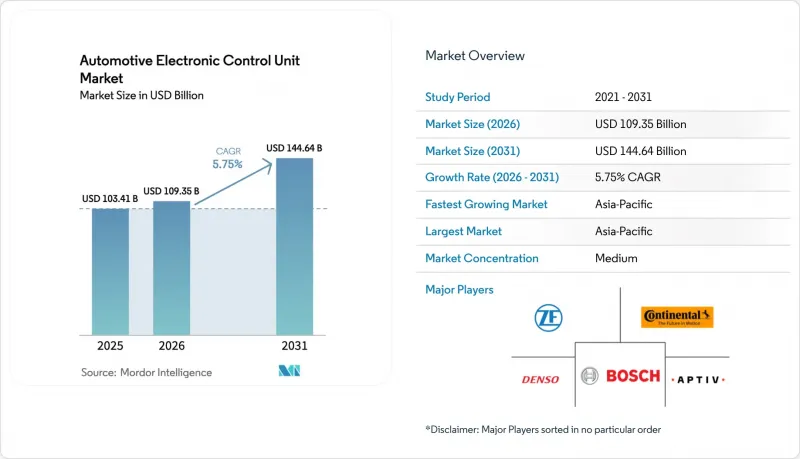
預計到 2026 年,汽車電控系統(ECU) 市場規模將達到 1,093.5 億美元,高於 2025 年的 1,034.1 億美元,預計到 2031 年將達到 1,446.4 億美元。
預計從 2026 年到 2031 年,其複合年成長率將達到 5.75%。
關鍵成長要素包括高級駕駛輔助系統 (ADAS) 法規的最後期限、乘用車和商用車的快速電氣化以及向集中式車輛架構的轉變。電池式電動車(BEV) 需要多個新的控制領域,包括電池、逆變器、車載充電器和溫度控管,這增加了每輛車半導體組件的成本。
全球汽車電控系統(ECU)市場趨勢及洞察
電氣化浪潮導致每輛車的ECU數量不斷增加。
在純電動動力傳動系統中,引入了專用控制單元,用於電池管理、逆變器邏輯、充電協商和能量回收煞車。每項功能都會增加傳統內燃機平台所不需要的處理負載,預計到2030年,每輛車的半導體成本將達到1,350美元,高於2019年的420美元。混合動力配置增加了整合的複雜性,因為需要演算法來無縫協調兩種動力源。據康明斯稱,其電子動力傳動系統控制模組可最佳化柴油、氫、天然氣和純電動系統,預示著多樣化的燃料策略將使ECU的安裝數量保持在高位。因此,每當OEM廠商推出新的電池式電動車或燃料電池專案時,汽車ECU市場規模都會擴大。
美國、歐盟和中國強制推行的ADAS(高級駕駛輔助系統)正在提振需求。
歐盟於2024年7月實施了修訂後的通用安全法規,強制所有新車配備智慧速度輔助、自動緊急煞車和後方偵測功能。在中國「智慧網聯網汽車」法規的推動下,2024年上半年,L2級智慧駕駛輔助功能在新乘用車銷售的滲透率達到42.4%。美國國家公路交通安全管理局(NHTSA)也在北美地區推行類似的ADAS(高級駕駛輔助系統)法規。每項法規都要求配備能夠進行即時感測器融合和功能安全診斷的高可靠性控制器。由此帶來的需求成長將直接帶動汽車ECU(電子控制單元)市場的發展。
全球半導體供應波動
汽車電子控制單元(ECU)仍依賴90奈米及以上成熟的製程技術,而該節點層級的全球晶圓供給能力長期處於緊張狀態。德國電子工業協會(VDA)預計,到2030年,儘管汽車製造商的半導體需求將增加兩倍,但其在半導體總產量中的佔有率預計僅從8%成長到14%。即使尖端製程的供應有所改善,供應供不應求也無法解決,因為供應商無法輕易將其晶圓代工廠的生產線切換到舊一代的製程節點。西門子正在推廣基於模型的檢驗,該技術允許軟體團隊在晶片製造完成之前檢驗ECU程式碼,從而在一定程度上緩解實體晶片短缺的影響。然而,供不應求仍然可能延遲整車上市,並將成為拉低汽車電控系統市場複合年成長率(CAGR)的因素。
細分市場分析
到2025年,內燃機平台將佔據汽車ECU市場佔有率的60.78%,但從2026年到2031年,電池式電動車)的複合年成長率(CAGR)最高,達到6.51%。重型車輛領域正在進一步加速這一趨勢。 2024年,全球電動卡車註冊量激增近80%,中國推出了超過430款純電動重型卡車車型。康明斯強調其靈活的控制韌體能夠適應從柴油到氫燃料乃至全電池組的各種動力系統,這表明動力系統的多樣化如何增加了程式碼的複雜性以及對ECU的整體需求。
相較之下,隨著排放氣體法規逐年收緊,內燃機平台對引擎管理單元的需求依然強勁。將於2024年生效的歐7排放標準強制要求對顆粒物過濾器和電池耐久性進行車載監測,這為現有的動力傳動系統ECU增加了新的診斷通道。因此,未來十年,汽車製造商將面臨雙平台策略,在保持強大的內燃機控制能力的同時,逐步為混合動力和純電動車(EV)項目增加電子控制功能。即使動力傳動系統架構日趨多樣化,這些相互衝突的要求預計仍將推動汽車電控系統市場收入的穩定成長。
到2025年,動力傳動系統控制器將佔據40.92%的市場。這是因為無論是內燃機汽車、混合動力汽車還是純電動車,所有類型的車輛都需要扭力、熱能和能量管理。同時,ADAS(高級駕駛輔助系統)和安全控制器正以4.27%的複合年成長率快速成長,成為汽車電控系統市場的旗艦創新。歐洲通用安全法規和中國智慧網聯汽車指南強制要求配備自動緊急煞車、駕駛員監視錄影機和智慧速度輔助等功能,而這些功能都依賴專用的高頻寬微控制器。隨著LiDAR和雷達價格的下降,感測器融合的負載不斷增加,從而推動了對64位元多核心處理器的需求。
車身、舒適性和照明子系統展現了傳統領域的演進。車窗、空調和座椅馬達等多個獨立控制盒正逐漸被區域控制器取代。儘管資訊娛樂和遠端資訊處理在市場佔有率上仍落後於其他領域,但OTA服務和訂閱模式的普及正迫使汽車製造商將主機升級到吉赫級系統晶片(SoC)。即使動力傳動系統市場趨於飽和,安全法規和數位業務收益的雙重推動力仍將為汽車電控系統(ECU)市場創造持續成長的潛力。
汽車電控系統)市場按動力系統(內燃機、混合動力、電池式電動車)、應用(高級駕駛輔助系統和安全系統等)、ECU容量(16位ECU、32位ECU、64位ECU)、自動駕駛等級(常規(L0-L1)等)、車輛類型(乘用車等)和地區進行細分。市場預測以價值(美元)和銷售(台)表示。
區域分析
預計到2025年,亞太地區將佔48.29%的市場佔有率,年複合成長率達7.72%,主要得益於中國智慧聯網汽車藍圖及其強大的國內半導體供應鏈。 L2級自動駕駛普及率超過40%,顯示該地區正在快速採用新的控制領域。光是2024年,中國汽車製造商就推出了超過430款純電動卡車車型。日本和韓國正透過統一的自動駕駛立法加速發展,而印度的生產連結獎勵計畫計畫正將該國打造成為未來的電子製造地。這些因素共同確保了豐富的ECU合約儲備,鞏固了亞太地區在汽車ECU市場的主導地位。
歐洲緊隨其後,成為監管最嚴格的國家。將於2024年5月頒布的歐7排放標準,除了核心排放氣體法規外,還增加了電池耐久性指標,要求動力傳動系統控制器更加複雜。同時,通用安全法規強制所有輕型車輛安裝智慧速度輔助系統、倒車影像和駕駛監控系統。為了實現晶片供應本地化,歐洲投資銀行(EIB)向恩智浦半導體(NXP)提供了10億歐元的貸款,用於汽車雷達和5奈米處理器的研發。作為回應,大陸集團(Continental)面向售後市場新增了700種引擎管理產品,這表明歐洲供應商正從監管變化中獲益。這些因素正為歐洲市場佔有率的穩定成長奠定基礎。
同時,北美正依靠財政獎勵來彌合技術差距。博世已從美國《晶片法案》(CHIPS Act)中獲得高達2.25億美元的資金,用於生產電動驅動系統所需的碳化矽晶圓。美國環保署的第三版溫室氣體排放計畫也要求原始設備製造商(OEM)從2027年起大幅減少重型卡車的排放。 《維修法案》(REPAIR Act)提案公開診斷數據以扶持獨立維修店,這正在影響OEM和售後市場企業在ECU軟體方面的角色分類。同時,恩智浦半導體(NXP)和VIS正在投資78億美元在新加坡建造一座300毫米晶圓廠,計劃於2027年投產,以確保區域供應能滿足未來汽車ECU市場的需求。
其他好處:
- Excel格式的市場預測(ME)表
- 3個月的分析師支持
目錄
第1章:引言
- 研究假設和市場定義
- 調查範圍
第2章:調查方法
第3章執行摘要
第4章 市場狀況
- 市場概覽
- 市場促進因素
- 電氣化浪潮導致每輛車上安裝的ECU數量不斷增加。
- 美國、歐盟和中國強制推行的ADAS(高級駕駛輔助系統)正在提振需求。
- 集中式/區域式電子電氣架構需要高效能的ECU。
- 半導體成本的快速下降將使向 64 位元架構的過渡成為可能。
- 具備網路安全措施的空中升級 (OTA) 功能是採購標準之一(而且被低估了)。
- 重型車輛和非公路用車的電氣化將為 ECU 創造一個新的總市場規模 (TAM)(目前被低估了)。
- 市場限制因素
- 全球半導體供應波動
- 軟體和硬體整合的複雜性
- OEM廠商不願意將資料管理權轉讓給一級供應商(這一點被低估了)。
- 新興的「維修權」立法正在威脅(並低估)售後市場ECU的利潤率。
- 價值鏈/供應鏈分析
- 監理情勢
- 技術展望
- 波特五力模型
- 新進入者的威脅
- 買方的議價能力
- 供應商的議價能力
- 替代品的威脅
- 競爭強度
第5章 市場規模及成長預測(價值(美元)及數量(單位))
- 透過推進力
- 內燃機
- 混合
- 電池式電動車
- 透過使用
- ADAS和安全系統
- 身體控制舒適系統
- 資訊娛樂和通訊系統
- 動力傳動系統系統
- 按ECU容量
- 16位ECU
- 32位ECU
- 64位ECU
- 按自動駕駛級別
- 常規型(L0-L1)
- 半自動駕駛(L2-L3)
- 自動駕駛(4-5級)
- 車輛類型
- 搭乘用車
- 商用車輛
- 按地區
- 北美洲
- 美國
- 加拿大
- 墨西哥
- 南美洲
- 巴西
- 阿根廷
- 南美洲其他地區
- 歐洲
- 德國
- 英國
- 法國
- 義大利
- 西班牙
- 俄羅斯
- 其他歐洲地區
- 亞太地區
- 中國
- 日本
- 印度
- 韓國
- 澳洲
- 亞太其他地區
- 中東和非洲
- 沙烏地阿拉伯
- 阿拉伯聯合大公國
- 土耳其
- 南非
- 埃及
- 其他中東和非洲地區
- 北美洲
第6章 競爭情勢
- 市場集中度
- 策略趨勢
- 市佔率分析
- 公司簡介
- Robert Bosch GmbH
- Continental AG
- Denso Corporation
- Aptiv PLC
- Lear Corporation
- ZF Friedrichshafen AG
- Hyundai Mobis Co. Ltd.
- Hitachi Astemo, Ltd.
- Nidec Corporation
- Panasonic Corporation(Automotive)
- Magneti Marelli(Marelli Holdings)
- Leopold Kostal GmbH & Co. KG
- Autoliv Inc.
- Veoneer Inc.
- Valeo SA
- NXP Semiconductors
- Renesas Electronics
- Infineon Technologies AG
- Texas Instruments Inc.
- Visteon Corporation
- Pektron Group
第7章 市場機會與未來展望
The Automotive Electronic Control Unit Market size in 2026 is estimated at USD 109.35 billion, growing from 2025 value of USD 103.41 billion with 2031 projections showing USD 144.64 billion, growing at 5.75% CAGR over 2026-2031.
The primary growth engines are regulatory deadlines for advanced driver-assistance systems, rapid electrification of passenger and commercial fleets, and the migration to centralized vehicle architectures. Battery electric vehicles require multiple new control domains-battery, inverter, on-board charger, and thermal management, multiplying the semiconductor bill of materials per vehicle.
Global Automotive Electronic Control Unit Market Trends and Insights
Electrification Wave Raises ECU Count Per Vehicle
Battery electric powertrains introduce dedicated control units for battery management, inverter logic, charging negotiation, and regenerative braking. Each function adds processing overhead that traditional combustion platforms never required, lifting semiconductor spend per vehicle from USD 420 in 2019 to an expected USD 1,350 by 2030. Hybrid configurations magnify integration complexity because algorithms must coordinate two propulsion sources seamlessly. Cummins reports that its electronic powertrain control modules optimize diesel, hydrogen, natural-gas, and fully electric systems, a preview of how diversified fuel strategies will keep ECU counts elevated. Consequently, the Automotive ECU Market gains incremental volume every time an OEM launches a new battery-electric or fuel-cell program.
ADAS Mandates in US, EU, China Boost Demand
The European Union activated the revised General Safety Regulation in July 2024, obligating every new car to ship with intelligent speed assistance, autonomous emergency braking, and reversing detection. China's Level-2 penetration reached 42.4% of new passenger-car sales in 1H 2024 under its intelligent connected-vehicle rules, and NHTSA is advancing similar ADAS provisions for North America. Each mandate needs a high-reliability controller capable of real-time sensor fusion and functional-safety diagnostics. The resulting volume uplift directly feeds the automotive ECU market.
Global Chip-Supply Volatility
Automotive ECUs still rely on mature 90 nm and larger process technology, a node class where global wafer capacity is chronically tight. VDA estimates that semiconductor demand from automakers will triple by 2030 while their share of overall chip output rises only from 8% to 14%. Suppliers cannot easily pivot foundry lines to trailing-edge nodes, so shortages linger even as leading-edge supply improves. Siemens promotes model-based verification that allows software teams to validate ECU code before silicon arrives, somewhat insulating programs from physical chip scarcity. Still, shortfalls can delay entire vehicle launches, knocking percentages off the automotive electronic control unit market CAGR.
Other drivers and restraints analyzed in the detailed report include:
- Centralized/Zonal E/E Architectures Need High-Performance ECUs
- Cyber-Secure, Over-the-Air Update Capability Becomes Sourcing Criterion
- OEM Reluctance to Cede Data-Control to Tier-1s
For complete list of drivers and restraints, kindly check the Table Of Contents.
Segment Analysis
Even though internal-combustion platforms retained 60.78% of the automotive ECU market share in 2025, battery electric vehicles added the fastest 6.51% CAGR between 2026 and 2031. Heavy-duty segments supercharge the trend: global electric-truck registrations jumped nearly 80% in 2024, with China launching more than 430 battery-electric heavy-duty models. Cummins emphasizes flexible control firmware that can adapt from diesel to hydrogen to full battery packs, illustrating how propulsion diversity increases code complexity and total ECU demand.
In contrast, combustion platforms continue to place large orders for engine-management units because emissions rules tighten every model year. Euro 7, published in 2024, mandates onboard monitoring of particulate filters and battery durability, adding new diagnostics channels to existing powertrain ECUs. OEMs therefore face a dual platform strategy through the decade: maintain robust combustion controls while adding incremental electronics for hybrid and pure EV programs. This tension supports steady incremental revenue for the automotive electronic control unit market even as powertrain architectures diverge.
Powertrain controllers generated 40.92% of the market share in 2025 because every vehicle-combustion, hybrid, or full electric-still needs torque, thermal, and energy management. ADAS & safety controllers, however, expand at 4.27% CAGR, making them the innovation flagship of the automotive electronic control unit market. Europe's General Safety Regulation and China's intelligent-connected guidelines require features such as automatic emergency braking, driver-monitoring cameras, and intelligent speed assistance, each relying on dedicated high-bandwidth microcontrollers. As lidar and radar migrate down price tiers, sensor-fusion loads grow, intensifying demand for 64-bit multicore processors.
Body, comfort, and lighting subsystems illustrate how legacy domains evolve; zonal controllers now replace multiple discrete boxes for windows, HVAC, and seat motors. Infotainment and telematics remain the smallest slice, but OTA services and subscription models compel OEMs to upgrade head units to gigahertz-class system-on-chips. The combined push from safety regulation and digital-service revenue gives the automotive electronic control unit market continuous headroom even after powertrain saturation.
The Automotive Electronic Control Unit Market is Segmented by Propulsion (Internal Combustion Engine, Hybrid, and Battery Electric Vehicle), Application (ADAS and Safety System, and More), ECU Capacity(16-Bit ECU, 32-Bit ECU, and 64-Bit ECU), Autonomy Level (Conventional (L0-L1), and More), Vehicle Type ( Passenger Car, and More), and Geography. The Market Forecasts are Provided in Terms of Value (USD) and Volume (Units).
Geography Analysis
Asia-Pacific anchored 48.29% of the market share in 2025, thanks to China's intelligent-connected vehicle roadmap and deep domestic semiconductor supply chain advantages, expanding at a CAGR of 7.72%. Level-2 penetration above 40% underscores how quickly the region adopts new control domains, and Chinese OEMs launched more than 430 battery-electric truck models in 2024 alone. Japan and South Korea added momentum with unified autonomous-driving legislation, while India's Production Linked Incentive scheme positions the country as a future electronics manufacturing hub. Collectively, these programs guarantee a dense pipeline of ECU contracts, securing Asia-Pacific's lead within the automotive ECU market
Europe follows as the strictest rule-setter. Euro 7, published in May 2024, layers battery durability metrics on top of core emissions caps, demanding more complex powertrain controllers. The General Safety Regulation simultaneously mandates intelligent speed assistance, reversing cameras, and driver-monitoring systems in all light vehicles. To localize chip supply, the European Investment Bank extended a EUR 1 billion loan to NXP for R&D in automotive radar and 5 nm processors. Continental responded by adding 700 new engine-management references for the aftermarket, illustrating how European suppliers monetize regulatory churn. These factors position Europe for steady share gains,
North America leans on financial incentives to close technology gaps. Bosch secured up to USD 225 million from the US CHIPS Act to build silicon-carbide wafers for electric drivetrains, and the EPA's Phase 3 greenhouse gas plan obligates OEMs to slash heavy-truck emissions beginning in 2027. The REPAIR Act proposes open diagnostic data to foster independent servicing, influencing how ECU software is partitioned between OEMs and aftermarket players. NXP and VIS meanwhile will spend USD 7.8 billion on a 300 mm fab in Singapore-production starts 2027-to guarantee regional supply resilience for future automotive ECU market demand.
- Robert Bosch GmbH
- Continental AG
- Denso Corporation
- Aptiv PLC
- Lear Corporation
- ZF Friedrichshafen AG
- Hyundai Mobis Co. Ltd.
- Hitachi Astemo, Ltd.
- Nidec Corporation
- Panasonic Corporation (Automotive)
- Magneti Marelli (Marelli Holdings)
- Leopold Kostal GmbH & Co. KG
- Autoliv Inc.
- Veoneer Inc.
- Valeo SA
- NXP Semiconductors
- Renesas Electronics
- Infineon Technologies AG
- Texas Instruments Inc.
- Visteon Corporation
- Pektron Group
Additional Benefits:
- The market estimate (ME) sheet in Excel format
- 3 months of analyst support
TABLE OF CONTENTS
1 Introduction
- 1.1 Study Assumptions & Market Definition
- 1.2 Scope of the Study
2 Research Methodology
3 Executive Summary
4 Market Landscape
- 4.1 Market Overview
- 4.2 Market Drivers
- 4.2.1 Electrification wave raises ECU count per vehicle
- 4.2.2 ADAS mandates in US, EU, China boost demand
- 4.2.3 Centralised / zonal E/E architectures need high-performance ECUs
- 4.2.4 Rapid semiconductor cost declines enable 64-bit migration
- 4.2.5 Cyber-secure, over-the-air (OTA) update capability becomes sourcing criterion (under-reported)
- 4.2.6 Heavy-duty & off-highway electrification creates a new ECU TAM (under-reported)
- 4.3 Market Restraints
- 4.3.1 Global chip-supply volatility
- 4.3.2 Software-hardware integration complexity
- 4.3.3 OEM reluctance to cede data-control to tier-1s (under-reported)
- 4.3.4 Emerging right-to-repair laws threaten aftermarket ECU margins (under-reported)
- 4.4 Value/Supply-Chain Analysis
- 4.5 Regulatory Landscape
- 4.6 Technological Outlook
- 4.7 Porter's Five Forces
- 4.7.1 Threat of New Entrants
- 4.7.2 Bargaining Power of Buyers
- 4.7.3 Bargaining Power of Suppliers
- 4.7.4 Threat of Substitutes
- 4.7.5 Intensity of Rivalry
5 Market Size & Growth Forecasts (Value (USD) and Volume (Units))
- 5.1 By Propulsion
- 5.1.1 Internal Combustion Engine
- 5.1.2 Hybrid
- 5.1.3 Battery Electric Vehicle
- 5.2 By Application
- 5.2.1 ADAS & Safety Systems
- 5.2.2 Body Control & Comfort Systems
- 5.2.3 Infotainment & Communication Systems
- 5.2.4 Powertrain Systems
- 5.3 By ECU Capacity
- 5.3.1 16-bit ECU
- 5.3.2 32-bit ECU
- 5.3.3 64-bit ECU
- 5.4 By Autonomy Level
- 5.4.1 Conventional (L0-L1)
- 5.4.2 Semi-Autonomous (L2-L3)
- 5.4.3 Autonomous (L4-L5)
- 5.5 By Vehicle Type
- 5.5.1 Passenger Car
- 5.5.2 Commercial Vehicle
- 5.6 By Geography
- 5.6.1 North America
- 5.6.1.1 United States
- 5.6.1.2 Canada
- 5.6.1.3 Mexico
- 5.6.2 South America
- 5.6.2.1 Brazil
- 5.6.2.2 Argentina
- 5.6.2.3 Rest of South America
- 5.6.3 Europe
- 5.6.3.1 Germany
- 5.6.3.2 United Kingdom
- 5.6.3.3 France
- 5.6.3.4 Italy
- 5.6.3.5 Spain
- 5.6.3.6 Russia
- 5.6.3.7 Rest of Europe
- 5.6.4 Asia-Pacific
- 5.6.4.1 China
- 5.6.4.2 Japan
- 5.6.4.3 India
- 5.6.4.4 South Korea
- 5.6.4.5 Australia
- 5.6.4.6 Rest of Asia-Pacific
- 5.6.5 Middle East and Africa
- 5.6.5.1 Saudi Arabia
- 5.6.5.2 United Arab Emirates
- 5.6.5.3 Turkey
- 5.6.5.4 South Africa
- 5.6.5.5 Egypt
- 5.6.5.6 Rest of Middle East and Africa
- 5.6.1 North America
6 Competitive Landscape
- 6.1 Market Concentration
- 6.2 Strategic Moves
- 6.3 Market Share Analysis
- 6.4 Company Profiles (Includes Global Level Overview, Market Level Overview, Core Segments, Financials as available, Strategic Information, Market Rank/Share for Key Companies, Products and Services, and Recent Developments)
- 6.4.1 Robert Bosch GmbH
- 6.4.2 Continental AG
- 6.4.3 Denso Corporation
- 6.4.4 Aptiv PLC
- 6.4.5 Lear Corporation
- 6.4.6 ZF Friedrichshafen AG
- 6.4.7 Hyundai Mobis Co. Ltd.
- 6.4.8 Hitachi Astemo, Ltd.
- 6.4.9 Nidec Corporation
- 6.4.10 Panasonic Corporation (Automotive)
- 6.4.11 Magneti Marelli (Marelli Holdings)
- 6.4.12 Leopold Kostal GmbH & Co. KG
- 6.4.13 Autoliv Inc.
- 6.4.14 Veoneer Inc.
- 6.4.15 Valeo SA
- 6.4.16 NXP Semiconductors
- 6.4.17 Renesas Electronics
- 6.4.18 Infineon Technologies AG
- 6.4.19 Texas Instruments Inc.
- 6.4.20 Visteon Corporation
- 6.4.21 Pektron Group
7 Market Opportunities & Future Outlook
- 7.1 White-space & Unmet-Need Assessment

 全球自主控制市場按區域分類(至2032年):依電網自動化系統、邊緣智慧與邊緣控制系統、資料管理與控制平台、發電、輸電與配電、石油與天然氣、資料中心、國防、金屬與採礦等領域分類
 電動車動力控制單元市場-全球產業規模、佔有率、趨勢、機會和預測:按車輛類型、需求類別、組件、地區和競爭格局分類,2021-2031年汽車ECU市場-全球產業規模、佔有率、趨勢、機會、預測:按動力系統、應用類型、ECU、自動駕駛、車輛類型、地區和競爭格局分類,2021-2031年
 電子控制管理市場:2026-2032年全球市場預測(依產品類型、技術、安裝類型、應用及最終用戶產業分類)汽車電控系統市場:2026-2032年全球市場預測(依車輛類型、動力系統、自動駕駛等級、電子架構、應用與銷售管道)硬體在環 (HIL) 模擬市場:按類型、組件、測試類型、應用和最終用戶分類-2026-2032 年全球市場預測
 汽車電控系統市場報告:按容量、車輛類型、驅動系統、應用和地區分類(2026-2034 年)
 汽車電控系統(ECU)市場規模、佔有率、成長及全球產業分析:按類型、應用和地區的洞察,2026-2034年的預測電動車控制單元市場規模、佔有率、成長率及全球市場分析:按類型、應用和地區的洞察,2026-2034年的預測
 2026年全球汽車ECU市場報告