


 |
市場調查報告書
商品編碼
2076875
全球自主控制市場按區域分類(至2032年):依電網自動化系統、邊緣智慧與邊緣控制系統、資料管理與控制平台、發電、輸電與配電、石油與天然氣、資料中心、國防、金屬與採礦等領域分類Zonal Autonomous Control Market by Grid Automation Systems, Edge Intelligence & Edge Control Systems, Data Management & Control Platforms, Generation, Transmission, Distribution, Oil & Gas, Data Center, Defense, Metal & Mining - Global Forecast to 2032 |
||||||


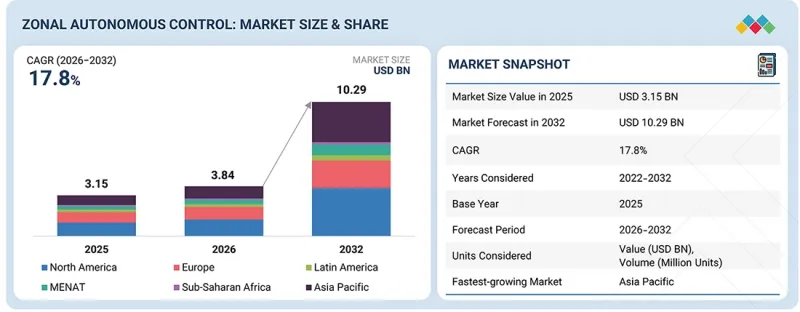
全球基於區域的自主控制市場規模預計將從 2026 年的 38.4 億美元成長到 2032 年的 102.9 億美元,複合年成長率為 17.8%。
| 調查範圍 | |
|---|---|
| 調查期 | 2021-2032 |
| 基準年 | 2025 |
| 預測期 | 2026-2032 |
| 單元 | 金額(美元) |
| 部分 | 按解決方案類型、應用程式和區域分類 |
| 目標區域 | 北美、歐洲、亞太地區及其他地區 |
隨著老舊電力基礎設施的現代化改造,人們對電網可靠性、氣候相關干擾以及可再生能源併網的日益關注,正推動區域特定自主控制(ZAC)系統得到廣泛應用。電力公司正增加對智慧電網自動化技術的投資,以增強運作連續性、實現自癒能力、管理分散式能源並支援即時分散式決策。此外,電氣化、極端天氣事件和不斷成長的電力消耗,也促使人們對電網運作的彈性和柔軟性提出了更高的要求,從而加速了自主控制平台在輸電、配電和工業能源網路中的部署。
“在發電領域,預計可再生能源板塊在預測期內將以最高的複合年成長率成長。”
在發電領域,預計可再生能源在預測期內將以最高的複合年成長率成長,這主要得益於全球向清潔、分散式能源系統加速轉型。隨著太陽能、風能和其他分散式能源(DER)的併網不斷推進,對先進的基於區域的自主控制解決方案的需求日益成長,這些解決方案旨在管理電網的波動性、間歇性和雙向電力流動。全球各國政府和監管機構正在製定嚴格的脫碳目標和可再生能源部署指令,進一步刺激了對電網現代化和智慧控制系統的投資。此外,微電網、能源儲存系統和產消者能源模式的日益普及也使電網運作更加複雜,需要基於區域的即時本地自主控制。因此,電力營運商正在擴大區域自主控制(ZAC)解決方案的部署,以提高電網的柔軟性、穩定性和效率,使可再生能源併網成為成長最快的領域。
“在工業領域,預計到 2032 年,資料中心細分市場將佔據最大的市場佔有率。”
在雲端運算、人工智慧工作負載和超大規模資料處理需求的推動下,數位基礎設施迅速擴張,預計到2032年,資料中心終端用戶領域將佔據最大的市場佔有率。資料中心需要可靠、不間斷且高效的電力供應,因此率先採用者先進的基於區域的自主控制解決方案,用於在電網邊緣進行即時監控、故障識別和能源最佳化。資料中心內再生能源來源和現場發電(例如微電網和能源儲存系統)的日益普及,進一步凸顯了智慧控制系統管理複雜電力流和確保電網穩定性的必要性。此外,運作、容錯性和能源效率的嚴格要求,以及超大規模營運商不斷增加的投資,正在加速自動化分散式電網控制技術的應用。因此,資料中心領域將繼續推動對基於區域的自主控制解決方案的需求,並在整個預測期內保持最大的市場佔有率。
“到2025年,北美將佔據最大的市場佔有率。”
預計到2025年,北美將佔據最大的市場佔有率,這主要得益於其先進的電網基礎設施、智慧電網技術的早期應用以及領先技術供應商的強大實力。該地區在分散式能源(DER)的現代化、數位化和整合方面投入巨資,並得到了強力的政府政策和法律規範的支持。此外,可再生能源專案、資料中心和電氣化舉措的快速擴張也推動了對智慧分散式電網控制解決方案的需求。美國和加拿大的電力公司正積極採用人工智慧驅動的電網管理系統、分散式能源資源管理系統(DERMS)和邊緣控制技術,以提高電網的可靠性、韌性和運作效率。這些因素共同促成了北美在2025年成為全球零電流控制(ZAC)市場的最大貢獻者。
本報告按區域對全球自主控制市場進行分析,概述了市場情況,分析了影響市場成長的各種因素、技術和專利趨勢、法律制度、案例研究、歷史和預測市場規模,並按各個細分市場/地區/主要國家進行了詳細分析,介紹了競爭格局和主要公司的概況。
目錄
第1章:引言
第2章執行摘要
第3章重要考察
第4章 市場概覽
- 市場動態
- 促進因素
- 抑制因子
- 機會
- 任務
- 價值鏈分析
- 生態系分析
- 案例研究分析
- 監理情勢
第4章 市場評估
- 按解決方案類型
- 電網自動化系統
- 邊緣智慧與控制系統
- 資料管理與控制平台
- 透過使用
- 變電站監測和運行
- 資產管理
- 邊緣管理
- 網路安全與威脅偵測
- 按最終用途
- 發電
- 動力傳輸
- 配電
- 產業
第5章:按區域分類的自主控制市場:按地區分類
- 北美洲
- 歐洲
- 拉丁美洲
- 中東、北非、土耳其
- 撒哈拉以南非洲
- 亞太地區
第6章 競爭情勢
- 概述
- 收入分析
- 市佔率分析
- 企業能力標竿分析:產品開發與商務策略
第7章:公司簡介
- 大公司
- GE VERNOVA
- SCHNEIDER ELECTRIC
- SIEMENS
- HITACHI ENERGY LTD
- LANDIS+GYR
- ABB
- S&C ELECTRIC COMPANY
- MITSUBISHI CORPORATION
- ITRON INC.
- HONEYWELL INTERNATIONAL INC.
- 其他公司
- ORACLE
- EATON CORPORATION PLC
- SCHWEITZER ENGINEERING LABORATORIES, INC.
- SURVALENT TECHNOLOGY CORPORATION
- GRIDX GMBH
- G&W ELECTRIC
- PSI SOFTWARE SE
- EMERSON ELECTRIC CO.
第8章:調查方法
第9章附錄
The global zonal autonomous control market is estimated to reach USD 10.29 billion by 2032 from USD 3.84 billion in 2026, registering a CAGR of 17.8%.
| Scope of the Report | |
|---|---|
| Years Considered for the Study | 2021-2032 |
| Base Year | 2025 |
| Forecast Period | 2026-2032 |
| Units Considered | Value (USD Billion) |
| Segments | By Solution Type, Application and Region |
| Regions covered | North America, Europe, APAC, RoW |
The increasing modernization of aging power infrastructure, combined with rising concerns over grid reliability, climate-related disruptions, and renewable energy integration, is significantly driving the adoption of zonal autonomous control (ZAC) systems. Utilities are increasingly investing in intelligent grid automation technologies to improve operational continuity, enable self-healing capabilities, manage distributed energy resources, and support real-time decentralized decision-making. In addition, the growing demand for resilient and flexible grid operations amid electrification, extreme weather events, and rising power consumption is accelerating the deployment of autonomous control platforms across transmission, distribution, and industrial energy networks.
"Renewable end use of the generation segment projected to grow at the highest CAGR during the forecast period"
The renewable end-use of generation segment is projected to grow at the highest CAGR during the forecast period, primarily due to the accelerating global transition toward clean and decentralized energy systems. Increasing integration of solar, wind, and other distributed energy resources (DERs) is driving the need for advanced zonal autonomous control solutions to manage grid variability, intermittency, and bidirectional power flows. Governments and regulators worldwide are implementing stringent decarbonization targets and renewable energy mandates, further boosting investments in grid modernization and intelligent control systems. Additionally, the rising deployment of microgrids, energy storage systems, and prosumer-based energy models is increasing the complexity of grid operations, thereby necessitating real-time, localized, and autonomous control at the zonal level. As a result, utilities are increasingly adopting ZAC solutions to enhance grid flexibility, stability, and efficiency, making renewable energy integration the fastest-growing application segment.
"Data center end use of industries segment projected to hold the largest market share by 2032"
The data center end-use segment is projected to hold the largest market share by 2032 due to the rapid expansion of digital infrastructure driven by cloud computing, AI workloads, and hyperscale data processing requirements. Data centers demand highly reliable, uninterrupted, and efficient power supply, making them early adopters of advanced zonal autonomous control solutions for real-time monitoring, fault isolation, and energy optimization at the grid edge. The increasing deployment of renewable energy sources and on-site generation (such as microgrids and energy storage systems) within data centers further necessitates intelligent control systems to manage complex power flows and ensure grid stability. Additionally, stringent requirements for uptime, resilience, and energy efficiency, coupled with rising investments by hyperscale operators, are accelerating the adoption of automated, decentralized grid control technologies. As a result, the data center segment continues to dominate demand for ZAC solutions, securing the largest market share over the forecast period.
"North America held the largest market share in 2025"
North America held the largest market share in the zonal autonomous control (ZAC) market in 2025 due to its advanced grid infrastructure, early adoption of smart grid technologies, and strong presence of leading technology providers. The region has witnessed significant investments in grid modernization, digitalization, and integration of distributed energy resources (DERs), driven by supportive government policies and regulatory frameworks. Additionally, the rapid growth of renewable energy projects, data centers, and electrification initiatives has increased the need for intelligent, decentralized grid control solutions. Utilities across the US and Canada are actively deploying AI-driven grid management systems, DERMS, and edge control technologies to enhance grid reliability, resilience, and operational efficiency. These factors collectively position North America as the leading contributor to the global ZAC market in 2025.
The breakdown of the profile of primary participants in the home automation system market is as follows:
- By Company Type: Tier 1 - 52%, Tier 2 - 28%, Tier 3 - 20%
- By Designation: C-level Executives - 24%, Directors - 33%, Others - 43%
- By Region: Asia Pacific - 38%, Europe - 27%, North America - 22%, MENAT - 5%, Latin America - 4%, and Sub-Saharan Africa - 4%
Note: Other designations include sales, marketing, and product managers.
The three tiers of the companies are based on their total revenues as of 2024: Tier 1: >USD 1 billion, Tier 2: USD 500 million-1 billion, and Tier 3: USD 500 million.
The zonal autonomous control market is dominated by a few globally established players such as GE Vernova, Schneider Electric, Siemens, Hitachi Energy Ltd, Landis+Gyr, ABB, S&C Electric Company, Honeywell International Inc, Smarter Grid Solutions, Inc., Itron Inc., gridX, Oracle, and Eaton. The study includes an in-depth competitive analysis of these key players in the home automation system market, with their company profiles, recent developments, and key market strategies.
Research Coverage
The report segments the zonal autonomous control market and forecasts its size by solution type, application, end use, and region. It also provides a comprehensive review of drivers, restraints, opportunities, and challenges influencing market growth. The report covers both qualitative and quantitative aspects of the market.
Reasons to Buy the Report:
The report will help leaders/new entrants in this market by providing approximate revenue figures for the overall zonal autonomous control market and related segments. This report will help stakeholders understand the competitive landscape and gain deeper insights to strengthen their market position and plan effective go-to-market strategies. The report will also help stakeholders understand the market pulse and provide information on key drivers, restraints, opportunities, and challenges.
The report provides insights into the following pointers:
- Analysis of key drivers (rising electrification & EV infrastructure expansion); restraints (legacy infrastructure incompatibility); opportunities (AI-driven edge intelligence & autonomous decision-making convergence); challenges (cybersecurity vulnerabilities & autonomous control governance risks)
- Product Development/Innovation: Detailed insights into upcoming technologies, research & development activities, and product launches in the zonal autonomous control market
- Market Development: Comprehensive information about lucrative markets by analyzing the zonal autonomous control market across varied regions
- Market Diversification: Exhaustive information about new products, untapped geographies, recent developments, and investments in the zonal autonomous control market
- Competitive Assessment: In-depth assessment of market shares, growth strategies, and service offerings of leading players like GE Vernova, Schneider Electric, Siemens, Hitachi Energy Ltd, Landis+Gyr, ABB, S&C Electric Company, Honeywell International Inc, Smarter Grid Solutions, Inc., Itron Inc., gridX, Oracle, and Eaton are some of the key players in the zonal autonomous control market
TABLE OF CONTENTS
1 INTRODUCTION
- 1.1 OBJECTIVE
- 1.2 MARKET DEFINITION
- 1.3 STUDY SCOPE
- 1.4 INCLUSION AND EXCLUSION
2 EXECUTIVE SUMMARY AND PREMIUM INSIGHTS
3 MARKET OVERVIEW AND DYNAMICS
- 3.1 INTRODUCTION
- 3.2 MARKET DYNAMICS
- 3.2.1 DRIVERS
- 3.2.2 RESTRAINTS
- 3.2.3 OPPORTUNITIES
- 3.2.4 CHALLENGES
- 3.3 VALUE CHAIN ANALYSIS
- 3.4 ECOSYSTEM ANALYSIS
- 3.5 CASE STUDY ANALYSIS
- 3.6 REGULATORY LANDSCAPE
4 MARKET ASSESSMENT
- 4.1 ZONAL AUTONOMOUS CONTROL MARKET, BY SOLUTION TYPE
- 4.1.1 INTRODUCTION
- 4.1.2 GRID AUTOMATION SYSTEMS
- 4.1.3 EDGE INTELLIGENCE & CONTROL SYSTEMS
- 4.1.4 DATA MANAGEMENT & CONTROL PLATFORMS
- 4.2 ZONAL AUTONOMOUS CONTROL MARKET, BY APPLICATION
- 4.2.1 INTRODUCTION
- 4.2.2 SUBSTATION MONITORING & OPERATIONS
- 4.2.3 ASSET MANAGEMENT
- 4.2.4 EDGE MANAGEMENT
- 4.2.5 CYBERSECURITY & THREAT DETECTION
- 4.3 ZONAL AUTONOMOUS CONTROL MARKET, BY END USE
- 4.3.1 INTRODUCTION
- 4.3.2 GENERATION
- 4.3.2.1 Conventional
- 4.3.2.2 Renewable
- 4.3.3 TRANSMISSION
- 4.3.4 DISTRIBUTION
- 4.3.5 INDUSTRIES
- 4.3.5.1 Oil & Gas
- 4.3.5.2 Data Centers
- 4.3.5.3 Defense
- 4.3.5.4 Manufacturing
- 4.3.5.5 Metals & Mining
- 4.3.5.6 Other Industries
5 ZONAL AUTONOMOUS CONTROL MARKET, BY REGION
- 5.1 INTRODUCTION
- 5.2 NORTH AMERICA
- 5.2.1.1 US
- 5.2.1.2 Canada
- 5.2.1.3 Mexico
- 5.2.2 EUROPE
- 5.2.2.1 Germany
- 5.2.2.2 UK
- 5.2.2.3 France
- 5.2.2.4 Italy
- 5.2.2.5 Spain
- 5.2.2.6 Rest of Europe
- 5.2.3 LATIN AMERICA
- 5.2.3.1 Brazil
- 5.2.3.2 Argentina
- 5.2.3.3 Chile
- 5.2.3.4 Rest of LATAM
- 5.2.4 MIDDLE EAST, NORTH AFRICA & TURKEY
- 5.2.4.1 GCC Countries
- 5.2.4.1.1 Saudi Arabia
- 5.2.4.1.2 UAE
- 5.2.4.1.3 Rest of GCC Countries
- 5.2.4.2 Turkey
- 5.2.4.3 North Africa
- 5.2.4.4 Rest of Middle East, North Africa & Turkey
- 5.2.4.1 GCC Countries
- 5.2.5 SUB-SAHARAN AFRICA
- 5.2.5.1 South Africa
- 5.2.5.2 Nigeria
- 5.2.5.3 Rest of Sub-Saharan Africa
- 5.2.6 ASIA PACIFIC
- 5.2.6.1 India
- 5.2.6.2 China
- 5.2.6.3 Oceania
- 5.2.6.3.1 Australia
- 5.2.6.3.2 New Zealand
- 5.2.6.4 Rest of Asia Pacific
6 COMPETITIVE LANDSCAPE
- 6.1 OVERVIEW
- 6.2 REVENUE ANALYSIS
- 6.3 MARKET SHARE ANALYSIS
- 6.4 CAPABILITY BENCHMARKING OF PLAYERS: BASED ON PRODUCT FOOTPRINT AND BUSINESS STRATEGY
- 6.4.1 STARS
- 6.4.2 EMERGING LEADERS
- 6.4.3 PERVASIVE PLAYERS
- 6.4.4 PARTICIPANTS
- 6.4.5 COMPANY FOOTPRINT
- 6.4.5.1 Solution Type Footprint
- 6.4.5.2 Application Footprint
- 6.4.5.3 End Use Footprint
- 6.4.5.4 Region Footprint
- 6.4.6 COMPETITIVE SCENARIO
- 6.4.7 PRODUCT LAUNCHES
- 6.4.7.1 Deals
7 COMPANY PROFILES
- 7.1 INTRODUCTION
- 7.2 KEY PLAYERS
- 7.2.1 GE VERNOVA
- 7.2.2 SCHNEIDER ELECTRIC
- 7.2.3 SIEMENS
- 7.2.4 HITACHI ENERGY LTD
- 7.2.5 LANDIS+GYR
- 7.2.6 ABB
- 7.2.7 S&C ELECTRIC COMPANY
- 7.2.8 MITSUBISHI CORPORATION
- 7.2.9 ITRON INC.
- 7.2.10 HONEYWELL INTERNATIONAL INC.
- 7.3 OTHER PLAYERS
- 7.3.1 ORACLE
- 7.3.2 EATON CORPORATION PLC
- 7.3.3 SCHWEITZER ENGINEERING LABORATORIES, INC.
- 7.3.4 SURVALENT TECHNOLOGY CORPORATION
- 7.3.5 GRIDX GMBH
- 7.3.6 G&W ELECTRIC
- 7.3.7 PSI SOFTWARE SE
- 7.3.8 EMERSON ELECTRIC CO.
8 RESEARCH METHODOLOGY
9 APPENDIX

 全球汽車ECU市場(至2033年):以內燃機及電動車應用(ADAS及安全、電池管理系統、資訊娛樂系統、動力傳動系統、遠端資訊處理、其他)、ECU處理能力(16
 汽車電控系統市場報告:趨勢、預測與競爭分析(至2035年)
 汽車ECU市場預測至2034年-全球分析(依ECU類型、車輛架構、車輛類型、動力系統、自動化程度、應用、最終用戶、銷售管道及地區分類)汽車區域架構市場預測至2034年-全球架構類型、組件、區域類型、網路技術、應用、銷售管道和區域分析汽車網域控制器市場預測至2034年-按網域類型、通訊技術、部署模式、車輛等級、應用、銷售管道和地區分類的全球分析
 電子控制管理市場:2026-2032年全球市場預測(依產品類型、技術、安裝方式、應用及最終用戶產業分類)汽車電控系統市場:按驅動系統、自動駕駛等級、電子架構、應用、通路和車輛類型分類-2026-2032年全球市場預測硬體回路(HIL) 模擬市場:按類型、測試類型、開發階段、自動化等級、部署模型、應用和最終用戶分類-2026-2032 年全球市場預測
 引擎控制單元 (ECU) 市場分析及預測(至 2035 年):按類型、產品類型、服務、技術、組件、應用、部署、最終用戶、功能和安裝類型分類汽車電控系統(ECU) 市場分析與預測(至 2035 年):類型、產品、技術、組件、應用、最終用戶、功能、安裝類型、解決方案