


 |
市場調查報告書
商品編碼
1940883
非洲聚對苯二甲酸乙二醇酯(PET):市場佔有率分析、產業趨勢與統計、成長預測(2026-2031)Africa Polyethylene Terephthalate (PET) - Market Share Analysis, Industry Trends & Statistics, Growth Forecasts (2026 - 2031) |
||||||

※ 本網頁內容可能與最新版本有所差異。詳細情況請與我們聯繫。
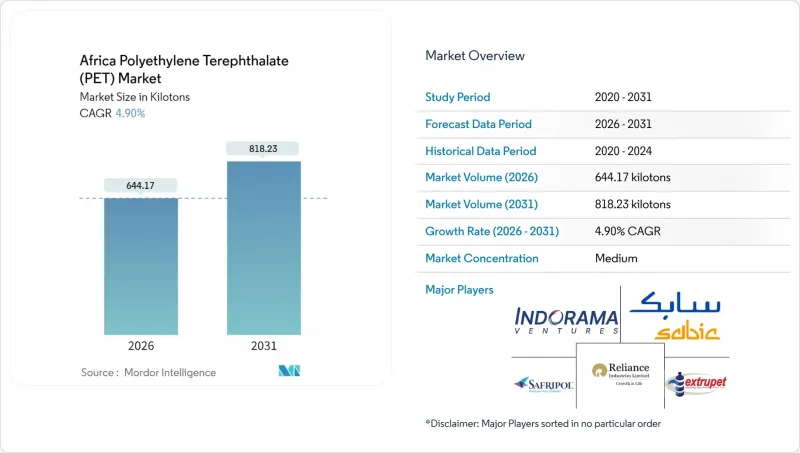
預計到 2026 年,非洲聚對苯二甲酸乙二醇酯 (PET) 市場規模將達到 644.17 千噸。
預計該數值將從 2025 年的 614.08 千噸成長到 2031 年的 818.23 千噸,2026 年至 2031 年的複合年成長率為 4.9%。
中產階級的持續成長、非洲大陸自由貿易區(AfCFTA)下的關稅協調以及本地瓶裝產能的擴張是推動需求成長的關鍵因素。品牌所有者青睞PET材質,因為它具有透明度高、強度重量比好以及與現有灌裝線親和性等優點;同時,由於生產者責任法規的加強,對再生PET的需求也在成長。跨國快速消費品(FMCG)公司不斷建造本地生產基地,將供應重心從依賴進口轉向依賴區域樹脂工廠。公共部門貸款與循環經濟目標相契合,將大規模藍色貸款和綠色債券用於建造綜合收集和回收基礎設施。然而,原油價格波動以及消費者對生物基替代品的興趣帶來了策略上的不確定性,這需要靈活的籌資策略和產品創新。
非洲聚對苯二甲酸乙二醇酯(PET)市場趨勢與洞察
該地區不斷壯大的中產階級的飲料消費量增加
都市區收入的快速成長推動了對碳酸軟性飲料、瓶裝水和機能飲料的需求。可口可樂HBC公司正投資10億美元擴大在奈及利亞的產能,而可口可樂飲料非洲公司將於2024年在奈米比亞開設一條價值5,000萬美元的瓶裝生產線。產量的增加帶來了瓶坯和瓶蓋的大宗訂單,確保了對原生樹脂的穩定需求。不斷成長的消費給不發達的廢棄物處理系統帶來了壓力,拉各斯和阿克拉等城市正在試點生產者費用押金返還計劃。飲料製造商正在整合封蓋、拉伸吹塑成型和填充生產線,以降低運輸成本並前置作業時間。灌裝量的增加降低了單位包裝成本,使PET包裝在價格上能與玻璃和鋁包裝競爭。
政府設定的再生包裝含量目標
肯亞2024年實施的「生產者延伸責任制」(EPR)法規透過對每件進口產品附加稅150肯亞先令的稅款並要求品牌註冊,為使用再生材料提供了明確的獎勵。南非的EPR框架(自2021年起生效)要求每年報告回收和處理量。奈及利亞監管機構正在製定類似的規則,並計劃在基礎設施到位後逐步實施最低再生材料含量標準。百事可樂撒哈拉以南非洲地區目前的目標是在其飲料產品線中實現20%的再生聚酯(rPET)含量,並已為區域採購協議奠定了基礎。 rPET含量較高的公司可以透過新興的生態標章計畫獲得更高的商店可見度。然而,有效實施這些措施需要將非正式的回收商正規化,並將清潔和固態縮聚(SSP)設備升級到食品級標準。
加速消費者向生物基/可堆肥替代品的轉變
2019年至2024年間,全球採用生物基包裝的新型食品和飲料產品年均成長60%。歐盟法規將某些可生物分解聚合物指定為可回收物,此監管先例可供非洲政策制定者效法。各大品牌正在試行可堆肥咖啡膠囊和澱粉基咖啡壺,這給小眾市場對PET的使用帶來了壓力。再生PET的價格通常比原生材料高出每噸150美元,因此實現長期成本平衡有助於推廣生物基解決方案。然而,由於原料物流、專用擠出設備以及工業堆肥設施的缺乏,擴大非洲生物聚合物的供應仍面臨許多挑戰。
細分市場分析
2025年,原生PET在非洲聚對苯二甲酸乙二醇酯(PET)市場佔有82.78%的佔有率,加工商看重其穩定的特性黏度和廣泛的食品級認證。該細分市場受益於成熟的進口管道、原料的優惠關稅待遇以及充足的瓶坯加工能力。瓶裝回收PET(rPET)的供應仍然受限,因為目前只有少數工廠運作專門的高溫洗滌和固相聚合(SSP)生產線來生產高品質的片狀PET。
到2031年,再生PET市場將以7.85%的複合年成長率成長,這主要得益於生產者責任延伸(EPR)法規以及飲料巨頭將經營團隊薪酬與循環包裝目標掛鉤的自願承諾。國際金融公司(IFC)的融資支持了新的清洗生產線和SSP(固相萃取)瓶頸的消除,而鏈延長添加劑則使得在不影響透明度的前提下恢復IVI(內部體積指數)成為可能。隨著這些投資的成長,到本十年末,非洲再生級聚對苯二甲酸乙二醇酯(PET)的市佔率可望達到兩位數。然而,在打包供應、監管一致性和信貸市場到位之前,原生樹脂可能仍將佔據主導地位,從而降低大規模再生PET(rPET)整合的風險。
非洲聚對苯二甲酸乙二醇酯(PET)市場報告按原料類型(原生PET、再生PET)、終端用戶產業(汽車、建築、電氣電子、工業機械、包裝及其他終端用戶產業)和地區(奈及利亞、南非、非洲其他地區)進行細分。市場預測以數量(噸)和價值(美元)為單位。
其他福利:
- Excel格式的市場預測(ME)表
- 3個月的分析師支持
目錄
第1章 引言
- 研究假設和市場定義
- 調查範圍
第2章調查方法
第3章執行摘要
第4章 市場情勢
- 市場概覽
- 市場促進因素
- 隨著該地區中產階級的壯大,飲料消費量也不斷增加。
- 政府對再生包裝含量設定的目標
- 跨國消費品製造商擴大本地灌裝產能
- 根據非洲大陸自由貿易區(AfCFTA)進行的關稅調整將降低PET進口成本。
- 新興發展金融機構/國際金融公司為PET回收基礎設施提供融資
- 市場限制
- 原物料價格波動與原油價格相關
- 消費者越來越傾向選擇生物基/可堆肥替代品
- 小規模再生聚乙烯(rPET)原料收集網路
- 價值鏈分析
- 波特五力模型
- 新進入者的威脅
- 供應商的議價能力
- 買方的議價能力
- 替代品的威脅
- 競爭對手之間的競爭
- 進出口趨勢
- 價格趨勢
- 形態趨勢
- 回收利用概述
- 法律規範
- 終端用戶產業趨勢
- 航太(航太零件生產收入)
- 汽車(汽車產量)
- 建築與施工(新建建築占地面積)
- 電氣電子設備(電氣電子設備生產收入)
- 包裝(塑膠包裝量)
第5章 市場規模和成長預測(價值和數量)
- 依原料類型
- 處女寵物
- 再生PET(rPET)
- 按最終用戶行業分類
- 車
- 建築/施工
- 電氣和電子設備
- 工業和機械
- 包裝
- 其他終端用戶產業
- 按地區
- 奈及利亞
- 南非
- 其他非洲地區
第6章 競爭情勢
- 市場集中度
- 策略趨勢
- 市佔率(%)/排名分析
- 公司簡介
- Alpek SAB de CV
- ALPLA
- Extrupet(Pty)Ltd.
- Far Eastern New Century Co., Ltd.
- Indorama Ventures Public Company Limited.
- Mohinani Group
- Mpact Group Limited
- PETCO
- Reliance Industries Limited
- SABIC
- Safripol Pty Ltd
- Sumilon Eco Pet Sarl
第7章 市場機會與未來展望
第8章:執行長面臨的關鍵策略挑戰
Africa Polyethylene Terephthalate (PET) market size in 2026 is estimated at 644.17 kilotons, growing from 2025 value of 614.08 kilotons with 2031 projections showing 818.23 kilotons, growing at 4.9% CAGR over 2026-2031.
Sustained middle-class growth, tariff harmonization under the African Continental Free Trade Area (AfCFTA), and expanding local bottling capacity are the primary forces lifting demand. Brand owners favor PET for its clarity, strength-to-weight ratio, and familiarity in existing filling lines, while recycled grades gain momentum as producer responsibility rules tighten. Multinational fast-moving consumer goods (FMCG) players continue to build localized production hubs, shifting the supply balance away from imports and toward regional resin plants. Public-sector lending taps into circular economy objectives, directing large-scale blue-loans and green-bonds toward integrated collection and recycling infrastructure. Nonetheless, oil-linked feedstock swings and consumer interest in bio-based alternatives create strategic uncertainty that requires agile sourcing strategies and product innovation.
Africa Polyethylene Terephthalate (PET) Market Trends and Insights
Rising Beverage Consumption by the Region's Growing Middle Class
Rapid income gains across urban hubs propel demand for carbonated drinks, bottled water, and functional beverages. Coca-Cola HBC has earmarked USD 1 billion for Nigerian capacity additions, while Coca-Cola Beverages Africa opened a USD 50 million bottling line in Namibia in 2024. Higher throughput translates into larger off-take contracts for preforms and caps, locking in steady offtake for virgin resin. Growing consumption stresses underdeveloped waste systems, prompting cities such as Lagos and Accra to pilot deposit-return schemes funded by producer levies. Beverage converters respond by co-locating closure injection, stretch-blow, and filling lines, reducing freight cost and cutting lead times. Rising fill volumes compress per-unit packaging costs, preserving PET's price competitiveness against glass and aluminum.
Government Targets for Recycled-Content Packaging
Kenya's 2024 Extended Producer Responsibility (EPR) regulations impose KES 150 per imported item and require brand registration, creating explicit incentives for recycled content. South Africa's EPR framework, live since 2021, demands annual reporting on collected and processed volumes. Nigeria's regulator is drafting similar rules that will phase in minimum recycled content thresholds once infrastructure matures. PepsiCo Sub-Saharan Africa now targets 20% rPET inclusion across its beverage lines, setting an anchor for regional offtake contracts. Firms that certify higher rPET ratios gain shelf visibility advantages under emerging eco-labeling schemes. Effective enforcement, however, hinges on formalizing informal collectors and upgrading washing and solid-state polycondensation (SSP) units to food-grade standards.
Rising Consumer Shift to Bio-Based/Compostable Alternatives
Global food and beverage launches featuring bio-based packaging rose 60% annually between 2019 and 2024. European Union rules recognize certain biodegradable polymers as recyclable, creating a regulatory precedent that African policymakers may emulate. Brands test compostable coffee-capsules and starch-based pots, pressuring PET volumes in niche segments. Recycled PET often trades USD 150 per tonne above virgin, widening the motivation to test bio-based solutions if long-run cost parity can be achieved. Scaling biopolymer supply in Africa remains complex because feedstock logistics, specialized extrusion equipment, and industrial composting sites are still limited.
Other drivers and restraints analyzed in the detailed report include:
- Expansion of Local Bottling Capacity by Multinational FMCGs
- AfCFTA-Driven Tariff Alignment Lowering PET Import Costs
- Sub-Scale Collection Networks for rPET Feedstock
For complete list of drivers and restraints, kindly check the Table Of Contents.
Segment Analysis
Virgin PET secured 82.78% of the Africa Polyethylene Terephthalate (PET) market share in 2025 because converters prize its consistent intrinsic viscosity and broad food-grade approvals. The segment benefits from mature import corridors, duty concessions on raw materials, and plentiful preform conversion capacity. Bottle-to-bottle rPET remains supply-constrained as high-grade flake requires specialized hot-wash and SSP lines that only a handful of plants operate today.
Recycled PET is advancing at an 7.85% CAGR to 2031, propelled by EPR regulations and voluntary pledges from beverage majors that link executive remuneration to circular-packaging milestones. International Finance Corporation loans underwrite new wash lines and SSP debottlenecking, while chain-extension additives now restore intrinsic viscosity without compromising clarity. As these investments scale, the Africa Polyethylene Terephthalate (PET) market size for recycled grades could reach meaningful double-digit share by the end of the decade. Still, virgin resin will dominate until bale supply, regulatory coherence, and credit markets align to de-risk full-scale rPET integration.
The Africa Polyethylene Terephthalate (PET) Market Report is Segmented by Source Type (Virgin PET, Recycled PET), End-User Industry (Automotive, Building and Construction, Electrical and Electronics, Industrial and Machinery, Packaging, Other End-User Industries), and Geography (Nigeria, South Africa, Rest of Africa). The Market Forecasts are Provided in Terms of Volume (Tons) and Value (USD).
List of Companies Covered in this Report:
- Alpek S.A.B. de C.V.
- ALPLA
- Extrupet (Pty) Ltd.
- Far Eastern New Century Co., Ltd.
- Indorama Ventures Public Company Limited.
- Mohinani Group
- Mpact Group Limited
- PETCO
- Reliance Industries Limited
- SABIC
- Safripol Pty Ltd
- Sumilon Eco Pet Sarl
Additional Benefits:
- The market estimate (ME) sheet in Excel format
- 3 months of analyst support
TABLE OF CONTENTS
1 Introduction
- 1.1 Study Assumptions & Market Definition
- 1.2 Scope of the Study
2 Research Methodology
3 Executive Summary
4 Market Landscape
- 4.1 Market Overview
- 4.2 Market Drivers
- 4.2.1 Rising beverage consumption by the region's growing middle-class
- 4.2.2 Government targets for recycled-content packaging
- 4.2.3 Expansion of local bottling capacity by multinational FMCGs
- 4.2.4 AfCFTA-driven tariff alignment lowering PET import costs
- 4.2.5 Emerging DFI/IFC financing for PET recycling infrastructure
- 4.3 Market Restraints
- 4.3.1 Volatile crude-oil-linked feedstock prices
- 4.3.2 Rising consumer shift to bio-based/compostable alternatives
- 4.3.3 Sub-scale collection networks for rPET feedstock
- 4.4 Value Chain Analysis
- 4.5 Porter's Five Forces
- 4.5.1 Threat of New Entrants
- 4.5.2 Bargaining Power of Suppliers
- 4.5.3 Bargaining Power of Buyers
- 4.5.4 Threat of Substitutes
- 4.5.5 Competitive Rivalry
- 4.6 Import And Export Trends
- 4.7 Price Trends
- 4.8 Form Trends
- 4.9 Recycling Overview
- 4.10 Regulatory Framework
- 4.11 End-use Sector Trends
- 4.11.1 Aerospace (Aerospace Component Production Revenue)
- 4.11.2 Automotive (Automobile Production)
- 4.11.3 Building and Construction (New Construction Floor Area)
- 4.11.4 Electrical and Electronics (Electrical and Electronics Production Revenue)
- 4.11.5 Packaging(Plastic Packaging Volume)
5 Market Size & Growth Forecasts (Value and Volume)
- 5.1 By Source Type
- 5.1.1 Virgin PET
- 5.1.2 Recycled PET (rPET)
- 5.2 By End-User Industry
- 5.2.1 Automotive
- 5.2.2 Building and Construction
- 5.2.3 Electrical and Electronics
- 5.2.4 Industrial and Machinery
- 5.2.5 Packaging
- 5.2.6 Other End-user Industries
- 5.3 By Geography
- 5.3.1 Nigeria
- 5.3.2 South Africa
- 5.3.3 Rest of Africa
6 Competitive Landscape
- 6.1 Market Concentration
- 6.2 Strategic Moves
- 6.3 Market Share (%)**/Ranking Analysis
- 6.4 Company Profiles (includes Global level Overview, Market level overview, Core Segments, Financials, Strategic Information, Market Rank/Share for key companies, Products & Services, and Recent Developments)
- 6.4.1 Alpek S.A.B. de C.V.
- 6.4.2 ALPLA
- 6.4.3 Extrupet (Pty) Ltd.
- 6.4.4 Far Eastern New Century Co., Ltd.
- 6.4.5 Indorama Ventures Public Company Limited.
- 6.4.6 Mohinani Group
- 6.4.7 Mpact Group Limited
- 6.4.8 PETCO
- 6.4.9 Reliance Industries Limited
- 6.4.10 SABIC
- 6.4.11 Safripol Pty Ltd
- 6.4.12 Sumilon Eco Pet Sarl
7 Market Opportunities & Future Outlook
- 7.1 White-Space & Unmet-Need Assessment
8 Key Strategic Questions for CEOs

 2026年全球聚對苯二甲酸乙二醇酯(PET)杯市場報告
 全球聚對苯二甲酸乙二醇酯(PET)市場規模、佔有率、趨勢和成長分析報告(2026-2034年)
 生物基聚對苯二甲酸丙二醇酯(BioPTT)市場:市場規模-按地區、應用和預測至2034年
 聚對苯二甲酸乙二醇酯市場分析及預測(至2035年):類型、產品類型、應用、形態、材料類型、製程、最終用戶、功能、安裝類型
 南美洲聚對苯二甲酸乙二酯(PET):市場佔有率分析、產業趨勢與統計、成長預測(2026-2031)全球再生聚對苯二甲酸乙二醇酯市場規模、佔有率、趨勢和成長分析報告(2026-2034年)2026年全球再生聚對苯二甲酸乙二酯市場報告2026年全球聚對苯二甲酸乙二醇酯(PET)及聚聚丁烯對苯二甲酸酯(PBT)樹脂市場報告2026年聚對苯二甲酸乙二酯全球市場報告
 聚對苯二甲酸乙二醇酯市場:依樹脂類型、製造流程、終端用途產業及應用分類-2026-2032年全球預測