


 |
市場調查報告書
商品編碼
1940850
歐洲乾粉砂漿:市場佔有率分析、產業趨勢與統計、成長預測(2026-2031)Europe Dry Mix Mortar - Market Share Analysis, Industry Trends & Statistics, Growth Forecasts (2026 - 2031) |
||||||

※ 本網頁內容可能與最新版本有所差異。詳細情況請與我們聯繫。
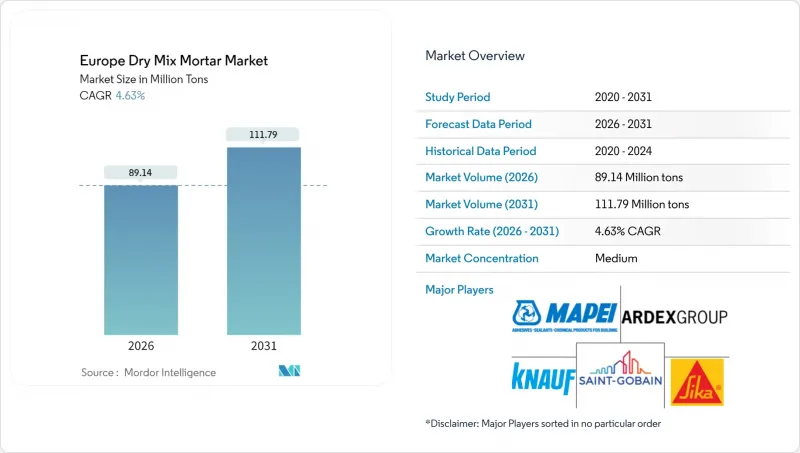
歐洲乾混砂漿市場預計將從 2025 年的 8,519 萬噸成長到 2026 年的 8,914 萬噸,預計到 2031 年將達到 1.1179 億噸,2026 年至 2031 年的複合年成長率為 4.63%。
この成長軌道は、同地域における低炭素建設への決定的な移行、公共部門の大規模維修予算、欧州綠色交易に基づく規制の整合性から生じています。老朽化した住宅存量の維修活動、自動サイロバッチングの普及拡大、再生材配合に関する急速な製品革新が、いずれも需要を後押ししています。競争戦略は、原料価格の変動を緩和する垂直統合と、厳格なVOC(揮発性有機化合物)およびシリカ粉塵の閾值を満たす継続的な製品研究開発に重点を置いています。競合情勢全体では、數位化された工場や循環型経済添加剤への投資が新たな市場機会を開拓すると同時に、永續性に関する認証における差別化を可能にしております。
歐洲乾粉砂漿市場趨勢與洞察
老舊建築存量推動了維修需求
欧州の建築物の4分の3以上は1990年以前に建設され、現在のエネルギー性能基準を満たしていません。ドイツの連邦政府による補助金制度やフランスのMaPrimeRenovプログラムにより、左官用モルタル、断熱モルタル、補修用モルタルへの安定した需要が生まれています。この維修需要の高い環境下では、接着性向上、低粉塵、繊維混入などの特殊配合が競争優位性を持っており、小規模な請負業者でも現場施工が容易な配合の拡大がメーカーに促されています。同時に、自動サイロシステムは熟練左官職人の不足を緩和し、密集した都市區の現場においても安定した混合品質を提供しております。
歐盟脫碳和能源效率指令
修訂後的《建築能源性能指令》(EPBD) 要求所有新建建築在 2030 年前達到近零能耗標準,並對現有建築進行大規模維修。這些法規迫使產品開發商採用低碳配方,其中包含再生細料和水泥基輔助材料。由於修訂後的《建築產品法規》預計將強制要求提交環境產品聲明 (EPD),因此,能夠證明其生產過程排放低於每噸 250 公斤二氧化碳當量 (CO2e) 的領先,很可能在公共競標中獲得優先權。
原物料價格波動
2024年,受能源通膨和歐盟排放交易體系(EU ETS)下碳排放權成本上漲的影響,水泥價格上漲。同時,由於物流瓶頸和更嚴格的採礦許可證規定,骨材價格也隨之上漲。由於原物料成本佔生產成本的70%之多,沒有避險策略的製造商面臨利潤空間被壓縮和合約價格調整延遲的困境。德國和荷蘭部分地區的砂石短缺導致特種細砂價格上漲,迫使生產商對再生玻璃和碎混凝土進行認證,以作為替代填充材。在成本轉嫁機制和替代原料穩定之前,這些原料成本的波動將限制生產成長。
細分市場分析
2025年、欧州の乾式モルタル市場において住宅計劃が52.00%を占めました。これは、加速する省エネ維修義務化により、隔熱材料、レンダリング、スクリードの需要が増加したためです。商業施設は規模こそ小さいもの、ハイブリッドオフィスの維修や小売店舗のフォーマット更新が活性化するため、2031年までにCAGR6.2%と最も高い伸び率を示すと予測されます。産業,公共施設向け需要は、抗菌タイル黏合劑を好む製薬用クリーンルーム建設に支えられています。TEN-T(欧州横断交通網)に基づくインフラ更新により、アンカー材、補修用水泥漿、防水スラリーの需要が安定的に増加しています。
住宅領域的主導地位主要得益於德國2024年創紀錄的120萬套維修,而法國的目標是每年完成50萬套大型維修。採用生物基纖維和相變微膠囊的高性能抹灰系統價格不菲,同時又能滿足嚴格的U值標準。商業領域的成長則源自於業主希望將辦公空間重新配置為協作區域,從而推動了對速凝找平材料的需求。工業活動依賴監管獎勵,這些措施強制要求建立清潔的生產工廠,使得低VOC(揮發性有機化合物)的地面砂漿成為必需品。承包商指出,自動化筒倉配料可以緩解勞動力短缺(在住宅維修尤為突出),防止工期延誤,並提高最終的施工品質。
歐洲乾粉砂漿市場報告按最終用途產業(商業、工業及公共、基礎設施、住宅)、應用領域(抹灰、粉刷、瓷磚黏合劑、水泥漿、防水漿料、混凝土保護與維修等)以及地區(法國、德國、義大利、俄羅斯、西班牙、英國、歐洲其他地區)進行細分。市場預測以噸為單位。
其他福利:
- Excel格式的市場預測(ME)表
- 3個月的分析師支持
目錄
第1章 引言
- 研究假設和市場定義
- 調查範圍
第2章調查方法
第3章執行摘要
第4章 市場情勢
- 市場概覽
- 市場促進因素
- 老舊建築存量推動了維修需求。
- 歐盟脫碳和能源效率指令
- 預製/異地建造的成長
- 疫情後綠色基礎設施獎勵策略
- 採用自動筒倉配料
- 市場限制
- 原物料價格波動
- 嚴格的揮發性有機化合物(VOC)和二氧化矽粉塵法規
- 熟練噴塗和抹灰工人短缺
- 價值鏈分析
- 法律規範
- 波特五力模型
- 新進入者的威脅
- 供應商的議價能力
- 買方的議價能力
- 替代品的威脅
- 競爭對手之間的競爭
第5章 市場規模與成長預測
- 按最終用途面積
- 商業的
- 工業和公共設施
- 基礎設施
- 住宅
- 透過使用
- 石膏
- 渲染
- 磁磚黏合劑
- 水泥漿
- 防水漿料
- 混凝土保護與維修
- 保溫和飾面系統
- 其他用途
- 按國家/地區
- 法國
- 德國
- 義大利
- 俄羅斯
- 西班牙
- 英國
- 其他歐洲地區
第6章 競爭情勢
- 市場集中度
- 策略趨勢
- 市佔率(%)/排名分析
- 公司簡介
- Ardex Group
- Baumit Group
- Cemex SAB DE CV
- Fassa Bortolo
- Holcim
- Kerakoll Spa
- Knauf Group
- LATICRETE International, Inc.
- MAPEI SpA
- Murexin GmbH
- Saint-Gobain
- Sika AG
- SOPREMA International
- Terraco Group
第7章 市場機會與未來展望
第8章:執行長面臨的關鍵策略挑戰
The Europe Dry Mix Mortar Market is expected to grow from 85.19 million tons in 2025 to 89.14 million tons in 2026 and is forecast to reach 111.79 million tons by 2031 at 4.63% CAGR over 2026-2031.
This growth trajectory stems from the region's decisive shift toward lower-carbon construction, substantial public-sector renovation budgets, and regulatory alignment under the European Green Deal. Renovation activity in the aging housing stock, the wider adoption of automated silo batching, and rapid product innovation around recycled content formulations are all reinforcing demand. Competitive strategies center on vertical integration to buffer raw material volatility and on continuous product research and development that meets strict VOC and silica dust thresholds. Across the competitive landscape, investments in digitalized plants and circular economy additives are unlocking new market opportunities while enabling differentiation in sustainability credentials.
Europe Dry Mix Mortar Market Trends and Insights
Ageing Building Stock Drives Renovation Demand
More than three-quarters of Europe's buildings were erected before 1990 and fail to meet today's energy-performance thresholds. Germany's federal incentives and France's MaPrimeRenov programs channel steady demand toward render, insulation, and repair mortars. Specialized blends with improved adhesion, low dust, and embedded fibers hold a competitive advantage in this retrofit-heavy environment, encouraging manufacturers to scale formulations that ease site application for smaller contractor crews. At the same time, automated silo systems are mitigating skilled-plasterer shortages and delivering consistent mix quality on dense urban job sites.
EU Decarbonisation and Energy-Efficiency Directives
The recast Energy Performance of Buildings Directive (EPBD) requires all new buildings to achieve nearly zero-energy status by 2030 and mandates the deep renovation of the existing stock. These mandates are prompting product developers to adopt lower-carbon-embodied recipes that incorporate recycled fines and supplementary cementitious materials. With environmental product declarations (EPDs) set to become compulsory under the revised Construction Products Regulation, early movers that can certify cradle-to-gate emissions under 250 kg CO2e per ton are likely to seize specification priority across public tenders.
Raw-Material Price Volatility
Cement prices rose in 2024, driven by energy inflation and carbon allowance costs under the EU ETS, while aggregates increased amid logistical bottlenecks and tighter mining permits. Raw inputs represent up to 70% of production expenses, so unhedged manufacturers faced margin compression and adjustment lags in contract pricing. Sand scarcity in parts of Germany and the Netherlands added a premium on specialty fines, compelling producers to qualify recycled glass and crushed concrete as substitute fillers. Fluctuating input costs thereby temper volume growth until pass-through mechanisms or alternative raw materials stabilize.
Other drivers and restraints analyzed in the detailed report include:
- Growth in Prefabricated/Off-Site Construction
- Post-Pandemic Green Infrastructure Stimulus
- Stringent VOC and Silica-Dust Regulations
For complete list of drivers and restraints, kindly check the Table Of Contents.
Segment Analysis
Residential projects accounted for 52.00% of the European dry mix mortar market in 2025, as accelerating energy-retrofit mandates drove increased demand for insulation, render, and screed volumes. Commercial premises, although smaller in scale, are projected to post the fastest 6.2% CAGR through 2031 as hybrid office refurbishments and retail format updates intensify. Industrial and institutional demand is fueled by pharmaceutical cleanroom builds that favor antimicrobial tile adhesives. Infrastructure upgrades under TEN-T add steady volumes in anchoring, repair grout, and waterproofing slurries.
The residential segment's primacy stems from Germany's 1.2 million-unit retrofit record in 2024 and France's target of 500,000 deep renovations annually. High-performance render systems integrating bio-based fibers and phase-change microcapsules secure premium pricing while meeting stringent U-value thresholds. Commercial growth benefits from owners' drive to repurpose office layouts into collaborative work zones, boosting demand for rapid-set leveling compounds. Industrial activity leans on legislative incentives for cleaner manufacturing plants, which mandate low-VOC flooring mortars. Contractors note that automated silo batching mitigates labor shortages, particularly those that are acute in residential refurbishment, thereby preventing delays and improving finishing quality.
The Europe Dry Mix Mortar Market Report is Segmented by End-Use Sector (Commercial, Industrial and Institutional, Infrastructure, and Residential), Application (Plaster, Render, Tile Adhesive, Grout, Waterproofing Slurry, Concrete Protection and Renovation, and More), and Geography (France, Germany, Italy, Russia, Spain, United Kingdom, and Rest of Europe). The Market Forecasts are Provided in Terms of Volume (Tons).
List of Companies Covered in this Report:
- Ardex Group
- Baumit Group
- Cemex S.A.B DE C.V.
- Fassa Bortolo
- Holcim
- Kerakoll Spa
- Knauf Group
- LATICRETE International, Inc.
- MAPEI S.p.A.
- Murexin GmbH
- Saint-Gobain
- Sika AG
- SOPREMA International
- Terraco Group
Additional Benefits:
- The market estimate (ME) sheet in Excel format
- 3 months of analyst support
TABLE OF CONTENTS
1 Introduction
- 1.1 Study Assumptions and Market Definition
- 1.2 Scope of the Study
2 Research Methodology
3 Executive Summary
4 Market Landscape
- 4.1 Market Overview
- 4.2 Market Drivers
- 4.2.1 Ageing building stock drives renovation demand
- 4.2.2 EU decarbonisation and energy-efficiency directives
- 4.2.3 Growth in prefabricated/off-site construction
- 4.2.4 Post-pandemic green infrastructure stimulus
- 4.2.5 Automated silo batching adoption
- 4.3 Market Restraints
- 4.3.1 Raw-material price volatility
- 4.3.2 Stringent VOC and silica-dust regulations
- 4.3.3 Skilled spray-plaster labour shortage
- 4.4 Value Chain Analysis
- 4.5 Regulatory Framework
- 4.6 Porter's Five Forces
- 4.6.1 Threat of New Entrants
- 4.6.2 Bargaining Power of Suppliers
- 4.6.3 Bargaining Power of Buyers
- 4.6.4 Threat of Substitutes
- 4.6.5 Competitive Rivalry
5 Market Size and Growth Forecasts (Volume)
- 5.1 By End-Use Sector
- 5.1.1 Commercial
- 5.1.2 Industrial and Institutional
- 5.1.3 Infrastructure
- 5.1.4 Residential
- 5.2 By Application
- 5.2.1 Plaster
- 5.2.2 Render
- 5.2.3 Tile Adhesive
- 5.2.4 Grout
- 5.2.5 Waterproofing Slurry
- 5.2.6 Concrete Protection and Renovation
- 5.2.7 Insulation and Finishing Systems
- 5.2.8 Other Applications
- 5.3 By Country
- 5.3.1 France
- 5.3.2 Germany
- 5.3.3 Italy
- 5.3.4 Russia
- 5.3.5 Spain
- 5.3.6 United Kingdom
- 5.3.7 Rest of Europe
6 Competitive Landscape
- 6.1 Market Concentration
- 6.2 Strategic Moves
- 6.3 Market Share (%)/Ranking Analysis
- 6.4 Company Profiles (includes Global level Overview, Market level overview, Core Segments, Financials as available, Strategic Information, Market Rank/Share for key companies, Products and Services, and Recent Developments)
- 6.4.1 Ardex Group
- 6.4.2 Baumit Group
- 6.4.3 Cemex S.A.B DE C.V.
- 6.4.4 Fassa Bortolo
- 6.4.5 Holcim
- 6.4.6 Kerakoll Spa
- 6.4.7 Knauf Group
- 6.4.8 LATICRETE International, Inc.
- 6.4.9 MAPEI S.p.A.
- 6.4.10 Murexin GmbH
- 6.4.11 Saint-Gobain
- 6.4.12 Sika AG
- 6.4.13 SOPREMA International
- 6.4.14 Terraco Group
7 Market Opportunities and Future Outlook
- 7.1 White-space and Unmet-Need Assessment
8 Key Strategic Questions for CEOs

 乾混砂漿添加劑和化學品市場-2026-2032年全球市場預測
 乾粉砂漿添加劑和化學品市場報告:按類型和地區分類,2026-2034 年
 2026年工業用預拌乾粉砂漿全球市場報告乾粉砂漿市場:按類型、包裝、計劃類型、應用、最終用途和分銷管道分類-2026-2032年全球市場預測2026年全球乾混砂漿市場報告
 乾混砂漿添加劑和化學品:市場佔有率分析、行業趨勢和統計數據以及成長預測(2026-2031 年)乾混砂漿:市場佔有率分析、產業趨勢與統計、成長預測(2026-2031)東協乾混砂漿:市佔率分析、產業趨勢與統計、成長預測(2026-2031)2026年全球乾混砂漿添加劑和化學品市場報告塔式乾粉砂漿攪拌站市場按產品類型、攪拌能力、應用、最終用途和分銷管道分類-2026-2032年全球預測