


 |
市場調查報告書
商品編碼
1939622
乾混砂漿:市場佔有率分析、產業趨勢與統計、成長預測(2026-2031)Dry Mix Mortar - Market Share Analysis, Industry Trends & Statistics, Growth Forecasts (2026 - 2031) |
||||||

※ 本網頁內容可能與最新版本有所差異。詳細情況請與我們聯繫。
預計乾混砂漿市場將從 2025 年的 3.3965 億噸成長到 2026 年的 3.5706 億噸,到 2031 年將達到 4.5834 億噸,2026 年至 2031 年的複合年成長率為 5.13%。
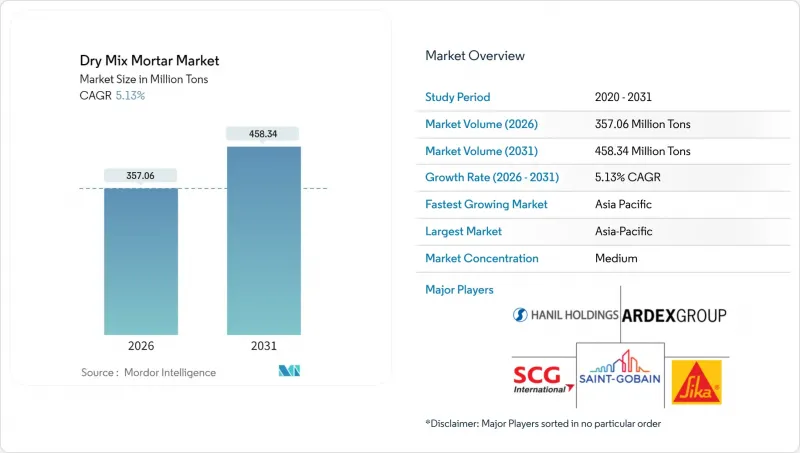
持續高都市化、亞洲國家強制性預混合料砂漿政策以及承包商對更快工期的需求,都是推動這一市場擴張的因素。工廠預製的混合料配方能夠最大限度地減少現場施工的差異,提高品質一致性,並降低勞動力需求。這些優勢在面臨技術純熟勞工短缺的地區尤其重要。細分市場的需求也向高附加價值混合料轉變,例如瓷磚黏合劑、外牆外保溫系統(EIFS)砂漿和維修材料,這些產品具有提高生產效率和節能的特性。隨著主要生產商確保原料供應並投資於自動化生產線以降低營運成本和碳排放,產業整合仍在繼續。然而,水泥和添加劑價格的波動,以及建造先進工廠所需的大量資本投資,正在限制整體成長前景。
全球乾混砂漿市場趨勢與洞察
亞太地區的快速都市化和基礎設施投資
預計到2025年,中國的都市化將達到68%,這將推動住宅維修和基礎設施升級中砂漿需求的穩定成長。高速鐵路網的擴張以及薄層產品在預製構件產業的廣泛應用,也促進了特種砂漿消費量的成長。泰國和越南政府的基礎設施預算維持著兩位數的建設支出成長,這鼓勵了當地製造商擴大產能並取代進口產品。該地區飛灰和礦渣的日益普及,有助於降低生產成本並符合環保法規。這些因素共同推動了乾混砂漿市場的長期成長。
節能建築標準-對外牆外保溫系統和保溫砂漿的需求
日益嚴格的保溫性能法規推動了對用於外牆外保溫系統(EIFS)中保溫板黏結和塗覆的砂漿的需求。歐盟的碳邊境管制機制對高排放進口產品徵收附加稅,並鼓勵在地採購低碳砂漿。中國新的高壓釜氣混凝土標準提高了抗壓強度指標,促使建築商採用符合規範的高黏結性外加劑。諸如DigiCoPro系統等數位化品質監測原型凸顯了砂漿產業向配備感測器的砂漿轉變,這些感測器可以追蹤養護狀態並確保最佳性能。修訂後的ISO 13007:2025標準和中國更嚴格的認證規則正式確立了這些高標準要求,並支援特種砂漿在多個地區的廣泛應用。
原物料價格波動
2024年,水泥原料成本波動劇烈,河沙價格下跌,導致小規模生產商面臨難以承受的利潤波動。生產商的應對措施是提高工業廢棄物的替代率,但這些替代通常需要額外的加工和嚴格的品管。區域碳定價進一步加劇了價格波動。貿易爭端和添加劑短缺導致的供應中斷使挑戰雪上加霜,迫使生產商頻繁調整價格,並損害了客戶關係。
細分市場分析
在乾粉砂漿市場中,磁磚黏合劑預計將呈現最快的成長軌跡,到2031年將以6.35%的複合年成長率成長。這主要得益於瓷磚銷售的成長。大尺寸瓷磚需要高性能、緩釋性能好的黏合劑,而預製建築中異地預製板的出現進一步增加了對黏度可控產品的需求。同時,由於抹灰層在結構層和飾面層中的多功能性,到2025年將保持最大的市場佔有率,達到33.45% 。都市區住宅存量廚房和浴室維修工程對抹灰和接縫密封劑的需求不斷成長,而防水漿料在高濕度沿海基礎設施中也獲得了獨特的市場需求。隔熱材料相容性砂漿透過兼顧隔熱和結構性能,滿足了更嚴格的節能標準。
隨著新建住宅向高階室內裝修方向發展,與瓷磚黏合劑相關的乾粉砂漿市場規模預計將迅速擴大。商業地板材料安裝商指出,返工率降低和施工時間縮短是其主要優勢,也因此支撐了較高的價格。製造商正透過推出具有抗泛鹼和適應基材移動特性的聚合物改質配方來區分產品。抹灰砂漿細分市場競爭仍然激烈,其成長主要與占地面積的增加有關。同時,專業製造商正專注於多層系統,透過單一品牌提供黏合劑、接縫密封劑和防水產品,從而提升產品的生命週期價值。
乾混砂漿報告按應用領域(抹灰、粉刷、瓷磚黏合劑、水泥漿、防水漿料、混凝土保護與維修等)、最終用途產業(商業、工業及公共、基礎設施、住宅)和地區(亞太、北美、歐洲、南美、中東和非洲)進行細分。市場預測以噸為單位。
區域分析
亞太地區將繼續引領乾混砂漿市場,預計到2025年將佔全球市場佔有率的46.80%,並預計在2031年之前以5.32%的複合年成長率持續成長。中國強制規定要求新建建築使用預混合料砂漿,以及持續的城市改造項目,都支撐了市場需求的成長。東南亞各國政府大力推動交通和能源計劃,加上在地化生產以減少進口,也推動了市場規模的成長。
預計北美地區將實現溫和成長,這得益於基礎設施建設相關法規的推動以及商業室內裝飾市場的復甦。持續存在的技術純熟勞工短缺推動了對桶裝式和筒倉式砂漿的需求,從而簡化了牆體組裝。由於貿易壁壘導致從中國的進口量下降,國內製造商正持續擴大區域倉庫以彌補缺口。加拿大的住宅開工量和墨西哥的工業設施建設正在穩定區域消費,而跨境供應鏈則確保了材料供應的穩定。
歐洲仍然是需求的主要貢獻者,這主要得益於嚴格的能源法規和老舊建築的加速維修。碳邊境調節機制有效地扶持了本地低碳砂漿,使本地生產商在成本上優於進口商。德國、法國和北歐國家正在推動飛灰混合砂漿的標準化。南美洲,尤其是巴西,展現出良好的發展前景,這得益於鐵路和地鐵計劃中對特種水泥漿的廣泛應用。在中東和非洲,與大型住宅和旅遊開發相關的建設化學品支出也將支撐需求。
其他福利:
- Excel格式的市場預測(ME)表
- 3個月的分析師支持
目錄
第1章 引言
- 研究假設和市場定義
- 調查範圍
第2章調查方法
第3章執行摘要
第4章 市場情勢
- 市場概覽
- 市場促進因素
- 亞太地區的快速都市化和基礎設施投資
- 節能建築標準-對外牆外隔熱系統(EIFS) 與保溫砂漿的需求
- 勞動力短缺推動了對即用型預混合料解決方案的需求。
- 推出智慧現場RFID聯動筒倉配料系統
- 利用砂漿基可列印混合物進行3D混凝土列印
- 市場限制
- 原料(水泥和添加劑)價格波動
- 自動化乾混料廠需高額資本投入
- 新興經濟體熟練建築工人短缺
- 價值鏈分析
- 法律規範
- 波特五力模型
- 新進入者的威脅
- 供應商的議價能力
- 買方的議價能力
- 替代品的威脅
- 競爭對手之間的競爭
第5章 市場規模與成長預測
- 透過使用
- 石膏
- 渲染
- 磁磚黏合劑
- 水泥漿
- 防水漿料
- 混凝土保護與維修
- 保溫和飾面系統
- 其他
- 按最終用途
- 商業的
- 工業和公共設施
- 基礎設施
- 住宅
- 按地區
- 亞太地區
- 中國
- 印度
- 日本
- 韓國
- 印尼
- 馬來西亞
- 泰國
- 越南
- 亞太其他地區
- 北美洲
- 美國
- 加拿大
- 墨西哥
- 歐洲
- 法國
- 德國
- 義大利
- 俄羅斯
- 西班牙
- 英國
- 其他歐洲地區
- 南美洲
- 巴西
- 阿根廷
- 其他南美洲
- 中東和非洲
- 沙烏地阿拉伯
- 南非
- 其他中東和非洲地區
- 亞太地區
第6章 競爭情勢
- 市場集中度
- 策略趨勢
- 市佔率(%)/排名分析
- 公司簡介
- Ardex Group
- CEMEX SAB de CV
- Grupo Puma
- HANIL HOLDINGS CO., LTD.
- Holcim
- LATICRETE International Inc.
- MAPEI SpA
- Saint-Gobain
- SAMPYO Group
- SCG International Corporation
- SIG
- Sika AG
- Trimurti Wall Care Products Pvt Ltd
- UltraTech Cement Ltd.
- Votorantim Cimentos
第7章 市場機會與未來展望
第8章:執行長面臨的關鍵策略挑戰
The Dry Mix Mortar Market is expected to grow from 339.65 million tons in 2025 to 357.06 million tons in 2026 and is forecast to reach 458.34 million tons by 2031 at 5.13% CAGR over 2026-2031.
Persistently high urbanization rates, mandatory pre-mixed mortar policies in several Asian countries, and contractors' need to shorten project schedules underpin this expansion. Factory-produced formulations minimize on-site variability, improve quality consistency, and reduce labor requirements, advantages that resonate strongly in regions facing skilled-worker shortages. Segmental demand is also shifting toward value-added blends such as tile adhesives, EIFS mortars, and renovation compounds that deliver higher productivity or energy-saving functionality. Consolidation among leading manufacturers continues as they secure raw material supplies and invest in automated production lines that cut operating costs and reduce carbon intensity. At the same time, volatile cement and additive prices, as well as the significant capital required for state-of-the-art plants, temper the overall growth outlook.
Global Dry Mix Mortar Market Trends and Insights
Rapid Urbanization and Infrastructure Outlay in Asia-Pacific
China's urbanization rate reached 68% in 2025, resulting in steady demand for mortar in residential renovations and infrastructure upgrades. High-speed rail expansion is driving an increase in specialized mortar consumption, as thin-layer products gain traction in prefabricated segments. Government infrastructure budgets in Thailand and Vietnam are sustaining double-digit construction spending, encouraging local producers to boost capacity and replace imported volumes. The region's incremental use of fly ash and slag lowers production costs and addresses environmental mandates. Together, these elements contribute significantly to the long-term growth of the dry mix mortar market.
Energy-Efficient Building Codes - Demand for EIFS and Insulation Mortars
Tighter thermal-performance regulations raise demand for mortars that bond and coat insulation boards in EIFS systems. The European Union's Carbon Border Adjustment Mechanism imposes charges on high-emission imports, prompting local sourcing of low-carbon mortars. China's new autoclaved aerated concrete standard increased compressive-strength metrics, prompting builders to adopt compatible high-adhesion mixes. Digital quality-monitoring prototypes, such as the DigiCoPro system, highlight the shift toward sensor-enabled mortars that track curing conditions and ensure optimal performance. Revised ISO 13007:2025 benchmarks and China's stricter certification rules formalize these higher requirements, supporting specialty-mortar uptake in multiple regions.
Raw-Material Price Volatility
Cement input costs fluctuated considerably in 2024, while river-sand prices fell, producing margin swings that small-scale manufacturers struggle to absorb. Producers respond by increasing industrial-waste substitution rates; however, these alternatives often require additional processing and stricter quality controls. Regional carbon pricing further compounds variability. Supply disruptions tied to trade disputes and additive shortages aggravate the challenge, forcing frequent price revisions that strain customer relations.
Other drivers and restraints analyzed in the detailed report include:
- Labor Shortages Driving Ready-to-Use Pre-Mixed Solutions
- Smart-Job-Site Adoption of RFID-Linked Silo Dosing
- High Capex for Automated Dry-Mix Plants
For complete list of drivers and restraints, kindly check the Table Of Contents.
Segment Analysis
Tile adhesive holds the fastest trajectory within the dry mix mortar market, growing at a 6.35% CAGR through 2031, driven by the sales of ceramic tiles. Large-format tiles require high-performance bonding agents with extended open times, and off-site panelization in prefabricated schemes amplifies the demand for controlled-viscosity products. In contrast, plaster maintains the largest volume base at 33.45% in 2025, due to its ubiquity across both structural and finishing layers. Render and grouts capture incremental volume from renovation of kitchens and bathrooms in urban housing stock, while waterproofing slurries find niche uptake in coastal infrastructure facing elevated moisture stress. Insulation-compatible mortars align with energy-code upgrades, bundling thermal and structural performance.
The dry mix mortar market size tied to tile adhesive is projected to surge as new housing starts pivot toward premium interior finishes. Commercial flooring contractors cite lower rework rates and quicker turnaround as key benefits, justifying price premiums. Manufacturers differentiate via polymer-modified formulations that resist efflorescence and accommodate substrate movement. The plaster sub-segment remains price-competitive, with growth largely tracking floor-space additions. Specialist providers, meanwhile, focus on composite-layer systems where a single brand can supply adhesive, grout, and waterproofing components to capture higher lifecycle value.
The Dry Mix Mortar Report is Segmented by Application (Plaster, Render, Tile Adhesive, Grouts, Water Proofing Slurries, Concrete Protection and Renovation, and More), End-Use Sector (Commercial, Industrial and Institutional, Infrastructure, and Residential), and Geography (Asia-Pacific, North America, Europe, South America, and Middle East and Africa). The Market Forecasts are Provided in Terms of Volume (Tons).
Geography Analysis
The Asia-Pacific region continued to dominate the dry mix mortar market in 2025, accounting for 46.80% of the global volume, and is forecast to expand at a 5.32% CAGR through 2031. Chinese regulations mandating the use of pre-mixed mortar in new buildings, coupled with ongoing urban renewal, sustain the momentum in demand. Southeast Asian governments are pushing transport and energy projects, which reinforces volume growth while localizing production to reduce imports.
North America is expected to post moderate growth, anchored by infrastructure bills and a rebound in commercial interiors. Persistent skilled-labor constraints heighten the appetite for bucketed or silo-fed mortars that streamline wall assemblies. Domestic producers continue adding regional depots to offset a drop in Chinese imports triggered by trade barriers. Canada's residential starts and Mexico's industrial build-outs stabilize regional consumption, with cross-border supply chains ensuring a steady flow of materials.
Europe retains a sizeable base fueled by stringent energy regulations and accelerated refurbishments of aging building stock. The Carbon Border Adjustment Mechanism effectively rewards local low-carbon mortars, giving regional producers a cost advantage versus importers. Standardization of fly-ash-blended mixes gains traction across Germany, France, and the Nordics. South America shows promise, particularly in Brazil, where rail and metro projects are adopting specialty grouts, while the Middle East and Africa benefit from construction chemicals expenditure tied to large-scale housing and tourism developments.
- Ardex Group
- CEMEX S.A.B. de C.V.
- Grupo Puma
- HANIL HOLDINGS CO., LTD.
- Holcim
- LATICRETE International Inc.
- MAPEI S.p.A.
- Saint-Gobain
- SAMPYO Group
- SCG International Corporation
- SIG
- Sika AG
- Trimurti Wall Care Products Pvt Ltd
- UltraTech Cement Ltd.
- Votorantim Cimentos
Additional Benefits:
- The market estimate (ME) sheet in Excel format
- 3 months of analyst support
TABLE OF CONTENTS
1 Introduction
- 1.1 Study Assumptions and Market Definition
- 1.2 Scope of the Study
2 Research Methodology
3 Executive Summary
4 Market Landscape
- 4.1 Market Overview
- 4.2 Market Drivers
- 4.2.1 Rapid urbanization and infrastructure outlay in Asia-Pacific
- 4.2.2 Energy-efficient building codes - demand for EIFS and insulation mortars
- 4.2.3 Labour shortages driving ready-to-use pre-mixed solutions
- 4.2.4 Smart-job-site adoption of RFID-linked silo dosing
- 4.2.5 3-D concrete printing using mortar-based printable mixes
- 4.3 Market Restraints
- 4.3.1 Raw-material (cement and additive) price volatility
- 4.3.2 High capex for automated dry-mix plants
- 4.3.3 Shortage of skilled applicators in emerging economies
- 4.4 Value Chain Analysis
- 4.5 Regulatory Framework
- 4.6 Porter's Five Forces
- 4.6.1 Threat of New Entrants
- 4.6.2 Bargaining Power of Suppliers
- 4.6.3 Bargaining Power of Buyers
- 4.6.4 Threat of Substitutes
- 4.6.5 Competitive Rivalry
5 Market Size and Growth Forecasts (Volume)
- 5.1 By Application
- 5.1.1 Plaster
- 5.1.2 Render
- 5.1.3 Tile Adhesive
- 5.1.4 Grouts
- 5.1.5 Water Proofing Slurries
- 5.1.6 Concrete Protection and Renovation
- 5.1.7 Insulation and Finishing Systems
- 5.1.8 Others
- 5.2 By End-use Sector
- 5.2.1 Commercial
- 5.2.2 Industrial and Institutional
- 5.2.3 Infrastructure
- 5.2.4 Residential
- 5.3 By Geography
- 5.3.1 Asia-Pacific
- 5.3.1.1 China
- 5.3.1.2 India
- 5.3.1.3 Japan
- 5.3.1.4 South Korea
- 5.3.1.5 Indonesia
- 5.3.1.6 Malaysia
- 5.3.1.7 Thailand
- 5.3.1.8 Vietnam
- 5.3.1.9 Rest of Asia-Pacific
- 5.3.2 North America
- 5.3.2.1 United States
- 5.3.2.2 Canada
- 5.3.2.3 Mexico
- 5.3.3 Europe
- 5.3.3.1 France
- 5.3.3.2 Germany
- 5.3.3.3 Italy
- 5.3.3.4 Russia
- 5.3.3.5 Spain
- 5.3.3.6 United Kingdom
- 5.3.3.7 Rest of Europe
- 5.3.4 South America
- 5.3.4.1 Brazil
- 5.3.4.2 Argentina
- 5.3.4.3 Rest of South America
- 5.3.5 Middle-East and Africa
- 5.3.5.1 Saudi Arabia
- 5.3.5.2 South Africa
- 5.3.5.3 Rest of Middle-East and Africa
- 5.3.1 Asia-Pacific
6 Competitive Landscape
- 6.1 Market Concentration
- 6.2 Strategic Moves
- 6.3 Market Share (%)/Ranking Analysis
- 6.4 Company Profiles {(includes Global level Overview, Market level overview, Core Segments, Financials as available, Strategic Information, Market Rank/Share for key companies, Products and Services, and Recent Developments)}
- 6.4.1 Ardex Group
- 6.4.2 CEMEX S.A.B. de C.V.
- 6.4.3 Grupo Puma
- 6.4.4 HANIL HOLDINGS CO., LTD.
- 6.4.5 Holcim
- 6.4.6 LATICRETE International Inc.
- 6.4.7 MAPEI S.p.A.
- 6.4.8 Saint-Gobain
- 6.4.9 SAMPYO Group
- 6.4.10 SCG International Corporation
- 6.4.11 SIG
- 6.4.12 Sika AG
- 6.4.13 Trimurti Wall Care Products Pvt Ltd
- 6.4.14 UltraTech Cement Ltd.
- 6.4.15 Votorantim Cimentos
7 Market Opportunities and Future Outlook
- 7.1 White-space and Unmet-Need Assessment
8 Key Strategic Questions for CEOs

 乾混砂漿添加劑和化學品市場-2026-2032年全球市場預測
 乾粉砂漿添加劑和化學品市場報告:按類型和地區分類,2026-2034 年
 2026年工業用預拌乾粉砂漿全球市場報告乾粉砂漿市場:按類型、包裝、計劃類型、應用、最終用途和分銷管道分類-2026-2032年全球市場預測2026年全球乾混砂漿市場報告
 乾混砂漿添加劑和化學品:市場佔有率分析、行業趨勢和統計數據以及成長預測(2026-2031 年)東協乾混砂漿:市佔率分析、產業趨勢與統計、成長預測(2026-2031)歐洲乾粉砂漿:市場佔有率分析、產業趨勢與統計、成長預測(2026-2031)2026年全球乾混砂漿添加劑和化學品市場報告塔式乾粉砂漿攪拌站市場按產品類型、攪拌能力、應用、最終用途和分銷管道分類-2026-2032年全球預測