


 |
市場調查報告書
商品編碼
1940776
美國工程服務:市場佔有率分析、行業趨勢和統計數據、成長預測(2026-2031 年)United States Engineering Services - Market Share Analysis, Industry Trends & Statistics, Growth Forecasts (2026 - 2031) |
||||||

※ 本網頁內容可能與最新版本有所差異。詳細情況請與我們聯繫。
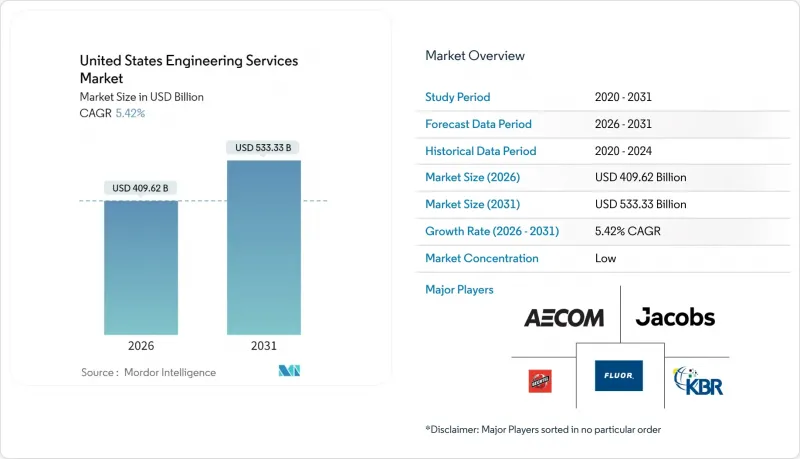
2025年美國工程服務市值為3,885.6億美元,預計到2031年將達到5,333.3億美元,高於2026年的4,096.2億美元。
預計在預測期(2026-2031 年)內,複合年成長率將達到 5.42%。
《基礎設施投資與就業創造法案》加速了聯邦基礎設施支出,《晶片/科學法案》為半導體產業提供激勵,持續的國防現代化預算也為一系列需要先進工程技術的複雜計劃提供了支持,這些項目將持續多年。製造業的復甦、電網現代化改造的需求,以及數位雙胞胎工作流程的快速商業化(旨在減少返工並擴大資產管理收入),也在重塑市場需求模式。競爭態勢正轉向收購,尤其是在清潔能源系統、先進製造和人工智慧設計等專業能力方面。同時,客戶的成本壓力正在推動整合工程、採購、施工和管理(EPCM)模式的發展。區域需求集中在加州、德克薩斯州、五大湖走廊以及快速發展的東南部都會區,這些地區的財政獎勵、低廉的土地成本和有利於商業發展的法規鼓勵了持續的資本注入。
美國工程服務市場趨勢與洞察
根據2021年《基礎設施和基礎設施發展法案》(IIJA),聯邦基礎設施資金大幅增加。
1.2兆美元的《基礎設施基礎設施和投資法案》(IIJA)是聯邦政府自州際公路時代以來對實體資產最積極的投資,迫使各機構聘請外部專家進行廣泛的工作,包括岩地工程勘察、抗災供水系統和智慧交通網路。自2022年以來,各州交通部門的諮詢支出增加了35%,而「購買美國貨」條款則強制要求重新設計供應鏈、檢驗國產化率並編制詳細的文檔,這導致工程諮詢費用增加。資金籌措指南中嵌入的氣候適應性要求推動了對數位雙胞胎的需求,以支援風險建模、生命週期成本分析和資產加固。這些新的合規措施延長了專案週期,同時增加了每個計劃的收入,並將美國工程服務市場擴展到所有50個州。
加速半導體製造廠和電池超級工廠的建設
巨型晶圓廠的平均單價在150億至400億美元之間,需要超高純度公用設施、10級至1級潔淨室以及小於2微米的隔振精度。這使得其單價比傳統工業計劃高出20%至30%。英特爾位於俄亥俄州的園區和台積電位於亞利桑那州的園區都簽訂了為期三至五年的工程契約,隨後是長期的營運支援協議。聯邦政府520億美元的《晶片法案》(CHIPS Act)激勵措施降低了這些資本計劃的風險,並為電氣、機械、製程和污染控制專家創造了多周期訂單基礎。特斯拉、通用汽車和福特汽車同時建造的電池工廠擴大了溫度控管、高壓設計和消防系統工程的市場機會,從而增加了美國工程服務市場的潛在總收入。
鋼材和混凝土投入成本波動的風險
2023年至2025年,鋼材價格年波動幅度達25%至40%,而水泥和預拌混凝土價格上漲15%至20%,這對計劃預算造成壓力,並增加了工程範圍縮減的風險。固定價格合約正在降低公司利潤率,並導致公共部門客戶推遲競標,從而抑制了美國工程服務市場的短期計費工時。成本加成合約雖然可以降低風險,但面臨採購障礙。儘管價格上漲條款和材料指數化定價機制日益普及,但不確定性仍抑制資本支出,導致複合年成長率預測下調。
細分市場分析
2025年,土木工程將佔總收入的34.88%,凸顯其在橋樑維修、公路拓寬以及由《基礎設施投資與就業法案》(IIJA)資助的抗災供水系統建設中的核心作用。加州高速鐵路和門戶隧道等計劃正在推動對抗震加固、岩土建模和隧道開挖監理的需求,從而確保美國工程服務市場擁有穩定的訂單。該領域將受益於設計壽命要求的提高和氣候適應性標準的加強,預計這將增加設計範圍和計費複雜性。
機械工程是成長最快的領域,其成長主要得益於對無塵室空調、高密度溫度控管以及半導體製造廠、電池工廠和超大規模資料中心中機器人整合等方面的需求。電氣工程的需求同樣強勁,電網現代化和電動車充電走廊的建設推動了對繼電器、中壓設計和智慧電錶分析服務的需求。環境工程正從修復技術擴展到氣候風險建模、碳捕獲系統和ESG合規,在標準土木工程範圍之外提供加值服務。化學工程是一個小眾但盈利的領域,涵蓋半導體蝕刻製程、先進製藥生產線和特殊材料,正在推高美國整體工程服務市場的平均時薪。
到2025年,顧問和設計產業將佔市場收入的17.76%,這主要得益於市場對BIM協調、供應鏈在地化和韌性規劃等前端專業知識的需求不斷成長。數位化優先交付模式,包括雲端託管的通用資料環境和人工智慧輔助的程式碼檢查,透過減少返工和上游工程轉移價值,正在鞏固該領域在美國工程服務市場的主導地位。
製程和工廠工程服務實現了顯著成長,這主要得益於需要超純水系統、惰性氣體系統和機器人生產線平衡等先進技術的巨型晶圓廠和超級工廠計劃。自動化和數位化工程服務預計將成為該領域中複合年成長率最高的服務,其特點是透過整合感測器、邊緣分析數位雙胞胎技術,實現試運行後最佳化的商業化。資產管理服務正在向基於績效的數據訂閱模式轉型,從而產生持續的現金流,並有助於穩定美國工程服務業的收入。
其他福利:
- Excel格式的市場預測(ME)表
- 分析師支持(3個月)
目錄
第1章 引言
- 研究假設和市場定義
- 調查範圍
第2章調查方法
第3章執行摘要
第4章 市場情勢
- 市場概覽
- 市場促進因素
- 根據2021年《基礎設施和基礎設施發展法案》(IIJA Act of 2021),聯邦基礎設施資金大幅增加。
- 加速半導體製造廠和電池超級工廠的建設
- 將生產線轉移到美國
- 大型太陽能和風能發電計畫的併網排隊人數創歷史新高
- 國防現代化(AUKUS,下一代防空系統)推動專家設計
- 透過引入人工智慧驅動的數位雙胞胎技術減少返工
- 市場限制
- 將鋼材和混凝土原料成本波動轉嫁給消費者的風險
- 由於《國家環境政策法案》(NEPA) 環境審查時間過長,工程開工延後。
- 由於技術純熟勞工短缺,導致計費成本上升
- 各州許可證制度的差異阻礙了擴張。
- 價值/供應鏈分析
- 監理與技術展望
- 波特五力模型
- 買方和消費者的議價能力
- 供應商的議價能力
- 新進入者的威脅
- 替代品的威脅
- 競爭對手之間的競爭
- 比較分析:內部工程與外包工程
- 供應商服務創新趨勢
第5章 市場規模與成長預測
- 透過使用
- 土木工程
- 機器
- 電
- 環境
- 化學
- 按服務類型
- 諮詢與設計
- 製程和工廠工程
- 產品工程與原型製作
- 自動化/數位工程
- 資產管理和維運(營運和維護)
- 按最終用戶行業分類
- 建築和基礎設施
- 石油和天然氣
- 製造業
- 公共產業(電力/水)
- 交通運輸(鐵路、機場、港口)
- 電訊和資料中心
- 醫療設施
- 按合約類型
- 內部
- 外包/工程總承包管理
第6章 競爭情勢
- 市場集中度
- 策略趨勢
- 市佔率分析
- 公司簡介
- AECOM
- Jacobs Engineering Group
- Bechtel Corporation
- Fluor Corporation
- KBR Inc.
- HDR Inc.
- Terracon
- Black and Veatch
- Jensen Hughes
- ECS Group of Companies
- WSP USA
- Tetra Tech
- STV Group
- Arup(US)
- Gannett Fleming
- Burns and McDonnell
- HNTB Corporation
- Parsons Corporation
- Louis Berger(WSP)
- AtkinsRealis(US)
第7章 市場機會與未來展望
The U.S. engineering services market was valued at USD 388.56 billion in 2025 and estimated to grow from USD 409.62 billion in 2026 to reach USD 533.33 billion by 2031, at a CAGR of 5.42% during the forecast period (2026-2031).
Accelerated federal infrastructure outlays under the Infrastructure Investment and Jobs Act, the CHIPS and Science Act's semiconductor incentives, and persistent defense-modernization budgets are sustaining a multi-year pipeline of complex projects that require deeper engineering expertise. Demand patterns are also being reshaped by manufacturing reshoring, grid-modernization imperatives, and the rapid commercialization of digital-twin workflows that cut rework and expand lifetime asset-management revenues. Competitive behavior is shifting toward acquisitions aimed at specialty capabilities-especially in clean-energy systems, advanced manufacturing, and AI-enabled design-while clients' cost pressures are encouraging integrated EPCM models. Regional demand is clustering around California, Texas, the Great Lakes corridor, and fast-growing Southeast metros where fiscal incentives, lower land costs, and pro-business regulation encourage sustained capital deployment.
United States Engineering Services Market Trends and Insights
Federal Infrastructure-Funding Boom Under 2021 IIJA
The USD 1.2 trillion IIJA marks the most aggressive federal commitment to physical assets since the Interstate Highway era, forcing agencies to hire external specialists for multi-disciplinary tasks that span geotechnical studies, resilient water systems, and intelligent-transportation networks. State DOTs have lifted consulting outlays by 35% since 2022, and Buy America clauses are compelling redesigns of supply chains, validation of domestic inputs, and extensive documentation, which add incremental fee layers for engineering consultants. Climate-resilience mandates embedded in funding guidelines are intensifying demand for risk-modeling, life-cycle cost analysis, and digital-twins that support asset hardening. These new compliance steps elongate schedules but expand revenue-per-project, expanding the U.S. engineering services market across all 50 states.
Accelerating Chip-Fab and Battery-Gigafactory Build-outs
Mega-fabs average USD 15-40 billion each, require ultra-pure utilities, class-10 to class-1 cleanrooms, and incorporate vibration isolation tolerances below two microns, driving premium bill rates that exceed traditional industrial projects by 20-30%. Intel's Ohio campus and TSMC's Arizona complex embed three-to-five-year engineering engagements, followed by long-term operations support contracts. Federal CHIPS incentives worth USD 52 billion de-risk these capital projects and underpin a multi-cycle orderbook for electrical, mechanical, process, and contamination-control specialists. Parallel battery-cell facilities from Tesla, GM, and Ford elevate opportunities in thermal-management, high-voltage design, and fire-suppression engineering, broadening total addressable revenues inside the U.S. engineering services market.
Volatile Steel and Concrete Input-Cost Pass-Through Risks
Steel prices fluctuated 25-40% annually during 2023-2025, while cement and ready-mix concrete rose 15-20%, squeezing project budgets and elevating risk of scope reduction. Fixed-price contracts thus expose firms to margin erosion and cause public-sector owners to delay bids, suppressing near-term billable hours in the U.S. engineering services market. Cost-plus agreements mitigate exposure yet face procurement hurdles. Escalation clauses and material indexes are gaining traction, but uncertainty still dampens CAPEX confidence, trimming the CAGR projection.
Other drivers and restraints analyzed in the detailed report include:
- Near-shoring of Manufacturing Lines to the U.S.
- Record-High Utility-Scale Solar and Wind Interconnection Queues
- Lengthy NEPA Environmental Reviews Delaying Starts
For complete list of drivers and restraints, kindly check the Table Of Contents.
Segment Analysis
Civil engineering captured 34.88% of 2025 revenue, underscoring its pivotal role in the bridge rehabilitation, highway expansion, and resilient water systems funded by the IIJA. Projects such as California's high-speed rail and the Gateway Tunnel boosted demand for seismic retrofits, geotechnical modeling, and tunnel-boring oversight, ensuring a steady backlog that underpins the U.S. engineering services market. The segment benefits from increasing design-life requirements and climate-resilience standards that extend scoping phases and raise billable complexity.
Mechanical engineering is the fastest-advancing discipline due to semiconductor fabs, battery plants, and hyperscale data centers that require cleanroom HVAC, high-density thermal-management, and robotics integration. Electrical engineering demand is equally brisk, spurred by grid-modernization and EV charging corridors, pulling in relay-protection, medium-voltage design, and smart-meter analytics services. Environmental engineering has expanded beyond remediation into climate-risk modeling, carbon-capture systems, and ESG compliance, adding premium services that tack onto standard civil scopes. Chemical engineering remains a niche yet lucrative field for semiconductor etching processes, advanced pharmaceutical lines, and specialty materials, lifting average hourly rates across the U.S. engineering services market.
Consulting and design captured 17.76% of market revenue in 2025, driven by owners' desire for front-end expertise in BIM coordination, supply-chain localization, and resiliency planning. Digital-first delivery, including cloud-hosted common data environments and AI-assisted code checks, is reducing rework and shifting value upstream, reinforcing the segment's lead position in the U.S. engineering services market.
Process-and-plant engineering recorded outsized growth through mega-fab and gigafactory projects, where ultra-pure water, inert-gas systems, and robotic line-balancing demand deep specialty knowledge. Automation and digital-engineering services represent the highest CAGR outlook in the segment, linking sensor integration, edge analytics, and digital-twins that monetize post-commissioning optimization. Asset-management services are evolving into performance-based, data-subscription models that generate recurring cash flows, stabilizing top-line trajectories across the U.S. engineering services industry.
The United States Engineering Services Market Report is Segmented by Application (Civil, Mechanical, and More), Service Type (Consulting and Design, Process and Plant Engineering, and More), End-User Industry (Construction and Infrastructure, Oil and Gas, and More), Engagement Model (In-House, Outsourced / EPCM). The Market Forecasts are Provided in Terms of Value (USD).
List of Companies Covered in this Report:
- AECOM
- Jacobs Engineering Group
- Bechtel Corporation
- Fluor Corporation
- KBR Inc.
- HDR Inc.
- Terracon
- Black and Veatch
- Jensen Hughes
- ECS Group of Companies
- WSP USA
- Tetra Tech
- STV Group
- Arup (US)
- Gannett Fleming
- Burns and McDonnell
- HNTB Corporation
- Parsons Corporation
- Louis Berger (WSP)
- AtkinsRealis (U.S.)
Additional Benefits:
- The market estimate (ME) sheet in Excel format
- 3 months of analyst support
TABLE OF CONTENTS
1 INTRODUCTION
- 1.1 Study Assumptions and Market Definition
- 1.2 Scope of the Study
2 RESEARCH METHODOLOGY
3 EXECUTIVE SUMMARY
4 MARKET LANDSCAPE
- 4.1 Market Overview
- 4.2 Market Drivers
- 4.2.1 Federal Infrastructure-Funding Boom under 2021 IIJA
- 4.2.2 Accelerating Chip Fabs and Battery Gigafactory Build-outs
- 4.2.3 Near-shoring of Manufacturing Lines to the U.S.
- 4.2.4 Record-High Utility-Scale Solar and Wind Interconnection Queues
- 4.2.5 Defense Modernization (AUKUS, NGAD) Driving Specialized Design
- 4.2.6 AI-Enabled Digital-Twin Adoption Cutting Re-work
- 4.3 Market Restraints
- 4.3.1 Volatile Steel and Concrete Input-Cost Pass-Through Risks
- 4.3.2 Lengthy NEPA Environmental Reviews Delaying Starts
- 4.3.3 Skilled-Labor Shortages Inflating Billing Rates
- 4.3.4 State-by-State Licensing Variances Hindering Scale
- 4.4 Value / Supply-Chain Analysis
- 4.5 Regulatory and Technological Outlook
- 4.6 Porter's Five Forces
- 4.6.1 Bargaining Power of Buyers/Consumers
- 4.6.2 Bargaining Power of Suppliers
- 4.6.3 Threat of New Entrants
- 4.6.4 Threat of Substitute Products
- 4.6.5 Intensity of Competitive Rivalry
- 4.7 Comparative Analysis: In-house vs Outsourced Engineering
- 4.8 Vendor Service Innovation Trends
5 MARKET SIZE AND GROWTH FORECASTS (VALUE)
- 5.1 By Application
- 5.1.1 Civil
- 5.1.2 Mechanical
- 5.1.3 Electrical
- 5.1.4 Environmental
- 5.1.5 Chemical
- 5.2 By Service Type
- 5.2.1 Consulting and Design
- 5.2.2 Process and Plant Engineering
- 5.2.3 Product Engineering and Prototyping
- 5.2.4 Automation / Digital Engineering
- 5.2.5 Asset Management and OandM
- 5.3 By End-user Industry
- 5.3.1 Construction and Infrastructure
- 5.3.2 Oil and Gas
- 5.3.3 Manufacturing
- 5.3.4 Utilities (Power, Water)
- 5.3.5 Transportation (Rail, Airports, Ports)
- 5.3.6 Telecommunications and Data Centers
- 5.3.7 Healthcare Facilities
- 5.4 By Engagement Model
- 5.4.1 In-house
- 5.4.2 Outsourced / EPCM
6 COMPETITIVE LANDSCAPE
- 6.1 Market Concentration
- 6.2 Strategic Moves
- 6.3 Market Share Analysis
- 6.4 Company Profiles
- 6.4.1 AECOM
- 6.4.2 Jacobs Engineering Group
- 6.4.3 Bechtel Corporation
- 6.4.4 Fluor Corporation
- 6.4.5 KBR Inc.
- 6.4.6 HDR Inc.
- 6.4.7 Terracon
- 6.4.8 Black and Veatch
- 6.4.9 Jensen Hughes
- 6.4.10 ECS Group of Companies
- 6.4.11 WSP USA
- 6.4.12 Tetra Tech
- 6.4.13 STV Group
- 6.4.14 Arup (US)
- 6.4.15 Gannett Fleming
- 6.4.16 Burns and McDonnell
- 6.4.17 HNTB Corporation
- 6.4.18 Parsons Corporation
- 6.4.19 Louis Berger (WSP)
- 6.4.20 AtkinsRealis (U.S.)
7 MARKET OPPORTUNITIES AND FUTURE OUTLOOK
- 7.1 White-space and Unmet-Need Assessment

 繪圖服務市場:全球市場按產品類型、價格範圍、應用和最終用戶分類的預測 - 2026-2032 年
 2026年全球人工智慧(AI)工程市場報告2026年全球工程服務市場報告2026年全球工程研發外包市場報告2026年全球物理、工程與生命科學市場報告
 2026-2030年全球工程服務市場冷彎型鋼工程服務市場按服務類型、型材類型、最終用途、通路和應用分類,全球預測(2026-2032年)水族館工程服務市場按產品類型、服務類型、水質和應用分類-2026-2032年全球預測重型起重工程計劃服務市場(按服務、技術、計劃規模和最終用途產業分類),全球預測(2026-2032)
 工程服務:市場佔有率分析、產業趨勢與統計、成長預測(2026-2031)