


 |
市場調查報告書
商品編碼
1940674
亞太地區快遞、速遞和小包裹(CEP):市場佔有率分析、行業趨勢和統計數據、成長預測(2026-2031)Asia-Pacific Courier, Express, And Parcel (CEP) - Market Share Analysis, Industry Trends & Statistics, Growth Forecasts (2026 - 2031) |
||||||

※ 本網頁內容可能與最新版本有所差異。詳細情況請與我們聯繫。
預計到 2026 年,亞太地區快遞、速遞和小包裹(CEP) 市場規模將達到 2,593.6 億美元。
這意味著從 2025 年的 2,430.8 億美元成長到 2031 年的 3,586.4 億美元,2026 年至 2031 年的複合年成長率為 6.70%。
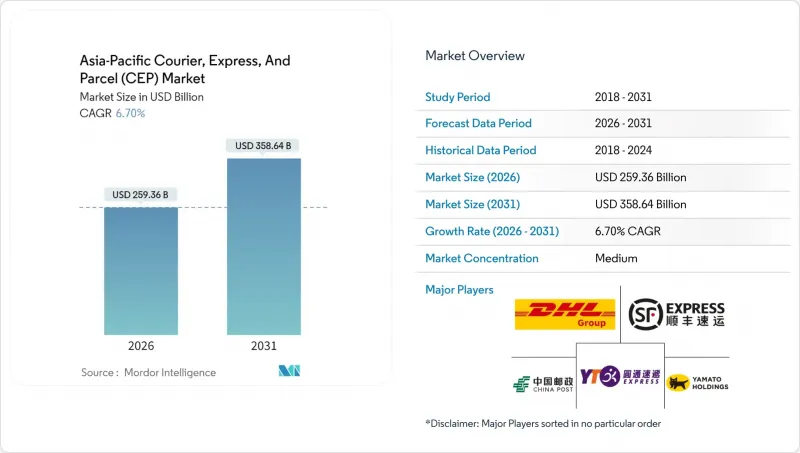
這一擴張反映了該地區電子商務的持續成長勢頭、數位支付的日益普及以及RCEP和CPTPP等支持性貿易框架。當日達服務正從一項高階附加服務服務轉變為基本服務,促使企業對都市區微型倉配中心進行大規模投資。能夠整合即時追蹤、預測路線和溫控功能的業者可望獲得高利潤的訂單量。同時,勞動力短缺和燃油價格波動正在限制營運利潤,並推動自動化進程。
亞太地區快遞、速遞與小包裹(CEP) 市場趨勢與洞察
電子商務和當日配送文化的快速發展
都市區收入的成長和行動網路的普及,使得隔天達和當日達成為亞洲主要城市的新標準。預計到2024年,區域電子商務市場規模將超過2兆美元,而當無法選擇快捷郵件服務時,消費者放棄購物車的現像日益普遍。物流公司正透過在城市郊區設立微型倉配中心來應對這項挑戰,並利用預測分析技術按郵遞區號聚合訂單。雖然提高當日達配送密度可以提升配送效率,但也增加了人事費用和房地產成本,從而推動了電動摩托車和自動儲物櫃的普及。快速生鮮電商模式將配送時間縮短至30分鐘以內,迫使傳統的中心輻射式網路轉型為以接近性為優先的節點式網狀結構。這些變化為能夠降低單位成本的企業帶來了獲利機會。
跨境電子商務商業聯盟(RCEP、CPTPP)
RCEP成員國已取消90%貿易商品的關稅,而CPTPP簡化的海關程序已將成員國境內的平均清關時間縮短了三分之一。中型物流公司正利用數位原產地證書實現曼谷和東京之間兩日達的門到門配送。菲律賓和越南的小規模經銷商正透過與區域一體化服務提供者建立市場合作關係,獲得出口管道,這些服務提供者提供貨運代理、關稅預付和退貨管理等服務。隨著進口限額的提高,小包裹量正從郵政路線轉向特快專遞,這有助於在商品價格走軟的情況下穩定收費系統。單一視窗平台之間互通性進一步減少了文書工作,並提高了服務的可靠性。
都市區對司機運作時間的限制和勞動力短缺
新加坡實施每週44小時工作制,東京市中心夜間貨車交通管制,導致尖峰時段的配送能力受限。日本和韓國人口老化,勞動人口萎縮,而小包裹量卻不斷增加。在中國的一線城市,物流業的薪資在2024年有所上漲,業者也提供入職獎金以吸引配送員。為了降低風險,貨運公司正在拓展替代收貨點並測試人行道機器人。然而,自動駕駛技術仍處於測試階段,勞動力短缺仍是目前限制物流配送的阻礙因素。
細分市場分析
2025年,電子商務將佔小包裹需求的34.42%,反映消費者根深蒂固的網路購物習慣。受生物製藥、臨床試驗樣本和居家醫療器材的推動,醫療配送將在2026年至2031年間以7.03%的複合年成長率成長。亞太地區的快遞、速遞和小包裹(CEP)市場以符合規範的低溫運輸運輸路線、被動式包裝和即時感測器為特徵。
製造業依賴即時原料配送維持穩定的基礎,而金融服務業則需要安全可追溯地運輸敏感文件。快速生鮮雜貨零售需要對高頻次、低價值訂單進行近乎即時的配送,從而擴大網路容量。
預計2026年至2031年,國際小包裹遞送量將以6.86%的複合年成長率成長。同時,截至2025年,國內貨物在亞太快遞、速遞和小包裹(CEP)市場中佔據了壓倒性的64.02%的佔有率。區域全面經濟夥伴關係協定(RCEP)下的海關數位化縮短了邊境停留時間,使得主要城市之間的遞送時間縮短至兩到三天。與跨境電商密切相關的亞太快遞、速遞和小包裹(CEP)市場預計將持續成長至2030年。雖然國內市場的密度優勢支撐了較低的單價,但大都會圈的當日送達保證卻對利潤率構成了壓力。
跨境需求在尋求供應鏈多元化的中型出口商中最為強勁。目前,快速電商平台承諾72小時內將韓國小眾美妝產品送達東南亞,買家需支付雙倍的高級追蹤費用。儘管有許多挑戰,例如資訊不對稱和語言障礙,但隨著海關、承運商和電商平台之間共用資料介面的建立,這些挑戰正在逐步緩解。
其他福利:
- Excel格式的市場預測(ME)表
- 3個月的分析師支持
目錄
第1章 引言
- 研究假設和市場定義
- 調查範圍
第2章調查方法
第3章執行摘要
第4章 市場情勢
- 市場概覽
- 人口統計數據
- 按經濟活動分類的GDP分配
- 按經濟活動分類的GDP成長
- 通貨膨脹
- 經濟表現及概況
- 電子商務產業的趨勢
- 製造業趨勢
- 運輸和倉儲業的GDP
- 出口趨勢
- 進口趨勢
- 燃油價格
- 物流績效
- 基礎設施
- 法律規範
- 澳洲
- 中國
- 印度
- 印尼
- 日本
- 馬來西亞
- 巴基斯坦
- 菲律賓
- 泰國
- 越南
- 價值鍊和通路分析
- 市場促進因素
- 電子商務和當日配送文化的快速發展
- 跨境電子商務企業間的合作(RCEP、CPTPP)
- 政府主導的智慧物流走廊(中國、印度、東協)
- 生技藥品和生鮮食品低溫運輸需求快速成長
- 人工智慧驅動的路線最佳化與自主樞紐
- 微型倉配和暗店的興起
- 市場限制
- 都市區的行車時間限制與勞力短缺
- 燃油價格波動與航空燃油額外費用
- 消除二、三線城市在醫療服務體系上的差距
- 地緣政治貿易路線中斷(海峽、南海)
- 市場創新
- 波特五力分析
- 新進入者的威脅
- 買方的議價能力
- 供應商的議價能力
- 替代品的威脅
- 競爭對手之間的競爭
第5章 市場規模與成長預測
- 目的地
- 國內的
- 國際的
- 配送速度
- 快遞
- 非快遞
- 模型
- B2B
- B2C
- C2C
- 運輸重量
- 重型貨物
- 輕型貨物
- 中等重量貨物
- 交通工具
- 航空
- 路
- 其他
- 終端用戶產業
- 電子商務
- 金融服務(BFSI)
- 衛生保健
- 製造業
- 一級產業
- 批發零售(線下)
- 其他
- 國家
- 澳洲
- 中國
- 印度
- 印尼
- 日本
- 馬來西亞
- 巴基斯坦
- 菲律賓
- 泰國
- 越南
- 亞太其他地區
第6章 競爭情勢
- 市場集中度
- 重大策略舉措
- 市佔率分析
- 公司簡介
- Blue Dart Express Limited
- China Post
- CJ Logistics Corporation
- DHL Group
- DTDC Express Limited
- FedEx
- Japan Post Holdings Co., Ltd.(including Toll Group)
- JWD Group
- SF Express(KEX-SF)
- SG Holdings Co., Ltd.
- Shanghai YTO Express(Logistics)Co., Ltd.
- United Parcel Service(UPS)
- Yamato Holdings Co., Ltd.
- ZTO Express
第7章 市場機會與未來展望
Asia-Pacific courier, express, and parcel market size in 2026 is estimated at USD 259.36 billion, growing from 2025 value of USD 243.08 billion with 2031 projections showing USD 358.64 billion, growing at 6.70% CAGR over 2026-2031.
This expansion reflects the region's sustained e-commerce momentum, wider digital payments adoption, and supportive trade frameworks such as RCEP and CPTPP. Same-day fulfillment expectations have shifted from premium add-ons to baseline service levels, prompting heavy investment in urban micro-fulfillment assets. Operators that integrate real-time tracking, predictive routing, and temperature-controlled capacity are positioned to secure higher-margin volumes. Meanwhile, labor constraints and fuel price swings temper operating margins and incentivize automation.
Asia-Pacific Courier, Express, And Parcel (CEP) Market Trends and Insights
E-commerce Boom and Same-Day Culture
Rising urban incomes and mobile internet access have entrenched next-day and same-day delivery as the new normal across leading Asian cities. Regional e-commerce value surpassed USD 2 trillion in 2024, and shoppers now abandon carts if express options are unavailable. Logistics firms respond by positioning inventory inside city-edge micro-fulfillment sites and using predictive analytics to consolidate orders by postcode. Same-day density boosts stop efficiency yet raise wages and real estate costs, prompting wider deployment of electric two-wheelers and automated lockers. Rapid-commerce grocery models compress fulfillment windows to under 30 minutes, forcing a redesign of traditional hub-and-spoke networks into nodal mesh layouts that prioritize proximity. These shifts underpin premium yield opportunities for operators able to keep unit costs in check.
Cross-Border E-Tailer Alliances (RCEP, CPTPP)
Tariff elimination on 90% of goods traded under RCEP and streamlined customs protocols under CPTPP have shortened average clearance times by one-third within member states. Mid-sized logistics providers now harness digital certificates of origin to offer two-day door-to-door delivery between Bangkok and Tokyo. Smaller sellers in the Philippines and Vietnam gain export access through marketplace tie-ups with regional integrators that bundle freight, duty pre-payment, and returns management. As import ceilings rise, parcel volumes shift from postal channels to premium express lanes, supporting rate integrity despite softening commodity prices. Enhanced interoperability across single-window platforms further shrinks paperwork and boosts service reliability.
Urban Driver-Hour Caps and Labor Shortages
Singapore's 44-hour weekly limit and Tokyo's downtown truck curfews constrain peak-hour capacity. Aging demographics in Japan and South Korea shrink the available workforce even as parcel counts climb. Chinese tier-one cities saw logistics wages climb during 2024, with operators offering sign-on bonuses to secure riders. To mitigate exposure, carriers extend alternative collection points and test sidewalk robots. Yet autonomous options remain at pilot scale, keeping tight labor supply a near-term constraint.
Other drivers and restraints analyzed in the detailed report include:
- Government Smart-Logistics Corridors
- Cold-Chain Surge for Biologics and Fresh Food
- Volatile Bunker and Jet-Fuel Surcharges
For complete list of drivers and restraints, kindly check the Table Of Contents.
Segment Analysis
E-commerce contributed 34.42% of parcel demand in 2025, reflecting entrenched online shopping behavior. Healthcare deliveries advance at a 7.03% CAGR between 2026-2031, driven by biologics, clinical trial samples, and home-care devices. The Asia-Pacific courier, express, and parcel market supports regulatory-compliant cold-chain lanes featuring passive packaging and real-time sensors.
Manufacturing maintains a stable baseline through just-in-time raw-material flows, while financial services require secure, tracked movement of confidential documents. Grocery quick commerce stretches network capacity with high-frequency, low-ticket orders demanding near-instant dispatch.
International parcel flows expanded at a 6.86% CAGR between 2026-2031, even as domestic consignments retained a commanding 64.02% hold on the Asia-Pacific courier, express, and parcel market in 2025. Customs digitalization under RCEP cuts border dwell time, enabling 2- to 3-day delivery between key metropolitan pairs. The Asia-Pacific courier, express, and parcel market size linked to cross-border e-commerce is forecast to grow steadily through 2030. Domestic density advantages support low unit costs, but same-day guarantees pressure margins in megacities.
Cross-border demand is strongest among mid-market exporters pursuing supply-chain diversification. Quick commerce marketplaces now promise 72-hour delivery for niche Korean beauty products into Southeast Asia, with buyers paying double the standard tariff for premium tracking. Addressing gaps and language barriers persists, yet is gradually mitigated through shared data interfaces between customs, carriers, and marketplaces.
The Asia-Pacific Courier, Express, and Parcel (CEP) Market Report is Segmented by Destination (Domestic and International), Speed of Delivery (Express and Non-Express), Model (Business-To-Business (B2B), and More), Shipment Weight (Heavy Weight, and More), Mode of Transport (Air, Road, and Others), End User Industry (E-Commerce, and More), and Country (China, and More). The Market Forecasts are Provided in Terms of Value (USD).
List of Companies Covered in this Report:
- Blue Dart Express Limited
- China Post
- CJ Logistics Corporation
- DHL Group
- DTDC Express Limited
- FedEx
- Japan Post Holdings Co., Ltd. (including Toll Group)
- JWD Group
- SF Express (KEX-SF)
- SG Holdings Co., Ltd.
- Shanghai YTO Express (Logistics) Co., Ltd.
- United Parcel Service (UPS)
- Yamato Holdings Co., Ltd.
- ZTO Express
Additional Benefits:
- The market estimate (ME) sheet in Excel format
- 3 months of analyst support
TABLE OF CONTENTS
1 Introduction
- 1.1 Study Assumptions and Market Definition
- 1.2 Scope of the Study
2 Research Methodology
3 Executive Summary
4 Market Landscape
- 4.1 Market Overview
- 4.2 Demographics
- 4.3 GDP Distribution by Economic Activity
- 4.4 GDP Growth by Economic Activity
- 4.5 Inflation
- 4.6 Economic Performance and Profile
- 4.6.1 Trends in E-Commerce Industry
- 4.6.2 Trends in Manufacturing Industry
- 4.7 Transport and Storage Sector GDP
- 4.8 Export Trends
- 4.9 Import Trends
- 4.10 Fuel Price
- 4.11 Logistics Performance
- 4.12 Infrastructure
- 4.13 Regulatory Framework
- 4.13.1 Australia
- 4.13.2 China
- 4.13.3 India
- 4.13.4 Indonesia
- 4.13.5 Japan
- 4.13.6 Malaysia
- 4.13.7 Pakistan
- 4.13.8 Philippines
- 4.13.9 Thailand
- 4.13.10 Vietnam
- 4.14 Value Chain and Distribution Channel Analysis
- 4.15 Market Drivers
- 4.15.1 E-Commerce Boom and Same-Day Culture
- 4.15.2 Cross-Border E-Tailer Alliances (RCEP, CPTPP)
- 4.15.3 Government Smart-Logistics Corridors (China, India, ASEAN)
- 4.15.4 Cold-Chain Surge for Biologics and Fresh Food
- 4.15.5 AI-Driven Route-Optimization and Autonomous Hubs
- 4.15.6 Micro-Fulfilment and Dark-Store Proliferation
- 4.16 Market Restraints
- 4.16.1 Urban Driver-Hour Caps and Labor Shortages
- 4.16.2 Volatile Bunker and Jet-Fuel Surcharges
- 4.16.3 Addressing-System Gaps in Tier-2/3 Cities
- 4.16.4 Geopolitical Trade-Lane Disruptions (Straits, SCS)
- 4.17 Technology Innovations in the Market
- 4.18 Porter's Five Forces Analysis
- 4.18.1 Threat of New Entrants
- 4.18.2 Bargaining Power of Buyers
- 4.18.3 Bargaining Power of Suppliers
- 4.18.4 Threat of Substitutes
- 4.18.5 Competitive Rivalry
5 Market Size and Growth Forecasts (Value, USD)
- 5.1 Destination
- 5.1.1 Domestic
- 5.1.2 International
- 5.2 Speed of Delivery
- 5.2.1 Express
- 5.2.2 Non-Express
- 5.3 Model
- 5.3.1 Business-to-Business (B2B)
- 5.3.2 Business-to-Consumer (B2C)
- 5.3.3 Consumer-to-Consumer (C2C)
- 5.4 Shipment Weight
- 5.4.1 Heavy Weight Shipments
- 5.4.2 Light Weight Shipments
- 5.4.3 Medium Weight Shipments
- 5.5 Mode of Transport
- 5.5.1 Air
- 5.5.2 Road
- 5.5.3 Others
- 5.6 End User Industry
- 5.6.1 E-Commerce
- 5.6.2 Financial Services (BFSI)
- 5.6.3 Healthcare
- 5.6.4 Manufacturing
- 5.6.5 Primary Industry
- 5.6.6 Wholesale and Retail Trade (Offline)
- 5.6.7 Others
- 5.7 Country
- 5.7.1 Australia
- 5.7.2 China
- 5.7.3 India
- 5.7.4 Indonesia
- 5.7.5 Japan
- 5.7.6 Malaysia
- 5.7.7 Pakistan
- 5.7.8 Philippines
- 5.7.9 Thailand
- 5.7.10 Vietnam
- 5.7.11 Rest of Asia-Pacific
6 Competitive Landscape
- 6.1 Market Concentration
- 6.2 Key Strategic Moves
- 6.3 Market Share Analysis
- 6.4 Company Profiles (Includes Global Level Overview, Market Level Overview, Core Segments, Financials as Available, Strategic Information, Market Rank/Share for Key Companies, Products and Services, and Recent Developments)
- 6.4.1 Blue Dart Express Limited
- 6.4.2 China Post
- 6.4.3 CJ Logistics Corporation
- 6.4.4 DHL Group
- 6.4.5 DTDC Express Limited
- 6.4.6 FedEx
- 6.4.7 Japan Post Holdings Co., Ltd. (including Toll Group)
- 6.4.8 JWD Group
- 6.4.9 SF Express (KEX-SF)
- 6.4.10 SG Holdings Co., Ltd.
- 6.4.11 Shanghai YTO Express (Logistics) Co., Ltd.
- 6.4.12 United Parcel Service (UPS)
- 6.4.13 Yamato Holdings Co., Ltd.
- 6.4.14 ZTO Express
7 Market Opportunities and Future Outlook
- 7.1 White-Space and Unmet-Need Assessment

 2026年全球宅配服務市場報告2026年全球宅配市場報告2026年全球當日配送服務市場報告2026年全球超當地語系化配送應用市場報告
 2026-2030年全球宅配包裹(CEP)市場
 宅配、包裹及小包裹市場報告:按服務類型、目的地、物品、最終用途行業和地區分類(2026-2034 年)2026年全球宅配車輛市場報告
 超當地語系化配送應用市場分析及預測(至2035年):按類型、產品、服務、技術、組件、應用、設備、流程、部署類型及最終用戶分類
 泰國快遞、速遞和小包裹(CEP) 市場佔有率分析、行業趨勢和統計數據、成長預測 (2026-2031)美國快遞、速遞和小包裹(CEP):市場佔有率分析、行業趨勢和統計數據、成長預測 (2026-2031)