


 |
市場調查報告書
商品編碼
1940665
特種車輛:市場佔有率分析、產業趨勢與統計、成長預測(2026-2031 年)Specialty Vehicles - Market Share Analysis, Industry Trends & Statistics, Growth Forecasts (2026 - 2031) |
||||||

※ 本網頁內容可能與最新版本有所差異。詳細情況請與我們聯繫。
2025年特種車輛市場價值為1,098.9億美元,預計到2031年將達到1,341.9億美元,而2026年為1,136.1億美元。
預計在預測期(2026-2031 年)內,複合年成長率將達到 3.38%。
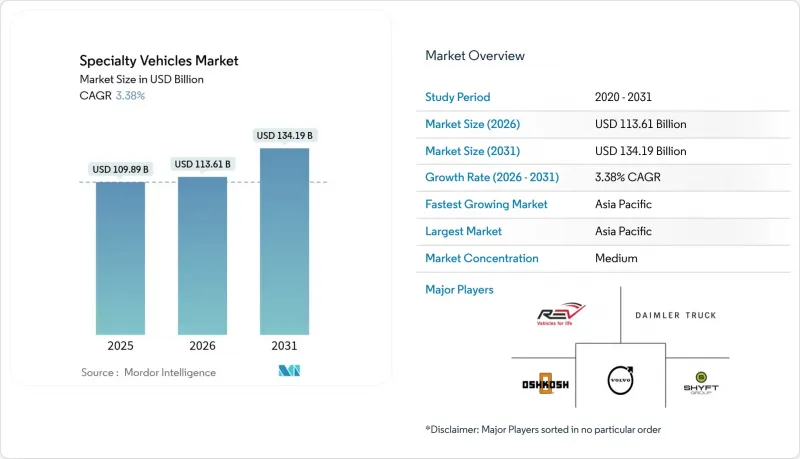
強勁的需求主要來自非選擇性支出領域,例如緊急醫療服務、公共和工業支援車輛。不斷擴大的城市基礎設施、人口老化帶來的緊急應變需求以及政府對零排放車輛的激勵措施,共同支持全球採購活動。隨著優先發展電動車的新興參與企業利用模組化設計和互聯技術縮短客製化前置作業時間並降低營運成本,競爭日益激烈。同時,老牌製造商則透過認證平台和覆蓋全國的售後服務網路來捍衛市場佔有率。
全球特種車輛市場趨勢與洞察
對緊急醫療救援車輛的需求不斷成長
人口老化和更嚴格的回應時間規定迫使醫療系統擴充救護車隊。美國醫療保險和醫療補助服務中心 (CMS) 擴大了社區緊急醫療服務的報銷範圍,增加了對高級生命支持車輛的撥款。都市區密度的增加進一步提高了對配備齊全、能夠快速到達現場的車輛的需求。社區健康計畫也強調移動診所的重要性,這些診所可以提供診斷、疫苗接種和慢性病後續照護。這些因素共同促成了永續採購,即便市政營運預算面臨壓力。在不斷擴展的零排放都市區地區,電動動力傳動系統正擴大應用於營運週期。
建築和礦業服務車輛的成長
大型計劃和資源開採作業正在將特種車輛市場拓展至嚴苛環境。美國《基礎建設投資與就業法案》在2022至2026會計年度累計1.2兆美元,用於支援移動式油罐車、服務車廂和現場指揮中心的需求。中國的「一帶一路」計劃也同樣刺激了亞太和非洲地區對特種服務車輛的需求。日益嚴格的安全法規要求車輛配備防塵系統、即時遠端資訊處理系統和緊急疏散設施。偏遠礦區正在部署行動環境監測實驗室,以滿足ESG(環境、社會和管治)要求。儘管建設週期仍易受宏觀經濟波動的影響,但老舊車輛的更新換代為年度需求提供了基礎。
高額的購置成本與生命週期成本
由於專用設備、小批量生產和嚴格的相容性測試,專用車輛的價格通常比主流商用平台高出 40% 至 60%。電動車的價格更高,但其燃油和維護成本的節省可在 7 至 10 年內累積。許多市政當局推遲車隊升級,並將車隊使用壽命延長至超出建議週期,增加了運作風險。由於更換零件和專業維修費用上漲,保險費率也在上漲。小規模私人業者感受到的壓力最大,有時會選擇租賃模式以避免資本支出。從不銹鋼罐到醫療用電子設備,持續高昂的投入成本可能會阻礙預算靈活性有限的地區的採用。
細分市場分析
到2025年,救護車將佔據特種車輛市場最大佔有率,收入佔比達31.05%,這主要得益於強制性更新週期和社區緊急醫療服務部署的增加。隨著人口老化和監管機構對快速反應時間的重視,這一細分市場有望繼續保持其主導地位。行動醫療車雖然絕對規模較小,但卻是快速成長的品類,在預防醫學和臨時疫苗接種點興起的推動下,其複合年成長率將達到5.30%。消防車將維持來自公共部門的穩定訂單,而由於災害管理日益複雜,對指揮中心的需求也將增加。
在人口密集的城市中心運作的救護車隊中,電氣化進程最為迅速,因為夜間在車庫充電可以配合輪班安排,而且零排放區也在不斷擴大。消防車的電氣化進程相對滯後,主要是因為需要高功率水泵,但混合動力輔助系統正在試驗中。工業設施專用油罐車由於續航里程和負載容量的要求,仍然使用柴油動力。那些能夠實現底盤和電氣系統標準化,同時保持模組化內飾的製造商,將在這個特種車輛市場佔據越來越大的佔有率。
到2025年,醫療保健服務將佔總需求的35.62%,這主要得益於醫院網路的現代化和緊急運輸保險報銷範圍的擴大。遠端醫療的發展推動了連網行動診斷設備的採購,使農村患者能夠與都市區的專家進行溝通。休閒和餐飲車輛(包括豪華巴士和行動餐車)將成為成長最快的應用領域,年複合成長率達3.96%,主要受消費者對體驗式休閒活動偏好的驅動。
在工業公用事業領域,移動變電站、電網維修車輛和管道檢測設備的訂單仍然強勁,這些設備能夠降低停機成本。執法機關正在更新其車隊,配備防彈裝置和人工智慧態勢情境察覺的新一代戰術響應車輛,但訂單量遠不及醫療行業。活動組織者正在增加移動指揮中心和醫療分診拖車的租賃,以滿足安全標準,這進一步增強了該專業車輛市場的共享經濟效應。在醫療產業,遵守美國消防協會(NFPA)救護車標準和美國食品藥物管理局(FDA)醫療設備法規仍然是一大挑戰,但即使在景氣衰退,穩定的預算撥款也是其優勢所在。
區域分析
預計到2025年,亞太地區將以36.28%的市佔率引領特種車輛市場,並在2031年之前維持3.83%的複合年成長率。中國醫院擴建計畫和正在進行的「一帶一路」建設將支撐對救護車和油罐車的強勁需求,而印度的智慧城市計畫將為指揮中心和消防設備提供資金。由於旅遊業的主導發展,東南亞國家的採購需求也在加速成長,這主要得益於飯店和工業服務車輛的增加。日本和韓國的汽車製造商正在為適用於人口密集城區的緊湊型電動救護車提供技術創新。
北美在特種車輛市場佔有成熟且技術先進的地位。與美國消防協會(NFPA)指南修訂相關的更新週期促使消防部門不斷更新車隊,而《基礎設施投資與就業法案》則為公共產業和建築車輛提供了資金支持。加拿大的資源型經濟支撐著非公路服務車隊的發展,而墨西哥以出口為導向的製造業正在訂購行動維修車,以最大限度地減少生產線停機時間。零排放車輛強制令,加上廣泛的氣候目標,正在加速紐約、洛杉磯和多倫多的電氣化進程。
歐洲在收緊監管方面處於主導,儘管年複合成長率較為緩慢。計劃於2030年推出的零排放都市區區域將確保對純電動救護車和垃圾車的需求,而歐盟的二氧化碳排放標準正推動混合動力消防車原型進入實地試驗階段。德國先進的工程技術能力正在加速模組化底盤的普及,而英國國民醫療服務體系(NHS)的車輛更新計畫也在預算限制下推動了採購工作。北歐國家擁有豐富的綠氫能計劃,正率先引進氫燃料電池救援車輛。
其他福利:
- Excel格式的市場預測(ME)表
- 3個月的分析師支持
目錄
第1章 引言
- 研究假設和市場定義
- 調查範圍
第2章調查方法
第3章執行摘要
第4章 市場情勢
- 市場概覽
- 市場促進因素
- 對緊急醫療救援車輛的需求不斷成長
- 建築和礦業服務車輛增加
- 拓展移動現場工業服務
- 政府對零排放特種車輛的獎勵
- 支援5G的遠端控制連接平台
- 模組化底盤平台,縮短客製化前置作業時間
- 市場限制
- 高額的購置成本與生命週期成本
- 複雜的多轄區監理核准
- 客製化設備領域技術純熟勞工短缺
- 小批量生產中關鍵零件的採購前置作業時間較長
- 價值/供應鏈分析
- 監管環境
- 技術展望
- 波特五力分析
- 新進入者的威脅
- 買方的議價能力
- 供應商的議價能力
- 替代品的威脅
- 競爭對手之間的競爭
第5章 市場規模與成長預測
- 按車輛類型
- 救護車
- 消防車
- 移動式油輪
- 移動指揮控制中心
- 行動醫療診所
- 其他
- 透過使用
- 執法機關與公共
- 醫療保健服務
- 工業和公共產業服務
- 休閒與飯店
- 其他
- 按推進系統/動力傳動系統
- 柴油引擎
- 汽油
- 混合
- 電動車
- 替代燃料(CNG/LNG/H2)
- 依所有權類型
- 政府和地方政府
- 私人車隊營運商
- 出租/租賃
- 按地區
- 北美洲
- 美國
- 加拿大
- 北美其他地區
- 南美洲
- 巴西
- 阿根廷
- 其他南美洲
- 歐洲
- 德國
- 英國
- 法國
- 義大利
- 西班牙
- 俄羅斯
- 其他歐洲地區
- 亞太地區
- 中國
- 印度
- 日本
- 韓國
- ASEAN
- 澳洲和紐西蘭
- 亞太其他地區
- 中東和非洲
- GCC
- 土耳其
- 南非
- 奈及利亞
- 其他中東和非洲地區
- 北美洲
第6章 競爭情勢
- 市場集中度
- 策略趨勢
- 市佔率分析
- 公司簡介
- REV Group
- Daimler Truck AG(Mercedes-Benz Special Trucks)
- Oshkosh Corporation
- Volvo Group
- Shyft Group
- LDV Inc.
- Matthews Specialty Vehicles
- Farber Specialty Vehicles
- Force Motors Limited
- Emergency One Group
- Rosenbauer International AG
- Wietmarscher Ambulanz-und Sonderfahrzeug GmbH
- XCMG Group(Special Purpose Division)
- Hyundai Everdigm
- Morita Holdings Corporation
- KME Fire Apparatus
第7章 市場機會與未來展望
The specialty vehicles market was valued at USD 109.89 billion in 2025 and estimated to grow from USD 113.61 billion in 2026 to reach USD 134.19 billion by 2031, at a CAGR of 3.38% during the forecast period (2026-2031).
Demand resilience comes from non-discretionary spending across emergency medical services, public safety, and industrial support fleets. Expansion of urban infrastructure, aging populations that raise emergency response needs, and government incentives for zero-emission fleets collectively sustain global procurement activity. Competitive intensity is rising as electric-first entrants leverage modular designs and connected technologies to compress customization lead times and lower operating costs. Meanwhile, established manufacturers protect share by pairing certified platforms with nationwide after-sales networks.
Global Specialty Vehicles Market Trends and Insights
Rising Demand for Emergency Medical Response Vehicles
Growing elderly populations and tighter response-time mandates are prompting healthcare systems to enlarge ambulance fleets. The Centers for Medicare & Medicaid Services widened reimbursement for community paramedicine, boosting capital budgets for advanced life-support vehicles. Urban density further intensifies the need for well-equipped units capable of faster scene arrival. Community-based healthcare programs also favor mobile medical clinics that can supply diagnostics, immunizations, and chronic-care follow-ups. Collectively these factors underpin sustained procurement even when municipal operating budgets face pressure. Electric powertrains are increasingly specified for city duty cycles where zero-emission zones loom.
Growth in Construction and Mining Service Fleets
Infrastructure mega-projects and resource extraction ventures are extending the specialty vehicle market's reach into rugged environments. The U.S. Infrastructure Investment and Jobs Act earmarked USD 1.2 trillion over five fiscal years (2022-2026), underpinning demand for mobile fuel tankers, service bodies, and onsite command centers . China's Belt and Road Initiative similarly keeps specialty service fleets active across Asia-Pacific and Africa. Stricter safety rules now require vehicles outfitted with dust-suppression systems, real-time telematics, and emergency shelters. Remote mines adopt mobile environmental-monitoring labs to satisfy ESG commitments. Although construction cycles remain sensitive to macroeconomic swings, replacement of aging fleets ensures a baseline of annual demand.
High Acquisition and Lifecycle Costs
Specialty vehicles often cost 40-60% more than mainstream commercial platforms due to bespoke equipment, small-batch production, and rigorous compliance testing. Electric versions elevate sticker prices even further, though fuel and maintenance savings accrue over 7-10 years. Many municipalities defer fleet refreshes, extending service life beyond recommended cycles and heightening downtime risk. Insurance premiums trend higher because replacement parts and skilled repairs command premium rates. Smaller private operators feel pressure most acutely, sometimes opting for rental models to circumvent capital outlays. Persistently high input prices-from stainless steel tanks to medical electronics-could dampen adoption where budget elasticity is limited.
Other drivers and restraints analyzed in the detailed report include:
- Expansion of Mobile On-Site Industrial Services
- Government Incentives for Zero-Emission Specialty Fleets
- Complex Multi-Jurisdictional Regulatory Approvals
For complete list of drivers and restraints, kindly check the Table Of Contents.
Segment Analysis
Ambulances generated the largest slice of the specialty vehicle market in 2025, capturing 31.05% revenue amid mandated replacement cycles and heightened community paramedicine deployment. The sub-segment is well-positioned to retain dominance given aging demographics and regulatory focus on faster response times. Mobile medical clinics, though smaller in absolute dollars, represent the breakout category with a 5.30% CAGR, reflecting healthcare's pivot to preventive outreach and pop-up vaccination hubs. Fire apparatus continues to post dependable public-sector orders, while command centers gain traction as disaster-management complexity increases.
Electrification is emerging fastest inside ambulance fleets operating in dense urban cores, where overnight depot charging aligns with duty patterns and zero-emission zones expand. Fire truck electrification lags due to high-draw pump requirements, yet hybrid assist systems are entering trials. Specialty tankers servicing industrial sites maintain diesel reliance because of range and payload needs. Manufacturers that standardize chassis and electrics while retaining modular interiors stand to capture a growing slice of this specialty vehicle market.
Medical and healthcare services accounted for 35.62% of overall 2025 demand, underpinned by hospital network modernization and expanded insurance reimbursements for ambulance transport. Telehealth growth stimulates procurement of connected mobile diagnostics units able to link rural patients to urban specialists. Recreational and hospitality vehicles, enveloping luxury motor coaches and mobile food units, form the fastest-expanding application cluster with a 3.96% CAGR as consumers favor experiential leisure activities.
Industrial utilities sustain significant orders for mobile substations, grid-repair trucks, and pipeline inspection rigs that mitigate downtime costs. Law enforcement agencies refresh fleets with next-generation tactical response vehicles featuring ballistic protection and AI-enabled situational awareness, although volumes trail medical orders. Event organizers increasingly lease mobile command suites and medical triage trailers to meet safety codes, reinforcing the sharing-economy effect across this specialty vehicle market. Compliance with NFPA ambulance standards and FDA medical device rules remains the chief hurdle in the healthcare slice, but reward comes via consistent budget allocations even in economic contractions.
The Specialty Vehicles Market Report is Segmented by Vehicle Type (Ambulances, Fire Trucks, and More), Application (Law Enforcement and Public Safety, Medical and Healthcare Services, and More), Propulsion/Powertrain (Diesel, Gasoline, and More), Ownership Model (Government and Municipal, Private Fleet Operators, and More), and Geography. The Market Forecasts are Provided in Terms of Value (USD).
Geography Analysis
Asia-Pacific leads the specialty vehicle market with a 36.28% share in 2025 and is tracking a 3.83% CAGR through 2031. China's hospital expansion programs and continued Belt and Road construction corridors sustain high ambulance and tanker demand, while India's Smart Cities Mission finances command centers and firefighting apparatus. Southeast Asian nations add procurement momentum as tourism-driven hospitality vehicles and industrial service fleets grow. Japanese and South Korean OEMs contribute innovation in compact electric ambulances that suit dense city streets.
North America represents a mature but technology-forward slice of the specialty vehicle market. Replacement cycles keyed to NFPA guideline updates keep fire departments renewing fleets, and the Infrastructure Investment and Jobs Act funnels funds to utility and construction vehicles. Canada's resource economy sustains off-road service rigs, while Mexico's export-oriented manufacturing base orders mobile maintenance trucks to minimize line stoppage. Electrification gathers pace in New York, Los Angeles, and Toronto where zero-emission fleet mandates converge with broader climate goals.
Europe shows moderate CAGR but leads regulatory stringency. Urban zero-emission zones slated for 2030 guarantee demand for battery-electric ambulances and refuse trucks, and EU CO2 standards push hybrid fire apparatus prototypes into field pilots. Germany's engineering depth accelerates modular chassis adoption, and the United Kingdom's NHS fleet renewal propels procurements despite fiscal constraints. Nordic countries pioneer hydrogen fuel-cell rescue vehicles on account of abundant green hydrogen projects.
- REV Group
- Daimler Truck AG (Mercedes-Benz Special Trucks)
- Oshkosh Corporation
- Volvo Group
- Shyft Group
- LDV Inc.
- Matthews Specialty Vehicles
- Farber Specialty Vehicles
- Force Motors Limited
- Emergency One Group
- Rosenbauer International AG
- Wietmarscher Ambulanz- und Sonderfahrzeug GmbH
- XCMG Group (Special Purpose Division)
- Hyundai Everdigm
- Morita Holdings Corporation
- KME Fire Apparatus
Additional Benefits:
- The market estimate (ME) sheet in Excel format
- 3 months of analyst support
TABLE OF CONTENTS
1 Introduction
- 1.1 Study Assumptions & Market Definition
- 1.2 Scope of the Study
2 Research Methodology
3 Executive Summary
4 Market Landscape
- 4.1 Market Overview
- 4.2 Market Drivers
- 4.2.1 Rising Demand for Emergency Medical Response Vehicles
- 4.2.2 Growth in Construction and Mining Service Fleets
- 4.2.3 Expansion of Mobile On-Site Industrial Services
- 4.2.4 Government Incentives for Zero-Emission Specialty Fleets
- 4.2.5 5G-Enabled Connected Platforms for Remote Operations
- 4.2.6 Modular Chassis Platforms That Cut Customization Lead-Time
- 4.3 Market Restraints
- 4.3.1 High Acquisition and Lifecycle Costs
- 4.3.2 Complex Multi-Jurisdictional Regulatory Approvals
- 4.3.3 Skilled Labor Shortages in Custom Up-Fitting
- 4.3.4 Long Lead-Times for Low-Volume Critical Components
- 4.4 Value / Supply-Chain Analysis
- 4.5 Regulatory Landscape
- 4.6 Technological Outlook
- 4.7 Porter's Five Forces Analysis
- 4.7.1 Threat of New Entrants
- 4.7.2 Bargaining Power of Buyers
- 4.7.3 Bargaining Power of Suppliers
- 4.7.4 Threat of Substitutes
- 4.7.5 Intensity of Competitive Rivalry
5 Market Size & Growth Forecasts (Value, USD)
- 5.1 By Vehicle Type
- 5.1.1 Ambulances
- 5.1.2 Fire Trucks
- 5.1.3 Mobile Fuel Tankers
- 5.1.4 Mobile Command and Control Centers
- 5.1.5 Mobile Medical Clinics
- 5.1.6 Others
- 5.2 By Application
- 5.2.1 Law Enforcement and Public Safety
- 5.2.2 Medical and Healthcare Services
- 5.2.3 Industrial and Utility Services
- 5.2.4 Recreational and Hospitality
- 5.2.5 Others
- 5.3 By Propulsion / Powertrain
- 5.3.1 Diesel
- 5.3.2 Gasoline
- 5.3.3 Hybrid
- 5.3.4 Electric
- 5.3.5 Alternative Fuels (CNG / LNG / H2)
- 5.4 By Ownership Model
- 5.4.1 Government and Municipal
- 5.4.2 Private Fleet Operators
- 5.4.3 Rental / Leasing
- 5.5 By Geography
- 5.5.1 North America
- 5.5.1.1 United States
- 5.5.1.2 Canada
- 5.5.1.3 Rest of North America
- 5.5.2 South America
- 5.5.2.1 Brazil
- 5.5.2.2 Argentina
- 5.5.2.3 Rest of South America
- 5.5.3 Europe
- 5.5.3.1 Germany
- 5.5.3.2 United Kingdom
- 5.5.3.3 France
- 5.5.3.4 Italy
- 5.5.3.5 Spain
- 5.5.3.6 Russia
- 5.5.3.7 Rest of Europe
- 5.5.4 Asia-Pacific
- 5.5.4.1 China
- 5.5.4.2 India
- 5.5.4.3 Japan
- 5.5.4.4 South Korea
- 5.5.4.5 ASEAN
- 5.5.4.6 Australia and New Zealand
- 5.5.4.7 Rest of Asia-Pacific
- 5.5.5 Middle East and Africa
- 5.5.5.1 GCC
- 5.5.5.2 Turkey
- 5.5.5.3 South Africa
- 5.5.5.4 Nigeria
- 5.5.5.5 Rest of Middle East and Africa
- 5.5.1 North America
6 Competitive Landscape
- 6.1 Market Concentration
- 6.2 Strategic Moves
- 6.3 Market Share Analysis
- 6.4 Company Profiles (includes Global Level Overview, Market Level Overview, Core Segments, Financials as Available, Strategic Information, Market Rank/Share for Key Companies, Products and Services, SWOT Analysis, and Recent Developments)
- 6.4.1 REV Group
- 6.4.2 Daimler Truck AG (Mercedes-Benz Special Trucks)
- 6.4.3 Oshkosh Corporation
- 6.4.4 Volvo Group
- 6.4.5 Shyft Group
- 6.4.6 LDV Inc.
- 6.4.7 Matthews Specialty Vehicles
- 6.4.8 Farber Specialty Vehicles
- 6.4.9 Force Motors Limited
- 6.4.10 Emergency One Group
- 6.4.11 Rosenbauer International AG
- 6.4.12 Wietmarscher Ambulanz- und Sonderfahrzeug GmbH
- 6.4.13 XCMG Group (Special Purpose Division)
- 6.4.14 Hyundai Everdigm
- 6.4.15 Morita Holdings Corporation
- 6.4.16 KME Fire Apparatus
7 Market Opportunities & Future Outlook
- 7.1 White-space & Unmet-Need Assessment

 特種車輛市場:按車輛類型、製造流程、動力系統、應用和最終用戶分類-2026-2032年全球預測裝甲巴士市場按防護等級、座位容量、動力類型、應用和銷售管道,全球預測(2026-2032年)
 專用車輛市場規模、佔有率和趨勢分析報告:按車輛類型、推進系統、應用、最終用途、地區和細分市場預測(2026-2033 年)
 專用拖車市場規模、佔有率、成長及全球產業分析:按類型、應用和地區分類,並提供 2026-2034 年的洞察和預測2026-2034年全球特種商用車市場規模、佔有率、趨勢和成長分析報告
 專用車輛市場-全球產業規模、佔有率、趨勢、機會和預測(按類型、應用、車輛類型、地區和競爭細分,2020-2030 年)
 專用車輛市場:依車輛類型和地區分類
 全球專用車輛市場
 專用商用車市場機會、成長動力、產業趨勢分析及 2025 - 2034 年預測
 特殊車輛的全球市場:各類型,各用途,推進系統,各地區,機會,預測,2018年~2032年