


 |
市場調查報告書
商品編碼
1939750
數位地圖:市場佔有率分析、產業趨勢與統計、成長預測(2026-2031)Digital Map - Market Share Analysis, Industry Trends & Statistics, Growth Forecasts (2026 - 2031) |
||||||

※ 本網頁內容可能與最新版本有所差異。詳細情況請與我們聯繫。
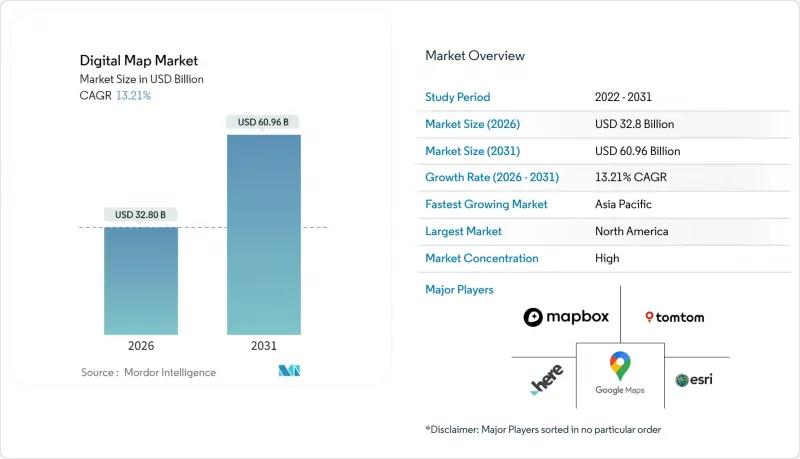
據估計,到 2026 年,數位地圖市場價值將達到 328 億美元,高於 2025 年的 289.7 億美元,預計到 2031 年將達到 609.6 億美元。
預計2026年至2031年年複合成長率(CAGR)為13.21%。
這項成長的驅動力在於向人工智慧驅動的雲端原生平台轉型,這些平台支撐著自動駕駛汽車、智慧城市數位雙胞胎和即時地理資訊系統。歐盟的eCall和企業範圍3碳排放測繪規則等法規要求,也推動了人工智慧在傳統導航之外的應用。
全球數位地圖市場趨勢與洞察
高清地圖在ADAS和自動駕駛車輛中的快速應用
BMW於2024年推出了德國首個L3級自動駕駛系統。該系統使用HERE高清即時地圖,在定位、路線規劃和運行設計域檢驗實現了車道級精度(誤差在17厘米以內)。 HERE的高精度地圖覆蓋範圍目前支援5300萬輛車,比2023年成長了40%,這表明汽車製造商對承包高精度數據的依賴。 TomTom的Orbis Maps 3D覆蓋了8,600萬公里的道路,並整合了基於車道的導航和電動車充電層。日本的動態地圖平台在2025年獲得了政府支持,將高清地圖擴展到機場和港口,目標是L4級自動駕駛卡車。基於人工智慧的特徵提取降低了更新成本並縮短了地圖製作週期,使能夠近乎即時更新網路的供應商獲得了競爭優勢。
聯網汽車的OTA地圖更新生態系統快速發展
聯網汽車正在將地圖更新從靜態授權轉向持續的空中下載 (OTA) 服務。哈曼的 Smart Delta技術可將地圖更新檔案壓縮高達 97%,在降低資料傳輸成本的同時,確保軟體定義車輛的安全性。為響應歐盟通用安全法規,全球十分之九的汽車製造商已採用 HERE 的智慧速度輔助地圖,為其車隊創建了標準化的空中下載 (OTA) 更新路徑。梅賽德斯-奔馳將在 2025 年 1 月的 OTA 更新中整合電動智慧和越野追蹤功能,展示地圖數據如何幫助售後功能變現。
以公分為單位不斷更新地圖的成本增加
隨著都市區建設和交通狀況日益嚴峻,車道級地圖更新需求帶來了巨大的營運成本。 TomTom目前正在融合包括衛星數據、LiDAR和行車記錄器在內的多感測器數據,以實現特徵提取自動化並縮短測繪週期。 GetNexar的AI視覺影像透過群眾外包行車記錄器影片降低了地圖製作成本,但其所需的資金對小型供應商而言仍然難以承受。成本壓力促使各廠商尋求合作和選擇性外包,以在不犧牲地圖精度的前提下維持更新頻率。
細分市場分析
到2025年,軟體解決方案將佔據數位地圖市場60.85%的佔有率,這反映出企業對可配置、API驅動且整合跨職能空間分析的平台的需求。功能豐富的SDK使開發人員能夠將地圖、路線導航和地理編碼功能嵌入到出行、物流和零售應用程式中。業務收益正以13.28%的複合年成長率成長,這反映出隨著企業將傳統GIS遷移到雲端環境,並需要託管整合、資料品質協調和用戶支援計劃,業務複雜性日益增加。現代平台中的AI模組可自動進行鐵路標誌檢測、標誌識別和資產狀況評估,從而提高營運效率。
對專業服務日益成長的需求也反映出合規要求,即必須對位置資料管道進行專家審核。文件工具、授權管理工具和地理圍籬策略引擎正被納入實施計劃中,以確保跨境部署的合法性。隨著企業資料量的成長,供應商營運的託管服務擴大承擔資料擷取、標準化和近即時串流處理的工作,從而確保除一次性許可費之外的持續收入。
預計到2025年,雲端部署將佔數位地圖市場規模的65.10%,並在2031年之前以15.55%的複合年成長率成長。彈性運算和儲存可確保每天數十億次路線請求的亞秒級查詢效能。自動擴展功能可應對惡劣天氣和假日期間的交通高峰。邊緣採集節點將最新的探測資料傳送到集中式儲存庫,從而確保為叫車、物流和緊急應變提供最新的地圖資料。
在國防、航空和監管嚴格的金融領域,本地部署仍在繼續,但隨著主權雲端區域、專用託管選項和機密運算飛地的普及,安全疑慮有所緩解,本地部署正在減少。成本模式正從計量收費支出 (CapEx) 轉向按需付費的營運支出 (OpEx),從而釋放資金用於人工智慧實驗和跨域資料整合。企業越來越傾向於將地圖繪製視為更廣泛的資料平台策略中的微服務,而不是獨立的地理資訊系統 (GIS) 功能。
數位地圖市場按解決方案(軟體、服務)、部署模式(本地部署、雲端部署)、地圖類型(導航地圖、高清即時地圖、地形圖和專題地圖)、最終用戶產業(汽車、工程建設、電信等)以及地區進行細分。市場預測以美元以金額為準。
區域分析
到2025年,北美將佔據數位地圖市場29.10%的佔有率,這主要得益於軟體定義車輛、雲端地理資訊系統(GIS)和國防地理空間專案的早期應用。聯邦機構正在積極推動開放空間框架的構建,而汽車製造商則持續投入大量研發力量用於自動化。大型基礎設施計劃正在採用數位地形模型(DTM)和全球導航衛星系統(GNSS)機器控制技術,以縮短施工週期並提高資產全生命週期的可視性。數據貨幣化主導,例如車隊遠端資訊處理服務提供商,正在持續提供匿名化的探測數據,這對於維護區域地圖的精確度至關重要。
亞太地區將在2031年前維持15.22%的最高複合年成長率,主要得益於5G用戶成長、智慧運輸資金投入以及政府主導的數位雙胞胎計畫。日本企業正在收集高精度道路數據,用於卡車編隊行駛和都市區無人計程車演示,從而加速了對精準測繪的需求。中國雲端服務供應商正在提供高容量位置API以支援電子商務物流,而印度的5G網路正在推動公共產業和農業領域的地理資訊系統(GIS)現代化。對區域超大規模資料中心的投資也將有助於應對資料主權法規,使全球供應商能夠透過國內終端服務本地客戶。
其他福利:
- Excel格式的市場預測(ME)表
- 分析師支持(3個月)
目錄
第1章 引言
- 研究假設和市場定義
- 調查範圍
第2章調查方法
第3章執行摘要
第4章 市場情勢
- 市場概覽
- 市場促進因素
- 快速採用高解析度地圖進行進階駕駛輔助系統和自動駕駛汽車應用
- 聯網汽車OTA地圖更新生態系的爆炸性成長
- 雲端原生GIS平台成為主流
- 全球智慧城市數位雙胞胎計畫發展
- 歐盟電子呼叫強制令及下一代道路安全法規
- 企業範圍 3 碳排放測繪要求
- 市場限制
- 以公分為單位不斷更新地圖的成本增加
- 加強資料隱私和在地化法律(GDPR、PIPL)
- 數據提供者與原始設備製造商之間的知識產權許可糾紛
- 人工智慧生成地圖中的演算法偏見與責任問題
- 價值/供應鏈分析
- 監管環境
- 技術展望
- 波特五力模型
- 新進入者的威脅
- 買方的議價能力
- 供應商的議價能力
- 替代品的威脅
- 競爭對手之間的競爭
第5章 市場規模與成長預測
- 透過解決方案
- 軟體
- 服務
- 透過部署
- 本地部署
- 雲
- 按地圖類型
- 導航地圖
- 高清即時地圖
- 地形圖和專題地圖
- 按最終用途行業分類
- 車
- 工程與施工
- 溝通
- 公共部門和國防部門
- 零售和地理行銷
- 其他最終用戶
- 按地區
- 北美洲
- 美國
- 加拿大
- 墨西哥
- 南美洲
- 巴西
- 阿根廷
- 其他南美洲
- 歐洲
- 德國
- 英國
- 法國
- 荷蘭
- 其他歐洲地區
- 亞太地區
- 中國
- 日本
- 印度
- 韓國
- 澳洲和紐西蘭
- 亞太其他地區
- 中東和非洲
- 中東
- 阿拉伯聯合大公國
- 沙烏地阿拉伯
- 土耳其
- 其他中東地區
- 非洲
- 南非
- 奈及利亞
- 其他非洲地區
- 中東
- 北美洲
第6章 競爭情勢
- 市場集中度
- 策略趨勢
- 市佔率分析
- 公司簡介
- Alphabet(Google Maps, Waze)
- HERE Technologies
- TomTom International BV
- Esri
- Mapbox
- Apple Inc.(Apple Maps)
- Maxar Technologies(DigitalGlobe)
- Collins Bartholomew
- Digital Map Products
- Digital Mapping Solutions
- DMTI Spatial
- Lepton Software
- ThinkGeo
- MapData Services
- NavInfo Co. Ltd.
- AutoNavi(Gaode, Alibaba)
- Baidu Maps
- Nearmap Ltd
- Zenrin Co. Ltd.
- Trimble Inc.
- CARTO
- OpenStreetMap Foundation
- MapQuest(Verizon)
第7章 市場機會與未來展望
The digital map market size in 2026 is estimated at USD 32.8 billion, growing from 2025 value of USD 28.97 billion with 2031 projections showing USD 60.96 billion, growing at 13.21% CAGR over 2026-2031.
Growth stems from the transition toward AI-powered, cloud-native platforms that support autonomous vehicles, smart-city digital twins, and real-time geographic information systems. Regulatory mandates such as EU eCall and emerging corporate Scope 3 carbon-mapping rules broaden adoption beyond conventional navigation.
Global Digital Map Market Trends and Insights
Rapid Uptake of HD Maps for ADAS and Autonomous Vehicles
BMW launched Germany's first Level 3 system in 2024 using HERE HD Live Map that delivers lane-level accuracy within 17 cm for localization, path planning, and operational-design-domain validation. HERE's high-precision coverage now supports 53 million vehicles, a 40% rise over 2023, indicating OEM reliance on turnkey HD data. TomTom's Orbis Maps 3D spans 86 million km of roads and integrates lane-based navigation with electric-vehicle charging layers. Japan's Dynamic Map Platform received government backing in 2025 to expand HD maps to airports and ports, targeting Level 4 autonomous trucks. AI-based feature extraction lowers refresh costs and shortens map-creation cycles, delivering competitive advantage to providers able to update networks in near-real time.
Explosive Growth of Connected-Car OTA Map-Update Ecosystems
Connected vehicles are shifting maps from static licenses to recurring over-the-air services. HARMAN's Smart Delta technology compresses map-update files by up to 97%, cutting data-transfer costs while maintaining software-defined-vehicle safety integrity. Nine of ten global OEMs deploy HERE's Intelligent Speed Assistance Map to address EU General Safety Regulation compliance, creating standardized OTA pathways for fleet-wide updates. Mercedes-Benz integrated electric-intelligence and off-road tracking features via its January 2025 OTA release, illustrating how map data enables post-sale feature monetization.
Escalating Costs of Continuous, Centimeter-Level Map Refresh
Lane-level refresh requirements drive substantial operational costs as construction and traffic changes intensify in urban zones. TomTom now fuses multi-sensor data-satellite, LiDAR, onboard cameras-to automate feature extraction and cut survey cycles. GetNexar's AI vision reduces cartography expense by crowd-sourcing dash-cam imagery, yet capital requirements remain onerous for smaller vendors. Cost pressures encourage alliances and selective outsourcing to maintain update cadence without sacrificing map accuracy.
Other drivers and restraints analyzed in the detailed report include:
- Mainstream Adoption of Cloud-Native GIS Platforms
- Smart-City Digital-Twin Programs Scaling Globally
- Heightened Data-Privacy and Localization Statutes (GDPR, PIPL)
For complete list of drivers and restraints, kindly check the Table Of Contents.
Segment Analysis
Software solutions captured 60.85% of the digital map market in 2025, reflecting enterprise demand for configurable, API-driven platforms that consolidate spatial analytics across departments. Feature-rich SDKs allow developers to embed maps, routing, and geocoding into mobility, logistics, and retail applications. Services revenue, growing at 13.28% CAGR, mirrors rising complexity as organizations migrate legacy GIS to cloud environments and seek managed integration, data-quality tuning, and user-enablement programs. AI modules within modern platforms automate line-mark detection, sign recognition, and asset-condition scoring, catalyzing operational efficiencies.
Professional-services uptake also reflects compliance mandates that require expert audits of location-data pipelines. Documentation, consent-management tools, and geo-fencing policy engines are bundled into implementation projects to ensure lawful deployment across borders. As enterprise data volumes scale, vendor-operated managed services increasingly handle ingestion, normalization, and near-real-time streaming, locking in recurring revenue beyond one-time license fees.
Cloud deployment held 65.10% share of the digital map market size in 2025 and is forecast to expand at 15.55% CAGR through 2031. Elastic compute and storage enable sub-second query performance for billions of daily route requests while auto-scaling manages traffic peaks during severe-weather or holiday seasons. Edge ingestion nodes push fresh probe data into centralized repositories, ensuring map freshness for ride-hailing, logistics, and emergency response.
On-premise installations persist in defense, aviation, and highly regulated finance but trend downward as sovereign-cloud regions, dedicated host options, and confidential-computing enclaves mitigate security objections. Cost models shift from capex to pay-as-you-go opex, freeing capital for AI experimentation and cross-domain data fusion. Enterprises increasingly view mapping as a micro-service consumed within broader data-platform strategies rather than a standalone GIS function.
Digital Map Market is Segmented by Solution (Software, Services), Deployment (On-Premise, Cloud), Map Type (Navigation Maps, HD and Real-Time Maps, Topographic and Thematic Maps), End User Industry (Automotive, Engineering and Construction, Telecommunications and More), and by Geography. The Market Forecasts are Provided in Terms of Value (USD).
Geography Analysis
North America accounted for 29.10% digital map market share in 2025, anchored by early adoption of software-defined vehicles, cloud GIS, and defense geospatial programs. Federal agencies promote open spatial frameworks, and automotive OEMs maintain deep research pipelines for automation. Large-scale infrastructure projects employ digital terrain models and GNSS machine-control to shorten build cycles and enhance asset lifecycle visibility. Data-monetization champions such as fleet telematics providers continuously feed anonymized probe data that sustain regional map accuracy.
Asia-Pacific delivers the highest 15.22% CAGR through 2031, powered by 5G subscriber growth, smart-mobility funding, and government-backed digital-twin mandates. Japan's industry collects HD corridor data for truck platooning and metropolitan robo-taxi pilots, accelerating HD mapping demand. China's cloud providers expose high-volume location APIs to power e-commerce logistics, while India's 5G networks stimulate GIS modernization across utilities and agriculture. Investments in regional hyperscale data centers also address data-sovereignty rules, enabling global vendors to serve local customers via in-country endpoints.
- Alphabet (Google Maps, Waze)
- HERE Technologies
- TomTom International B.V.
- Esri
- Mapbox
- Apple Inc. (Apple Maps)
- Maxar Technologies (DigitalGlobe)
- Collins Bartholomew
- Digital Map Products
- Digital Mapping Solutions
- DMTI Spatial
- Lepton Software
- ThinkGeo
- MapData Services
- NavInfo Co. Ltd.
- AutoNavi (Gaode, Alibaba)
- Baidu Maps
- Nearmap Ltd
- Zenrin Co. Ltd.
- Trimble Inc.
- CARTO
- OpenStreetMap Foundation
- MapQuest (Verizon)
Additional Benefits:
- The market estimate (ME) sheet in Excel format
- 3 months of analyst support
TABLE OF CONTENTS
1 INTRODUCTION
- 1.1 Study Assumptions and Market Definition
- 1.2 Scope of the Study
2 RESEARCH METHODOLOGY
3 EXECUTIVE SUMMARY
4 MARKET LANDSCAPE
- 4.1 Market Overview
- 4.2 Market Drivers
- 4.2.1 Rapid uptake of HD maps for ADAS and autonomous vehicles
- 4.2.2 Explosive growth of connected-car OTA map-update ecosystems
- 4.2.3 Mainstream adoption of cloud-native GIS platforms
- 4.2.4 Smart-city digital-twin programs scaling globally
- 4.2.5 Mandatory EU eCall and next-gen road-safety regulations
- 4.2.6 Corporate Scope-3 carbon mapping requirements
- 4.3 Market Restraints
- 4.3.1 Escalating costs of continuous, centimetre-level map refresh
- 4.3.2 Heightened data-privacy and localization statutes (GDPR, PIPL)
- 4.3.3 IP-licensing disputes among data providers and OEMs
- 4.3.4 Algorithmic bias and liability concerns in AI-generated maps
- 4.4 Value / Supply-Chain Analysis
- 4.5 Regulatory Landscape
- 4.6 Technological Outlook
- 4.7 Porter's Five Forces
- 4.7.1 Threat of New Entrants
- 4.7.2 Bargaining Power of Buyers
- 4.7.3 Bargaining Power of Suppliers
- 4.7.4 Threat of Substitutes
- 4.7.5 Intensity of Competitive Rivalry
5 MARKET SIZE AND GROWTH FORECASTS (VALUE)
- 5.1 By Solution
- 5.1.1 Software
- 5.1.2 Services
- 5.2 By Deployment
- 5.2.1 On-Premise
- 5.2.2 Cloud
- 5.3 By Map Type
- 5.3.1 Navigation Maps
- 5.3.2 HD and Real-time Maps
- 5.3.3 Topographic and Thematic Maps
- 5.4 By End-use Industry
- 5.4.1 Automotive
- 5.4.2 Engineering and Construction
- 5.4.3 Telecommunications
- 5.4.4 Public Sector and Defense
- 5.4.5 Retail and Geomarketing
- 5.4.6 Other End User
- 5.5 By Geography
- 5.5.1 North America
- 5.5.1.1 United States
- 5.5.1.2 Canada
- 5.5.1.3 Mexico
- 5.5.2 South America
- 5.5.2.1 Brazil
- 5.5.2.2 Argentina
- 5.5.2.3 Rest of South America
- 5.5.3 Europe
- 5.5.3.1 Germany
- 5.5.3.2 United Kingdom
- 5.5.3.3 France
- 5.5.3.4 Netherlands
- 5.5.3.5 Rest of Europe
- 5.5.4 Asia-Pacific
- 5.5.4.1 China
- 5.5.4.2 Japan
- 5.5.4.3 India
- 5.5.4.4 South Korea
- 5.5.4.5 Australia and New Zealand
- 5.5.4.6 Rest of Asia-Pacific
- 5.5.5 Middle East and Africa
- 5.5.5.1 Middle East
- 5.5.5.1.1 United Arab Emirates
- 5.5.5.1.2 Saudi Arabia
- 5.5.5.1.3 Turkey
- 5.5.5.1.4 Rest of Middle East
- 5.5.5.2 Africa
- 5.5.5.2.1 South Africa
- 5.5.5.2.2 Nigeria
- 5.5.5.2.3 Rest of Africa
- 5.5.5.1 Middle East
- 5.5.1 North America
6 COMPETITIVE LANDSCAPE
- 6.1 Market Concentration
- 6.2 Strategic Moves
- 6.3 Market Share Analysis
- 6.4 Company Profiles (includes Global level Overview, Market level overview, Core Segments, Financials as available, Strategic Information, Market Rank/Share for key companies, Products and Services, and Recent Developments)
- 6.4.1 Alphabet (Google Maps, Waze)
- 6.4.2 HERE Technologies
- 6.4.3 TomTom International B.V.
- 6.4.4 Esri
- 6.4.5 Mapbox
- 6.4.6 Apple Inc. (Apple Maps)
- 6.4.7 Maxar Technologies (DigitalGlobe)
- 6.4.8 Collins Bartholomew
- 6.4.9 Digital Map Products
- 6.4.10 Digital Mapping Solutions
- 6.4.11 DMTI Spatial
- 6.4.12 Lepton Software
- 6.4.13 ThinkGeo
- 6.4.14 MapData Services
- 6.4.15 NavInfo Co. Ltd.
- 6.4.16 AutoNavi (Gaode, Alibaba)
- 6.4.17 Baidu Maps
- 6.4.18 Nearmap Ltd
- 6.4.19 Zenrin Co. Ltd.
- 6.4.20 Trimble Inc.
- 6.4.21 CARTO
- 6.4.22 OpenStreetMap Foundation
- 6.4.23 MapQuest (Verizon)
7 MARKET OPPORTUNITIES AND FUTURE OUTLOOK
- 7.1 White-space and Unmet-need Assessment

 數位地圖市場-2026-2032年全球市場預測
 數位地圖市場報告:按類型、應用、解決方案、部署模式、應用領域、最終用戶產業和地區分類(2026-2034 年)
 數位地圖市場分析及預測(至2035年):類型、產品類型、服務、技術、組件、應用、部署模式、最終用戶
 2026年全球數位地圖市場報告
 全球數位地圖市場規模、佔有率、趨勢和成長分析報告(2026-2034)全球數位地圖服務市場規模、佔有率、趨勢和成長分析報告(2026-2034年)
 數位地圖市場-全球產業規模、佔有率、趨勢、機會及預測(按組件、部署類型、技術、應用、最終用戶、地區和競爭格局分類),2021-2031年網路視覺化軟體市場:按公司規模、解決方案類型、組件、部署模式、應用和行業垂直領域分類 - 全球預測(2026-2032 年)
 全球數位地圖市場(按解決方案和用例)預測(至 2030 年)
 2025-2029年全球數位地圖市場