


 |
市場調查報告書
商品編碼
1939704
自行車:市場佔有率分析、產業趨勢與統計、成長預測(2026-2031)Bicycle - Market Share Analysis, Industry Trends & Statistics, Growth Forecasts (2026 - 2031) |
||||||

※ 本網頁內容可能與最新版本有所差異。詳細情況請與我們聯繫。
預計自行車市場將從 2025 年的 835 億美元成長到 2026 年的 921.4 億美元,到 2031 年將達到 1507.7 億美元,2026 年至 2031 年的複合年成長率為 10.35%。
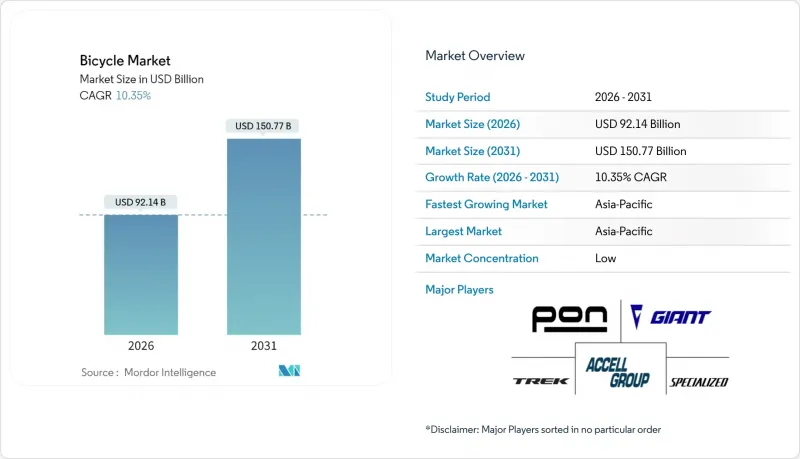
隨著都市區擴大實施堵塞收費,以及企業將騎行激勵措施納入員工健康計劃,自行車需求持續成長。政府基礎設施投資遠超預期,以及旨在減少碳排放的嚴格氣候政策,進一步推動了這項需求。此外,電池安全技術的不斷進步正在解決安全隱患,並擴大潛在消費群。直銷品牌的興起和軟體驅動的車隊服務的整合正在重塑零售環境,最佳化營運效率,並改善客戶體驗。不斷上漲的燃油價格進一步凸顯了自行車相對於汽車的成本優勢,使其成為自行車市場中更具經濟可行性的選擇。總而言之,在有利的法規結構、技術進步以及城市生活方式向永續和積極出行方式轉變的推動下,自行車市場持續成長。
全球自行車市場趨勢與洞察
政府支持促進綠色交通途徑
世界各國政府日益認知到,騎行不僅僅是一項休閒活動,更是應對氣候變遷基礎設施的重要組成部分。歐盟於2024年4月通過的《歐洲自行車宣言》便是這項轉變的有力佐證。該宣言概述了成員國為加強自行車基礎設施建設並促進其融入永續交通系統而作出的36項具有約束力的承諾。同樣,在美國,「積極交通基礎設施投資計畫」每年將提供4,450萬美元,用於支持互聯自行車網路的建設,從而提升騎乘者的便利性和安全性。在州一級,加州承諾在四年內投入9.3億美元,用於建造265英里(約420公里)的新自行車道,進一步強調了自行車在城市規劃中的重要性。這些全面的政策措施正在推動對自行車相關產品和服務的持續需求,促使製造商擴大產能,零售商增加庫存,以滿足自行車市場日益成長的需求。
都市區擁擠促使人們騎自行車上班。
隨著城市密度壓力的增加,特大城市,尤其是在亞太地區,面臨交通堵塞帶來的經濟和社會成本,因此,自行車出行解決方案至關重要。擁擠收費和低排放區鼓勵人們騎自行車出行,而非駕駛私家車。混合辦公模式也正在改變通勤方式,讓騎自行車成為短程、彈性出行的理想選擇。荷蘭就是一個很好的例子,它成功地將自行車與連接鐵路網路的專用自行車高速公路相結合,透過創建多模態系統,同時應對了環境和出行方面的挑戰。企業採用自行車出行也受到員工健康計畫和永續發展報告要求的推動。自行車基礎設施的投資有助於吸引人才、實現碳減排目標,並提高自行車市場與環境、社會和管治(ESG) 目標的契合度。
自行車和其他快速交通途徑的普及是阻礙人們騎自行車的因素。
隨著電動Scooter、共享旅遊服務和自動駕駛汽車測試在短途出行領域佔據主導地位,交通途徑之間的競爭日益激烈。在都市區,擁有電動自行車的成本如今已與普通電動Scooter或共享出行訂閱服務的成本相當,價格競爭愈演愈烈。微出行平台的整合催生了眾多綜合交通應用程式,使得騎乘成為眾多出行選擇之一。在擁有發達地鐵網路的亞太城市,公共運輸的進步降低了騎乘作為長途通勤方式的吸引力。儘管對替代交通途徑的監管進展迅速,但自行車基礎設施的建設卻相對落後。例如,電動Scooter共享專案審核速度很快,而自行車相關計劃則需要更長時間。然而,騎行帶來的健康和環境效益限制了替代品的威脅,並確保了其市場地位。
細分市場分析
預計到2025年,電動自行車將佔自行車市場50.74%的佔有率,並在2031年之前以12.52%的複合年成長率成長。在UL 2849等安全認證提升消費者信心的推動下,電動自行車市場規模預計在未來十年內將增加一倍以上。如今,電池可拆卸且符合航空標準,從而拓展了電動自行車的應用場景。同時,傳統公路車和城市自行車的銷售量保持穩定,為零部件供應商帶來了規模經濟效益。
技術融合正在重塑競爭優勢:整合導航、防盜追蹤和預測性維護等技術正在提升騎乘體驗,並推高高階價格。亞太地區的生產商受益於成本效益高的生產能力,而歐洲組裝則利用其地理優勢搶佔高階市場。中國強制性的電池回收制度為其他地區樹立了榜樣,並可能為合規品牌帶來業務收益。對於那些將自行車與車隊分析結合的軟體公司而言,市場機會依然存在,它們能夠以輕資產的方式為出行預算提供支援。
到2025年,傳統車架仍將佔據自行車市場85.12%的主導地位。這一主導地位反映了消費者對其的認可,這得益於其極具吸引力的量產幾何結構、經濟實惠的價格以及與現有基礎設施的無縫兼容性。同時,折疊式自行車預計將迎來強勁成長,到2031年將實現11.22%的年複合成長率。這一成長率是整體自行車市場成長率的兩倍,主要驅動力是消費者對緊湊、節省空間解決方案的需求不斷成長,尤其是在應對都市區住宅空間有限以及需要高效連接鐵路網路等挑戰方面。
材料技術的進步,例如鎂合金鉸鏈和快拆夾具,降低了折疊自行車的重量,並使其保固期與普通自行車相同,從而解決了人們的擔憂。自行車產業也看到,越來越多的員工開始選擇折疊式自行車作為通勤工具,因為它們可以安全地存放在辦公桌下或小型儲物櫃中。歐洲,特別是德國和荷蘭,推行支持鐵路和自行車聯合通勤的政策,也為折疊式自行車提供了監管支持。然而,在折疊式自行車的零售價格接近普通自行車之前,預計普通自行車仍將佔據年度銷售的大部分。
區域分析
預計到2025年,亞太地區將佔全球市場的47.68%,鞏固其作為主要收入來源的地位。受多種因素影響,該地區預計到2031年將達到13.08%的高複合年成長率。中國自行車市場正經歷顯著成長,這得益於電動自行車的普及、強制性電池回收政策的實施以及積極推廣摩托車作為永續交通途徑的城市交通政策。同時,日本正策略性地使其認證體系與歐洲標準接軌,簡化出口程序,並提升國內品牌的國際競爭力。
在北美和歐洲,大規模的基礎設施投資項目正在創造穩定且永續的自行車需求。從市場地域分佈來看,製造業活動集中在亞洲,而已開發市場則在利好政策的推動下實現了成長。這種趨勢不僅促進了貿易流動,鞏固了亞洲老牌製造商的優勢,也為高級產品。
中東和非洲的自行車市場正經歷強勁成長,電動自行車的普及率以兩位數的速度加速成長,傳統自行車的需求也保持穩定。杜拜、開普敦、內羅畢和特拉維夫等主要城市的消費者越來越將自行車,尤其是電動式自行車,視為汽車和摩托車等傳統交通工具的現代化環保替代品。然而,缺乏標準化的安全法規、保險體系和道路使用權仍然是限制非洲國家自行車市場快速發展的一大挑戰。
其他福利:
- Excel格式的市場預測(ME)表
- 3個月的分析師支持
目錄
第1章 引言
- 研究假設和市場定義
- 調查範圍
第2章調查方法
第3章執行摘要
第4章 市場情勢
- 市場概覽
- 市場促進因素
- 都市區擁擠促使人們選擇騎自行車進行日常通勤。
- 健身趨勢推動自行車運動
- 政府支持促進綠色交通途徑
- 日益增強的環保意識和永續性正在推動消費者循環消費。
- 職場健康計畫鼓勵員工騎自行車
- 燃油價格上漲使騎自行車成為一種經濟實惠的出行方式。
- 市場限制
- 替代交通方式(例如摩托車)和其他更快捷的交通途徑的普及
- 仿冒自行車阻礙市場成長
- 電動自行車高成本
- 遍遠地區道路狀況差
- 監管環境
- 技術進步
- 波特五力模型
- 新進入者的威脅
- 買方的議價能力
- 供應商的議價能力
- 替代品的威脅
- 競爭對手之間的競爭
第5章 市場規模與成長預測
- 依產品類型
- 路城
- 山地/全地形
- 混合
- 電動自行車
- 其他類型
- 有意為之
- 通常
- 折疊式的
- 最終用戶
- 男性
- 女士
- 孩子
- 透過分銷管道
- 線下零售店
- 線上零售商
- 按地區
- 北美洲
- 美國
- 加拿大
- 墨西哥
- 北美其他地區
- 歐洲
- 德國
- 英國
- 義大利
- 法國
- 西班牙
- 荷蘭
- 波蘭
- 比利時
- 瑞典
- 其他歐洲地區
- 亞太地區
- 中國
- 印度
- 日本
- 澳洲
- 印尼
- 韓國
- 泰國
- 新加坡
- 亞太其他地區
- 南美洲
- 巴西
- 阿根廷
- 哥倫比亞
- 智利
- 秘魯
- 南美洲其他地區
- 中東和非洲
- 南非
- 沙烏地阿拉伯
- 阿拉伯聯合大公國
- 奈及利亞
- 埃及
- 摩洛哥
- 土耳其
- 其他中東和非洲地區
- 北美洲
第6章 競爭情勢
- 市場集中度
- 策略趨勢
- 市佔率分析
- 公司簡介
- Accell Group NV
- Trek Bicycle Corporation
- Pon Holdings BV
- Giant Manufacturing Co. Ltd
- Specialized Bicycle Components Inc.
- Shimano Inc.
- Scott Sports SA
- Merida Industry Co. Ltd
- Stryder Cycle Private Limited
- Cycles Devinci inc.
- Pending System GmbH & Co. KG
- Brompton Bicycle Ltd
- Decathlon SA
- Rad Power Bikes Inc.
- Riese and Muller GmbH
- Bulls Bikes GmbH
- Yadea Group Holdings Ltd
- Canyon Bicycles GmbH
- Hero Cycles Limited
- Ribble Cycles
第7章 市場機會與未來展望
The Bicycle market is expected to grow from USD 83.5 billion in 2025 to USD 92.14 billion in 2026 and is forecast to reach USD 150.77 billion by 2031 at 10.35% CAGR over 2026-2031.
Urban centers are increasingly implementing congestion charges, while employers are incorporating bicycle incentives into wellness programs, driving sustained demand for bicycles. This demand is further reinforced by significant government investments in infrastructure, which have already exceeded projections, alongside stricter climate policies aimed at reducing carbon emissions. Additionally, ongoing advancements in battery safety technology are expanding the potential consumer base by addressing safety concerns. The emergence of direct-to-consumer brands and the integration of software-enabled fleet services are redefining the retail landscape, optimizing operational efficiencies, and enhancing customer accessibility. Rising fuel prices are further amplifying the cost advantage of bicycles over motorized vehicles, making them a more economically viable option in the bicycle market. Overall, the bicycle market continues to experience growth, supported by favorable regulatory frameworks, technological progress, and a shift in urban lifestyles toward sustainable and active mobility solutions.
Global Bicycle Market Trends and Insights
Government support encourages eco-friendly transportation methods
Governments worldwide are increasingly recognizing cycling as a critical element of climate infrastructure rather than merely a recreational activity. This shift is evident in the European Union's adoption of the European Declaration on Cycling in April 2024, which outlines 36 binding commitments for member states to enhance cycling infrastructure and promote its integration into sustainable transport systems . Similarly, in the United States, the Active Transportation Infrastructure Investment Program provides USD 44.5 million annually to develop connected cycling networks, fostering greater accessibility and safety for cyclists. On a state level, California has committed USD 930 million over four years to build 265 miles of new bike paths, further emphasizing the importance of cycling in urban planning . These comprehensive policy measures are driving sustained demand for cycling-related products and services, encouraging manufacturers to scale up production capacities and motivating retailers to increase their inventory levels to meet the growing market needs in the bicycle market.
Urban congestion boosts bicycle usage for daily commute
As urban density pressures rise, especially in Asia-Pacific megacities facing traffic congestion's economic and social costs, the need for cycling solutions is critical. Congestion pricing and low-emission zones further promote cycling over private vehicles. Hybrid work models have also reshaped commuting, making cycling ideal for shorter, flexible trips. The Netherlands exemplifies successful cycling integration with cycling highways linked to rail networks, creating a multimodal transport system that rivals car ownership while addressing environmental and mobility challenges. Corporations are increasingly adopting cycling, driven by employee wellness initiatives and sustainability reporting mandates. Investments in cycling infrastructure help attract talent and meet carbon reduction goals, aligning with environmental and social governance (ESG) objectives in the bicycle market.
Availability of substitute like bikes, and other faster transport modes discourages the use of bicycle
Competition among transport modes is intensifying as electric scooters, ride-sharing services, and autonomous vehicle pilots address short-distance mobility. In urban areas, e-bike ownership costs now rival those of electric scooters and ride-sharing subscriptions, heightening pricing competition. Integrated transport apps, driven by micromobility platform consolidation, have made bicycles one of many transport options. In Asia-Pacific cities with extensive metro systems, public transportation advancements have reduced cycling's appeal for longer commutes. While regulations for alternative transport modes advance quickly, cycling infrastructure faces delays. For instance, electric scooter-sharing programs receive rapid approvals, whereas cycling projects take longer. However, cycling's health and environmental benefits limit substitution threats, ensuring its market presence.
Other drivers and restraints analyzed in the detailed report include:
- Fitness trends increase popularity of cycling activities
- Environmental awareness and sustainability drives bicycle usage among consumers
- High e-bike cost restricts wider adoption globally
For complete list of drivers and restraints, kindly check the Table Of Contents.
Segment Analysis
E-bicycles held 50.74% of the bicycle market in 2025, and the segment is forecast to post a 12.52% CAGR to 2031. The bicycle market size for e-bicycles is therefore on track to more than double within the decade, propelled by safety certifications such as UL 2849 that boost consumer trust. Batteries are now removable and airline-compliant, widening use cases. Meanwhile, conventional road and city bikes preserve large sales volumes, sustaining economies of scale for component suppliers.
Technology convergence defines competitive edges: integrated navigation, theft-tracking, and predictive maintenance enrich the rider experience and push premium price points. Asia-Pacific producers benefit from cost-efficient capacity, while European assemblers leverage proximity to capture premium niches. Battery recycling mandates in China set a template other regions may follow, adding after-sales service revenue for compliant brands. Market entry remains open for software-native firms bundling bikes with fleet analytics, providing asset-light access to mobility budgets.
In 2025, regular frames continue to dominate the bicycle market, accounting for a substantial 85.12% market share. This dominance highlights the strong appeal of mass-produced geometries, cost-effective pricing, and seamless compatibility with existing infrastructure, which collectively make regular frames a preferred choice among consumers. On the other hand, folding designs are projected to experience a robust growth trajectory, registering an impressive 11.22% CAGR through 2031. This growth rate, which is double that of the overall bicycle market, is primarily driven by the rising demand for compact and space-efficient solutions, particularly in response to challenges such as limited urban housing space and the growing need for efficient last-mile connectivity with rail networks.
Material advances in magnesium hinges and quick-release clamps now limit weight premiums, and warranty parity with regular bikes removes past hesitations. In the bicycle industry, corporations also favor foldables for employee fleets because units store safely under desks and in small lockers. European policy supporting combined rail-bike commutes, notably in Germany and the Netherlands, gives folding models regulatory tailwinds. Yet the bulk of annual volume will still come from regular bikes until folding retail prices close the gap.
The Bicycle Market Report is Segmented by Product Type (Road/City, Mountain/All-Terrain, Hybrid, E-Bicycle, and Others), Design (Regular and Folding), End-User (Men, Women, and Children), Distribution Channel (Offline Retail Stores and Online Retail Stores), and Geography (North America, Europe, Asia-Pacific, South America, and Middle East and Africa). The Market Forecasts are Provided in Terms of Value (USD).
Geography Analysis
In 2025, the Asia-Pacific region solidified its position as a key revenue contributor, accounting for 47.68% of the global market. The region is forecasted to achieve a strong compound annual growth rate (CAGR) of 13.08% through 2031, driven by several factors. In China, the bicycle market is experiencing significant growth due to the widespread adoption of e-bikes, the enforcement of mandatory battery-recycling initiatives, and urban traffic policies that actively encourage the use of two-wheelers as a sustainable mode of transportation. Japan, on the other hand, is strategically aligning its certification frameworks with European standards, thereby simplifying export procedures and enhancing the global competitiveness of its domestic brands.
In North America and Europe, large-scale infrastructure investment programs are creating a stable and sustained demand for bicycles. The market's geographic distribution underscores a concentration of manufacturing activities in Asia, while developed markets are witnessing growth driven by favorable policy measures. This dynamic fosters trade flows that not only reinforce the dominance of established Asian manufacturers but also create opportunities for premium product positioning in Western markets, catering to a consumer base that values high-quality and innovative offerings.
The bicycle market in the Middle East and Africa is experiencing robust growth, with e-bike adoption accelerating at double-digit rates and traditional bicycles maintaining steady demand. Urban consumers in key cities such as Dubai, Cape Town, Nairobi, and Tel Aviv are increasingly perceiving bicycles, particularly e-bikes, as modern, eco-conscious alternatives to conventional vehicles like cars and motorbikes. However, the lack of standardized safety regulations, insurance frameworks, and traffic rights continues to pose challenges, hindering the rapid formalization of the bicycle market in several African nations.
- Accell Group NV
- Trek Bicycle Corporation
- Pon Holdings BV
- Giant Manufacturing Co. Ltd
- Specialized Bicycle Components Inc.
- Shimano Inc.
- Scott Sports SA
- Merida Industry Co. Ltd
- Stryder Cycle Private Limited
- Cycles Devinci inc.
- Pending System GmbH & Co. KG
- Brompton Bicycle Ltd
- Decathlon SA
- Rad Power Bikes Inc.
- Riese and Muller GmbH
- Bulls Bikes GmbH
- Yadea Group Holdings Ltd
- Canyon Bicycles GmbH
- Hero Cycles Limited
- Ribble Cycles
Additional Benefits:
- The market estimate (ME) sheet in Excel format
- 3 months of analyst support
TABLE OF CONTENTS
1 INTRODUCTION
- 1.1 Study Assumptions and Market Definition
- 1.2 Scope of the Study
2 RESEARCH METHODOLOGY
3 EXECUTIVE SUMMARY
4 MARKET LANDSCAPE
- 4.1 Market Overview
- 4.2 Market Drivers
- 4.2.1 Urban congestion boosts bicycle usage for daily commute
- 4.2.2 Fitness trends increase popularity of cycling activities
- 4.2.3 Government support encourages eco-friendly transportation methods
- 4.2.4 Environmental awareness and sustainability drives bicycle usage among consumers
- 4.2.5 Workplace wellness programs encourage employee bicycle usage
- 4.2.6 Rising fuel prices make bicycles cost-effective alternatives
- 4.3 Market Restraints
- 4.3.1 Availability of substitute like bikes, and other faster transport modes discourages the use of bicycle
- 4.3.2 Presence of counterfeit bicycles hinders market growth
- 4.3.3 High e-bike cost restricts wider adoption globally
- 4.3.4 Poor road conditions in rural areas hinder smooth bicycle experience
- 4.4 Regulatory Landscape
- 4.5 Technological Advancements
- 4.6 Porter's Five Forces
- 4.6.1 Threat of New Entrants
- 4.6.2 Bargaining Power of Buyers
- 4.6.3 Bargaining Power of Suppliers
- 4.6.4 Threat of Substitute Products
- 4.6.5 Intensity of Competitive Rivalry
5 MARKET SIZE AND GROWTH FORECASTS (VALUE)
- 5.1 By Product Type
- 5.1.1 Road/City
- 5.1.2 Mountain/All-Terrain
- 5.1.3 Hybrid
- 5.1.4 E-Bicycle
- 5.1.5 Other Types
- 5.2 By Design
- 5.2.1 Regular
- 5.2.2 Folding
- 5.3 By End-User
- 5.3.1 Men
- 5.3.2 Women
- 5.3.3 Children
- 5.4 By Distribution Channel
- 5.4.1 Offline Retail Stores
- 5.4.2 Online Retail Stores
- 5.5 By Geography
- 5.5.1 North America
- 5.5.1.1 United States
- 5.5.1.2 Canada
- 5.5.1.3 Mexico
- 5.5.1.4 Rest of North America
- 5.5.2 Europe
- 5.5.2.1 Germany
- 5.5.2.2 United Kingdom
- 5.5.2.3 Italy
- 5.5.2.4 France
- 5.5.2.5 Spain
- 5.5.2.6 Netherlands
- 5.5.2.7 Poland
- 5.5.2.8 Belgium
- 5.5.2.9 Sweden
- 5.5.2.10 Rest of Europe
- 5.5.3 Asia-Pacific
- 5.5.3.1 China
- 5.5.3.2 India
- 5.5.3.3 Japan
- 5.5.3.4 Australia
- 5.5.3.5 Indonesia
- 5.5.3.6 South Korea
- 5.5.3.7 Thailand
- 5.5.3.8 Singapore
- 5.5.3.9 Rest of Asia-Pacific
- 5.5.4 South America
- 5.5.4.1 Brazil
- 5.5.4.2 Argentina
- 5.5.4.3 Colombia
- 5.5.4.4 Chile
- 5.5.4.5 Peru
- 5.5.4.6 Rest of South America
- 5.5.5 Middle East and Africa
- 5.5.5.1 South Africa
- 5.5.5.2 Saudi Arabia
- 5.5.5.3 United Arab Emirates
- 5.5.5.4 Nigeria
- 5.5.5.5 Egypt
- 5.5.5.6 Morocco
- 5.5.5.7 Turkey
- 5.5.5.8 Rest of Middle East and Africa
- 5.5.1 North America
6 COMPETITIVE LANDSCAPE
- 6.1 Market Concentration
- 6.2 Strategic Moves
- 6.3 Market Share Analysis
- 6.4 Company Profiles (includes Global level Overview, Market level overview, Core Segments, Financials as available, Strategic Information, Market Rank/Share for key companies, Products and Services, and Recent Developments)
- 6.4.1 Accell Group NV
- 6.4.2 Trek Bicycle Corporation
- 6.4.3 Pon Holdings BV
- 6.4.4 Giant Manufacturing Co. Ltd
- 6.4.5 Specialized Bicycle Components Inc.
- 6.4.6 Shimano Inc.
- 6.4.7 Scott Sports SA
- 6.4.8 Merida Industry Co. Ltd
- 6.4.9 Stryder Cycle Private Limited
- 6.4.10 Cycles Devinci inc.
- 6.4.11 Pending System GmbH & Co. KG
- 6.4.12 Brompton Bicycle Ltd
- 6.4.13 Decathlon SA
- 6.4.14 Rad Power Bikes Inc.
- 6.4.15 Riese and Muller GmbH
- 6.4.16 Bulls Bikes GmbH
- 6.4.17 Yadea Group Holdings Ltd
- 6.4.18 Canyon Bicycles GmbH
- 6.4.19 Hero Cycles Limited
- 6.4.20 Ribble Cycles
7 MARKET OPPORTUNITIES AND FUTURE OUTLOOK

 2026-2030年全球自行車市場
 自行車市場機會、成長要素促進因素、產業趨勢分析及2026-2035年預測。
 自行車市場-全球產業規模、佔有率、趨勢、機會和預測:按類型、技術、銷售管道、地區和競爭格局分類,2021-2031年
 自行車及騎乘裝備市場:依自行車類型、車架材料及銷售管道分類-2026-2032年全球市場預測自行車市場:2026-2032年全球市場預測(按類型、產品類型、變速系統、車架材料、分銷管道、應用、消費群體和最終用戶分類)
 自行車市場分析及預測(至2035年):依類型、產品類型、服務、技術、零件、應用、材質、最終使用者、模式、安裝類型分類
 全球自行車市場規模、佔有率、趨勢和成長分析報告(2026-2034)自行車市場規模、佔有率、成長及全球產業分析:按類型、應用和地區分類,並預測至2026-2034年雙人自行車市場-全球產業規模、佔有率、趨勢、機會與預測:動力類型、應用、銷售管道、地區與競爭格局(2021-2031年)
 北美自行車市場:市場佔有率分析、產業趨勢與統計、成長預測(2026-2031)