


 |
市場調查報告書
商品編碼
1939639
海底光纜:市場佔有率分析、產業趨勢與統計、成長預測(2026-2031)Submarine Optical Fiber Cable - Market Share Analysis, Industry Trends & Statistics, Growth Forecasts (2026 - 2031) |
||||||

※ 本網頁內容可能與最新版本有所差異。詳細情況請與我們聯繫。
預計到 2026 年,海底光纜市場規模將達到 58.9 億美元,高於 2025 年的 53.1 億美元,預計到 2031 年將達到 98.6 億美元。
預計2026年至2031年年複合成長率(CAGR)為10.87%。
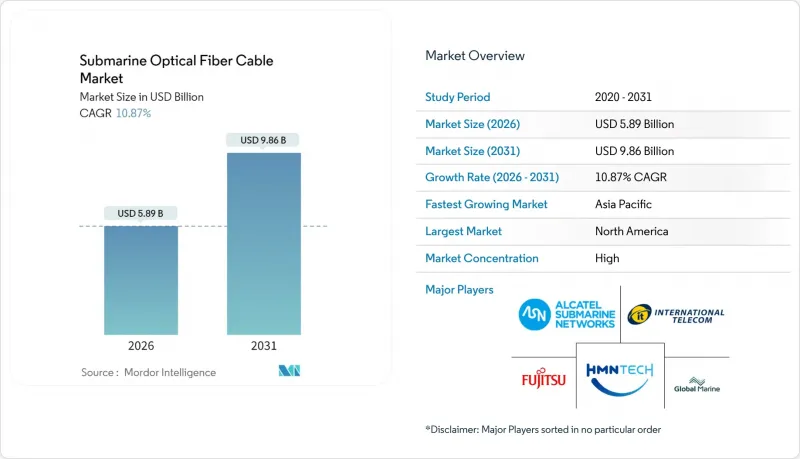
超大規模雲端服務供應商不斷擴大投資,加速向400GbE/800GbE升級,以及空間復用(SDM)系統的商業部署,正在重塑洲際互聯的競爭格局和經濟模式。 60Tbps及以上的系統設計正逐漸成為標準,降低了單位頻寬成本,並支援人工智慧密集資料流。容量擴展策略與國家安全相關的監管發展日益交織,例如,美國聯邦通訊委員會(FCC)的2024-2025年海底光纜許可審查正在指導路由選擇和供應商認證。同時,維修船的瓶頸和波羅的海的反覆中斷顯示地緣政治風險日益增加,推高了營運成本和保險費。
全球海底光纜市場趨勢與洞察
智慧型手機普及率不斷提高,對網路頻寬的需求日益成長
受5G和新興人工智慧工作負載對頻寬需求不斷成長的推動,洲際流量預計到2029年將以每年39%的速度成長。海底電纜的延遲僅為1-5毫秒,比衛星星系的延遲低幾個數量級,使其在高頻交易和工業IoT應用場景中保持競爭力。即將推出的6G規範旨在實現1Tbps的峰值速率,這推動了對能夠處理800GbE波長的中繼器的需求。南海路由核准的延誤限制了新增容量,並導致流向東南亞的流量價格上漲。
超大規模雲端和OTT在專用電纜領域的投資
Meta、Google、亞馬遜和微軟的私有化程度超過了傳統的財團資金籌措,總投資超過200億美元。超大規模資料中心業者資料中心內部的直接終端連接無需地面回程傳輸,從而降低了延遲和營運成本,同時增強了資料主權控制。谷歌的250Tbps「Dunant」計畫和Meta的5萬公里「沃特沃斯計畫」正是這種新型垂直整合模式的典範。
運作高成本的維護和修理船舶
僅有60艘專用船舶維護600多個運作的系統,一旦發生多處故障,恢復時間將非常漫長。北極和太平洋地區的維修成本每次事故超過100萬美元,且維修工作僅限於季節性天氣窗口期,這使得高風險地區的年度保費上漲了15%至20%。
細分市場分析
到2025年,濕式設備將佔海底光纜市場規模的52.74%,這主要得益於對20對及以上光纖設計的中繼器需求不斷成長。 Subcom公司正積極拓展其海上服務能力,以因應這項需求激增。随着地缘政治局势日益复杂,维修周期延长,专业维修船的价值也随之提升,辅助和海上服务正以11.86%的复合年增长率快速增长。
在長達25年的營運壽命期內,持續的維護收入為服務供應商提供了可預測的現金流。雖然陸基設施由於登陸站電力和監控系統的老化而面臨穩定的更換需求,但它們對海底光纜市場的貢獻仍然很小。
儘管單模光纖在2025年將佔總收入的67.02%,但空分複用(SDM)多芯光纖預計到2031年將以每年13.62%的速度成長。諸如OFS公司的TeraWave SCUBA 4X等SDM設備可將容量提升四倍,從而緩解即將到來的香農極限。住友電工的耦合多芯光纖實現了0.158 dB/km的衰減,證明了SDM性能即使在跨越海洋的距離上也依然可靠。
Google在 Dunant 衛星上部署的 12 對光纖 SDM 架構已證明商業性可行性,並正在加速其更廣泛的應用,而多模光纖仍僅限於辦公室內部應用。
區域分析
北美在2025年將佔據海底光纜市場36.25%的佔有率,這主要得益於超大規模叢集和健全的法規結構。谷歌投資10億美元建造美日海底光纜將有助於提升太平洋地區的輸電能力,而LS Cable在維吉尼亞投資6.81億美元的設施將確保美國國內光纜供應的穩定性。
亞太地區預計將以11.40%的複合年成長率成長,這主要得益於數位經濟項目和避開地緣政治熱點的替代路線,例如印度的藍色起源著陸項目和Softbank Corporation新建的跨太平洋海底光纜。中國供應商HMN Technologies和中天科技正在擴大生產,但美國的製裁迫使它們轉向「一帶一路」沿線市場。
歐洲正利用其成熟的跨大西洋走廊,同時推進遠北光纖計劃,以期為亞洲帶來低延遲優勢。歐盟範圍內的海底電纜安全行動計畫以及法國政府對阿爾卡特海底網路公司的收購,凸顯了各國在基礎建設方面的優先事項。歐盟的海底電纜安全行動計畫制定了強力的措施,以預防、偵測和應對海底電纜面臨的威脅,並強調了歐盟保護關鍵基礎設施的承諾。諾基亞完成對阿爾卡特海底網路公司向法國政府的出售,此舉顯示了海底電纜技術的戰略重要性,也顯示歐洲各國政府將這項技術視為重要的國家資產,並需要主權監管。
其他福利:
- Excel格式的市場預測(ME)表
- 3個月的分析師支持
目錄
第1章 引言
- 研究假設和市場定義
- 調查範圍
第2章調查方法
第3章執行摘要
第4章 市場情勢
- 市場概覽
- 市場促進因素
- 智慧型手機普及率不斷提高,對網路頻寬的需求日益成長
- 擴大新興地區的光纖連接
- 超大規模雲端和OTT營運商投資專用電纜
- 通訊業者間400GbE/800GbE快速升級週期
- 推動建設低延遲的區域間路由
- 使用混合動力和數據電纜的離岸風力發電
- 市場限制
- 高昂的維修和維修成本
- 增加對低地球軌道衛星星系的投資
- 海底電纜登陸許可的地緣政治延誤
- 淺水區光纖電纜被盜和破壞
- 監管環境
- 技術展望
- 波特五力模型
- 供應商的議價能力
- 買方的議價能力
- 新進入者的威脅
- 替代品的威脅
- 競爭程度
- 宏觀趨勢(包括新冠肺炎疫情)的影響
- 投資分析
- 海底電纜計劃資料庫
第5章 市場規模與成長預測
- 按組件
- ウェットプラント設備
- 乾式設備
- 補助サービスおよび船舶サービス
- 其他部件
- ケーブルタイプ別
- 單模光纖
- 多模光纖
- SDM/マルチコアファイバー
- クライアントタイプ別
- 通訊業者
- 內容和超大規模雲端供應商
- 政府および研究機関ネットワーク
- 洋上エネルギー事業者
- その他のクライアントタイプ
- 容量設計別
- 16 Tbps 或更低的系統
- 16~60 Tbpsシステム
- 60 Tbps超システム
- 按地區
- 北美洲
- 美國
- 加拿大
- 南美洲
- 巴西
- 阿根廷
- 南美洲其他地區
- 歐洲
- 德國
- 法國
- 英國
- 其他歐洲地區
- 亞太地區
- 中國
- 印度
- 日本
- 澳洲
- 亞太其他地區
- 中東和非洲
- 中東
- 沙烏地阿拉伯
- 阿拉伯聯合大公國
- 土耳其
- 其他中東地區
- 非洲
- 南非
- 埃及
- 奈及利亞
- 其他非洲地區
- 中東
- 北美洲
第6章 競合情勢
- 市場集中度
- 策略趨勢
- 市佔率分析
- 公司簡介
- Alcatel Submarine Networks Ltd.
- HMN Technologies Co., Ltd.
- Nexans SA
- Fujitsu Ltd.
- Global Marine Group Ltd.
- Orange Marine SAS
- Sumitomo Electric Industries Ltd.
- LS Cable and System Ltd.
- Jiangsu Hengtong Marine Cable Systems Co., Ltd.
- SB Submarine Systems Co., Ltd.
- IT International Telecom Inc.
- PT Communication Cable Systems Indonesia Tbk
- NTT Communications Corporation
- Verizon Communications Inc.
- Telstra Group Limited
- China Unicom Global Limited
- Telekom Malaysia Berhad
- Oman Telecommunications Company SAOG(Omantel)
- Meta Platforms, Inc.
- Amazon.com, Inc.
- Google LLC
第7章 市場機會與未來展望
The submarine optical fiber cable market size in 2026 is estimated at USD 5.89 billion, growing from 2025 value of USD 5.31 billion with 2031 projections showing USD 9.86 billion, growing at 10.87% CAGR over 2026-2031.
Heightened investment by hyperscale cloud providers, accelerating 400 GbE/800 GbE upgrade cycles, and the commercial roll-out of Space Division Multiplexing (SDM) systems are reshaping the competitive landscape and economics of intercontinental connectivity. Systems designed for 60 + Tbps are now routine, lowering unit bandwidth costs and enabling AI-intensive data flows. Capacity expansion strategies increasingly intersect with national-security rule-making, exemplified by the FCC's 2024-2025 overhaul of cable-licensing procedures, which is steering route selection and vendor qualification. At the same time, repair-ship bottlenecks and repeated Baltic-Sea disruptions reveal a growing exposure to geopolitical risks that elevate operating expenditure and insurance premiums.
Global Submarine Optical Fiber Cable Market Trends and Insights
Growing Smartphone Penetration and Rising Internet Bandwidth Demand
Intercontinental traffic is projected to climb 39% annually through 2029 as 5G and emerging AI workloads multiply bandwidth requirements. Submarine links sustain 1-5 millisecond latency, an order of magnitude lower than satellite constellations, preserving competitiveness for high-frequency trading and industrial IoT use cases. Forthcoming 6G specifications targeting 1 Tbps peak rates intensify the call for repeaters able to handle 800 GbE wavelengths. Unresolved route-approval delays in the South China Sea restrict new capacity, creating price premiums for Southeast-Asian traffic.
Hyperscale Cloud and OTT Investment in Private Cables
Private ownership by Meta, Google, Amazon, and Microsoft now eclipses traditional consortium funding and exceeds USD 20 billion in aggregate commitments. Direct termination inside hyperscaler data centers eliminates terrestrial backhaul, trimming latency and OPEX while tightening data-sovereignty control. Google's 250 Tbps Dunant and Meta's 50,000 km Project Waterworth exemplify the new vertical-integration model.
High Maintenance and Repair-Ship Costs
Just 60 specialized vessels support more than 600 active systems, extending restoration timelines when multiple outages occur. Arctic and trans-Pacific repairs exceed USD 1 million per incident and face seasonal weather windows, elevating insurance premiums by 15-20% annually in high-risk zones.
Other drivers and restraints analyzed in the detailed report include:
- Rapid 400 GbE/800 GbE Upgrade Cycle Among Carriers
- Push Toward Low-Latency Trans-Polar Routes
- Growing Investment in LEO Satellite Constellations
For complete list of drivers and restraints, kindly check the Table Of Contents.
Segment Analysis
Wet-plant equipment contributed 52.74% of the submarine optical fiber cable market size in 2025 and benefits from 20 + fiber-pair designs that intensify repeater demand. SubCom's expansion of marine fulfillment capabilities is aligned with this demand surge. Auxiliary and marine services are scaling at a 11.86% CAGR as complex geopolitical disruptions lengthen repair cycles and raise the value of specialized intervention vessels.
Continued maintenance revenue over a 25-year operational life adds predictable cash flows for service providers. Dry-plant equipment enjoys steady replacement demand as landing-station power and monitoring systems age, though it remains a smaller contributor to the submarine optical fiber cable market.
Single-mode fiber represented 67.02% of 2025 revenue; however, SDM multi-core fiber is forecast to grow at an annual rate of 13.62% to 2031. SDM units such as OFS's TeraWave SCUBA 4X deliver fourfold capacity improvements, mitigating the looming Shannon-limit crunch. Sumitomo Electric's coupled multi-core fiber achieves 0.158 dB/km attenuation, validating SDM performance over trans-oceanic spans.
Google's deployment of 12 fiber-pair SDM architecture on Dunant proves commercial viability and accelerates broader adoption. Multimode fiber remains limited to intra-station applications.
The Submarine Optical Fiber Cable Market Report is Segmented by Component (Wet-Plant Equipment, Dry-Plant Equipment, and More), Cable Type (Single-Mode Fiber, Multimode Fiber, and More), Client Type (Telecom Operators, Content and Hyperscale Cloud Providers, and More), Capacity Design (less Than or Equal To 16 Tbps Systems, 16-60 Tbps Systems, and More), and Geography. The Market Forecasts are Provided in Terms of Value (USD).
Geography Analysis
North America's 36.25% share of the submarine optical fiber cable market in 2025 is driven by a hyperscale cluster and strong regulatory frameworks. Google's USD 1 billion US-Japan cable commitment reinforces Pacific capacity while LS Cable's USD 681 million Virginia plant secures domestic supply resilience.
The Asia Pacific is projected to expand at a 11.40% CAGR, driven by digital economy programs and alternative routes that circumvent geopolitical flashpoints. India's Blue Origin landing and SoftBank's new trans-Pacific build typify this activity. Chinese vendors HMN Technologies and ZTT scale up production, although U.S. sanctions prompt them to shift toward Belt-and-Road markets.
Europe leverages mature trans-Atlantic corridors while championing the Far North Fiber project for Asia latency advantages. EU-wide cable-security action plans and the French State's acquisition of Alcatel Submarine Networks highlight sovereign-infrastructure priorities. The European Union's Action Plan on Cable Security establishes robust measures for preventing, detecting, and responding to threats against submarine cables, underscoring the EU's commitment to safeguarding its critical infrastructure. In a move highlighting the strategic importance of submarine cable technology, Nokia finalized the sale of Alcatel Submarine Networks to the French State, signaling European governments' view of this technology as a vital national asset warranting sovereign oversight.
- Alcatel Submarine Networks Ltd.
- HMN Technologies Co., Ltd.
- Nexans S.A.
- Fujitsu Ltd.
- Global Marine Group Ltd.
- Orange Marine SAS
- Sumitomo Electric Industries Ltd.
- LS Cable and System Ltd.
- Jiangsu Hengtong Marine Cable Systems Co., Ltd.
- S.B. Submarine Systems Co., Ltd.
- IT International Telecom Inc.
- PT Communication Cable Systems Indonesia Tbk
- NTT Communications Corporation
- Verizon Communications Inc.
- Telstra Group Limited
- China Unicom Global Limited
- Telekom Malaysia Berhad
- Oman Telecommunications Company S.A.O.G. (Omantel)
- Meta Platforms, Inc.
- Amazon.com, Inc.
- Google LLC
Additional Benefits:
- The market estimate (ME) sheet in Excel format
- 3 months of analyst support
TABLE OF CONTENTS
1 INTRODUCTION
- 1.1 Study Assumptions and Market Definition
- 1.2 Scope of the Study
2 RESEARCH METHODOLOGY
3 EXECUTIVE SUMMARY
4 MARKET LANDSCAPE
- 4.1 Market Overview
- 4.2 Market Drivers
- 4.2.1 Growing smartphone penetration and rising internet bandwidth demand
- 4.2.2 Increasing fiber connectivity in emerging regions
- 4.2.3 Hyperscale cloud and OTT investment in private cables
- 4.2.4 Rapid 400 GbE/800 GbE upgrade cycle among carriers
- 4.2.5 Push toward Low-Latency trans-polar routes
- 4.2.6 Offshore wind farms adopting hybrid power-data cables
- 4.3 Market Restraints
- 4.3.1 High maintenance and repair-ship costs
- 4.3.2 Growing investment in LEO satellite constellations
- 4.3.3 Geopolitical cable-landing permit delays
- 4.3.4 Fiber-optic theft/vandalism in shallow waters
- 4.4 Regulatory Landscape
- 4.5 Technological Outlook
- 4.6 Porter's Five Forces
- 4.6.1 Bargaining Power of Suppliers
- 4.6.2 Bargaining Power of Buyers
- 4.6.3 Threat of New Entrants
- 4.6.4 Threat of Substitute Products
- 4.6.5 Degree of Competition
- 4.7 Impact of Macro Trends (incl. COVID-19)
- 4.8 Investment Analysis
- 4.9 Submarine Cable Projects Database
5 MARKET SIZE AND GROWTH FORECASTS (VALUE)
- 5.1 By Component
- 5.1.1 Wet-Plant Equipment
- 5.1.2 Dry-Plant Equipment
- 5.1.3 Auxiliary and Marine Services
- 5.1.4 Other Components
- 5.2 By Cable Type
- 5.2.1 Single-mode Fiber
- 5.2.2 Multimode Fiber
- 5.2.3 SDM / Multi-core Fiber
- 5.3 By Client Type
- 5.3.1 Telecom Operators
- 5.3.2 Content and Hyperscale Cloud Providers
- 5.3.3 Government and Research Networks
- 5.3.4 Offshore Energy Operators
- 5.3.5 Other Clinet Types
- 5.4 By Capacity Design
- 5.4.1 less than or equal to 16 Tbps Systems
- 5.4.2 16 - 60 Tbps Systems
- 5.4.3 above 60 Tbps Systems
- 5.5 By Geography
- 5.5.1 North America
- 5.5.1.1 United States
- 5.5.1.2 Canada
- 5.5.2 South America
- 5.5.2.1 Brazil
- 5.5.2.2 Argentina
- 5.5.2.3 Rest of South America
- 5.5.3 Europe
- 5.5.3.1 Germany
- 5.5.3.2 France
- 5.5.3.3 United Kingdom
- 5.5.3.4 Rest of Europe
- 5.5.4 Asia Pacific
- 5.5.4.1 China
- 5.5.4.2 India
- 5.5.4.3 Japan
- 5.5.4.4 Australia
- 5.5.4.5 Rest of Asia Pacific
- 5.5.5 Middle East and Africa
- 5.5.5.1 Middle East
- 5.5.5.1.1 Saudi Arabia
- 5.5.5.1.2 United Arab Emirates
- 5.5.5.1.3 Turkey
- 5.5.5.1.4 Rest of Middle East
- 5.5.5.2 Africa
- 5.5.5.2.1 South Africa
- 5.5.5.2.2 Egypt
- 5.5.5.2.3 Nigeria
- 5.5.5.2.4 Rest of Africa
- 5.5.5.1 Middle East
- 5.5.1 North America
6 COMPETITIVE LANDSCAPE
- 6.1 Market Concentration
- 6.2 Strategic Moves
- 6.3 Market Share Analysis
- 6.4 Company Profiles (includes Global level Overview, Market level overview, Core Segments, Financials as available, Strategic Information, Market Rank/Share for key companies, Products and Services, and Recent Developments)
- 6.4.1 Alcatel Submarine Networks Ltd.
- 6.4.2 HMN Technologies Co., Ltd.
- 6.4.3 Nexans S.A.
- 6.4.4 Fujitsu Ltd.
- 6.4.5 Global Marine Group Ltd.
- 6.4.6 Orange Marine SAS
- 6.4.7 Sumitomo Electric Industries Ltd.
- 6.4.8 LS Cable and System Ltd.
- 6.4.9 Jiangsu Hengtong Marine Cable Systems Co., Ltd.
- 6.4.10 S.B. Submarine Systems Co., Ltd.
- 6.4.11 IT International Telecom Inc.
- 6.4.12 PT Communication Cable Systems Indonesia Tbk
- 6.4.13 NTT Communications Corporation
- 6.4.14 Verizon Communications Inc.
- 6.4.15 Telstra Group Limited
- 6.4.16 China Unicom Global Limited
- 6.4.17 Telekom Malaysia Berhad
- 6.4.18 Oman Telecommunications Company S.A.O.G. (Omantel)
- 6.4.19 Meta Platforms, Inc.
- 6.4.20 Amazon.com, Inc.
- 6.4.21 Google LLC
7 MARKET OPPORTUNITIES AND FUTURE OUTLOOK
- 7.1 White-space and Unmet-Need Assessment

 海底光纜市場-2026-2032年全球市場預測
 海底電纜市場規模、佔有率和趨勢分析報告:按應用、電壓、最終用途、組件、交付方式、地區和細分市場預測(2026-2033 年)
 海底電纜市場:按服務、應用和地區分類海底通訊電纜系統市場:2026-2032年全球市場預測(依資料傳輸速率、技術、部署類型、網路所有權類型、光纖對數、電纜長度和應用分類)UBM電鍍服務市場(按電鍍材料、基材、技術、應用和最終用途產業分類),全球預測,2026-2032年
 海底電纜市場規模、佔有率和成長分析(按服務類型、類型、電壓、最終用途、絕緣材料和地區分類)-2026-2033年產業預測
 全球海底電纜檢測設備市場
 海底電纜檢測設備市場-全球產業規模、佔有率、趨勢、機會和預測(按類型、應用、部署模式、地區和競爭細分,2020-2030 年預測)
 2032 年海底電纜市場預測:按組件、電纜類型、電壓、服務、應用、最終用戶和地區進行的全球分析
 全球海底電纜市場(2025-2029)