


 |
市場調查報告書
商品編碼
1939584
自動導引運輸車(AGV):市場佔有率分析、產業趨勢與統計、成長預測(2026-2031)Automated Guided Vehicle (AGV) - Market Share Analysis, Industry Trends & Statistics, Growth Forecasts (2026 - 2031) |
||||||

※ 本網頁內容可能與最新版本有所差異。詳細情況請與我們聯繫。
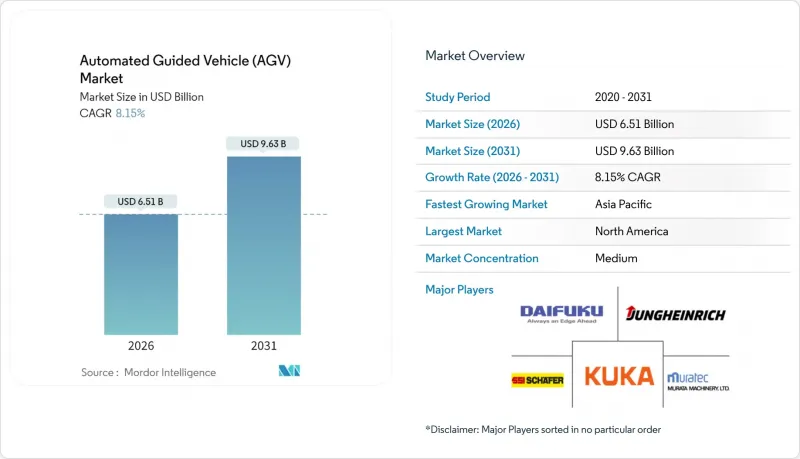
自動導引運輸車(AGV) 市場預計將從 2025 年的 60.2 億美元成長到 2026 年的 65.1 億美元,預計到 2031 年將達到 96.3 億美元,2026 年至 2031 年的複合年成長率為 8.15%。
這一成長趨勢的驅動力來自電商訂單的激增、持續的勞動力短缺以及對全天候無誤物料搬運的需求。旺季訂單量可成長300%至400%,遠超傳統的人工處理能力,促使業者轉向自動駕駛車輛(AGV)。專用5G網路為AGV提供所需的確定性連接,與早期部署的Wi-Fi相比,可提高20%的生產效率並降低15%的資本支出。人工智慧驅動的導航,特別是視覺SLAM技術,可將部署時間縮短20%,並實現無需人工引導的佈局重新配置。對網路安全的日益關注以及對稀土元素供應限制的擔憂抑制了人們的熱情,但迄今為止,這些風險都沒有減緩採購步伐。
全球自動導引運輸車(AGV)市場趨勢與洞察
電子商務物流自動化快速成長
隨著全通路零售的蓬勃發展,AGV市場正從提升效率擴展到業務永續營運領域。由於揀貨作業約佔倉庫成本的55%,克羅格(Kroger)和奧卡多(Ocado)等大型零售商正將其機器人貨物運輸車隊規模擴大四倍,以確保當日送達。 AGV與倉庫管理軟體的即時整合已將物料搬運成本降低了70%。得益於能夠在狹窄通道中靈活穿梭的緊湊型AGV的出現,面積不足平方公尺的城市微型倉配中心如今已成為現實。模組化採購模式使小規模企業能夠根據訂單量的成長靈活增加車輛,從而避免前期投資。
人事費用上升和勞動短缺
倉儲業的離職率持續超過75%,預計2030年全球整體勞動力缺口將達到8,500萬人。在日本,由於勞動力供應鏈崩壞,售價1,500萬日圓的自動堆高機(AGV)仍比人工堆高機更具競爭力。案例研究證實,AGV的投資回收期最短可達8個月,凸顯了其卓越的內部報酬率(IRR)。全天候不間斷的運作能夠創造更多附加價值,而人機混合的勞動力模式則能提高吞吐量和員工滿意度。勞動力短缺促使許多物流中心將AGV的應用從可選項轉變為必選方案,推動了AGV市場的整體成長。
中小企業初始資本投資負擔
初始實施成本從 5 萬美元到 50 萬美元不等,對於利潤微薄的公司來說可能是一筆不小的負擔,尤其是在藉貸成本高昂的情況下。然而,如果將 AGV 與物聯網庫存管理系統結合使用,在勞動密集型應用情境下,8 到 18 個月即可達到損益兩平。機器人即服務 (RaaS) 模式顯著降低了資本支出,並包含持續的技術支援。像 Agility Robotics 這樣的供應商正憑藉其全方位服務合約主導。在北美和歐盟,高達 10% 的研發稅額扣抵以及基於清潔行業準則的加速折舊計畫進一步減輕了資本負擔。儘管短期內存在一些摩擦,但資金籌措創新正使中小企業能夠比以往任何週期更早進入自動駕駛汽車市場。
細分市場分析
到2025年,單元貨載平台將佔總收入的31.48%,憑藉其在多功能設施內移動托盤、貨櫃和周轉箱的能力,將推動自動導引車(AGV)市場的發展。目前規模較小的自動堆高機預計將以8.54%的複合年成長率成長,這反映了市場對垂直運輸能力以及與現有貨架系統相容性的需求。牽引式堆高機在需要依序運輸重型車架零件的汽車工廠中廣受歡迎,而組裝車輛在需要無塵操作的電子無塵室中也越來越受歡迎。
在寸土寸金的都市區,多層倉庫正在興起,而雙模式(手動/自動)操作降低了變更管理的門檻,使得堆高機式車輛的需求日益成長。托盤搬運車式自動導引車是零售商入庫貨物處理自動化的第一步,而手推車和輕載型設計則非常適合高頻次的電商揀貨。此外,防爆型和醫藥級自動導引車也擁有持續的細分市場。這些趨勢共同推動了自動導引車市場在所有產品線中的持續成長。
汽車製造商預計到2025年,AGV(自動導引車)將佔其總收入的34.63%,他們正利用AGV實現準時組裝並減少在製品庫存。然而,隨著當日送達成為消費者的一項基本需求,零售和電商配銷中心預計將以8.18%的複合年成長率超越其他行業。食品飲料業者正在擴大AGV在冷藏區域的部署,以避免低溫環境下的人手不足。同時,電子產品製造商正在使用AGV將精密子組件定位到毫米級精度,從而推動了自動導引車市場的廣泛應用。
為回應藥品良好分銷規範 (GDP) 的要求,醫藥物流領域擴大採用自動導引車 (AGV)。第三方物流公司報告稱,部署機器人車隊後,人工工時減少了 42%。在航太領域,對飛機零件的公差控制要求極高,因此需要設計能夠搬運超重型貨物的 AGV。這些跨行業的變革表明基本客群正在擴大,從而增強了 AGV 市場,同時又不會增加對單一行業的依賴。
區域分析
預計到2025年,北美將維持AGV市場37.07%的收入佔有率,這主要得益於倉庫工人超過25美元的時薪以及根深蒂固的電子商務網路對高速履約的需求。亞馬遜和沃爾瑪等主要客戶已展現出大規模採用機器人技術的趨勢,這正在重塑下游供應商生態系統。在美國,財政獎勵、研發稅額扣抵和特殊折舊計劃確保了即使在利率上升時期也能持續的資本流入。同時,加拿大在冷鏈倉儲和資源物流領域也看到了AGV應用的日益普及。
亞太地區預計將以8.36%的複合年成長率(CAGR)實現最快成長,直至2031年。這主要得益於中國「暗工廠」的推廣以及日本人口結構變化導致的嚴重勞動力短缺。該地區擁有全球955個私有5G網路中的大部分,為對延遲敏感的AGV控制提供了連接優勢。印度的生產關聯激勵計畫和東協多元化的供應鏈正在創造更多適合自動化待開發區的全新項目。
歐洲預計將保持穩定成長,並專注永續性。歐盟委員會的《清潔工業轉型指南》正在加速機器人設備的折舊免稅額,並鼓勵以更有效率的方式取代高能耗的人工作業。德國的汽車和機械產業正在採用以自動導引車(AGV)為核心的全面工業4.0架構,而英國則優先發展主要都會區周邊的物流樞紐。中東、非洲和南美洲是新興但極具吸引力的市場,採礦、港口和石化產業的安全效益足以支撐投資,從而推動全球自動導引運輸車(AGV)市場的擴張。
其他福利:
- Excel格式的市場預測(ME)表
- 3個月的分析師支持
目錄
第1章 引言
- 研究假設和市場定義
- 調查範圍
第2章調查方法
第3章執行摘要
第4章 市場情勢
- 市場概覽
- 市場促進因素
- 電子商務履約自動化快速成長
- 勞動成本上升和勞動短缺
- 人工智慧導航和感測器套件的進步
- 中小企業採用「暗倉」模式的趨勢迅速成長
- 與專用 5G 網路整合以實現確定性控制
- 已開發市場中以ESG主導的自動化舉措
- 市場限制
- 中小企業初始資本投入高
- 多個領域的維修工程師短缺
- 車隊管理軟體中的網路安全責任
- 高扭力AGV馬達稀土元素材料短缺
- 監管環境
- 技術展望
- 波特五力分析
- 供應商的議價能力
- 買方的議價能力
- 新進入者的威脅
- 替代品的威脅
- 競爭對手之間的競爭
- 宏觀經濟和疫情後因素的影響
第5章 市場規模與成長預測
- 依產品類型
- 自動堆高機AGV
- 牽引車/曳引機/拖輪 AGV
- 單元貨載AGV
- 組裝AGV
- 托盤搬運車AGV
- 手推車和小載AGV
- 專用AGV
- 其他產品類型
- 按最終用戶行業分類
- 車
- 食品/飲料
- 零售與電子商務
- 電子電器設備
- 製藥和醫療保健
- 分銷及第三方物流(3PL)
- 航太/國防
- 一般製造業
- 其他終端用戶產業
- 按負載容量
- 低於500公斤
- 500~1,000 kg
- 1,000~2,000 kg
- 2000公斤或以上
- 透過使用
- 物料管理和運輸
- 揀貨和分類
- 拖車裝卸
- 包裝和托盤堆垛
- 組裝工作
- 低溫運輸和冷藏保管
- 危險物品處理
- 按地區
- 北美洲
- 美國
- 加拿大
- 南美洲
- 巴西
- 阿根廷
- 南美洲其他地區
- 歐洲
- 德國
- 英國
- 法國
- 義大利
- 西班牙
- 俄羅斯
- 其他歐洲地區
- 亞太地區
- 中國
- 日本
- 韓國
- 印度
- ASEAN
- 亞太其他地區
- 中東和非洲
- 中東
- 阿拉伯聯合大公國
- 沙烏地阿拉伯
- 土耳其
- 其他中東地區
- 非洲
- 南非
- 埃及
- 其他非洲地區
- 中東
- 北美洲
第6章 競爭情勢
- 市場集中度
- 策略趨勢
- 市佔率分析
- 公司簡介
- ABB Ltd.
- AutoStore AS
- BALYO SA
- Berkshire Grey, Inc.
- Clearpath Robotics Inc.
- Daifuku Co., Ltd.
- Dematic Corp.(KION Group)
- Elettric80 SpA
- FANUC Corporation
- Fetch Robotics, Inc.
- John Bean Technologies Corporation
- Jungheinrich AG
- KUKA AG
- Locus Robotics Corp.
- Mobile Industrial Robots A/S
- Murata Machinery, Ltd.
- Oceaneering International, Inc.
- Omron Adept Technologies, Inc.
- Scott Technology Limited
- Seegrid Corporation
- SSI SCHAFER Systems International DWC LLC
- Swisslog Holding AG
- System Logistics SpA
- Toyota Material Handling Co., Ltd.
第7章 市場機會與未來展望
The Automated Guided Vehicle market is expected to grow from USD 6.02 billion in 2025 to USD 6.51 billion in 2026 and is forecast to reach USD 9.63 billion by 2031 at 8.15% CAGR over 2026-2031.
Intensifying e-commerce order spikes, persistent labor shortages, and the need for round-the-clock, error-free material handling are underpinning this trajectory. Operators are turning to autonomous mobile fleets because peak-season order volumes can climb 300-400%, a level traditional manual processes cannot sustain. Private 5G networks now provide the deterministic connectivity AGVs require, delivering 20% productivity gains and 15% lower capex than Wi-Fi in early rollouts. AI-enabled navigation, most notably Visual SLAM, cuts commissioning time by 20% and allows layout re-configuration without physical guides. Heightened cybersecurity focus and looming rare-earth supply constraints temper enthusiasm, yet neither risk has slowed procurement to date.
Global Automated Guided Vehicle (AGV) Market Trends and Insights
Rapid Growth of E-commerce Fulfillment Automation
Omnichannel retail has pushed the automated guided vehicle market beyond efficiency gains and into business-continuity territory. Picking functions absorb roughly 55% of warehousing costs, prompting Kroger, Ocado and other large retailers to quadruple their fleets of goods-to-person robots to keep same-day-delivery promises. Real-time links between AGVs and warehouse-management software are trimming material-handling expenses by 70%. Urban micro-fulfillment sites, often below 1,000 m2, have become viable thanks to slimmer AGV form factors that maneuver in tight corridors. Modular procurement models allow smaller merchants to add vehicles as order volumes escalate, insulating them from large upfront bets. Collectively, these changes ensure the automated guided vehicle market continues scaling on the back of e-commerce growth.
Escalating Labor Costs and Workforce Scarcity
Warehousing attrition routinely exceeds 75%, and a global shortfall of 85 million workers is expected by 2030. In Japan, autonomous forklifts priced at 15 million yen still outcompete manual units because the labor pipeline is crumbling. Documented installations show payback in as little as eight months, strengthening the internal-rate-of-return case for AGVs. Round-the-clock operation without fatigue adds further value, while hybrid workforces pairing people with robots improve both throughput and job satisfaction. Labor scarcity therefore shifts AGV adoption from discretionary to mandatory in many distribution centers, powering growth across the automated guided vehicle market.
High Upfront Capital Expenditure for SMEs
Initial deployments range from USD 50,000 to USD 500,000 and can strain thin margins, especially where borrowing costs run high. Documented labor-intensive use cases, however, hit breakeven in 8-18 months when IoT inventory control accompanies the AGV rollout. Robots-as-a-Service models slash capex and embed ongoing technical support, with vendors such as Agility Robotics spearheading full-service contracts. R&D tax credits worth up to 10% and accelerated depreciation schedules under clean-industry guidelines further lighten cash burdens in North America and the EU. Despite near-term friction, financing innovations help SMEs enter the automated guided vehicle market sooner than in earlier cycles.
Other drivers and restraints analyzed in the detailed report include:
- Advancements in AI-enabled Navigation and Sensor Suites
- Surge in "Dark Warehouse" Adoption Among SMEs
- Shortage of Multi-disciplinary Maintenance Technicians
For complete list of drivers and restraints, kindly check the Table Of Contents.
Segment Analysis
Unit-Load platforms captured 31.48% of 2025 sales, anchoring the automated guided vehicle market with their ability to move pallets, containers and totes across multipurpose facilities. Automated Forklift models, though smaller at present, are projected for an 8.54% CAGR, reflecting demand for vertical-reach capability and compatibility with existing racking systems. Tow-tractor variants thrive in automotive plants where heavy framed components require sequential transfer, whereas assembly-line vehicles gain ground in electronics clean rooms that favor particle-free motion.
Demand is tilting toward forklift-style vehicles because multilevel warehouses proliferate in land-constrained cities and because dual-mode manual/autonomous operation eases change-management hurdles. Pallet-truck AGVs remain the first automation step for retailers handling inbound freight, while cart and small-load designs suit high-frequency e-commerce picks. Niche opportunities endure for explosion-proof and pharmaceutical-grade units. Collectively, these dynamics underpin sustained growth of the automated guided vehicle market across all product lines.
Automotive manufacturers owned 34.63% of 2025 turnover, using AGVs to feed just-in-time assembly and reduce work-in-process buffers. Yet retail and e-commerce distribution centers should outpace every other vertical at an 8.18% CAGR as same-day delivery becomes non-negotiable for consumers. Food-and-beverage operators extend AGV use into refrigerated zones to sidestep labor shortages in cold environments, while electronics producers exploit millimeter-level positioning for fragile sub-assemblies, reinforcing broader adoption in the automated guided vehicles market.
Pharmaceutical logistics increasingly turns to AGVs to comply with Good Distribution Practices, and third-party logistics firms report 42% labor-hour savings after installing robot fleets. Aerospace adopters demand tight tolerance handling for fuselage sections, spawning ultra-heavy-duty designs. These cross-industry shifts indicate a broadening customer base that strengthens the automated guided vehicle market without over-reliance on any single vertical.
The Automated Guided Vehicle (AGV) Market Report is Segmented by Product Type (Automated Forklift, Tow/Tractor/Tug, and More), End-User Industry (Automotive, Food and Beverage, and More), Payload Capacity (Less Than 500 Kg, 500-1, 000 Kg, 1, 000-2, 000 Kg, and More), Application (Material Handling and Transportation, Order Picking and Sortation, and More), and Geography. The Market Forecasts are Provided in Terms of Value (USD).
Geography Analysis
North America retained 37.07% revenue share in 2025 in the AVG market due to hourly warehouse wages exceeding USD 25 and deeply entrenched e-commerce networks that demand high fulfillment velocity. Anchor customers such as Amazon and Walmart validate large-scale robotic deployments, which in turn create downstream supplier ecosystems. U.S. fiscal incentive, R&D credits and bonus depreciation schedules, ensure continued capital inflows even as interest rates rise, while Canada favors AGVs for cold-storage and resource-sector logistics.
Asia Pacific will log the fastest 8.36% CAGR through 2031, led by China's "dark factory" push and Japan's acute demographic-driven labor crunch. The region boasts the bulk of the world's 955 private 5G networks, a connectivity edge supporting latency-sensitive AGV controls. India's production-linked incentive schemes and ASEAN supply-chain diversification add new greenfield sites primed for automation.
Europe presents a steady, sustainability-oriented profile. The European Commission's Clean Industrial Transition guidelines extend accelerated depreciation to robotics, accelerating replacement of energy-intensive manual processes. Germany's automotive and machinery sectors adopt holistic Industry 4.0 architectures with AGVs at the core, while the United Kingdom prioritizes logistics hubs ringing major metropolitan areas. The Middle East, Africa and South America remain nascent but attractive for applications in mining, ports and petrochemicals where safety benefits justify investment, expanding the global automated guided vehicle market footprint.
- ABB Ltd.
- AutoStore AS
- BALYO SA
- Berkshire Grey, Inc.
- Clearpath Robotics Inc.
- Daifuku Co., Ltd.
- Dematic Corp. (KION Group)
- Elettric80 S.p.A.
- FANUC Corporation
- Fetch Robotics, Inc.
- John Bean Technologies Corporation
- Jungheinrich AG
- KUKA AG
- Locus Robotics Corp.
- Mobile Industrial Robots A/S
- Murata Machinery, Ltd.
- Oceaneering International, Inc.
- Omron Adept Technologies, Inc.
- Scott Technology Limited
- Seegrid Corporation
- SSI SCHAFER Systems International DWC LLC
- Swisslog Holding AG
- System Logistics S.p.A.
- Toyota Material Handling Co., Ltd.
Additional Benefits:
- The market estimate (ME) sheet in Excel format
- 3 months of analyst support
TABLE OF CONTENTS
1 INTRODUCTION
- 1.1 Study Assumptions and Market Definition
- 1.2 Scope of the Study
2 RESEARCH METHODOLOGY
3 EXECUTIVE SUMMARY
4 MARKET LANDSCAPE
- 4.1 Market Overview
- 4.2 Market Drivers
- 4.2.1 Rapid growth of e-commerce fulfillment automation
- 4.2.2 Escalating labor costs and workforce scarcity
- 4.2.3 Advancements in AI-enabled navigation and sensor suites
- 4.2.4 Surge in "dark warehouse" adoption among SMEs
- 4.2.5 Integration with private 5G networks for deterministic control
- 4.2.6 ESG-driven automation incentives in developed markets
- 4.3 Market Restraints
- 4.3.1 High upfront capital expenditure for SMEs
- 4.3.2 Shortage of multi-disciplinary maintenance technicians
- 4.3.3 Cyber-security liabilities in fleet management software
- 4.3.4 Scarcity of rare-earth materials for high-torque AGV motors
- 4.4 Regulatory Landscape
- 4.5 Technological Outlook
- 4.6 Porter's Five Forces Analysis
- 4.6.1 Bargaining Power of Suppliers
- 4.6.2 Bargaining Power of Buyers
- 4.6.3 Threat of New Entrants
- 4.6.4 Threat of Substitutes
- 4.6.5 Intensity of Competitive Rivalry
- 4.7 Impact of Macroeconomic and Post-Pandemic Factors
5 MARKET SIZE AND GROWTH FORECASTS (VALUE)
- 5.1 By Product Type
- 5.1.1 Automated Forklift AGVs
- 5.1.2 Tow / Tractor / Tug AGVs
- 5.1.3 Unit-Load AGVs
- 5.1.4 Assembly-Line AGVs
- 5.1.5 Pallet Truck AGVs
- 5.1.6 Cart and Small Load AGVs
- 5.1.7 Special-Purpose AGVs
- 5.1.8 Other Product Types
- 5.2 By End-User Industry
- 5.2.1 Automotive
- 5.2.2 Food and Beverage
- 5.2.3 Retail and E-Commerce
- 5.2.4 Electronics and Electrical
- 5.2.5 Pharmaceutical and Healthcare
- 5.2.6 Logistics and 3PL
- 5.2.7 Aerospace and Defense
- 5.2.8 General Manufacturing
- 5.2.9 Other End-User Industries
- 5.3 By Payload Capacity
- 5.3.1 Less than 500 kg
- 5.3.2 500 - 1,000 kg
- 5.3.3 1,000 - 2,000 kg
- 5.3.4 above 2,000 kg
- 5.4 By Application
- 5.4.1 Material Handling and Transportation
- 5.4.2 Order Picking and Sortation
- 5.4.3 Trailer Loading / Unloading
- 5.4.4 Packaging and Palletizing
- 5.4.5 Assembly Operations
- 5.4.6 Cold-Chain and Refrigerated Storage
- 5.4.7 Hazardous Materials Handling
- 5.5 By Geography
- 5.5.1 North America
- 5.5.1.1 United States
- 5.5.1.2 Canada
- 5.5.2 South America
- 5.5.2.1 Brazil
- 5.5.2.2 Argentina
- 5.5.2.3 Rest of South America
- 5.5.3 Europe
- 5.5.3.1 Germany
- 5.5.3.2 United Kingdom
- 5.5.3.3 France
- 5.5.3.4 Italy
- 5.5.3.5 Spain
- 5.5.3.6 Russia
- 5.5.3.7 Rest of Europe
- 5.5.4 Asia Pacific
- 5.5.4.1 China
- 5.5.4.2 Japan
- 5.5.4.3 South Korea
- 5.5.4.4 India
- 5.5.4.5 ASEAN
- 5.5.4.6 Rest of Asia Pacific
- 5.5.5 Middle East and Africa
- 5.5.5.1 Middle East
- 5.5.5.1.1 United Arab Emirates
- 5.5.5.1.2 Saudi Arabia
- 5.5.5.1.3 Turkey
- 5.5.5.1.4 Rest of Middle East
- 5.5.5.2 Africa
- 5.5.5.2.1 South Africa
- 5.5.5.2.2 Egypt
- 5.5.5.2.3 Rest of Africa
- 5.5.5.1 Middle East
- 5.5.1 North America
6 COMPETITIVE LANDSCAPE
- 6.1 Market Concentration
- 6.2 Strategic Moves
- 6.3 Market Share Analysis
- 6.4 Company Profiles (includes Global-level Overview, Market-level Overview, Core Segments, Financials as available, Strategic Information, Market Rank/Share, Products and Services, Recent Developments)
- 6.4.1 ABB Ltd.
- 6.4.2 AutoStore AS
- 6.4.3 BALYO SA
- 6.4.4 Berkshire Grey, Inc.
- 6.4.5 Clearpath Robotics Inc.
- 6.4.6 Daifuku Co., Ltd.
- 6.4.7 Dematic Corp. (KION Group)
- 6.4.8 Elettric80 S.p.A.
- 6.4.9 FANUC Corporation
- 6.4.10 Fetch Robotics, Inc.
- 6.4.11 John Bean Technologies Corporation
- 6.4.12 Jungheinrich AG
- 6.4.13 KUKA AG
- 6.4.14 Locus Robotics Corp.
- 6.4.15 Mobile Industrial Robots A/S
- 6.4.16 Murata Machinery, Ltd.
- 6.4.17 Oceaneering International, Inc.
- 6.4.18 Omron Adept Technologies, Inc.
- 6.4.19 Scott Technology Limited
- 6.4.20 Seegrid Corporation
- 6.4.21 SSI SCHAFER Systems International DWC LLC
- 6.4.22 Swisslog Holding AG
- 6.4.23 System Logistics S.p.A.
- 6.4.24 Toyota Material Handling Co., Ltd.
7 MARKET OPPORTUNITIES AND FUTURE OUTLOOK
- 7.1 White-Space and Unmet-Need Assessment

 自動導引運輸車(AGV) 市場預測至 2034 年—按組件、車輛類型、導航技術、應用、最終用戶和地區分類的全球分析
 自動導引車(AGV)市場:按組件、車輛類型、導航技術、有效載荷能力、應用、最終用戶和分銷管道分類-2026-2032年全球市場預測
 自動導引運輸車(AGV)市場規模、佔有率和趨勢分析報告:按車輛類型、導航技術、應用、行業、組件、電池類型、運作模式和細分市場進行預測(2026-2033 年)
 自動導引運輸車(AGV)市場規模、佔有率、趨勢和預測:按類型、驅動方式、導航技術、應用、行業和地區分類,2026-2034年
 2026年全球自主地面車輛(AGV)市場報告小型AGV市場:按類型、導航技術、負載容量、應用和最終用戶分類-2026-2032年全球市場預測
 自動導引車 (AGV) 市場分析及至 2035 年預測:類型、產品類型、服務、技術、組件、應用、最終用戶、功能、安裝方式、模式自動導引車軟體市場:依軟體類型、產業、部署模式和企業規模分類-2026-2032年全球預測
 全球自動導引運輸車(AGV)市場規模、佔有率、趨勢和成長分析報告(2026-2034年)全球晶圓處理自動化市場預測至2034年:依組件、設備類型、自動化程度、技術、應用、最終用戶及地區分類