


 |
市場調查報告書
商品編碼
1939570
白色水泥:市場佔有率分析、產業趨勢與統計、成長預測(2026-2031)White Cement - Market Share Analysis, Industry Trends & Statistics, Growth Forecasts (2026 - 2031) |
||||||

※ 本網頁內容可能與最新版本有所差異。詳細情況請與我們聯繫。
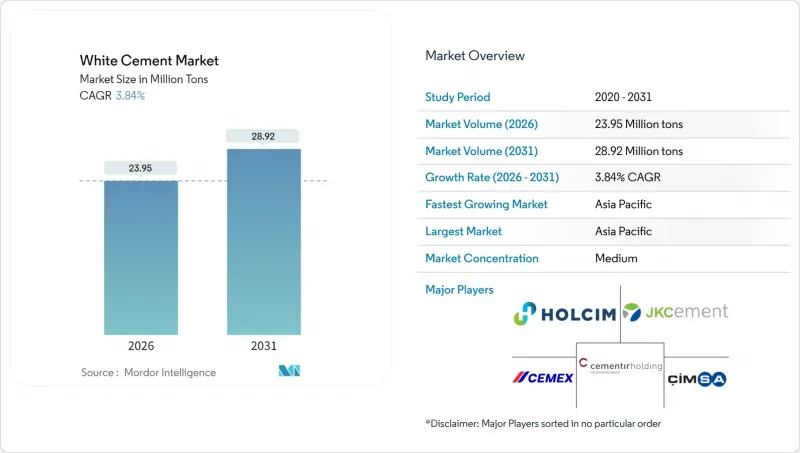
預計白水泥市場將從 2025 年的 2,306 萬噸成長到 2026 年的 2,395 萬噸,到 2031 年將達到 2,892 萬噸,2026 年至 2031 年的複合年成長率為 3.84%。
高階建築飾面、隔熱屋頂系統以及亞太和中東地區大型計劃的穩步推進,是推動需求成長的主要因素。高都市化、不斷成長的可支配收入以及日益嚴格的綠色建築標準,都進一步鞏固了白水泥市場的成長動能。擁有專用白水泥窯的生產商擁有定價權,因為這些窯爐需要低鐵原料,且生產過程能源密集,供應有限。競爭優勢體現在最佳化產能、管理合適的石灰石供應鏈以及創新配方技術,以滿足歷史建築修復和高性能結構的需求。
全球白水泥市場趨勢與洞察
裝飾和建築領域的需求快速成長
在人口密集的城市中,建築師偏好使用白色水泥,因為它外觀均勻淺淡,能夠有效區分高層住宅大樓和體驗式零售綜合體。不斷上漲的都市區地價推動了人們對視覺效果獨特的建築的需求,進而促使建築商對裸露的白色水泥產生需求,以降低外牆成本。此外,住宅對能夠提升房產價值的優質材料的需求,也進一步推動了水磨石地板和GRC板材等室內裝潢元素的發展。受印度大都會圈豪華住宅計劃需求的推動,JK水泥公司2024年的裝飾級產品銷售量激增。市政法規提倡使用高太陽反射率的表面,這與私營部門的美學目標不謀而合,使得裝飾性應用成為白色水泥市場需求的強勁驅動力。
亞太地區和中東的大型計劃
沙烏地阿拉伯的NEOM新城、印度的智慧城市計畫以及「一帶一路」示範計劃等旗艦計畫均指定使用白水泥建造火車站、航站樓、橋樑和文化設施。設計指南強調減少眩光、提升熱舒適度和持久的色彩穩定性—這些特性都得益於白水泥配方。阿拉伯聯合大公國已撥款152億美元用於2024年的公共基礎設施建設,其中相當一部分將用於機場候機廳和地鐵系統,這些設施需要淺色、耐污漬的飾面。為了緩解進口瓶頸,建築商傾向於與區域生產商簽訂長期供應協議,從而將白水泥市場的供應週期遠遠延長至典型的建築週期之外。這些大型企劃也制定了品質標準,指導後續的地方政府和城市發展,使未來的需求量增加一倍。
與普通水泥相比,生產成本和能源成本更高。
白水泥窯爐需要維持更高的燒製溫度,並且避免使用替代燃料來降低成本,因為這些燃料可能會影響顏色。水泥集團(Cementir Group)宣布,到2024年,能源成本將佔白水泥生產成本的35%,而灰水泥的比例為28%。在歐洲,碳定價加劇了這一劣勢,在電價上漲期間會進一步壓低營運利潤率。大型基礎設施項目的公共採購通常以最低競標為準,除非有熱性能或外觀方面的特殊要求,這限制了白水泥的普及。因此,短期盈利取決於對沖能源價格風險和最佳化餘熱回收系統。
細分市場分析
預計到2025年,I型水泥的產量將佔總產量的51.63%,年複合成長率達3.96%,鞏固了其作為裝飾性建築幕牆、水磨石和預製建築構件基準等級的地位。其優異的可加工性和均衡的抗壓強度簡化了施工管理,並可實現結構柱、牆板和室內抹灰等單一材料的應用。透過添加聚合物添加劑改進混合工藝,I型水泥的應用範圍已擴展至中等荷載橋面,蠶食了先前由II型水泥佔據的市場。 JK水泥等製造商於2024年推出了新型I型水泥混合料,在不影響流動性的前提下提高了早期強度,從而穩步鞏固了其市場領先地位。性能的持續提升增強了設計師的信心,並減少了替代材料的使用,進一步鞏固了I型水泥在白水泥市場的地位。
II型水泥適用於硫酸鹽耐受性、氯離子滲透性或高抗壓強度超過I型閾值的嚴苛環境。雖然II型水泥在白水泥市場中所佔佔有率較小,但在沿海工業廠、石化碼頭和海水淡化基礎設施等領域卻能獲得溢價。沙烏地阿拉伯NEOM計劃的管道文件描述了用於發電廠地基的客製化II型水泥混合料,顯示其需求雖小但穩定。 「其他」類別(包括修復級、超高性能和3D列印配方)在2024年實現了最高的成長率。然而,專利申請量年增25%,顯示特殊應用領域具有巨大的成長潛力,並可能在未來十年逐步重塑II型水泥的分類。
白水泥市場報告按類型(I型、II型、其他)、最終用途產業(商業、工業及公共、基礎設施、住宅)和地區(亞太、北美、歐洲、南美、中東和非洲)進行細分。市場預測以噸為單位。
區域分析
亞太地區將佔全球水泥消費量的近一半,到2025年將達到全球消費量的47.55%,預計到2031年將達到4.33%的最高區域複合年成長率。中國的水泥消費成長主要得益於高層建築的持續建設以及省級政府推行的屋頂隔熱措施。印度是僅次於中國的第二大水泥消費市場,其水泥消費正經歷快速成長,這主要得益於智慧城市投資和聯邦住宅計畫。越南和泰國等東南亞市場則受惠於飯店和零售業資本投資的擴張,以及東協地區水泥分銷物流成本的有利條件。
北美正經歷穩定但低調的成長,主要得益於維修和歷史建築保護工作。在美國,建築規範強制要求採用冷屋頂標準,推動了南部各州對白水泥的需求;而在加拿大,商業開發商正採用淺色外牆以滿足節能標準。墨西哥則利用跨國供應鏈在美國陽光地帶附近開發工業園區,確保供應穩定,不受匯率波動的影響。
在歐洲,建築保護、修復和高階建築飾面正日益受到青睞。能源成本和碳排放交易正在擠壓利潤空間,但可再生和高反射率材料的政策獎勵在一定程度上抵消了這種影響。中東和非洲地區雖然絕對噸位小規模,但得益於NEOM新城、利雅德地鐵延伸線和南非倉儲中心等旗艦計劃,正經歷著強勁的發展勢頭。極端氣候條件凸顯了熱反射率的優勢,推動政府在公共資產規範中採用白水泥。南美洲是一個新興但充滿潛力的地區,尤其是在巴西,房地產融資中的永續性標準正在推動高反射率建築幕牆的普及。阿根廷的商業辦公大樓維修正在用白水泥覆層改造20世紀70年代的建築,這凸顯了在宏觀經濟波動中,整個大陸都在向高階材料轉型。
其他福利:
- Excel格式的市場預測(ME)表
- 3個月的分析師支持
目錄
第1章 引言
- 研究假設和市場定義
- 調查範圍
第2章調查方法
第3章執行摘要
第4章 市場情勢
- 市場概覽
- 市場促進因素
- 裝飾和建築水泥的需求迅速成長
- 亞太地區、中東和非洲的大型計劃
- 炎熱氣候下對隔熱屋頂材料的需求
- 文物修復中的優質化
- 低碳白PLC
- 電子商務在DIY領域的滲透
- 市場限制
- 與普通水泥相比,生產成本和能源成本更高。
- 低鐵原料短缺
- 替代燃料和水泥外加劑的顏色限制
- 價值鏈分析
- 監管環境
- 波特五力模型
- 供應商的議價能力
- 買方的議價能力
- 新進入者的威脅
- 替代品的威脅
- 競爭對手之間的競爭
第5章 市場規模與成長預測
- 按類型
- 一型
- II 型
- 其他
- 按最終用途
- 商業的
- 工業和公共設施
- 基礎設施
- 住宅
- 按地區
- 亞太地區
- 中國
- 印度
- 日本
- 韓國
- 澳洲
- 印尼
- 泰國
- 越南
- 亞太其他地區
- 北美洲
- 美國
- 加拿大
- 墨西哥
- 歐洲
- 德國
- 法國
- 義大利
- 西班牙
- 英國
- 俄羅斯
- 其他歐洲地區
- 南美洲
- 巴西
- 阿根廷
- 其他南美洲
- 中東和非洲
- 沙烏地阿拉伯
- 阿拉伯聯合大公國
- 其他中東和非洲地區
- 亞太地區
第6章 競爭情勢
- 市場集中度
- 策略趨勢
- 市佔率(%)/排名分析
- 公司簡介
- Buzzi Unicem SpA
- Cementir Holding NV
- Cementos Portland Valderrivas
- CEMEX SAB de CV
- Cimsa Cimento
- Federal White Cement
- HOLCIM
- Jiangxi Yinshan White Cement Co., Ltd.
- JK Cement Ltd.
- OYAK Cimento
- Riyadh Cement Co.
- Royal White Cement, Inc.
- Saudi White Cement Co.
- SCG Cement-Building Materials
- UltraTech Cement Ltd.
第7章 市場機會與未來展望
第8章:CEO們需要思考的關鍵策略問題
The White Cement market is expected to grow from 23.06 million tons in 2025 to 23.95 million tons in 2026 and is forecast to reach 28.92 million tons by 2031 at 3.84% CAGR over 2026-2031.
Demand acceleration flows from premium architectural finishes, heat-reflective roofing systems, and a steady pipeline of infrastructure mega-projects across Asia-Pacific and the Middle East. High urbanization rates, rising disposable incomes, and stricter green-building codes collectively reinforce the growth path of the white cement market. Producers with dedicated white cement kilns enjoy pricing power because the product requires low-iron raw materials and operates under energy-intensive conditions that restrict supply. Competitive differentiation centers on capacity optimization, supply-chain control of suitable limestone, and formulation innovation aimed at meeting heritage-restoration and high-performance structural requirements.
Global White Cement Market Trends and Insights
Decorative and Architectural Construction Surge
Architects specify white cement to create uniform, light-toned facades that differentiate high-rise residential towers and experiential retail complexes in densely populated cities. Rising urban land prices intensify the need for visually distinctive buildings, pushing contractors toward exposed white concrete that eliminates cladding costs. Decorative interior elements such as terrazzo floors and GRC panels further magnify volume uptake, as homeowners pursue premium materials that elevate property value. JK Cement recorded a jump in decorative-grade sales in 2024, fueled by metropolitan India's luxury housing projects. Municipal regulations that promote higher solar-reflectance surfaces dovetail with private-sector aesthetic goals, making decorative usage a resilient demand pillar for the white cement market.
Infrastructure Mega-Projects in Asia-Pacific and Middle East
Flagship undertakings such as Saudi Arabia's NEOM city, India's Smart Cities Mission, and Belt and Road showcase projects specify white cement for stations, terminals, bridges, and cultural landmarks. Design guidelines emphasize glare reduction, thermal comfort, and enduring color stability-attributes amplified in white cement formulations. The UAE allocated USD 15.2 billion to public-sector infrastructure in 2024, channeling a sizable share toward airport concourses and metro systems that require bright, stain-resistant finishes. Contractors favor long-term supply agreements with regional producers to mitigate import bottlenecks, extending the visibility of the white cement market pipeline well beyond typical building cycles. These mega-projects also set quality benchmarks that govern subsequent provincial and municipal developments, multiplying forward demand.
High Production and Energy Costs Compared with Grey Cement
Specialized kilns for white cement maintain higher firing temperatures and reject cost-saving alternative fuels that might contaminate color. Cementir Group disclosed that energy accounted for 35% of its white cement production expenditure in 2024, compared to 28% for grey cement. Carbon-pricing schemes compound the disadvantage in Europe, pushing operating margins downward during periods of electricity inflation. Public procurement for large-scale infrastructure often awards contracts to the lowest bidder, limiting the adoption of white cement unless thermal or visual criteria require it. Short-term profitability, therefore, hinges on hedging energy exposure and optimizing waste-heat recovery systems.
Other drivers and restraints analyzed in the detailed report include:
- Heat-Reflective Roofing Demand in Hot Climates
- Heritage Restoration Premiumization
- Scarcity of Low-Iron Raw Materials
For complete list of drivers and restraints, kindly check the Table Of Contents.
Segment Analysis
Type I generated 51.63% of 2025 output and is forecast to accelerate at a 3.96% CAGR, underscoring its role as the baseline grade across ornamental facades, terrazzo, and architectural precast elements. High workability and balanced compressive-strength trajectories simplify contractor logistics, allowing a single inventory item to span structural columns, wall panels, and interior plasters. Upgrading mixes with polymeric additives has expanded their applicability to medium-load bridge decks, encroaching on the territory once held by Type II. Manufacturers such as JK Cement introduced a new Type I blend in 2024, demonstrating higher early strength without sacrificing flow properties, marking an iterative progression that maintains market leadership. Continuous performance gains reinforce specifier confidence and discourage substitution, cementing Type I's franchise in the white cement market.
Type II addresses aggressive environments where sulfate resistance, chloride permeability, or elevated compressive strength surpass Type I thresholds. Though representing a smaller slice of the white cement market, Type II secures premium pricing from coastal industrial plants, petrochemical docks, and desalination infrastructure. Pipeline documents for Saudi Arabia's NEOM include tailored Type II mixes for power-block foundations, indicating niche but sticky demand. The "Others" category, encompassing restoration-grade, ultra-high-performance, and 3D-printing formulations, logged the fastest percentage growth in 2024. Nevertheless, patent activity surged 25% year-over-year, suggesting a long runway for specialized applications that could incrementally reshape type segmentation over the next decade.
The White Cement Market Report is Segmented by Type (Type I, Type II, and Others), End-Use Sector (Commercial, Industrial and Institutional, Infrastructure, and Residential), and Geography (Asia-Pacific, North America, Europe, South America, and Middle-East and Africa). The Market Forecasts are Provided in Terms of Volume (Tons).
Geography Analysis
The Asia-Pacific region anchors nearly half of the global volume, reflecting a 47.55% share in 2025 and delivering the top regional CAGR of 4.33% through 2031. China's consumption is driven by continuous high-rise construction and provincial mandates on cool roofing. India trails but grows faster due to smart city investments and federal housing programs; Southeast Asian markets, such as Vietnam and Thailand, ride the upcycle in hospitality and retail capital expenditures, aided by favorable logistics costs for intra-ASEAN cement flows.
North America contributes steady, if less spectacular, gains, concentrated in renovation and heritage-preservation activities. U.S. building codes referencing cool-roof standards bolster demand for white cement in southern states, while Canadian commercial developers adopt light-colored facades for energy code compliance. Mexico taps cross-border supply chains to fuel industrial parks near the U.S. Sun Belt, ensuring stable inflows despite currency volatility.
Europe emphasizes conservation and premium architectural veneers. Energy costs and carbon trading pinch margins, yet policy incentives for recyclable, high-albedo materials provide partial offsets. The Middle East and Africa, though smaller in absolute tonnage, display robust momentum linked to flagship projects such as NEOM, Riyadh metro extensions, and South African warehouse hubs. Extreme climate amplifies thermal-reflectance advantages, nudging government specifications toward white cement for public-domain assets. South America remains nascent but promising, especially in Brazil where sustainability criteria in real-estate financing encourage the adoption of high-reflectance facades. Argentina's commercial-office refurbishments also integrate white cement cladding to modernize 1970s-era buildings, highlighting a continental shift toward premium materials even amid macroeconomic flux.
- Buzzi Unicem S.p.A.
- Cementir Holding N.V.
- Cementos Portland Valderrivas
- CEMEX S.A.B. de C.V.
- Cimsa Cimento
- Federal White Cement
- HOLCIM
- Jiangxi Yinshan White Cement Co., Ltd.
- JK Cement Ltd.
- OYAK Cimento
- Riyadh Cement Co.
- Royal White Cement, Inc.
- Saudi White Cement Co.
- SCG Cement-Building Materials
- UltraTech Cement Ltd.
Additional Benefits:
- The market estimate (ME) sheet in Excel format
- 3 months of analyst support
TABLE OF CONTENTS
1 Introduction
- 1.1 Study Assumptions and Market Definition
- 1.2 Scope of the Study
2 Research Methodology
3 Executive Summary
4 Market Landscape
- 4.1 Market Overview
- 4.2 Market Drivers
- 4.2.1 Decorative and architectural construction surge
- 4.2.2 Infrastructure mega-projects in the Asia-Pacific and the Middle East, and African countries
- 4.2.3 Heat-reflective roofing demand in hot climates
- 4.2.4 Heritage restoration premiumization
- 4.2.5 Low-carbon white PLC adoption
- 4.2.6 E-commerce penetration in DIY segment
- 4.3 Market Restraints
- 4.3.1 High production and energy costs compared to grey cement
- 4.3.2 Scarcity of low-iron raw materials
- 4.3.3 Colour constraints on alternative fuels and SCMs
- 4.4 Value Chain Analysis
- 4.5 Regulatory Landscape
- 4.6 Porter's Five Forces
- 4.6.1 Bargaining Power of Suppliers
- 4.6.2 Bargaining Power of Buyers
- 4.6.3 Threat of New Entrants
- 4.6.4 Threat of Substitutes
- 4.6.5 Competitive Rivalry
5 Market Size and Growth Forecasts (Volume)
- 5.1 By Type
- 5.1.1 Type I
- 5.1.2 Type II
- 5.1.3 Others
- 5.2 By End-Use Sector
- 5.2.1 Commercial
- 5.2.2 Industrial and Institutional
- 5.2.3 Infrastructure
- 5.2.4 Residential
- 5.3 By Geography
- 5.3.1 Asia-Pacific
- 5.3.1.1 China
- 5.3.1.2 India
- 5.3.1.3 Japan
- 5.3.1.4 South Korea
- 5.3.1.5 Australia
- 5.3.1.6 Indonesia
- 5.3.1.7 Thailand
- 5.3.1.8 Vietnam
- 5.3.1.9 Rest of Asia-Pacific
- 5.3.2 North America
- 5.3.2.1 United States
- 5.3.2.2 Canada
- 5.3.2.3 Mexico
- 5.3.3 Europe
- 5.3.3.1 Germany
- 5.3.3.2 France
- 5.3.3.3 Italy
- 5.3.3.4 Spain
- 5.3.3.5 United Kingdom
- 5.3.3.6 Russia
- 5.3.3.7 Rest of Europe
- 5.3.4 South America
- 5.3.4.1 Brazil
- 5.3.4.2 Argentina
- 5.3.4.3 Rest of South America
- 5.3.5 Middle-East and Africa
- 5.3.5.1 Saudi Arabia
- 5.3.5.2 United Arab Emirates
- 5.3.5.3 Rest of Middle-East and Africa
- 5.3.1 Asia-Pacific
6 Competitive Landscape
- 6.1 Market Concentration
- 6.2 Strategic Moves
- 6.3 Market Share(%)/Ranking Analysis
- 6.4 Company Profiles (includes Global level Overview, Market level overview, Core Segments, Financials as available, Strategic Information, Market Rank/Share for key companies, Products and Services, and Recent Developments)
- 6.4.1 Buzzi Unicem S.p.A.
- 6.4.2 Cementir Holding N.V.
- 6.4.3 Cementos Portland Valderrivas
- 6.4.4 CEMEX S.A.B. de C.V.
- 6.4.5 Cimsa Cimento
- 6.4.6 Federal White Cement
- 6.4.7 HOLCIM
- 6.4.8 Jiangxi Yinshan White Cement Co., Ltd.
- 6.4.9 JK Cement Ltd.
- 6.4.10 OYAK Cimento
- 6.4.11 Riyadh Cement Co.
- 6.4.12 Royal White Cement, Inc.
- 6.4.13 Saudi White Cement Co.
- 6.4.14 SCG Cement-Building Materials
- 6.4.15 UltraTech Cement Ltd.
7 Market Opportunities and Future Outlook
- 7.1 White-space and Unmet-need Assessment
8 Key Strategic Questions for Cement CEOs

 白色水泥市場:依產品類型、製造流程、應用、最終用戶和銷售管道-全球預測,2026-2032年
 白色水泥市場規模、佔有率、趨勢和預測:按類型、應用和地區分類(2026-2034年)
 白水泥市場-全球產業規模、佔有率、趨勢、機會、預測:按類型、包裝規格、最終用戶、地區和競爭格局分類,2021-2031年
 亞太地區白水泥:市佔率分析、產業趨勢與統計、成長預測(2026-2031年)
 全球白水泥市場規模、佔有率、趨勢和成長分析報告(2026-2034年)日本白水泥市場規模、佔有率、趨勢和預測:按類型、應用和地區分類,2026-2034年
 2026年全球白水泥市場報告
 白水泥市場機會、成長動力、產業趨勢分析及2025-2034年預測
 白水泥市場規模、佔有率、趨勢分析報告:按產品、按應用、按地區、細分市場預測,2025-2030