


 |
市場調查報告書
商品編碼
1939152
熱感噴塗:市場佔有率分析、產業趨勢與統計、成長預測(2026-2031)Thermal Spray - Market Share Analysis, Industry Trends & Statistics, Growth Forecasts (2026 - 2031) |
||||||

※ 本網頁內容可能與最新版本有所差異。詳細情況請與我們聯繫。
熱感噴塗市場預計將從 2025 年的 118.7 億美元成長到 2026 年的 123.6 億美元,預計到 2031 年將達到 151.5 億美元,2026 年至 2031 年的複合年成長率為 4.15%。
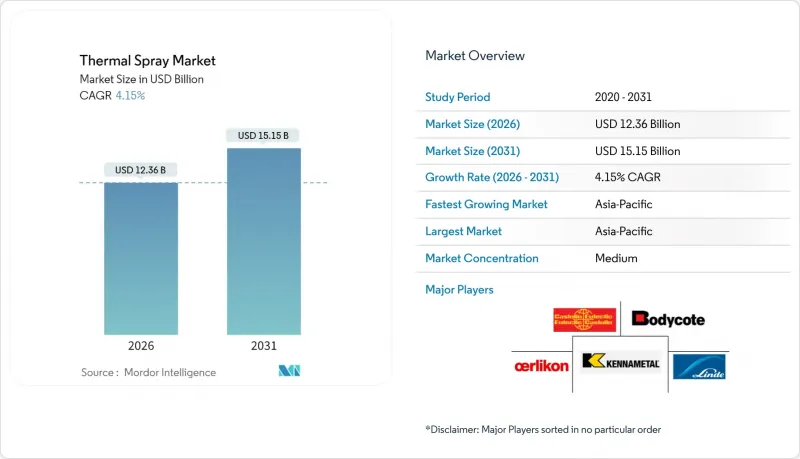
隨著航太、醫療設備和新一代汽車製造商用高性能塗層取代傳統的表面處理流程,延長零件壽命並改善溫度控管,市場對高性能塗層的需求正在成長。對自動化設備和即時製程監控的投資持續緩解著技術純熟勞工短缺的問題,而向電動噴塗技術的轉變也恰逢其時,滿足了日益嚴格的環境法規的要求。亞太地區的製造地正在迅速擴張,推動了該地區對電子產品和電動動力傳動系統總成部件用塗層材料和承包噴塗單元的需求。
全球熱感噴塗市場趨勢及展望
熱感噴塗羥基磷灰石塗層在整形外科和人工植牙中的應用日益廣泛
熱感噴塗羥基磷灰石塗層能顯著促進骨骼生長並降低排異率,使其成為承重整形外科螺絲、人工髖關節柄和牙科植入物的理想表面處理材料。製程控制能夠設計出與鬆質骨形態相符的微孔結構,加速骨整合並縮短復原時間。該技術已獲得美國FDA II類醫療設備和CE核准,並被全球植入製造商迅速採用。隨著美國、德國和日本人口老化,外科手術數量持續成長,對磷酸鈣粉末的原料需求也隨之增加。設備供應商目前提供封閉回路型機器人與在線連續厚度計相結合的解決方案,以確保塗層的可重複性並解決外科醫生對塗層剝離的擔憂。隨著醫院對感染指標的監測日益密切,羥基磷灰石表面的生物活性特性帶來了更多臨床益處,推動熱感噴塗市場穩定成長。
旋轉設備和液壓桿中硬鉻鍍層的替代品
REACH 和 OSHA 關於六價鉻的法規日益嚴格,迫使原始設備製造商 (OEM) 尋求替代技術,高速火焰噴塗 (HVOF) 塗層成為一種永續的替代方案。 HVOF 塗層通常可達到 60 HRC 以上的硬度,同時將孔隙率降低到 1% 以下,使液壓軸和壓縮機葉輪的使用壽命延長一倍以上。維護成本的降低意味著製程工業停機成本的降低,從而增強了整體擁有成本 (TCO) 優勢,推動了熱感噴塗市場的普及。自動化臂架機械手使 HVOF 能夠在難以觸及的孔洞中進行噴塗,從而擴大了適用部件的範圍。北美一家油氣鑽井船隊的初步改造計畫表明,投資回收期不到 18 個月,這促使亞洲鑄造廠廣泛採用該技術。隨著 ESG審核收緊供應鏈評估標準,從鍍鉻槽轉向無溶劑噴塗室可立即帶來減少排放的益處。
推出高硬度三價鉻塗層,只需少量資本投入即可實現。
新一代三價鉻鍍液僅需入門級高速火焰噴塗(HVOF)單元三分之一的投資即可達到50 HRC的硬度,對於成本敏感型市場的小規模液壓桿修復商提案,極具吸引力。供應商強調其與現有工具的兼容性,無需新建通風和除塵系統。早期現場測試結果證實,對於運作低於200°C的齒輪軸,其耐腐蝕性良好,這抑制了這些細分市場近期對熱感噴塗替代方案的需求。然而,三價鉻難以應用於厚塗層,且不能應用於暴露於燃燒氣體的零件。因此,它仍然主要作為航太和油氣泵領域的熱隔離層和耐磨覆蓋層。所以,這項技術更被視為一種選擇性阻礙因素,而非普遍威脅。
細分市場分析
預計到 2031 年,設備類別將以 6.06% 的複合年成長率成長,超過塗料的成長速度。塗料在 2025 年佔據了整個熱感噴塗市場 76.82% 的佔有率。配備六軸機器人和封閉回路型流量控制的自動化單元可將塗層之間的差異降低到 2µm 以下,這是渦輪機 OEM 為實現零計劃外停機時間而設定的要求。
粉末和絲材的持續收入仍然至關重要,因為每沉積一公斤都會對更換噴嘴和等離子電極產生阻力。碳化鎢鈷粉末仍然是耐磨配方中的主流,但供不應求和價格波動促使人們更加關注能夠延長噴嘴壽命的工藝配方和過噴回收技術。供應商目前正在推廣模組化送料裝置,這些裝置可以在10分鐘內完成細顆粒和粗顆粒之間的切換,從而提高工廠的柔軟性。降噪室和旋風除塵器正經歷兩位數的成長率,這創造了一個輔助但盈利的細分市場,符合德國和韓國的工廠安全法規。
熱感噴塗市場報告按產品類型(塗層、材料、熱感噴塗設備)、熱感噴塗塗層和表面處理方式(燃燒能和電能)、終端用戶行業(航太、工業燃氣渦輪機、汽車、電子、石油天然氣等)以及地區(亞太、北美、歐洲、南美、中東和非洲)進行細分。市場預測以美元計價。
區域分析
預計到2025年,亞太地區將佔熱感噴塗市場34.20%的佔有率,年複合成長率達4.98%。這反映了中國半導體工廠的積極回流以及日本先進電池工廠的擴張。區域各國政府正在補貼智慧機械的進口,降低了採用自動化噴塗室的門檻。然而,技術純熟勞工短缺問題依然存在,促使原始設備製造商(OEM)與印度和馬來西亞的職業培訓機構合作,這些機構提供基於ISO 14924標準的操作員認證。
北美和歐洲現有的飛機機隊和嚴格的職業安全準則為無鉻塗層的應用提供了支援。美國仍然是碳化鎢粉末的最大單一買家,而德國則是電漿炬出口的主導。這兩個地區都在加大對耐氫塗層研發的投入。
儘管南美和中東及非洲地區的絕對收入落後於其他地區,但與石化工廠升級和礦山輸送機維修相關的設備訂單正穩步成長,增速達兩位數。因此,儘管每個地區的市場發展都受到不同終端市場促進因素的影響,但全球熱感噴塗市場正朝著數位化、環保型表面處理解決方案的通用方向發展。
其他福利:
- Excel格式的市場預測(ME)表
- 3個月的分析師支持
目錄
第1章 引言
- 研究假設和市場定義
- 調查範圍
第2章調查方法
第3章執行摘要
第4章 市場情勢
- 市場概覽
- 市場促進因素
- 熱感噴塗羥基磷灰石塗層在整形外科和牙科植入中的應用日益廣泛
- 旋轉設備和液壓桿中硬鉻鍍層的替代品
- 新一代窄體飛機引擎對耐高溫、輕質合金的需求
- 汽車產業向氫燃料內燃機和電動動力傳動系統的轉型,正在推動對耐磨氣缸塗層的需求。
- 用於極端地熱和太空應用的高熵合金(HEA)塗層
- 市場限制
- 低成本投資的興起導致硬質三價鉻電鍍成本上升
- 亞洲和拉丁美洲合約加工商的工藝可重複性和熟練勞動力短缺問題
- 重要原料(碳化鎢、鈷、稀土元素氧化物)的價格波動風險與供應風險
- 價值鏈分析
- 波特五力模型
- 供應商的議價能力
- 買方的議價能力
- 新進入者的威脅
- 替代品的威脅
- 競爭程度
第5章 市場規模與成長預測
- 依產品類型
- 塗層
- 材料
- 塗層材料
- 粉末
- 陶瓷
- 金屬
- 聚合物和其他粉末
- 線材/桿
- 其他塗層材料
- 粉末
- 補充資料(輔助資料)
- 塗層材料
- 熱感噴塗設備
- 熱感噴塗系統
- 除塵器
- 噴槍和噴嘴
- 送料設備
- 備用零件
- 隔音罩
- 其他熱感噴塗設備
- 熱感噴塗塗層和表面處理
- 燃燒
- 電能
- 按最終用戶行業分類
- 航太
- 工業用燃氣渦輪機
- 車
- 電子設備
- 石油和天然氣
- 醫療設備
- 能源與電力
- 其他終端用戶產業
- 按地區
- 亞太地區
- 中國
- 印度
- 日本
- 韓國
- 馬來西亞
- 泰國
- 印尼
- 越南
- 亞太其他地區
- 北美洲
- 美國
- 加拿大
- 墨西哥
- 歐洲
- 德國
- 英國
- 法國
- 義大利
- 西班牙
- 北歐國家
- 土耳其
- 俄羅斯
- 其他歐洲地區
- 南美洲
- 巴西
- 阿根廷
- 哥倫比亞
- 南美洲其他地區
- 中東和非洲
- 沙烏地阿拉伯
- 卡達
- 阿拉伯聯合大公國
- 奈及利亞
- 埃及
- 南非
- 其他中東和非洲地區
- 亞太地區
第6章 競爭情勢
- 市場集中度
- 策略趨勢
- 市佔率(%)/排名分析
- 公司簡介
- Thermal Spray Coatings Companies
- APS Materials, Inc.
- ASB Industries Inc
- BODYCOTE
- CHROMALLOY GAS TURBINE LLC
- Curtiss-Wright Corporation
- Fisher Barton
- FM Industries
- Lincotek Trento SpA
- Linde PLC
- OC Oerlikon Management AG
- Thermion
- TOCALO Co., Ltd.
- Thermal Spray Equipment Companies
- Aimtek, Inc.
- Air Products and Chemicals, Inc.
- Arzell, Inc.
- Camfil
- Castolin Eutectic
- CenterLine(Windsor)Limited
- Donaldson Company, Inc.
- Flame Spray Technologies BV
- GTV VerschleiBschutz GmbH
- HAI Inc
- Hannecard Roller Coatings, Inc.-ASB Industries
- Imperial Systems, Inc.
- Kennametal Inc
- Lincoteck Equipment SPA
- Linde PLC
- Metalizing Equipment Co Pvt Ltd
- Metallisation Limited
- OC Oerlikon Management AG
- Powder Feed Dynamics, Inc
- Progressive Surface
- Saint-Gobain
- Surface Technology Services BV
- Thermion
- Thermal Spray Materials Companies
- AIM MRO Holdings, LLC.
- Aimtek, Inc.
- AlSher APM, LLC
- AMETEK, Inc.
- C&M Technologies GmbH
- Castolin Eutectic
- CenterLine(Windsor)Limited
- Elmet Technologies
- Fisher Barton
- Global Tungsten & Powders
- HAI Inc
- Hoganas AB
- Hunter Chemical, LLC
- Kennametal Inc
- Linde PLC
- LSN Diffusion Limited
- Metallisation Limited
- Metallizing Equipment Co. Pvt. Ltd
- OC Oerlikon Management AG
- Polymet
- Powder Alloy Corporation
- Saint-Gobain
- Sandvik AB
- Thermion
- Thermal Spray Coatings Companies
第7章 市場機會與未來展望
The Thermal Spray market is expected to grow from USD 11.87 billion in 2025 to USD 12.36 billion in 2026 and is forecast to reach USD 15.15 billion by 2031 at 4.15% CAGR over 2026-2031.
Demand is rising as aerospace, medical-device, and next-generation automotive manufacturers replace legacy surface treatments with high-performance coatings that extend part life and improve thermal management. Investments in automated equipment and real-time process monitoring continue to ease skilled-labor constraints, while the shift to electric energy spray techniques aligns with tightening environmental regulations. The Asia-Pacific manufacturing base is expanding rapidly, driving regional consumption of both coating materials and turnkey spray cells aimed at electronics and e-powertrain components.
Global Thermal Spray Market Trends and Insights
Increasing Use of Thermally-Sprayed Hydroxyapatite Coatings in Orthopedic and Dental Implants
Thermally-sprayed hydroxyapatite coatings significantly improve bone ingrowth and reduce rejection rates, making them the preferred surface finish for load-bearing orthopedic screws, hip stems, and dental fixtures. Process control enables tailored porosity that matches cancellous bone morphology, accelerating osseointegration and shortening rehabilitation periods. Regulatory acceptance under U.S. FDA class II devices and CE marking frameworks supports rapid adoption among global implant makers. Growing geriatric populations in the United States, Germany, and Japan keep procedural volumes expanding, sustaining raw-material demand for calcium-phosphate powders. Equipment suppliers now bundle closed-loop robots and inline thickness gauges that assure repeatability, addressing surgeon concerns regarding coating delamination. As hospitals track infection metrics more closely, the bioactive nature of hydroxyapatite surfaces provides an additional clinical advantage that keeps the thermal spray market on a steady upswing.
Replacement of Hard-Chrome Plating in Rotating Equipment and Hydraulic Rods
Tightening REACH and OSHA rules on hexavalent chromium have forced OEMs to seek alternatives, positioning high-velocity oxygen fuel (HVOF) coatings as the sustainable successor. HVOF layers routinely exceed 60 HRC hardness while slashing porosity below 1%, more than doubling component lifetimes for hydraulic shafts and compressor impellers. Reduced maintenance translates into lower down-time costs for process industries, bolstering the total cost-of-ownership argument in favor of thermal spray market adoption. Automated boom manipulators now apply HVOF inside hard-to-reach bores, extending the addressable part universe. Early conversion programs in North American oil-and-gas drill fleets demonstrated payback periods under 18 months, spurring wider replication in Asian foundries. As ESG auditors tighten supply-chain scorecards, the switch from chrome baths to solvent-free spray booths provides an immediate emissions win.
Emergence of Hard Trivalent Chrome Coatings with Lower CAPEX
Next-generation trivalent chrome baths provide 50 HRC hardness at investment levels one-third those of an entry-level HVOF cell, a value proposition that appeals to small hydraulic-rod refurbishers in cost-sensitive markets. Suppliers emphasize drop-in compatibility with existing fixtures, eliminating the need for new ventilation or dust-collection systems. Early field results confirm acceptable corrosion resistance for gear shafts operating below 200 °C, blunting near-term replacements by the thermal spray market in those niches. However, trivalent chrome struggles at higher thicknesses and cannot serve components exposed to combustion gases, which preserves the advantage for thermal barrier and wear-resistant overlays in aerospace as well as oil-and-gas pumps. The technology therefore acts as a selective restraint rather than a universal threat.
Other drivers and restraints analyzed in the detailed report include:
- Demand for High-Temperature Lightweight Alloys in Next-Gen Narrow-Body Aircraft Engines
- Automotive Shift Toward Hydrogen ICE and E-Powertrains Requiring Wear-Resistant Cylinder Coatings
- Process Repeatability and Skilled-Operator Shortage in Asia and Latin America Job-Shops
For complete list of drivers and restraints, kindly check the Table Of Contents.
Segment Analysis
The equipment category is projected to expand at a 6.06% CAGR through 2031, surpassing consumables in growth momentum even though coatings retained a 76.82% share of the overall thermal spray market in 2025. Automated cells equipped with six-axis robots and closed-loop mass-flow control reduce coat-to-coat variance below 2 µm, a requirement set by turbine OEMs aiming for zero unplanned downtime.
Recurring revenues from powders and wires remain pivotal, as every kilogram deposited creates a pull-through effect for replacement nozzles and plasma electrodes. Tungsten carbide-cobalt powders continue to dominate wear-protection formulas, but scarcity and price volatility have sparked process recipes that extend tip life or recycle overspray. Suppliers now promote modular feeder units that switch between fine and coarse fractions in under 10 minutes, enhancing shop flexibility. Noise-attenuating booths and cyclone-based dust collectors clock double-digit growth rates, an ancillary but lucrative niche aligned with factory-safety mandates in Germany and South Korea.
The Thermal Spray Report is Segmented by Product Type (Coatings, Materials, and Thermal-Spray Equipment), Thermal Spray Coatings and Finishes (Combustion and Electric Energy), End-User Industry (Aerospace, Industrial Gas Turbines, Automotive, Electronics, Oil and Gas, and More), and Geography (Asia-Pacific, North America, Europe, South America, and Middle-East and Africa). The Market Forecasts are Provided in Terms of Value (USD).
Geography Analysis
Asia-Pacific contributed 34.20% of the thermal spray market in 2025 and is forecast to climb at a 4.98% CAGR, reflecting aggressive onshoring of semiconductor fabs in China and advanced battery plants in Japan. Regional governments channel subsidies into smart-machinery imports, lowering payback barriers for automated spray booths. Still, the skilled-labor gap persists, pushing OEMs to partner with vocational institutes in India and Malaysia that offer operator certification under ISO 14924 standards.
North America and Europe are underpinned by legacy aerospace fleets and strict occupational safety guidelines favoring chrome-free overlays. The United States remains the largest single-country buyer of tungsten carbide powders, while Germany leads in plasma-torch exports. Both regions invest in research and development focused on hydrogen-compatible coatings.
South America and the Middle East and Africa trail in absolute revenues but post steady double-digit equipment orders linked to petrochemical plant upgrades and mining conveyor refurbishments. Each geography therefore plays to distinct end-market triggers, yet converges on a common trajectory of digitalized and environmentally compliant surface-engineering solutions within the global thermal spray market.
- Thermal Spray Coatings Companies
- Thermal Spray Equipment Companies
- Thermal Spray Materials Companies
Additional Benefits:
- The market estimate (ME) sheet in Excel format
- 3 months of analyst support
TABLE OF CONTENTS
1 Introduction
- 1.1 Study Assumptions and Market Definition
- 1.2 Scope of the Study
2 Research Methodology
3 Executive Summary
4 Market Landscape
- 4.1 Market Overview
- 4.2 Market Drivers
- 4.2.1 Increasing use of thermally-sprayed hydroxyapatite coatings in orthopedic and dental implants
- 4.2.2 Replacement of hard-chrome plating in rotating equipment and hydraulic rods
- 4.2.3 Demand for high-temperature lightweight alloys in next-gen narrow-body aircraft engines
- 4.2.4 Automotive shift toward hydrogen ICE and e-powertrains requiring wear-resistant cylinder coatings
- 4.2.5 Adoption of high-entropy alloy (HEA) coatings for extreme geothermal and space applications
- 4.3 Market Restraints
- 4.3.1 Emergence of hard trivalent chrome coatings with lower CAPEX
- 4.3.2 Process repeatability and skilled-operator shortage in Asia and LATAM job-shops
- 4.3.3 Volatile pricing and supply risk for critical feedstocks (WC-Co, rare-earth oxides)
- 4.4 Value Chain Analysis
- 4.5 Porter's Five Forces
- 4.5.1 Bargaining Power of Suppliers
- 4.5.2 Bargaining Power of Buyers
- 4.5.3 Threat of New Entrants
- 4.5.4 Threat of Substitute Products
- 4.5.5 Degree of Competition
5 Market Size and Growth Forecasts (Value)
- 5.1 By Product Type
- 5.1.1 Coatings
- 5.1.2 Materials
- 5.1.2.1 Coating Materials
- 5.1.2.1.1 Powders
- 5.1.2.1.1.1 Ceramics
- 5.1.2.1.1.2 Metals
- 5.1.2.1.1.3 Polymers and Other Powders
- 5.1.2.1.2 Wires/Rods
- 5.1.2.1.3 Other Coating Materials
- 5.1.2.1.1 Powders
- 5.1.2.2 Supplementary Materials (Auxiliary Material)
- 5.1.2.1 Coating Materials
- 5.1.3 Thermal-Spray Equipment
- 5.1.3.1 Thermal Spray Coating Systems
- 5.1.3.2 Dust Collection Equipment
- 5.1.3.3 Spray Guns and Nozzles
- 5.1.3.4 Feeder Equipment
- 5.1.3.5 Spare Parts
- 5.1.3.6 Noise-reducing Enclosures
- 5.1.3.7 Other Thermal Spray Equipment
- 5.2 By Thermal Spray Coatings and Finishes
- 5.2.1 Combustion
- 5.2.2 Electric Energy
- 5.3 By End-user Industry
- 5.3.1 Aerospace
- 5.3.2 Industrial Gas Turbines
- 5.3.3 Automotive
- 5.3.4 Electronics
- 5.3.5 Oil and Gas
- 5.3.6 Medical Devices
- 5.3.7 Energy and Power
- 5.3.8 Other End-user Industries
- 5.4 By Geography
- 5.4.1 Asia-Pacific
- 5.4.1.1 China
- 5.4.1.2 India
- 5.4.1.3 Japan
- 5.4.1.4 South Korea
- 5.4.1.5 Malaysia
- 5.4.1.6 Thailand
- 5.4.1.7 Indonesia
- 5.4.1.8 Vietnam
- 5.4.1.9 Rest of Asia-Pacific
- 5.4.2 North America
- 5.4.2.1 United States
- 5.4.2.2 Canada
- 5.4.2.3 Mexico
- 5.4.3 Europe
- 5.4.3.1 Germany
- 5.4.3.2 United Kingdom
- 5.4.3.3 France
- 5.4.3.4 Italy
- 5.4.3.5 Spain
- 5.4.3.6 NORDIC Countries
- 5.4.3.7 Turkey
- 5.4.3.8 Russia
- 5.4.3.9 Rest of Europe
- 5.4.4 South America
- 5.4.4.1 Brazil
- 5.4.4.2 Argentina
- 5.4.4.3 Colombia
- 5.4.4.4 Rest of South America
- 5.4.5 Middle-East and Africa
- 5.4.5.1 Saudi Arabia
- 5.4.5.2 Qatar
- 5.4.5.3 United Arab Emirates
- 5.4.5.4 Nigeria
- 5.4.5.5 Egypt
- 5.4.5.6 South Africa
- 5.4.5.7 Rest of Middle-East and Africa
- 5.4.1 Asia-Pacific
6 Competitive Landscape
- 6.1 Market Concentration
- 6.2 Strategic Moves
- 6.3 Market Share (%)/Ranking Analysis
- 6.4 Company Profiles (includes Global level Overview, Market level overview, Core Segments, Financials as available, Strategic Information, Market Rank/Share, Products and Services, Recent Developments)
- 6.4.1 Thermal Spray Coatings Companies
- 6.4.1.1 APS Materials, Inc.
- 6.4.1.2 ASB Industries Inc
- 6.4.1.3 BODYCOTE
- 6.4.1.4 CHROMALLOY GAS TURBINE LLC
- 6.4.1.5 Curtiss-Wright Corporation
- 6.4.1.6 Fisher Barton
- 6.4.1.7 FM Industries
- 6.4.1.8 Lincotek Trento S.p.A.
- 6.4.1.9 Linde PLC
- 6.4.1.10 OC Oerlikon Management AG
- 6.4.1.11 Thermion
- 6.4.1.12 TOCALO Co., Ltd.
- 6.4.2 Thermal Spray Equipment Companies
- 6.4.2.1 Aimtek, Inc.
- 6.4.2.2 Air Products and Chemicals, Inc.
- 6.4.2.3 Arzell, Inc.
- 6.4.2.4 Camfil
- 6.4.2.5 Castolin Eutectic
- 6.4.2.6 CenterLine (Windsor) Limited
- 6.4.2.7 Donaldson Company, Inc.
- 6.4.2.8 Flame Spray Technologies B.V.
- 6.4.2.9 GTV VerschleiBschutz GmbH
- 6.4.2.10 HAI Inc
- 6.4.2.11 Hannecard Roller Coatings, Inc. - ASB Industries
- 6.4.2.12 Imperial Systems, Inc.
- 6.4.2.13 Kennametal Inc
- 6.4.2.14 Lincoteck Equipment SPA
- 6.4.2.15 Linde PLC
- 6.4.2.16 Metalizing Equipment Co Pvt Ltd
- 6.4.2.17 Metallisation Limited
- 6.4.2.18 OC Oerlikon Management AG
- 6.4.2.19 Powder Feed Dynamics, Inc
- 6.4.2.20 Progressive Surface
- 6.4.2.21 Saint-Gobain
- 6.4.2.22 Surface Technology Services BV
- 6.4.2.23 Thermion
- 6.4.3 Thermal Spray Materials Companies
- 6.4.3.1 AIM MRO Holdings, LLC.
- 6.4.3.2 Aimtek, Inc.
- 6.4.3.3 AlSher APM, LLC
- 6.4.3.4 AMETEK, Inc.
- 6.4.3.5 C&M Technologies GmbH
- 6.4.3.6 Castolin Eutectic
- 6.4.3.7 CenterLine (Windsor) Limited
- 6.4.3.8 Elmet Technologies
- 6.4.3.9 Fisher Barton
- 6.4.3.10 Global Tungsten & Powders
- 6.4.3.11 HAI Inc
- 6.4.3.12 Hoganas AB
- 6.4.3.13 Hunter Chemical, LLC
- 6.4.3.14 Kennametal Inc
- 6.4.3.15 Linde PLC
- 6.4.3.16 LSN Diffusion Limited
- 6.4.3.17 Metallisation Limited
- 6.4.3.18 Metallizing Equipment Co. Pvt. Ltd
- 6.4.3.19 OC Oerlikon Management AG
- 6.4.3.20 Polymet
- 6.4.3.21 Powder Alloy Corporation
- 6.4.3.22 Saint -Gobain
- 6.4.3.23 Sandvik AB
- 6.4.3.24 Thermion
- 6.4.1 Thermal Spray Coatings Companies
7 Market Opportunities and Future Outlook
- 7.1 White-space and Unmet-Need Assessment

 熱噴塗用鉬絲市場:全球市場預測,2026-2032年熱噴塗設備市場:全球市場預測,2026-2032年
 熱噴塗服務市場:商業機會、成長要素、產業趨勢分析及 2026-2035 年預測。
 歐洲熱噴塗市場:市場佔有率分析、產業趨勢與統計、成長預測(2026-2031年)熱噴塗設備市場商機、成長要素、產業趨勢分析及2026-2034年預測。基於氧化釔的等離子噴塗粉末市場:按產品類型、製程類型、氧化釔含量範圍、塗層厚度和最終用途產業分類,全球預測(2026-2032年)
 2026年全球熱感噴塗市場報告熱噴塗設備:市場佔有率分析、產業趨勢與統計、成長預測(2025-2030 年)熱噴塗材料:市場佔有率分析、行業趨勢和統計、成長預測(2025-2030 年)
 全球熱噴塗材料市場(2024-2028)