


 |
市場調查報告書
商品編碼
1939108
農業灌溉設備:市場佔有率分析、產業趨勢與統計、成長預測(2026-2031)Agricultural Irrigation Machinery - Market Share Analysis, Industry Trends & Statistics, Growth Forecasts (2026 - 2031) |
||||||

※ 本網頁內容可能與最新版本有所差異。詳細情況請與我們聯繫。
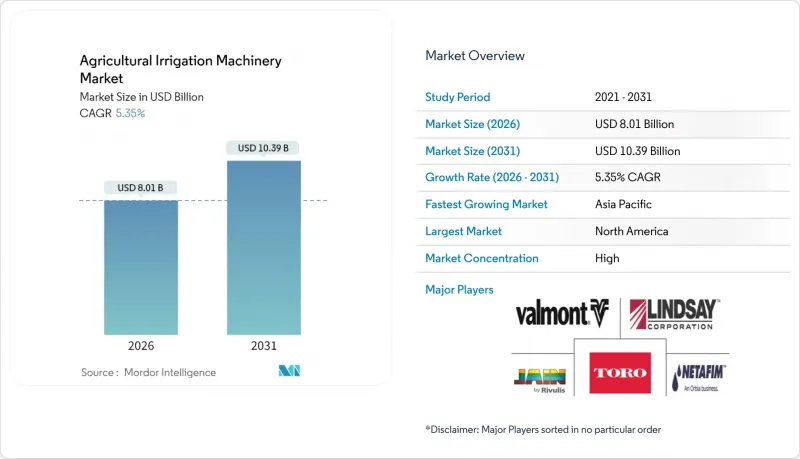
2025年農業灌溉機械市場價值為76億美元,預計2031年將達到103.9億美元,高於2026年的80.1億美元。
預計在預測期(2026-2031 年)內,複合年成長率將達到 5.35%。
水資源日益短缺、精密農業的普及以及慷慨的補貼政策正在推動農業灌溉設備市場的發展,而技術賦能的服務模式則帶來了新的商機。感測器和自動化領域的創新產品以及從一次性設備銷售向長期資訊服務的轉變,加劇了市場競爭。儘管與環境、社會和治理(ESG)相關的資金投入正在加速微灌技術的普及,但發展中地區土地所有權的分散化限制了整體成長。能夠提供本地化售後服務並解決塑膠廢棄物問題的製造商,將更有利於抓住農業灌溉設備市場不斷成長的需求。
全球農業灌溉機械市場趨勢與洞察
政府對微灌系統安裝的補貼
聯邦政府擴大保護資金投入,有助於降低中型生產商的前期成本。美國農業部(USDA)的環境品質獎勵計畫(EQIP)補貼高達75%的系統成本,並在2024財政年度撥款19億美元用於提高效率。多年通膨控制保障鼓勵製造商擴大產能,而基於績效的指標則使供應商的產品與政策目標一致。資金籌措的確定性使設備製造商更有信心投資於產能和供應鏈基礎設施。該計劃強調可衡量的節水成果,這與製造商的精密農業技術相契合,為技術整合解決方案創造了競爭優勢。
水資源日益短缺推動了精準灌溉的需求
重點農業區的水資源壓力指標正加速從漫灌到精準灌溉系統的轉型。聯合國最新發布的《水資源發展報告》預測,全球有20億人居住在水資源緊張的國家,到2050年,農業用水需求將增加35%。這種經濟上的迫切需求不僅體現在水成本上,也體現在遵守監管規定的必要性上,因為各地對用水報告的要求日益嚴格。精準灌溉系統能夠提供詳細的用水量分析,使其不再只是提高效率的手段,而是成為不可或缺的合規工具。
樞軸系統的高初始資本成本
儘管經濟效益和資金籌措方案有所改善,但中心支軸式噴灌系統的高昂資本投入仍是其推廣應用的一大障礙。根據地形和技術規格的不同,整套安裝中心支軸式噴灌系統的成本在每英畝 1200 美元到 2000 美元之間,這對於中型農業企業來說需要大量的資金投入。在水費適中的地區,投資回收期可能長達七到十年,這給面臨價格波動的農產品生產商帶來了現金流管理的挑戰。設備融資通常需要 20% 到 30% 的首付,這給同時改造多個田地的經營者造成了流動性限制。製造商正在透過模組化安裝方法和租賃購買計劃來解決這個問題,但初始資金需求仍然是限制其普及應用的關鍵因素。
細分市場分析
到2025年,滴灌系統將維持46.08%的農業灌溉機械市場佔有率,主要得益於其卓越的用水效率和精準施肥能力。在氣候壓力日益加劇的情況下,這一主導地位支撐著該細分市場強勁的發展前景。噴灌系統是成長最快的細分市場,預計到2031年將以8.05%的複合年成長率成長,這主要得益於大面積面積種植機械化程度的提高。中心支軸式噴灌系統透過整合感測器縮短決策週期,進一步釋放了成長潛力。 Valley Irrigation公司的AgSense 365體現了向整合式控制面板的轉變,從而提升了產品的全生命週期服務價值。
此細分市場的加速成長反映了主要農業地區水費上漲和勞動力短缺帶來的經濟效益改善。其他灌溉方式,包括地表灌溉和漫灌,由於水資源日益短缺以及法規結構向以效率為導向的技術轉變,其採用率正在下降。細分市場趨勢表明,農業生產結構正在向支持數據驅動型農業管理方法的精準供水系統轉變。
區域分析
2025年,北美將佔總收入的32.12%,這得益於慷慨的成本分攤計劃和成熟的分銷網路。 2031年之前的預算穩定性將維持設備的更新換代週期,即使市場飽和限制了銷售成長。加拿大注重氣候適應型農業以及墨西哥以出口為導向的園藝產業,都為區域農業灌溉設備市場注入了新的動力。
亞太地區是成長最快的地區,複合年成長率達8.06%,這主要得益於中國強制性的水資源壓力管理措施以及印度的「總理農業灌溉計畫」(Pradhan Mantri Krishi Sinchai Yojana),該計畫正推動微灌技術的快速普及。日本老化的農業人口正在加速自動化投資,而東南亞的溫室叢集則對配備豐富感測器的滴灌系統有著迫切的需求。預計到2031年,這些因素將共同推動亞太地區農業灌溉機械市場規模的顯著成長。
在歐洲,精準灌溉預計將在通用農業政策(CAP)的環境支柱下穩步發展,該政策將其定位為永續活動,並符合綠色金融的條件。地中海地區的乾旱正在加速地下灌溉的普及,而荷蘭和德國則優先發展封閉式溫室灌溉。在中東和非洲,政府支持的大型農場和氣候智慧型農業走廊正在推動市場需求。在南美洲的大豆產區,為緩解降雨量變化而對中心支軸式噴灌系統的投資,正在增強農業灌溉設備市場地理多元化的收入基礎。
其他福利:
- Excel格式的市場預測(ME)表
- 3個月的分析師支持
目錄
第1章 引言
- 研究假設和市場定義
- 調查範圍
第2章調查方法
第3章執行摘要
第4章 市場情勢
- 市場概覽
- 市場促進因素
- 政府對微灌系統安裝的補貼
- 水資源短缺日益嚴重,推動了精準灌溉的需求。
- 勞動力短缺推動中型農場機械化
- 物聯網感測器整合支援「按需收費」的服務模式。
- 透過與環境、社會及公司治理(ESG)掛鉤的融資方式激勵節水投資
- 針對節水技術的排碳權計畫層出不窮
- 市場限制
- 樞軸系統的初始資本成本高
- 發展中國家土地所有權分散化限制了投資收益(ROI)。
- 人們越來越關注滴灌管產生的塑膠廢棄物
- 互聯灌溉網路中的網路漏洞
- 監管環境
- 技術展望
- 波特五力分析
- 供應商的議價能力
- 買方的議價能力
- 替代品的威脅
- 新進入者的威脅
- 競爭對手之間的競爭
第5章 市場規模與成長預測
- 透過灌溉法
- 噴水灌溉
- 泵浦組
- 管子
- 耦合器
- 噴頭或噴灌頭
- 配件及配件
- 感應器
- 控制器
- 注射器
- 流量計
- 滴灌
- 閥門
- 回流防止裝置
- 壓力調節器
- 篩選
- 發送器
- 管子
- 其他滴灌部件
- 中心支線灌溉
- 其他灌溉方法
- 噴水灌溉
- 透過使用
- 穀物和穀類
- 豆類和油籽
- 水果和蔬菜
- 其他用途
- 按地區
- 北美洲
- 美國
- 加拿大
- 墨西哥
- 北美其他地區
- 歐洲
- 德國
- 英國
- 法國
- 義大利
- 荷蘭
- 俄羅斯
- 其他歐洲地區
- 亞太地區
- 中國
- 印度
- 日本
- 柬埔寨
- 亞太其他地區
- 南美洲
- 巴西
- 阿根廷
- 秘魯
- 其他南美洲
- 中東
- 沙烏地阿拉伯
- 土耳其
- 其他中東地區
- 非洲
- 南非
- 埃及
- 其他非洲地區
- 北美洲
第6章 競爭情勢
- 市場集中度
- 策略趨勢
- 市佔率分析
- 公司簡介
- Netafim Ltd.(Orbia Advance Corporation)
- Valmont Industries, Inc.(Valley Irrigation)
- Lindsay Corporation
- Jain Irrigation Systems Limited(Rivulis Irrigation Limited)
- The Toro Company
- Nelson Irrigation Corporation
- Rain Bird Corporation
- Mahindra & Mahindra Limited
- Hunter Industries Incorporated
- Reinke Manufacturing Company, Inc.
- Ningbo Rainfine Irrigation Co., Ltd.
- TL Irrigation Company
- Sistemas Azud, SA
- Antelco Pty Ltd.
第7章 市場機會與未來展望
The agricultural irrigation machinery market was valued at USD 7.60 billion in 2025 and estimated to grow from USD 8.01 billion in 2026 to reach USD 10.39 billion by 2031, at a CAGR of 5.35% during the forecast period (2026-2031).
Rising water scarcity, the adoption of precision agriculture, and robust subsidy pipelines are combining to propel the agricultural irrigation machinery market, while technology-enabled service models offer fresh revenue opportunities. Competitive intensity is shaped by product innovations in sensors and automation, as well as the shift from one-off equipment sales to long-term data services. Capital availability through ESG-linked funding accelerates the deployment of micro-irrigation, yet fragmented landholdings in developing regions temper overall growth. Manufacturers that localize after-sales support and address plastic-waste concerns position themselves to capture incremental demand in the agricultural irrigation machinery market.
Global Agricultural Irrigation Machinery Market Trends and Insights
Government subsidies for micro-irrigation adoption
Expanded federal conservation funding makes upfront costs more accessible for medium-scale growers. The United States Department of Agriculture (USDA) Environmental Quality Incentives Program covered up to 75% of system outlays in fiscal 2024, allocating USD 1.9 billion to efficiency upgrades. Multi-year guarantees from the Inflation Reduction Act encourage manufacturers to boost production capacity, while outcome-based metrics align vendor offerings with policy targets. This funding certainty enables equipment manufacturers to invest in production capacity and supply chain infrastructure with confidence. The program's emphasis on measurable water savings outcomes aligns with manufacturers' precision agriculture capabilities, creating competitive advantages for technology-integrated solutions.
Rising water scarcity pushing demand for precision irrigation
Water stress indicators across major agricultural regions are accelerating the transition from flood irrigation to precision delivery systems. The United Nations' latest water development report identifies 2 billion people living in water-stressed countries, with agricultural water demand projected to increase 35% by 2050. The economic imperative extends beyond water costs to include regulatory compliance, as jurisdictions implement increasingly stringent water-use reporting requirements. Precision irrigation systems' ability to provide detailed consumption analytics positions them as essential compliance tools rather than optional efficiency upgrades.
High upfront capital cost for pivot systems
The capital intensity of center-pivot irrigation systems remains a significant barrier to adoption, despite improving economics and financing options. Complete pivot installations range from USD 1,200 to USD 2,000 per acre, depending on terrain and technology specifications, representing substantial capital commitments for mid-sized operations. The payback period extends to 7-10 years in regions with moderate water costs, posing a challenge to cash flow management for commodity producers facing price volatility. Equipment financing terms typically require down payments of 20-30%, creating liquidity constraints for operators seeking to modernize multiple fields simultaneously. Manufacturers are responding with modular installation approaches and lease-to-own programs, but adoption remains constrained by initial capital requirements.
Other drivers and restraints analyzed in the detailed report include:
- Labor shortages accelerating mechanization on mid-size farms
- Integration of IoT sensors enabling pay-as-you-grow models
- Fragmented land holdings limiting equipment ROI in developing countries
For complete list of drivers and restraints, kindly check the Table Of Contents.
Segment Analysis
Drip systems retained 46.08% of the agricultural irrigation machinery market share in 2025 on superior water-use efficiency and fertigation precision. This dominance underpins a robust segment outlook as climate stresses intensify. Sprinkler equipment is the fastest-growing sub-segment, projected to post an 8.05% CAGR through 2031 as labor shortages spur mechanization across broad-acre grains. Pivot solutions unlock additional upside through sensor integration that shortens decision cycles. Valley Irrigation's AgSense 365 exemplifies the shift to unified control dashboards, lifting lifetime service value.
The segment's growth acceleration reflects improved economics as water costs rise and labor availability declines across major agricultural regions. Other irrigation types, including surface and flood systems, face declining adoption as water scarcity intensifies and regulatory frameworks increasingly favor efficiency-oriented technologies. The segmentation dynamics indicate a structural shift toward precision delivery systems capable of supporting data-driven agricultural management practices.
The Agricultural Irrigation Machinery Market Report is Segmented by Irrigation Type (Sprinkler Irrigation, Drip Irrigation, Pivot Irrigation, and Other Irrigation Types), by Application Type (Grains and Cereals, Pulses and Oilseeds, Fruits and Vegetables, and Other Applications), and by Geography (North America, Europe, Asia-Pacific, South America, Middle East, and Africa). The Market Forecasts are Provided in Terms of Value (USD).
Geography Analysis
North America contributed 32.12% of 2025 revenue, anchored by generous cost-share programs and mature distribution networks. Budget certainty through 2031 sustains replacement and upgrade cycles, even as market saturation moderates volume growth. Canada's climate-resilient farming priorities and Mexico's export-oriented horticulture add incremental momentum to the regional agricultural irrigation machinery market.
Asia-Pacific is positioned as the fastest-growing region at an 8.06% CAGR, boosted by water-stress mandates in China and rapid micro-irrigation rollouts under India's Pradhan Mantri Krishi Sinchayee Yojana. Japan's aging farmer demographic accelerates automation spending, while Southeast Asian greenhouse clusters seek sensor-rich drip systems. This confluence drives outsized gains in the agricultural irrigation machinery market size within Asia-Pacific through 2031.
Europe delivers steady expansion under the Common Agricultural Policy's environmental pillar, which labels precision irrigation as a sustainable activity eligible for green finance. Mediterranean drought episodes hasten subsurface installations, whereas the Netherlands and Germany emphasize closed-loop greenhouse watering. In the Middle East and Africa, state-backed megafarms and climate-smart corridors dominate demand. South America's soybean heartland invests in pivots to smooth rainfall variability, reinforcing a diversified geographic revenue stream across the agricultural irrigation machinery market.
- Netafim Ltd. (Orbia Advance Corporation)
- Valmont Industries, Inc. (Valley Irrigation)
- Lindsay Corporation
- Jain Irrigation Systems Limited (Rivulis Irrigation Limited)
- The Toro Company
- Nelson Irrigation Corporation
- Rain Bird Corporation
- Mahindra & Mahindra Limited
- Hunter Industries Incorporated
- Reinke Manufacturing Company, Inc.
- Ningbo Rainfine Irrigation Co., Ltd.
- T-L Irrigation Company
- Sistemas Azud, S.A.
- Antelco Pty Ltd.
Additional Benefits:
- The market estimate (ME) sheet in Excel format
- 3 months of analyst support
TABLE OF CONTENTS
1 Introduction
- 1.1 Study Assumptions and Market Definition
- 1.2 Scope of the Study
2 Research Methodology
3 Executive Summary
4 Market Landscape
- 4.1 Market Overview
- 4.2 Market Drivers
- 4.2.1 Government subsidies for micro-irrigation adoption
- 4.2.2 Rising water scarcity pushing demand for precision irrigation
- 4.2.3 Labor shortages accelerating mechanization on mid-size farms
- 4.2.4 Integration of IoT sensors enabling pay-as-you-grow service models
- 4.2.5 ESG-linked finance rewarding water-efficiency investments
- 4.2.6 Surge in carbon-credit schemes for water-saving technologies
- 4.3 Market Restraints
- 4.3.1 High upfront capital cost for pivot systems
- 4.3.2 Fragmented land holdings limiting equipment ROI in developing countries
- 4.3.3 Growing concern over plastic waste from drip lines
- 4.3.4 Cyber-vulnerability of connected irrigation networks
- 4.4 Regulatory Landscape
- 4.5 Technological Outlook
- 4.6 Porter's Five Forces Analysis
- 4.6.1 Bargaining Power of Suppliers
- 4.6.2 Bargaining Power of Buyers
- 4.6.3 Threat of Substitute Products
- 4.6.4 Threat of New Entrants
- 4.6.5 Intensity of Competitive Rivalry
5 Market Size and Growth Forecasts (Value)
- 5.1 By Irrigation Type
- 5.1.1 Sprinkler Irrigation
- 5.1.1.1 Pumping Unit
- 5.1.1.2 Tubing
- 5.1.1.3 Couplers
- 5.1.1.4 Spray or Sprinkler Heads
- 5.1.1.5 Fittings and Accessories
- 5.1.1.6 Sensors
- 5.1.1.7 Controllers
- 5.1.1.8 Injectors
- 5.1.1.9 Flow Meters
- 5.1.2 Drip Irrigation
- 5.1.2.1 Valves
- 5.1.2.2 Backflow Preventers
- 5.1.2.3 Pressure Regulators
- 5.1.2.4 Filters
- 5.1.2.5 Emitters
- 5.1.2.6 Tubing
- 5.1.2.7 Other Drip Irrigation Components
- 5.1.3 Pivot Irrigation
- 5.1.4 Other Irrigation Types
- 5.1.1 Sprinkler Irrigation
- 5.2 By Application Type
- 5.2.1 Grains and Cereals
- 5.2.2 Pulses and Oilseeds
- 5.2.3 Fruits and Vegetables
- 5.2.4 Other Applications
- 5.3 By Geography
- 5.3.1 North America
- 5.3.1.1 United States
- 5.3.1.2 Canada
- 5.3.1.3 Mexico
- 5.3.1.4 Rest of North America
- 5.3.2 Europe
- 5.3.2.1 Germany
- 5.3.2.2 United Kingdom
- 5.3.2.3 France
- 5.3.2.4 Italy
- 5.3.2.5 Netherlands
- 5.3.2.6 Russia
- 5.3.2.7 Rest of Europe
- 5.3.3 Asia-Pacific
- 5.3.3.1 China
- 5.3.3.2 India
- 5.3.3.3 Japan
- 5.3.3.4 Cambodia
- 5.3.3.5 Rest of Asia-Pacific
- 5.3.4 South America
- 5.3.4.1 Brazil
- 5.3.4.2 Argentina
- 5.3.4.3 Peru
- 5.3.4.4 Rest of South America
- 5.3.5 Middle East
- 5.3.5.1 Saudi Arabia
- 5.3.5.2 Turkey
- 5.3.5.3 Rest of Middle East
- 5.3.6 Africa
- 5.3.6.1 South Africa
- 5.3.6.2 Egypt
- 5.3.6.3 Rest of Africa
- 5.3.1 North America
6 Competitive Landscape
- 6.1 Market Concentration
- 6.2 Strategic Moves
- 6.3 Market Share Analysis
- 6.4 Company Profiles (Includes Global-level Overview, Market-level Overview, Core Segments, Financials as Available, Strategic Information, Market Rank or Share, Products and Services, Recent Developments)
- 6.4.1 Netafim Ltd. (Orbia Advance Corporation)
- 6.4.2 Valmont Industries, Inc. (Valley Irrigation)
- 6.4.3 Lindsay Corporation
- 6.4.4 Jain Irrigation Systems Limited (Rivulis Irrigation Limited)
- 6.4.5 The Toro Company
- 6.4.6 Nelson Irrigation Corporation
- 6.4.7 Rain Bird Corporation
- 6.4.8 Mahindra & Mahindra Limited
- 6.4.9 Hunter Industries Incorporated
- 6.4.10 Reinke Manufacturing Company, Inc.
- 6.4.11 Ningbo Rainfine Irrigation Co., Ltd.
- 6.4.12 T-L Irrigation Company
- 6.4.13 Sistemas Azud, S.A.
- 6.4.14 Antelco Pty Ltd.
7 Market Opportunities and Future Outlook

 噴水灌溉系統市場:按類型、組件、移動性、作物類型、自動化程度、水源、最終用戶和分銷管道分類-2026-2032年全球市場預測
 自主灌溉控制系統市場預測至2034年:全球分析(按組件、灌溉方式、農場類型、技術、應用、最終用戶和地區分類)
 灌溉機械市場:按類型、應用和地區分類全自動灌溉系統市場:按組件、技術、應用和地區分類
 農業灌溉機械市場規模、佔有率和趨勢分析報告:按灌溉系統、組件、自動化程度、應用、地區和細分市場預測(2026-2033 年)灌溉噴灌系統市場:依系統類型、安裝類型、應用和分銷管道分類,全球預測,2026-2032年全球噴水灌溉市場:市場規模、佔有率和趨勢分析(按類型、自動化程度、應用、組件、移動性和地區分類),細分市場預測(2026-2033 年)智慧錨桿鑽機市場按操作模式、鑽孔機類型、技術類型、最終用戶產業和分銷管道分類,全球預測(2026-2032年)滴灌管生產線市場:依管型、材質、直徑、壁厚、應用及通路分類,全球預測,2026-2032年
 日本灌溉系統市場規模、佔有率、趨勢及預測(按灌溉系統類型、作物類型、應用和地區分類,2026-2034年)