


 |
市場調查報告書
商品編碼
1939097
亞太地區熱感成像系統:市場佔有率分析、產業趨勢與統計、成長預測(2026-2031)Asia-Pacific Thermal Imaging Systems - Market Share Analysis, Industry Trends & Statistics, Growth Forecasts (2026 - 2031) |
||||||

※ 本網頁內容可能與最新版本有所差異。詳細情況請與我們聯繫。
亞太地區熱感成像系統市場預計將從 2025 年的 27.6 億美元成長到 2026 年的 29.1 億美元,到 2031 年達到 38.3 億美元,2026 年至 2031 年的複合年成長率為 5.60%。
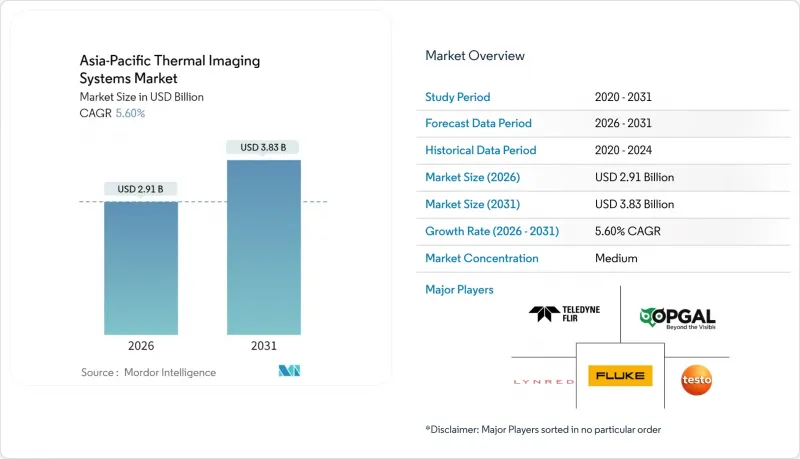
隨著國防部資助邊境監控系統升級、工業企業實施預測性維護計畫以及消費性電子設備整合緊湊型熱成像技術的應用正在加速普及。非冷凍微測輻射熱計的價格平均每年下降15-20%,為建築檢測和智慧型手機配件等中價位市場創造了機會。中國、日本和韓國政府的畜牧生物安全法規以及工廠自動化程度的提高,正在將潛在基本客群擴展到傳統安防買家之外。製冷型中波紅外線攝影機的許可限制以及晶圓級VOx元件的供應不穩定仍然是成本和進度方面的主要風險。為了確保亞太地區熱感成像系統市場的未來成長,開發商正優先考慮採用頻譜短波紅外線解決方案、硫系光學元件和邊緣人工智慧分析技術。
亞太地區熱感成像系統市場趨勢與洞察
降低非製冷微測輻射熱計感測器的成本
中國晶圓廠快速擴大量產規模,使得VOx微測輻射熱計的價格每年下降15-20%,攜帶式熱成像設備的零售價跌破500美元。這使得建築商和住宅檢查員能夠負擔得起智慧型手機的熱成像附加元件,從而擴大了其在中等收入市場的用戶群體。工業電工也開始使用手持式熱成像儀來偵測開關設備中的熱點,避免發生代價高昂的故障,從而享受更低的整體擁有成本帶來的好處。銷售量的成長正在拉低利潤率,促使供應商專注於增值雲端軟體和分析訂閱服務。感測技術的普及正在推動亞太地區熱感成像系統市場的持續成長。
亞太地區國防和邊防安全支出不斷成長
隨著南海和喜馬拉雅山脈地區領土緊張局勢加劇,各國國防預算都在增加。自2016年以來,美國已累計4.75億美元用於亞太地區的海上態勢感知(MDA)建設。熱成像設備正安裝在海岸雷達、車載情報監視偵察(ISR)吊艙以及反無人機系統(UAS)電池上,能夠晝夜追蹤小型無人機。澳洲正在採購配備紅外線設備的P-8「海神」反潛巡邏機,新加坡則在其港口監控網路中部署多層熱成像攝影機。採購週期強調採用開放式架構,以便整合人工智慧分類工具,從而加快操作員的回應速度。這種長期的採購計劃確保了多年交付,並支撐了亞太地區的熱感成像系統市場。
冷卻相機的初始成本高,且出口許可證受到限制。
ITAR 和 EAR 法規要求中波紅外線 (MWIR) 系統獲得美國核准,這導致數月的繁瑣核准流程,並限制了中國和俄羅斯的買家。此外,低溫冷卻設備增加了生命週期成本,限制了其在國防和監視領域以外的市場競爭力。因此,儘管探測範圍較小,但各機構往往不得不選擇非冷卻替代方案,這限制了亞太地區熱感成像系統的市場規模。
細分市場分析
預計2025年,熱成像技術將佔據亞太地區熱感成像系統市場最大佔有率,市場規模將達10.2億美元。這主要得益於日本、韓國以及中國沿海地區的工廠檢測和建築評估需求。反無人機系統(Counter-UAS)專案目前規模較小,但預計到2031年將以5.93%的複合年成長率成長。衝突地區無人機的激增預計將提升亞太地區熱感成像系統在國防分析領域的市場佔有率。
由於預測性維護帶來的即時投資回報以及越來越多的建築規範強制要求進行紅外線審核,熱成像技術持續保持主導地位。消防機構正在使用能夠穿透煙霧識別熱源的堅固耐用型成像器,從而縮短工業火災的反應時間。海上和沿海監視系統將熱成像疊加到雷達影像上,提供全天候情境察覺,幫助海軍打擊非法捕魚和走私活動。 NEC 的森林火災偵測網展示了熱成像技術在颱風頻繁的日本災害應變中的價值。醫療和搜救隊正在採用無人機搭載的系統在能見度低的情況下定位倖存者,這進一步拓展了熱成像技術的應用場景,並推動了亞太地區熱感成像系統市場的成長。
儘管到2025年熱感攝影機仍將佔總收入的54.10%,但模組出貨量預計將在2031年之前以6.22%的最高複合年成長率成長,這表明原始設備製造商(OEM)正在亞太地區熱感成像系統市場中轉向更大的模組佔有率。智慧型手機配件套件和汽車夜視套件更傾向於使用無需額外光學組件即可整合到現有基板的模組,從而提供更大的設計柔軟性。
對於工業和公共計劃,配備堅固機殼、整合分析功能和網路功能的全組裝攝影機仍然是標準配備。然而,Teledyne FLIR 的 Hadron X 熱成像儀相容於重量低於 250 克的無人機機架,展現了小型化如何吸引大規模生產客戶。模組供應商正在捆綁 SDK 和 AI 加速功能,以縮短不熟悉熱成像技術的整合商的上市時間。因此,模組的日益普及將使收入來源多元化,並加強與亞太地區熱感成像系統市場 OEM 廠商的合作。
其他福利:
- Excel格式的市場預測(ME)表
- 分析師支持(3個月)
目錄
第1章 引言
- 研究假設和市場定義
- 調查範圍
第2章調查方法
第3章執行摘要
第4章 市場情勢
- 市場概覽
- 市場促進因素
- 降低非製冷微測輻射熱計感測器的成本
- 亞太地區國防和邊防安全支出不斷成長
- 工業預測性維護的採用情況
- 熱感核心整合到智慧型手機、無人機和ADAS中
- 利用人工智慧熱分析技術進行強制性畜牧生物安全檢查
- 硫系光學元件可降低鍺供應風險
- 市場限制
- 冷卻相機的初始成本高,且出口許可證受到限制。
- 認證熱成像服務提供者短缺
- 半導體級VOx/InSb晶圓供應的脆弱性
- 智慧城市隱私法規限制熱監測
- 產業價值鏈分析
- 監管環境
- 技術展望
- 波特五力分析
- 新進入者的威脅
- 買方的議價能力
- 供應商的議價能力
- 替代品的威脅
- 競爭對手之間的競爭
第5章 市場規模與成長預測
- 透過使用
- 熱成像
- 海上/沿海監視
- 邊境監控
- 反無人機/無人飛行器措施
- 關鍵基礎設施安全
- 其他(消防局、智慧型手機、醫療、PVS)
- 依產品
- 熱感像儀
- 熱感成像瞄準鏡/瞄準器
- 熱感模組/核心
- 透過技術
- 非製冷長波紅外線(VOx/a-Si)
- 冷卻式中波紅外線和長波紅外線(InSb,MCT)
- 短波紅外線和頻譜
- 按最終用戶行業分類
- 航太/國防
- 執法機關與公共
- 醫學和獸醫學
- 汽車與出行
- 石油天然氣和加工工業
- 製造業和公共產業
- 其他終端使用者區域
- 按國家/地區
- 中國
- 日本
- 印度
- 東南亞
- 韓國
- 澳洲和紐西蘭
- 亞太其他地區
第6章 競爭情勢
- 市場集中度
- 策略趨勢
- 市佔率分析
- 公司簡介
- Teledyne FLIR LLC
- Wuhan Guide Infrared Co., Ltd.
- Lynred
- Hangzhou Hikvision Digital Technology Co., Ltd.
- Fluke Corporation
- Opgal Optronic Industries Ltd.
- Testo SE and Co. KGaA
- Trijicon, Inc.
- Dongguan Xintai Instrument Co., Ltd.
- Thermoteknix Systems Ltd.
- Raytron Technology Co., Ltd.
- Zhejiang Dali Technology Co., Ltd.
- Meridian Innovation Ltd.
- Nippon Avionics Co., Ltd.
- NEC Avio Infrared Technologies Co., Ltd.
- Shenzhen SAT Infrared Technology Co., Ltd.
- Leonardo SpA
- L3Harris Technologies, Inc.
- BAE Systems plc
- Axis Communications AB
- Seek Thermal, Inc.
- InfraTec GmbH
- Infrared Cameras Inc.
- Tien-Yuan Technology Co., Ltd.
第7章 市場機會與未來展望
The Asia-Pacific thermal imaging systems market is expected to grow from USD 2.76 billion in 2025 to USD 2.91 billion in 2026 and is forecast to reach USD 3.83 billion by 2031 at 5.60% CAGR over 2026-2031.
Adoption accelerates as defense ministries fund border-surveillance upgrades, industrial firms deploy predictive-maintenance programs, and consumer devices integrate compact thermal cores. Declining uncooled micro-bolometer prices, averaging 15-20% annual reductions, open mid-tier opportunities in building inspection and smartphone accessories. Government livestock bio-security mandates and rising factory automation in China, Japan, and South Korea broaden the addressable base beyond traditional security buyers. Export-licensing friction for cooled MWIR cameras and wafer-grade VOx supply fragility remain primary cost and schedule risks. Developers are therefore prioritizing multispectral SWIR solutions, chalcogenide optics, and edge-AI analytics to safeguard future growth paths in the Asia-Pacific thermal imaging systems market.
Asia-Pacific Thermal Imaging Systems Market Trends and Insights
Declining Cost of Uncooled Micro-Bolometer Sensors
Rapid scale-up at Chinese fabs brought 15-20% annual price declines in VOx micro-bolometers, pulling portable thermal devices below USD 500 retail. Builders and home inspectors can now justify thermal add-ons for smartphones, expanding user counts in middle-income markets. Industrial electricians adopt handheld viewers to spot hot spots in switchgear before costly failures, benefiting from lower total cost of ownership. Volume gains widen though margins compress, pushing vendors toward value-added cloud software and analytics subscriptions. The democratization of sensing thus underpins a durable upswing in the Asia-Pacific thermal imaging systems market.
Rising Defense and Border-Security Spending in APAC
Territorial tensions in the South China Sea and along the Himalayas keep defense budgets rising, with USD 475 million earmarked by the U.S. for APAC maritime domain awareness since 2016. Thermal imagers equip coastal radars, vehicle-mounted ISR pods, and counter-UAS batteries capable of tracking small drones day and night. Australia procures thermal-equipped P-8 Poseidon aircraft, while Singapore layers heat-sensing cameras onto harbor surveillance grids. Procurement cycles emphasize open architectures to insert AI classification tools that accelerate operator response. Long-lead acquisition pipelines thus assure multi-year deliveries that buoy the Asia-Pacific thermal imaging systems market.
High Upfront Cost and Export-Licence Constraints for Cooled Cameras
ITAR and EAR regulations mandate U.S. sign-off for MWIR systems, adding months of paperwork and constraining Chinese and Russian buyers. Cryogenic coolers also lift lifetime costs, limiting marketability outside defense and research. Consequently, agencies often settle for uncooled alternatives despite reduced range, trimming the ceiling of the Asia-Pacific thermal imaging systems market.
Other drivers and restraints analyzed in the detailed report include:
- Industrial Predictive-Maintenance Adoption
- Smartphone, Drone and ADAS Integration of Thermal Cores
- Semiconductor-Grade VOx / InSb Wafer Supply Fragility
For complete list of drivers and restraints, kindly check the Table Of Contents.
Segment Analysis
Thermography generated USD 1.02 billion in 2025, the single largest slice of the Asia-Pacific thermal imaging systems market size, anchored by factory inspection and building diagnostics in Japan, South Korea, and coastal China. Counter-UAS programs, though smaller today, are projected to log a 5.93% CAGR to 2031, expanding the Asia-Pacific thermal imaging systems market share for defense analytics as drones proliferate across contested borders.
Thermography retains leadership because predictive-maintenance ROI is immediate, and building codes increasingly specify infrared audits. Firefighting agencies employ rugged imagers that penetrate smoke and pinpoint hot spots, reducing response times during industrial blazes. Maritime and coastal surveillance packages layer thermal onto radars for 24/7 situational awareness, helping navies deter illegal fishing and smuggling. NEC's forest-fire detection grids illustrate thermal's value in disaster preparedness across typhoon-prone Japan. Medical and search-and-rescue teams adopt drone-mounted systems to locate survivors in low-visibility conditions, further broadening use cases and supporting growth within the Asia-Pacific thermal imaging systems market.
Thermal cameras continued to capture 54.10% of revenue in 2025, yet module shipments are on track for the strongest 6.22% CAGR through 2031, highlighting an OEM pivot that elevates module share of the Asia-Pacific thermal imaging systems market size. Smartphone attach-kits and automotive night-vision packages prefer modules that slot into existing boards without adding optical assemblies, boosting design flexibility.
Complete cameras still anchor industrial and public-safety projects where rugged housings, analytics, and networking come pre-integrated. Nonetheless, Teledyne FLIR's Hadron X aligns with drone frames weighing under 250 g, showing how miniaturization attracts volume customers. Module vendors bundle SDKs and AI acceleration to reduce time-to-market for integrators unfamiliar with thermography. Rising module penetration, therefore, diversifies revenue streams and cements OEM ties inside the Asia-Pacific thermal imaging systems market.
The Asia-Pacific Thermal Imaging Systems Market Report is Segmented by Application (Thermography, Maritime and Coastal Surveillance, and More), Product (Thermal Cameras, Thermal Scopes/Sights, and More), Technology (Uncooled LWIR, and More), End-User Vertical (Aerospace and Defence, Law-Enforcement and Public Safety, and More), and Country. The Market Forecasts are Provided in Terms of Value (USD).
List of Companies Covered in this Report:
- Teledyne FLIR LLC
- Wuhan Guide Infrared Co., Ltd.
- Lynred
- Hangzhou Hikvision Digital Technology Co., Ltd.
- Fluke Corporation
- Opgal Optronic Industries Ltd.
- Testo SE and Co. KGaA
- Trijicon, Inc.
- Dongguan Xintai Instrument Co., Ltd.
- Thermoteknix Systems Ltd.
- Raytron Technology Co., Ltd.
- Zhejiang Dali Technology Co., Ltd.
- Meridian Innovation Ltd.
- Nippon Avionics Co., Ltd.
- NEC Avio Infrared Technologies Co., Ltd.
- Shenzhen SAT Infrared Technology Co., Ltd.
- Leonardo S.p.A.
- L3Harris Technologies, Inc.
- BAE Systems plc
- Axis Communications AB
- Seek Thermal, Inc.
- InfraTec GmbH
- Infrared Cameras Inc.
- Tien-Yuan Technology Co., Ltd.
Additional Benefits:
- The market estimate (ME) sheet in Excel format
- 3 months of analyst support
TABLE OF CONTENTS
1 INTRODUCTION
- 1.1 Study Assumptions and Market Definition
- 1.2 Scope of the Study
2 RESEARCH METHODOLOGY
3 EXECUTIVE SUMMARY
4 MARKET LANDSCAPE
- 4.1 Market Overview
- 4.2 Market Drivers
- 4.2.1 Declining cost of uncooled micro-bolometer sensors
- 4.2.2 Rising defence and border-security spending in Asia-Pacific
- 4.2.3 Industrial predictive-maintenance adoption
- 4.2.4 Smartphone, drone and ADAS integration of thermal cores
- 4.2.5 Livestock bio-security mandates using AI-thermal analytics
- 4.2.6 Chalcogenide optics easing germanium supply risk
- 4.3 Market Restraints
- 4.3.1 High upfront cost and export-licence constraints for cooled cameras
- 4.3.2 Scarcity of certified thermography service providers
- 4.3.3 Semiconductor-grade VOx / InSb wafer supply fragility
- 4.3.4 Smart-city privacy rules limiting thermal surveillance
- 4.4 Industry Value Chain Analysis
- 4.5 Regulatory Landscape
- 4.6 Technological Outlook
- 4.7 Porter's Five Forces Analysis
- 4.7.1 Threat of New Entrants
- 4.7.2 Bargaining Power of Buyers
- 4.7.3 Bargaining Power of Suppliers
- 4.7.4 Threat of Substitutes
- 4.7.5 Intensity of Competitive Rivalry
5 MARKET SIZE AND GROWTH FORECASTS (VALUE)
- 5.1 By Application
- 5.1.1 Thermography
- 5.1.2 Maritime and Coastal Surveillance
- 5.1.3 Border Surveillance
- 5.1.4 Counter-UAS / Drones
- 5.1.5 Critical Infrastructure Security
- 5.1.6 Others (Fire-fighting, Smartphones, Medical, PVS)
- 5.2 By Product
- 5.2.1 Thermal Cameras
- 5.2.2 Thermal Scopes / Sights
- 5.2.3 Thermal Modules / Cores
- 5.3 By Technology
- 5.3.1 Uncooled LWIR (VOx / a-Si)
- 5.3.2 Cooled MWIR and LWIR (InSb, MCT)
- 5.3.3 SWIR and Multispectral
- 5.4 By End-User Vertical
- 5.4.1 Aerospace and Defence
- 5.4.2 Law-Enforcement and Public Safety
- 5.4.3 Healthcare and Veterinary
- 5.4.4 Automotive and Mobility
- 5.4.5 Oil and Gas and Process Industries
- 5.4.6 Manufacturing and Utilities
- 5.4.7 Other End-User Verticals
- 5.5 By Country
- 5.5.1 China
- 5.5.2 Japan
- 5.5.3 India
- 5.5.4 Southeast Asia
- 5.5.5 South Korea
- 5.5.6 Australia and New Zealand
- 5.5.7 Rest of Asia-Pacific
6 COMPETITIVE LANDSCAPE
- 6.1 Market Concentration
- 6.2 Strategic Moves
- 6.3 Market Share Analysis
- 6.4 Company Profiles (includes Global level Overview, Market level overview, Core Segments, Financials as available, Strategic Information, Market Rank/Share for key companies, Products and Services, and Recent Developments)
- 6.4.1 Teledyne FLIR LLC
- 6.4.2 Wuhan Guide Infrared Co., Ltd.
- 6.4.3 Lynred
- 6.4.4 Hangzhou Hikvision Digital Technology Co., Ltd.
- 6.4.5 Fluke Corporation
- 6.4.6 Opgal Optronic Industries Ltd.
- 6.4.7 Testo SE and Co. KGaA
- 6.4.8 Trijicon, Inc.
- 6.4.9 Dongguan Xintai Instrument Co., Ltd.
- 6.4.10 Thermoteknix Systems Ltd.
- 6.4.11 Raytron Technology Co., Ltd.
- 6.4.12 Zhejiang Dali Technology Co., Ltd.
- 6.4.13 Meridian Innovation Ltd.
- 6.4.14 Nippon Avionics Co., Ltd.
- 6.4.15 NEC Avio Infrared Technologies Co., Ltd.
- 6.4.16 Shenzhen SAT Infrared Technology Co., Ltd.
- 6.4.17 Leonardo S.p.A.
- 6.4.18 L3Harris Technologies, Inc.
- 6.4.19 BAE Systems plc
- 6.4.20 Axis Communications AB
- 6.4.21 Seek Thermal, Inc.
- 6.4.22 InfraTec GmbH
- 6.4.23 Infrared Cameras Inc.
- 6.4.24 Tien-Yuan Technology Co., Ltd.
7 MARKET OPPORTUNITIES AND FUTURE OUTLOOK
- 7.1 White-space and Unmet-Need Assessment

 熱成像市場:按應用、最終用戶和地區分類
 熱成像市場:全球市場預測(按產品類型、技術、銷售管道、最終用途和應用分類)- 2026-2032 年
 全球國防熱成像模組(冷卻型)市場:2026–2036攜帶式熱感雙筒望遠鏡市場:按技術、解析度、價格範圍、應用、最終用戶和分銷管道分類,全球預測,2026-2032年低溫中波熱感市場:檢測器材料、平台、解析度、影格速率、應用和最終用戶成像器-全球預測,2026-2032年攜帶式測溫熱感成像器市場:依技術、價格範圍、頻譜範圍、解析度、最終用途產業、應用類型和分銷管道分類,全球預測(2026-2032年)
 熱成像市場商機、成長要素、產業趨勢分析及2026-2035年預測。
 熱成像市場分析及至2035年的預測:按類型、產品、服務、技術、組件、應用、設備、最終用戶、功能及安裝類型
 2026年全球熱感成像市場報告
 熱感成像市場-全球產業規模、佔有率、趨勢、機會、預測:按類型、應用、技術、垂直市場、地區和競爭對手分類,2021-2031年