


 |
市場調查報告書
商品編碼
1939072
德國塑膠包裝市場:市場佔有率分析、產業趨勢與統計、成長預測(2026-2031)Germany Plastic Packaging - Market Share Analysis, Industry Trends & Statistics, Growth Forecasts (2026 - 2031) |
||||||

※ 本網頁內容可能與最新版本有所差異。詳細情況請與我們聯繫。
德國塑膠包裝市場預計將從 2025 年的 253.5 億美元成長到 2026 年的 261.6 億美元,預計到 2031 年將達到 305.9 億美元,2026 年至 2031 年的複合年成長率為 3.18%。
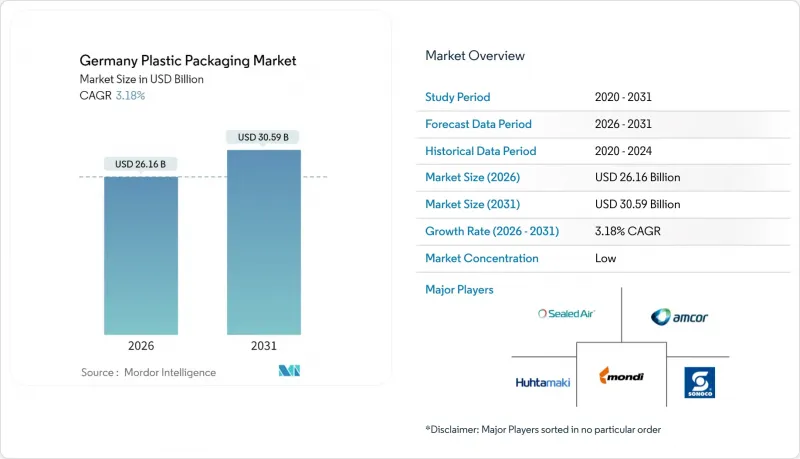
這一成長反映了循環經濟設計原則的日益普及,同時也是為了應對不斷上漲的能源成本和日益嚴格的監管要求。食品包裝仍是市場主導領域,預計2024年將佔總收入的39.32%,而化妝品和個人護理用品領域將以5.58%的複合年成長率推動成長,直至2030年。由於電子商務的擴張、輕量化物流的推廣以及單一材料應用的加強,軟包裝鞏固了主導地位。在硬質包裝領域,PET受惠於德國的押金制度和高回收率,而聚丙烯複合材料則在汽車輕量化計畫中日益普及。儘管2024年德國國內加工商的銷售額下降了4.3%,但憑藉高回收率、快速的材料創新和深度產業整合,德國塑膠包裝市場仍展現出強大的韌性。
德國塑膠包裝市場趨勢與分析
生產者延伸責任推動了對可回收單一材料的需求。
德國《包裝方法》收緊了可回收性法規,迫使品牌所有者從複雜的複合結構轉向單一聚合物結構。中央包裝註冊機構(ZSVR)將於2024年修訂其最低標準,並對多層包裝徵收更高的遵循成本,從而引導投資流向單一材料的聚乙烯和聚丙烯阻隔解決方案。 Mondi和Fresnap的可回收單一材料寵物食品包裝袋就是一個很好的例子,它展示了監管壓力如何轉化為大規模商業部署。這種方法有助於採購部門在零售商的永續性評估中獲得更高的分數,使合規性成為市場差異化優勢。
德國電子商務的快速成長推動了輕巧軟性小包裹信封的發展
儘管線上零售量有所波動,但其持續成長迫使小包裹業者減少包裝重量。 DS Smith 估計,2024 年德國時尚物流業使用了 7.91 億個塑膠運輸袋,預計到 2030 年將成長 42%。軟性運輸袋已成為服裝和小件電子產品的標準選擇,有助於降低體積重量費用和碳排放。亞馬遜承諾在其物流中心逐步淘汰塑膠,這促使第三方經銷商效仿,加速了向單一來源可再生材料的轉型。
德國提案的塑膠稅(0.80歐元/公斤)將推高原生樹脂價格。
《一次性塑膠基金法》於2025年1月生效,該法案對每公斤非再生塑膠包裝徵收0.80歐元的課稅。德國聯邦環境署估計,這項稅收每年將產生約14億歐元的收入,直接影響原生聚合物加工商(umweltbundesamt.de)。雖然這項措施提高了使用再生塑膠的經濟效益,但也為食品級再生聚乙烯(rPET)和再生聚丙烯(rPP)供應緊張的行業的利潤率帶來了壓力。加之自2022年起工業用電價格上漲265%,導致多家中型擠出生產商暫停了擴張計畫。
細分市場分析
到2025年,聚乙烯仍將佔據軟包裝市場44.12%的佔有率,這主要得益於其成本效益、高密封性和成熟的回收系統。德國聚乙烯包裝市場規模預計將在2025年達到112.6億美元,並繼續保持穩定成長的趨勢,這主要得益於不含EVOH且具有氧氣阻隔性能的單一材料包裝袋的推廣應用。諸如可再生聚烯基紙觸複合薄膜等新興薄膜預計將以6.55%的複合年成長率成長,這表明輕質高阻隔結構方面的研發投入將持續增加,從而有助於降低生產者責任成本。
其他硬質樹脂也呈現類似趨勢。由於押金返還政策,PET將佔硬質樹脂總收入的33.05%,而聚丙烯預計將以5.49%的複合年成長率成長,到2031年將超過其他硬質基材。聚丙烯的尺寸穩定性和耐熱性使其非常適合用於調理食品餐盒和電動車電池機殼,從而增強了消費者和工業市場的需求。同時,由於與回收相關的政策阻力,PVC和聚苯乙烯的成長動能持續減弱。
軟包裝在德國塑膠包裝市場佔據主導地位,預計到2025年將佔53.62%的銷售佔有率。與硬質包裝相比,立式袋、預拉鍊袋和成型-填充-封口一體機可節省高達70%的材料,這對於面臨環境成本波動的品牌所有者而言是一項決定性優勢。到2031年,該細分市場的複合年成長率將達到4.58%,超過硬質包裝。這意味著軟包裝生產線運作的資本投入更少,換線速度更快,使加工商能夠滿足電子商務帶來的產量波動需求。
對於碳酸飲料、化妝品罐和需要尺寸穩定性的藥品應用而言,硬質容器仍然至關重要。 PET寶特瓶的回收率高達93%,且具有高光學透明度,可防止食品級rPET環造成污染。同時,肖特製藥的紙板注射器套表明,即使是高價值的醫療設備也在嘗試使用纖維-塑膠混合材料,以符合醫院廢棄物分類通訊協定。
其他福利:
- Excel格式的市場預測(ME)表
- 3個月的分析師支持
目錄
第1章 引言
- 研究假設和市場定義
- 調查範圍
第2章調查方法
第3章執行摘要
第4章 市場情勢
- 市場概覽
- 市場促進因素
- 強制性生產者延伸責任制(包裝方法)推動了對單一材料再生材料的需求
- 德國電子商務的快速成長推動了對輕便、靈活的小包裹信封的需求。
- 德國汽車和工業領域的輕量化:從金屬到硬質塑膠
- PET可回收瓶配額的增加推動了rPET瓶坯和瓶子的使用。
- 已調理食品文化的興起正在推動對微波爐適用塑膠托盤的需求。
- 低溫運輸生技藥品產品線的擴展推動了對醫用塑膠管瓶和泡殼包裝的需求。
- 市場限制
- 德國提案的塑膠稅(0.80歐元/公斤)將推高原生樹脂價格。
- 零售業主導的纖維產品轉型(Aldi、Reve、Lidl)和塑膠貨架佔有率的萎縮。
- 德國高昂的電價推高了轉換器的轉換利潤率。
- 食品級再生塑膠 (rPCR) 供應的限制阻礙了再生材料含量目標的實現。
- 供應鏈分析
- 監理展望
- 技術展望
- 貿易場景(依相關HS編碼)
- 波特五力分析
- 供應商的議價能力
- 買方的議價能力
- 新進入者的威脅
- 替代品的威脅
- 競爭對手之間的競爭
- 當前回收和永續性狀況
第5章 市場規模與成長預測
- 依材料類型
- 硬質塑膠
- 聚乙烯(PE)
- 聚丙烯(PP)
- 聚對苯二甲酸乙二醇酯(PET)
- 聚氯乙烯(PVC)
- 聚苯乙烯(PS)和發泡聚苯乙烯(EPS)
- 其他硬質塑膠
- 軟塑膠
- 聚乙烯(PE)
- 雙軸延伸聚丙烯(BOPP)
- 澆鑄聚丙烯(CPP)
- 聚氯乙烯(PVC)
- 乙烯-乙烯醇共聚物(EVOH)
- 其他軟質塑膠
- 硬質塑膠
- 按包裝類型
- 硬質塑膠包裝
- 瓶子和罐子
- 托盤和翻蓋式容器
- 托盤和木箱
- 其他硬質塑膠包裝
- 軟塑膠包裝
- 小袋
- 袋子和麻袋
- 薄膜和包裝
- 其他軟質塑膠包裝
- 硬質塑膠包裝
- 按最終用途行業分類
- 食物
- 糖果甜點和零食
- 麵包和穀物
- 生鮮食品
- 乳製品
- 其他食品
- 飲料
- 瓶裝水
- 果汁和花蜜
- 乳類飲料
- 碳酸飲料
- 其他飲料
- 製藥
- 化妝品和個人護理
- 工業的
- 寵物食品和動物護理
- 其他終端用戶產業
- 食物
- 透過分銷管道
- 銷售管道
- 間接銷售管道
第6章 競爭情勢
- 市場集中度
- 策略趨勢
- 市佔率分析
- 公司簡介
- Amcor plc
- Constantia Flexibles Group
- Alpla Werke Alwin Lehner GmbH
- Sudpack Verpackungen GmbH & Co. KG
- Gerresheimer AG
- Klockner Pentaplast GmbH
- Paccor Packaging GmbH
- Mondi Group(Germany)
- Huhtamaki Oyj(Germany)
- Schur Flexibles Holding GmbH
- Bischof+Klein SE & Co. KG
- Greiner Packaging GmbH
- Sealed Air Corporation
- Sonoco Products Company
- Coveris Holding SA
- Wipak Walsrode GmbH & Co. KG
- Tetra Laval Group
- Silgan Holdings Inc.
- Plastipak Holdings Inc.
第7章 市場機會與未來展望
The Germany plastic packaging market is expected to grow from USD 25.35 billion in 2025 to USD 26.16 billion in 2026 and is forecast to reach USD 30.59 billion by 2031 at 3.18% CAGR over 2026-2031.
The expansion reflects the sector's ongoing transition toward circular-economy design principles while absorbing higher energy costs and stringent regulatory demands. Food packaging remains the anchor for volume, accounting for 39.32% of 2024 revenues, yet cosmetics and personal care is the pace-setter with a 5.58% CAGR through 2030. Flexible formats consolidate their lead as e-commerce, lightweight logistics and mono-material adoption intensify. In rigid solutions, PET benefits from Germany's deposit system and high recycling rates, whereas polypropylene compounds gain traction in automotive light-weighting programs. Despite a 4.3% decline in domestic converter turnover during 2024, the Germany plastic packaging market continues to demonstrate resilience through high collection rates, rapid material innovation and deep industrial integration.
Germany Plastic Packaging Market Trends and Insights
Extended Producer Responsibility mandates driving recyclable mono-material demand
Germany's Packaging Act tightens recyclability rules, prompting brand owners to shift from complex laminates toward single-polymer structures. The Central Agency Packaging Register (ZSVR) released updated minimum standards in 2024 that attach higher compliance fees to multi-layer packs, channeling investment into mono-material polyethylene and polypropylene barrier solutions. Mondi and Fressnapf's recyclable mono-material pet-food pouch exemplifies how regulatory pressure is translating into large-scale commercial roll-outs. The approach also helps procurement teams score higher on retailer sustainability scorecards, turning compliance into a market differentiator.
E-commerce boom in Germany fueling lightweight flexible parcel mailers
Online retail keeps growing even as volumes fluctuate, pushing parcel operators to trim packing weight. DS Smith estimates 791 million plastic shipping bags were deployed in German fashion logistics during 2024 with unit demand projected to rise 42% to 2030. Flexible mailers reduce dimensional weight fees and carbon emissions, making them the default choice for apparel and small electronics. Amazon's pledge to phase out plastics in its own fulfillment operations pressures third-party sellers to follow, accelerating the shift toward mono-material recyclables.
Proposed EUR 0.80/kg German plastics tax inflating virgin resin prices
The Single-Use Plastics Fund Act that entered force in January 2025 levies EUR 0.80 on every kilogram of non-recycled plastic packaging. The Federal Environment Agency estimates annual collections near EUR 1.4 billion, a direct hit on converters working with virgin polymer streams umweltbundesamt.de. The measure sharpens the financial case for recycled content but also squeezes margins where food-grade rPET or rPP supply remains tight. Coupled with a 265% spike in industrial electricity tariffs since 2022, several mid-sized extruders have paused expansion plans.
Other drivers and restraints analyzed in the detailed report include:
- Automotive & industrial lightweighting shifting from metal to rigid plastics
- Mehrweg PET refill quotas accelerating rPET preform and bottle usage
- Retailer-led fiber shift shrinking plastic shelf share
For complete list of drivers and restraints, kindly check the Table Of Contents.
Segment Analysis
Polyethylene retained 44.12% share of flexible revenues in 2025, underpinned by cost efficiency, high seal integrity and mature recycling streams. The Germany plastic packaging market size for polyethylene formats stood at USD 11.26 billion in 2025 and continues to edge upward as converters roll out mono-material pouches with EVOH-free oxygen barriers. Emerging films such as recyclable polyolefin-based paper-touch laminates are expanding at 6.55% CAGR, indicating sustained R&D investment in lightweight, high-barrier structures that unlock producer responsibility fee rebates.
Other rigid resins tell a similar story. PET captured 33.05% share of rigid revenues thanks to the deposit-return system, while polypropylene outpaces other rigid substrates with a 5.49% CAGR through 2031. Polypropylene's dimensional stability and heat resistance suit it for ready-meal trays and EV battery casings, reinforcing its demand in both consumer and industrial verticals. Conversely PVC and polystyrene continue to lose traction under recycling-related policy headwinds.
Flexible solutions held 53.62% share of 2025 revenues, validating their role as the workhorse of the Germany plastic packaging market. Stand-up pouches, pre-zipped bags and form-fill-seal webs deliver material savings of up to 70% compared with rigid tubs, a decisive advantage for brand owners paying modulated eco-fees. The segment's 4.58% CAGR through 2031 eclipses rigid formats because flexible lines require lower capital and operate at faster change-over speeds, helping converters absorb fluctuating run sizes linked to e-commerce.
Rigid containers remain indispensable for carbonated beverages, cosmetics jars and pharma applications requiring dimensional stability. PET bottles achieve 93% take-back and high optical clarity, preventing contamination of food-grade rPET loops. Meanwhile, SCHOTT Pharma's cardboard-based syringe wallet demonstrates how even high-value medical devices are testing fiber-slash-plastic hybrids to align with hospital waste-segregation protocols.
The Germany Plastic Packaging Market Report is Segmented by Material Type (Rigid Plastic, Flexible Plastic), Packaging Type (Rigid: Bottles and Jars, Trays and Clamshells, Other Rigid; Flexible: Pouches, Bags and Sacks, Films and Wraps, Other Flexible), End-Use Industry (Food, Beverage, Pharmaceutical, and More), and Distribution Channels (Direct Sales, Indirect Sales). The Market Forecasts are Provided in Terms of Value (USD).
List of Companies Covered in this Report:
- Amcor plc
- Constantia Flexibles Group
- Alpla Werke Alwin Lehner GmbH
- Sudpack Verpackungen GmbH & Co. KG
- Gerresheimer AG
- Klockner Pentaplast GmbH
- Paccor Packaging GmbH
- Mondi Group (Germany)
- Huhtamaki Oyj (Germany)
- Schur Flexibles Holding GmbH
- Bischof + Klein SE & Co. KG
- Greiner Packaging GmbH
- Sealed Air Corporation
- Sonoco Products Company
- Coveris Holding SA
- Wipak Walsrode GmbH & Co. KG
- Tetra Laval Group
- Silgan Holdings Inc.
- Plastipak Holdings Inc.
Additional Benefits:
- The market estimate (ME) sheet in Excel format
- 3 months of analyst support
TABLE OF CONTENTS
1 INTRODUCTION
- 1.1 Study Assumptions and Market Definition
- 1.2 Scope of the Study
2 RESEARCH METHODOLOGY
3 EXECUTIVE SUMMARY
4 MARKET LANDSCAPE
- 4.1 Market Overview
- 4.2 Market Drivers
- 4.2.1 Extended Producer Responsibility (VerpackG) Mandates Driving Recyclable Mono-Material Demand
- 4.2.2 E-commerce Boom in Germany Fueling Lightweight Flexible Parcel Mailers
- 4.2.3 Lightweighting in German Automotive and Industrial Sectors Shifting from Metal to Rigid Plastics
- 4.2.4 Mehrweg PET Refill Quotas Accelerating rPET Preform and Bottle Usage
- 4.2.5 Convenience-Ready Meal Culture Boosting Microwave-Suitable Plastic Trays
- 4.2.6 Cold-Chain Biologics Pipeline Expanding Demand for Medical-Grade Plastic Vials and Blisters
- 4.3 Market Restraints
- 4.3.1 Proposed € 0.80/kg German Plastics Tax Inflating Virgin Resin Prices
- 4.3.2 Retailer Led Fiber Shift (Aldi, REWE, Lidl) Shrinking Plastic Shelf Share
- 4.3.3 High German Electricity Costs Raising Conversion Margins for Converters
- 4.3.4 Limited Food-Grade rPCR Supply Curtailing Recycled Content Targets
- 4.4 Supply-Chain Analysis
- 4.5 Regulatory Outlook
- 4.6 Technological Outlook
- 4.7 Trade Scenario (Under Relevant HS Code)
- 4.8 Porter's Five Forces Analysis
- 4.8.1 Bargaining Power of Suppliers
- 4.8.2 Bargaining Power of Buyers
- 4.8.3 Threat of New Entrants
- 4.8.4 Threat of Substitutes
- 4.8.5 Intensity of Competitive Rivalry
- 4.9 Recycling and Sustainability Landscape
5 MARKET SIZE AND GROWTH FORECASTS (VALUE)
- 5.1 By Material Type
- 5.1.1 Rigid Plastic
- 5.1.1.1 Polyethylene (PE)
- 5.1.1.2 Polypropylene (PP)
- 5.1.1.3 Polyethylene Terephthalate (PET)
- 5.1.1.4 Polyvinyl Chloride (PVC)
- 5.1.1.5 Polystyrene (PS) and Expanded Polystyrene (EPS)
- 5.1.1.6 Other Rigid Plastic
- 5.1.2 Flexible Plastic
- 5.1.2.1 Polyethylene (PE)
- 5.1.2.2 Biaxially Oriented Polypropylene (BOPP)
- 5.1.2.3 Cast Polypropylene (CPP)
- 5.1.2.4 Polyvinyl Chloride (PVC)
- 5.1.2.5 Ethylene-Vinyl Alcohol (EVOH)
- 5.1.2.6 Other Flexible Plastic
- 5.1.1 Rigid Plastic
- 5.2 By Packaging Type
- 5.2.1 Rigid Plastic Packaging
- 5.2.1.1 Bottles and Jars
- 5.2.1.2 Trays and Clamshells
- 5.2.1.3 Pallets and Crates
- 5.2.1.4 Other Rigid Plastic Packaging
- 5.2.2 Flexible Plastic Packaging
- 5.2.2.1 Pouches
- 5.2.2.2 Bags and Sacks
- 5.2.2.3 Films and Wraps
- 5.2.2.4 Other Flexible Plastic Packaging
- 5.2.1 Rigid Plastic Packaging
- 5.3 By End-use Industry
- 5.3.1 Food
- 5.3.1.1 Confectionery and Snacks
- 5.3.1.2 Breads and Cereals
- 5.3.1.3 Fresh Produce
- 5.3.1.4 Dairy based products
- 5.3.1.5 Other Food Products
- 5.3.2 Beverage
- 5.3.2.1 Bottled Water
- 5.3.2.2 Juices and Nectars
- 5.3.2.3 Dairy Based Beverages
- 5.3.2.4 Carbonated Soft Drinks
- 5.3.2.5 Other Beverages
- 5.3.3 Pharmaceutical
- 5.3.4 Cosmetics and Personal Care
- 5.3.5 Industrial
- 5.3.6 Pet Food and Animal Care
- 5.3.7 Other End-use Industry
- 5.3.1 Food
- 5.4 By Distribution Channels
- 5.4.1 Direct Sales Channels
- 5.4.2 Indirect Sales Channels
6 COMPETITIVE LANDSCAPE
- 6.1 Market Concentration
- 6.2 Strategic Moves
- 6.3 Market Share Analysis
- 6.4 Company Profiles (includes Global-level Overview, Market-level Overview, Core Segments, Financials as available, Strategic Information, Market Rank/Share, Products and Services, Recent Developments)
- 6.4.1 Amcor plc
- 6.4.2 Constantia Flexibles Group
- 6.4.3 Alpla Werke Alwin Lehner GmbH
- 6.4.4 Sudpack Verpackungen GmbH & Co. KG
- 6.4.5 Gerresheimer AG
- 6.4.6 Klockner Pentaplast GmbH
- 6.4.7 Paccor Packaging GmbH
- 6.4.8 Mondi Group (Germany)
- 6.4.9 Huhtamaki Oyj (Germany)
- 6.4.10 Schur Flexibles Holding GmbH
- 6.4.11 Bischof + Klein SE & Co. KG
- 6.4.12 Greiner Packaging GmbH
- 6.4.13 Sealed Air Corporation
- 6.4.14 Sonoco Products Company
- 6.4.15 Coveris Holding SA
- 6.4.16 Wipak Walsrode GmbH & Co. KG
- 6.4.17 Tetra Laval Group
- 6.4.18 Silgan Holdings Inc.
- 6.4.19 Plastipak Holdings Inc.
7 MARKET OPPORTUNITIES AND FUTURE OUTLOOK
- 7.1 White-Space and Unmet-Need Assessment

 2026年全球瓦楞塑膠包裝市場報告
 再生塑膠(PCR)包裝市場預測至2034年-按產品、材料、最終用戶和地區分類的全球分析塑膠瓦楞包裝市場預測至2034年-按包裝類型、材料類型、最終用戶和地區分類的全球分析
 塑膠包裝市場:2026-2032年全球市場預測(按包裝類型、包裝材料、製造技術、包裝形式和最終用途行業分類)
 PCR塑膠包裝市場:商業機會、成長要素、產業趨勢分析及2026-2035年預測
 醫療設備和植入用高純度塑膠市場規模、佔有率和成長分析:按產品、應用和地區分類-產業預測(2026-2033 年)
 塑膠包裝市場規模、佔有率和趨勢分析報告:按材料、產品、技術、應用、地區和細分市場分類(2026-2033 年)
 散裝聚苯乙烯包裝市場:按應用和地區分類
 塑膠包裝市場分析及預測(至2035年):依類型、產品類型、應用、材料類型、技術、最終用戶、功能及工藝分類
 再生塑膠包裝市場規模、佔有率、成長及全球產業分析:按類型、應用和地區分類,並提供2026-2034年的洞察和預測