


 |
市場調查報告書
商品編碼
1939065
印刷標籤:市場佔有率分析、產業趨勢與統計、成長預測(2026-2031)Print Label - Market Share Analysis, Industry Trends & Statistics, Growth Forecasts (2026 - 2031) |
||||||

※ 本網頁內容可能與最新版本有所差異。詳細情況請與我們聯繫。
預計到 2026 年,印刷標籤市場價值將達到 570.5 億美元,高於 2025 年的 552.4 億美元。
預計到 2031 年將達到 670.2 億美元,2026 年至 2031 年的複合年成長率為 3.28%。
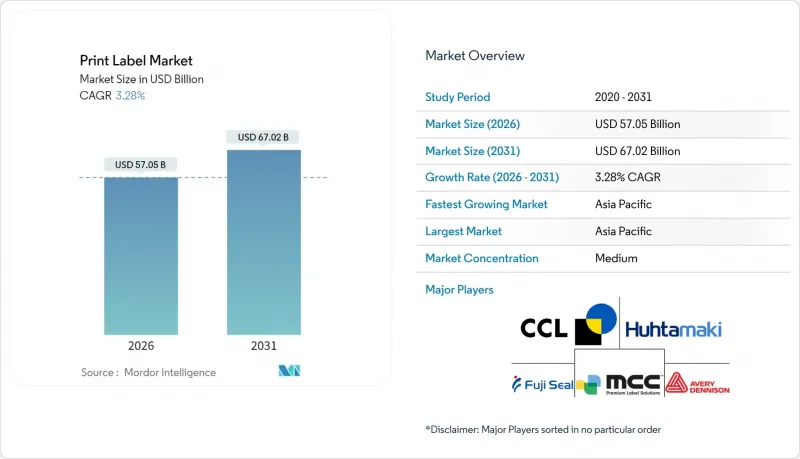
這項穩定擴張反映了印刷業從純粹的類比工藝向以永續性發展為導向、利用數位技術的生產模式的轉變,後者能夠降低最低訂購量、縮短前置作業時間並減少材料廢棄物。儘管柔版印刷仍佔據最大的設備容量佔有率,但隨著加工商尋求滿足快速成長的SKU和電商標籤需求,噴墨系統正在迅速擴張。品牌所有者對無底紙印刷格式和智慧識別碼的偏好,以及藥品序列化和食品可追溯性的要求,正在重塑加工商的投資重點。儘管基材和黏合劑價格波動帶來的成本壓力將持續存在,但穩健的利潤率將取決於混合數位-柔版工作流程、供應鏈整合以及符合循環經濟原則的材料。
全球印刷標籤市場趨勢與洞察
加速引進高速數位印刷機進行小批量生產
數位噴墨平台正為消費品品牌帶來全新的SKU策略,因為低至500張的印量即可獲利,而傳統的柔版印刷則需要1萬張的起印閾值。例如,R.R. Donnelley公司斥資2500萬美元對其位於喬治亞的工廠進行升級改造,就體現了加工商為提高產能和可變數據柔軟性而投入的巨額資本。混合噴墨和柔版印刷塔式生產線簡化了換版流程,但也造成了操作人員技能方面的差距,柔版印刷技術協會等行業組織正透過其FIRST 5.0課程來解決這個問題。隨著高速數位生產效率和類比經濟效益的融合,印刷標籤市場將朝著混合技術生產單元的方向發展,從而縮短前置作業時間和減少庫存。
品牌所有者轉向無底紙標籤以減少廢棄物
取消離型紙可減少高達 30% 的標籤廢棄物,並提高捲筒密度,從而降低物流成本,並有助於提升永續發展指標。市場領導報告稱,無離型紙標籤的銷售額實現了兩位數的成長,其中生產者延伸責任制 (EPR) 的成本推動了其普及,尤其是在食品零售業。轉型面臨的障礙包括專用應用設備和能夠在濕度波動條件下保持良好性能的黏合劑配方,但供應商正在擴大產能。 UPM Raflatac 報告稱,2025 年第一季環比成長 13%,部分原因是歐洲對無離型紙標籤的需求。加工商的競爭優勢取決於掌握與傳統壓敏黏著劑工作流程不同的新型塗佈和分切技術。
原物料價格波動對加工企業的利潤率帶來壓力。
預計從2024年起,紙漿和造紙、PET以及丙烯酸黏合劑的價格指數將繼續出現兩位數的波動,這將使加工商極易受到原料成本的影響,而原料成本佔銷貨成本的比例高達75%。全球性企業正在利用避險策略和規模經濟效應,而艾利丹尼森公司雖然銷售額下降了0.1%,但透過成本控制維持了息稅前利潤。規模較小的加工商難以將年度合約中的附加費轉嫁給品牌所有者。像索諾科這樣的綜合性公司正在投資3,000萬美元擴大黏合劑產能,以確保供應並減輕原物料價格波動的影響。在基材市場穩定之前,利潤率的下降可能會抑制小型公司在印刷標籤市場的投資。
細分市場分析
噴墨技術5.3%的複合年成長率凸顯了其在重塑印刷標籤市場中的重要角色。儘管柔印憑藉其成熟的製版生態系統仍然佔據大批量SKU的大部分佔有率,但噴墨技術對承印物的適應性以及一鍵式換版功能,使加工商能夠獲得高利潤的小批量訂單,用於促銷宣傳活動。隨著設備成本的下降和白色油墨不透明度接近絲網印刷質量,與噴墨印刷相關的印刷標籤市場規模預計將穩定成長。在加工商中,混合配置——將噴墨印刷機添加到柔印生產線——正成為資本投資計劃的主流,它既能支持可變數據,又能保持成熟的模擬模切工作流程。
Astronova 的 Trojan 標籤平台(在 2024 年德魯巴印刷展上發布)面向中等寬度標籤市場,旨在為精釀飲料和化妝品加工商提供媲美膠印的套準精度和極簡的設置。凹版印刷在超長標籤生產領域仍佔據優勢,尤其受到大型飲料代工企業的青睞,但隨著 UV 噴墨印刷能夠達到與 Pantone 色卡相媲美的覆蓋率,膠印的市場佔有率正在萎縮。絲網印刷技術在對薄膜厚度要求嚴格的耐用電子產品應用中仍將繼續存在,但其在印刷標籤市場的佔有率將持續下降。
區域分析
亞太地區在2025年以35.86%的市佔率主導印刷標籤市場,預計到2031年將以4.63%的複合年成長率維持最高成長。中國龐大的製造業基礎和印度不斷擴張的包裝市場(2025年市場規模達2,048.1億美元)是推動該地區成長的主要動力。當地加工商正投資中幅數位印刷機,以滿足快速成長的消費品牌需求。同時,日本和韓國政府的回收政策推動了可再生基材和可水洗油墨的應用。東南亞國家正在轉型為電商履約中心,刺激了對熱轉印運輸標籤和QR碼退貨標籤的需求。
北美是技術領域的標竿地區,大型零售商的強制要求推動了雲端連接RFID標籤的快速普及。 2024年,樹脂價格下跌帶來的利潤壓力影響了營收,但加工商透過自動化和高價值應用抵消了這些不利因素。 2024年11月藥品序列化截止日期正在加速美國工廠的硬體更新換代,從而提升智慧標籤在印刷標籤市場的滲透率。
歐洲正經歷成熟的需求與嚴格的循環經濟法規並存的局面。在法國和德國,生產者延伸責任制(EPR)促進了無襯紙和單一材料結構的推廣。英國的強制性法規指導著薄壁和可回收性的發展,並刺激了無溶劑黏合劑的研發。東歐的加工商正吸引來自歐盟各地品牌的委託製造,這些品牌希望在不犧牲合規性的前提下提高成本效益。
拉丁美洲和中東及非洲的貢獻規模雖小,但成長迅速。巴西和墨西哥正在擴大飲料收縮膜套標的生產能力,波灣合作理事會(GCC)國家正將業務多元化拓展至包裝食品領域,進口技術訣竅和資本設備。儘管非洲市場面臨貿易壁壘和基礎設施限制,但行動商務的成長表明可變數據標籤解決方案具有長期潛力。
其他福利:
- Excel格式的市場預測(ME)表
- 3個月的分析師支持
目錄
第1章 引言
- 研究假設和市場定義
- 調查範圍
第2章調查方法
第3章執行摘要
第4章 市場情勢
- 市場概覽
- 市場促進因素
- 加速引進能夠處理短交貨時間和SKU多樣化的高速數位(噴墨)印表機
- 品牌所有者正在轉向使用背襯壓敏標籤,以減少廢棄物和物流成本。
- 電子商務的快速成長推動了對可變數據運輸和退貨標籤的需求
- 監管機構推動使用智慧/條碼標籤,以實現端到端的可追溯性(例如,歐盟藥品防偽指令、美國藥品安全追蹤法)
- 精釀飲品和高階食品市場的成長,對高階、精美標籤的需求也隨之成長。
- 低溫運輸物流中用於食品安全的新型抗菌標籤塗層
- 市場限制
- 紙張、薄膜和黏合劑的價格波動正在給加工商的利潤率帶來壓力。
- 中小加工企業缺乏操作混合式數位柔版印刷機的技能
- 品牌所有者越來越傾向於直接在包裝上進行數位印刷(無需標籤)。
- 循環經濟市場中多層收縮標籤與套模標籤回收的難題
- 產業價值鏈分析
- 監管環境
- 技術展望
- 波特五力分析
- 供應商的議價能力
- 買方的議價能力
- 新進入者的威脅
- 替代品的威脅
- 競爭對手之間的競爭
第5章 市場規模與成長預測
- 透過印刷過程
- 膠印
- 凹版印刷
- 柔版印刷
- 螢幕
- 凸版印刷
- 靜電照相術
- 噴墨
- 按標籤格式
- 濕膠標籤
- 感壓標籤
- 無底紙標籤
- 多份追蹤標籤
- 套模標籤
- 縮水/拉伸套
- 按最終用戶行業分類
- 食物
- 飲料
- 醫療和藥品
- 化妝品和個人護理
- 家用清潔用品
- 工業和汽車
- 物流與電子商務
- 電子設備/家用電器
- 按地區
- 北美洲
- 美國
- 加拿大
- 墨西哥
- 南美洲
- 巴西
- 阿根廷
- 其他南美洲
- 歐洲
- 英國
- 德國
- 法國
- 義大利
- 西班牙
- 俄羅斯
- 其他歐洲地區
- 亞太地區
- 中國
- 日本
- 印度
- 韓國
- 澳洲
- 亞太其他地區
- 中東和非洲
- 中東
- 阿拉伯聯合大公國
- 沙烏地阿拉伯
- 土耳其
- 其他中東地區
- 非洲
- 南非
- 奈及利亞
- 其他非洲地區
- 中東
- 北美洲
第6章 競爭情勢
- 市場集中度
- 策略趨勢
- 市佔率分析
- 公司簡介
- CCL Industries Inc.
- Avery Dennison Corporation
- Multi-Color Corporation
- Fuji Seal International, Inc.
- Mondi plc
- Huhtamaki Oyj
- 3M Company
- Brady Corporation
- Ahlstrom-Munksjo Oyj
- Autajon Group
- Taghleef Industries LLC
- Ravenwood Packaging Ltd.
- SATO Holdings Corporation
- Taylor Corporation
- Weber Packaging Solutions, Inc.
- Resource Label Group, LLC
- Advanced Labelworx, Inc.
- Alliance Prints USA, Inc.
- Clarion Safety Systems, LLC
第7章 市場機會與未來展望
Print label market size in 2026 is estimated at USD 57.05 billion, growing from 2025 value of USD 55.24 billion with 2031 projections showing USD 67.02 billion, growing at 3.28% CAGR over 2026-2031.
Steady expansion reflects the sector's shift from purely analog processes to digitally enabled, sustainability-focused production frameworks that lower minimum order quantities, compress lead times, and cut material waste. Flexography still controls the largest share of installed capacity, yet inkjet systems are scaling rapidly as converters look to satisfy proliferating SKUs and e-commerce labeling needs. Brand owners' preference for linerless formats and intelligent identifiers, plus mandated pharmaceutical serialization and food traceability, is reshaping converter investment priorities. Cost pressure from substrate and adhesive volatility continues, but margin resilience hinges on hybrid digital-flexo workflows, supply-chain integration, and circular-economy compliant materials.
Global Print Label Market Trends and Insights
Accelerated Adoption of High-Speed Digital Presses for Short-Run Production
Digital inkjet platforms enable profitable runs as low as 500 pieces, contrasting with flexography's historical 10,000-unit threshold, thereby unlocking new SKU strategies for consumer brands. Capital outlays, such as R.R. Donnelley's USD 25 million Georgia upgrade, illustrate the scale converters commit to gain throughput and variable-data flexibility. Hybrid lines integrating inkjet and flexo towers streamline changeovers yet create operator-skill gaps that industry groups like the Flexographic Technical Association address through FIRST 5.0 curricula. As high-speed digital productivity converges with analog economics, the print label market will migrate toward mixed-technology production cells that compress lead times and inventory.
Brand-Owner Shift Toward Linerless Labels for Waste Reduction
Eliminating release liners cuts label waste up to 30% and boosts roll density, generating logistics savings that resonate with sustainability scorecards. Market leaders report double-digit linerless revenue growth, especially within food retail, where Extended Producer Responsibility fees spur adoption. Transition barriers include specialized applicators and adhesive formulations that must perform across humidity swings, but suppliers are scaling capacity. UPM Raflatac reported 13% quarter-on-quarter growth in Q1 2025, partly on European linerless demand. Converter competitiveness hinges on mastering new coating and slitting techniques that diverge from conventional pressure-sensitive workflows.
Raw Material Price Volatility Pressuring Converter Margins
Paper pulp, PET, and acrylic adhesive indices have swung by double digits since 2024, leaving converters exposed because materials account for up to 75% of cost of sales. While global players leverage hedging and scale, Avery Dennison reported a 0.1% sales dip yet preserved EBIT via cost controls, SME converters struggle to pass surcharges to brand owners under annual contracts. Consolidators such as Sonoco channel USD 30 million into adhesive capacity expansions to secure supply and dilute input swings. Until substrate markets stabilize, margin compression will temper investment appetite among smaller firms in the print label market.
Other drivers and restraints analyzed in the detailed report include:
- E-Commerce Expansion Driving Variable-Data Printing Demand
- Regulatory Traceability Requirements Accelerating Smart-Label Adoption
- Technical Skill Gaps in Hybrid Digital-Flexo Operations
For complete list of drivers and restraints, kindly check the Table Of Contents.
Segment Analysis
Inkjet technology's 5.3% CAGR underscores its role in reshaping the print label market. Flexography still produces the bulk of long-run SKUs thanks to mature platemaking ecosystems, but inkjet's substrate versatility and 1-click changeovers let converters secure high-margin micro-runs for promotional campaigns. The print label market size associated with inkjet presses is forecast to grow steadily as equipment costs fall and white ink opacity rivals screen-print quality. Across converters, hybrid architectures that bolt inkjet bars onto flexo lines dominate capex roadmaps, enabling variable data without abandoning proven analog die-cutting workflows.
AstroNova's TrojanLabel platform, launched at Drupa 2024, typifies the mid-web category aimed at craft beverage and cosmetics converters seeking near-offset registration with minimal setup. Gravure's niche in ultra-long runs remains secure for large beverage co-packers, yet offset lithography's footprint narrows as UV-inkjet delivers comparable Pantone coverage. Screen technology survives in electronics durables where film thickness is critical, but its share within the print label market will continue to erode.
The Print Label Market Report is Segmented by Print Process (Offset Lithography, Gravure, Flexography, Screen, Letterpress, Electrophotography, and Inkjet), Label Format (Wet-Glue, Pressure-Sensitive, Linerless, Multi-Part Tracking, In-Mold, and Shrink and Stretch Sleeves), End-User Industry (Food, Beverage, Healthcare and Pharmaceuticals, and More), and Geography. The Market Forecasts are Provided in Terms of Value (USD).
Geography Analysis
Asia-Pacific dominated the print label market in 2025 with a 35.86% share and is projected to post the highest 4.63% CAGR to 2031. China's extensive manufacturing base and India's packaging expansion valued at USD 204.81 billion for 2025 underpin regional momentum. Local converters invest in mid-web digital presses to handle proliferating consumer brands, while government recycling mandates in Japan and South Korea encourage adoption of recyclable facestock and wash-off inks. Southeast Asian nations pivot toward e-commerce fulfillment hubs, stimulating demand for thermal shipping labels and QR-based return tags.
North America remains a technology bellwether, with rapid uptake of cloud-connected RFID labels driven by big-box retail mandates. Margin pressures from resin deflation challenged revenue in 2024, yet converters offset headwinds via automation and high-value applications. The region's pharma serialization deadline of November 2024 spurred hardware upgrades across U.S. plants, reinforcing smart-label penetration within the print label market.
Europe combines mature demand with stringent circular-economy rules. Extended Producer Responsibility fees in France and Germany favor linerless and mono-material constructions. The UK's Essential Requirements Regulations guide downgauging and recyclability, stimulating R&D into solvent-free adhesives. Eastern European converters attract contract manufacturing for pan-EU brands seeking cost efficiency without sacrificing regulatory compliance.
Latin America, the Middle East, and Africa account for smaller but rising contributions. Brazil and Mexico scale capacity for beverage shrink sleeves, while Gulf Cooperation Council members diversify into packaged foods, importing technical know-how alongside capital equipment. African markets grapple with trade barriers and infrastructure constraints, yet mobile commerce growth signals long-term potential for variable-data label solutions.
- CCL Industries Inc.
- Avery Dennison Corporation
- Multi-Color Corporation
- Fuji Seal International, Inc.
- Mondi plc
- Huhtamaki Oyj
- 3M Company
- Brady Corporation
- Ahlstrom-Munksjo Oyj
- Autajon Group
- Taghleef Industries LLC
- Ravenwood Packaging Ltd.
- SATO Holdings Corporation
- Taylor Corporation
- Weber Packaging Solutions, Inc.
- Resource Label Group, LLC
- Advanced Labelworx, Inc.
- Alliance Prints USA, Inc.
- Clarion Safety Systems, LLC
Additional Benefits:
- The market estimate (ME) sheet in Excel format
- 3 months of analyst support
TABLE OF CONTENTS
1 INTRODUCTION
- 1.1 Study Assumptions and Market Definition
- 1.2 Scope of the Study
2 RESEARCH METHODOLOGY
3 EXECUTIVE SUMMARY
4 MARKET LANDSCAPE
- 4.1 Market Overview
- 4.2 Market Drivers
- 4.2.1 Accelerated adoption of high-speed digital (inkjet) presses for short-run, SKU-proliferated label jobs
- 4.2.2 Brand-owner shift toward linerless pressure-sensitive labels to cut waste and logistics costs
- 4.2.3 E-commerce boom driving demand for variable-data shipping and return labels
- 4.2.4 Regulatory push for smart/barcode labels enabling end-to-end traceability (e.g., EU FMD, U.S. DSCSA)
- 4.2.5 Growth of craft beverage and gourmet foods requiring premium, embellishment-rich labels
- 4.2.6 Emerging antimicrobial label coatings for food safety in cold-chain logistics
- 4.3 Market Restraints
- 4.3.1 Volatile paper, film and adhesive prices squeezing converter margins
- 4.3.2 Skill-gap in operating hybrid digital-flexo presses among SME converters
- 4.3.3 Rising brand-owner preference for direct-to-package digital printing (no label)
- 4.3.4 Difficult recycling of multi-layer shrink and in-mold labels in circular-economy markets
- 4.4 Industry Value Chain Analysis
- 4.5 Regulatory Landscape
- 4.6 Technological Outlook
- 4.7 Porter's Five Forces Analysis
- 4.7.1 Bargaining Power of Suppliers
- 4.7.2 Bargaining Power of Buyers
- 4.7.3 Threat of New Entrants
- 4.7.4 Threat of Substitutes
- 4.7.5 Intensity of Competitive Rivalry
5 MARKET SIZE AND GROWTH FORECASTS (VALUE)
- 5.1 By Print Process
- 5.1.1 Offset Lithography
- 5.1.2 Gravure
- 5.1.3 Flexography
- 5.1.4 Screen
- 5.1.5 Letterpress
- 5.1.6 Electrophotography
- 5.1.7 Inkjet
- 5.2 By Label Format
- 5.2.1 Wet-Glue Labels
- 5.2.2 Pressure-Sensitive Labels
- 5.2.3 Linerless Labels
- 5.2.4 Multi-Part Tracking Labels
- 5.2.5 In-Mold Labels
- 5.2.6 Shrink and Stretch Sleeves
- 5.3 By End-User Industry
- 5.3.1 Food
- 5.3.2 Beverage
- 5.3.3 Healthcare and Pharmaceuticals
- 5.3.4 Cosmetics and Personal Care
- 5.3.5 Household Cleaning
- 5.3.6 Industrial and Automotive
- 5.3.7 Logistics and E-commerce
- 5.3.8 Electronics and Appliances
- 5.4 By Geography
- 5.4.1 North America
- 5.4.1.1 United States
- 5.4.1.2 Canada
- 5.4.1.3 Mexico
- 5.4.2 South America
- 5.4.2.1 Brazil
- 5.4.2.2 Argentina
- 5.4.2.3 Rest of South America
- 5.4.3 Europe
- 5.4.3.1 United Kingdom
- 5.4.3.2 Germany
- 5.4.3.3 France
- 5.4.3.4 Italy
- 5.4.3.5 Spain
- 5.4.3.6 Russia
- 5.4.3.7 Rest of Europe
- 5.4.4 Asia Pacific
- 5.4.4.1 China
- 5.4.4.2 Japan
- 5.4.4.3 India
- 5.4.4.4 South Korea
- 5.4.4.5 Australia
- 5.4.4.6 Rest of Asia Pacific
- 5.4.5 Middle East and Africa
- 5.4.5.1 Middle East
- 5.4.5.1.1 United Arab Emirates
- 5.4.5.1.2 Saudi Arabia
- 5.4.5.1.3 Turkey
- 5.4.5.1.4 Rest of Middle East
- 5.4.5.2 Africa
- 5.4.5.2.1 South Africa
- 5.4.5.2.2 Nigeria
- 5.4.5.2.3 Rest of Africa
- 5.4.5.1 Middle East
- 5.4.1 North America
6 COMPETITIVE LANDSCAPE
- 6.1 Market Concentration
- 6.2 Strategic Moves
- 6.3 Market Share Analysis
- 6.4 Company Profiles (includes Global level Overview, Market level Overview, Core Segments, Financials as available, Strategic Information, Market Rank/Share, Products and Services, Recent Developments)
- 6.4.1 CCL Industries Inc.
- 6.4.2 Avery Dennison Corporation
- 6.4.3 Multi-Color Corporation
- 6.4.4 Fuji Seal International, Inc.
- 6.4.5 Mondi plc
- 6.4.6 Huhtamaki Oyj
- 6.4.7 3M Company
- 6.4.8 Brady Corporation
- 6.4.9 Ahlstrom-Munksjo Oyj
- 6.4.10 Autajon Group
- 6.4.11 Taghleef Industries LLC
- 6.4.12 Ravenwood Packaging Ltd.
- 6.4.13 SATO Holdings Corporation
- 6.4.14 Taylor Corporation
- 6.4.15 Weber Packaging Solutions, Inc.
- 6.4.16 Resource Label Group, LLC
- 6.4.17 Advanced Labelworx, Inc.
- 6.4.18 Alliance Prints USA, Inc.
- 6.4.19 Clarion Safety Systems, LLC
7 MARKET OPPORTUNITIES AND FUTURE OUTLOOK
- 7.1 White-space and Unmet-Need Assessment

 標籤印刷市場:按標籤格式、印刷過程、終端用戶產業和地區分類
 列印貼標及貼標設備:市場佔有率分析、產業趨勢與統計、成長預測(2026-2031)美國印刷標籤:市場佔有率分析、產業趨勢與統計、成長預測(2026-2031 年)
 印刷標籤市場報告:按原料、印刷過程、標籤格式、最終用途行業和地區分類(2026-2034年)
 2026年全球印刷標籤市場報告北美印刷標籤市場:市場佔有率分析、產業趨勢與統計、成長預測(2026-2031)
 印刷組件和標籤(熱轉印、數位印刷、網版印刷):全球市場佔有率和排名、總收入和需求預測(2025-2031 年)日本印刷標籤市場規模、佔有率、趨勢及預測(按原料、印刷過程、標籤格式、最終用途行業和地區),2025 年至 2033 年
 印刷標籤市場規模、佔有率及成長分析(依印刷製程、標籤格式、原料、最終用途產業、地區及細分市場預測),2025 年至 2032 年
 2025-2029年全球印刷標籤市場