


 |
市場調查報告書
商品編碼
1939061
數位電子看板:市場佔有率分析、產業趨勢與統計、成長預測(2026-2031)Digital Signage - Market Share Analysis, Industry Trends & Statistics, Growth Forecasts (2026 - 2031) |
||||||

※ 本網頁內容可能與最新版本有所差異。詳細情況請與我們聯繫。
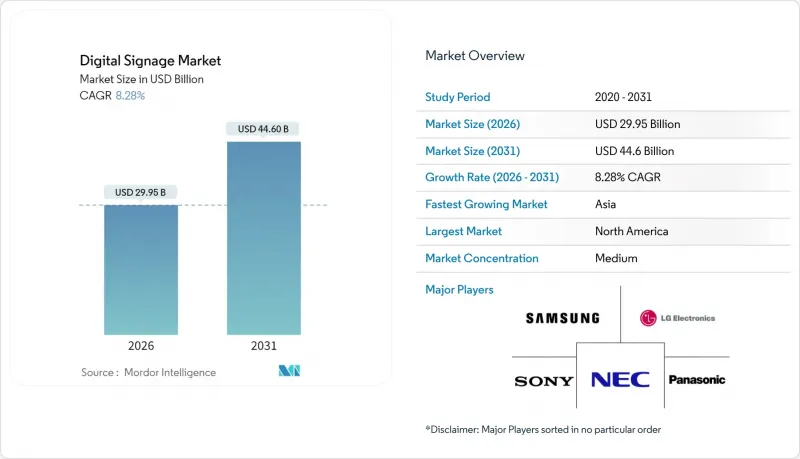
數位電子看板市場預計到 2026 年價值 299.5 億美元,高於 2025 年的 276.6 億美元,預計到 2031 年將達到 446 億美元。
預計2026年至2031年年複合成長率(CAGR)為8.28%。
這一成長得益於人工智慧驅動的內容引擎的廣泛應用、5G邊緣網路的部署以及節能型微型LED螢幕的普及。大型企業正在利用互聯顯示器統一混合辦公環境中的通訊,而市政當局則將互動式電子白板融入智慧城市基礎設施,以提高交通出行和公共舉措的效率。隨著受眾分析平台將商店螢幕轉化為創收的零售媒體資產,零售商正在加大投資。同時,交通運營商正在部署即時乘客資訊系統以提升服務品質。
全球數位電子看板市場趨勢與洞察
人工智慧驅動的受眾分析推動動態內容個人化
零售商正逐漸摒棄千篇一律的循環顯示,轉而採用人工智慧引擎,根據消費者的接近即時調整訊息。電腦視覺模組能夠測量年齡層、性別和停留時間,從而觸發創新變化,轉換率可望提升高達 30%。美國、英國、德國和法國的連鎖零售商正利用這些洞察,結合會員應用程式數據,打造全通路宣傳活動。廣告代理商願意為這種精準曝光支付高額的 CPM,將門市網路轉化為高利潤的媒體管道。儘管 GDPR 合規性正在影響歐洲的部署速度,但供應商正在採用「隱私納入設計」工作流程,在分析前對影片幀進行本地匿名化處理。這些因素正推動數位電子看板市場在中期內保持強勁成長動能。
利用 5G 和邊緣運算實現戶外即時串流傳輸
東京、首爾、新加坡和雪梨的交通部門正在利用毫米波5G骨幹網,為戶外LED顯示器提供超低延遲的影片和緊急警報。板載邊緣伺服器預先快取高解析度影片片段,從而降低資料傳輸成本,並可根據交通感測器的峰值變化即時調整宣傳活動內容。亞洲交通樞紐的研究表明,當5G取代傳統光纖時,生產力可提高52%至245%,成本節省高達90%。隨著更多大都會地區部署獨立的5G核心網,數位電子看板市場必將迎來蓬勃發展。
內容管理系統(CMS)標準分散化,導致多個供應商之間的互通性變得複雜。
全球零售商通常經營多個品牌的螢幕,但目前尚無通用的調度或分析通訊協定。電訊(ITU) 警告稱,缺乏互通性會減緩技術普及速度並增加整體擁有成本。這迫使許多公司依賴單一供應商生態系統,限制了競爭性競標。產業組織正在努力開發應用程式介面 (API),但由於各供應商的藍圖不同,進展緩慢。這種情況限制了數位電子看板市場短期內的擴充性。
細分市場分析
到2025年,電視牆將佔據27.65%的收入佔有率,憑藉其在控制室和旗艦店中營造的沉浸式效果,繼續保持主導地位。數位電子看板市場持續強調品牌劇院和企業大會等活動的規模需求。快餐店對數位海報的需求也保持穩定,因為加盟商優先考慮的是易於更新的內容。
另一方面,隨著消費者接受自助結帳系統、導航和會員註冊,自助服務終端預計到2031年將以9.1%的複合年成長率快速成長。數位電子看板市場的零售商正在部署人工智慧模組,以便在結帳時推薦其他產品,從而提高平均購買價值。透明液晶顯示器在奢侈品商店和汽車展示室中佔據了一席之地,將產品展示與數據疊加相結合。製造商目前正在嘗試為交通樞紐開發混合型設備,將多面板電視牆與自助服務終端互動結合。
到2025年,硬體組件將佔總收入的60.12%,並將繼續構成數位電子看板市場的基礎,其中包括LED顯示器、媒體播放機和安裝套件。像素成本的下降將使資本支出在4-5年的更新週期內保持在可控範圍內。
隨著企業意識到內容編配與分析能夠提升投資報酬率,軟體收入正以10.39%的複合年成長率(兩位數)成長。雲端儀錶板透過遠距離診斷確保設備運作,人工智慧調度器提升宣傳活動的針對性,供應商正在整合播放證明帳本,使廣告主能夠審核曝光情況,從而增強了數位電子看板市場的信心。
區域分析
到2025年,北美將佔全球營收的33.08%,這主要得益於美國企業升級改造,將大廳轉型為數位展示空間。加拿大零售商正在加速收銀系統的現代化,從而穩定了區域需求。該地區的數位電子看板市場受益於成熟的雲端基礎設施,降低了採用門檻。
亞太地區正以8.42%的複合年成長率成長,這主要得益於中國的城市叢集計劃、日本的技術出口熱潮、印度的購物中心蓬勃發展以及東南亞旅遊業的復甦。面板和積體電路的一體化供應鏈正在降低單價,為該地區的買家提供了定價空間,並促進了數位電子看板市場的滲透。
受生態設計法規和強勁購買力的推動,歐洲市場正保持穩定成長。儘管歷史街區的標誌限制增加了合規負擔,但德國和斯堪的納維亞半島的企業正在採用節能的A級顯示螢幕,以應對旅遊目的地成長停滯的局面。東歐機場正競相利用身臨其境型資訊牆來鞏固其樞紐地位,數位電子看板市場向東擴張。
其他福利:
- Excel格式的市場預測(ME)表
- 分析師支持(3個月)
目錄
第1章 引言
- 研究假設和市場定義
- 調查範圍
第2章調查方法
第3章執行摘要
第4章 市場情勢
- 市場概覽
- 市場促進因素
- 人工智慧驅動的受眾分析技術,協助北美及歐洲零售商店及交通走廊實現動態內容個人化。
- 5G和邊緣運算技術使亞洲和大洋洲主要交通樞紐的戶外即時串流播放成為可能。
- 歐盟企業永續性指令加速節能型微型LED和電子紙牌的普及
- 疫情後混合辦公模式推動美國企業採用雲端為基礎的通訊儀錶板
- 在中東地區整合大型數位廣告看板的大型智慧計劃(NEOM,杜拜 2040)
- 零售媒體商業化戰略推動拉丁美洲大型大眾零售連鎖店採用電視牆
- 市場限制
- 內容管理系統(CMS)標準分散化,使全球零售商的多供應商互通性變得複雜。
- 歐洲歷史城區戶外LED建築幕牆建設面臨高額的資本投資與審核障礙
- 美國公共運輸顯示器遭勒索軟體攻擊,凸顯網路安全漏洞
- 用於大型面板的專用驅動積體電路的供應鏈價格正在上漲。
- 產業生態系分析
- 技術展望
- 波特五力分析
- 新進入者的威脅
- 買方的議價能力
- 供應商的議價能力
- 替代品的威脅
- 競爭對手之間的競爭
第5章 市場規模與成長預測
- 按類型
- 電視牆
- 視訊螢幕
- 亭
- 透明液晶螢幕
- 數位海報
- 廣告看板
- 其他類型
- 按組件
- 硬體
- LCD/LED顯示器
- 有機發光二極體顯示器
- 微型LED顯示器
- 媒體播放機
- 控制器
- 投影機/投影幕
- 其他硬體
- 軟體
- 服務
- 安裝與整合
- 託管服務
- 支援與維護
- 硬體
- 透過部署
- 本地部署
- 基於雲端的
- 混合
- 按螢幕尺寸
- 小於 32 英寸
- 32英寸至52英寸
- 52吋或以上
- 超大尺寸,100吋或更大
- 按位置
- 店內/室內
- 戶外的
- 按最終用途行業分類
- 零售
- 運輸
- 飯店業
- 公司
- 教育
- 衛生保健
- 政府
- 體育娛樂
- 銀行和金融服務
- 製造工廠
- 按地區
- 北美洲
- 美國
- 加拿大
- 墨西哥
- 歐洲
- 德國
- 英國
- 法國
- 北歐國家
- 其他歐洲地區
- 南美洲
- 巴西
- 其他南美洲
- 亞太地區
- 中國
- 日本
- 印度
- 東南亞
- 亞太其他地區
- 中東和非洲
- 中東
- GCC
- 土耳其
- 其他中東地區
- 非洲
- 南非
- 其他非洲地區
- 中東
- 北美洲
第6章 競爭情勢
- 市場集中度
- 策略趨勢
- 市佔率分析
- 公司簡介
- NEC Display Solutions Ltd.
- LG Display Co. Ltd.
- Samsung Electronics Co. Ltd.
- Panasonic Corporation
- Sony Group Corporation
- Stratacache
- Planar Systems Inc.
- Hitachi Ltd.
- Barco NV
- Goodview
- Cisco Systems Inc.
- Scala Inc.
- Broadsign International LLC
- Appspace Inc.
- BrightSign LLC
- Mvix Inc.
- Christie Digital Systems USA Inc.
- Daktronics Inc.
- Leyard Optoelectronic Co. Ltd.
- Unilumin Group Co. Ltd.
- JCDecaux SA
- E Ink Holdings Inc.
- Clear Channel Outdoor Holdings Inc.
- Sharp Corporation
第7章 市場機會與未來展望
Digital signage market size in 2026 is estimated at USD 29.95 billion, growing from 2025 value of USD 27.66 billion with 2031 projections showing USD 44.6 billion, growing at 8.28% CAGR over 2026-2031.
Consistent uptake of AI-driven content engines, 5G-enabled edge networks and energy-frugal MicroLED screens underpins this expansion. Large enterprises are using connected displays to unify communications across hybrid workplaces, while city authorities weave interactive boards into smart-city infrastructure to streamline mobility and public safety initiatives. Retailers intensify investment as audience-analytics platforms transform in-store screens into revenue-generating retail-media assets. At the same time, transportation operators deploy real-time passenger information systems that raise service quality.
Global Digital Signage Market Trends and Insights
AI-powered audience analytics boosting dynamic content personalisation
Retailers now replace one-size-fits-all loops with AI engines that adjust messaging in real time when shoppers approach. Computer-vision modules gauge age bracket, gender and engagement length, then trigger creative variants that can lift conversion by as much as 30%. Chains in the United States, United Kingdom, Germany and France link these insights with loyalty-app data to enrich omnichannel campaigns. Agencies pay premium CPMs for such precise exposure, turning store networks into high-margin media channels. Compliance with GDPR shapes rollout pace in Europe, yet vendors embed privacy-by-design workflows that anonymise video frames locally before analysis. These factors keep the digital signage market on a solid medium-term growth path.
5G + edge computing enabling real-time outdoor streaming
Transit authorities in Tokyo, Seoul, Singapore and Sydney use millimetre-wave 5G backbones to push ultra-low-latency video and emergency alerts to outdoor LED boards. On-device edge servers pre-cache high-resolution clips, cutting data transit cost and letting campaigns switch instantly when foot-traffic sensors spike. Studies for Asian transport hubs show productivity gains from 52% to 245% and cost savings up to 90% when 5G replaces legacy fibre. As more metros activate standalone 5G cores, the digital signage market receives an immediate uplift.
Fragmented CMS standards complicating multi-vendor interoperability
Global retailers often juggle screens from several brands yet find no common protocol for scheduling or analytics. The International Telecommunication Union warns that the lack of interoperability slows deployments and raises total ownership cost. Many firms therefore lock into single-vendor ecosystems, limiting competitive bids. Industry alliances are drafting APIs, but diverging roadmaps among vendors keep progress slow. This reality curbs near-term scalability for the digital signage market.
Other drivers and restraints analyzed in the detailed report include:
- EU corporate sustainability mandates accelerating energy-efficient displays
- Post-pandemic hybrid work models driving cloud dashboards
- Cyber-security vulnerabilities spotlighted by ransomware on transit displays
For complete list of drivers and restraints, kindly check the Table Of Contents.
Segment Analysis
Video walls dominated 2025 revenue with 27.65% share due to their immersive impact in control rooms and flagship retail settings. The digital signage market continues to favour their scale for brand theatre and corporate town-hall events. Demand also stays steady for digital posters in quick-serve restaurants because franchisees value simple content swaps.
Kiosks, however, offer the fastest 9.1% CAGR to 2031 as shoppers embrace self-checkout, wayfinding and loyalty enrollment on responsive touchscreens. Retailers in the digital signage market deploy AI modules that recommend add-ons at check-out, nudging ticket size. Transparent LCD enclosures carve a niche in luxury stores and automotive showrooms, merging product visibility with data overlays. Manufacturers now experiment with hybrid rigs that fuse multi-panel video walls and kiosk interaction for transit concourses.
Hardware parts generated 60.12% of 2025 turnover and remain foundational to the digital signage market, covering LED tiles, media players and mounting kits. Falling pixel costs keep capex manageable for refresh cycles every four-to-five years.
Software revenue is growing at a double-digit 10.39% CAGR as companies discover that content orchestration and analytics drive ROI. Cloud dashboards secure fleet uptime through remote diagnostics, while AI schedulers improve campaign relevance. Vendors integrate proof-of-play ledgers so advertisers can audit exposures, raising confidence in the digital signage market.
The Digital Signage Market Report is Segmented by Type (Video Wall, Video Screen, Kiosk, and More), Component (Hardware, Software, and Services), Deployment (On-Premise, Cloud-Based, and Hybrid), Screen Size (Below 32", 32"-52", and More), Location (In-store/Indoor, and Outdoor), End-Use Industry (Retail, Transportation, Hospitality, Corporate, and More), and Geography. The Market Forecasts are Provided in Terms of Value (USD).
Geography Analysis
North America held 33.08% 2025 income, anchored by United States corporate refurbishments that turned lobbies into digital-first showcases. Canadian retailers accelerate checkout modernisation, keeping regional demand steady. The digital signage market here benefits from mature cloud infrastructure that reduces deployment friction.
Asia-Pacific is on an 8.42% CAGR trajectory, propelled by China's city cluster projects, Japan's technology export push, India's mall boom and Southeast Asia's tourism recovery. An integrated supply chain for panels and ICs lowers unit costs, giving regional buyers price latitude that boosts the digital signage market's penetration.
Europe records stable gains supported by ecodesign mandates and high purchasing power. Historic-district signage caps add compliance effort, yet German and Nordic corporates adopt energy-class A displays, offsetting tourist-zone pauses. Eastern European airports compete for hub status through immersive wayfinding walls, expanding the digital signage market eastward.
- NEC Display Solutions Ltd.
- LG Display Co. Ltd.
- Samsung Electronics Co. Ltd.
- Panasonic Corporation
- Sony Group Corporation
- Stratacache
- Planar Systems Inc.
- Hitachi Ltd.
- Barco NV
- Goodview
- Cisco Systems Inc.
- Scala Inc.
- Broadsign International LLC
- Appspace Inc.
- BrightSign LLC
- Mvix Inc.
- Christie Digital Systems USA Inc.
- Daktronics Inc.
- Leyard Optoelectronic Co. Ltd.
- Unilumin Group Co. Ltd.
- JCDecaux SA
- E Ink Holdings Inc.
- Clear Channel Outdoor Holdings Inc.
- Sharp Corporation
Additional Benefits:
- The market estimate (ME) sheet in Excel format
- 3 months of analyst support
TABLE OF CONTENTS
1 INTRODUCTION
- 1.1 Study Assumptions and Market Definition
- 1.2 Scope of the Study
2 RESEARCH METHODOLOGY
3 EXECUTIVE SUMMARY
4 MARKET LANDSCAPE
- 4.1 Market Overview
- 4.2 Market Drivers
- 4.2.1 AI-powered audience analytics boosting dynamic content personalisation in North American and European retail and transit corridors
- 4.2.2 5G + edge computing enabling real-time outdoor streaming across major Asian and Oceanian transport hubs
- 4.2.3 EU corporate sustainability mandates accelerating adoption of energy-efficient MicroLED and e-paper signage
- 4.2.4 Post-pandemic hybrid work models driving cloud-based corporate communication dashboards in the USA
- 4.2.5 Smart-city mega-projects (NEOM, Dubai 2040) integrating large-format digital billboards across the Middle East
- 4.2.6 Retail-media monetisation strategies fuelling video-wall roll-outs by Latin-American big-box chains
- 4.3 Market Restraints
- 4.3.1 Fragmented CMS standards complicating multi-vendor interoperability for global retailers
- 4.3.2 High CAPEX and permitting hurdles for outdoor LED facades in historical European city centres
- 4.3.3 Cyber-security vulnerabilities spotlighted by ransomware on United States transit displays
- 4.3.4 Supply-chain price spikes in specialty driver-ICs for large panels
- 4.4 Industry Ecosystem Analysis
- 4.5 Technological Outlook
- 4.6 Porter's Five Forces Analysis
- 4.6.1 Threat of New Entrants
- 4.6.2 Bargaining Power of Buyers
- 4.6.3 Bargaining Power of Suppliers
- 4.6.4 Threat of Substitutes
- 4.6.5 Intensity of Competitive Rivalry
5 MARKET SIZE AND GROWTH FORECASTS (VALUES)
- 5.1 By Type
- 5.1.1 Video Wall
- 5.1.2 Video Screen
- 5.1.3 Kiosk
- 5.1.4 Transparent LCD Screen
- 5.1.5 Digital Poster
- 5.1.6 Billboard
- 5.1.7 Other Types
- 5.2 By Component
- 5.2.1 Hardware
- 5.2.1.1 LCD/LED Display
- 5.2.1.2 OLED Display
- 5.2.1.3 MicroLED Display
- 5.2.1.4 Media Players
- 5.2.1.5 Controllers
- 5.2.1.6 Projector/Projection Screens
- 5.2.1.7 Other Hardware
- 5.2.2 Software
- 5.2.3 Services
- 5.2.3.1 Installation and Integration
- 5.2.3.2 Managed Services
- 5.2.3.3 Support and Maintenance
- 5.2.1 Hardware
- 5.3 By Deployment
- 5.3.1 On-premise
- 5.3.2 Cloud-based
- 5.3.3 Hybrid
- 5.4 By Screen Size
- 5.4.1 Below 32"
- 5.4.2 32"-52"
- 5.4.3 Above 52"
- 5.4.4 Ultra-large Above 100"
- 5.5 By Location
- 5.5.1 In-store/Indoor
- 5.5.2 Outdoor
- 5.6 By End-use Industry
- 5.6.1 Retail
- 5.6.2 Transportation
- 5.6.3 Hospitality
- 5.6.4 Corporate
- 5.6.5 Education
- 5.6.6 Healthcare
- 5.6.7 Government
- 5.6.8 Sports and Entertainment
- 5.6.9 Banking and Financial Services
- 5.6.10 Manufacturing Facilities
- 5.7 By Geography
- 5.7.1 North America
- 5.7.1.1 United States
- 5.7.1.2 Canada
- 5.7.1.3 Mexico
- 5.7.2 Europe
- 5.7.2.1 Germany
- 5.7.2.2 United Kingdom
- 5.7.2.3 France
- 5.7.2.4 Nordics
- 5.7.2.5 Rest of Europe
- 5.7.3 South America
- 5.7.3.1 Brazil
- 5.7.3.2 Rest of South America
- 5.7.4 Asia-Pacific
- 5.7.4.1 China
- 5.7.4.2 Japan
- 5.7.4.3 India
- 5.7.4.4 South-East Asia
- 5.7.4.5 Rest of Asia-Pacific
- 5.7.5 Middle East and Africa
- 5.7.5.1 Middle East
- 5.7.5.1.1 Gulf Cooperation Council Countries
- 5.7.5.1.2 Turkey
- 5.7.5.1.3 Rest of Middle East
- 5.7.5.2 Africa
- 5.7.5.2.1 South Africa
- 5.7.5.2.2 Rest of Africa
- 5.7.5.1 Middle East
- 5.7.1 North America
6 COMPETITIVE LANDSCAPE
- 6.1 Market Concentration
- 6.2 Strategic Moves
- 6.3 Market Share Analysis
- 6.4 Company Profiles (includes Global level Overview, Market level overview, Core Segments, Financials as available, Strategic Information, Market Rank/Share for key companies, Products and Services, and Recent Developments)
- 6.4.1 NEC Display Solutions Ltd.
- 6.4.2 LG Display Co. Ltd.
- 6.4.3 Samsung Electronics Co. Ltd.
- 6.4.4 Panasonic Corporation
- 6.4.5 Sony Group Corporation
- 6.4.6 Stratacache
- 6.4.7 Planar Systems Inc.
- 6.4.8 Hitachi Ltd.
- 6.4.9 Barco NV
- 6.4.10 Goodview
- 6.4.11 Cisco Systems Inc.
- 6.4.12 Scala Inc.
- 6.4.13 Broadsign International LLC
- 6.4.14 Appspace Inc.
- 6.4.15 BrightSign LLC
- 6.4.16 Mvix Inc.
- 6.4.17 Christie Digital Systems USA Inc.
- 6.4.18 Daktronics Inc.
- 6.4.19 Leyard Optoelectronic Co. Ltd.
- 6.4.20 Unilumin Group Co. Ltd.
- 6.4.21 JCDecaux SA
- 6.4.22 E Ink Holdings Inc.
- 6.4.23 Clear Channel Outdoor Holdings Inc.
- 6.4.24 Sharp Corporation
7 MARKET OPPORTUNITIES AND FUTURE OUTLOOK
- 7.1 White-space and Unmet-need Assessment

 數位相機顯示器市場報告:趨勢、預測和競爭分析(至2035年)
 2026年全球數位電子看板市場報告
 全球智慧指示牌市場規模、佔有率、趨勢和成長分析報告(2026-2034)
 數位看板市場:依產品、組件(硬體、服務)、應用和行業劃分 - 至2036年的全球預測
 LED數位記分板市場分析及預測(至2035年):依類型、產品類型、服務、技術、組件、應用、形狀、材質、最終用戶、安裝類型分類數位電子看板市場分析及預測(至2035年):依類型、產品、服務、技術、組件、應用、形式、部署方式、最終用戶及安裝類型分類醫療數位電子看板市場分析及預測(至2035年):按類型、產品、服務、技術、組件、應用、部署模式、最終用戶、功能和安裝類型分類
 數位電子看板市場規模、佔有率、趨勢及預測(按類型、組件、技術、應用、位置、規模和地區分類),2026-2034年2026年全球數位側窗顯示器市場報告
 全球數位電子看板市場:依產品類型、顯示尺寸、安裝位置、應用、最終用途、企業規模和地區分類-預測至2030年