


 |
市場調查報告書
商品編碼
1939051
汽車傳動軸:市場佔有率分析、產業趨勢與統計、成長預測(2026-2031)Automotive Drive Shaft - Market Share Analysis, Industry Trends & Statistics, Growth Forecasts (2026 - 2031) |
||||||

※ 本網頁內容可能與最新版本有所差異。詳細情況請與我們聯繫。
預計到 2026 年,汽車傳動軸市場規模將達到 123 億美元。
預計該產業規模將從 2025 年的 116.3 億美元成長到 2031 年的 162.6 億美元,2026 年至 2031 年的複合年成長率為 5.74%。
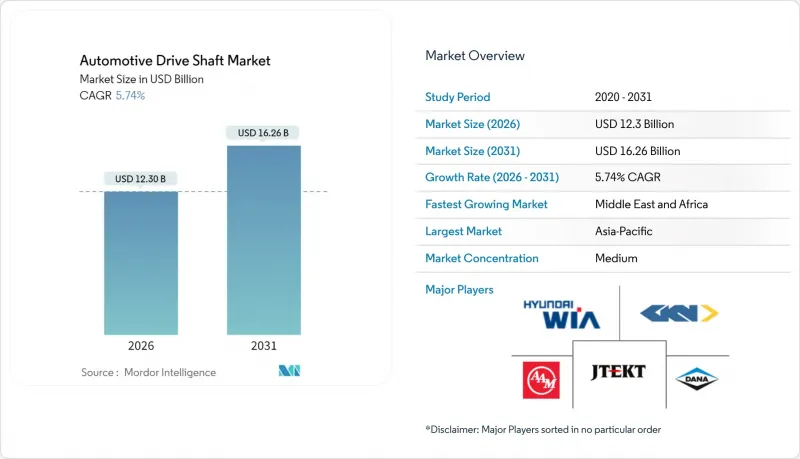
這種成長軌跡反映出市場已做好適應電氣化需求的準備,同時又希望維持傳統動力傳動系統的強勁性能。從多部件傳統傳動軸轉向精密輕量化替代方案的轉變,在汽車製造商需要在各種車輛架構中平衡成本壓力和性能要求的同時,也帶來了變革和機會。
全球汽車傳動軸市場趨勢與洞察
E軸整合重組了軸結構
電動橋的整合從根本上改變了傳動軸的要求,它摒棄了傳統的多部件結構,同時對後輪驅動電動車架構中的高精度、輕量化傳動軸提出了更高的需求。特斯拉 Model S Plaid 和BMW iX 就是很好的例子,它們展示了整合式馬達-變速箱單元如何減少零件數量,同時又需要用於扭力向量控制的專用碳纖維傳動軸。這種架構的轉變解釋了為什麼儘管每輛車的傳動軸使用量可能會下降,但純電動車 (BEV) 市場仍將以 14.25% 的複合年成長率成長。舍弗勒計劃於 2025 年 4 月為一家中國電動汽車製造商生產滾珠螺桿驅動裝置,這表明供應商如何將其精密製造能力從傳統的傳動系統應用轉移到電動動力傳動系統領域。這種轉變為擁有尖端材料專業知識的供應商創造了機遇,同時也為以鋼鐵為主導的傳統製造商帶來了挑戰。
碳纖維的應用已超越高階市場,加速普及
在對輕量化和提升NVH(噪音、振動與聲振粗糙度)性能的需求驅動下,碳纖維複合材料傳動軸的應用範圍正從豪華車領域擴展到高性能量產車型。福特最新的F-150系列和BMW3系列車型均採用碳纖維傳動軸,在實現燃油經濟性目標的同時,也能在高扭力工況下保持耐用性。這種材料比鋼輕60%,允許使用更長的傳動軸而不會對轉速造成顯著限制,這使其在空間佈局受限的全輪驅動(AWD)車型中尤為重要。隨著生產規模的擴大,碳纖維傳動軸的成本每年下降約15-20%,使得在量產車型中採用碳纖維傳動軸變得經濟實惠,從而擺脫了傳統高階市場的限制。隨著汽車製造商優先考慮輕量化策略以抵消混合動力和電動動力傳動系統中電池重量的增加,這一趨勢正在加速發展。
原料價格波動給利潤率帶來壓力。
碳纖維和特殊鋼價格的波動正給整個傳動軸供應鏈的利潤率帶來壓力。碳纖維價格受航太需求週期和能源成本的影響,每季波動幅度高達25%至30%。由於碳纖維生產集中在少數幾家全球供應商(東麗、SGL Carbon和Hexcel)手中,當航太需求復甦或可再生能源應用需求激增時,就會出現供應瓶頸。用於高性能應用的特殊鋼也面臨類似的價格波動,由於採礦業中斷以及地緣政治緊張局勢對原料供應的影響,鉻鉬合金價格預計在2024年上漲18%。這種波動迫使供應商實施動態定價機制和避險策略,使長期OEM合約變得更加複雜。這可能會延緩尖端材料在成本敏感型應用中的推廣。
細分市場分析
到2025年,中空軸將佔據56.63%的市場佔有率,這反映了與實心軸相比,空心軸在重量減輕和製造成本效率方面實現了最佳平衡。其設計優勢包括最佳化的壁厚,與實心軸相比,可在保持相當扭矩容量的同時,實現40-50%的減重。複合材料/碳纖維增強複合材料(CFRP)軸的市場佔有率將在2031年之前以12.62%的複合年成長率成長,這主要得益於其在高階車型和對性能要求極高的應用中的廣泛應用,在這些應用中,減輕重量可以抵消更高的材料成本。兩段式/滑入式設計滿足了緊湊型車輛架構(尤其是前輪驅動車輛)的特定空間佈局要求,在這些車輛中,空間限制使得安裝一體式軸變得困難。
重型商用車和越野車領域對實心軸的需求持續成長,因為耐用性要求比重量因素更為重要。這一領域的穩定性反映了商用車製造商的保守態度,他們優先考慮的是久經考驗的可靠性,而非尖端材料。中空軸製造技術的創新,包括液壓成形和先進焊接技術,在保持成本競爭力的同時,也持續拓展其在各車型領域的適用性。
到2025年,傳統鋼材將維持67.32%的市場佔有率,這反映了其成本效益和在全球供應鏈中成熟的製造基礎設施。然而,碳纖維/碳纖維增強複合材料(CFRP)到2031年將以14.33%的複合年成長率快速成長,這標誌著輕量化解決方案的應用範圍正在從高階應用轉向高階應用。高強度合金鋼將用於中等強度的應用,在這些應用中,減重要求超過了傳統鋼材的能力,但成本限制了碳纖維的普及。鋁材的應用將集中在一些特定的應用場景,在這些場景中,耐腐蝕性和適度的減重要求使得鋁材的溢價高於鋼材。
這種材料轉變反映了汽車產業為實現輕量化所採取的策略,其驅動力源自於燃油經濟性法規和最佳化電動車續航里程的需求。碳纖維製造規模的擴大,包括自動化纖維鋪放和樹脂轉注成形,既降低了生產成本,也提高了品質穩定性。這項技術進步使得碳纖維得以應用於傳統上由鋼材主導的大批量生產領域,尤其是在傳動軸等對長度和臨界轉速有較高要求的領域,輕量材料更受青睞。
區域分析
到2025年,亞太地區將佔據全球45.72%的市場佔有率,這主要得益於中國大規模的汽車生產規模以及東南亞國協不斷擴大的商用車產能。該地區的成長動力主要來自基礎建設規劃帶來的商用車需求成長,尤其是產業走廊的建設,為貨運需求的持續成長創造了條件,尤其是在印尼、泰國和越南。 2025年2月,中國商用車產量達到31.8萬輛(年增36.6%),充分展現了該地區對軸的需求規模。由於接近性主要整車製造商的生產基地以及成熟的供應鏈關係,區域供應商能夠降低物流成本並前置作業時間。
北美和歐洲是成熟的汽車市場,擁有完善的汽車製造地,推動各細分市場對傳動軸部件的穩定需求。北美市場的成長主要集中在SUV和皮卡領域,全輪驅動(AWD)的興起帶動了對軸間傳動軸的需求。同時,由於嚴格的排放氣體法規,歐洲市場優先採用輕量化材料。這兩個地區對高階應用和先進材料的關注,為擁有碳纖維技術和精密製造能力的供應商創造了機會。兩國政府的獎勵,例如美國的「48C條款」計畫和歐盟的「綠色交易」產業政策,都支持當地製造業發展,促進了國內零件生產。
中東和非洲地區預計將成為成長最快的地區,到2031年複合年成長率將達到8.77%,這主要得益於全部區域的基礎設施發展計畫和不斷成長的汽車保有量。南非汽車製造業的擴張以及阿拉伯聯合大公國物流樞紐的發展,正在創造對商用車零件的需求,而產油國的經濟多元化計劃則為汽車組裝業務提供了支持。該地區的成長反映了廣泛的工業化趨勢,這些趨勢正在創造對交通基礎設施和商用車車隊的持續需求。然而,各國市場發展仍然不平衡,政策支持和製造能力的差異導致了成長軌蹟的分化。
其他福利:
- Excel格式的市場預測(ME)表
- 3個月的分析師支持
目錄
第1章 引言
- 研究假設和市場定義
- 調查範圍
第2章調查方法
第3章執行摘要
第4章 市場情勢
- 市場概覽
- 市場促進因素
- 電動車中整合電驅動軸減少了對多部件軸的需求,但也推動了對高精度、輕型傳動軸的需求。
- 高性能和豪華車輛中碳纖維複合材料軸的快速應用
- 政府加大對國內輕質材料製造業的誘因
- 北美和歐洲的SUV車型將過渡到基於後輪驅動的全輪驅動系統
- 東協和非洲工業走廊商用車產量快速成長
- 無線傳動系統分析實現預測性維護改造
- 市場限制
- 原料價格波動(碳纖維、特殊鋼)
- 東亞精密管材拉拔供應鏈集中
- 中國和歐盟內燃機乘用車銷售下滑
- 複合複合材料分層造成的保固責任風險
- 價值/價值鏈分析
- 監管環境
- 技術展望
- 波特五力模型
- 新進入者的威脅
- 買方和消費者的議價能力
- 供應商的議價能力
- 替代品的威脅
- 競爭對手之間的競爭
第5章 市場規模及成長預測(價值(美元))
- 依設計類型
- 中空軸
- 實心軸
- 兩件式/插入式管
- 複合材料/碳纖維軸
- 材料
- 普通鋼材
- 高強度合金鋼
- 鋁
- 碳纖維/CFRP
- 按職位類型
- 後橋軸
- 前軸
- 四輪驅動軸間/傳動軸
- 按車輛類型
- 搭乘用車
- 輕型商用車
- 中型和重型商用車輛
- 按動力傳動系統/推進系統
- 內燃機(ICE)
- 混合動力汽車(HEV 和 PHEV)
- 電池式電動車(BEV)
- 按銷售管道
- OEM
- 售後市場
- 按地區
- 北美洲
- 美國
- 加拿大
- 北美其他地區
- 南美洲
- 巴西
- 阿根廷
- 其他南美洲
- 歐洲
- 德國
- 英國
- 法國
- 義大利
- 其他歐洲地區
- 亞太地區
- 中國
- 日本
- 印度
- 韓國
- 亞太其他地區
- 中東和非洲
- 阿拉伯聯合大公國
- 沙烏地阿拉伯
- 埃及
- 南非
- 其他中東和非洲地區
- 北美洲
第6章 競爭情勢
- 市場集中度
- 策略趨勢
- 市佔率分析
- 公司簡介
- GKN PLC(Melrose Industries PLC)
- Dana Incorporated
- JTEKT Corporation
- Hyundai Wia Corporation
- Nexteer Automotive Group Ltd.
- American Axle and Manufacturing Holdings Inc.
- NTN Corporation
- Showa Corporation
- IFA Rotorion Holding GmbH
- ZF Friedrichshafen AG
- Meritor Inc.
- Neapco Holdings LLC
- GSP Automotive Group
- Wanxiang Qianchao Co. Ltd.
- Hitachi Astemo Ltd.
- ElringKlinger AG(Composite Shaft Division)
- Poclain Powertrain
- Jilin Jinghua Automotive Parts
- Univance Corporation
- Yujiang Vicray Industrial Co.
第7章 市場機會與未來展望
Automotive drive shaft market size in 2026 is estimated at USD 12.3 billion, growing from 2025 value of USD 11.63 billion with 2031 projections showing USD 16.26 billion, growing at 5.74% CAGR over 2026-2031.
This growth trajectory reflects the market's adaptation to electrification demands while maintaining robust performance in traditional powertrains. The transition from multi-piece conventional shafts to high-precision lightweight alternatives creates both disruption and opportunity, as OEMs balance cost pressures with performance requirements across diverse vehicle architectures.
Global Automotive Drive Shaft Market Trends and Insights
E-axle Integration Reshapes Shaft Architecture
E-axle integration fundamentally alters drive shaft requirements by eliminating traditional multi-piece configurations while creating demand for high-precision lightweight propeller shafts in rear-wheel-drive electric architectures. Tesla's Model S Plaid and BMW iX demonstrate how integrated motor-gearbox units reduce component count yet require specialized carbon-fiber propeller shafts for torque vectoring applications. This architectural shift explains why BEV segments grow at 14.25% CAGR despite potentially reducing per-vehicle shaft content. Schaeffler's April 2025 production launch of ball screw drives for Chinese EV manufacturers illustrates how suppliers adapt precision manufacturing capabilities from traditional driveline applications to electric powertrains. The transition creates opportunities for suppliers with advanced materials expertise while challenging traditional steel-focused manufacturers.
Carbon-Fiber Adoption Accelerates Beyond Premium Segments
Carbon-fiber composite shaft adoption extends beyond luxury applications into performance-oriented mainstream vehicles, driven by weight reduction mandates and NVH improvement requirements. Ford's latest F-150 variants and BMW's 3-Series incorporate carbon-fiber propeller shafts to achieve fuel economy targets while maintaining durability under high-torque conditions. The material's 60% weight reduction compared to steel enables longer shaft lengths without critical speed limitations, particularly valuable in AWD configurations where packaging constraints intensify. Manufacturing scale improvements reduce carbon-fiber shaft costs by approximately 15-20% annually, making adoption economically viable for volume applications beyond the traditional premium segment focus. This trend accelerates as OEMs prioritize lightweighting strategies to offset battery weight penalties in hybrid and electric powertrains.
Raw Material Price Volatility Pressures Margins
Carbon fiber and specialty steel price volatility creates margin pressure across the drive shaft supply chain, with carbon fiber prices fluctuating 25-30% quarterly based on aerospace demand cycles and energy costs. The concentration of carbon fiber production among few global suppliers (Toray, SGL Carbon, Hexcel) creates supply bottlenecks when demand surges from aerospace recovery and renewable energy applications. Specialty steel grades used in high-performance applications face similar volatility, with chromium-molybdenum alloy prices increasing 18% in 2024 due to mining disruptions and geopolitical tensions affecting raw material supply. This volatility forces suppliers to implement dynamic pricing mechanisms and hedge strategies that complicate long-term OEM contracts, potentially slowing adoption of advanced materials in cost-sensitive applications.
Other drivers and restraints analyzed in the detailed report include:
- Government Incentives Drive Localization
- AWD Proliferation Drives Inter-Axle Demand
- Supply Chain Concentration Creates Vulnerability
For complete list of drivers and restraints, kindly check the Table Of Contents.
Segment Analysis
Hollow shafts command 56.63% market share in 2025, reflecting their optimal balance of weight reduction and manufacturing cost efficiency compared to solid alternatives. The design's advantages include 40-50% weight reduction versus solid shafts while maintaining equivalent torque capacity through optimized wall thickness engineering. Composite/CFRP shafts accelerate at 12.62% CAGR through 2031, driven by premium vehicle adoption and performance applications where weight savings justify higher material costs. Two-piece/slip-in tube configurations serve specific packaging requirements in compact vehicle architectures, particularly in front-wheel-drive applications where space constraints limit single-piece shaft installation.
Solid shaft applications persist in heavy-duty commercial vehicles and off-road applications where durability requirements outweigh weight considerations. The segment's stability reflects commercial vehicle manufacturers' conservative approach, prioritizing proven reliability over advanced materials. Manufacturing innovations in hollow shaft production, including hydroforming and advanced welding techniques, continue to expand the design's applicability across vehicle segments while maintaining cost competitiveness against solid alternatives.
Conventional steel maintains 67.32% market share in 2025, reflecting its cost-effectiveness and established manufacturing infrastructure across global supply chains. However, carbon-fiber/CFRP materials surge at 14.33% CAGR through 2031, indicating a fundamental shift toward lightweight solutions that extends beyond premium applications. High-strength alloy steel serves intermediate applications where weight reduction requirements exceed conventional steel capabilities but cost constraints limit carbon-fiber adoption. Aluminum applications focus on specific use cases where corrosion resistance and moderate weight reduction justify the material premium over steel alternatives.
The material transition reflects broader automotive lightweighting mandates driven by fuel economy regulations and electric vehicle range optimization. Carbon-fiber manufacturing scale improvements, including automated fiber placement and resin transfer molding, reduce production costs while improving quality consistency. This technological advancement enables carbon-fiber adoption in volume applications previously dominated by steel, particularly in propeller shaft applications where length and critical speed requirements favor lightweight materials.
The Automotive Drive Shaft Market Report is Segmented by Design Type (Hollow Shaft, Solid Shaft, Two-piece/Slip-in Tube, and More), Material (Conventional Steel, and More), Position Type (Rear Axle Shafts, and More), Vehicle Type (Passenger Cars, and More), Powertrain/Propulsion (ICE, Hybrid, BEV), Sales Channel (OEM, Aftermarket), and Geography (North America, and More). The Market Forecasts are Provided in Terms of Value (USD).
Geography Analysis
Asia-Pacific dominates with 45.72% market share in 2025, driven by China's massive vehicle production scale and ASEAN's expanding commercial vehicle manufacturing capabilities. The region's growth stems from infrastructure development programs that boost commercial vehicle demand, particularly in Indonesia, Thailand, and Vietnam where industrial corridor development creates sustained freight transportation requirements. China's February 2025 commercial vehicle production of 318,000 units, representing 36.6% year-over-year growth, demonstrates the scale of demand driving regional shaft requirements. Regional suppliers benefit from proximity to major OEM production facilities and established supply chain relationships that reduce logistics costs and lead times.
North America and Europe represent mature markets with established automotive manufacturing bases that drive steady demand for drive shaft components across diverse vehicle segments. North American growth focuses on SUV and pickup truck segments where AWD proliferation creates demand for inter-axle propeller shafts, while European markets emphasize lightweight materials adoption driven by stringent emissions regulations. The regions' focus on premium applications and advanced materials creates opportunities for suppliers with carbon-fiber expertise and precision manufacturing capabilities. Government incentives in both regions support local manufacturing development, with the U.S. Section 48C program and European Union's Green Deal industrial policy encouraging domestic component production.
Middle-East and Africa emerges as the fastest-growing region at 8.77% CAGR through 2031, driven by infrastructure development programs and increasing vehicle ownership rates across the region. South Africa's automotive manufacturing expansion and UAE's logistics hub development create demand for commercial vehicle components, while oil-rich nations economic diversification programs support automotive assembly operations. The region's growth reflects broader industrialization trends that create sustained demand for transportation infrastructure and commercial vehicle fleets. However, the market is uneven across countries, with differing policy support and manufacturing capacity shaping growth trajectories.
- GKN PLC (Melrose Industries PLC)
- Dana Incorporated
- JTEKT Corporation
- Hyundai Wia Corporation
- Nexteer Automotive Group Ltd.
- American Axle and Manufacturing Holdings Inc.
- NTN Corporation
- Showa Corporation
- IFA Rotorion Holding GmbH
- ZF Friedrichshafen AG
- Meritor Inc.
- Neapco Holdings LLC
- GSP Automotive Group
- Wanxiang Qianchao Co. Ltd.
- Hitachi Astemo Ltd.
- ElringKlinger AG (Composite Shaft Division)
- Poclain Powertrain
- Jilin Jinghua Automotive Parts
- Univance Corporation
- Yujiang Vicray Industrial Co.
Additional Benefits:
- The market estimate (ME) sheet in Excel format
- 3 months of analyst support
TABLE OF CONTENTS
1 Introduction
- 1.1 Study Assumptions and Market Definition
- 1.2 Scope of the Study
2 Research Methodology
3 Executive Summary
4 Market Landscape
- 4.1 Market Overview
- 4.2 Market Drivers
- 4.2.1 E-axle integration in BEVs reduces need for multi-piece shafts but drives demand for high-precision lightweight prop-shafts
- 4.2.2 Rapid adoption of carbon-fiber composite shafts in performance and premium vehicles
- 4.2.3 Increasing government incentives for local lightweight-material manufacturing
- 4.2.4 Shift toward rear-wheel-based AWD for SUVs in North America and Europe
- 4.2.5 Booming CV production in ASEAN and Africa industrial corridors
- 4.2.6 Over-the-air driveline analytics unlocking predictive-maintenance retrofits
- 4.3 Market Restraints
- 4.3.1 Raw-material (carbon fiber, specialty steel) price volatility
- 4.3.2 Supply-chain concentration of precision tube-drawing in East Asia
- 4.3.3 Declining ICE passenger-car sales in China and EU
- 4.3.4 Warranty-liability risks from composite shaft delamination
- 4.4 Value/Supply-Chain Analysis
- 4.5 Regulatory Landscape
- 4.6 Technological Outlook
- 4.7 Porter's Five Forces
- 4.7.1 Threat of New Entrants
- 4.7.2 Bargaining Power of Buyers/Consumers
- 4.7.3 Bargaining Power of Suppliers
- 4.7.4 Threat of Substitute Products
- 4.7.5 Intensity of Competitive Rivalry
5 Market Size and Growth Forecasts (Value (USD))
- 5.1 By Design Type
- 5.1.1 Hollow Shaft
- 5.1.2 Solid Shaft
- 5.1.3 Two-piece/Slip-in Tube
- 5.1.4 Composite/Carbon-Fiber Shaft
- 5.2 By Material
- 5.2.1 Conventional Steel
- 5.2.2 High-Strength Alloy Steel
- 5.2.3 Aluminum
- 5.2.4 Carbon-Fiber/CFRP
- 5.3 By Position Type
- 5.3.1 Rear Axle Shafts
- 5.3.2 Front Axle Shafts
- 5.3.3 Inter-axle/Propeller Shafts for AWD
- 5.4 By Vehicle Type
- 5.4.1 Passenger Cars
- 5.4.2 Light Commercial Vehicles
- 5.4.3 Medium and Heavy Commercial Vehicles
- 5.5 By Powertrain / Propulsion
- 5.5.1 Internal Combustion Engine (ICE)
- 5.5.2 Hybrid (HEV and PHEV)
- 5.5.3 Battery Electric Vehicle (BEV)
- 5.6 By Sales Channel
- 5.6.1 OEM
- 5.6.2 Aftermarket
- 5.7 By Geography
- 5.7.1 North America
- 5.7.1.1 United States
- 5.7.1.2 Canada
- 5.7.1.3 Rest of North America
- 5.7.2 South America
- 5.7.2.1 Brazil
- 5.7.2.2 Argentina
- 5.7.2.3 Rest of South America
- 5.7.3 Europe
- 5.7.3.1 Germany
- 5.7.3.2 United Kingdom
- 5.7.3.3 France
- 5.7.3.4 Italy
- 5.7.3.5 Rest of Europe
- 5.7.4 Asia-Pacific
- 5.7.4.1 China
- 5.7.4.2 Japan
- 5.7.4.3 India
- 5.7.4.4 South Korea
- 5.7.4.5 Rest of Asia-Pacific
- 5.7.5 Middle-East and Africa
- 5.7.5.1 United Arab Emirates
- 5.7.5.2 Saudi Arabia
- 5.7.5.3 Egypt
- 5.7.5.4 South Africa
- 5.7.5.5 Rest of Middle-East and Africa
- 5.7.1 North America
6 Competitive Landscape
- 6.1 Market Concentration
- 6.2 Strategic Moves
- 6.3 Market Share Analysis
- 6.4 Company Profiles (Includes Global level Overview, Market level overview, Core Segments, Financials as available, Strategic Information, Market Rank/Share for key companies, Products and Services, and Recent Developments)
- 6.4.1 GKN PLC (Melrose Industries PLC)
- 6.4.2 Dana Incorporated
- 6.4.3 JTEKT Corporation
- 6.4.4 Hyundai Wia Corporation
- 6.4.5 Nexteer Automotive Group Ltd.
- 6.4.6 American Axle and Manufacturing Holdings Inc.
- 6.4.7 NTN Corporation
- 6.4.8 Showa Corporation
- 6.4.9 IFA Rotorion Holding GmbH
- 6.4.10 ZF Friedrichshafen AG
- 6.4.11 Meritor Inc.
- 6.4.12 Neapco Holdings LLC
- 6.4.13 GSP Automotive Group
- 6.4.14 Wanxiang Qianchao Co. Ltd.
- 6.4.15 Hitachi Astemo Ltd.
- 6.4.16 ElringKlinger AG (Composite Shaft Division)
- 6.4.17 Poclain Powertrain
- 6.4.18 Jilin Jinghua Automotive Parts
- 6.4.19 Univance Corporation
- 6.4.20 Yujiang Vicray Industrial Co.
7 Market Opportunities and Future Outlook
- 7.1 White-space and Unmet-need Assessment

 2026年全球汽車傳動軸市場報告
 汽車傳動軸市場:依驅動系統、車輛類型、銷售管道和地區分類。
 汽車傳動軸市場機會、成長要素、產業趨勢分析及2026年至2035年預測
 電機軸市場按應用、類型、材料、直徑範圍、塗層、銷售管道和最終用途行業分類,全球預測(2026-2032年)
 汽車傳動軸市場規模、佔有率和成長分析(按設計類型、地點類型、車輛類型、銷售管道和地區分類)-2026-2033年產業預測
 軸帶式發電機市場-2025年至2030年預測
![汽車傳動軸市場 - [傳動軸類型:單件式、多件式;驅動系統:兩輪驅動(全軸、半軸)、四輪驅動] - 全球產業分析、規模、佔有率、成長、趨勢及預測,2025-2035 年](/sample/img/cover/42/default_cover_6.png) 汽車傳動軸市場 - [傳動軸類型:單件式、多件式;驅動系統:兩輪驅動(全軸、半軸)、四輪驅動] - 全球產業分析、規模、佔有率、成長、趨勢及預測,2025-2035 年
汽車傳動軸市場 - [傳動軸類型:單件式、多件式;驅動系統:兩輪驅動(全軸、半軸)、四輪驅動] - 全球產業分析、規模、佔有率、成長、趨勢及預測,2025-2035 年 汽車用驅動軸的全球市場的評估:各車輛類型,不同設計,位置,各地區,機會,預測(2018年~2032年)
 等速傳動軸市場報告:2030 年趨勢、預測與競爭分析