


 |
市場調查報告書
商品編碼
1939012
精密農業:市場佔有率分析、產業趨勢與統計、成長預測(2026-2031)Precision Farming - Market Share Analysis, Industry Trends & Statistics, Growth Forecasts (2026 - 2031) |
||||||

※ 本網頁內容可能與最新版本有所差異。詳細情況請與我們聯繫。
預計到 2026 年,精密農業市場規模將達到 166.1 億美元,高於 2025 年的 147.7 億美元。
預計到 2031 年,該市場規模將達到 298.6 億美元,2026 年至 2031 年的複合年成長率為 12.45%。
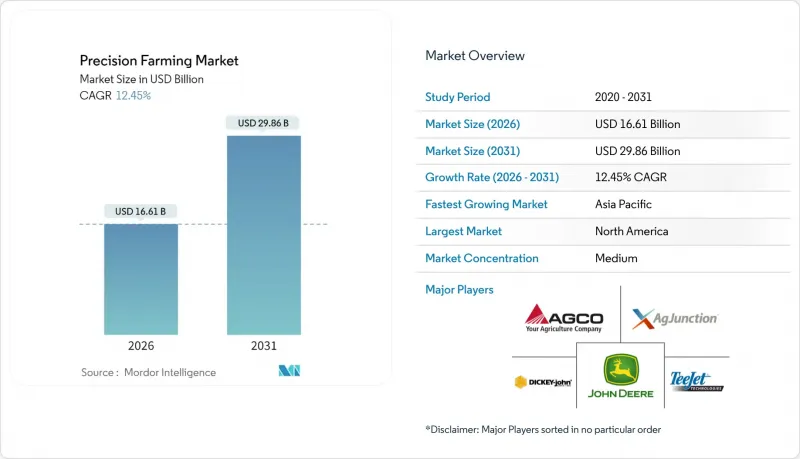
衛星物聯網衛星群、GNSS引導的自動駕駛系統以及人工智慧驅動的自主設備的廣泛應用,正在擴大數位農業的範圍,並將排碳權獎勵轉化為實際的投資回報。約翰迪爾與SpaceX合作,在通訊盲區提供亞英寸級遙測技術;AGCO與PTx Trimble合資,為混合車隊開發改造解決方案;以及美國農業部的“氣候智慧型商品計劃”,都在強化技術循環,推動可變投入最佳化。雖然硬體仍佔據大部分支出,但軟體和邊緣人工智慧分析正以兩位數的速度迎頭趕上,反映出該產業正從數據收集轉向即時決策自動化。北美仍保持最大的區域佔有率,而亞太地區則經歷了最高的複合年成長率,這主要得益於印度的智慧農業生態系統和中國的精密農業政策。
全球精密農業市場趨勢與洞察
在大型農場引入GNSS自動駕駛系統
大型農場(超過1000公頃)的GNSS自動駕駛系統採用率顯著高於中型農場(52%),達70%。這一趨勢是推動精密農業市場發展的關鍵因素,約翰迪爾的StarFire 7000接收器能夠接收更多衛星頻段並提高收斂速度。 SpaceX的Starlink即使在沒有行動電話網路覆蓋的區域也回程傳輸導航數據,使操作員能夠晝夜不停地進行自動駕駛。 AGCO的OutRun改裝套件與其他曳引機相容,正在推動混合型車輛轉向系統的升級。在勞動力日益短缺的情況下,機器人技術能夠實現完美的直線行駛、防止重疊作業並節省柴油,這使其作為稀缺操作員的替代方案更提案。燃油成本的節省和運作效率的提高進一步提升了投資報酬率,延長了機器在有限的播種季節的運作距離。
頻譜/熱感無人機感測器的成本迅速下降
目前全球已有超過30萬架農業無人機作業,覆蓋超過5億公頃的農地。大疆創新(DJI)的Mavic 3 頻譜無人機價格已降至以往只有大型農場才能負擔得起的水平。在蒙大拿州的麥田試驗表明,配備WEED-IT視覺系統的定點噴灑無人機可將除草劑用量減少90%至95%。感測器小型化降低了有效載荷重量,並將飛行時間延長了一倍,同時保持了測量葉綠素和冠層濕度所需的光譜解析度。巴西和美國放寬了超視距飛行的作業範圍,加速了其在大型農田的應用。人工智慧驅動的異常檢測技術能夠比肉眼提前一周檢測到營養脅迫,使農民能夠在產量損失發生之前採取措施。
多個製造商的機器之間資料互通性的挑戰
大約73%的農民使用來自多個製造商的曳引機、播種機和噴藥機,這造成了資料孤島,阻礙了端到端的分析。 OGC SensorThings API承諾為地理空間和機械資料提供通用封裝,但專有檔案格式和不同的CAN匯流排通訊協定阻礙了無縫資料流。 AGCO和Trimble的合資企業PTx承諾提供與品牌無關的轉向和數據同步,但改造舊設備成本高昂,且需要經銷商的專業知識。歐洲推動開放標準和MQTT傳輸層是一個積極的徵兆,但小型供應商由於擔心產品同質化,進展緩慢。如果沒有更深入的整合,農民將繼續依賴U盤和雲端門戶,從而限制了完全自主化可能帶來的生產力提升。
細分市場分析
導航系統將持續維持領先地位,2025年將佔據精密農業市場37.45%的佔有率。強大的GNSS接收器機械設備能夠以亞英寸級的精度在複雜地形中導航。受化肥和農藥價格上漲推動精準施肥的驅動,變數施肥技術(VRT)精密農業市場預計到2031年將以13.55%的複合年成長率成長。無人機遙感探測利用低成本的頻譜設備,大疆創新(DJI)報告稱,將施肥地圖與處方噴霧器連接起來,已使農藥用量減少了67.78%。隨著創業投資資金轉向邊緣人工智慧平台,機器人技術正獲得越來越多的關注。 Four Growers和Bonsai Robotics已總合籌集2,400萬美元,用於在50萬英畝的土地上實現收割作業的自動化。衛星物聯網為該技術平台提供了補充,可以傳輸來自沒有行動電話覆蓋的田地的感測器數據,並不斷更新自主模組的模型。
邊緣運算和雲端分析協同工作:邊緣硬體即時處理影像串流,而雲端引擎則分析季節性模式。約翰迪爾的第二代自動駕駛技術堆疊整合了這兩層,目標是在本世紀末實現玉米和大豆的完全自動駕駛。農民越來越傾向於使用混合型設備,而不是只選擇單一品牌;AGCO公司憑藉其OutRun套件抓住了這一變化,該套件無需更換高成本的曳引機。有鑑於這些趨勢,能夠將開放API與硬體無關組件結合的技術供應商最有優勢抓住面積擴張所帶來的機會。
到2025年,硬體將佔精密農業市場51.20%的佔有率,涵蓋感測器、控制器、無人機和自主平台。然而,隨著邊緣人工智慧在幾秒鐘內(即使在網路中斷的情況下)提供可操作的處方箋,軟體收入正以13.40%的複合年成長率成長。感測器正變得小規模農場也能安裝高密度的土壤濕度網格並創建可變灌溉地圖。像約翰迪爾的G5-Plus這樣的顯示器增加了乙太網路介面,可以將更豐富的資料集從農機具傳輸到駕駛室。車載電腦正在將GNSS、機器視覺和遙測功能整合到單一基板,從而顯著降低自主迴路的延遲。
隨著營運商越來越依賴第三方合作夥伴進行軟體修補和即時網路威脅監控,精密農業託管服務的市場規模預計將會擴大。 CNH 和 Raven 的數據分析套件利用人工智慧驅動的選擇性噴灑技術,可將除草劑用量減少 77%。衛星回程傳輸確保作業期間的處方同步,這對於 77% 缺乏 4G 網路覆蓋的農田來說至關重要。隨著硬體利潤率的下降,供應商正尋求透過捆綁更新、演算法和排碳權報告儀表板的訂閱模式來獲取經常性收入。
區域分析
北美地區預計到2025年將保持41.15%的市場佔有率,這主要得益於成熟的全球導航衛星系統(GNSS)網路、完善的經銷商體係以及允許碳排放項目進行數位化記錄的法規環境。與新興地區相比,北美地區的成長率將保持平穩,部分原因是2025年農民意向調查顯示,在商品價格波動的情況下,農民會採取謹慎的資本規劃。然而,舊款顯示器的積極更新換代以及車隊自主性的提升將繼續支撐市場需求。
亞太地區精密農業市場成長最快,達到13.95%,這主要得益於印度智慧農業市場的蓬勃發展(預計到2028年將達到8.8621億美元)以及中國對數位農業的政策支持。政府對衛星星系、低成本無人機和農村寬頻的投資正在推動小規模農戶採用精準農業技術。 2024年,超過12億美元的創業投資將用於自動化果園噴藥機和農業金融科技信用評分系統,將投入資金與感測器檢驗的田間數據結合。在澳大利亞,自動駕駛田間作業車隊正在緩解長期的勞動力短缺問題,並逐步擴大耕地面積。
歐洲正穩步推進環境法規,要求到2030年將化學品使用量減少50%,並將精準噴灑作為合規手段。德國的一項試驗研究證實,在不影響產量的情況下,農藥使用量可減少10%至20%,這大大增強了農民的信心。拉丁美洲的精準噴灑普及率參差不齊。巴西和阿根廷因乾旱造成的收入損失導致2024年曳引機銷量下降了14%,而無人機噴灑在放鬆管制後迅速發展。中東和非洲仍處於精準噴灑的早期階段。衛星物聯網是撒哈拉以南非洲農民的生命線,該地區的即時動態定位(RTK)網路覆蓋率仍停滯在40%。然而,缺乏經濟性和技術限制了其普及。
其他福利:
- Excel格式的市場預測(ME)表
- 3個月的分析師支持
目錄
第1章 引言
- 研究假設和市場定義
- 調查範圍
第2章調查方法
第3章執行摘要
第4章 市場情勢
- 市場概覽
- 市場促進因素
- 大型農場快速採用GNSS自動駕駛系統
- 頻譜和熱成像無人機感測器的成本迅速下降
- 政府碳權計畫獎勵可變比例的碳排放減排
- 衛星物聯網衛星群整合實現亞英寸級精度現場遙測
- 農場保險折扣引入了基於人工智慧的風險評分
- 創業投資資金從農場管理SaaS轉向邊緣人工智慧機器人
- 市場限制
- 多種品牌機器之間的資料互通性差距
- 針對農業營運技術網路的農村網路安全威脅
- 撒哈拉以南非洲的RTK網路覆蓋範圍趨於穩定
- 農民抵制演算法決策和自主權喪失
- 產業生態系分析
- 監管環境
- 技術展望
- 波特五力分析
- 買方的議價能力
- 供應商的議價能力
- 新進入者的威脅
- 替代品的威脅
- 競爭對手之間的競爭
第5章 市場規模與成長預測
- 透過技術
- 導航系統
- GNSS/GPS
- GIS
- 可變工作技術
- 可變肥料
- 可變播種
- 可變農藥
- 遙感探測
- 無人機和無人駕駛飛行器(UAV)
- 機器人和自主設備
- 邊緣和雲端分析平台
- 其他技術
- 導航系統
- 按組件
- 硬體
- 感測器和致動器
- 控制器和顯示器
- 機上計算與連接
- 軟體
- 農業管理SaaS
- 數據分析與人工智慧
- 服務
- 整合與諮詢
- 託管服務
- 硬體
- 透過使用
- 產量監測
- 可變工作應用
- 田間測繪
- 土壤和作物健康監測
- 灌溉管理
- 作物巡查
- 收割自動化和物流
- 其他用途
- 按農場規模
- 小規模農場(少於100公頃)
- 中型農場(100-1000公頃)
- 大型農場(超過1000公頃)
- 按地區
- 北美洲
- 美國
- 加拿大
- 墨西哥
- 南美洲
- 巴西
- 阿根廷
- 其他南美洲
- 歐洲
- 德國
- 英國
- 法國
- 西班牙
- 義大利
- 荷蘭
- 其他歐洲地區
- 亞太地區
- 中國
- 日本
- 印度
- 澳洲
- 韓國
- 亞太其他地區
- 中東和非洲
- 中東
- 沙烏地阿拉伯
- 阿拉伯聯合大公國
- 土耳其
- 其他中東地區
- 非洲
- 南非
- 奈及利亞
- 肯亞
- 其他非洲地區
- 中東
- 北美洲
第6章 競爭情勢
- 市場集中度
- 策略趨勢
- 市佔率分析
- 公司簡介
- Deere and Company
- Trimble Inc.
- AGCO Corporation
- CNH Industrial NV
- Raven Industries
- Topcon Positioning Systems
- Lindsay Corporation
- TeeJet Technologies
- DICKEY-john
- BASF Digital Farming(xarvio)
- Yara International ASA
- Climate Corp(Bayer)
- Hexagon Agriculture
- CropX Technologies
- DJI Agriculture
- Farmers Edge
- Granular
- Ag Leader Technology
- Kubota Smart Agri
- Sentera
第7章 市場機會與未來展望
Precision Farming market size in 2026 is estimated at USD 16.61 billion, growing from 2025 value of USD 14.77 billion with 2031 projections showing USD 29.86 billion, growing at 12.45% CAGR over 2026-2031.
Satellite IoT constellations, GNSS-guided auto-steering, and AI-enabled autonomous equipment are widening digital farming's addressable base and translating carbon-credit incentives into tangible return on investment. John Deere's collaboration with SpaceX for sub-inch telemetry in cellular dead zones, AGCO's PTx Trimble joint venture for mixed-fleet retrofits, and the USDA's Climate-Smart Commodities program are reinforcing a technology cycle that rewards variable-rate input optimization. Hardware still dominates spending, yet software and edge-AI analytics are outpacing with double-digit growth, mirroring the industry shift from data collection to real-time decision automation. North America retains the largest regional share, while Asia Pacific delivers the fastest CAGR on the back of India's smart-ag ecosystem and China's precision farming policy mandates.
Global Precision Farming Market Trends and Insights
GNSS-Enabled Auto-Steering on Large Farms
Adoption of GNSS auto-steering has reached 70% on farms over 1,000 ha versus 52% on midsize holdings, a trend increasingly shaping the precision farming market, aided by John Deere's StarFire 7000 receiver that locks onto more satellite bands for faster convergence. SpaceX Starlink backhauls the guidance data where cellular networks fail, letting operators run autonomous passes throughout the day and night. AGCO's OutRun retrofit kit democratizes steering upgrades for mixed fleets, supporting tractors from rival brands. Labor shortages heighten the value proposition by substituting scarce operators with robotics that maintain perfectly straight rows, suppress overlap, and conserve diesel. Return on investment is amplified through reduced fuel costs and higher field-hour utilization that push machinery farther during tight planting windows.
Rapid Cost Declines in Multispectral/Thermal Drone Sensors
More than 300,000 agricultural drones now treat over 500 million ha worldwide, with DJI's Mavic 3 Multispectral priced below the threshold once reserved for large farms. Farm trials on Montana wheat show 90-95% herbicide savings when spot-spray drones are paired with WEED-IT vision systems. Sensor miniaturization has lowered payload weight, doubling flight endurance while preserving spectral resolution for chlorophyll and canopy moisture readings. Regulatory easing in Brazil and the United States has widened the operational envelope for beyond-visual-line-of-sight flights, accelerating adoption on broad-acre crops. AI-enabled anomaly detection now flags nutrient stress a week sooner than the naked eye, letting growers intervene before yield loss sets in.
Data-Interoperability Gaps Among Mixed-Brand Machinery
Roughly 73% of growers operate tractors, planters, and sprayers from multiple OEMs, creating data silos that handicap end-to-end analytics. The OGC SensorThings API promises a universal wrapper for geospatial and machinery data, yet proprietary file formats and differing CAN bus protocols block seamless flows. AGCO's PTx Trimble venture pledges brand-agnostic steering and data sync, but retrofits on legacy rigs are costly and require dealership expertise. Europe's push for open standards and MQTT transport layers is a positive signal, though adoption lags smaller vendors who fear commoditization. Without convergence, farmers continue to juggle USB sticks and cloud portals, capping the productivity gains that full autonomy could deliver.
Other drivers and restraints analyzed in the detailed report include:
- Carbon-Credit Schemes Rewarding Variable-Rate Input Cuts
- Satellite IoT Constellations for Sub-Inch Telemetry
- Rural Cybersecurity Threats Targeting Farm OT Networks
For complete list of drivers and restraints, kindly check the Table Of Contents.
Segment Analysis
Guidance Systems held the leading 37.45% precision farming market share in 2025, sustained by robust GNSS receivers that steer machinery to sub-inch paths under variable terrain. The precision farming market size for Variable-Rate Technology is forecast to grow at a 13.55% CAGR through 2031, driven by rising fertilizer and chemical prices that incentivize targeted application. Drone-based remote sensing leverages cheaper multispectral payloads, with DJI reporting a 67.78% cut in chemical volumes when maps feed prescription sprayers. Robots are gaining traction as venture funding pivots to edge-AI platforms; Four Growers and Bonsai Robotics collectively raised USD 24 million to automate harvesting on 500,000 acres. Satellite IoT rounds out the stack, relaying sensor inputs from fields outside cellular reach so models stay current for autonomy modules.
Edge and cloud analytics work in tandem: edge hardware processes vision streams in real time, while cloud engines crunch seasonal patterns. John Deere's second-generation autonomy stack merges both layers to target full corn and soybean autonomy by decade's end. Farmers increasingly prefer mixed-fleet retrofits over single-brand replacements, a shift AGCO capitalized on with its OutRun kit that omits a high-cost tractor swap. Given these dynamics, technology suppliers who pair open APIs with hardware-agnostic components are best positioned to capture incremental acreage.
Hardware captured 51.20% of the precision farming market in 2025, covering sensors, controllers, drones, and autonomous platforms. Yet, software revenue is climbing at a 13.40% CAGR as edge-AI delivers actionable prescriptions within seconds, even when the network drops. Sensors have shrunk to postage-stamp footprints, letting small farms afford dense soil-moisture grids that feed variable-rate irrigation maps. Displays like John Deere's G5-Plus add Ethernet to pass richer datasets from implements back to the cab. On-board computers integrate GNSS, machine vision, and telemetry onto a single board, slashing latency for autonomy loops.
The precision farming market size for managed services is set to widen as operators lean on third-party partners to patch software and monitor cyber threats in real time. Data analytics suites from CNH and Raven trim herbicide by 77% with AI-directed selective spraying. Satellite backhaul ensures prescriptions sync during fieldwork, a crucial fail-safe for 77% of cropland without 4G. As hardware margins compress, vendors seek recurring revenue through subscriptions that bundle updates, algorithms, and carbon-credit reporting dashboards.
The Precision Farming Market Report is Segmented by Technology (Guidance Systems, Remote Sensing, Variable-Rate Technology, Drones and UAVs, and More), Component (Hardware, Software, and Services), Application (Yield Monitoring, Variable-Rate Application, Field Mapping, Soil and Crop Health Monitoring, and More), Farm Size (Small, Medium, and Large Farms), and Geography. The Market Forecasts are Provided in Terms of Value (USD).
Geography Analysis
North America retained 41.15% regional share in 2025, aided by mature GNSS networks, an established dealer ecosystem, and a regulatory environment that recognizes digital records for carbon programs. The market has plateaued in growth rate relative to emerging regions, partly because 2025 farmer sentiment surveys show cautious capital plans amid volatile commodity prices. Nevertheless, active replacement cycles for legacy displays and expansion into full-machine autonomy should preserve the continent's demand floor.
The Asia-Pacific region recorded the fastest growth rate of 13.95% in the precision farming market, propelled by India's smart-ag market, projected to reach USD 886.21 million by 2028, and China's policy mandates around digital agriculture. Government-funded satellite constellations, low-cost drones, and rural broadband investments underpin adoption across smallholder plots. Venture capital flows of more than USD 1.2 billion in 2024 concentrated on automated orchard sprayers and agri-fintech credit scoring that ties input loans to sensor-verified field data. Australia adds incremental acreage with autonomous broad-acre fleets that alleviate chronic labor shortages.
Europe advances steadily under environmental legislation requiring a 50% cut in chemicals by 2030, positioning precision spraying as a compliance lever. Field trials in Germany confirm 10-20% pesticide reductions without yield sacrifice, bolstering farmer confidence. Latin America's adoption pace diverges: Brazil and Argentina slowed tractor purchases by 14% in 2024 due to drought-linked income declines, yet accelerated drone spraying after regulatory relaxation. The Middle East and Africa remain early in the curve; satellite IoT is a lifeline for Sub-Saharan growers where RTK networks stall at 40% coverage, but affordability and skills gaps temper speed.
- Deere and Company
- Trimble Inc.
- AGCO Corporation
- CNH Industrial N.V.
- Raven Industries
- Topcon Positioning Systems
- Lindsay Corporation
- TeeJet Technologies
- DICKEY-john
- BASF Digital Farming (xarvio)
- Yara International ASA
- Climate Corp (Bayer)
- Hexagon Agriculture
- CropX Technologies
- DJI Agriculture
- Farmers Edge
- Granular
- Ag Leader Technology
- Kubota Smart Agri
- Sentera
Additional Benefits:
- The market estimate (ME) sheet in Excel format
- 3 months of analyst support
TABLE OF CONTENTS
1 INTRODUCTION
- 1.1 Study Assumptions and Market Definition
- 1.2 Scope of the Study
2 RESEARCH METHODOLOGY
3 EXECUTIVE SUMMARY
4 MARKET LANDSCAPE
- 4.1 Market Overview
- 4.2 Market Drivers
- 4.2.1 Surge in GNSS-enabled auto-steering adoption on large farms
- 4.2.2 Rapid cost declines in multispectral/thermal drone sensors
- 4.2.3 Government carbon-credit schemes rewarding variable-rate input cuts
- 4.2.4 Integration of satellite IoT constellations for sub-inch field telemetry
- 4.2.5 Insurance discounts for farms deploying AI-based risk scoring
- 4.2.6 Venture funding shift from farm-management SaaS to edge-AI robotics
- 4.3 Market Restraints
- 4.3.1 Data-interoperability gaps among mixed-brand machinery
- 4.3.2 Rural cybersecurity threats targeting farm OT networks
- 4.3.3 Plateauing RTK-network coverage in Sub-Saharan Africa
- 4.3.4 Farmer resistance to algorithmic decision loss of autonomy
- 4.4 Industry Ecosystem Analysis
- 4.5 Regulatory Landscape
- 4.6 Technological Outlook
- 4.7 Porter's Five Forces Analysis
- 4.7.1 Bargaining Power of Buyers
- 4.7.2 Bargaining Power of Suppliers
- 4.7.3 Threat of New Entrants
- 4.7.4 Threat of Substitutes
- 4.7.5 Intensity of Competitive Rivalry
5 MARKET SIZE AND GROWTH FORECASTS (VALUE)
- 5.1 By Technology
- 5.1.1 Guidance Systems
- 5.1.1.1 GNSS / GPS
- 5.1.1.2 GIS
- 5.1.2 Variable-Rate Technology
- 5.1.2.1 Variable-Rate Fertilizer
- 5.1.2.2 Variable-Rate Seeding
- 5.1.2.3 Variable-Rate Pesticide
- 5.1.3 Remote Sensing
- 5.1.4 Drones and UAVs
- 5.1.5 Robotics and Autonomous Equipment
- 5.1.6 Edge and Cloud Analytics Platforms
- 5.1.7 Other Technologies
- 5.1.1 Guidance Systems
- 5.2 By Component
- 5.2.1 Hardware
- 5.2.1.1 Sensors and Actuators
- 5.2.1.2 Controllers and Displays
- 5.2.1.3 On-board Computing and Connectivity
- 5.2.2 Software
- 5.2.2.1 Farm-Management SaaS
- 5.2.2.2 Data Analytics and AI
- 5.2.3 Services
- 5.2.3.1 Integration and Consulting
- 5.2.3.2 Managed Services
- 5.2.1 Hardware
- 5.3 By Application
- 5.3.1 Yield Monitoring
- 5.3.2 Variable-Rate Application
- 5.3.3 Field Mapping
- 5.3.4 Soil and Crop Health Monitoring
- 5.3.5 Irrigation Management
- 5.3.6 Crop Scouting
- 5.3.7 Harvest Automation and Logistics
- 5.3.8 Other Applications
- 5.4 By Farm Size
- 5.4.1 Small Farms (less than 100 ha)
- 5.4.2 Medium Farms (100 - 1,000 ha)
- 5.4.3 Large Farms (greater than 1,000 ha)
- 5.5 By Geography
- 5.5.1 North America
- 5.5.1.1 United States
- 5.5.1.2 Canada
- 5.5.1.3 Mexico
- 5.5.2 South America
- 5.5.2.1 Brazil
- 5.5.2.2 Argentina
- 5.5.2.3 Rest of South America
- 5.5.3 Europe
- 5.5.3.1 Germany
- 5.5.3.2 United Kingdom
- 5.5.3.3 France
- 5.5.3.4 Spain
- 5.5.3.5 Italy
- 5.5.3.6 Netherlands
- 5.5.3.7 Rest of Europe
- 5.5.4 Asia-Pacific
- 5.5.4.1 China
- 5.5.4.2 Japan
- 5.5.4.3 India
- 5.5.4.4 Australia
- 5.5.4.5 South Korea
- 5.5.4.6 Rest of Asia-Pacific
- 5.5.5 Middle East and Africa
- 5.5.5.1 Middle East
- 5.5.5.1.1 Saudi Arabia
- 5.5.5.1.2 United Arab Emirates
- 5.5.5.1.3 Turkey
- 5.5.5.1.4 Rest of Middle East
- 5.5.5.2 Africa
- 5.5.5.2.1 South Africa
- 5.5.5.2.2 Nigeria
- 5.5.5.2.3 Kenya
- 5.5.5.2.4 Rest of Africa
- 5.5.5.1 Middle East
- 5.5.1 North America
6 COMPETITIVE LANDSCAPE
- 6.1 Market Concentration
- 6.2 Strategic Moves
- 6.3 Market Share Analysis
- 6.4 Company Profiles (includes Global level Overview, Market level overview, Core Segments, Financials as available, Strategic Information, Market Rank/Share for key companies, Products and Services, and Recent Developments)
- 6.4.1 Deere and Company
- 6.4.2 Trimble Inc.
- 6.4.3 AGCO Corporation
- 6.4.4 CNH Industrial N.V.
- 6.4.5 Raven Industries
- 6.4.6 Topcon Positioning Systems
- 6.4.7 Lindsay Corporation
- 6.4.8 TeeJet Technologies
- 6.4.9 DICKEY-john
- 6.4.10 BASF Digital Farming (xarvio)
- 6.4.11 Yara International ASA
- 6.4.12 Climate Corp (Bayer)
- 6.4.13 Hexagon Agriculture
- 6.4.14 CropX Technologies
- 6.4.15 DJI Agriculture
- 6.4.16 Farmers Edge
- 6.4.17 Granular
- 6.4.18 Ag Leader Technology
- 6.4.19 Kubota Smart Agri
- 6.4.20 Sentera
7 MARKET OPPORTUNITIES AND FUTURE OUTLOOK
- 7.1 White-space and Unmet-Need Assessment

 全球精密農業市場規模、佔有率、趨勢和成長分析報告(2026-2034)
 精密農業設備市場:按設備類型、技術、產品、應用和最終用戶分類-2026-2032年全球市場預測
 即時農業監測感測器市場預測至 2034 年:按感測器類型、連接方式、農場類型、動力來源、應用、最終用戶和地區進行全球分析。
 衛星和地理空間技術在農業生產力中的作用:分析與預測(2025-2035 年)
 精密農業市場規模、佔有率和成長分析:按產品、技術、應用、最終用途和地區分類-2026-2033年產業預測精密農業市場:2026-2032年全球市場預測(按產品類型、技術、農場規模、應用和最終用戶分類)人工智慧精密農業市場預測至2034年:按組件、技術、應用、最終用戶和區域分類的全球分析
 精密農業市場:依產品、應用和區域分類
 2026年全球人工智慧精密農業市場報告
 精密農業市場分析及預測(至2035年):依類型、產品類型、服務、技術、組件、應用、形式、設備、流程及最終用戶分類