


 |
市場調查報告書
商品編碼
1937400
東南亞諮詢服務:市場佔有率分析、產業趨勢與統計、成長預測(2026-2031)South-East Asia Consulting Services - Market Share Analysis, Industry Trends & Statistics, Growth Forecasts (2026 - 2031) |
||||||

※ 本網頁內容可能與最新版本有所差異。詳細情況請與我們聯繫。
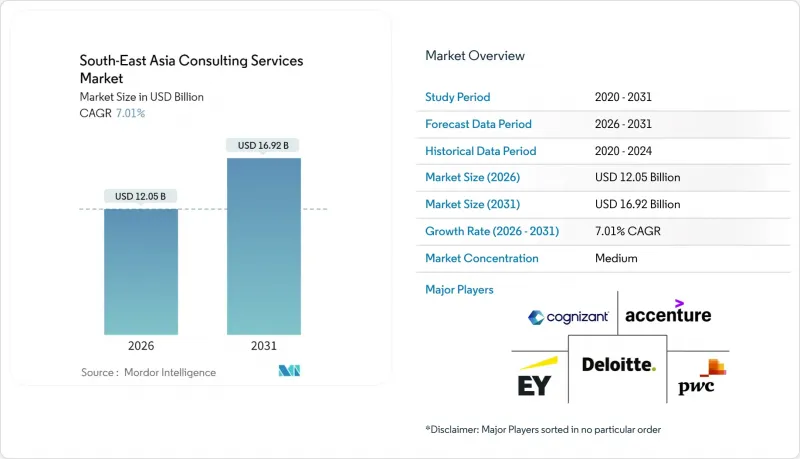
預計到 2026 年,東南亞諮詢服務市場規模將達到 120.5 億美元。
這意味著從 2025 年的 112.6 億美元成長到 2031 年的 169.2 億美元,2026 年至 2031 年的複合年成長率為 7.01%。
推動東協十國諮詢需求的關鍵因素包括:政府主導的強力的數位化藍圖、強制性的永續發展報告以及中小企業的快速發展。企業競相升級舊有應用程式並整合人工智慧平台,因此在IT和數位化諮詢上投入大量資金。同時,透明環境資訊揭露的推動也帶動了對永續發展和ESG諮詢的需求。此外,為了滿足客戶的持續需求,收入週期也在進行重組,從一次性計劃轉向基於訂閱的諮詢模式。利用雲端原生交付和獨立人才平台的專業顧問公司正在價格和敏捷性方面挑戰傳統企業。此外,「中國+1」供應鏈的重組正推動製造業向越南、泰國和馬來西亞轉移,催生了對跨境監管服務的需求。
東南亞諮詢服務市場趨勢與洞察
數位優先轉型計劃
新加坡的智慧國家計畫和馬來西亞的數位投資局等政府項目,全部區域的轉型計劃投入總計480億美元。印尼計畫將27,000個公共部門應用程式整合為9個超級應用程式,這凸顯了變革管理、網路安全和雲端遷移的複雜性,而這些都需要專家諮詢。新加坡的Analytics.gov平台目前為超過1600個公共部門使用者提供支持,凸顯了資料管治、人工智慧模型建構和多機構流程協調所需的諮詢工作的重要性。泰國電力局採用PLEXOS進行電網最佳化,顯示能源產業對資源規劃諮詢的需求日益成長。這些舉措表明,企業架構、管治和員工技能發展的多年合約為何是東南亞諮詢服務市場穩定的收入來源。
小型企業和Start-Ups的快速成長需要擴充性的建議
佔東協企業總數97%的中小微型微企業(MSMEs)面臨3,000億美元的資金缺口,促使各國政府和援助機構補貼獲得諮詢服務。 [HSBC.COM] 遠低於傳統每日350至1500美元收費標準的訂閱模式已廣受歡迎,使企業家能夠以每日250至1600美元的價格獲得獨立專家的按需指導。越南的創投生態系統得到了InnoVen Capital 190筆融資的支持,顯示高成長型Start-Ups對資金籌措、單位經濟效益和打入市場策略諮詢的需求旺盛。諸如東協社會企業發展計畫4.0等機構計畫提供培訓和高達4萬美元的種子津貼,進一步擴大了諮詢基本客群。隨著創辦人將永續盈利放在首位,對具備資本效率和 ESG 整合專業知識的顧問的需求不斷成長,從而增強了東南亞諮詢服務市場的長期成長勢頭。
擴大內部諮詢部門
像星展銀行這樣的金融機構正在組建內部數位轉型團隊,以減少對外部顧問在日常分析、網路安全和DevOps任務方面的依賴。這些專業團隊擁有豐富的組織知識,並與企業文化緊密契合,其執行速度正日益達到甚至超過外部顧問的水平。隨著越來越多的公司採用這種模式,一些常規諮詢職能被納入內部,導致商品化服務帶來的收入成長放緩。然而,複雜的多市場轉型、陌生的監管變化以及獨立的董事會審核仍然需要外部的客觀性,因此對高附加價值工作的需求仍然存在。諮詢公司正透過深化專業化並提供難以由內部團隊複製的、基於績效的諮詢服務來應對這一需求。
細分市場分析
到了2025年,IT和數位化顧問將佔總營收的37.02%,這凸顯了企業迫切需要逐步淘汰傳統技術堆疊、採用雲端原生架構並部署人工智慧工作負載。在超大規模雲端投資和公共部門數位化轉型的推動下,東南亞地區該領域的諮詢服務市場規模預計將穩定成長。永續發展和ESG諮詢將以17.55%的複合年成長率成長,這得益於新加坡2025年ESG報告強制令以及泰國SET ESG評級體系更名以與富時羅素標準接軌。隨著客戶對整合數位化和ESG的藍圖的需求日益成長,企業正在對技術人員進行碳核算框架的交叉培訓。策略和營運諮詢正受益於製造業「中國+1」策略轉型,而風險和合規顧問則正利用資料本地化方法各異導致的部署架構碎片化問題獲利。儘管有 30-70% 的技術職缺,但人力資源諮詢依然強勁,推動了人才分析和勞動力規劃計劃。
顧問公司正將人工智慧助理融入交付流程,以實現文件審核和情境建模的自動化,從而縮短迭代周期並提高諮詢利潤率。像Tact Social Consulting這樣的公司已與超大規模資料中心業者雲端服務供應商合作,將雲端積分與ESG諮詢服務捆綁銷售,並在泰國贏得了企業試點計畫。隨著以結果為基礎的收費系統模式取代按小時計費模式,服務提供者正透過成本節約、風險緩解或碳減排指標來量化價值——這種方法引起了追求透明度的財務長們的共鳴。在東南亞諮詢服務市場,儘管永續發展工作激增,但預計到2031年,數位化諮詢收入的佔有率仍將維持在35%以上。這表明,融合技術和ESG需求的雙管齊下成長模式將持續存在。
到2025年,金融服務業將佔總支出的27.05%,這主要得益於全面的數位銀行藍圖、開放的API支援以及嚴格的反洗錢措施。泰國開泰銀行(KBank)旗下的KBTG以及越南MSB與Backbase的合作項目,都是機構投資全通路平台和人工智慧驅動的信貸引擎的典型案例。能源和公共產業行業將以14.06%的複合年成長率實現最快成長,這主要得益於電網現代化和可再生能源併網計劃,例如泰國的PLEXOS部署和印尼東爪哇首個數位化變電站。隨著電子和汽車公司重組供應鏈,製造業諮詢的需求正在激增。同時,通訊業者正將高價值資本支出集中在5G和資料中心擴建,吸引了對基礎設施諮詢服務的需求。
隨著印尼九大超級應用的整合,政府和公共部門的交易激增,推動了對專案管理辦公室、網路安全和服務設計等領域專業知識的需求。在零售和電子商務領域,由於預計到2025年行動錢包帳戶數量將達到4.4億,客戶體驗重塑和詐欺分析成為關注焦點。醫療保健提供者正在向雲端遷移,以縮短理賠處理時間並改善患者分診,這為符合HIPAA標準的替代解決方案和舊有系統退役創造了諮詢機會。這些領域的共同作用,維持了強勁的交易管道,再次鞏固了東南亞諮詢服務市場作為新興亞洲經濟體諮詢業務中心的地位。
其他福利:
- Excel格式的市場預測(ME)表
- 3個月的分析師支持
目錄
第1章 引言
- 研究假設和市場定義
- 調查範圍
第2章調查方法
第3章執行摘要
第4章 市場洞察
- 市場概覽
- 市場促進因素
- 數位優先轉型計劃
- 小型企業和Start-Ups的快速成長正在推動擴充性諮詢服務的需求。
- 人工智慧、分析和雲端平台採用
- 政府數位經濟藍圖及外國直接投資流入
- 強制性ESG報告推動永續性諮詢
- 中國+1供應鏈重組及東協的轉型
- 市場限制
- 建立內部諮詢部門
- 產品同質化導致價格下降
- 雙語專家短缺
- 數據主權和居住限制
- 價值鏈分析
- 監管環境
- 技術展望
- 波特五力分析
- 供應商的議價能力
- 買方的議價能力
- 新進入者的威脅
- 替代品的威脅
- 競爭對手之間的競爭
- 產業生態系分析
- 主要用例和案例研究
- 宏觀經濟趨勢評估
- 投資分析
第5章 市場規模與成長預測
- 按服務類型
- 人力資源諮詢
- 財務諮詢
- IT與數位諮詢
- 策略與商業諮詢
- 風險與合規諮詢
- 永續發展與ESG諮詢
- 按最終用戶行業分類
- 金融服務
- 生命科學與醫療保健
- IT/通訊
- 政府/公共部門
- 能源與公共產業
- 製造業
- 零售與電子商務
- 依諮詢類型
- 企劃為基礎的諮詢
- 諮詢合約類型:諮詢
- 託管服務/外包
- 諮詢服務(訂閱制)
- 按公司規模
- 中小企業
- 主要企業
- 按國家/地區
- 新加坡
- 印尼
- 泰國
- 越南
- 菲律賓
- 馬來西亞
- 東南亞及其他地區
第6章 競爭情勢
- 市場集中度
- 策略趨勢
- 市佔率分析
- 公司簡介
- Accenture plc
- Deloitte Touche Tohmatsu Limited
- PricewaterhouseCoopers International Limited(PwC)
- Ernst and Young Global Limited
- KPMG International Limited
- McKinsey & Company, Inc.
- Boston Consulting Group, Inc.
- Bain & Company, Inc.
- Cognizant Technology Solutions Corporation
- Tata Consultancy Services Limited
- Wipro Limited
- Mercer LLC
- Aon plc
- Protiviti Inc.
- AT Kearney, Inc.
- Roland Berger Holding GmbH
- LEK Consulting LLC
- Frost & Sullivan, Inc.
- RSM International Limited
- YCP Holdings Limited
第7章 市場機會與未來展望
The South-East Asia consulting services market size in 2026 is estimated at USD 12.05 billion, growing from 2025 value of USD 11.26 billion with 2031 projections showing USD 16.92 billion, growing at 7.01% CAGR over 2026-2031.
Robust government-led digitalization roadmaps, mandatory sustainability reporting, and rapid SME formation are the primary forces expanding advisory demand across the ten ASEAN member states. Enterprises racing to modernize legacy applications and integrate AI platforms are channeling the largest spending into IT and Digital Consulting, while the push for transparent environmental disclosures propels Sustainability and ESG advisory uptake. Concurrently, a pivot from episodic projects to subscription-based advisory models is reshaping revenue cycles as clients favor continuous support. Boutiques leveraging cloud-native delivery and independent talent platforms now challenge incumbents on price and agility, while China+1 supply-chain realignment sends manufacturers to Vietnam, Thailand, and Malaysia, unlocking cross-border regulatory workstreams.
South-East Asia Consulting Services Market Trends and Insights
Digital-first Transformation Programmes
Government programmes such as Singapore's Smart Nation initiative and Malaysia's Digital Investment Office are collectively injecting USD 48 billion into regional transformation projects . Indonesia's plan to merge 27,000 public-sector apps into nine super-apps exemplifies the complexity of change management, cybersecurity, and cloud migration tasks that demand specialized advice. Singapore's Analytics.gov platform, now supporting more than 1,600 public-sector users, highlights the consultative work required to govern data, build AI models, and align multi-agency processes. Thailand's electricity authority chose PLEXOS for grid optimization, signaling rising need for resource-planning advisory across energy utilities. Together these initiatives demonstrate why multi-year engagements around enterprise architecture, governance, and talent upskilling form a resilient revenue stream for the South-East Asia consulting services market.
SME and Start-up Boom Demanding Scalable Advice
Ninety-seven percent of ASEAN businesses are MSMEs, and they face a USD 300 billion funding deficit, prompting governments and donors to subsidize advisory access [HSBC.COM]. Subscription models priced well below the traditional USD 350-1,500 daily rate are gaining ground, enabling founders to secure on-call guidance using independent experts billing USD 250-1,600 per day. Vietnam's venture ecosystem, supported by InnoVen Capital's 190 loans, illustrates the appetite for fundraising, unit economics, and go-to-market consulting among high-growth startups. Institutional programs such as the ASEAN Social Enterprise Development Programme 4.0 supply training and seed grants up to USD 40,000, further widening the advisory client base. As founders prioritize sustainable profitability, demand rises for consultants versed in capital efficiency and ESG integration, reinforcing long-term momentum for the Southeast Asia consulting services market.
Corporate In-house Consulting Build-outs
Financial institutions such as DBS have cultivated internal digital-transformation squads, reducing dependence on third-party advisors for day-to-day analytics, cybersecurity, and DevOps mandates. These captive units accumulate institutional knowledge and align tightly with corporate culture, often matching or outpacing external consultants on speed of execution. As more enterprises replicate the model, a portion of routine advisory spend migrates in-house, trimming revenue growth for commoditized services. However, complex multi-market transformations, unfamiliar regulatory changes, and independent board-mandated reviews still require external objectivity, preserving scope for high-value engagements. Consulting firms are responding by deepening specialization and offering outcome-based contracts that internal teams struggle to replicate.
Other drivers and restraints analyzed in the detailed report include:
- Adoption of AI, Analytics and Cloud Platforms
- Government Digital-Economy Road-maps and FDI Inflows
- Price Erosion from Commoditized Offerings
For complete list of drivers and restraints, kindly check the Table Of Contents.
Segment Analysis
IT and Digital Consulting contributes 37.02% of 2025 revenue, underscoring enterprise urgency to decommission legacy stacks, adopt cloud-native architectures, and deploy AI workloads. The Southeast Asia consulting services market size for this segment is forecast to expand steadily alongside hyperscale cloud investments and public-sector digital mandates. Sustainability and ESG Consulting, growing at an 17.55% CAGR, gains momentum from Singapore's 2025 compulsory ESG reporting and Thailand's re-branded SET ESG Ratings that align with FTSE Russell standards . Clients increasingly demand integrated digital-plus-ESG roadmaps, prompting firms to cross-train technologists in carbon-accounting frameworks. Strategy and Operations Consulting benefits from manufacturers' China+1 shifts, while Risk and Compliance advisors capitalize on divergent data-localization laws that fragment deployment architectures. HR Consulting remains resilient as 30-70% of tech roles sit vacant, driving projects in talent analytics and workforce planning.
Consultancies now embed AI copilots into delivery, automating document review and scenario modeling, thus shortening sprint cycles and elevating advisory margins. Firms like Tact Social Consulting partner with hyperscalers to bundle cloud credits with ESG advisory, winning enterprise pilots across Thailand. As output-based fees displace billable-hour models, providers quantify value via cost savings, risk mitigation, or carbon-reduction metrics, an approach that resonates with CFOs seeking transparency. The South-East Asia consulting services market share of digital advisory revenue is projected to hold above 35% through 2031 despite the surge in sustainability work, indicating a durable dual-track growth pattern that fuses technology and ESG imperatives.
Financial Services represented 27.05% of 2025 spending, anchored by exhaustive digital banking roadmaps, open-API compliance, and stringent anti-money-laundering rules. KBank's KBTG unit and Vietnam's MSB-Backbase partnership are emblematic of institutions investing in omnichannel platforms and AI-enabled credit engines. Energy and Utilities produces the fastest expansion at 14.06% CAGR, fueled by grid modernization and renewable-integration projects such as Thailand's PLEXOS deployment and Indonesia's first digital substation in East Java. Manufacturing consulting demand swells as electronics and automotive firms replot supply chains, while telecom operators channel big-ticket capex into 5G and data-center buildouts, attracting infrastructure advisory.
Government and Public Sector engagements escalate with Indonesia's nine-super-app consolidation, pushing requirements for program management offices, cybersecurity, and service-design expertise. Retail and E-commerce assignments focus on customer-journey redesign and fraud analytics as mobile wallets multiply to an expected 440 million accounts by 2025. Healthcare providers pursue cloud migrations to compress claims-processing times and improve patient triage, opening avenues for HIPAA-analog compliance and legacy-system decommissioning consulting. Collectively, these verticals sustain a robust pipeline, reaffirming the South-East Asia consulting services market as the advisory hotspot within emerging Asian economies.
The Southeast Asia Consulting Services Market Report is Segmented by Service Type (HR Consulting, Financial Consulting, and More), End-User Industry (Financial Services, Life Sciences and Healthcare, IT and Telecommunications, and More), Consulting Model (Project-Based Advisory, Retainer-Based Advisory, and More), Firm Size (SMEs, and Large Enterprises), and Country. The Market Forecasts are Provided in Terms of Value (USD).
List of Companies Covered in this Report:
- Accenture plc
- Deloitte Touche Tohmatsu Limited
- PricewaterhouseCoopers International Limited (PwC)
- Ernst and Young Global Limited
- KPMG International Limited
- McKinsey & Company, Inc.
- Boston Consulting Group, Inc.
- Bain & Company, Inc.
- Cognizant Technology Solutions Corporation
- Tata Consultancy Services Limited
- Wipro Limited
- Mercer LLC
- Aon plc
- Protiviti Inc.
- A.T. Kearney, Inc.
- Roland Berger Holding GmbH
- L.E.K. Consulting LLC
- Frost & Sullivan, Inc.
- RSM International Limited
- YCP Holdings Limited
Additional Benefits:
- The market estimate (ME) sheet in Excel format
- 3 months of analyst support
TABLE OF CONTENTS
1 INTRODUCTION
- 1.1 Study Assumptions and Market Definition
- 1.2 Scope of the Study
2 RESEARCH METHODOLOGY
3 EXECUTIVE SUMMARY
4 MARKET INSIGHTS
- 4.1 Market Overview
- 4.2 Market Drivers
- 4.2.1 Digital-first transformation programmes
- 4.2.2 SME and start-up boom demanding scalable advice
- 4.2.3 Adoption of AI, analytics and cloud platforms
- 4.2.4 Government digital-economy road-maps and FDI inflows
- 4.2.5 Mandatory ESG-reporting fuelling sustainability advisory
- 4.2.6 China+1 supply-chain realignment into ASEAN
- 4.3 Market Restraints
- 4.3.1 Corporate in-house consulting build-outs
- 4.3.2 Price erosion from commoditised offerings
- 4.3.3 Shortage of bilingual domain experts
- 4.3.4 Data-sovereignty and residency barriers
- 4.4 Value Chain Analysis
- 4.5 Regulatory Landscape
- 4.6 Technological Outlook
- 4.7 Porter's Five Forces Analysis
- 4.7.1 Bargaining Power of Suppliers
- 4.7.2 Bargaining Power of Buyers
- 4.7.3 Threat of New Entrants
- 4.7.4 Threat of Substitutes
- 4.7.5 Competitive Rivalry
- 4.8 Industry Ecosystem Analysis
- 4.9 Key Use Cases and Case Studies
- 4.10 Assessment of Macroeconomic Trends
- 4.11 Investment Analysis
5 MARKET SIZE AND GROWTH FORECASTS (VALUE)
- 5.1 By Service Type
- 5.1.1 HR Consulting
- 5.1.2 Financial Consulting
- 5.1.3 IT and Digital Consulting
- 5.1.4 Strategy and Operations Consulting
- 5.1.5 Risk and Compliance Consulting
- 5.1.6 Sustainability and ESG Consulting
- 5.2 By End-user Industry
- 5.2.1 Financial Services
- 5.2.2 Life Sciences and Healthcare
- 5.2.3 IT and Telecommunications
- 5.2.4 Government and Public Sector
- 5.2.5 Energy and Utilities
- 5.2.6 Manufacturing
- 5.2.7 Retail and E-commerce
- 5.3 By Consulting Model
- 5.3.1 Project-based Advisory
- 5.3.2 Retainer-based Advisory
- 5.3.3 Managed Services / Outsourcing
- 5.3.4 Advisory-as-a-Service (Subscription)
- 5.4 By Firm Size
- 5.4.1 Small and Medium Enterprises (SMEs)
- 5.4.2 Large Enterprises
- 5.5 By Country
- 5.5.1 Singapore
- 5.5.2 Indonesia
- 5.5.3 Thailand
- 5.5.4 Vietnam
- 5.5.5 Philippines
- 5.5.6 Malaysia
- 5.5.7 Rest of Southeast Asia
6 COMPETITIVE LANDSCAPE
- 6.1 Market Concentration
- 6.2 Strategic Moves
- 6.3 Market Share Analysis
- 6.4 Company Profiles (includes Global level Overview, Market level overview, Core Segments, Financials as available, Strategic Information, Market Rank/Share for key companies, Products and Services, and Recent Developments)
- 6.4.1 Accenture plc
- 6.4.2 Deloitte Touche Tohmatsu Limited
- 6.4.3 PricewaterhouseCoopers International Limited (PwC)
- 6.4.4 Ernst and Young Global Limited
- 6.4.5 KPMG International Limited
- 6.4.6 McKinsey & Company, Inc.
- 6.4.7 Boston Consulting Group, Inc.
- 6.4.8 Bain & Company, Inc.
- 6.4.9 Cognizant Technology Solutions Corporation
- 6.4.10 Tata Consultancy Services Limited
- 6.4.11 Wipro Limited
- 6.4.12 Mercer LLC
- 6.4.13 Aon plc
- 6.4.14 Protiviti Inc.
- 6.4.15 A.T. Kearney, Inc.
- 6.4.16 Roland Berger Holding GmbH
- 6.4.17 L.E.K. Consulting LLC
- 6.4.18 Frost & Sullivan, Inc.
- 6.4.19 RSM International Limited
- 6.4.20 YCP Holdings Limited
7 MARKET OPPORTUNITIES AND FUTURE OUTLOOK
- 7.1 White-space and Unmet-Need Assessment

 企業敏捷轉型服務市場:2026-2032年全球市場預測(依服務類型、調查方法、轉型階段、合約模式、部署模式、產業及組織規模分類)
 2026年全球IT諮詢市場報告2026年全球企業敏捷轉型服務市場報告
 企業敏捷轉型服務市場規模、佔有率、趨勢和預測:按方法論、服務類型、組織規模、產業和地區分類,2026-2034 年2026年全球公司秘書服務市場報告2026年全球房地產諮詢服務市場報告2026年全球精算諮詢服務市場報告2026年全球設計、研究、促銷與諮詢服務市場報告
 2026-2030年全球行銷諮詢市場
 永續發展諮詢服務:市場佔有率分析、產業趨勢與統計、成長預測(2026-2031)