


 |
市場調查報告書
商品編碼
1937349
歐洲電動巴士:市場佔有率分析、產業趨勢與統計、成長預測(2026-2031)Europe Electric Bus - Market Share Analysis, Industry Trends & Statistics, Growth Forecasts (2026 - 2031) |
||||||

※ 本網頁內容可能與最新版本有所差異。詳細情況請與我們聯繫。
2025年歐洲電動巴士市場規模為44.6億美元,預計從2026年的54.9億美元成長到2031年的155.8億美元。
預計在預測期(2026-2031 年)內,複合年成長率將達到 23.18%。
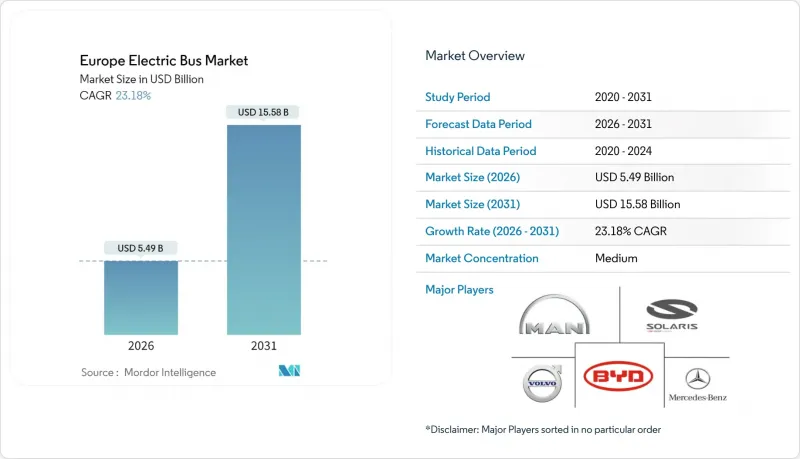
歐盟層面嚴格的二氧化碳排放標準、不斷擴大的清潔車輛採購配額以及電動巴士與柴油巴士日益擴大的總擁有成本 (TCO) 差距,使得純電動巴士成為市政車隊的標配。電池價格的持續下降、歐盟10億歐元的充電基礎建設資金,以及預計自2027年起因歐盟碳排放交易體系(ETS-2)實施而導致的柴油燃料成本上漲,都在推動營運商對電動化的支持。在監管確定性、經濟效益改善以及企業對永續性品牌日益成長的需求等因素的共同推動下,歐洲電動巴士市場有望迎來一個強勁的投資週期。
歐洲電動巴士市場趨勢與洞察
從2026年起,與柴油車相比,總擁有成本將下降。
到2024年,由於磷酸鐵鋰電池的廣泛應用,電池價格大幅下降,與鎳鈷錳酸鋰電池相比,電池組成本降低了約20%。考慮到維護成本的降低以及歐盟排放交易體系第二階段(ETS-2)碳課稅的影響,預計2025年購買的電動公車將在運作四年內實現與柴油車相同的總擁有成本(TCO)。梅賽德斯-奔馳eCitaro在柏林和烏特勒支的初步部署,由於動力傳動系統中易損件減少,年度維護成本降低了30%以上。車隊營運商目前正在推廣三班倒的運作模式,將電動利用率提高到96%以上,從而加快了投資回報。這些經濟效益增強了私部門的信心,並解釋了2025年專業電動公車業者的創業投資資金成長18%的原因。
歐盟清潔車輛指令截止日期
《清潔車輛指令》下的強制性採購目標消除了城市交通機構的不確定性,並有助於就整合車輛供應和充電解決方案的多年期合約競標。德國的《清潔車輛採購法》規定,2026年至2030年間,清潔車輛的採購比例必須提高到65%,其中一半必須是零排放車輛。法國和西班牙也在製定類似的立法,將需求集中到可預測的大規模批量採購中,使製造商能夠最佳化生產線並降低單位成本。各國在整合不同合約實體的目標方面柔軟性,這也提高了採購能力,使小規模的城市能夠享受批量折扣。因此,到2024年,歐盟都市區新增公車中已有超過49%是零排放車輛,預計到2027年這一比例將超過70%。
現有倉庫併網瓶頸
由於公共產業面臨長期核准積壓,專為柴油車建造的設施的變電站和電纜升級工程仍然延誤。米蘭和慕尼黑的營運商報告稱,他們等待2兆瓦的併網時間超過18個月,迫使他們暫時依賴行動充電器,這限制了夜間的用電量。歐盟委員會的電網行動計畫預測,到2030年,電力需求將增加60%,但許多城市中心幾乎沒有剩餘的電纜容量來支援集中充電。這些延誤導致合約生效日期推遲,並可能推高車庫改造預算,儘管交付充足,但短期訂單計劃仍面臨不確定性。
細分市場分析
到2025年,純電動車技術將佔據歐洲電動巴士市場81.95%的佔有率,這主要得益於監管要求和成熟的供應鏈縮小了採購價格差距。強力的政策支持、簡化的動力系統以及電池成本的下降預計將推動該細分市場在2031年前實現24.10%的複合年成長率。燃料電池巴士仍然是日行駛里程超過400公里線路的戰略選擇,但氫氣加註站的缺乏限制了其普及。插電式混合動力巴士目前主要以過渡性合約運營,因為其車庫維修尚未完成。
製造商正在電動和氫燃料電池公車產品線中實現電力電子和溫度控管系統的標準化,從而降低研發成本。索拉里斯公司訂單,同時保持純電動公車的量產,使其能夠靈活應對不斷變化的政策趨勢。由於地方政府的大量補貼側重於「零排放」目標而非特定技術,車隊管理者仍然選擇純電動公車,因為它們符合短期監管要求且成本可靠,這將鞏固其在未來五年內在該領域的主導地位。
2025年,磷酸鋰鐵鋰電池組將佔據歐洲電動巴士市場48.75%的佔有率,並以24.60%的複合年成長率(CAGR)成為該品類成長最快的市場,直到2031年。這主要得益於其成本優勢和卓越的熱穩定性,符合營運商的安全和經濟效益考量。此電池化學體系擁有超過4000次充放電循環的壽命,無需中期更換電池即可實現長達12年的資產生命週期規劃,進而降低全生命週期資本支出。雷諾選擇從寧德時代(CATL)的匈牙利工廠採購磷酸鐵鋰電池模組,體現了整車製造商對歐洲供應穩定性的信心。對於需要高能量密度的鉸接式巴士而言,鎳錳鈷酸鋰(NiMCO)電池仍然是首選,但鈷價上漲和日益嚴格的ESG(環境、社會和治理)審查對其構成了不利影響。
歐洲電動巴士市場的擴張得益於磷酸鐵鋰電池(LFP)的普及,而鐵基複合材料(NMC)車輛相比,電池保固索賠數量呈下降趨勢,這表明技術風險有所降低。鈉離子電池的研究可能會在預測期內帶來一種新的低成本電池方案,但商業化規模應用不太可能在2030年之前實現,預計磷酸鐵鋰電池仍將佔據主導地位。
其他福利:
- Excel格式的市場預測(ME)表
- 分析師支持(3個月)
目錄
第1章 引言
- 研究假設和市場定義
- 調查範圍
第2章調查方法
第3章執行摘要
第4章 市場情勢
- 市場概覽
- 市場促進因素
- 歐盟清潔車輛指令合規期限
- 自2026年起,柴油車的總擁有成本將降低
- 國內零排放公共採購分配
- 透過在倉庫安裝儲能電池來降低尖峰時段的用電費用
- 利用電池即服務合約降低資本投資風險
- 歐盟排放交易體系(ETS-2)下不斷上漲的碳價將增加柴油車的營運成本,並加速電動公車的轉型。
- 市場限制
- 現有車輛段電網連接瓶頸
- 第一代電動公車的殘值存在很大的不確定性。
- 歐盟可能對中國製造的電動公車徵收關稅,這可能會增加系統成本。
- 持證高壓維修技術人員短缺
- 價值/供應鏈分析
- 監管環境
- 技術展望
- 波特五力模型
- 新進入者的威脅
- 買方的議價能力
- 供應商的議價能力
- 替代品的威脅
- 競爭對手之間的競爭
第5章 市場規模及成長預測(價值(美元))
- 依推進類型
- 電池電動巴士(BEB)
- 插電式混合動力電動巴士(PHEB)
- 燃料電池電動巴士(FCEB)
- 電池化學
- 磷酸鋰鐵(LFP)
- 鋰鎳錳鈷氧化物(NMC)
- 鎳氫電池(NiMH)
- 其他(鈉離子電池、全固態電池)
- 按巴士長度
- 小於9米
- 9-14公尺(標準)
- 超過14公尺(鉸接式巴士/雙層巴士)
- 依消費者類型
- 政府/市政交通
- 私家車營運商
- 透過使用
- 城市交通
- 城際/區域間
- 機場和接駁車服務
- 按國家/地區
- 德國
- 英國
- 法國
- 義大利
- 西班牙
- 荷蘭
- 挪威
- 波蘭
- 瑞典
- 芬蘭
- 比利時
- 瑞士
- 其他歐洲地區
第6章 競爭情勢
- 市場集中度
- 策略趨勢
- 市佔率分析
- 公司簡介
- Solaris Bus & Coach sp. z oo
- MAN Truck & Bus
- Mercedes-Benz Group AG
- Volvo Buses
- BYD Auto Co., Ltd
- VDL Bus & Coach
- Ebusco
- IVECO Group
- Scania
- Otokar
- Van Hool
- Yutong Europe
- Irizar e-mobility
- Wrightbus
- Karsan
- CaetanoBus
- Temsa
- Bozankaya
- Switch Mobility
第7章 市場機會與未來展望
The Europe electric bus market size was valued at USD 4.46 billion in 2025 and estimated to grow from USD 5.49 billion in 2026 to reach USD 15.58 billion by 2031, at a CAGR of 23.18% during the forecast period (2026-2031).
Aggressive EU-level CO2 standards, expanding clean-vehicle procurement quotas, and widening gaps in total cost of ownership versus diesel have converged to make battery-electric buses the default option for municipal fleets. Operators increasingly favor electrification because battery prices continue to fall, charging infrastructure is backed by a EUR 1 billion EU funding stream, and ETS-2 carbon pricing is set to raise diesel fuel costs from 2027. The Europe electric bus market, therefore, combines regulatory certainty with improving economics and rising corporate appetite for sustainability branding, reinforcing the investment cycle.
Europe Electric Bus Market Trends and Insights
Falling Total Cost of Ownership Versus Diesel After 2026
Battery prices fell sharply in 2024 on wider LFP adoption, cutting pack costs by about 20% compared with NMC. When maintenance savings and ETS-2 carbon charges are added, an electric bus purchased in 2025 is projected to reach TCO parity with a diesel unit within four years of service. Early deployments of the Mercedes-Benz eCitaro in Berlin and Utrecht reveal annual maintenance savings exceeding 30% thanks to fewer drivetrain wear parts. Fleet operators are now standardizing three-shift duty cycles that push electric utilization above 96%, which accelerates payback. Such economics underpin private-sector confidence and explain why venture funding for specialized e-bus operators climbed 18% in 2025 .
EU Clean-Vehicles Directive Deadlines
Binding procurement targets under the Clean-Vehicles Directive remove uncertainty for city transport agencies, prompting multi-year tenders that bundle vehicle supply and charging solutions. Germany's Saubere-Fahrzeuge-Beschaffungs-Gesetz lifts required clean-vehicle purchases to 65% for 2026-2030, half of which must be zero-emission. Similar transpositions in France and Spain are clustering demand into large, predictable tranches that let manufacturers optimize production lines and reduce per-unit costs. National flexibility to pool targets across contracting authorities also raises purchasing power, helping smaller cities gain volume discounts. As a result, more than 49% of new EU city buses were already zero-emission in 2024, a share expected to exceed 70% by 2027 .
Grid-Connection Bottlenecks at Legacy Depots
Upgrading substations and cabling at sites built for diesel fleets remains slow because utilities face long permitting backlogs. Operators in Milan and Munich report waits of 18 months or more for 2-MW connections, forcing interim reliance on mobile chargers that limit overnight energy intake. The European Commission's Action Plan for Grids identifies a 60% increase in electricity demand by 2030, yet many city centers have little spare cabling capacity to handle clustered charging. Delays can push back contract start dates and inflate depot conversion budgets, cooling near-term delivery schedules despite healthy order books.
Other drivers and restraints analyzed in the detailed report include:
- National Zero-Emission Public-Procurement Quotas
- On-Site Depot Battery-Storage Shaving Peak-Demand Charges
- Residual-Value Uncertainty for First-Generation E-Buses
For complete list of drivers and restraints, kindly check the Table Of Contents.
Segment Analysis
Battery-electric technology controlled 81.95% of the Europe electric bus market in 2025, driven by regulatory mandates and the maturing supply chain that reduce purchase price gaps. Strong policy backing, simpler drivetrains, and falling battery costs support a 24.10% CAGR for the segment through 2031. Fuel-cell buses remain a strategic hedge for routes exceeding 400 km daily, but scarce hydrogen refueling sites restrict widespread adoption. Plug-in hybrids now serve mostly in transitional contracts where depot upgrades are incomplete.
Manufacturers are standardizing power electronics and thermal-management systems across their electric and hydrogen lines, which lowers development expense. Solaris is executing a 130-unit hydrogen order for Bologna while maintaining battery-electric production at volume, ensuring flexibility if policy signals shift. Because heavy municipal subsidies target zero tailpipe emissions rather than a specific technology, fleet managers continue to pick battery-electric options for near-term compliance and cost reliability, cementing segment leadership for the next five years.
Lithium-iron-phosphate packs captured 48.75% Europe electric bus market share in 2025 and lead the category with the fastest projected expansion of 24.60% CAGR through 2031, driven by cost advantages and superior thermal stability that resonate with operator safety and economic priorities. The chemistry's cycle life of 4,000+ charge events helps operators plan for 12-year asset lives without mid-life battery swaps, cutting lifetime capex. Renault's decision to source LFP modules from CATL's Hungarian plant illustrates OEM confidence in European supply security. Lithium nickel manganese cobalt oxide remains the chemistry of choice for articulated buses that need high energy density, but rising cobalt prices and ESG scrutiny create headwinds.
Europe electric bus market size gains tied to LFP are reinforced by EU Battery Regulation recycled-content quotas that are easier to meet with iron-based cathodes. Operators in Helsinki and Vienna report battery warranty claims trending lower than early NMC fleets, signaling reduced technical risk. Over the forecast horizon, sodium-ion research may add yet another low-cost chemistry, but commercial scale is unlikely before 2030, leaving LFP dominant.
The Europe Electric Bus Market Report is Segmented by Propulsion Type (Battery Electric Bus (BEB), Plug-In Hybrid Electric Bus (PHEB), and More), Battery Chemistry (Lithium-Iron-Phosphate (LFP), Nickel-Metal Hydride (NiMH), and More), Bus Length (Less Than 9 M, 9-14 M (Standard), and More), Consumer Type, Application and Country. The Market Forecasts are Provided in Terms of Value (USD).
List of Companies Covered in this Report:
- Solaris Bus & Coach sp. z o.o.
- MAN Truck & Bus
- Mercedes-Benz Group AG
- Volvo Buses
- BYD Auto Co., Ltd
- VDL Bus & Coach
- Ebusco
- IVECO Group
- Scania
- Otokar
- Van Hool
- Yutong Europe
- Irizar e-mobility
- Wrightbus
- Karsan
- CaetanoBus
- Temsa
- Bozankaya
- Switch Mobility
Additional Benefits:
- The market estimate (ME) sheet in Excel format
- 3 months of analyst support
TABLE OF CONTENTS
1 Introduction
- 1.1 Study Assumptions & Market Definition
- 1.2 Scope of the Study
2 Research Methodology
3 Executive Summary
4 Market Landscape
- 4.1 Market Overview
- 4.2 Market Drivers
- 4.2.1 EU Clean-Vehicles Directive compliance deadlines
- 4.2.2 Falling total-cost-of-ownership versus diesel after 2026
- 4.2.3 National zero-emission public-procurement quotas
- 4.2.4 On-site depot battery-storage shaving peak-demand charges
- 4.2.5 Battery-as-a-Service contracts lowering capex risk
- 4.2.6 Escalating EU carbon-pricing under ETS-2 boosts diesel operating costs, accelerating e-bus switch
- 4.3 Market Restraints
- 4.3.1 Grid-connection bottlenecks at legacy depots
- 4.3.2 High residual-value uncertainty for first-generation e-buses
- 4.3.3 Potential EU tariffs on Chinese e-buses could raise system costs
- 4.3.4 Shortage of certified high-voltage maintenance technicians
- 4.4 Value / Supply-Chain Analysis
- 4.5 Regulatory Landscape
- 4.6 Technological Outlook
- 4.7 Porter's Five Forces
- 4.7.1 Threat of New Entrants
- 4.7.2 Bargaining Power of Buyers
- 4.7.3 Bargaining Power of Suppliers
- 4.7.4 Threat of Substitutes
- 4.7.5 Intensity of Competitive Rivalry
5 Market Size & Growth Forecasts (Value (USD))
- 5.1 By Propulsion Type
- 5.1.1 Battery Electric Bus (BEB)
- 5.1.2 Plug-in Hybrid Electric Bus (PHEB)
- 5.1.3 Fuel-Cell Electric Bus (FCEB)
- 5.2 By Battery Chemistry
- 5.2.1 Lithium-Iron-Phosphate (LFP)
- 5.2.2 Lithium Nickel Manganese Cobalt Oxide (NMC)
- 5.2.3 Nickel-Metal Hydride (NiMH)
- 5.2.4 Others (Sodium-ion, Solid-state)
- 5.3 By Bus Length
- 5.3.1 Less than 9 m
- 5.3.2 9-14 m (Standard)
- 5.3.3 Above 14 m (Articulated/Double-decker)
- 5.4 By Consumer Type
- 5.4.1 Government / Municipal Transit Agencies
- 5.4.2 Private Fleet Operators
- 5.5 By Application
- 5.5.1 Intra-city Urban Transit
- 5.5.2 Inter-city & Regional
- 5.5.3 Airport & Shuttle Services
- 5.6 By Country
- 5.6.1 Germany
- 5.6.2 United Kingdom
- 5.6.3 France
- 5.6.4 Italy
- 5.6.5 Spain
- 5.6.6 Netherlands
- 5.6.7 Norway
- 5.6.8 Poland
- 5.6.9 Sweden
- 5.6.10 Finland
- 5.6.11 Belgium
- 5.6.12 Switzerland
- 5.6.13 Rest of Europe
6 Competitive Landscape
- 6.1 Market Concentration
- 6.2 Strategic Moves
- 6.3 Market Share Analysis
- 6.4 Company Profiles (includes Global Level Overview, Market Level Overview, Core Segments, Financials as Available, Strategic Information, Market Rank/Share for Key Companies, Products and Services, SWOT Analysis, and Recent Developments)
- 6.4.1 Solaris Bus & Coach sp. z o.o.
- 6.4.2 MAN Truck & Bus
- 6.4.3 Mercedes-Benz Group AG
- 6.4.4 Volvo Buses
- 6.4.5 BYD Auto Co., Ltd
- 6.4.6 VDL Bus & Coach
- 6.4.7 Ebusco
- 6.4.8 IVECO Group
- 6.4.9 Scania
- 6.4.10 Otokar
- 6.4.11 Van Hool
- 6.4.12 Yutong Europe
- 6.4.13 Irizar e-mobility
- 6.4.14 Wrightbus
- 6.4.15 Karsan
- 6.4.16 CaetanoBus
- 6.4.17 Temsa
- 6.4.18 Bozankaya
- 6.4.19 Switch Mobility
7 Market Opportunities & Future Outlook
- 7.1 White-space & Unmet-need Assessment

 2026年全球電動校車車輛管理市場報告
 學校和校園的電動出行解決方案市場預測(至2034年):按車輛類型、電池容量、驅動系統、乘客容量、應用和地區分類的全球分析
 電動中重型客車市場:依動力類型、車身尺寸、充電方式、所有權類型、電池容量和應用分類-2026-2032年全球市場預測
 電池驅動電動巴士市場:機會、成長要素、產業趨勢分析以及 2026 年至 2035 年的預測。
 全球電動巴士市場規模、佔有率、趨勢和成長分析報告(2026-2034年)全球電池驅動電動巴士市場規模、佔有率、趨勢和成長分析報告(2026-2034)燃料電池電動巴士全球市場規模、佔有率、趨勢和成長分析報告(2026-2034)
 日本電動巴士市場規模、佔有率、趨勢及預測(按動力方式、電池類型、車身長度、續航里程、電池容量和地區分類,2026-2034年)
 全球電動巴士市場:依電池類型、動力系統、應用、巴士尺寸、車身類型、充電方式、電池容量和地區劃分 - 市場規模、市場動態、主要參與者、機會分析和預測(2026-2035年)全球電動鉸接式城市公車市場:按推進技術、電池化學成分、充電方式、車輛長度和最終用戶分類的預測(2026-2032年)