


 |
市場調查報告書
商品編碼
1937346
美國陶瓷磚:市場佔有率分析、產業趨勢與統計、成長預測(2026-2031)US Ceramic Tiles - Market Share Analysis, Industry Trends & Statistics, Growth Forecasts (2026 - 2031) |
||||||

※ 本網頁內容可能與最新版本有所差異。詳細情況請與我們聯繫。
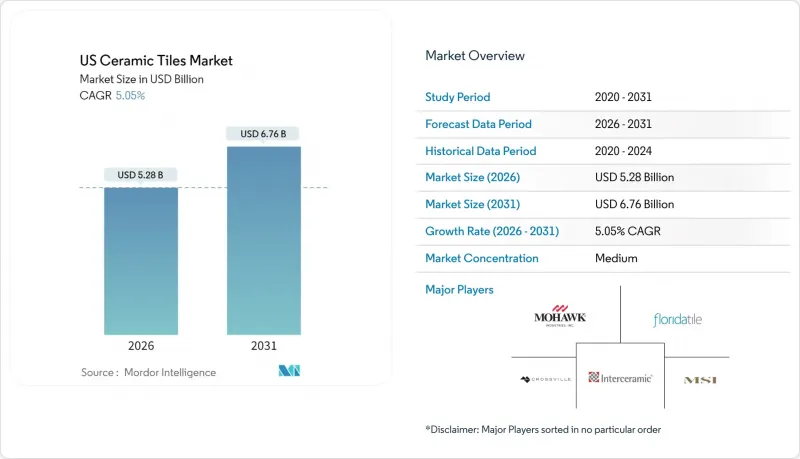
美國磁磚市場預計將從 2025 年的 50.3 億美元成長到 2026 年的 52.8 億美元,到 2031 年達到 67.6 億美元,2026 年至 2031 年的複合年成長率為 5.05%。
住宅翻新需求的成長、陽光地帶穩定的住宅開工量以及低VOC建築材料的監管激勵措施,都支撐著這項擴張。隨著反傾銷稅減少低成本進口產品,以及天然氣價格下跌降低燒製成本並支持國內生產競爭力,國內製造商的市場佔有率正在擴大。數位印刷技術、大尺寸瓷磚和地暖設計的普及,拓展了應用範圍並推高了平均售價。同時,熟練安裝人員的人手不足以及來自硬芯LVT(強化複合乙烯基瓷磚)日益激烈的競爭,限制了絕對銷量的成長。
美國陶瓷磚市場趨勢與分析
陽光地帶的住宅開工量依然強勁。
儘管其他地區的建築需求放緩,但陽光地帶的建築需求仍然強勁,預計佛羅裡達州2024年的建築材料銷售額將達到9.976億美元。有利的氣候、人口湧入以及有利於商業發展的政策,使得建築許可數量保持相對穩定,從而為瓷磚製造商提供了可預測的訂單。製造商正在最佳化圍繞這些高需求地區的物流網路,以降低運輸成本並縮短交貨時間。炎熱氣候下的節能標準認可了陶瓷的蓄熱性能,並鼓勵建築師指定使用陶瓷材料。瓷磚的防潮性和耐用性,以及持續的氣候調適投資,進一步提升了其吸引力。
擴大大塊瓷磚的使用
建築設計對無縫表面的偏好推動了6毫米和12毫米瓷磚面板的普及,這種面板減少了接縫,縮短了安裝時間。路易斯維爾瓷磚公司(Louisville Tile)於2025年推出的6毫米瓷磚面板就是一個很好的例子,它展示了預切割瓷磚如何解決安裝人員短缺的問題,同時又能實現高階定價。道爾托伊爾公司(Daltoil)在2025年KBIS展會上推出的超大尺寸瓷磚“ONE Quartz”,將大理石的美感延伸至人流量大的區域,且無需重複圖案。數位噴墨技術的進步使得在大尺寸表面上複製逼真的條紋成為可能,這使其區別於傳統的方形瓷磚。資本密集的瓷磚窯爐和拋光生產線構成了准入門檻,有利於擁有規模優勢的現有企業。這種規格也符合醫療保健、飯店和豪華住宅計劃的衛浴趨勢。
天然氣價格波動推高了爐子的成本。
能源成本約佔瓷器生產預算的30%,其中90%由天然氣供應。美國能源資訊署(EIA)預測,天然氣價格在2024年觸底至每百萬英熱單位2.21美元後,到2026年將上漲超過每百萬英熱單位4美元,這將給陶瓷製造商帶來壓力。大型企業集團可以透過多年期合約和汽電共生對沖來降低風險,而中小型獨立製造商則面臨利潤率壓力和價格轉嫁。能源價格波動也會重新平衡價格競爭力,因為進口的燃煤窯爐會影響價格,讓定價競爭更加複雜。投資電窯爐可以提供長期穩定性,但需要大量資金和電網升級,而這些都需要時間才能見效。
細分市場分析
截至2025年,陶瓷瓷磚在美國陶瓷磚市場佔有55.12%的佔有率,這主要得益於其低吸水率及適用於室內外無縫銜接的特性。先進的噴墨列印技術實現了深紋理、混凝土外觀和紡織紋理的呈現,突破了傳統設計的限制。製造商正在拓展瓷磚產品線,推出2公分厚的鋪路磚和6毫米厚的薄板,應用範圍從透氣外牆延伸至家具檯面。在成本優先於性能的場合,釉藥瓷磚依然具有競爭力,為注重性價比的零售產品組合提供了支持。無釉陶土磚適用於摩擦係數超過0.8的商用廚房。馬賽克和手工磚則佔據了客製化的小眾市場,其價格通常是平均每平方英尺價格的數倍。回收玻璃粉和蘊藏量回收技術的應用,降低了碳排放,提升了整個產業的永續性永續性。這些創新措施充分展現了美國陶瓷磚市場如何同時滿足主流和特殊需求。
投資歐洲式Continua Plus壓機,可生產無限尺寸的瓷磚,包括1.6米 x 3.2米的板材,只需三道工序即可切割成檯面坯料。這些生產線提高了產量和產量比率,同時減少了人工成本,即使在通用瓷磚價格面臨下行壓力的情況下,也能保持穩定的利潤率。製造商正利用專有釉藥實現抗菌、防滑或太陽反射表面,從而為進入醫療、交通和覆材等領域創造了機會。擴大國內產能還能縮短供應鏈,確保及時補貨,進而保護美國瓷磚市場免受未來關稅衝擊的影響。持續的技術創新使瓷質磚成為成長引擎,同時也使其在與其他地板材料競爭中脫穎而出。
到2025年,地板材料應用將占美國瓷磚市場的68.05%,主要應用於浴室、廚房和人流量大的商業走廊。承重性能、抗污性和終身耐磨保證符合設施管理人員的優先考慮因素。承重限制的放寬推動了多層住宅計劃中大型瓷磚面板的採用,從而減輕了業主共同的維護負擔。同時,牆面覆層的複合年成長率高達5.36%,成長最為迅猛,主要得益於垂直方向統一石材紋理設計的流行趨勢,以營造統一的視覺效果。零售商店採用瓷磚裝飾牆來傳達高階品牌形象,同時滿足消防安全標準。醫療機構的走廊採用瓷磚簷底,以承受強效化學清潔劑的侵蝕。屋頂雖然仍是小眾市場,但在尋求隔熱和防水的豪華地中海風格住宅中,需求不斷成長。這些趨勢表明,美國瓷磚市場能夠靈活滿足各種表面的美觀、功能和法規需求。
高黏結力、低VOC黏合劑的進步縮短了固化時間,從而加快了牆面安裝速度,並加快了維修。機械式卡扣系統使得維修中能夠安裝20毫米厚的透氣牆板,顯著降低了建築圍護結構的能耗。製造商提供包含裝飾條、窗台和圓角等多種選擇的樣品庫,方便客戶進行全空間規格製定。行銷強調,整個樓層使用統一的材料可以減少視覺上的雜亂感,並最大限度地減少未來翻新時可能出現的差異。隨著消費者將牆面視為自我表達的畫布,金屬質感、織物質感和幾何浮雕瓷磚的市場佔有率正在不斷成長。這些趨勢共同推動了美國整體瓷磚市場牆面瓷磚細分市場的成長,而地磚的銷售量則保持穩定。
其他福利:
- Excel格式的市場預測(ME)表
- 分析師支持(3個月)
目錄
第1章 引言
- 研究假設和市場定義
- 調查範圍
第2章調查方法
第3章執行摘要
第4章 市場情勢
- 市場概覽
- 市場促進因素
- 陽光地帶的住宅開工量依然強勁。
- 大尺寸磁磚板材的應用日益廣泛
- 節能型輻射地板暖氣的需求趨勢
- 新冠疫情後商業設施維修熱潮
- 室內空氣品質法規建議使用低揮發性有機化合物(VOC)瓷磚。
- 聯邦緊急事務管理局 (FEMA) 為防洪建材提供的韌性津貼
- 市場限制
- 天然氣價格波動推高了窯爐燒製成本。
- 合格的瓷磚安裝工人手不足
- 與LVT/SPC硬質芯材地板的競爭格局
- 某些釉藥添加劑有 PFAS 訴訟風險
- 產業價值鏈分析
- 波特五力分析
- 新進入者的威脅
- 供應商的議價能力
- 買方的議價能力
- 替代品的威脅
- 競爭對手之間的競爭
- 洞察市場最新趨勢與創新
- 深入了解近期產業發展動態(新產品發布、策略性舉措、投資、合作、合資、擴張、併購等)
第5章 市場規模及成長預測(金額:美元)
- 依產品類型
- 陶瓷瓷磚
- 釉藥磁磚
- 無釉陶瓷磚
- 馬賽克瓷磚
- 其他(裝飾瓷磚、圖案瓷磚、手工瓷磚)
- 透過使用
- 地板材料
- 牆
- 屋頂材料
- 最終用戶
- 住宅
- 商業的
- 飯店業(飯店、度假村)
- 零售店
- 辦公室和公共設施
- 衛生保健
- 教育設施
- 交通樞紐(機場、捷運、客運站)
- 其他商業用戶
- 依建築類型
- 新建工程
- 維修和更換
- 透過分銷管道
- 磁磚和石材專賣店
- 居家裝潢和DIY專賣店
- 線上零售
- 直接向承包商銷售
- 按地區
- 東北
- 中西部
- 東南
- 西南
- 西方
第6章 競爭情勢
- 市場集中度
- 策略趨勢
- 市佔率分析
- 公司簡介
- Mohawk Industries(Dal-Tile, Marazzi, American Olean)
- Florida Tile
- Crossville Inc.
- Interceramic USA
- MSI Surfaces
- Emser Tile
- Porcelanosa USA
- Roca Tile USA
- Bedrosians Tile & Stone
- Anatolia Tile+Stone
- Walker Zanger
- Artistic Tile
- American Wonder Porcelain
- Mariner USA
- Dal-Tile Mexico Imports
- StonePeak Ceramics
- LAUFEN Bathrooms(US)
- Florim USA
- IWT Florida(Tesoro)
- Vitromex USA
第7章 市場機會與未來展望
The United States ceramic tiles market is expected to grow from USD 5.03 billion in 2025 to USD 5.28 billion in 2026 and is forecast to reach USD 6.76 billion by 2031 at 5.05% CAGR over 2026-2031.
Strong residential remodeling demand, steady Sun Belt housing starts, and regulatory preferences for low-VOC building materials underpin this expansion. Domestic producers are gaining ground as antidumping duties reduce low-priced imports, while favorable natural-gas prices lower firing costs and support competitive local manufacturing . Digital printing, large-format porcelain slabs, and radiant-floor compatible designs are widening application potential and average selling prices. At the same time, labor shortages in qualified installers and intensifying competition from rigid-core LVT restrain absolute volume growth.
US Ceramic Tiles Market Trends and Insights
Resilient Housing Starts in Sun Belt States
Sun Belt construction continues to anchor demand even as other regions cool, with Florida's construction materials revenue reaching USD 997.6 million in 2024. Favorable climate, population inflows, and pro-business policies keep building permits comparatively stable, supporting predictable orders for tile producers. Manufacturers optimize logistics networks around these high-volume corridors, trimming freight costs and delivery lead times. Energy-efficient codes in hot climates reward the thermal-mass benefits of ceramic, nudging architects toward specification. Ongoing climate-adaptation investments further elevate tile's appeal because of its moisture resistance and durability.
Growing Adoption of Large-Format Porcelain Slabs
Architectural preference for seamless surfaces is accelerating 6 mm and 12 mm porcelain panels, which reduce grout lines and installation time. Louisville Tile's 6 mm panels launched in 2025 demonstrate how pre-cut formats address installer scarcity while commanding premium pricing. Daltile's ONE Quartz extra-large slabs unveiled at KBIS 2025 extend marble aesthetics into high-traffic zones without repeat patterns. Digital inkjet advances generate photorealistic veining on macro surfaces, differentiating from conventional squares. Capital-intensive slab kilns and polishing lines act as entry barriers, favoring incumbents with scale advantages. The format also aligns with hygiene trends in healthcare, hospitality, and luxury residential projects.
Volatile Natural-Gas Prices Inflating Kiln Costs
Energy constitutes roughly 30% of porcelain production budgets, and natural gas supplies 90% of that load. After bottoming at USD 2.21 per MMBtu in 2024, EIA projects prices will climb past USD 4.00 by 2026, pressuring kiln operators. Larger groups hedge exposure through multiyear contracts and co-generation, but smaller independents face squeezed margins or pass-through price hikes. Energy volatility also resets parity against imports from regions with coal-fired kilns, complicating competitive pricing. Investments in electric kilns offer long-run stability yet require substantial capital and grid upgrades, delaying widespread adoption.
Other drivers and restraints analyzed in the detailed report include:
- Energy-Efficient Radiant-Heated Flooring Demand
- Post-Covid Commercial Renovation Wave
- Labor Shortages in Qualified Tile Installers
For complete list of drivers and restraints, kindly check the Table Of Contents.
Segment Analysis
Porcelain holds 55.12% of United States ceramic tiles market share as of 2025, reflecting its low water-absorption rating and suitability for indoor-outdoor continuity. Advanced inkjet printing now renders deep veining, concrete patina, and textile textures, erasing historical design constraints. Manufacturers expand into 2 cm thick pavers and 6 mm thin panels, broadening end-uses from ventilated facades to furniture tops. Glazed ceramic remains relevant where cost sensitivity outweighs performance, sustaining value-oriented retail assortments. Unglazed quarry tiles cater to commercial kitchens that require coefficient-of-friction ratings exceeding 0.8. Mosaic and handmade formats occupy bespoke niches, often commanding multiples of average price per square foot. Sustainability credentials strengthen across categories as recycled glass frit and waste-heat recovery lower embodied carbon. Collectively, the mix illustrates how innovation allows the United States ceramic tiles market to serve mainstream and specialist demand simultaneously.
Investment in European-style Continua+ presses enables endless porcelain sizes, including 1.6 m-by-3.2 m slabs that cut to countertop blanks in three passes. These lines boost throughput and yield while reducing labor, supporting margin resilience even as commodity squares face price compression. Producers leverage proprietary glazes to deliver antimicrobial, anti-slip, or solar-reflective surfaces that open doors to healthcare, transportation, and exterior cladding specifications. Domestic capacity expansion also shields the United States ceramic tiles market from future tariff shocks by shortening supply chains and ensuring just-in-time replenishment. Continuous technological improvements position porcelain as both the growth engine and the competitive moat against substitute floorings.
Floor layouts account for 68.05% of United States ceramic tiles market size in 2025, rooted in bathrooms, kitchens, and high-traffic commercial corridors. Heavy-duty ratings, stain resistance, and lifetime wear warranties align with facility manager priorities. In multistory residential projects, dead-load limits increasingly permit large porcelain panels, reducing grout maintenance for owners. Conversely, wall cladding registers the fastest CAGR at 5.36%, propelled by design trends that run identical stone looks vertically for cohesion. Retail stores embrace tile feature walls to convey premium branding while meeting fire-code requirements. Health-care corridors adopt tiled wainscoting to survive aggressive chemical cleaning. Roofing, though niche, grows in Mediterranean-style luxury builds seeking thermal insulation and rain-shedding performance. These dynamics show the United States ceramic tiles market flexibly adapting to aesthetic, functional, and regulatory needs across surfaces.
Advances in high-bond, low-VOC mastics shorten cure times, allowing accelerated wall installations that fit compressed renovation schedules. Mechanical clip systems make 20 mm ventilated facades viable even for retrofit, slashing building-envelope energy loads. Manufacturers pack sample libraries with matching trims, thresholds, and bullnose options to encourage full-room specifications. Marketing emphasizes that uniform material across planes reduces visual clutter and future touch-up variance. As consumers view walls as canvases for personal expression, tile with metallic, fabric-inspired, or geometric relief finishes gains share. Collectively, these trends keep floor volume stable while elevating wall-segment growth within the broader United States ceramic tiles market.
The United States Ceramic Tiles Market Report is Segmented by Product Type (Porcelain Tiles, Glazed Ceramic Tiles and More), Application (Floor, Wall, Roofing), End-User (Residential, Commercial), Construction Type (New Construction, Renovation and Replacement), Distribution Channel (Specialty Stores and More), and Geography (Northeast, Midwest and More). The Market Forecasts are Provided in Terms of Value (USD).
List of Companies Covered in this Report:
- Mohawk Industries (Dal-Tile, Marazzi, American Olean)
- Florida Tile
- Crossville Inc.
- Interceramic USA
- MSI Surfaces
- Emser Tile
- Porcelanosa USA
- Roca Tile USA
- Bedrosians Tile & Stone
- Anatolia Tile + Stone
- Walker Zanger
- Artistic Tile
- American Wonder Porcelain
- Mariner USA
- Dal-Tile Mexico Imports
- StonePeak Ceramics
- LAUFEN Bathrooms (U.S.)
- Florim USA
- IWT Florida (Tesoro)
- Vitromex USA
Additional Benefits:
- The market estimate (ME) sheet in Excel format
- 3 months of analyst support
TABLE OF CONTENTS
1 Introduction
- 1.1 Study Assumptions & Market Definition
- 1.2 Scope of the Study
2 Research Methodology
3 Executive Summary
4 Market Landscape
- 4.1 Market Overview
- 4.2 Market Drivers
- 4.2.1 Resilient housing starts in Sun-Belt states
- 4.2.2 Growing adoption of large-format porcelain slabs
- 4.2.3 Energy-efficient radiant-heated flooring demand
- 4.2.4 Post-Covid commercial renovation wave
- 4.2.5 Indoor-air-quality regulations favoring low-VOC tiles
- 4.2.6 FEMA resilience grants for flood-resistant building materials
- 4.3 Market Restraints
- 4.3.1 Volatile natural-gas prices inflating kiln firing costs
- 4.3.2 Labor shortages in qualified tile installers
- 4.3.3 Competition from LVT/SPC rigid core flooring
- 4.3.4 PFAS litigation risk in certain glaze additives
- 4.4 Industry Value Chain Analysis
- 4.5 Porter's Five Forces Analysis
- 4.5.1 Threat of New Entrants
- 4.5.2 Bargaining Power of Suppliers
- 4.5.3 Bargaining Power of Buyers
- 4.5.4 Threat of Substitutes
- 4.5.5 Competitive Rivalry
- 4.6 Insights into the Latest Trends and Innovations in the Market
- 4.7 Insights on Recent Developments (New Product Launches, Strategic Initiatives, Investments, Partnerships, JVs, Expansion, M&As, etc.) in the Industry
5 Market Size & Growth Forecasts (Value in USD)
- 5.1 By Product Type
- 5.1.1 Porcelain Tiles
- 5.1.2 Glazed Ceramic Tiles
- 5.1.3 Unglazed Ceramic Tiles
- 5.1.4 Mosaic Tiles
- 5.1.5 Others (Decorative, Patterned, Handmade)
- 5.2 By Application
- 5.2.1 Floor
- 5.2.2 Wall
- 5.2.3 Roofing
- 5.3 By End-User
- 5.3.1 Residential
- 5.3.2 Commercial
- 5.3.2.1 Hospitality (Hotels, Resorts)
- 5.3.2.2 Retail Spaces
- 5.3.2.3 Offices & Institutions
- 5.3.2.4 Healthcare
- 5.3.2.5 Educational Facilities
- 5.3.2.6 Transport Hubs (Airports, Metro, Bus Terminals)
- 5.3.2.7 Other Commercial Users
- 5.4 By Construction Type
- 5.4.1 New Construction
- 5.4.2 Renovation and Replacement
- 5.5 By Distribution Channel
- 5.5.1 Specialty Tile & Stone Stores
- 5.5.2 Home Improvement & DIY Stores
- 5.5.3 Online Retail
- 5.5.4 Direct Sales to Contractors
- 5.6 By Geography
- 5.6.1 Northeast
- 5.6.2 Midwest
- 5.6.3 Southeast
- 5.6.4 Southwest
- 5.6.5 West
6 Competitive Landscape
- 6.1 Market Concentration
- 6.2 Strategic Moves
- 6.3 Market Share Analysis
- 6.4 Company Profiles (includes Global level Overview, Market level overview, Core Segments, Financials as available, Strategic Information, Market Rank/Share for key companies, Products & Services, and Recent Developments)
- 6.4.1 Mohawk Industries (Dal-Tile, Marazzi, American Olean)
- 6.4.2 Florida Tile
- 6.4.3 Crossville Inc.
- 6.4.4 Interceramic USA
- 6.4.5 MSI Surfaces
- 6.4.6 Emser Tile
- 6.4.7 Porcelanosa USA
- 6.4.8 Roca Tile USA
- 6.4.9 Bedrosians Tile & Stone
- 6.4.10 Anatolia Tile + Stone
- 6.4.11 Walker Zanger
- 6.4.12 Artistic Tile
- 6.4.13 American Wonder Porcelain
- 6.4.14 Mariner USA
- 6.4.15 Dal-Tile Mexico Imports
- 6.4.16 StonePeak Ceramics
- 6.4.17 LAUFEN Bathrooms (U.S.)
- 6.4.18 Florim USA
- 6.4.19 IWT Florida (Tesoro)
- 6.4.20 Vitromex USA
7 Market Opportunities & Future Outlook
- 7.1 AI-assisted design personalization portals
- 7.2 Carbon-neutral tile certifications & EPD labeling

 2026年全球水泥瓦市場報告2026年全球瓷器和陶瓷馬賽克市場報告2026年全球磁磚填縫劑市場報告2026年全球陶瓷地磚和牆磚市場報告
 陶瓷磚市場報告:按類型、應用和地區分類 2026-2034 年
 防滑瓷磚市場規模、佔有率和成長分析:按類型、商業模式、應用、最終用途、地區和行業預測,2026-2033年全球陶瓷磚市場:機會與策略展望(至2034年)
 陶瓷磚市場分析及預測(至2035年):依類型、產品、技術、應用、材質、最終使用者、安裝方式、解決方案及銷售形式分類
 西班牙瓷磚市場:市場佔有率分析、行業趨勢與統計、成長預測(2026-2031)日本水泥瓦市場:規模、佔有率、趨勢和預測:按類型、應用和地區分類,2026-2034年