


 |
市場調查報告書
商品編碼
1911463
頻率控制與定時裝置:市場佔有率分析、產業趨勢與統計、成長預測(2026-2031)Frequency Control And Timing Devices - Market Share Analysis, Industry Trends & Statistics, Growth Forecasts (2026 - 2031) |
||||||

※ 本網頁內容可能與最新版本有所差異。詳細情況請與我們聯繫。
預計頻率控制和定時設備市場將從 2025 年的 64.1 億美元成長到 2026 年的 68.6 億美元,到 2031 年將達到 96.3 億美元,2026 年至 2031 年的複合年成長率為 7.01%。
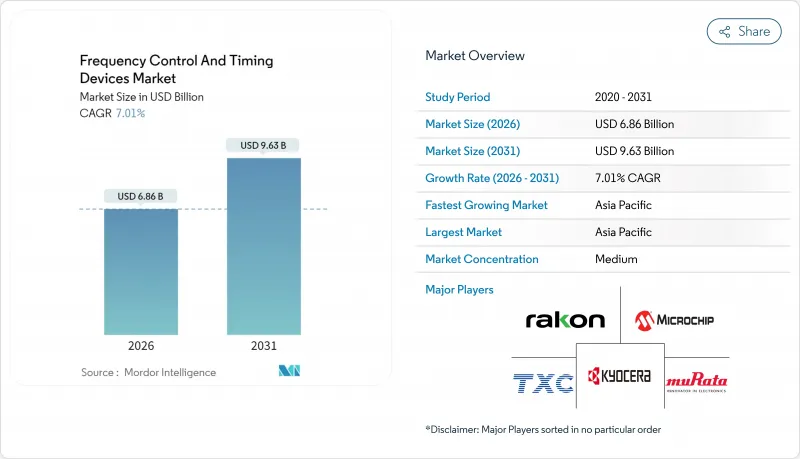
這項市場演變反映了精準同步在5G無線接取網路、人工智慧增強型超大規模資料中心以及安全關鍵型汽車電子產品中扮演的關鍵角色。網路營運商、雲端服務供應商和電動車製造商對亞微秒精度的需求日益成長,使得定時元件從低價值的通用產品轉變為系統性能的戰略推動因素。振盪器,尤其是溫度補償振盪器和恆溫振盪器,因其能夠提供獨立5G時分雙工(TDD)單元所需的超穩定參考頻率,而成為市場需求的主要驅動力。儘管石英振盪器仍是主流技術,但快速成長的微機電振盪器正在不斷擴大市場佔有率,因為設計人員在物聯網節點和汽車控制單元中追求更小的尺寸、更寬的溫度範圍和低耗電量。亞太地區憑藉其一體化的電子元件供應鏈以及國內對5G終端、電動車和工業自動化設備日益成長的需求,佔據了最大的區域市場佔有率。
全球頻率控制與定時元件市場趨勢及展望
5G基礎建設發展進展
獨立組網的5G架構需要1.5微秒以內的同步精度以防止小區間干擾,這使得TCXO和OCXO成為必不可少的無線電組件。小型基地台密集化使得延遲驅動的定時預算更加複雜,需要對每個節點進行單獨的延遲補償。供應商對頻率穩定性提出了更高的要求,而普通石英晶體無法滿足這些要求。隨著供應商在屋頂安裝中以基於MEMS的超級TCXO取代共振器以提高抗振性能,廣域基地台也開始部署超級TCXO。計畫中的5G-Advanced升級路徑將引入時間敏感網路、網路切片和超可靠低延遲通訊(URLLC),到2030年,這些技術都將逐步提高精度要求。
汽車業的電氣化和ADAS的普及
電動動力傳動系統依賴精確的逆變器開關,而ADAS雷達、LiDAR和攝影機融合技術則需要微秒同步時間戳來維持空間一致性。目前,集中式車載電腦將主時鐘分配給數十個ECU,這使得能夠承受引擎室振動和-40°C至+125°C溫度波動的微機電振盪器變得尤為重要。汽車製造商正在強制要求AEC-Q200認證,該認證週期較長,但可確保15年的現場可靠性。隨著L3和L4級自動駕駛技術在2026年後的普及,奈秒同步將成為感測器融合演算法的設計標準。
高精度晶體坯料晶圓廠產能限制
來自雲杉松礦的高純度二氧化矽是高品質振盪器的主要原料,但2024年颶風海倫造成的供應中斷暴露了這種單一來源供應的脆弱性。全球只有少數晶圓廠能夠以亞ppm級的頻率公差進行蝕刻和研磨,這導致了配額分配政策,並將振盪器的前置作業時間延長至26週或更久。對合成石英生長和雷射退火技術的投資旨在釋放新的產能,但商業化生產不太可能在2027年之前實現。 MEMS供應商正在推廣矽基替代方案作為風險緩解措施,但石英在OCXO級穩定性方面仍具有卓越的性能。
細分市場分析
預計到2025年,振盪器將佔據頻率控制和定時裝置市場56.12%的佔有率,並在2031年之前以8.44%的複合年成長率成長,鞏固了其在通訊、汽車和工業平台中作為綜合時鐘解決方案的地位。在這一類別中,溫度補償晶體振盪器(TCXO)正迅速崛起,因為它們能夠在-40°C至+85°C的溫度範圍內保持±0.1 ppm的穩定性,這對於小型蜂窩無線電至關重要。電壓調節器晶體振盪器(VCXO)在5G大規模MIMO陣列中也越來越受歡迎,其中鎖相環(PLL)微調可以抑制多普勒頻移。
微機電振盪器是振盪器類別中成長最快的細分市場,與傳統的石英晶體振盪器相比,其抗振性能提高了20倍,功耗降低了50%。數位可程式設計使得頻率設定可以做到臨時調整,從而縮短客戶的供應鏈週期數週。雖然石英晶體振盪器仍然是低頻應用的基本元件,但共振器在射頻濾波器和雙工器領域仍然佔有一席之地,因為表面聲波傳播能夠提供極高的選擇性。
憑藉數十年的可靠性和成熟的全球晶圓廠,石英晶體元件預計到2025年將佔據頻率控制和定時元件市場71.25%的佔有率。然而,隨著原始設備製造商(OEM)優先考慮小型化、耐高溫和抗衝擊性能,微機電系統(MEMS)解決方案的市場佔有率預計將以7.48%的複合年成長率成長。晶粒和晶圓層次電子構裝的最新進展使得微機電振盪器的Z軸高度能夠低於0.35毫米,使其能夠應用於超薄5G設備。
表面聲波元件在射頻濾波領域發揮特殊作用,能夠處理3 GHz以上的上變頻器級。將石英振盪器與基於MEMS的溫度控制電路相結合的混合結構提供了一種共存而非完全替代的方案。精密雷射微調技術的不斷進步已將晶體老化降低到每年±1 ppm以下,確保了其在衛星有效載荷和儀器的OCXO級定時應用中的實際應用。
區域分析
亞太地區預計到2025年將佔據頻率控制和定時元件市場45.78%的佔有率,凸顯了該地區作為製造地和大眾消費市場的雙重優勢。隨著5G宏基地台的擴建和電動車的加速普及,中國將增強上游需求;而擁有石英技術傳統的日本將為全球超高穩定性石英坯料的供應提供支援;韓國將推動記憶體工廠和全國性5G中頻段網路對定時裝置的採購;台灣晶圓代工廠將提供後端組裝服務。面對出口限制帶來的不利影響,亞太地區的原始設備製造商(OEM)正在區域貿易區內推進MEMS模具和石英坯料加工的本地化生產。
北美維持第二的位置,這主要得益於超大規模資料中心總合新增超過1吉瓦的運算能力。 《晶片技術創新法案》(CHIPS Act)的激勵措施正在重振美國本土的矽微機電系統(MEMS)和合成石英晶圓廠,從而降低對單一國家依賴的風險。國防現代化預算支持了用於受保護衛星通訊以及定位、導航和授時項目的OCXO(溫度補償晶體振盪器)和CSAC(晶體振盪器)的需求。
歐洲的前景取決於汽車和工業自動化產業。德國汽車製造商強制要求車載中央電腦使用符合AEC-Q200標準的裝置,而法國和義大利的航太主要企業則要求使用抗輻射加固的OCXO。歐盟的「數位主權」舉措正在津貼MEMS研發叢集,而永續性指令則鼓勵在大規模生產的消費性電子產品中使用低功耗矽時序裝置,而非傳統的石英晶體。在中東、非洲和南美等新興地區,對4G到5G升級和智慧電網計劃的投資正在推動對經濟高效的SMD石英晶共振器的新興但不斷成長的需求。
其他福利:
- Excel格式的市場預測(ME)表
- 3個月的分析師支持
目錄
第1章 引言
- 研究假設和市場定義
- 調查範圍
第2章調查方法
第3章執行摘要
第4章 市場情勢
- 市場概覽
- 市場促進因素
- 5G基礎建設發展進展
- 汽車業的電氣化和ADAS的普及
- 雲端和人工智慧工作負載驅動超大規模資料中心
- 邊緣運算物聯網節點的普及
- 衛星衛星群需要精確計時。
- 晶片級手錶(CSAC)成本曲線取得突破
- 市場限制
- 高精度晶體坯料晶圓廠產能限制
- 消費性電子產品商品化導致價格下行壓力
- 智慧財產權策略時機選擇中的出口管制風險
- 安全關鍵型垂直產業的認證週期較長
- 產業價值鏈分析
- 監管環境
- 技術展望
- 波特五力分析
- 買方的議價能力
- 供應商的議價能力
- 新進入者的威脅
- 替代品的威脅
- 競爭對手之間的競爭
第5章 市場規模與成長預測
- 依產品類型
- 水晶
- 振盪器
- 溫度補償晶體振盪器(TCXO)
- 電壓調節器晶體振盪器(VCXO)
- 恆溫晶體振盪器(OCXO)
- 微機電振盪器
- 其他振盪器
- 共振器
- 透過技術
- 石英
- MEMS
- 表面聲波(SAW)
- 其他
- 透過包裝
- 表面黏著型元件(SMD)
- 通孔/DIP
- 最終用戶
- 電訊和資料中心
- 汽車/運輸設備
- 家用電子電器
- 工業與物聯網
- 航太/國防
- 醫療和醫療設備
- 其他最終用戶
- 按地區
- 北美洲
- 美國
- 加拿大
- 墨西哥
- 歐洲
- 德國
- 英國
- 法國
- 其他歐洲地區
- 亞太地區
- 中國
- 日本
- 韓國
- 印度
- 亞太其他地區
- 南美洲
- 巴西
- 阿根廷
- 南美洲其他地區
- 中東
- 以色列
- 沙烏地阿拉伯
- 阿拉伯聯合大公國
- 土耳其
- 其他中東地區
- 非洲
- 南非
- 埃及
- 其他非洲地區
- 北美洲
第6章 競爭情勢
- 市場集中度
- 策略趨勢
- Vendor Positioning Analysis
- 公司簡介
- Murata Manufacturing Co., Ltd.
- Kyocera Corporation
- Seiko Epson Corporation
- TXC Corporation
- Nihon Dempa Kogyo Co., Ltd.
- Daishinku Corporation
- Microchip Technology Inc.
- SiTime Corporation
- Rakon Limited
- Siward Crystal Technology Co., Ltd.
- Hosonic Technology Co., Ltd.
- Texas Instruments Incorporated
- NXP Semiconductors NV
- Abracon LLC
- ECS Inc. International
- Vectron International, Inc.
- IQD Frequency Products Ltd.
- Pletronics, Inc.
- CTS Corporation
第7章 市場機會與未來展望
The frequency control and timing devices market is expected to grow from USD 6.41 billion in 2025 to USD 6.86 billion in 2026 and is forecast to reach USD 9.63 billion by 2031 at 7.01% CAGR over 2026-2031.
This market size trajectory reflects the pivotal role that precision synchronization now plays in 5G radio access networks, AI-enhanced hyperscale data centers, and safety-critical automotive electronics . Network operators, cloud providers, and electric-vehicle OEMs increasingly specify sub-microsecond accuracy, turning timing components from low-value commodities into strategic enablers of system performance. Oscillators, especially temperature-compensated and oven-controlled variants, lead demand because they deliver the ultra-stable references required in stand-alone 5G Time Division Duplex cells. Quartz remains the dominant technology, yet fast-rising MEMS oscillators gain ground as designers pursue smaller footprints, wider temperature tolerance, and lower power budgets in IoT nodes and automotive control units. Asia Pacific secures the largest regional footprint owing to its integrated electronics supply chain and accelerating domestic consumption of 5G handsets, EVs, and industrial automation equipment.
Global Frequency Control And Timing Devices Market Trends and Insights
5G Infrastructure Build-out Momentum
Standalone 5G architecture pushes synchronization accuracy to within 1.5 microseconds to prevent inter-cell interference, turning TCXOs and OCXOs into mandatory radio components . Small-cell densification compounds latency-driven timing budgets because each node requires individual delay compensation. Equipment vendors now issue tighter frequency-stability specifications that cannot be met with generic crystals. MEMS-based Super-TCXOs enter macro base stations as vendors trade quartz for higher vibration resilience at rooftop locations . The planned 5G-Advanced upgrade path introduces time-sensitive networking, network slicing, and URLLC, each escalating accuracy thresholds through 2030.
Electrification and ADAS Penetration in Automotive Industry
Electric powertrains depend on precise inverter switching, while ADAS radar, LiDAR, and camera fusion require microsecond-aligned time stamps to maintain spatial coherence. Centralized vehicle computers now distribute a master clock to dozens of ECUs, elevating MEMS oscillators because they endure under-hood vibration and -40 °C to +125 °C temperature swings. Automotive OEMs enforce AEC-Q200 certification, lengthening qualification cycles but ensuring 15-year field reliability. As Level-3 and Level-4 autonomy expand after 2026, nanosecond-grade synchronization will become a design baseline for sensor fusion algorithms.
Fab Capacity Constraints for High-Precision Quartz Blanks
Ultra-pure silica from the Spruce Pine mine feeds the highest-Q resonator supply chain; Hurricane Helene's 2024 disruption exposed single-source vulnerability . Only a handful of fabs worldwide can etch and lap blanks to sub-ppm frequency tolerance, generating allocation policies that lengthen oscillator lead times beyond 26 weeks. Investments in synthetic quartz growth and laser-annealing aim to unlock new capacity, yet commercial output is unlikely before 2027. MEMS vendors market silicon-based alternatives as risk-mitigation options, although quartz still outperforms in OCXO class stability.
Other drivers and restraints analyzed in the detailed report include:
- Cloud and AI Workloads Fuelling Hyperscale Data Centers
- Edge-Computing IoT Node Proliferation
- Price Erosion from Commoditization in Consumer Devices
For complete list of drivers and restraints, kindly check the Table Of Contents.
Segment Analysis
Oscillators commanded 56.12% of the frequency control and timing devices market share in 2025 and are projected to expand at an 8.44% CAGR to 2031, underscoring their role as complete clock solutions across telecom, automotive, and industrial platforms. Within this cohort, temperature-compensated crystal oscillators gained momentum because they maintain +-0.1 ppm stability across -40 °C to +85 °C ranges essential for small-cell radios. Voltage-controlled crystal oscillators rose in popularity among 5G massive-MIMO arrays, where phase-locked-loop trimming curbs Doppler-induced offsets.
MEMS oscillators account for the fastest-growing slice inside the oscillator category due to their 20X better vibration immunity and 50% lower power draw compared with legacy quartz solutions. Their digital programmability enables last-minute frequency configuration, shortening customer supply-chain cycles by several weeks. Crystals remain the foundational building block at lower frequencies, while resonators retain niche adoption in RF filters and duplexers where surface-acoustic-wave propagation offers steep skirt selectivity.
Quartz devices represented 71.25% of the frequency control and timing devices market in 2025, safeguarded by decades-long reliability records and mature global fabs. However, MEMS solutions are forecast to capture incremental share through a 7.48% CAGR as OEMs prioritize smaller footprints and high temperature shock resistance. Recent silicon-die thinning and hermetic wafer-level packaging cut MEMS oscillator Z-height below 0.35 mm, unlocking adoption in ultra-slim 5G handsets.
Surface-acoustic-wave components keep a specialized role in RF filtering, where they can handle up-converter steps above 3 GHz. Hybrid topologies that marry a quartz resonator with MEMS-based temperature control circuits illustrate the path toward coexistence rather than outright substitution. Continuous improvements in precision laser-trimming push quartz aging below +-1 ppm per year, ensuring its viability in OCXO-class timing for satellite payloads and metrology instrumentation.
The Frequency Control and Timing Devices Market Report is Segmented by Product Type (Crystals, Oscillators, Resonators), Technology (Quartz, MEMS, Surface-Acoustic-Wave, Others), Packaging (Surface-Mount Device, Through-Hole/DIP), End-User (Telecommunications and Data Centres, Automotive and Transportation, Consumer Electronics, Industrial and IoT, and More), and Geography. The Market Forecasts are Provided in Terms of Value (USD).
Geography Analysis
Asia Pacific's 45.78% share of the frequency control and timing devices market in 2025 underscores its dual identity as a manufacturing powerhouse and a high-volume consumer base. China intensifies upstream demand as it scales 5G macro sites and accelerates EV adoption, while Japan's quartz heritage anchors global supply of ultra-stable blanks. South Korea channels timing purchases into memory fabs and nationwide 5G mid-band coverage, and Taiwan's foundries supply back-end assembly services. Export-control headwinds prompt APAC OEMs to localize MEMS tooling and crystal-blank finishing within regional trade blocs.
North America holds the second-largest position, propelled by hyperscale data-center campuses that collectively add more than 1 GW of new compute power annually. The CHIPS Act's incentives catalyze domestic fabs for both silicon MEMS and synthetic quartz, cushioning the region from single-country disruption risk. Defense modernization budgets sustain OCXO and CSAC requirements for protected satcom and position-navigation-timing programs.
Europe's outlook is tethered to its automotive and industrial automation franchise; German OEMs mandate AEC-Q200 devices for centralized vehicle computers, and French and Italian aerospace primes stipulate radiation-tolerant OCXOs. The EU's digital sovereignty initiative channels grants into MEMS R&D clusters, while sustainability directives favor lower-power silicon timing over legacy quartz in high-volume consumer appliances. Emerging regions in the Middle East, Africa, and South America invest in 4G-to-5G upgrades and smart-grid projects, representing nascent yet rising demand for cost-effective SMD crystals.
- Murata Manufacturing Co., Ltd.
- Kyocera Corporation
- Seiko Epson Corporation
- TXC Corporation
- Nihon Dempa Kogyo Co., Ltd.
- Daishinku Corporation
- Microchip Technology Inc.
- SiTime Corporation
- Rakon Limited
- Siward Crystal Technology Co., Ltd.
- Hosonic Technology Co., Ltd.
- Texas Instruments Incorporated
- NXP Semiconductors N.V.
- Abracon LLC
- ECS Inc. International
- Vectron International, Inc.
- IQD Frequency Products Ltd.
- Pletronics, Inc.
- CTS Corporation
Additional Benefits:
- The market estimate (ME) sheet in Excel format
- 3 months of analyst support
TABLE OF CONTENTS
1 INTRODUCTION
- 1.1 Study Assumptions and Market Definition
- 1.2 Scope of the Study
2 RESEARCH METHODOLOGY
3 EXECUTIVE SUMMARY
4 MARKET LANDSCAPE
- 4.1 Market Overview
- 4.2 Market Drivers
- 4.2.1 5G infrastructure build-out momentum
- 4.2.2 Electrification and ADAS penetration in the automotive industry
- 4.2.3 Cloud and AI workloads fuelling hyperscale data centres
- 4.2.4 Edge-computing IoT node proliferation
- 4.2.5 Satellite mega-constellations requiring precision timing
- 4.2.6 Chip-scale atomic clock (CSAC) cost curve breakthroughs
- 4.3 Market Restraints
- 4.3.1 Fab capacity constraints for high-precision quartz blanks
- 4.3.2 Price erosion from commoditisation in consumer devices
- 4.3.3 Export-control risks on the strategic timing of IP
- 4.3.4 Long qualification cycles in safety-critical verticals
- 4.4 Industry Value-Chain Analysis
- 4.5 Regulatory Landscape
- 4.6 Technological Outlook
- 4.7 Porter's Five Forces Analysis
- 4.7.1 Bargaining Power of Buyers
- 4.7.2 Bargaining Power of Suppliers
- 4.7.3 Threat of New Entrants
- 4.7.4 Threat of Substitutes
- 4.7.5 Intensity of Competitive Rivalry
5 MARKET SIZE AND GROWTH FORECASTS (VALUE)
- 5.1 By Product Type
- 5.1.1 Crystals
- 5.1.2 Oscillators
- 5.1.2.1 Temperature-Compensated Crystal Oscillator (TCXO)
- 5.1.2.2 Voltage-Controlled Crystal Oscillator (VCXO)
- 5.1.2.3 Oven-Controlled Crystal Oscillator (OCXO)
- 5.1.2.4 MEMS Oscillator
- 5.1.2.5 Other Oscillators
- 5.1.3 Resonators
- 5.2 By Technology
- 5.2.1 Quartz
- 5.2.2 MEMS
- 5.2.3 Surface-Acoustic-Wave (SAW)
- 5.2.4 Others
- 5.3 By Packaging
- 5.3.1 Surface-Mount Device (SMD)
- 5.3.2 Through-Hole / DIP
- 5.4 By End-User
- 5.4.1 Telecommunications and Data Centres
- 5.4.2 Automotive and Transportation
- 5.4.3 Consumer Electronics
- 5.4.4 Industrial and IoT
- 5.4.5 Aerospace and Defence
- 5.4.6 Healthcare and Medical Devices
- 5.4.7 Other End-Users
- 5.5 By Geography
- 5.5.1 North America
- 5.5.1.1 United States
- 5.5.1.2 Canada
- 5.5.1.3 Mexico
- 5.5.2 Europe
- 5.5.2.1 Germany
- 5.5.2.2 United Kingdom
- 5.5.2.3 France
- 5.5.2.4 Rest of Europe
- 5.5.3 Asia Pacific
- 5.5.3.1 China
- 5.5.3.2 Japan
- 5.5.3.3 South Korea
- 5.5.3.4 India
- 5.5.3.5 Rest of Asia Pacific
- 5.5.4 South America
- 5.5.4.1 Brazil
- 5.5.4.2 Argentina
- 5.5.4.3 Rest of South America
- 5.5.5 Middle East
- 5.5.5.1 Israel
- 5.5.5.2 Saudi Arabia
- 5.5.5.3 UAE
- 5.5.5.4 Turkey
- 5.5.5.5 Rest of Middle East
- 5.5.6 Africa
- 5.5.6.1 South Africa
- 5.5.6.2 Egypt
- 5.5.6.3 Rest of Africa
- 5.5.1 North America
6 COMPETITIVE LANDSCAPE
- 6.1 Market Concentration
- 6.2 Strategic Moves
- 6.3 Vendor Positioning Analysis
- 6.4 Company Profiles (includes Global level Overview, Market level overview, Core Segments, Financials as available, Strategic Information, Products and Services, and Recent Developments)
- 6.4.1 Murata Manufacturing Co., Ltd.
- 6.4.2 Kyocera Corporation
- 6.4.3 Seiko Epson Corporation
- 6.4.4 TXC Corporation
- 6.4.5 Nihon Dempa Kogyo Co., Ltd.
- 6.4.6 Daishinku Corporation
- 6.4.7 Microchip Technology Inc.
- 6.4.8 SiTime Corporation
- 6.4.9 Rakon Limited
- 6.4.10 Siward Crystal Technology Co., Ltd.
- 6.4.11 Hosonic Technology Co., Ltd.
- 6.4.12 Texas Instruments Incorporated
- 6.4.13 NXP Semiconductors N.V.
- 6.4.14 Abracon LLC
- 6.4.15 ECS Inc. International
- 6.4.16 Vectron International, Inc.
- 6.4.17 IQD Frequency Products Ltd.
- 6.4.18 Pletronics, Inc.
- 6.4.19 CTS Corporation
7 MARKET OPPORTUNITIES AND FUTURE OUTLOOK
- 7.1 White-space and Unmet-Need Assessment

 時鐘緩衝器和驅動器市場報告:趨勢、預測和競爭分析(至2035年)
 時脈緩衝器市場規模、佔有率和成長分析:按緩衝器類型、頻寬、輸出類型、最終用戶產業、實現方式、銷售管道和地區分類-2026-2033年產業預測
 頻率控制·定時元件的全球市場 - 終端用戶,用途,競爭企業
 全球定時元件市場規模、佔有率、趨勢和成長分析報告(2026-2034)
 時脈緩衝器市場分析及至2035年預測:類型、產品、技術、組件、應用、最終用戶、功能、安裝、解決方案
 時序元件市場:按產品類型、材質、最終用戶和分銷管道分類 - 2026-2032年全球預測
 2026年全球定時元件市場報告2026年全球時鐘緩衝器市場報告
 全球定時元件市場,2026-2030年
 時序元件市場規模、佔有率和成長分析(按類型、材質、安裝類型、產業細分和地區分類)-2026-2033年產業預測