


 |
市場調查報告書
商品編碼
1911444
移動機器人:市場佔有率分析、產業趨勢與統計、成長預測(2026-2031)Mobile Robots - Market Share Analysis, Industry Trends & Statistics, Growth Forecasts (2026 - 2031) |
||||||

※ 本網頁內容可能與最新版本有所差異。詳細情況請與我們聯繫。
預計到 2026 年,移動機器人市場規模將達到 110.3 億美元,從 2025 年的 86.4 億美元成長到 2031 年的 373.4 億美元,2026 年至 2031 年的複合年成長率為 27.62%。
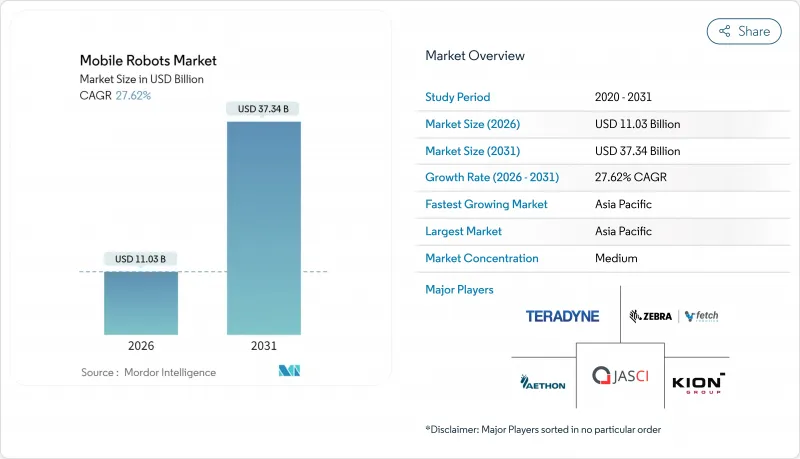
這一快速成長反映了電子商務訂單量的持續成長、5G部署的加速以及人工智慧的快速發展,這些因素共同推動了行動機器人從試點計劃轉變為核心營運資產。企業面臨長期勞動力短缺和長時間運作,促使他們採用大規模機器人車隊來降低加班成本並提高訂單履行可靠性。技術供應商也積極響應,推出了低成本的感測器套件、基於訂閱的電池服務以及基於雲端的車隊編配軟體,進一步降低了中型企業採用這些技術的門檻。隨著物流供應商競相採用新一代機器人,競爭日益激烈,擁有經過認證的導航、安全性和服務能力的製造商因此獲得了規模優勢。
全球移動機器人市場趨勢與洞察
電子商務倉庫自動化激增
為了因應線上訂單的激增,各大零售商紛紛對其配送中心維修,部署了數百台自主移動機器人(AMR)。 DHL供應鏈在歐洲將其Locus機器人車隊規模擴大了三倍,協作揀貨次數突破5億次。這項里程碑的達成時間僅為預期的一半左右。沃爾瑪正投資220億美元興建五座自動化食品倉庫,平均面積達70萬平方英尺,計畫在2026年初將三分之二的門市轉型為履約。吞吐量呈指數級成長:GEODIS的記錄顯示,每小時的運輸次數從65次增加到98次以上;Saddle Creek 物流在部署自主移動機器人(AMR)後,產量增加了一倍。這些生產力的提升促使市場將移動機器人納入長期物流規劃,使勞動力轉向薪酬更高的管理職位,並實現了多層倉庫的當日送達服務。
人事費用上升和技術純熟勞工短缺
勞動力老化和勞動市場緊張促使工廠將重複性、高強度的工作自動化。 Bertel O. Steen 公司安裝了一套由 47 台機器人組成的 AutoStoreGrid 系統,使儲存容量翻了四倍,運轉率達到 99.7%,有效緩解了高峰期的人員短缺問題。 Boots Warehouse 公司在將繁重的推車搬運工作交給自主移動機器人 (AMR) 後,員工滿意度顯著提升。這支 24 小時運轉的運作隊伍減少了加班和缺勤,這在人口結構變化導致勞動力供應日益緊張的歐洲尤為重要。
高資本投入與不確定的投資回報
工業移動機器人的總安裝成本(包括周邊設備和整合)平均每台15萬美元,使得小規模的企業不願即時升級。中型倉庫發現,降低離職率和提高安全性等無形收益難以量化,導致評估週期在某些情況下長達兩個會計年度以上。儘管訂閱融資模式已經出現,但人們對長期擁有成本的疑慮仍然存在。
細分市場分析
截至2025年,自主移動機器人(AMR)將佔總收入的51.88%,這反映了其對基礎設施友好的部署模式以及從「貨物到人」的成熟投資回報率。 AMR移動機器人市場預計將從2026年的57億美元成長到2031年的178.9億美元,複合年成長率(CAGR)為25.7%。整合六軸機械手臂的AMR在套件組裝、機器操作輔助和無塵室作業方面具有價值,預計到2031年,此類移動機器人市場規模將達到91.5億美元,複合年成長率為34.1%。
移動機器人市場的發展趨勢強調模組化硬體和低程式碼編程,從而加速了不同工作流程之間的重新部署。 Standard Bots公司籌集了6300萬美元,用於將其配備機械手臂的平台商業化,該平台能夠進行生產線旁補貨和碼垛作業,這反映了風險投資家對機動性和移動性解決方案的信心。 AGV(自動導引車)在高吞吐量、固定路線的環境中佔據一定的市場佔有率,UGV(無人導引車)用於危險區域的審核,而UAV(無人機)已開始在高層倉庫進行庫存盤點試點。
預計到2025年,自動堆高機將佔總收入的37.78%,這主要得益於現有設備加裝自動化套件以減輕變更管理負擔的趨勢。預計到2031年,該細分市場規模將達到124.9億美元,佔按類型分類的移動機器人市場總規模的33.45%。受汽車製造商向多車型生產線轉型需求的推動,組裝移動平台預計將以32.0%的複合年成長率實現最快成長。
牽引式機器人已在航太和機場物流領域廣泛應用,在這些領域,牽引能力和精確的排隊編隊比速度更為重要。單元貨載和推車機器人正在微型倉配中心迅速發展,它們與先進的貨架系統協同工作,以減少步行距離。和賽每月10萬台雷射雷達的出貨能力降低了感測器的平均售價,使得即使是入門級推車也能實現自動駕駛。
全球移動機器人市場報告按產品類型(AGV、AMR 等)、外形規格(自主堆高機、牽引/曳引機/拖曳機器人等)、導航技術(基於雷射雷達的 SLAM、2D碼/基準碼等)、最終用途行業(倉儲和配送、製造、食品和飲料等)、有效載荷能力(小於 100 公斤、100-5000-5000-5000公斤)和地區進行細分。
區域分析
預計到2025年,亞太地區將佔全球收入的42.85%,並在2031年之前以30.4%的複合年成長率成長,這主要得益於中國的產業政策及其到2028年實現機器人產值1080億美元的目標。中國供應商,例如優尼特瑞(Unitree),加強了出口管道,而日本和韓國供應商則改進了感測器模組以降低總體擁有成本。印度的生產連結獎勵計畫計劃,加上電子商務滲透率的不斷提高,促進了在服裝物流中心部署試點機器人車隊。
北美則位居第二,這主要得益於美國在全通路零售、小包裹分揀和現有工廠改造的應用。沃爾瑪的自動化藍圖、DHL創紀錄的揀貨速度以及GEODIS在墨西哥的擴張,都證明了跨境供應鏈規模化策略的有效性。加拿大一家低溫運輸工廠利用政府對先進製造業的獎勵,試點應用了先進製造模組(AMMR)進行溫控藥品包裝。
在歐洲,嚴格的CE認證標準和歐盟機械指令2023/1230的實施要求,使得相關技術的採用步伐較為謹慎。德國汽車製造商已將攝影機和雷射雷達融合平台整合到其電動汽車電池生產線中,而北歐連鎖超市則強制部署碳中和機器人車隊,以實現其2030年的氣候目標。中東和非洲地區仍在發展中,但石化檢測和自由貿易區物流領域的試點計畫已引起關注。結合5G網路和倉儲建設的基礎設施走廊的開發也為此提供了推動。
其他福利:
- Excel格式的市場預測(ME)表
- 3個月的分析師支持
目錄
第1章 引言
- 研究假設和市場定義
- 調查範圍
第2章調查方法
第3章執行摘要
第4章 市場情勢
- 市場概覽
- 市場促進因素
- 電子商務倉庫自動化激增
- 人事費用上升和技術純熟勞工短缺
- 人工智慧和感測器融合技術的進步將降低自動駕駛的成本。
- 5G專用網路能夠編配龐大的車隊。
- 電池即服務降低了初始資本投資成本
- 透過維修加速採用碳中和物流
- 市場限制
- 高額資本投入與不確定性的投資報酬率
- 傳統站點連線限制
- 缺乏安全認證的自主移動機器人(AMR)軟體框架
- 半導體和雷射雷達供應鏈波動
- 關鍵法規結構評估
- 價值鏈分析
- 技術展望
- 波特五力模型
- 供應商的議價能力
- 買方的議價能力
- 新進入者的威脅
- 替代品的威脅
- 競爭對手之間的競爭
- 關鍵相關人員影響評估
- 主要用例和案例研究
- 宏觀經濟因素對市場的影響
- 投資分析
第5章 市場區隔
- 依產品類型
- 自動導引車(AGV)
- 自主移動機器人(AMR)
- 自主移動操作機器人(AMMR)
- 無人地面車輛(UGV)
- 無人機(UAV-室內物流)
- 按外形規格
- 自動駕駛堆高機
- 拖曳/曳引機/拖船機器人
- 單元貨載和推車機器人
- 用於組裝的移動平台
- 透過導航技術
- 基於LiDAR的SLAM
- QR碼/信託碼
- 僅相機視覺
- 混合式(雷射雷達+視覺)
- 磁力/反射器引導
- 按最終用途行業分類
- 倉儲和配送
- 製造業
- 食品/飲料
- 製藥和醫療保健
- 其他行業
- 按負載容量
- 體重低於100公斤
- 100~500 kg
- 500~1,000 kg
- >1,000 kg
- 按地區
- 北美洲
- 美國
- 加拿大
- 墨西哥
- 南美洲
- 巴西
- 阿根廷
- 南美洲其他地區
- 歐洲
- 德國
- 英國
- 法國
- 義大利
- 俄羅斯
- 其他歐洲地區
- 亞太地區
- 中國
- 日本
- 韓國
- 印度
- ASEAN
- 亞太其他地區
- 中東和非洲
- 中東
- 沙烏地阿拉伯
- 阿拉伯聯合大公國
- 土耳其
- 其他中東地區
- 非洲
- 南非
- 奈及利亞
- 其他非洲地區
- 中東
- 北美洲
第6章 競爭情勢
- 市場集中度
- 策略趨勢
- 市佔率分析
- 公司簡介
- Teradyne Inc
- Geek+Inc
- KION Group AG
- Toyota Industries Corp
- Daifuku Co Ltd
- Boston Dynamics Inc
- Fetch Robotics Inc(Zebra Technologies)
- 6 River Systems Inc(Shopify)
- AutoStore AS
- GreyOrange Pte Ltd
- Balyo SA
- Locus Robotics Corp
- Vecna Robotics Inc
- Seegrid Corp
- Hikrobot Technology Co Ltd
- Aethon Inc(ST Engineering)
- Clearpath Robotics Inc.
- Magazino GmbH
- Seer Robotics Co Ltd
- Youibot Robotics Co Ltd
- Bastian Solutions LLC
- JASCI LLC
- inVia Robotics Inc
- IAM Robotics LLC
- SCOTT Technology Ltd
- John Bean Technologies Corp
- Murata Machinery Ltd
- Omron Corp
第7章 市場機會與未來展望
The Mobile Robots Market size in 2026 is estimated at USD 11.03 billion, growing from 2025 value of USD 8.64 billion with 2031 projections showing USD 37.34 billion, growing at 27.62% CAGR over 2026-2031.
This steep growth reflected sustained e-commerce order volumes, accelerated 5G roll-outs, and rapid artificial-intelligence improvements that collectively turned mobile robots from pilot projects into core operating assets. Enterprises faced chronic labour shortages and longer operating hours, prompting large-scale fleet deployments that reduced overtime costs and improved fulfilment reliability. Technology vendors responded with lower-cost sensor suites, subscription battery services, and cloud fleet orchestration software, further lowering adoption barriers for midsize facilities. Competitive intensity sharpened as logistics providers raced to standardize on next-generation robots, creating scale advantages for manufacturers with certified navigation, safety, and service capabilities.
Global Mobile Robots Market Trends and Insights
Surge in e-commerce warehouse automation
Larger retailers retrofitted distribution hubs with hundreds of AMRs to process surging online orders. DHL Supply Chain surpassed 500 million collaborative picks after tripling its Locus fleet across Europe, a milestone reached in nearly half the earlier time frame. Walmart committed USD 22 billion to five automated grocery campuses averaging 700,000 ft2, positioning two-thirds of its stores to rely on robotic fulfilment by early 2026. Throughputs rose sharply: GEODIS recorded 98+ picks per hour versus 65 previously, while Saddle Creek Logistics doubled output after integrating AMRs. These productivity gains locked mobile robots market adoption into long-term fulfilment roadmaps, shifting labour to higher-wage supervisory roles and enabling same-day shipping across multi-level facilities.
Rising labour-cost and skilled-worker shortages
Ageing workforces and tight labour markets prompted factories to automate repetitive, high-strain tasks. Bertel O. Steen quadrupled storage capacity and achieved 99.7% uptime with a 47-robot AutoStore grid, easing head-count pressures during peak seasons. Boots Warehouse reported higher employee satisfaction once heavy cart transport duties shifted to AMRs. Around-the-clock robot fleets eliminated overtime premiums and reduced absenteeism, critical in Europe where demographic trends compress the available workforce.
High CAPEX and ROI uncertainty
The total installed cost for an industrial mobile robot averaged USD 150,000 per unit after peripherals and integration, discouraging smaller facilities from immediate upgrades. Midsize warehouses struggled to model intangible benefits such as lower turnover and improved safety, extending evaluation cycles beyond two fiscal years. Subscription financing models emerged but faced scepticism regarding the long-term cost of ownership.
Other drivers and restraints analyzed in the detailed report include:
- Advances in AI and sensor-fusion cutting autonomy costs
- 5G private networks enabling large-fleet orchestration
- Shortage of safety-certified AMR software frameworks
For complete list of drivers and restraints, kindly check the Table Of Contents.
Segment Analysis
AMRs retained 51.88% revenue in 2025, reflecting their infrastructure-light deployment model and proven ROI in goods-to-person fulfilment. The mobile robots market size for AMRs is forecast to climb from USD 5.7 billion in 2026 to USD 17.89 billion by 2031 at a 25.7% CAGR. AMMRs, which integrate six-axis manipulators, are projected to achieve a USD 9.15 billion mobile robots market size by 2031 following a 34.1% CAGR, offering value in kitting, machine tending, and clean-room operations.
Dynamics within the mobile robots market emphasised modular hardware and low-code programming that accelerated redeployment between workflows. Standard Bots secured USD 63 million to commercialise arm-equipped platforms capable of line-side replenishment and palletisation, signalling venture confidence in manipulation-plus-mobility solutions . AGVs kept niche relevance in high-throughput, fixed-path settings, while UGVs fulfilled hazardous-area inspection, and UAVs commenced inventory audit pilots in high-bay warehouses.
Self-driving forklifts represented 37.78% of 2025 revenue as brownfield sites retrofitted familiar equipment with autonomy kits to reduce change-management hurdles. This sub-segment is forecast to reach USD 12.49 billion by 2031, equal to 33.45% of the projected mobile robots market size for form factors. Assembly-line mobile platforms are expected to post the quickest gain, expanding at 32.0% CAGR on demand from automakers transitioning to multi-model lines.
Tow-tractor robots found traction in aerospace and airport logistics, where tug capacity and precise queuing mattered more than speed. Unit-load and cart robots expanded rapidly inside micro-fulfilment centres, pairing with advanced racking to shorten walk steps. Hesai's ability to ship 100,000 LiDAR units per month lowered sensor ASPs, making autonomy options viable even for entry-level carts.
The Global Mobile Robots Market Report is Segmented by Product Type (AGV, AMR, and More), Form Factor (Self-Driving Forklifts, Tow/Tractor/Tug Robots, and More), Navigation Technology (LiDAR-Based SLAM, QR/Fiducial Codes, and More), End-Use Industry (Warehousing and Distribution, Manufacturing, Food and Beverage, and More), Payload Capacity (<100 Kg, 100 - 500 Kg, 500 - 1 000 Kg, < 1 000 Kg), and Geography.
Geography Analysis
Asia-Pacific retained 42.85% of 2025 revenue and is forecast to post a 30.4% CAGR through 2031, buoyed by China's industrial policy and the country's aim to reach USD 108 billion robotics output by 2028 . Chinese vendors such as Unitree strengthened export channels, while Japanese and South Korean suppliers refined sensor modules that lowered total cost of ownership. India's Production-Linked Incentive scheme, coupled with rising e-commerce penetration, triggered proof-of-concept fleets in apparel fulfilment centers.
North America ranked second, led by United States deployments across omnichannel retail, parcel sorting, and brownfield manufacturing retrofits. Walmart's automation roadmap, DHL's record pick rates, and GEODIS's Mexico expansion collectively validated scaling strategies for cross-border supply chains. Canadian cold-chain facilities piloted AMMRs for temperature-sensitive pharma packaging, leveraging government incentives for advanced manufacturing.
Europe adopted a measured pace, influenced by stringent CE marking and upcoming EU Machinery Regulation 2023/1230 requirements. German automakers integrated camera-LiDAR fusion platforms within EV battery lines, while Nordic grocery chains mandated carbon-neutral robot fleets to meet 2030 climate targets. Middle East and Africa remained nascent but attracted pilots in petrochemical inspection and free-zone logistics, benefiting from infrastructure corridors that bundled 5G networks with warehouse builds.
- Teradyne Inc
- Geek+ Inc
- KION Group AG
- Toyota Industries Corp
- Daifuku Co Ltd
- Boston Dynamics Inc
- Fetch Robotics Inc (Zebra Technologies)
- 6 River Systems Inc (Shopify)
- AutoStore AS
- GreyOrange Pte Ltd
- Balyo SA
- Locus Robotics Corp
- Vecna Robotics Inc
- Seegrid Corp
- Hikrobot Technology Co Ltd
- Aethon Inc (ST Engineering)
- Clearpath Robotics Inc.
- Magazino GmbH
- Seer Robotics Co Ltd
- Youibot Robotics Co Ltd
- Bastian Solutions LLC
- JASCI LLC
- inVia Robotics Inc
- IAM Robotics LLC
- SCOTT Technology Ltd
- John Bean Technologies Corp
- Murata Machinery Ltd
- Omron Corp
Additional Benefits:
- The market estimate (ME) sheet in Excel format
- 3 months of analyst support
TABLE OF CONTENTS
1 INTRODUCTION
- 1.1 Study Assumptions and Market Definition
- 1.2 Scope of the Study
2 RESEARCH METHODOLOGY
3 EXECUTIVE SUMMARY
4 MARKET LANDSCAPE
- 4.1 Market Overview
- 4.2 Market Drivers
- 4.2.1 Surge in e-commerce warehouse automation
- 4.2.2 Rising labour-cost and skilled-worker shortages
- 4.2.3 Advances in AI and sensor-fusion cutting autonomy costs
- 4.2.4 5G private networks enabling large-fleet orchestration
- 4.2.5 Battery-as-a-service lowering upfront CAPEX
- 4.2.6 Carbon-neutral logistics retrofits accelerating deployments
- 4.3 Market Restraints
- 4.3.1 High CAPEX and ROI uncertainty
- 4.3.2 Legacy-site connectivity limitations
- 4.3.3 Shortage of safety-certified AMR software frameworks
- 4.3.4 Semiconductor and LiDAR supply-chain volatility
- 4.4 Evaluation of Critical Regulatory Framework
- 4.5 Value Chain Analysis
- 4.6 Technological Outlook
- 4.7 Porter's Five Forces
- 4.7.1 Bargaining Power of Suppliers
- 4.7.2 Bargaining Power of Buyers
- 4.7.3 Threat of New Entrants
- 4.7.4 Threat of Substitutes
- 4.7.5 Competitive Rivalry
- 4.8 Impact Assessment of Key Stakeholders
- 4.9 Key Use Cases and Case Studies
- 4.10 Impact on Macroeconomic Factors of the Market
- 4.11 Investment Analysis
5 MARKET SEGMENTATION
- 5.1 By Product Type
- 5.1.1 Automated Guided Vehicles (AGV)
- 5.1.2 Autonomous Mobile Robots (AMR)
- 5.1.3 Autonomous Mobile Manipulation Robots (AMMR)
- 5.1.4 Unmanned Ground Vehicles (UGV)
- 5.1.5 Unmanned Aerial Vehicles (UAV - indoor logistics)
- 5.2 By Form Factor
- 5.2.1 Self-driving Forklifts
- 5.2.2 Tow / Tractor / Tug Robots
- 5.2.3 Unit-Load and Cart Robots
- 5.2.4 Assembly-Line Mobile Platforms
- 5.3 By Navigation Technology
- 5.3.1 LiDAR-based SLAM
- 5.3.2 QR / Fiducial Codes
- 5.3.3 Camera-Only Vision
- 5.3.4 Hybrid (LiDAR + Vision)
- 5.3.5 Magnetic / Reflector Guidance
- 5.4 By End-use Industry
- 5.4.1 Warehousing and Distribution
- 5.4.2 Manufacturing
- 5.4.3 Food and Beverage
- 5.4.4 Pharmaceuticals and Healthcare
- 5.4.5 Other Industries
- 5.5 By Payload Capacity
- 5.5.1 < 100 kg
- 5.5.2 100 - 500 kg
- 5.5.3 500 - 1 000 kg
- 5.5.4 > 1 000 kg
- 5.6 By Geography
- 5.6.1 North America
- 5.6.1.1 United States
- 5.6.1.2 Canada
- 5.6.1.3 Mexico
- 5.6.2 South America
- 5.6.2.1 Brazil
- 5.6.2.2 Argentina
- 5.6.2.3 Rest of South America
- 5.6.3 Europe
- 5.6.3.1 Germany
- 5.6.3.2 United Kingdom
- 5.6.3.3 France
- 5.6.3.4 Italy
- 5.6.3.5 Russia
- 5.6.3.6 Rest of Europe
- 5.6.4 Asia-Pacific
- 5.6.4.1 China
- 5.6.4.2 Japan
- 5.6.4.3 South Korea
- 5.6.4.4 India
- 5.6.4.5 ASEAN
- 5.6.4.6 Rest of Asia-Pacific
- 5.6.5 Middle East and Africa
- 5.6.5.1 Middle East
- 5.6.5.1.1 Saudi Arabia
- 5.6.5.1.2 United Arab Emirates
- 5.6.5.1.3 Turkey
- 5.6.5.1.4 Rest of Middle East
- 5.6.5.2 Africa
- 5.6.5.2.1 South Africa
- 5.6.5.2.2 Nigeria
- 5.6.5.2.3 Rest of Africa
- 5.6.5.1 Middle East
- 5.6.1 North America
6 COMPETITIVE LANDSCAPE
- 6.1 Market Concentration
- 6.2 Strategic Moves
- 6.3 Market Share Analysis
- 6.4 Company Profiles {(includes Global level Overview, Market level overview, Core Segments, Financials as available, Strategic Information, Market Rank/Share for key companies, Products and Services, and Recent Developments)}
- 6.4.1 Teradyne Inc
- 6.4.2 Geek+ Inc
- 6.4.3 KION Group AG
- 6.4.4 Toyota Industries Corp
- 6.4.5 Daifuku Co Ltd
- 6.4.6 Boston Dynamics Inc
- 6.4.7 Fetch Robotics Inc (Zebra Technologies)
- 6.4.8 6 River Systems Inc (Shopify)
- 6.4.9 AutoStore AS
- 6.4.10 GreyOrange Pte Ltd
- 6.4.11 Balyo SA
- 6.4.12 Locus Robotics Corp
- 6.4.13 Vecna Robotics Inc
- 6.4.14 Seegrid Corp
- 6.4.15 Hikrobot Technology Co Ltd
- 6.4.16 Aethon Inc (ST Engineering)
- 6.4.17 Clearpath Robotics Inc.
- 6.4.18 Magazino GmbH
- 6.4.19 Seer Robotics Co Ltd
- 6.4.20 Youibot Robotics Co Ltd
- 6.4.21 Bastian Solutions LLC
- 6.4.22 JASCI LLC
- 6.4.23 inVia Robotics Inc
- 6.4.24 IAM Robotics LLC
- 6.4.25 SCOTT Technology Ltd
- 6.4.26 John Bean Technologies Corp
- 6.4.27 Murata Machinery Ltd
- 6.4.28 Omron Corp
7 MARKET OPPORTUNITIES AND FUTURE OUTLOOK
- 7.1 White-space and Unmet-Need Assessment

 行動機器人市場:2026-2032年全球市場預測(依產品類型、導航技術、組件、酬載能力、自主等級、運作環境、動力來源與應用分類)行動機器人市場:依機器人類型、技術、應用、最終用戶和通路分類-2026-2032年全球市場預測
 移動機器人
移動機器人 移動機器人市場展望(至2035年):產業趨勢與全球預測
 全球移動機器人充電站市場規模、佔有率、趨勢和成長分析報告(2026-2034年)
 2026年全球移動機器人市場報告2026年全球移動機器人軟體市場報告
 行動控制機器人市場 - 全球產業規模、佔有率、趨勢、機會、預測:按類型、產品、應用、地區和競爭格局分類,2021-2031年移動機器人市場-全球產業規模、佔有率、趨勢、機會和預測(按類型、應用、地區和競爭格局分類,2020-2030 年預測)全球移動機器人市場 - 預測 2025-2030