


 |
市場調查報告書
商品編碼
1910608
雷射焊接機:市場佔有率分析、產業趨勢與統計、成長預測(2026-2031)Laser Welding Machines - Market Share Analysis, Industry Trends & Statistics, Growth Forecasts (2026 - 2031) |
||||||

※ 本網頁內容可能與最新版本有所差異。詳細情況請與我們聯繫。
預計雷射焊接機市場將從 2025 年的 35.5 億美元成長到 2026 年的 37.7 億美元,到 2031 年將達到 50.6 億美元,2026 年至 2031 年的複合年成長率為 6.08%。
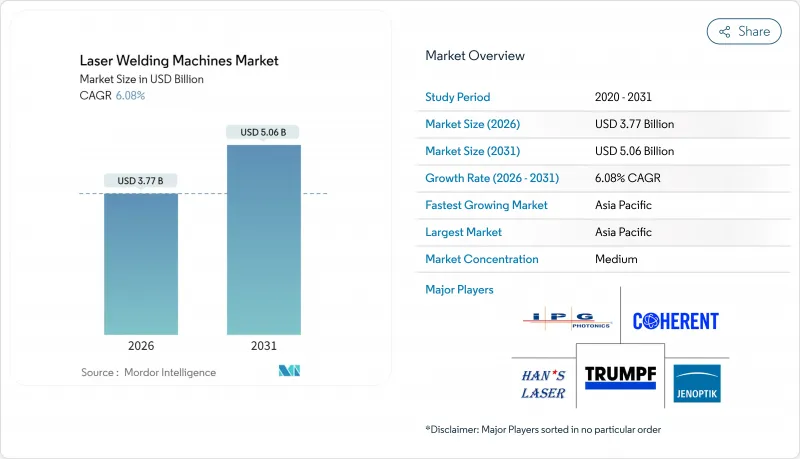
這一成長趨勢主要得益於電池組組裝的強勁資本投資、工業4.0機器人單元的日益普及以及手持式四合一光纖系統的日益普及。雷射焊接機市場也受到製造商逐步拋棄傳統焊接方式的推動,他們追求更高的精度、更低的熱輸入和更無縫的自動化。鍺和鎵供應有限導致材料成本上漲,提高了市場進入門檻,但同時也加速了主要廠商自主生產雷射光源。對能夠焊接高反射率銅的綠色波長平台的巨大需求,進一步擴大了高階供應商的潛在機會。
全球雷射焊接機市場趨勢與洞察
焊接電動車電池組的需求迅速成長
電動車的日益普及推動了對能夠深入銅材並最大限度地減少孔隙的雷射光源的需求。特斯拉的4680個圓柱形電池需要厚度超過2毫米的焊縫,同時也要保持銅基板95%以上的導電率。紅外線雷射器在銅中僅吸收5%的入射能量,而綠光雷射器則能將吸收率提高到35-50%,從而減少飛濺和返工。綠光光源價格的上漲有助於供應商擴大利潤空間,汽車製造商正在其未來的超級工廠中推廣這些系統的標準化應用。預計到2020年代中期,此因素將為整體成長貢獻1.2個百分點。
適用於中小型企業的便利式四合一光纖焊接機
像IPG的LightWELD 2000 XR這樣的可攜式設備,將焊接、切割、清洗和硬焊功能整合在一個2千瓦的功率單元中,售價不到5萬美元。這種手持式設計使得車間可以用一台設備取代多個傳統工位,同時保持了現場維修的靈活性。東協和拉丁美洲的中小型企業正在採用這些系統,以避免投資50萬美元購買機器人設備,並將投資回收期縮短至18個月以內。此外,當地銀行提供的低利率租賃方案也刺激了市場需求,使短期利率貢獻率提高了1.1個百分點。
高昂的資本成本與電弧焊接替代方案相比
一套完整的雷射焊接單元造價在20萬至200萬美元之間,遠高於MIG或TIG焊接設備1.5萬至5萬美元的成本。在人事費用低於每小時15美元的低成本地區,如果投資回報期超過三年,製造商會延後採用這項技術。由於鎵和舉措的限制,零件價格上漲,光學元件和晶片的成本上漲高達25%,進一步提高了採用這項技術的門檻。雖然存在資金籌措,但信貸取得仍然不均衡,短期內將使複合年成長率下降0.9個百分點。
細分市場分析
光纖平台憑藉其卓越的成本績效和成熟的整合商生態系統,預計將在2025年保持43.68%的收入佔有率。光纖系統雷射焊接機的市場規模受益於光纖原料成本的下降,但其光束參數乘積通常在4至8毫米毫弧度之間,限制了超精細加工的應用。固體雷射雖然價格較高,但可提供低於2毫米毫弧度的輸出功率,推動了微電子和血管支架組裝等領域的應用。這種高精度正推動固體雷射在2031年之前以6.43%的複合年成長率成長,成為所有技術配置中成長最快的。供應商透過將能夠在奈秒脈衝和連續波之間切換的光束模組捆綁銷售,來規避跨產品競爭的風險。同時,二氧化碳雷射器仍然主要應用於小眾的塑膠焊接領域,而精度適中的直接二極體雷射則贏得了汽車座椅靠背框架的訂單。
綠色波長單元正在「其他」類別中嶄露頭角,其銅吸收率超過35%。通快(TRUMPF)的TruDisk Pulse在匯流排焊接領域樹立了新的標桿,在500W平均功率下實現了穩定的小孔焊接條件。系統整合商正在對現有的光纖焊接站進行改造,採用倍頻模組升級光學元件,而不是報廢整個單元。這些維修升級為雷射焊接機市場帶來了持續的收入,包括校準服務和備用光學元件的出貨,從而提高了供應商的利潤率。
到2025年,機器人整合單元將佔據41.85%的市場佔有率,這主要得益於其在汽車和航太產業的廣泛應用。這些單元採用六軸運動機構和視覺引導操作,可實現小於50µm的重複焊接定位精度。然而,手持式設備最受關注,其複合年成長率高達8.39%。便捷的即插即用電源模組和一體化耗材盒等易於維護的配件,推動了手持式雷射焊接機市場佔有率的成長。對於沒有保護氣體設施的操作人員,他們正在採用內建雙氣嘴的設備,該設備可在氬氣和氮氣之間切換。桌上型工作站和混合型設備分別面向研發實驗室和晶圓級封裝領域,但其普及速度相對較慢。
船舶船體維修和風力塔維修等現場服務領域,對於可攜式系統而言仍是一片尚未開發的處女地。 LightWELD 2000 XR 現場不銹鋼維修速度比 TIG 焊接快 70%,能夠更快恢復船舶的運作。隨著保險公司開始強制要求對關鍵船舶資產進行雷射維修,手持式雷射設備的普及應用正經歷著監管方面的推動。服務合約是初始設備銷售的補充,包含基於訂閱的培訓、光學元件更換和軟體更新等服務。
區域分析
到2025年,亞太地區將佔據雷射焊接機市場49.35%的佔有率,並將保持最快的成長速度,到2031年複合年成長率將達到7.62%。預計到2024年,中國的雷射焊接機裝置容量將超過2.5萬台,地方政府正在補貼新工廠的建設,以加強區域供應鏈。日本系統整合商正在將精密機器人與國產光纖光源結合,以解決技術純熟勞工的問題。同時,韓國正在補貼需要多層銅板焊接的電池組製造地。印度的生產連結獎勵計畫促進了本地設備組裝,降低了進口關稅,並鼓勵西方供應商與印度系統整合商合作。
北美地區維持高價策略,充分利用其在航太和III類醫療設備產業的優勢。美國中西部地區電動車的普及加速了綠色波長電池的安裝,但鍺供應風險可能導致光學成本上漲高達75%。加拿大監管機構正在加快稀土元素礦的核准,但提煉瓶頸意味著仍依賴進口。 《通膨控制法案》下的聯邦稅額扣抵可報銷清潔製造設施高達30%的資本支出,進而降低資本投資對價格的敏感度。
在歐洲,由於面臨中國新參與企業的成本競爭,德國中型機械製造商的成長較為溫和。將於2026年生效的歐盟碳邊境調節機制將鼓勵採用低熱輸入工藝,例如雷射焊接,尤其是在鋼鐵密集型行業。斯堪地那維亞的造船廠正在試點使用手持式系統來改造氨氣相容推進系統,而東歐的汽車工廠則在使用與通快公司合作的當地整合商提供的承包單元。 《供應安全法》正在推動一個聯盟在歐盟內部發展氮化鎵外延片製造能力,旨在削弱中國在上游原料領域的主導地位。
其他福利:
- Excel格式的市場預測(ME)表
- 3個月的分析師支持
目錄
第1章 引言
- 研究假設和市場定義
- 調查範圍
第2章調查方法
第3章執行摘要
第4章 市場情勢
- 市場概覽
- 市場促進因素
- 焊接電動車電池組的需求迅速成長
- 引入與工業4.0相容的機器人單元
- 適用於中小型企業的便利式四合一光纖焊接機
- 精密醫療設備組裝業務成長
- 綠色波長銅焊接效率
- 中歐清潔技術供應鏈補貼競爭
- 市場限制
- 高額資本投入與電弧焊接替代方案的比較
- 雷射焊接工程師短缺
- 兩用雷射的貿易合規風險
- 光纖傳輸中易受污染性影響
- 價值/供應鏈分析
- 監管環境
- 技術展望
- 產業吸引力-波特五力分析
- 新進入者的威脅
- 買方的議價能力
- 供應商的議價能力
- 替代品的威脅
- 競爭對手之間的競爭
- 雷射塑膠焊接亮點
第5章 市場規模與成長預測
- 透過技術
- 纖維
- CO2
- 固態
- 二極體
- 其他(雜交,綠色)
- 依系統類型
- 手持式/可攜式
- 固定式檯面
- 機器人整合單元
- 混合多功能(焊接、切割、清洗)
- 透過使用
- 車
- 電子設備
- 航太/國防
- 礦業
- 石油和天然氣
- 其他(醫療、珠寶飾品、生物工程科學等)
- 依材料類型
- 鋼
- 鋁
- 鈦
- 銅
- 塑膠和聚合物
- 其他金屬(例如:鎳、鎳合金、貴金屬、鎂及其合金等)
- 按地區
- 北美洲
- 美國
- 加拿大
- 墨西哥
- 南美洲
- 巴西
- 阿根廷
- 南美洲其他地區
- 歐洲
- 英國
- 德國
- 法國
- 義大利
- 西班牙
- 比荷盧經濟聯盟(比利時、荷蘭、盧森堡)
- 北歐國家(丹麥、芬蘭、冰島、挪威、瑞典)
- 其他歐洲
- 亞太地區
- 中國
- 印度
- 日本
- 澳洲
- 韓國
- 東協(印尼、泰國、菲律賓、馬來西亞、越南)
- 亞太其他地區
- 中東和非洲
- 沙烏地阿拉伯
- 阿拉伯聯合大公國
- 卡達
- 科威特
- 土耳其
- 埃及
- 南非
- 奈及利亞
- 其他中東和非洲地區
- 北美洲
第6章 競爭情勢
- 市場集中度
- 策略趨勢
- 市佔率分析
- 公司簡介
- TRUMPF Group
- IPG Photonics Corporation
- Han's Laser Technology Group
- Coherent Corp.
- Jenoptik AG
- Emerson Electric(Branson)
- FANUC Robotics
- Panasonic Smart Factory
- Huagong Laser Engineering
- Wuhan Golden Laser
- LaserStar Technologies
- Amada Miyachi
- Baison Laser
- Lincoln Electric(PythonX)
- Alpha Laser GmbH
- NLight Inc.
- Raycus Fiber Laser
- HGTECH
- II-VI Incorporated
- DILAS Diode Laser
第7章 市場機會與未來展望
The Laser Welding Machines market is expected to grow from USD 3.55 billion in 2025 to USD 3.77 billion in 2026 and is forecast to reach USD 5.06 billion by 2031 at 6.08% CAGR over 2026-2031.
Robust capital spending on battery-pack assembly lines, growing deployment of Industry 4.0 robotic cells, and wider availability of handheld four-in-one fiber systems are the primary engines behind this growth trajectory. The laser welding machines market also benefits from a gradual pivot away from conventional fusion methods as manufacturers seek tighter tolerances, lower heat input, and seamless automation. Material cost inflation linked to germanium and gallium restrictions has raised entry barriers, yet it simultaneously accelerates in-house laser source production among leading players. Pent-up demand for green-wavelength platforms capable of welding highly reflective copper further widens the addressable opportunity for premium vendors.
Global Laser Welding Machines Market Trends and Insights
Surge in EV-battery Pack Welding Demand
Escalating electric-vehicle penetration lifts demand for laser sources that achieve deeper copper penetration with minimal porosity. Tesla's 4680 cylindrical cells rely on welds surpassing 2 mm while maintaining electrical conductivity above 95% of base copper. Infrared lasers absorb only 5% of incident energy on copper, yet green-wavelength devices raise absorption to 35-50%, trimming spatter and rework. Premium pricing on green sources widens vendor margins, and automakers standardize these systems across future Gigafactories. The driver adds 1.2 percentage points to overall growth through mid-decade.
Hand-Held 4-in-1 Fiber Welders for SMEs
Portable units, such as IPG's LightWELD 2000 XR, consolidate welding, cutting, cleaning, and brazing in a 2 kW device priced below USD 50,000. The handheld form factor lets workshops replace multiple conventional stations while preserving mobility for field repairs. SMEs in ASEAN and Latin America acquire these systems to bypass USD 500,000 robotic installations, shrinking payback periods to under 18 months. Demand accelerates further as local banks bundle low-interest leasing packages, lifting the driver's short-term contribution to 1.1 percentage points.
High Capex Versus Arc Alternatives
Complete laser welding cells range from USD 200,000 to USD 2 million, dwarfing the USD 15,000-50,000 outlay for MIG or TIG setups. Manufacturers in lower-cost geographies where labor sits below USD 15 per hour delay adoption when ROI stretches beyond three years. Component price spikes arising from gallium and germanium restrictions inflate optics and chip costs by up to 25%, aggravating the hurdle. Financing initiatives exist, but credit access remains uneven, pulling down CAGR by 0.9 percentage points in the near term.
Other drivers and restraints analyzed in the detailed report include:
- Green-Wavelength Copper Welding Efficiencies
- Adoption of Industry 4.0 Robotic Cells
- Shortage of Laser-Welding Technicians
For complete list of drivers and restraints, kindly check the Table Of Contents.
Segment Analysis
Fiber platforms retained 43.68% of 2025 revenue on the back of favorable cost-performance ratios and established integrator ecosystems. The laser welding machines market size for fiber systems benefits from raw-fiber cost deflation, but beam parameter products typically hover between 4 and 8 mm-mrad, limiting ultra-fine work. Solid-state configurations, while pricier, deliver sub-2 mm-mrad outputs that drive micro-electronics and vascular stent assembly. This precision underpins a 6.43% CAGR for solid-state through 2031, the fastest inside the technology mix. Vendors hedge against cannibalization by bundling switchable beam modules that toggle between nanosecond pulsing and continuous wave. Meanwhile, CO2 lasers cling to niche plastic welding duties, and direct-diode devices secure automotive seat-back frame contracts where moderate precision suffices.
Green-wavelength units rise within the "Others" bucket because they reach copper absorption rates above 35%. TRUMPF's TruDisk Pulse sets new benchmarks in busbar welding, achieving stable keyhole regimes at 500 W average power. Integrators retrofit legacy fiber stations with frequency-doubled modules, upgrading optics rather than scrapping entire cells. The laser welding machines market captures annuity revenues from these retrofits, including calibration services and spare optics shipments, thereby thickening vendor margin profiles.
Robotic-integrated cells controlled 41.85% of the market value in 2025, owing to entrenched automotive and aerospace pipelines. These cells deliver repeatable sub-50 µm weld positioning through six-axis kinematics and vision-guided motion. However, handheld devices spark the most enthusiasm, expanding at 8.39% CAGR. The laser welding machines market share of handheld units benefits from drop-in power modules and all-in-one consumable cartridges, easing maintenance. Operators without shielding-gas infrastructure now employ built-in dual-gas nozzles that alternate between argon and nitrogen. Bench-top stations and hybrid machines target R&D labs and wafer-level packaging, respectively, but encounter slower uptake.
Field services such as ship-hull repair or wind-tower refurbishment form an untapped vein for portable systems. LightWELD 2000 XR completes on-site stainless repairs 70% faster than TIG, freeing vessels sooner. Insurance firms begin mandating laser repair in critical maritime assets, adding a regulatory tailwind to handheld adoption. Service contracts bundle training, optics swaps, and software updates under subscription, complementing initial equipment sales.
The Laser Welding Machines Market Report is Segmented by Technology (Fiber, CO2, Solid-State, and More), by System Type (Hand-held/Portable, Stationary Bench-Top, and More), by Application (Automotive, Electronics, Mining, Oil & Gas and More), by Material Type (Steel, Aluminum, Titanium, Copper, and More), and by Geography (North America, South America, Europe, and More). The Market Forecasts are Provided in Terms of Value (USD).
Geography Analysis
Asia-Pacific dominated the laser welding machines market with 49.35% value in 2025 and remains the fastest-growing territory at a 7.62% CAGR to 2031. China's capacity surpassed 25,000 laser systems in 2024, with provincial governments subsidizing new plant builds to reinforce local supply chains. Japanese integrators combine precision robots with domestic fiber sources to absorb skilled-labor shortages, while South Korea channels subsidies toward battery-pack fabrication centers that demand multilayer copper welding. India's production-linked incentives nurture localized equipment assembly, reducing import duties and encouraging Western vendors to partner with Indian system houses.
North America leverages its entrenched aerospace and Class-III medical device clusters to maintain premium pricing. EV expansion across the United States Midwest accelerates green-wavelength cell installation, although germanium supply risks lift optics costs by as much as 75%. Canadian regulators fast-track rare-earth mining approvals, yet refining bottlenecks force continued import dependence. Federal tax credits under the Inflation Reduction Act reimburse up to 30% of capital expenditures on clean manufacturing assets, buffering capex sensitivity.
Europe experiences middling growth as German mid-sized machine builders contend with cost competition from Chinese entrants. The European Union's Carbon Border Adjustment Mechanism, effective 2026, incentivizes low-heat-input processes like laser welding, especially in steel-intensive sectors. Scandinavian shipyards trial handheld systems to retrofit ammonia-ready propulsion lines, while Eastern European auto plants adopt turnkey cells supplied by local integrators partnered with TRUMPF. Supply security legislation spurs consortiums to develop gallium-nitride epi-wafer capabilities inside the bloc, aiming to loosen China's stranglehold on upstream raw materials.
- TRUMPF Group
- IPG Photonics Corporation
- Han's Laser Technology Group
- Coherent Corp.
- Jenoptik AG
- Emerson Electric (Branson)
- FANUC Robotics
- Panasonic Smart Factory
- Huagong Laser Engineering
- Wuhan Golden Laser
- LaserStar Technologies
- Amada Miyachi
- Baison Laser
- Lincoln Electric (PythonX)
- Alpha Laser GmbH
- NLight Inc.
- Raycus Fiber Laser
- HGTECH
- II-VI Incorporated
- DILAS Diode Laser
Additional Benefits:
- The market estimate (ME) sheet in Excel format
- 3 months of analyst support
TABLE OF CONTENTS
1 Introduction
- 1.1 Study Assumptions & Market Definition
- 1.2 Scope of the Study
2 Research Methodology
3 Executive Summary
4 Market Landscape
- 4.1 Market Overview
- 4.2 Market Drivers
- 4.2.1 Surge in EV-battery pack welding demand
- 4.2.2 Adoption of Industry 4.0 robotic cells
- 4.2.3 Hand-held 4-in-1 fiber welders for SMEs
- 4.2.4 Growth of precision medical-device assembly
- 4.2.5 Green-wavelength copper welding efficiencies
- 4.2.6 Subsidy races in China-EU clean-tech supply chains
- 4.3 Market Restraints
- 4.3.1 High capex vs. arc alternatives
- 4.3.2 Shortage of laser-welding technicians
- 4.3.3 Trade-compliance risks on dual-use lasers
- 4.3.4 Fiber-delivery contamination sensitivity
- 4.4 Value / Supply-Chain Analysis
- 4.5 Regulatory Landscape
- 4.6 Technological Outlook
- 4.7 Industry Attractiveness - Porter's Five Forces Analysis
- 4.7.1 Threat of New Entrants
- 4.7.2 Bargaining Power of Buyers
- 4.7.3 Bargaining Power of Suppliers
- 4.7.4 Threat of Substitutes
- 4.7.5 Competitive Rivalry
- 4.8 Spotlight on Laser Plastic Welding
5 Market Size & Growth Forecasts (Value, In USD Billion)
- 5.1 By Technology
- 5.1.1 Fiber
- 5.1.2 CO2
- 5.1.3 Solid-State
- 5.1.4 Diode
- 5.1.5 Others (Hybrid, Green)
- 5.2 By System Type
- 5.2.1 Hand-held / Portable
- 5.2.2 Stationary Bench-top
- 5.2.3 Robotic-Integrated Cell
- 5.2.4 Hybrid Multi-Function (Weld-Cut-Clean)
- 5.3 By Application
- 5.3.1 Automotive
- 5.3.2 Electronics
- 5.3.3 Aerospace & Defense
- 5.3.4 Mining
- 5.3.5 Oil & Gas
- 5.3.6 Others (medical, jewelry, BES, etc.)
- 5.4 By Material Type
- 5.4.1 Steel
- 5.4.2 Aluminum
- 5.4.3 Titanium
- 5.4.4 Copper
- 5.4.5 Plastics & Polymers
- 5.4.6 Others (other metals nickel, nickel alloys, precious metals, magnesium & alloys, etc.)
- 5.5 By Geography
- 5.5.1 North America
- 5.5.1.1 United States
- 5.5.1.2 Canada
- 5.5.1.3 Mexico
- 5.5.2 South America
- 5.5.2.1 Brazil
- 5.5.2.2 Argentina
- 5.5.2.3 Rest of South America
- 5.5.3 Europe
- 5.5.3.1 United Kingdom
- 5.5.3.2 Germany
- 5.5.3.3 France
- 5.5.3.4 Italy
- 5.5.3.5 Spain
- 5.5.3.6 BENELUX (Belgium, Netherlands, and Luxembourg)
- 5.5.3.7 NORDICS (Denmark, Finland, Iceland, Norway, and Sweden)
- 5.5.3.8 Rest of Europe
- 5.5.4 Asia-Pacific
- 5.5.4.1 China
- 5.5.4.2 India
- 5.5.4.3 Japan
- 5.5.4.4 Australia
- 5.5.4.5 South Korea
- 5.5.4.6 ASEAN (Indonesia, Thailand, Philippines, Malaysia, Vietnam)
- 5.5.4.7 Rest of Asia-Pacific
- 5.5.5 Middle East and Africa
- 5.5.5.1 Saudi Arabia
- 5.5.5.2 United Arab Emirates
- 5.5.5.3 Qatar
- 5.5.5.4 Kuwait
- 5.5.5.5 Turkey
- 5.5.5.6 Egypt
- 5.5.5.7 South Africa
- 5.5.5.8 Nigeria
- 5.5.5.9 Rest of Middle East and Africa
- 5.5.1 North America
6 Competitive Landscape
- 6.1 Market Concentration
- 6.2 Strategic Moves
- 6.3 Market Share Analysis
- 6.4 Company Profiles (includes Global level Overview, Market level overview, Core Segments, Financials as available, Strategic Information, Products & Services, and Recent Developments)
- 6.4.1 TRUMPF Group
- 6.4.2 IPG Photonics Corporation
- 6.4.3 Han's Laser Technology Group
- 6.4.4 Coherent Corp.
- 6.4.5 Jenoptik AG
- 6.4.6 Emerson Electric (Branson)
- 6.4.7 FANUC Robotics
- 6.4.8 Panasonic Smart Factory
- 6.4.9 Huagong Laser Engineering
- 6.4.10 Wuhan Golden Laser
- 6.4.11 LaserStar Technologies
- 6.4.12 Amada Miyachi
- 6.4.13 Baison Laser
- 6.4.14 Lincoln Electric (PythonX)
- 6.4.15 Alpha Laser GmbH
- 6.4.16 NLight Inc.
- 6.4.17 Raycus Fiber Laser
- 6.4.18 HGTECH
- 6.4.19 II-VI Incorporated
- 6.4.20 DILAS Diode Laser
7 Market Opportunities & Future Outlook
- 7.1 White-space & Unmet-Need Assessment

 超音波焊接監測整合設備市場:全球市場預測,2026-2032年
 雷射焊接機市場規模、佔有率、成長率、全球產業分析、區域趨勢及2026年至2034年預測。醫療設備雷射焊接機市場:全球市場預測,2026-2032年雷射塑膠焊接市場:2026-2032年全球市場預測(依焊接方法、雷射類型、設備配置、聚合物類型、功率輸出、波長等級、自動化程度、應用、終端用戶產業及銷售管道)
 全球雷射焊接機市場研究報告(2026版)
 雷射焊接機市場:按技術、應用和地區分類
 雷射焊接機市場機會、成長要素、產業趨勢分析及2026-2035年預測。鋁焊接市場:依焊絲類型、焊接方法、終端用戶產業及地區分類。XBC電池雷射設備市場:依雷射類型、電池類型、功率範圍、應用、最終用戶、通路分類,全球預測(2026-2032)正負極集電極雷射焊接機市場:按雷射類型、焊接模式、應用和銷售管道,全球預測,2026-2032年