


 |
市場調查報告書
商品編碼
1910545
房車(休閒車)租賃:市場佔有率分析、行業趨勢和統計數據、成長預測(2026-2031)Recreational Vehicle Rental - Market Share Analysis, Industry Trends & Statistics, Growth Forecasts (2026 - 2031) |
||||||

※ 本網頁內容可能與最新版本有所差異。詳細情況請與我們聯繫。
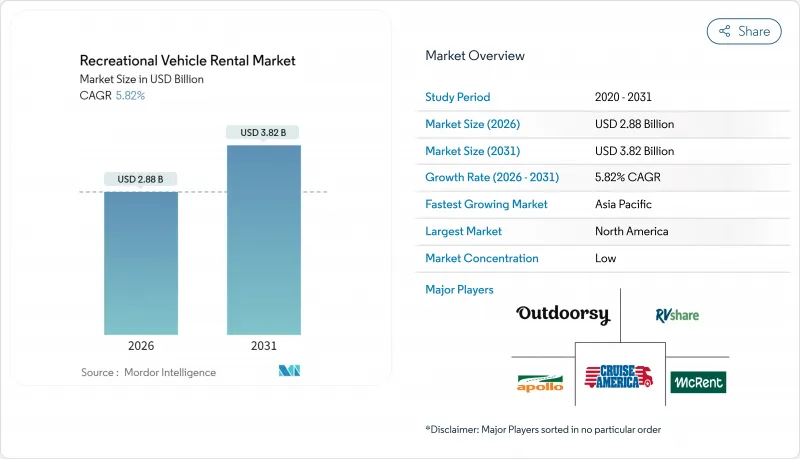
預計到 2025 年,休閒車 (RV) 租賃市場價值將達到 27.2 億美元,從 2026 年的 28.8 億美元成長到 2031 年的 38.2 億美元。
預計在預測期(2026-2031 年)內,複合年成長率將達到 5.82%。
儘管燃油價格上漲和區域規劃限制增加了營運成本,但市場仍保持穩定成長。自駕遊度假方式的轉變、P2P預訂平台的普及以及更易於駕駛和維護的現代車輛設計的改進,都在推動市場需求。營運商正在加速採用遠端資訊處理技術以提高車輛運轉率,而一些州和歐盟國家的政策制定者正在努力將零排放獎勵與車輛更換週期相匹配。競爭格局瞬息萬變,整合嘗試面臨反壟斷審查,但採購和保險方面的規模經濟效益仍有利於大型車隊所有者。
全球房車(休閒車)租借市場趨勢及洞察
國內自駕遊旅遊業蓬勃發展
國內公路旅行已從疫情期間的替代出行方式轉變為主流休閒選擇。調查顯示,70%的美國旅客計劃在2025年至少進行一次公路旅行,高於2023年的57%。富裕家庭也加入了這一趨勢,推高了平均每日租金,但並未減少使用。隨著公路旅客尋求自給自足的交通方式,越來越多的家庭選擇配備車載淋浴設備和Wi-Fi的旅居車。旅行社報告稱,2025年中期預訂的旅遊套裝中,近一半將包含自駕遊行程,是前一年的兩倍。這種持續成長的趨勢凸顯了獨立旅行方式的持續轉變,直接惠及房車租賃市場。
P2P(P2P)租賃平台的成長
P2P網路釋放了未充分利用的庫存。光是Outdoorsy一家公司預計到2024年累計預訂額就將超過30億美元,並計畫到2029年達到80億美元。房東數量的成長速度超過了專業車隊的擴張速度,使得房車租賃市場能夠在無需大量資產負債表投資的情況下擴大車輛選擇範圍和地理覆蓋範圍。為都市區旅行者解決「最後一公里」難題的配送服務,已將P2P行程的平均時間延長至7天。平台提供的保險計劃和全天候道路救援服務降低了新用戶的風險感知。極具吸引力的單價成長使價格漲幅低於飯店業的通膨水平,從而擴大了價值差距,鼓勵用戶重複預訂。
高昂的維護和保險成本
現代房車配備了複雜的電池、滑出式機構和資訊娛樂系統,推高了維修成本。熟練技工仍供不應求,主要市場的維修廠人工費超過每小時 160 美元。大型車隊可以協商多車保險,但小規模車主卻無法做到,這進一步擴大了房車租賃市場的成本差距。預防性維護計劃和延長保固雖然有效,但需要資金投入,這對於現金流緊張的營運商來說可能是一筆不小的負擔。
細分市場分析
到2025年,車隊營運商的收入佔總收入的69.60%,其中私人車隊營運商的成長率最高。規模經濟使企業車隊能夠獲得批量採購折扣、集中維護和全面的保險。合併後的公司正尋求透過收購來擴大區域覆蓋範圍,但競爭監管機構正在阻止反競爭行為,例如澳洲Apollo Tourism和Tourism Holdings提案的收購方案。零排放法規相關的遵循成本有利於資金雄厚的車隊,因為它們可以資金籌措充電樁和技術人員再培訓的費用。
在P2P平台提供一站式預訂、驗證和保險服務的環境下,個體車主蓬勃發展。許多車主透過專注於本地活動或寵物友善露營車等細分市場,提高了全年運轉率。平台提供的維護網路使小規模車主無需自行建造基礎設施即可完成安全檢查。這些趨勢使個體車主成為靈活的補充而非直接替代,最終豐富了整個休閒車租賃市場。
到2025年,線上通路將佔租賃市場佔有率的61.10%,複合年成長率達7.89%,這反映出租賃市場正在發生決定性的數位轉型。即時庫存管理、動態定價和整合支付等技術已將預訂週期從數週縮短至數天。年輕的租車者依賴行動應用程式規劃行程,並要求營運商提供360度全景車輛展示和人工智慧聊天支援。
對於行程複雜的客戶而言,線下預訂仍然至關重要,因為首次預訂的客戶需要諮詢車輛類型、營地選擇和路線安全等問題。營運商正擴大採用「線上線下結合」的模式,客戶先在線上完成預訂流程,然後透過展示室參觀或視訊通話最終確認條款。這種混合模式既能滿足更廣泛的房車租賃市場需求,也能保持線下服務的可靠性。
區域分析
預計到2025年,北美將維持46.30%的收入佔有率。美國擁有廣泛的露營地網路、成熟的保險產品以及較高的可支配收入,這些都支撐著蓬勃發展的休閒車(RV)租賃市場。加州的「先進清潔卡車」法規已被九個州採納,該法規要求從2025年起逐步擴大零排放車輛的銷售。雖然這會帶來一些初期成本,但預計從長遠來看,這將降低營運成本(rvia.org)。加拿大受益於豐富的自然景觀和國內旅遊稅收優惠政策,而墨西哥的高速公路建設和不斷壯大的中產階級正在推動潛在需求並促進早期成長。
到2031年,亞太地區將以11.18%的複合年成長率成為成長最快的地區。截至2024年,日本將擁有16.5萬輛註冊露營車和超過500家獲得認證的房車營地。在中國,由於國內電動車供應鏈和新建高速公路網路的推動,汽車租賃生態系統正在迅速運作中。澳洲仍然是背包客的重要目的地,但競爭監管機構反對車輛整合,因為這可能導致價格上漲。印度的新增旅客數量顯著增加,各邦旅遊局支持的路邊設施正在降低房車租賃市場的進入門檻。
由於跨境旅行法規的統一和低排放區的擴大,歐洲房車市場正經歷穩定成長。 Erwin Hymer集團2024年銷售額達33.6億美元,佔歐洲23.6%的市佔率(erwinhymergroup.com)。德國的高速公路網路和密集的經銷商網路推動了房車的更新換代需求,而法國和西班牙則依靠其沿海地區的吸引力和悠久的露營文化。凝聚基金改善了東歐成員國的道路狀況,並逐步提高了房車的普及率。一條從挪威延伸至義大利的電動車充電走廊增強了人們對電池驅動旅居車的信心,並將歐洲打造成為零排放車輛的試驗場。
其他福利:
- Excel格式的市場預測(ME)表
- 3個月的分析師支持
目錄
第1章 引言
第2章調查方法
第3章執行摘要
第4章 市場情勢
- 市場概覽
- 市場促進因素
- 國內自駕遊旅遊業蓬勃發展
- P2P(P2P)租賃平台的成長
- 千禧世代和Z世代可支配收入不斷成長。
- 利用遠端資訊運轉率最佳化車隊利用率
- 企業將房車用作移動式臨時辦公空間
- 零排放房車獎勵加速了電動車的普及
- 市場限制
- 高昂的維護和保險成本
- 資產運轉率的季節性下降
- 地方政府對休閒車輛過夜停車有限制。
- 由於零件供應瓶頸,運轉率降低。
- 價值/供應鏈分析
- 監管環境
- 技術展望
- 波特五力模型
- 供應商的議價能力
- 消費者議價能力
- 新進入者的威脅
- 替代品的威脅
- 競爭對手之間的競爭
第5章 市場規模及成長預測(金額)
- 按租賃供應商類型
- 個人和私人業主
- 車隊營運商
- 按預訂類型
- 線下預訂
- 線上預訂
- 依產品類型
- 旅居車
- A級旅居車
- B級旅居車
- C級旅居車
- 拖曳式房車
- 第五輪拖車
- 旅行拖車
- 卡車露營車
- 運動型多用途拖車
- 旅居車
- 按租賃期限
- 短期(1-7天)
- 期中(8-30天)
- 長期(超過30天)
- 按地區
- 北美洲
- 美國
- 加拿大
- 北美其他地區
- 南美洲
- 巴西
- 阿根廷
- 南美洲其他地區
- 歐洲
- 德國
- 英國
- 法國
- 西班牙
- 義大利
- 俄羅斯
- 其他歐洲地區
- 亞太地區
- 中國
- 印度
- 日本
- 韓國
- 澳洲
- 亞太其他地區
- 中東和非洲
- 阿拉伯聯合大公國
- 沙烏地阿拉伯
- 土耳其
- 南非
- 其他中東和非洲地區
- 北美洲
第6章 競爭情勢
- 市場集中度
- 策略趨勢
- 市佔率分析
- 公司簡介
- Cruise America
- Apollo Tourism & Leisure Ltd
- Outdoorsy, Inc.
- RVshare
- McRent
- Indie Campers
- RoadSurfer GmbH
- Camplify
- Yescapa
- El Monte RV
- Just Go Motorhome Hire
- Escape Campervans
- JUCY Rentals
- Spaceships Rentals
- Bunk Campers
第7章 市場機會與未來展望
The RV Rental Market was valued at USD 2.72 billion in 2025 and estimated to grow from USD 2.88 billion in 2026 to reach USD 3.82 billion by 2031, at a CAGR of 5.82% during the forecast period (2026-2031).
Consistent growth is visible even as fuel inflation and zoning constraints raise operating costs. A structural pivot toward road-trip vacations lifts demand, the spread of peer-to-peer booking platforms, and design upgrades that make modern vehicles easier to drive and maintain. Operators are accelerating telematics roll-outs to improve vehicle uptime, while policymakers in several states and EU countries are linking zero-emission incentives to fleet turnover. Competitive dynamics remain fluid as consolidation attempts meet antitrust scrutiny, yet scale advantages in procurement and insurance continue to favor large fleet owners.
Global Recreational Vehicle Rental Market Trends and Insights
Surge in Domestic Road-Trip Tourism
Domestic road-trip travel has moved from pandemic workaround to mainstream leisure choice. Surveys show 70% of U.S. travelers plan at least one road trip during 2025, up from 57% in 2023. Affluent households are joining the trend, lifting average daily rental rates without dampening volume. Road travelers seek self-contained mobility, which pushes more families toward motorized units equipped with onboard showers and Wi-Fi. Travel agencies report that nearly half of packaged vacations booked in mid-2025 revolve around drive-in itineraries, double the prior year. This continued adoption confirms a lasting shift toward independent travel that directly benefits the RV rental market.
Expansion of Peer-to-Peer (P2P) Rental Platforms
P2P networks have unlocked underused inventory. Outdoorsy alone surpassed USD 3 billion in lifetime bookings in 2024 and targets USD 8 billion by 2029. Host growth outpaces professional fleet additions, helping the RV rental market widen vehicle choice and geographic reach without heavy balance-sheet investment. Average P2P trip length rose to seven days, aided by delivery services that solve last-mile issues for urban renters. Platform insurance programs and 24/7 roadside support lower perceived risk for first-time users. Attractive unit economics keep price increases below hotel inflation, extending the value gap that fuels repeat bookings.
High Maintenance & Insurance Costs
Modern RVs carry complex batteries, slide-outs, and infotainment systems that drive repair bills higher. Skilled technicians remain scarce, pushing workshop labor rates past USD 160 per hour in top markets. Large fleets can negotiate multi-vehicle policies that small owners cannot match, widening cost disparities inside the RV rental market. Preventive programs and extended warranties help, yet they demand capital outlays that weigh on cash-flow-constrained operators.
Other drivers and restraints analyzed in the detailed report include:
- Rising Disposable Income Among Millennials & Gen-Z
- Telematics-Enabled Fleet Uptime Optimization
- Municipal Restrictions on Overnight RV Parking
For complete list of drivers and restraints, kindly check the Table Of Contents.
Segment Analysis
Fleet operators controlled 69.60% of 2025 revenue while individual owners delivered the fastest growth. Scale lets corporate fleets secure bulk purchasing discounts, centralized maintenance, and umbrella insurance. Consolidators pursue bolt-on acquisitions to extend regional coverage, yet competition watchdogs have blocked anticompetitive moves such as the Apollo Tourism-Tourism Holdings proposal in Australia. Compliance costs linked to zero-emission mandates favor well-capitalized fleets that can finance depot chargers and technician re-training.
Private owners thrive where P2P platforms provide turnkey booking, verification, and insurance. Many reach higher annual utilization by targeting local events and niche formats such as pet-friendly campervans. Platform-provided maintenance networks allow small owners to meet safety inspections without building infrastructure. These dynamics position individual hosts as agile complements rather than direct substitutes, ultimately enriching choice across the RV rental market.
Online channels captured 61.10% of 2025 rentals and compound at an 7.89% rate, reflecting a decisive digital shift. Real-time inventory, dynamic pricing, and integrated payments shorten the booking window from weeks to days. Younger renters rely on mobile apps for trip planning, pushing operators to offer 360-degree vehicle tours and AI chat support.
Offline bookings remain relevant for complex itineraries where first-time users seek advice on vehicle class, campground selection, and route safety. Operators increasingly integrate chat-to-store models: customers start online, then finalize terms through showroom visits or video calls. This hybrid approach preserves the trust advantage of personal service while scaling the reach of the RV rental market.
The RV Rental Market is Segmented by Rental Supplier Type (Private and Individual Owners and Fleet Operators), Booking Type (Offline Booking and Online Booking), Product Type (Motorized RVs and Towable RVs), Rental Duration (Short-Term, Mid-Term and Long-Term), and Geography (North America, South America, Europe, Asia-Pacific and Middle East and Africa). The Market Forecasts are Provided in Terms of Value (USD).
Geography Analysis
North America retained a 46.30% revenue share in 2025. The United States supplies an extensive campground grid, mature insurance products, and high disposable income that keep the rv rental market buoyant. California's Advanced Clean Trucks rule, already adopted by nine additional states, will require escalating zero-emission sales from 2025, creating upfront costs but long-term operating savings rvia.org. Canada benefits from expansive wilderness routes and tax incentives for domestic tourism, while Mexico shows early promise where highway upgrades and middle-class expansion widen addressable demand.
Asia-Pacific posts the fastest 11.18% CAGR through 2031. Japan leads with 165,000 registered campervans and over 500 certified RV parks as of 2024. China's car-rental ecosystem grows quickly on the back of domestic EV supply chains and new highway corridors. Australia remains a core backpacker circuit, though competition authorities oppose fleet mergers that could raise prices. India supplies a sizable pipeline of first-time travelers; supportive state tourism boards fund roadside amenities that lower entry barriers for the RV rental market.
Europe delivers steady growth as cross-border travel rules harmonize and low-emission zones expand. The Erwin Hymer Group captured 23.6% European market share in 2024 on USD 3.36 billion sales erwinhymergroup.com. Germany's autobahn network and dense dealer footprint foster high replacement demand, while France and Spain rely on coastal draws and established campsite cultures. Eastern EU members receive cohesion-funded road upgrades that gradually raise RV adoption rates. Electric-charging corridors from Norway to Italy enhance confidence in battery-powered motorhomes, positioning Europe as a test bed for zero-emission fleets.
- Cruise America
- Apollo Tourism & Leisure Ltd
- Outdoorsy, Inc.
- RVshare
- McRent
- Indie Campers
- RoadSurfer GmbH
- Camplify
- Yescapa
- El Monte RV
- Just Go Motorhome Hire
- Escape Campervans
- JUCY Rentals
- Spaceships Rentals
- Bunk Campers
Additional Benefits:
- The market estimate (ME) sheet in Excel format
- 3 months of analyst support
TABLE OF CONTENTS
1 Introduction
2 Research Methodology
3 Executive Summary
4 Market Landscape
- 4.1 Market Overview
- 4.2 Market Drivers
- 4.2.1 Surge in Domestic Road-Trip Tourism
- 4.2.2 Expansion of Peer-To-Peer (P2P) Rental Platforms
- 4.2.3 Rising Disposable Income Among Millennials & Gen-Z
- 4.2.4 Telematics-Enabled Fleet Uptime Optimisation
- 4.2.5 Corporate Use of Rvs As Mobile Pop-Up Spaces
- 4.2.6 Zero-Emission RV Incentives Accelerating Electrified Fleets
- 4.3 Market Restraints
- 4.3.1 High Maintenance and Insurance Costs
- 4.3.2 Seasonality-Driven Low Asset Utilisation
- 4.3.3 Municipal Restrictions On Overnight RV Parking
- 4.3.4 Spare-Part Supply Bottlenecks Delaying Turnaround
- 4.4 Value / Supply-Chain Analysis
- 4.5 Regulatory Landscape
- 4.6 Technological Outlook
- 4.7 Porter's Five Forces
- 4.7.1 Bargaining Power of Suppliers
- 4.7.2 Bargaining Power of Consumers
- 4.7.3 Threat of New Entrants
- 4.7.4 Threat of Substitute Products
- 4.7.5 Intensity of Competitive Rivalry
5 Market Size & Growth Forecasts (Value (USD))
- 5.1 By Rental Supplier Type
- 5.1.1 Private and Individual Owners
- 5.1.2 Fleet Operators
- 5.2 By Booking Type
- 5.2.1 Offline Booking
- 5.2.2 Online Booking
- 5.3 By Product Type
- 5.3.1 Motorized RVs
- 5.3.1.1 Class A Motorhomes
- 5.3.1.2 Class B Motorhomes
- 5.3.1.3 Class C Motorhomes
- 5.3.2 Towable RVs
- 5.3.2.1 Fifth-Wheel Trailers
- 5.3.2.2 Travel Trailers
- 5.3.2.3 Truck Campers
- 5.3.2.4 Sports Utility Trailers
- 5.3.1 Motorized RVs
- 5.4 By Rental Duration
- 5.4.1 Short-term (1-7 days)
- 5.4.2 Mid-term (8-30 days)
- 5.4.3 Long-term (More than 30 days)
- 5.5 By Geography
- 5.5.1 North America
- 5.5.1.1 United States
- 5.5.1.2 Canada
- 5.5.1.3 Rest of North America
- 5.5.2 South America
- 5.5.2.1 Brazil
- 5.5.2.2 Argentina
- 5.5.2.3 Rest of South America
- 5.5.3 Europe
- 5.5.3.1 Germany
- 5.5.3.2 United Kingdom
- 5.5.3.3 France
- 5.5.3.4 Spain
- 5.5.3.5 Italy
- 5.5.3.6 Russia
- 5.5.3.7 Rest of Europe
- 5.5.4 Asia-Pacific
- 5.5.4.1 China
- 5.5.4.2 India
- 5.5.4.3 Japan
- 5.5.4.4 South Korea
- 5.5.4.5 Australia
- 5.5.4.6 Rest of Asia-Pacific
- 5.5.5 Middle East and Africa
- 5.5.5.1 United Arab Emirates
- 5.5.5.2 Saudi Arabia
- 5.5.5.3 Turkey
- 5.5.5.4 South Africa
- 5.5.5.5 Rest of Middle East and Africa
- 5.5.1 North America
6 Competitive Landscape
- 6.1 Market Concentration
- 6.2 Strategic Moves
- 6.3 Market Share Analysis
- 6.4 Company Profiles (Includes Global Level Overview, Market Level Overview, Core Segments, Financials as Available, Strategic Information, Market Rank/Share for Key Companies, Products and Services, SWOT Analysis, and Recent Developments)
- 6.4.1 Cruise America
- 6.4.2 Apollo Tourism & Leisure Ltd
- 6.4.3 Outdoorsy, Inc.
- 6.4.4 RVshare
- 6.4.5 McRent
- 6.4.6 Indie Campers
- 6.4.7 RoadSurfer GmbH
- 6.4.8 Camplify
- 6.4.9 Yescapa
- 6.4.10 El Monte RV
- 6.4.11 Just Go Motorhome Hire
- 6.4.12 Escape Campervans
- 6.4.13 JUCY Rentals
- 6.4.14 Spaceships Rentals
- 6.4.15 Bunk Campers


