


 |
市場調查報告書
商品編碼
1910443
膨脹型塗料:市場佔有率分析、產業趨勢與統計、成長預測(2026-2031)Intumescent Coatings - Market Share Analysis, Industry Trends & Statistics, Growth Forecasts (2026 - 2031) |
||||||

※ 本網頁內容可能與最新版本有所差異。詳細情況請與我們聯繫。
預計到 2026 年,膨脹型塗料市場價值將達到 14.1 億美元,從 2025 年的 13.6 億美元成長到 2031 年的 17.1 億美元,2026 年至 2031 年的年複合成長率(CAGR)為 3.89%。
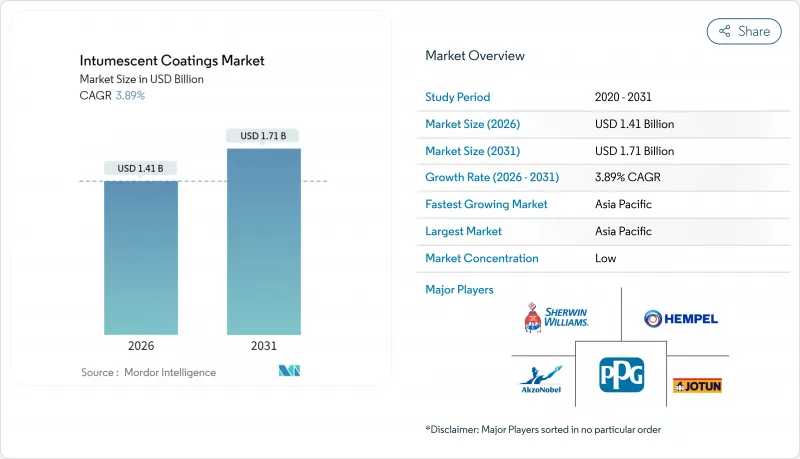
全球日益嚴格的消防安全標準、對環保建築材料的堅定支持,以及在不損害結構鋼材防護性能的前提下展現其外觀的需求,共同推動了膨脹型防火塗料的普及。市場需求成長並非爆發式成長,而是循序漸進,這顯示其韌性源自於監管合規週期,而非投機性的建築熱潮。水性化學品已佔市場收入的40%,隨著揮發性有機化合物監管的日益嚴格,促使設計人員傾向於選擇低氣味解決方案,預計這一比例將繼續上升。在人口密集的城市、海上能源設施和模組化工廠等場所,人們越來越傾向於主動降低火災風險,這顯示膨脹型防火塗料的應用場景十分廣泛,尤其強調其遇熱膨脹後形成隔熱炭層的薄膜特性。隨著耐久性、固化速度和塗層厚度等方面的技術進步不斷延長產品壽命,膨脹型防火塗料市場的收入成長越來越體現為每平方英尺使用壽命價值的提升,而非單純的銷售成長。
全球膨脹型塗料市場趨勢與洞察
加速亞太地區高層建築消防安全標準的製定
對於超過24公尺的塔樓,新的建築規範幾乎強制要求使用薄膜塗層,這為開發商提供了一種無需增加結構重量即可提供兩小時防護的產品。中國和印度的認證體系強調第三方測試,提高了進入門檻,同時也讓先驅者獲得了優勢。因此,隨著都市區高度的增加和疏散時間的縮短,膨脹型防火塗料市場正迎來強勁的成長動能。符合當地建築規範的供應商更容易獲得投標競標,而且核准流程通常涵蓋多個計劃階段,從而提高了收入前景。
擴大石油和天然氣探勘活動
2024年,烴類專用產品佔了44.2%的市場佔有率,這主要得益於海上上層建築、液化天然氣工廠和煉油廠需要應對超過1100°C的池火溫度。北美頁岩氣開發項目維持了造船廠的運作,並帶動了環氧膨脹型防火膜的穩定訂單。由於營運商重視單一合約的責任制,統包工程的供應和安裝承包商得以維持較高的利潤率。通過UL 1709等通訊協定測試的塗料往往會在規範清單中保留多年,從而為膨脹型防火塗料市場提供了持續的收入來源。
環氧樹脂價格波動
原料成本波動會對利潤率造成壓力,尤其是對於採購現貨的亞洲生產商。多年期供應合約雖然能提供部分保障,但無法完全消除原物料價格突然上漲的風險。預算超支可能導致計劃啟動延遲,並在規格允許的情況下進行產品替換,從而暫時減緩膨脹型塗料市場的成長。
細分市場分析
到2025年,纖維素塗料將佔市場總收入的52.60%(7.154億美元),並繼續保持主導地位,這主要得益於商業和住宅鋼結構對耐慢燃火災的大規模需求。纖維素塗料價格相對較低,推動了其在中高層建築計劃中的應用,而監管強制執行並非唯一的促進因素。建築師看到了纖維素塗料明顯的成本效益,並傾向於重複使用。這表明,即使對碳氫化合物產品的需求激增,纖維素塗料的潛在需求仍然強勁。同時,累計達到6.446億美元,年複合成長率(CAGR)為4.92%,成長率超過整體市場。這些產品必須經受住噴射火和池火測試,而且一旦EPC公司批准了某個品牌,他們很少會在計劃進行過程中更換品牌。這種連續性鞏固了長期的維護合作關係,並帶來了可預測的售後服務收入。因此,即使噸位較低,碳氫化合物細分市場也能產生更高的單份合約收入,從而加強膨脹塗料市場的價值集中度。
碳氫化合物塗料的強勁成長與沿岸地區和中東地區新建的FPSO裝置、LNG出口裝置以及煉油廠的升級改造直接相關。環氧樹脂系統仍然是海上設施的標準平台,因為此類塗料即使在熱衝擊下也必須保持附著力。隨著各國能源策略轉向下游自給自足,碳氫化合物應用領域膨脹型防火塗料的市場規模預計將會擴大。同時,由於都市化進程加快,裸露的鋼材在城市環境中展現出現代美感,纖維素基產品在這些地區仍需求旺盛。雖然這兩種防火方案的發展路徑不同,但它們並非爭奪同一面積,而是各自滿足不同的安全需求,增強了各自的市場滲透率。
到2025年,水性塗料將佔總收入的40.80%,年複合成長率達5.22%,這將推動低VOC(揮發性有機化合物)應用方法的普及。水性塗料氣味溫和,無需人員在場即可進行塗裝,此實用優勢簡化了維修的物流流程。這最大限度地減少了業主因停工造成的損失,而停工損失往往被忽視,但卻是促進重複購買的重要因素。溶劑型和混合型環氧樹脂塗料仍佔據剩餘市場佔有率,尤其適用於需要在低溫下快速固化的環境,例如海上設施和寒冷氣候地區。然而,供應商正在調整溶劑配方,以確保VOC含量低於未來的監管基準值,這預示著一種漸進式的轉變,而不是突然淘汰。
隨著監管限制日益嚴格,設計人員在評估技術時,不僅關注其耐火性能,也關注其生產過程中隱含的碳排放。水性塗料在這兩方面都越來越受歡迎,促使計劃工程師放棄傳統的溶劑型塗料。預計膨脹型塗料市場規模將越來越受到生命週期評估的影響,生命週期評估旨在評估從生產到應用過程中的低碳排放。混合型環氧樹脂憑藉其優異的機械強度和環境性能,保持著市場地位,這表明性能目標和永續性目標正在逐步融合。
膨脹型塗料報告按應用(纖維素基、碳氫化合物基)、技術(溶劑型、水性、環氧基)、樹脂類型(環氧樹脂、丙烯酸樹脂、聚氨酯等)、終端用戶產業(建築、汽車等)和地區(亞太地區、北美、歐洲等)對產業進行細分。市場預測以美元計價。
區域分析
預計到2025年,亞太地區將創造4.706億美元(佔全球營收的34.60%)的市場規模,並在2031年之前以5.57%的複合年成長率成長。中國在高層建築安全和石化自給自足方面的雙重目標,支撐了纖維素和碳氫化合物兩大類產品的穩定需求。印度的智慧城市計畫已將被動防火納入市政競標清單,使得膨脹型防火塗料的供應實際上成為政府資助的高層建築建設的必要條件。在當地建廠的位置商可以降低外匯風險,並享受有利於國內生產的稅收優惠。
北美仍然是膨脹型塗料市場的核心支柱。頁岩氣開發推動了液化天然氣和管道建設,而老舊橋樑的改造則促使人們按照美國聯邦公路管理局(FHWA)的指導方針,採用膨脹型塗料維修。以美元計價的供應鏈降低了匯率風險,而廣泛的本地服務網路則能夠快速進行檢查和維修,從而抵消原料價格波動的影響。模組化建築正在創造一個新的需求領域,這得益於工廠內噴塗工藝縮短了施工時間。
在塗料指令的推動下,歐洲展現出強勁的監管勢頭,鼓勵水性塗料的創新。德國和斯堪地那維亞的納維亞半島的綠色建築認證將採購與產品碳含量評分掛鉤,推動了市場需求。歐洲綠色交易提供的資金支持,用於扶持木質素基添加劑的試點生產線,並鼓勵供應商在區域實驗室測試生物基生產路線。因此,歐洲往往是低碳塗料的領先,而這些產品隨後在全球範圍內流行起來,進一步塑造了膨脹型塗料市場的競爭格局。
其他福利:
- Excel格式的市場預測(ME)表
- 3個月的分析師支持
目錄
第1章 引言
- 研究假設和市場定義
- 調查範圍
第2章調查方法
第3章執行摘要
第4章 市場情勢
- 市場概覽
- 市場促進因素
- 加速亞太地區高層建築消防安全標準的製定
- 擴大石油和天然氣探勘活動
- 歐盟低VOC法規促進了水性塗料的普及。
- 北美模組化異地鋼結構製造
- 轉向環保塗料
- 市場限制
- 環氧樹脂價格波動
- 膨脹型防火塗料高成本
- 與其他消防方法的競爭
- 價值鏈分析
- 波特五力模型
- 供應商的議價能力
- 買方的議價能力
- 新進入者的威脅
- 替代品的威脅
- 競爭強度
第5章 市場規模與成長預測
- 透過使用
- 纖維素基
- 碳氫化合物
- 透過技術
- 溶劑型
- 水溶液
- 環氧樹脂基
- 依樹脂類型
- 環氧樹脂
- 丙烯酸纖維
- 聚氨酯
- 醇酸樹脂
- 其他樹脂
- 按最終用戶行業分類
- 建造
- 石油和天然氣
- 汽車/運輸設備
- 其他終端用戶產業
- 按地區
- 亞太地區
- 中國
- 印度
- 日本
- 韓國
- 亞太其他地區
- 北美洲
- 美國
- 加拿大
- 墨西哥
- 歐洲
- 德國
- 英國
- 法國
- 義大利
- 俄羅斯
- 其他歐洲地區
- 南美洲
- 巴西
- 阿根廷
- 其他南美洲
- 中東和非洲
- 沙烏地阿拉伯
- 南非
- 其他中東和非洲地區
- 亞太地區
第6章 競爭情勢
- 市場集中度
- 策略趨勢
- 市佔率分析
- 公司簡介
- Akzo Nobel NV
- Albi Protective Coatings
- BASF
- Contego International Inc.
- Etex Group
- Flame-Stop Inc.
- Hempel A/S
- Hexion Inc.
- Huntsman International LLC
- Isolatek International
- Jotun
- No-Burn, Inc.
- PPG Industries, Inc.
- RPM International Inc.
- Teknos Group
- The Sherwin-Williams Co.
- Tremco Incorporated
第7章 市場機會與未來展望
The Intumescent Coatings Market size in 2026 is estimated at USD 1.41 billion, growing from 2025 value of USD 1.36 billion with 2031 projections showing USD 1.71 billion, growing at 3.89% CAGR over 2026-2031.
Adoption is anchored in stricter global fire-safety standards, a decisive shift toward greener building materials and the desire to keep structural steel visible without compromising protection. Demand increases are incremental rather than explosive, a pattern that hints at resilience built on code compliance cycles instead of speculative construction booms. Water-based chemistries already generate 40% of revenue, and regulatory limits on volatile organic compounds suggest this share will keep rising as specifiers prefer low-odor solutions. The growing preference for proactive fire-risk mitigation in high-density cities, offshore energy hubs and modular factories points to broad use cases that value thin films which expand into an insulating char when exposed to heat. Parallel innovation around durability, faster cure and lower applied thickness is extending product life, so revenue growth increasingly reflects a higher lifetime value per square foot rather than pure volume gains in the Intumescent coatings market.
Global Intumescent Coatings Market Trends and Insights
Accelerated High-Rise Fire Codes in Asia Pacific
New requirements for towers above 24 m make thin-film coatings nearly mandatory, giving developers products that deliver two-hour protection without adding structural weight. Certification regimes in China and India reward third-party testing, raising entry hurdles and giving early movers an edge. The Intumescent coatings market therefore enjoys a structural boost as skyline density grows and evacuation windows tighten. Suppliers that align product labels with local codes enter bid lists more easily, and approvals granted now often span multiple project phases, improving revenue visibility.
Growth in Oil and Gas Exploration Activities
Hydrocarbon-specialized products held 44.2% share in 2024 because offshore topsides, LNG plants and refineries must manage pool-fire temperatures above 1,100 °C. Shale-linked construction across North America keeps fabrication yards busy, sustaining a steady order flow of epoxy intumescent films. Contractors that bundle supply with installation achieve greater margin retention as operators value single-contract accountability. Once a coating wins protocol testing like UL 1709 it tends to remain on specification lists for years, supporting recurring income streams in the Intumescent coatings market.
Epoxy Resin Price Volatility
Fluctuations in raw material costs squeeze margins, especially for Asian producers that buy spot cargoes. Multi-year supply contracts provide partial insulation yet cannot eliminate exposure when feedstock prices spike quickly. Budget overruns may delay project starts or trigger product substitution where standards allow, temporarily slowing growth in the Intumescent coatings market.
Other drivers and restraints analyzed in the detailed report include:
- EU Low-VOC Mandate Boosting Water-Borne Formulations
- Modular Off-Site Steel Fabrication in North America
- High Cost of Intumescent Coatings
For complete list of drivers and restraints, kindly check the Table Of Contents.
Segment Analysis
Cellulosic coatings accounted for 52.60% of 2025 revenue equal to USD 715.4 million and continue to dominate because large volumes of commercial and residential steel require protection against slow-burn fires. Their relatively lower price broadens accessibility for mid-rise projects, so regulatory enforcement is not the sole driver. Architects see a clear cost-to-benefit ratio that supports repeat use, implying resilient baseline demand even if hydrocarbon volumes escalate faster. In contrast, hydrocarbon-rated lines generated USD 644.6 million yet are forecast to outpace the headline market with a 4.92% CAGR to 2031. These products must survive jet-fire and pool-fire testing, and once an EPC firm qualifies a brand it rarely changes mid-project. That stickiness locks in extended maintenance work, creating predictable after-sales income. The hydrocarbon subset therefore raises revenue per contract even if tonnage remains lower, reinforcing value concentration within the Intumescent coatings market.
The stronger growth rate in hydrocarbon films ties directly to new FPSO units, LNG export trains and refining upgrades in the Gulf Coast and Middle East. Offshore assets demand coatings that adhere under thermal shock, so epoxy systems remain the default platform. The Intumescent coatings market size for hydrocarbon applications is projected to climb as national energy strategies focus on downstream self-sufficiency. Cellulosic lines, meanwhile, keep pace with densifying cities where exposed steel delivers modern aesthetics. Together, the two fire scenarios carve distinct paths, but each strengthens overall penetration because they address separate safety imperatives rather than competing for the same square footage.
Water-borne solutions held 40.80% of 2025 revenue and are advancing at a 5.22% CAGR, leading the push toward low-VOC construction practices. Their absence of strong odor permits coating while tenants remain in place, a practical gain that simplifies refurbishment logistics. Building owners thus minimize downtime costs, an overlooked yet significant driver of repeat purchasing. Solvent-based and hybrid epoxy chemistries still account for the balance, favored where rapid cure at low temperature is mandatory, particularly offshore or in cold climates. Even so, suppliers tweak solvent blends to push VOC levels below future regulatory thresholds, signaling an evolutionary rather than abrupt phase-out.
As regulatory ceilings tighten, specifiers benchmark technologies not only on fire endurance but also on embodied carbon. Water-based films score well on both counts, encouraging project engineers to switch from older solvent types. The Intumescent coatings market size is expected to be increasingly influenced by lifecycle assessments that reward low emissions from manufacturing through application. Hybrid epoxies retain altitude by offering mechanical robustness plus improved environmental scores, illustrating a gradual convergence of performance and sustainability objectives.
The Intumescent Coatings Report Segments the Industry by Application (Cellulosic, Hydrocarbon), Technology (Solvent Based, Water Based, Epoxy Based), Resin Type (Epoxy, Acrylic, Polyurethane and More), End-User Industry (Construction, Automotive and More), and Geography (Asia-Pacific, North America, Europe, and More). The Market Forecasts are Provided in Terms of Value (USD).
Geography Analysis
Asia Pacific generated USD 470.6 million or 34.60% of global revenue in 2025 and is forecast to climb at 5.57% CAGR through 2031. China enforces dual goals of high-rise safety and petrochemical self-reliance, underpinning steady volume in both cellulosic and hydrocarbon categories. India's Smart Cities program embeds passive fire protection into municipal tender checklists, effectively making intumescent supply a prerequisite for state-funded towers. Producers that localize factories in the region mitigate exchange-rate risk and capture tax incentives that favor domestic manufacturing.
North America remains a core pillar of the Intumescent coatings market. The shale play drives fresh LNG and pipeline assets while an aging bridge stock invites intumescent retrofits referenced in FHWA guidelines. Supply chains hedged in USD reduce currency exposure, and broad field-service networks enable rapid inspection and remedial work that offset raw-material swings. Modular construction adds a new demand layer, since factory spraying compresses build schedules.
Europe demonstrates strong regulatory pull derived from the Paints Directive, which rewards water-borne innovations. German and Scandinavian green-building labels amplify demand by linking procurement to embodied carbon scoring. Funding under the European Green Deal subsidizes pilot lines for lignin-based additives, encouraging suppliers to test bio-based routes inside regional labs. As a result, Europe often becomes the first adopter of low-carbon grades that later scale globally, further shaping the competitive direction of the Intumescent coatings market.
- Akzo Nobel N.V.
- Albi Protective Coatings
- BASF
- Contego International Inc.
- Etex Group
- Flame-Stop Inc.
- Hempel A/S
- Hexion Inc.
- Huntsman International LLC
- Isolatek International
- Jotun
- No-Burn, Inc.
- PPG Industries, Inc.
- RPM International Inc.
- Teknos Group
- The Sherwin-Williams Co.
- Tremco Incorporated
Additional Benefits:
- The market estimate (ME) sheet in Excel format
- 3 months of analyst support
TABLE OF CONTENTS
1 Introduction
- 1.1 Study Assumptions and Market Definition
- 1.2 Scope of the Study
2 Research Methodology
3 Executive Summary
4 Market Landscape
- 4.1 Market Overview
- 4.2 Market Drivers
- 4.2.1 Accelerated High-Rise Fire Codes in Asia Pacific
- 4.2.2 Growth in the Oil and Gas Exploration Activities
- 4.2.3 EU Low-VOC Mandate Boosting Water-Borne Formulations
- 4.2.4 Modular Off-Site Steel Fabrication in North America
- 4.2.5 Shift Toward Environmentally Friendly Coatings
- 4.3 Market Restraints
- 4.3.1 Epoxy Resin Price Volatility
- 4.3.2 High Cost of Intumescent Coatings
- 4.3.3 Competition from Alternative Fire Protection Methods
- 4.4 Value Chain Analysis
- 4.5 Porter's Five Forces
- 4.5.1 Bargaining Power of Suppliers
- 4.5.2 Bargaining Power of Buyers
- 4.5.3 Threat of New Entrants
- 4.5.4 Threat of Substitutes
- 4.5.5 Degree of Rivalry
5 Market Size and Growth Forecasts (Value)
- 5.1 By Application
- 5.1.1 Cellulosic
- 5.1.2 Hydrocarbon
- 5.2 By Technology
- 5.2.1 Solvent-Based
- 5.2.2 Water-Based
- 5.2.3 Epoxy Based
- 5.3 By Resin Type
- 5.3.1 Epoxy
- 5.3.2 Acrylic
- 5.3.3 Polyurethane
- 5.3.4 Alkyd
- 5.3.5 Other Resins
- 5.4 By End-user Industry
- 5.4.1 Construction
- 5.4.2 Oil and Gas
- 5.4.3 Automotive and Transportation
- 5.4.4 Other End-user Industries
- 5.5 By Geography
- 5.5.1 Asia-Pacific
- 5.5.1.1 China
- 5.5.1.2 India
- 5.5.1.3 Japan
- 5.5.1.4 South Korea
- 5.5.1.5 Rest of Asia-Pacific
- 5.5.2 North America
- 5.5.2.1 United States
- 5.5.2.2 Canada
- 5.5.2.3 Mexico
- 5.5.3 Europe
- 5.5.3.1 Germany
- 5.5.3.2 United Kingdom
- 5.5.3.3 France
- 5.5.3.4 Italy
- 5.5.3.5 Russia
- 5.5.3.6 Rest of Europe
- 5.5.4 South America
- 5.5.4.1 Brazil
- 5.5.4.2 Argentina
- 5.5.4.3 Rest of South America
- 5.5.5 Middle East and Africa
- 5.5.5.1 Saudi Arabia
- 5.5.5.2 South Africa
- 5.5.5.3 Rest of Middle East and Africa
- 5.5.1 Asia-Pacific
6 Competitive Landscape
- 6.1 Market Concentration
- 6.2 Strategic Moves
- 6.3 Market Share Analysis
- 6.4 Company Profiles (includes Global level Overview, Market level overview, Core Segments, Financials as available, Strategic Information, Market Rank/Share, Products & Services, Recent Developments)
- 6.4.1 Akzo Nobel N.V.
- 6.4.2 Albi Protective Coatings
- 6.4.3 BASF
- 6.4.4 Contego International Inc.
- 6.4.5 Etex Group
- 6.4.6 Flame-Stop Inc.
- 6.4.7 Hempel A/S
- 6.4.8 Hexion Inc.
- 6.4.9 Huntsman International LLC
- 6.4.10 Isolatek International
- 6.4.11 Jotun
- 6.4.12 No-Burn, Inc.
- 6.4.13 PPG Industries, Inc.
- 6.4.14 RPM International Inc.
- 6.4.15 Teknos Group
- 6.4.16 The Sherwin-Williams Co.
- 6.4.17 Tremco Incorporated
7 Market Opportunities & Future Outlook
- 7.1 White-Space and Unmet-Need Assessment

 可膨脹塗料市場:2026-2032年全球市場預測(依產品類型、樹脂類型、應用方法、膜厚、終端用戶產業及通路分類)水性膨脹塗料市場:2026-2032年全球市場預測(依樹脂類型、技術、銷售管道、應用及最終用途產業分類)
 2026年全球膨脹型塗料市場報告
 膨脹型塗料市場規模、佔有率及成長分析(按類型、基材、應用技術及地區分類)-2026-2033年產業預測
 膨脹型塗料市場-全球產業規模、佔有率、趨勢、機會和預測,按類型、應用、最終用途、地區和競爭格局分類,2020-2030年預測
 全球發泡防火塗料市場(按類型、基材、應用方法、最終用途行業和地區分類)-預測至2030年服飾防水噴霧市場(按產品類型、形式、織物相容性、應用和銷售管道)——2025-2030 年全球預測
 發泡防火塗料市場:2025-2030 年預測
 發泡防火塗料市場規模、佔有率和趨勢分析報告:按類型、基材、技術、應用、應用技術、防火等級、最終用途、地區和細分趨勢,2025-2033 年
 發泡防火塗料市場預測(至2032年):按類型、基材、配方基礎、技術、應用、最終用戶和地區進行的全球分析