


 |
市場調查報告書
商品編碼
1906921
空調設備:市場佔有率分析、產業趨勢與統計、成長預測(2026-2031)HVAC Equipment - Market Share Analysis, Industry Trends & Statistics, Growth Forecasts (2026 - 2031) |
||||||

※ 本網頁內容可能與最新版本有所差異。詳細情況請與我們聯繫。
預計到 2025 年,暖通空調設備市場價值將達到 1,003.3 億美元,到 2026 年將成長至 1,083.7 億美元,到 2031 年將成長至 1,592.5 億美元,預測期(2026-2031 年)的複合成長率為 8.01%。
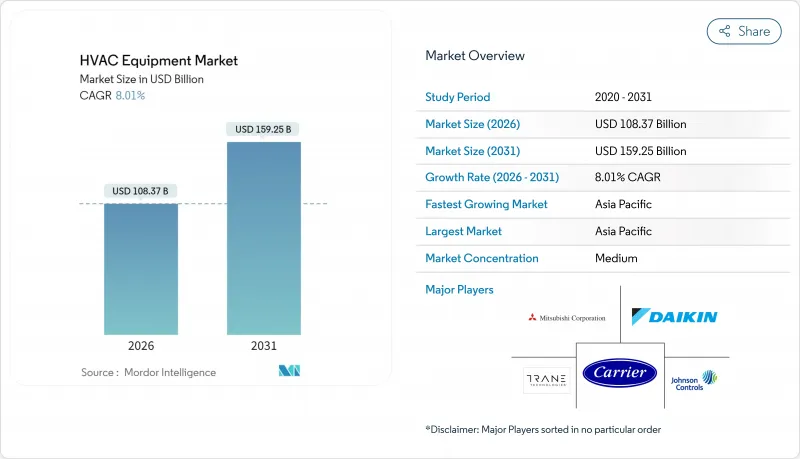
日益嚴格的能源效率法規、向低全球暖化潛勢(GWP)冷媒的轉變以及提升運行性能和終端用戶價值的數位化控制升級,共同推動了成長勢頭。市場需求廣泛:歐洲和北美對熱泵的支持措施正在重塑供暖系統格局;資料中心的擴張給傳統製冷設計帶來了壓力;亞洲的都市化進程持續推動著室內空調的銷售。隨著原始設備製造商(OEM)競相獲取適用於寒冷氣候的軟體人才和熱泵技術(智慧財產權),領先供應商之間的整合正在加速。同時,區域性專業廠商正在拓展尚未開發的細分市場,例如面向偏遠地區的太陽能混合系統。預計到2027年,與2025年1月冷媒法規截止日期相關的短期供應摩擦將有所緩解,這將使高階電氣化解決方案的發展軌跡更加清晰。
全球暖通空調設備市場趨勢與洞察
歐洲嚴格的建築節能標準加速了熱泵的普及應用。
歐洲「近零能耗建築」強制令將推動2024年熱泵裝機量較2022年成長38%,其中新建建築的熱泵裝機量將佔該地區總銷量的一半。北歐國家超過60%的新建住宅將安裝熱泵,而大容量型號的熱泵也正進入商業維修市場,從而持續推動對寒冷氣候技術供應商的需求。
北歐和FLAP-D地區資料中心建設的快速成長將推動精密冷卻的需求。
受以下因素推動,液冷技術的應用正在加速:機架密度超過30kW的增加、冷凍能力年成長率達35%,以及瑞典和挪威新開工項目數量成長65%。江森自控表示,資料中心計劃佔其商用空調收入的18%,高於去年同期的12%。
成熟市場中合格暖通空調技術人員短缺
目前,整個產業的重新設計成本超過 100 億美元,導致平均系統價格上漲 8-12%,這將是短期負擔,直到 2026 年開始規模經濟改善。
細分市場分析
到2025年,空調設備在暖通空調設備市場中佔比達到45.62%。氣溫上升和都市區的壯大推動了強勁的需求。同年,中國住宅室內空調的普及率達73% [cheaa.org]。在北美,無管道迷你分離式空調正以每年18%的速度成長,因為住宅希望在無需維修管道系統的情況下實現分區舒適度。
VRF系統是成長最快的細分市場,預計到2031年將以12.49%的複合年成長率成長。醫院、飯店和綜合用途大樓非常重視同時供暖和冷氣的柔軟性。三菱電機預計,到2024年,其全球VRF系統裝置量將成長32%。
到2025年,維修和更換需求將佔暖通空調設備市場規模的62.78%,主要是由於2005年至2010年需求擴張期間安裝的系統達到使用壽命終點。哈佛大學的一項研究預測,到2024年,受業主追求節能成本的驅動,美國家庭的暖通空調更換需求將增加14%。
新建設雖然規模仍然較小,但預計將以每年 9.18% 的速度成長。美國將於 2023 年生效的更嚴格的能源標準將使最低能源效率標準提高 15%,這將促使建築商擴大採用高性能節能方案。基於性能的維修持續成長,江森自控目前已佔其維修累積訂單的 32%。
暖通空調設備市場報告按設備類型(鍋爐/爐灶、熱泵等)、安裝類型(新建、維修/更換等)、最終用戶(住宅、商業等)、建築類型(辦公大樓、醫療機構等)和地區(美國、中國等)對產業進行細分。市場規模和預測均以美元計價。
區域分析
受城市建設和中產階級壯大的推動,亞太地區預計到2025年將佔全球暖通空調設備市場34.42%的佔有率。其中,中國市場佔該地區總價值的42%,但隨著房地產市場趨於穩定,年成長率放緩至6.73% [daikin.com]。日本和韓國市場青睞高規格的VRF系統和空氣淨化機型,而越南和印尼的商業建築市場則呈現兩位數成長。
北美地區佔總收入的29.03%,這主要得益於美國熱泵銷量激增32%,而熱泵銷量激增則源於強勁的更換需求以及《通貨膨脹控制法案》的獎勵[carrier.com]。資料中心和醫療計劃推動商業收入成長了22%。
歐洲佔24.16%。儘管面臨宏觀經濟逆風,2024年熱泵出貨量仍成長了17%。隨著歐盟成員國計劃逐步淘汰石化燃料,維修熱潮推動了暖通空調設備的更換,暖通空調設備的更換支出佔總支出的38%。
中東是成長最快的市場,預計複合年成長率將達到 10.44%,這主要得益於沙烏地阿拉伯的「2030 願景」計畫推動了大規模區域供冷擴張,以及阿拉伯聯合大公國開發商迅速採用 VRF 系統。
其他福利:
- Excel格式的市場預測(ME)表
- 3個月的分析師支持
目錄
第1章 引言
- 研究假設和市場定義
- 調查範圍
第2章調查方法
第3章執行摘要
第4章 市場情勢
- 市場概覽
- 市場促進因素
- 歐洲嚴格的建築節能標準加速了熱泵的普及應用。
- 北歐和FLAP-D地區資料中心建設的快速成長正在推動對精密冷卻的需求。
- 亞洲高層住宅建築中變冷媒流量(VRF)系統的快速普及
- 美國《通貨膨脹控制法案》的稅額扣抵促進了爐子早期更換週期。
- 東歐區域供熱的擴張推動了大容量鍋爐的維修
- 在非洲的離網礦區,太陽能混合空調系統正變得越來越受歡迎。
- 市場限制
- 原始設備製造商 (OEM) 向低全球暖化潛勢 (GWP) 冷媒過渡的初始成本較高
- 成熟市場中合格暖通空調技術人員短缺
- 半導體供應鏈的波動限制了VRF逆變器的供應。
- 歐盟對氟碳化合物實施的嚴格配額制度增加了進口商的合規負擔。
- 價值/供應鏈分析
- 監理展望
- 技術展望
- 波特五力分析
- 供應商的議價能力
- 買方的議價能力
- 新進入者的威脅
- 替代品的威脅
- 競爭對手之間的競爭
- 關鍵績效指標
第5章 市場規模與成長預測
- 透過裝置
- 加熱設備
- 鍋爐和熔爐
- 熱泵
- 單元式加熱器
- 通風設備
- 空調機組
- 加濕器和除濕器
- 空氣過濾器
- 風機盤管機組
- 空調設備
- 單元空調
- 管道式分離空調
- 無管道迷你分離式空調
- 屋頂式空調機組
- 可變冷媒流量(VRF)系統
- 室內空調
- 包裝式終端空調
- 冷卻器
- 單元空調
- 加熱設備
- 按安裝類型
- 新建設
- 維修/更新
- 最終用戶
- 住宅
- 商業的
- 產業
- 依建築類型(商業設施)
- 辦公大樓
- 醫療設施
- 飯店及休閒
- 零售商店和購物中心
- 教育機構
- 資料中心
- 按地區
- 北美洲
- 美國
- 加拿大
- 墨西哥
- 南美洲
- 巴西
- 阿根廷
- 智利
- 歐洲
- 德國
- 英國
- 法國
- 義大利
- 西班牙
- 亞太地區
- 中國
- 印度
- 日本
- 韓國
- ASEAN
- 中東
- 沙烏地阿拉伯
- 阿拉伯聯合大公國
- 土耳其
- 卡達
- 非洲
- 南非
- 奈及利亞
- 埃及
- 北美洲
第6章 競爭情勢
- 市場集中度
- 策略趨勢
- 市佔率分析
- 公司簡介
- Daikin Industries Ltd.
- Carrier Global Corp.
- Trane Technologies PLC
- Johnson Controls International PLC
- Mitsubishi Electric Corp.
- Lennox International Inc.
- Rheem Manufacturing Co.
- Midea Group
- Gree Electric Appliances Inc.
- NIBE Group
- Panasonic Corp.
- Samsung Electronics(HVAC Division)
- LG Electronics(Air-Solution)
- Bosch Thermotechnology
- Vaillant Group
- Alfa Laval AB
- Stiebel Eltron GmbH and Co. KG
- Systemair AB
- Greenheck Fan Corporation
- FlaktGroup
- TROX GmbH
- Swegon Group AB
- Hitachi-Johnson Controls Air Conditioning
- Danfoss A/S(Commercial Compressors)
第7章 市場機會與未來展望
The HVAC equipment market was valued at USD 100.33 billion in 2025 and estimated to grow from USD 108.37 billion in 2026 to reach USD 159.25 billion by 2031, at a CAGR of 8.01% during the forecast period (2026-2031).
Growth momentum rests on tightening energy-efficiency rules, the pivot to low-GWP refrigerants and digital-control upgrades that lift both operating performance and end-user value. Demand is broad-based: heat-pump incentives in Europe and North America are reshaping heating portfolios, data-center build-outs are straining traditional cooling designs and urbanization in Asia keeps room-air-conditioner volumes rising. Consolidation among tier-one vendors is accelerating as OEMs race to lock in software talent and cold-climate heat-pump IP, while regional specialists are moving into unserved niches such as solar-hybrid systems for remote sites. Short-term supply frictions tied to the January 2025 refrigerant deadline are likely to ease by 2027, setting a clearer runway for premium electrification solutions.
Global HVAC Equipment Market Trends and Insights
Stringent Building-Energy Codes in Europe Accelerating Heat-Pump Adoption
Europe's near-zero-energy-building mandate moved heat-pump installations 38% higher in 2024 versus 2022, pushing penetration in new builds to half of all units sold across the bloc. Nordic countries now deploy heat pumps in more than 60% of new homes, and large-capacity variants are entering commercial retrofits, creating a durable pull for cold-climate technology providers
Surge in Data-Center Construction in Nordics and FLAP-D Elevating Precision-Cooling Demand
Rack densities topping 30 kW, a 35% annual leap in cooling capacity and 65% growth in Swedish-Norwegian build-starts are fuelling liquid-cooling adoption. Johnson Controls notes that data-center projects now generate 18% of its commercial HVAC revenue, up from 12% a year earlier.
Talent Shortage of Certified HVAC Technicians in Mature Markets
Industrywide redesign outlays now exceed USD 10 billion and have lifted average system prices 8-12%, a short-lived drag until economies of scale improve after 2026
Other drivers and restraints analyzed in the detailed report include:
- Rapid Uptake of VRF Systems in High-Rise Asian Residential Complexes
- Inflation Reduction Act Tax Credits Catalyzing Early Furnace-Replacement Cycles
- High Up-Front Cost of Low-GWP Refrigerant Transition for OEMs
For complete list of drivers and restraints, kindly check the Table Of Contents.
Segment Analysis
Air-conditioning units contributed 45.62% to the HVAC equipment market in 2025 as rising temperatures and urban middle-class growth kept demand resilient. Residential room air conditioners in China reached 73% penetration that year [cheaa.org]. Ductless mini-splits advanced 18% annually in North America, where homeowners want zonal comfort without duct retrofits.
VRF remains the fastest-growing sub-segment, expanding at a 12.49% CAGR through 2031. Hospitals, hotels and mixed-use towers prize its simultaneous heating-cooling flexibility. Mitsubishi Electric recorded a 32% jump in global VRF installations in 2024
Retrofit and replacement activity represented 62.78% of the HVAC equipment market size in 2025, largely because systems commissioned during the 2005-2010 boom have reached end of life. Harvard research shows U.S. household HVAC replacements rose 14% in 2024 as owners chased lower utility bills.
New construction, although smaller, is forecast to climb 9.18% annually. Stricter 2023 U.S. energy-code updates lifted minimum efficiency thresholds 15%, prompting builders to specify premium packages. Performance-based retrofits continue to gain ground, with Johnson Controls indicating such contracts account for 32% of its retrofit backlog
HVAC Equipment Market Report Segments the Industry by Equipment Type (Boilers and Furnaces, Heat Pumps and More), Installation Type (New Construction, Retrofit / Replacement and More), End User (Residential, Commercial and More), Building Type (Office Buildings, Healthcare Facilities and More), and Geography (United States, China and More). The Market Sizes and Forecasts are Provided in Terms of Value (USD).
Geography Analysis
Asia-Pacific controlled 34.42% of the HVAC equipment market in 2025, driven by urban construction and middle-income expansion. China alone made up 42% of regional value, though its annual growth cooled to 6.73% as real-estate activity stabilized [daikin.com]. Japan and Korea favor high-spec VRF and air-purification models, while Vietnam and Indonesia post double-digit gains on commercial builds.
North America accounted for 29.03%, buoyed by robust replacement demand and a 32% surge in U.S. heat-pump sales following Inflation Reduction Act incentives [carrier.com]. Data-center and healthcare projects lifted commercial revenue 22%.
Europe held 24.16%; heat-pump shipments climbed 17% in 2024 despite macro headwinds. HVAC upgrades made up 38% of EU renovation-wave spending as member states schedule fossil-fuel phaseouts.
The Middle East is the fastest-growing pocket, forecast at a 10.44% CAGR, with Saudi Arabia's Vision 2030 adding large-scale district-cooling capacity and UAE developers adopting VRF at speed.
- Daikin Industries Ltd.
- Carrier Global Corp.
- Trane Technologies PLC
- Johnson Controls International PLC
- Mitsubishi Electric Corp.
- Lennox International Inc.
- Rheem Manufacturing Co.
- Midea Group
- Gree Electric Appliances Inc.
- NIBE Group
- Panasonic Corp.
- Samsung Electronics (HVAC Division)
- LG Electronics (Air-Solution)
- Bosch Thermotechnology
- Vaillant Group
- Alfa Laval AB
- Stiebel Eltron GmbH and Co. KG
- Systemair AB
- Greenheck Fan Corporation
- FlaktGroup
- TROX GmbH
- Swegon Group AB
- Hitachi-Johnson Controls Air Conditioning
- Danfoss A/S (Commercial Compressors)
Additional Benefits:
- The market estimate (ME) sheet in Excel format
- 3 months of analyst support
TABLE OF CONTENTS
1 INTRODUCTION
- 1.1 Study Assumptions and Market Definition
- 1.2 Scope of the Study
2 RESEARCH METHODOLOGY
3 EXECUTIVE SUMMARY
4 MARKET LANDSCAPE
- 4.1 Market Overview
- 4.2 Market Drivers
- 4.2.1 Stringent Building Energy Codes in Europe Accelerating Heat-Pump Adoption
- 4.2.2 Surge in Data-Center Construction in Nordics and FLAP-D Region Elevating Precision Cooling Demand
- 4.2.3 Rapid Uptake of Variable-Refrigerant-Flow (VRF) Systems in High-Rise Asian Residential Complexes
- 4.2.4 Inflation Reduction Act (U.S.) Tax Credits Catalyzing Early Furnace Replacement Cycles
- 4.2.5 District-Heating Expansion in Eastern Europe Spurring Large-capacity Boiler Retrofits
- 4.2.6 Solar-Hybrid HVAC Packages Gaining Traction in Off-Grid African Mining Camps
- 4.3 Market Restraints
- 4.3.1 High Up-front Cost of Low-GWP Refrigerant Transition for OEMs
- 4.3.2 Talent Shortage of Certified HVAC Technicians in Mature Markets
- 4.3.3 Semiconductor Supply-Chain Volatility Constraining VRF Inverter Availability
- 4.3.4 Stringent F-Gas Quotas in EU Increasing Compliance Burden for Importers
- 4.4 Value / Supply-Chain Analysis
- 4.5 Regulatory Outlook
- 4.6 Technological Outlook
- 4.7 Porter's Five Forces Analysis
- 4.7.1 Bargaining Power of Suppliers
- 4.7.2 Bargaining Power of Buyers
- 4.7.3 Threat of New Entrants
- 4.7.4 Threat of Substitutes
- 4.7.5 Intensity of Competitive Rivalry
- 4.8 Key Performance Indicators
5 MARKET SIZE AND GROWTH FORECASTS (VALUE)
- 5.1 By Equipment Type
- 5.1.1 Heating Equipment
- 5.1.1.1 Boilers and Furnaces
- 5.1.1.2 Heat Pumps
- 5.1.1.3 Unitary Heaters
- 5.1.2 Ventilation Equipment
- 5.1.2.1 Air Handling Units
- 5.1.2.2 Humidifiers and Dehumidifiers
- 5.1.2.3 Air Filters
- 5.1.2.4 Fan Coil Units
- 5.1.3 Air-Conditioning Equipment
- 5.1.3.1 Unitary Air Conditioners
- 5.1.3.1.1 Ducted Splits
- 5.1.3.1.2 Ductless Mini-Splits
- 5.1.3.1.3 Packaged Rooftops
- 5.1.3.1.4 Variable Refrigerant Flow (VRF) Systems
- 5.1.3.2 Room Air Conditioners
- 5.1.3.3 Packaged Terminal Air Conditioners
- 5.1.3.4 Chillers
- 5.1.3.1 Unitary Air Conditioners
- 5.1.1 Heating Equipment
- 5.2 By Installation Type
- 5.2.1 New Construction
- 5.2.2 Retrofit / Replacement
- 5.3 By End User
- 5.3.1 Residential
- 5.3.2 Commercial
- 5.3.3 Industrial
- 5.4 By Building Type (Commercial)
- 5.4.1 Office Buildings
- 5.4.2 Healthcare Facilities
- 5.4.3 Hospitality and Leisure
- 5.4.4 Retail Stores and Malls
- 5.4.5 Educational Institutions
- 5.4.6 Data Centers
- 5.5 By Geography
- 5.5.1 North America
- 5.5.1.1 United States
- 5.5.1.2 Canada
- 5.5.1.3 Mexico
- 5.5.2 South America
- 5.5.2.1 Brazil
- 5.5.2.2 Argentina
- 5.5.2.3 Chile
- 5.5.3 Europe
- 5.5.3.1 Germany
- 5.5.3.2 United Kingdom
- 5.5.3.3 France
- 5.5.3.4 Italy
- 5.5.3.5 Spain
- 5.5.4 Asia-Pacific
- 5.5.4.1 China
- 5.5.4.2 India
- 5.5.4.3 Japan
- 5.5.4.4 South Korea
- 5.5.4.5 ASEAN
- 5.5.5 Middle East
- 5.5.5.1 Saudi Arabia
- 5.5.5.2 United Arab Emirates
- 5.5.5.3 Turkey
- 5.5.5.4 Qatar
- 5.5.6 Africa
- 5.5.6.1 South Africa
- 5.5.6.2 Nigeria
- 5.5.6.3 Egypt
- 5.5.1 North America
6 COMPETITIVE LANDSCAPE
- 6.1 Market Concentration
- 6.2 Strategic Moves
- 6.3 Market Share Analysis
- 6.4 Company Profiles (includes Global level Overview, Market level overview, Core Segments, Financials as available, Strategic Information, Market Rank/Share, Products and Services, Recent Developments)
- 6.4.1 Daikin Industries Ltd.
- 6.4.2 Carrier Global Corp.
- 6.4.3 Trane Technologies PLC
- 6.4.4 Johnson Controls International PLC
- 6.4.5 Mitsubishi Electric Corp.
- 6.4.6 Lennox International Inc.
- 6.4.7 Rheem Manufacturing Co.
- 6.4.8 Midea Group
- 6.4.9 Gree Electric Appliances Inc.
- 6.4.10 NIBE Group
- 6.4.11 Panasonic Corp.
- 6.4.12 Samsung Electronics (HVAC Division)
- 6.4.13 LG Electronics (Air-Solution)
- 6.4.14 Bosch Thermotechnology
- 6.4.15 Vaillant Group
- 6.4.16 Alfa Laval AB
- 6.4.17 Stiebel Eltron GmbH and Co. KG
- 6.4.18 Systemair AB
- 6.4.19 Greenheck Fan Corporation
- 6.4.20 FlaktGroup
- 6.4.21 TROX GmbH
- 6.4.22 Swegon Group AB
- 6.4.23 Hitachi-Johnson Controls Air Conditioning
- 6.4.24 Danfoss A/S (Commercial Compressors)
7 MARKET OPPORTUNITIES AND FUTURE OUTLOOK
- 7.1 White-space and Unmet-Need Assessment

 暖通空調設備市場:2026-2032年全球市場預測(按組件、技術、燃料類型、容量、最終用途、安裝類型和分銷管道分類)
 暖通空調設備市場:按應用、產品類型和地區分類
 暖通空調設備市場規模、佔有率、趨勢和預測:按類型、系統類型、最終用戶和地區分類,2026-2034年
 全球暖通空調設備市場規模、佔有率、趨勢和成長分析報告(2026-2034年)印度暖通空調市場(2025-2030 年)
 歐洲暖通空調設備市場-佔有率分析、產業趨勢、統計數據和成長預測(2026-2031年)
 暖通空調設備市場規模、佔有率和成長分析(按類型、設備類型、系統類型、業務類型、最終用戶和地區分類)-2026-2033年產業預測
 全球暖通空調馬達市場
 HVAC 設備市場規模、佔有率、成長分析(按類型、按設備類型、按系統類型、按業務類型、按最終用戶、按地區)- 行業預測 2025-2032北美暖通空調設備:市場佔有率分析、產業趨勢與統計、成長預測(2025-2030 年)