


 |
市場調查報告書
商品編碼
1906256
亞磷醯胺:市場佔有率分析、產業趨勢與統計、成長預測(2026-2031)Phosphoramidite - Market Share Analysis, Industry Trends & Statistics, Growth Forecasts (2026 - 2031) |
||||||

※ 本網頁內容可能與最新版本有所差異。詳細情況請與我們聯繫。
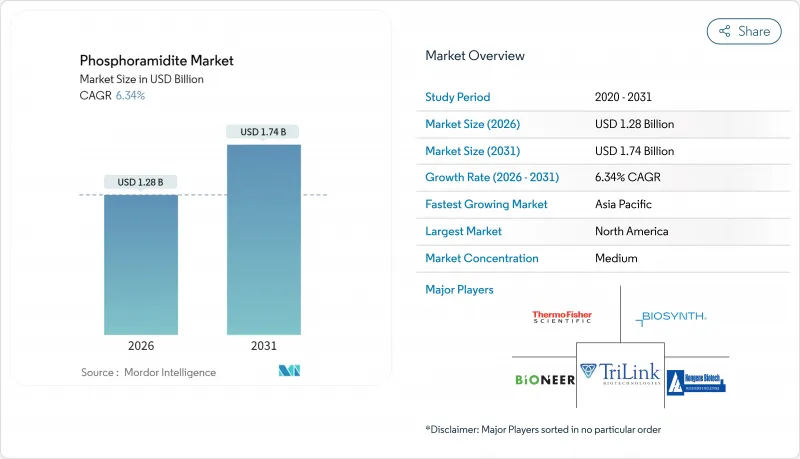
預計到 2026 年,亞磷醯胺市值將達到 12.8 億美元,高於 2025 年的 12 億美元。
預計到 2031 年,該市場規模將達到 17.4 億美元,2026 年至 2031 年的複合年成長率為 6.34%。
治療性寡核苷酸、基因編輯技術以及合成生物學規模化生產的進步正匯聚成一股強勁的需求成長動能。美國食品藥物管理局(FDA) 於 2024 年核准的兩種藥物——伊美替司他 (imetelstat) 和奧利扎森 (olezarsen)——證明了此類藥物的療效,並推動了整個價值鏈的產能擴張。同時,對高通量合成技術的投資降低了單位成本,提高了其在診斷和研究應用中的可用性。政府對基因組醫學的津貼,以及產業為確保地域分散的供應鏈所做的努力,進一步增強了長期消費前景。
全球亞磷醯胺市場趨勢與洞察
核酸療法研發管線快速擴張
2024年核准的兩款First-in-Class藥物imetelstat和olezarsen證實了反義寡核苷酸和GalNAc偶聯平台的臨床療效,推動了目前全球正在進行的229項腫瘤臨床試驗。同年發布的FDA綜合指南簡化了藥理學和安全性要求,並縮短了研發週期。這些協同效應導致後期研發項目數量激增,這些項目需要千噸符合GMP規範的亞磷醯胺。隨著每個候選藥物從早期階段推進商業化階段,隨著生產規模從克級擴大到噸級,年需求量增加一倍。隨著藥物組合從罕見疾病轉向常見心血管代謝疾病,每位患者族群的藥物需求將進一步成長,預計未來十年需求將持續成長。
加速合成生物學平台的應用
合成生物學領域整體正經歷兩位數成長,主要得益於RNA疫苗、精準酵素和生物基化學品的發展。 DNA晶圓代工廠和雲端設計工具支援超高通量合成,消耗大量的亞磷醯胺。酵素方法,例如Codexis公司98%偶聯效率的平台,可以減少雜質並補充現有的化學方法,但目前還無法取代它們。人工智慧的整合最佳化了建造設計,增加了序列的複雜性和長度,這兩方面都會導致每批次試劑用量的增加。在美國、德國和新加坡新建生物合成平台的投資,凸顯了開發人員對化學合成建構模組的堅定信心。
符合GMP標準的生產設施需要高額資金投入。
光是新建工廠擴建一項就可能耗資超過7.25億美元,例如安捷倫公司在2025年宣布,其寡核苷酸產能將翻倍,並於2026年開始營運。建設的複雜性體現在反應器組、溶劑回收系統和C級潔淨室等各個方面,驗證期往往長達數年。小規模的新參與企業通常難以獲得資金籌措,導致產能集中在財力雄厚的現有企業手中。較長的投資回收期和技術過時的風險加劇了投資風險,即使市場需求不斷成長,也阻礙了新企業進入市場。
細分市場分析
到2025年,DNA亞磷醯胺將佔據亞磷醯胺市場51.85%的佔有率,其在反義和診斷探針合成中的核心作用將繼續推動市場成長。儘管基數較小,但由於對體內穩定性的需求不斷成長,LNA亞型預計將以8.21%的複合年成長率超越其他化學類型。隨著多千噸腫瘤和心臟病藥物進入後期臨床試驗,用於DNA誘變的亞磷醯胺市場預計將穩定擴張。學術界的持續需求,以及新興的CRISPR引導RNA工作流程,將支撐RNA亞磷醯胺的需求,而2'-O-甲基化和硫代磷酸酯等特殊修飾則在高價格分佈創造了一個利基市場。
多重修飾策略的進步,例如1,3-二硫雜環己烷-2-基甲氧羰基醯化鹼基的方法,正在擴大聯合治療的設計可能性。一些生物技術公司正在測試的酶連接構建方法,與化學DNA亞磷醯胺相比,尤其是在高度修飾的DNA骨架中,它們具有互補而非競爭關係。
到2025年,受治療產品線不斷擴展和垂直整合生產模式的推動,製藥和生物技術公司將佔據亞磷醯胺市場56.74%的佔有率。然而,外包趨勢正在推動合約開發和生產組織(CDMO)和受託研究機構(CRO)的發展,預計這兩類組織在預測期內將以9.18%的最快成長。藥明康德(WuXi STA)的27條運作中的寡核苷酸生產線以及TriLink的CleanCap授權模式凸顯了市場對相關服務的強勁需求。學術機構保持著穩定的基礎需求,而診斷檢查室則擴大訂購用於受監管檢測套組的高純度產品。
區域分析
預計到2025年,北美將佔據39.78%的收入佔有率,這得益於完善的監管環境、大規模開發商的存在以及大量創業投資的流入。默克集團(Merck KGaA)斥資7,600萬美元對其位於密蘇裡州的生物偶聯工廠進行升級,顯示該地區的資本密集度將持續保持高位。此外,美國透過TriLink許可生態系統在CleanCap支持的mRNA技術領域也主導,進一步鞏固了該國的創新叢集。
亞太地區預計到2031年將以7.29%的複合年成長率成長,主要受低生產成本和國內對先進治療方法日益成長的需求驅動。無錫STA位於泰興的佔地169英畝的工廠自2024年初運作以來,代表了國內合約研發生產機構(CDMO)的規模。鼓勵「中國+多國」採購的政策轉變,以及修訂後的反間諜法規,正促使跨國公司將其供應鏈多元化至印度、越南和泰國,從而重塑其供應鏈的區域結構。
歐洲憑藉先進的製造技術和嚴格的品質標準,仍然是重要的戰略基地。 BioSpring位於奧芬巴赫的RNA大型生產設施計畫於2027年竣工,屆時將成為全球最大的專用核酸生產設施之一,彰顯了該地區對高價值生物製藥的承諾。加上歐洲藥物寡核苷酸聯盟的協調工作,該地區將繼續保持其在卓越製造和綠色化學應用方面的標竿地位。
其他福利:
- Excel格式的市場預測(ME)表
- 3個月的分析師支持
目錄
第1章 引言
- 研究假設和市場定義
- 調查範圍
第2章調查方法
第3章執行摘要
第4章 市場情勢
- 市場概覽
- 市場促進因素
- 核酸療法研發管線快速擴張
- 加速合成生物學平台的應用
- 對個人化醫療和診斷的需求日益成長
- 政府資助基因組研究舉措
- 高通量寡核苷酸合成的技術進步
- 對安全生物製藥供應鏈的策略性投資
- 市場限制
- 符合GMP標準的生產設施需要高額資金投入。
- 嚴格的原料純度監管標準
- 與溶劑廢棄物處理相關的環境問題。
- 複雜低聚物化學領域熟練勞動力短缺
- 監管環境
- 波特五力分析
- 新進入者的威脅
- 買方的議價能力
- 供應商的議價能力
- 替代品的威脅
- 競爭對手之間的競爭
第5章 市場規模與成長預測
- 按類型
- DNA亞磷醯胺
- RNA亞磷醯胺
- LNA亞磷醯胺
- 2'-O-甲基化RNA亞磷醯胺
- 特種/改質亞磷醯胺
- 最終用戶
- 製藥和生物技術公司
- 學術和研究機構
- CDMO 和 CRO
- 診斷實驗室
- 其他最終用戶
- 透過使用
- 治療性寡核苷酸
- 診斷試劑
- 基因和細胞療法
- 合成生物學與基因編輯
- 研究工具
- 按純度等級
- 標準調查等級
- 高效液相層析級
- GMP級
- 超高純度
- 透過合成方法
- 固相化學合成
- 酶促DNA/RNA合成
- 化學-酵素混合法
- 按生產規模
- 研究/創造規模(小於1毫莫耳)
- 試驗/臨床規模(>100 mmol)
- 商業/GMP生產規模(100毫莫耳或以上)
- 地區
- 北美洲
- 美國
- 加拿大
- 墨西哥
- 歐洲
- 德國
- 英國
- 法國
- 義大利
- 西班牙
- 其他歐洲地區
- 亞太地區
- 中國
- 日本
- 印度
- 澳洲
- 韓國
- 亞太其他地區
- 中東和非洲
- GCC
- 南非
- 其他中東和非洲地區
- 南美洲
- 巴西
- 阿根廷
- 南美洲其他地區
- 北美洲
第6章 競爭情勢
- 市場集中度
- 市佔率分析
- 公司簡介
- Thermo Fisher Scientific Inc.
- Danaher Corp.(Integrated DNA Technologies)
- Merck KGaA(Sigma-Aldrich)
- Biosynth Ltd
- TriLink BioTechnologies
- Bioneer Corporation
- Hongene Biotech Corp.
- LGC Biosearch Technologies
- Glen Research
- Bachem AG
- Eurofins Genomics
- Synbio Technologies
- PolyOrg, Inc.
- Creative Biolabs, Inc.
- Lumiprobe Corp.
- QIAGEN NV
- Agilent Technologies Inc.
- Twist Bioscience
- BOC Sciences
- GenScript Biotech
第7章 市場機會與未來展望
Phosphoramidite market size in 2026 is estimated at USD 1.28 billion, growing from 2025 value of USD 1.20 billion with 2031 projections showing USD 1.74 billion, growing at 6.34% CAGR over 2026-2031.
Therapeutic oligonucleotides, gene-editing advances, and synthetic biology scale-up collectively underpin robust demand momentum. Two United States Food and Drug Administration approvals in 2024-imetelstat and olezarsen-validated the drug-class and triggered capacity additions across the value chain. Parallel investments in high-throughput synthesis technologies have lowered unit costs, improving accessibility for diagnostics and research applications. Government grants for genomic medicine along with industry initiatives to secure geographically diverse supply chains further reinforce long-term consumption prospects.
Global Phosphoramidite Market Trends and Insights
Rapid Expansion of Nucleic Acid Therapeutics Pipeline
Two first-in-class approvals in 2024, imetelstat and olezarsen, confirmed clinical efficacy for antisense and GalNAc-conjugated platforms and encouraged 229 oncology trials now active worldwide. Comprehensive FDA guidance issued the same year has streamlined pharmacology and safety expectations, shortening development timelines. The cumulative result is a rising pool of late-stage assets requiring kilogram-scale GMP phosphoramidites. Each candidate's progression from early stage to commercial launch multiplies annual demand because manufacturing campaigns scale from grams to multiple metric tons. As pharmaceutical portfolios pivot from rare disorders to prevalent cardiometabolic diseases the material requirement per patient cohort swells further, extending demand visibility into the next decade.
Accelerating Adoption of Synthetic Biology Platforms
The wider synthetic biology arena is expanding at double-digit rates, driven by RNA vaccines, precision enzymes, and bio-based chemicals. DNA foundries and cloud-based design tools support ultrahigh-throughput syntheses that consume vast volumes of phosphoramidites. Enzymatic approaches such as Codexis' 98% coupling-efficiency platform reduce impurities and complement established chemical methods without yet displacing them. Integration of artificial intelligence optimizes construct design, raising sequence complexity and length, both of which raise reagent usage per batch. Capital spending by new biofoundries in the United States, Germany, and Singapore evidences durable developer confidence in chemically synthesized building blocks.
High Capital Requirements for GMP-Grade Manufacturing Facilities
A single greenfield plant expansion can exceed USD 725 million, as confirmed by Agilent's 2025 announcement to double oligonucleotide output with operations commencing in 2026. Build-out complexity spans reactor suites, solvent recovery systems, and Class C cleanrooms, while validation timelines stretch to multiple years. Smaller entrants often struggle to marshal comparable funding, which concentrates capacity among financially robust incumbents. Extended payback periods and the prospect of technology obsolescence amplify investment risk, thereby tempering market entry despite rising demand.
Other drivers and restraints analyzed in the detailed report include:
- Growing Demand for Personalized Medicine and Diagnostics
- Government Funding for Genomic Research Initiatives
- Stringent Regulatory Standards for Raw Material Purity
For complete list of drivers and restraints, kindly check the Table Of Contents.
Segment Analysis
DNA phosphoramidites held 51.85% of the phosphoramidite market share in 2025 and continue anchoring the phosphoramidite market thanks to their central role in antisense and diagnostic probe synthesis. LNA subtypes, while representing a smaller base, are forecast to outpace other chemistries at an 8.21% CAGR amid rising in vivo stability needs. The phosphoramidite market size for DNA-based variants is projected to expand steadily as multi-kilogram oncology and cardiology drug campaigns enter late-stage trials. Continued academic demand plus new CRISPR guide-RNA workflows sustain RNA amidite volume, whereas specialty modifications such as 2'-O-methyl and thiophosphate commands premium pricing niches.
Advances in multi-modification strategies, exemplified by the 1,3-dithian-2-yl-methoxycarbonyl method for acylated bases, are broadening design possibilities for combination therapies. Enzymatic ligation-based construction methods trialed by several biotech firms complement, rather than compete with, chemical DNA amidites, particularly for highly modified backbones.
Pharmaceutical and biotechnology enterprises consumed 56.74% of the phosphoramidite market in 2025, driven by expanding therapeutic pipelines and vertically integrated manufacturing ambitions. Outsourcing trends nonetheless propel CDMOs and CROs, whose 9.18% CAGR marks the fastest uptake in the forecast horizon. WuXi STA's 27 operational oligonucleotide lines and TriLink's CleanCap licensing model attest to brisk service demand. Academic institutions preserve a meaningful baseline volume, while diagnostic labs increasingly order high-purity lots for regulated test kits.
The Phosphoramidite Market Report is Segmented by Type (DNA Phosphoramidites, and More), End-User (Pharmaceutical & Biotechnology Companies, and More), Application (Therapeutic Oligonucleotides, and More), Purity Grade (Standard Research Grade, and More), Synthesis Method (Solid-Phase Chemical Synthesis, and More), and Geography (North America, and More). The Market Forecasts are Provided in Terms of Value (USD).
Geography Analysis
North America posted 39.78% revenue share in 2025, underpinned by established regulatory clarity, large developer presence, and significant venture-capital flows. Merck KGaA's USD 76 million upgrade of its Missouri bioconjugation site illustrates sustained capital deepening within the region. The United States also leads in CleanCap-enabled mRNA technologies through TriLink's licensing ecosystem, reinforcing domestic innovation clusters.
Asia-Pacific is forecast to grow at 7.29% CAGR through 2031, propelled by lower production costs and rising internal demand for advanced therapies. WuXi STA's 169-acre Taixing facility, operational since early 2024, exemplifies the scale domestic CDMOs are reaching. Policy shifts encouraging "China-plus-many" sourcing, combined with updated anti-espionage regulations, are prompting multinational firms to diversify across India, Vietnam, and Thailand, reshaping supply-chain geography.
Europe maintains a strategic foothold through advanced manufacturing and rigorous quality norms. BioSpring's Offenbach RNA megafacility, on track for completion in 2027, will be among the world's largest dedicated nucleic-acid plants, underscoring regional commitment to high-value biologics. Coupled with the European Pharma Oligonucleotide Consortium's harmonization work, the continent remains a reference point for manufacturing excellence and green-chemistry adoption.
- Thermo Fisher Scientific
- Danaher Corp. (Integrated DNA Technologies)
- Merck
- Biosynth Ltd
- TriLink BioTechnologies
- Bioneer
- Hongene Biotech Corp.
- LGC Biosearch Technologies
- Glen Research
- Bachem AG
- Eurofins
- Synbio Technologies
- PolyOrg, Inc.
- Creative Biolabs, Inc.
- Lumiprobe Corp.
- QIAGEN
- Agilent Technologies
- Twist Bioscience
- BOC Sciences
- GenScript Biotech
Additional Benefits:
- The market estimate (ME) sheet in Excel format
- 3 months of analyst support
TABLE OF CONTENTS
1 Introduction
- 1.1 Study Assumptions & Market Definition
- 1.2 Scope of the Study
2 Research Methodology
3 Executive Summary
4 Market Landscape
- 4.1 Market Overview
- 4.2 Market Drivers
- 4.2.1 Rapid Expansion of Nucleic Acid Therapeutics Pipeline
- 4.2.2 Accelerating Adoption of Synthetic Biology Platforms
- 4.2.3 Growing Demand For Personalized Medicine and Diagnostics
- 4.2.4 Government Funding For Genomic Research Initiatives
- 4.2.5 Technological Advancements in High-Throughput Oligo Synthesis
- 4.2.6 Strategic Investments in Secure Biopharma Supply Chains
- 4.3 Market Restraints
- 4.3.1 High Capital Requirements for GMP-Grade Manufacturing Facilities
- 4.3.2 Stringent Regulatory Standards for Raw Material Purity
- 4.3.3 Environmental Concerns Over Solvent Waste Disposal
- 4.3.4 Limited Skilled Workforce For Complex Oligo Chemistry
- 4.4 Regulatory Landscape
- 4.5 Porter's Five Forces Analysis
- 4.5.1 Threat Of New Entrants
- 4.5.2 Bargaining Power Of Buyers
- 4.5.3 Bargaining Power Of Suppliers
- 4.5.4 Threat Of Substitutes
- 4.5.5 Intensity Of Competitive Rivalry
5 Market Size & Growth Forecasts (Value, USD)
- 5.1 By Type
- 5.1.1 DNA Phosphoramidites
- 5.1.2 RNA Phosphoramidites
- 5.1.3 LNA Phosphoramidites
- 5.1.4 2'-O-Methyl RNA Phosphoramidites
- 5.1.5 Specialty / Modified Phosphoramidites
- 5.2 By End-User
- 5.2.1 Pharmaceutical & Biotechnology Companies
- 5.2.2 Academic & Research Institutes
- 5.2.3 CDMOs & CROs
- 5.2.4 Diagnostic Laboratories
- 5.2.5 Other End-Users
- 5.3 By Application
- 5.3.1 Therapeutic Oligonucleotides
- 5.3.2 Diagnostics
- 5.3.3 Gene & Cell Therapy
- 5.3.4 Synthetic Biology & Gene Editing
- 5.3.5 Research Tools
- 5.4 By Purity Grade
- 5.4.1 Standard Research Grade
- 5.4.2 HPLC Grade
- 5.4.3 GMP Grade
- 5.4.4 Ultra-High Purity Grade
- 5.5 By Synthesis Method
- 5.5.1 Solid-Phase Chemical Synthesis
- 5.5.2 Enzymatic DNA/RNA Synthesis
- 5.5.3 Hybrid Chemical-Enzymatic
- 5.6 By Production Scale
- 5.6.1 Research / Discovery Scale (<1 mmol)
- 5.6.2 Pilot / Clinical Scale (1>100 mmol)
- 5.6.3 Commercial / GMP Manufacturing Scale (>100 mmol)
- 5.7 Geography
- 5.7.1 North America
- 5.7.1.1 United States
- 5.7.1.2 Canada
- 5.7.1.3 Mexico
- 5.7.2 Europe
- 5.7.2.1 Germany
- 5.7.2.2 United Kingdom
- 5.7.2.3 France
- 5.7.2.4 Italy
- 5.7.2.5 Spain
- 5.7.2.6 Rest of Europe
- 5.7.3 Asia-Pacific
- 5.7.3.1 China
- 5.7.3.2 Japan
- 5.7.3.3 India
- 5.7.3.4 Australia
- 5.7.3.5 South Korea
- 5.7.3.6 Rest of Asia-Pacific
- 5.7.4 Middle East & Africa
- 5.7.4.1 GCC
- 5.7.4.2 South Africa
- 5.7.4.3 Rest of Middle East & Africa
- 5.7.5 South America
- 5.7.5.1 Brazil
- 5.7.5.2 Argentina
- 5.7.5.3 Rest of South America
- 5.7.1 North America
6 Competitive Landscape
- 6.1 Market Concentration
- 6.2 Market Share Analysis
- 6.3 Company Profiles (includes Global level Overview, Market level overview, Core Business Segments, Financials, Headcount, Key Information, Market Rank, Market Share, Products and Services, and analysis of Recent Developments)
- 6.3.1 Thermo Fisher Scientific Inc.
- 6.3.2 Danaher Corp. (Integrated DNA Technologies)
- 6.3.3 Merck KGaA (Sigma-Aldrich)
- 6.3.4 Biosynth Ltd
- 6.3.5 TriLink BioTechnologies
- 6.3.6 Bioneer Corporation
- 6.3.7 Hongene Biotech Corp.
- 6.3.8 LGC Biosearch Technologies
- 6.3.9 Glen Research
- 6.3.10 Bachem AG
- 6.3.11 Eurofins Genomics
- 6.3.12 Synbio Technologies
- 6.3.13 PolyOrg, Inc.
- 6.3.14 Creative Biolabs, Inc.
- 6.3.15 Lumiprobe Corp.
- 6.3.16 QIAGEN N.V.
- 6.3.17 Agilent Technologies Inc.
- 6.3.18 Twist Bioscience
- 6.3.19 BOC Sciences
- 6.3.20 GenScript Biotech
7 Market Opportunities & Future Outlook
- 7.1 White-Space & Unmet-Need Assessment

 亞磷醯胺市場:按類型、形態、應用和最終用戶分類-2026-2032年全球市場預測
 2026年全球亞磷醯胺市場報告
 亞磷醯胺市場分析及預測(至2035年):依類型、產品、服務、技術、應用、形態、最終用戶及功能分類2'-OMe-C 淋巴醯胺市場按產品類型、應用、最終用戶和分銷管道分類,全球預測,2026-2032 年2'-OMe-G亞磷醯胺市場按產品類型、應用、最終用戶和分銷管道分類,全球預測,2026-2032年2'-OMe-Ibu-G亞磷醯胺市場按純度等級、產品形式、方法、應用和最終用戶分類 - 全球預測(2026-2032)DMT-dG亞磷醯胺市場按純度等級、合成規模、技術、應用和最終用戶分類,全球預測,2026-2032年
 亞磷酰胺市場:產業趨勢及2035年全球預測 - 依亞磷酰胺類型、合成寡核苷酸類型、應用領域、治療領域及地區劃分
 亞磷醯胺市場-全球產業規模、佔有率、趨勢、機會和預測,按類型、應用、地區和競爭細分,2020-2030 年
 亞磷醯胺市場規模、佔有率和趨勢分析報告:按類型、應用、最終用途、地區和細分市場預測,2025 年至 2033 年